Broken Record

The ‘Heritage at Risk’ register for 2014 was published by English Heritage today. The Register includes grade I and II* listed buildings, grade II listed buildings in London, and all listed places of worship, scheduled monuments, registered parks and gardens, registered battlefields and protected wreck sites assessed as being at risk.

There are eight entries from around the Lichfield District this year, including scheduled monuments at Alrewas, Elford, Fradley and Streethay, the Fazeley and Bonehill conservation area and three buildings, namely, the Angel Croft Hotel on Beacon Street, the Manor House at Hamstall Ridware and the old church tower at St John’s in Shenstone.

Angel Croft Railings

The Angel Croft Hotel has been deemed ‘At Risk’ for many years, but there is now a glimmer of hope that Lichfield’s fallen Angel may be saved. This year’s entry notes that, ‘permission has been granted for conversion to apartments with an agreement to secure the repair of the gates and railings. Work should start in the summer’. Time will tell, but I really do hope that 2014 will be the last time that the Angel Croft appears on the register.

Whilst the plight of the decaying Angel Croft is well known in Lichfield, other local entries on the list may be less familiar, but no less worthy of salvation. Fazeley, according to Lichfield District Council, ‘represents a remarkably intact industrial community of the period 1790-1850. It contains all the principle building types necessary to sustain the community; terraced housing, mills, factories, a church, a chapel, public houses, a school and prestigious detached Georgian houses’. They go on to say that, ‘the waterways, pools and associated structures built by Robert Peel Snr are an important part of Fazeley’s industrial heritage and have archaeological significance. Their significance extends beyond just the immediate locality as they represent one of the most important water power systems dating from the early part of the Industrial Revolution. As a contrast to Fazeley’s industrial heritage, the appraisal tell us that, ‘the historic hamlet of Bonehill…. is an important remnant of the areas agricultural past and despite the developments of the twentieth century still retains a peaceful, rural feel. It has a direct association with the nationally renowned Peel family’.

Yesterday, Gareth Thomas, GIS Manager at Lichfield District Council, uploaded a number of photos from their archive to Flickr. It just so happens that alongside the reminiscence-tastic images of Lichfield shops and businesses, Gareth has uploaded a number of photographs of the conservation area at Fazeley and Bonehill, showing us just what is at risk here, hopefully inspiring us to pay a visit ourselves.
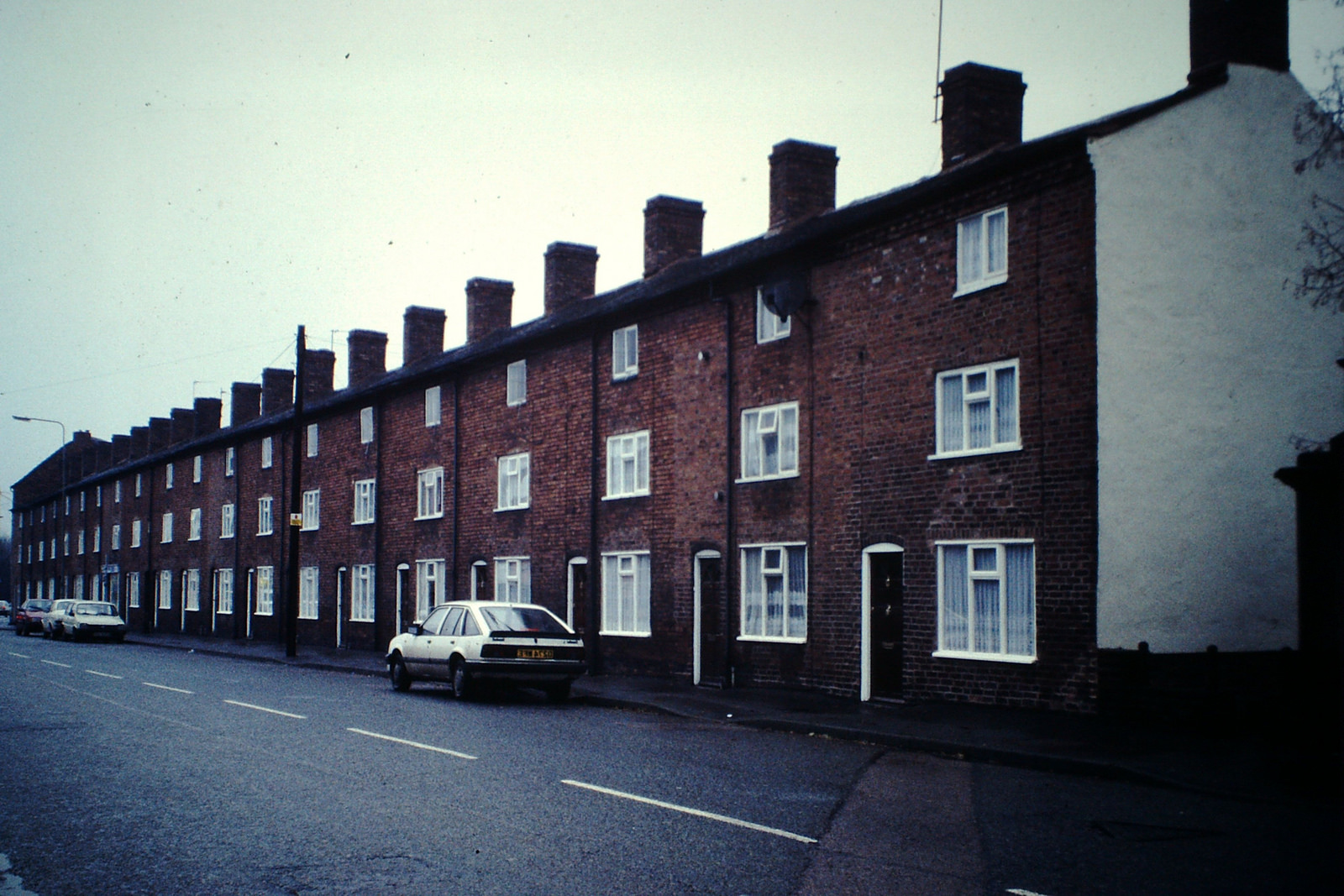
Taken from Lichfield GIS photostream, Flickr

Taken from Lichfield GIS photostream, Flickr

Taken from GIS Lichfield photostream, Flickr

Taken from GIS Lichfield photostream, Flickr

Taken from GIS photostream, Flickr

Taken from GIS Lichfield photostream, Flickr

Taken from GIS Lichfield, Flickr

Taken from GIS Lichfield photostream, Flickr

Also making an appearance in both the Lichfield District Council’s photo collection and on the ‘At Risk’ Register, is the Manor House at Hamstall Ridware. The pictures speak for themselves – the condition of watchtower is so bad that it is deemed at risk of collapse. Perhaps appropriately for something that may not be long for this world, I first caught sight of it from the churchyard of St Michael’s and All Angels and managed to find out a little about its history here.

Taken from GIS Lichfield photostream, Flickr

Taken from GIS Lichfield photostream, Flickr

Taken from GIS Lichfield photostream, Flickr

That’s quite a crack! Taken from GIS Lichfield photostream, Flickr

Hamstall Ridware manor 3 Hamstall Ridware manor and church

Over in Shenstone, it seems there are ongoing discussions between the council, the Parish Council and the church regarding the old tower. At least for the time being, the structure is ‘considered stable’ – let’s hope that they all start singing from the same hymn sheet soon.
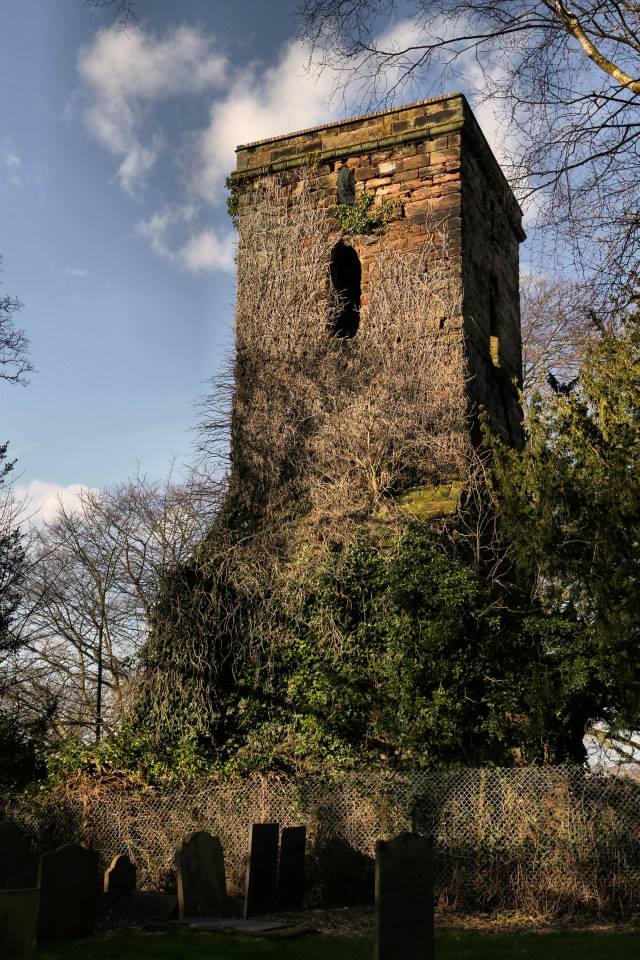
Old tower at St John's Shenstone, by Jason Kirkham

Old tower at St John’s Shenstone, by Jason Kirkham

Same time, same places next year folks? Let’s hope not…


Thanks to Gareth Thomas and Lichfield District Council for the archived photos of Fazeley and Hamstall Ridware, and to Jason Kirkham for his photograph of the old tower of St John’s at Shenstone.

Night at ye Museum

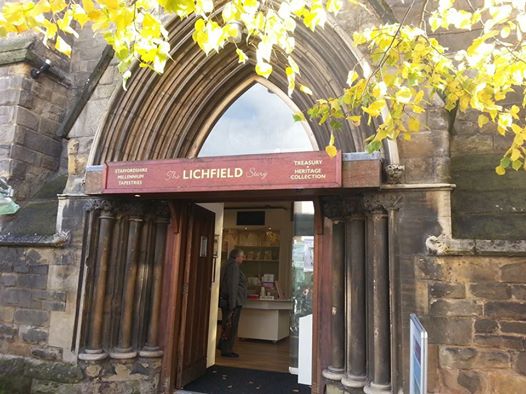
Until further notice, entry to Lichfield Museum (formerly known as the Heritage Centre) at St Mary’s in the Market Square is free of charge! On hearing this, I thought I’d find out a little more about one of its predecessors and set off to find Mr Greene’s Museum, at 12 Sadler Street.

The site of Richard Greene's house and museum, Market St, Lichfield

The site of Richard Greene’s house and museum, Market St, Lichfield

Sadler Street is now of course Market Street, and the only trace of Lichfield’s late eighteenth century ‘Museum of Curiosities’ is a plaque attached to a wall at the entrance to the City Arcade.

Richard Greene Museum Plaque

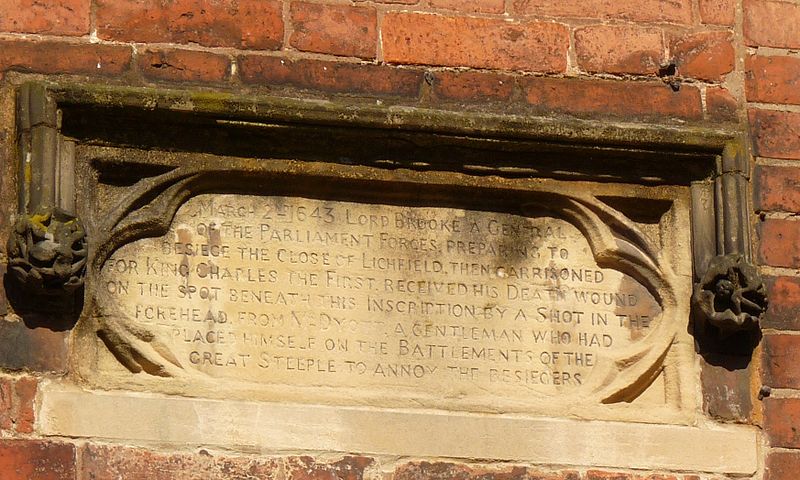
To give us an idea of what this museum was like there are some drawings here on the Staffordshire Past Track site and ‘A Descriptive Catalogue of the Rarities, in Mr Greene’s Museum at Lichfield’ (1), is available here via googlebooks. Highlights for me include my old favourite, ‘the Earthen Vessel found (with several others of smaller size) in the Walls of the late Conventual Church of Fair-well near Lichfield, at the time it was taken down in order to be rebuilt’, and also, ‘Part of the Porch, under which stood Lord Brooke General of the Parliament forces, when he receiv’d a mortal wound in his forehead, by some shot from the Battlements of the great Steeple of the Cathedral Church of Lichfield, the force of which was abated by the bullets passing through the above piece of Board’. Perhaps it was ownership of this bit of legendary Lichfield history which inspired Mr Greene to commission the plaque outside 24 Dam Street, better known as Brooke House? (2)

Photograph of plaque commemorating the death of Parliamentary general Lord Brooke in Lichfield in March 1643. Photograph by JRPG, taken from Wikipedia

Photograph of plaque commemorating the death of Parliamentary general Lord Brooke in Lichfield in March 1643. Photograph by JRPG, taken from Wikipedia

I’d also like to have seen the ‘small Leaden box, in which is contained some Relicks, and Silver Lace, found in an ancient Leaden Coffin in the Cathedral Church of Lichfield 1748’, but there may be those who would be more interested in the Horn of the Sea Unicorn, five feet and six inches long or even the balls of hair found in the stomach of a cow. Each to their own.

One of the most famous exhibits was a Musical Altar Clock. These days ‘The Lichfield Clock’, as it is now known, can be found at the Victoria Art Gallery in Bath, but what happened to the other objects from the museum?  After Greene died in 1793, the collection was sold by his son to various collectors. Some of it was bought back to Lichfield by his grandson, Richard Wright, and displayed in a new museum in the Cathedral Close, which then moved to a property in the north of Dam Street (2). When Wright died in 1821, the collection was broken up again. Given the unique nature of some of the items, I reckon that it might be possible to track these down with a bit of googling? I understand that some of the collection did remain here in Lichfield, and may in the current museum at St Mary’s. Let’s hope that if nothing else we managed to hold onto the head of a pike which weighed forty pounds, taken at Burton on Trent.

Free Entrance!

Free Entrance!

Joking apart, the museum played an important role in the West Midlands enlightenment of the late eighteenth century. According to the Revolutionary Players website,  ‘By contemporary museum standards of collection and display, Greene was an eccentric antiquarian, but he provided a window on the world for those who were enthusiastically investigating, accumulating and classifying knowledge’.

As far as I can tell, Lichfield’s window on the world was closed until 1859, when a new museum was opened at the edge of what is now Beacon Park….but that’s a visit we’ll keep for another day.

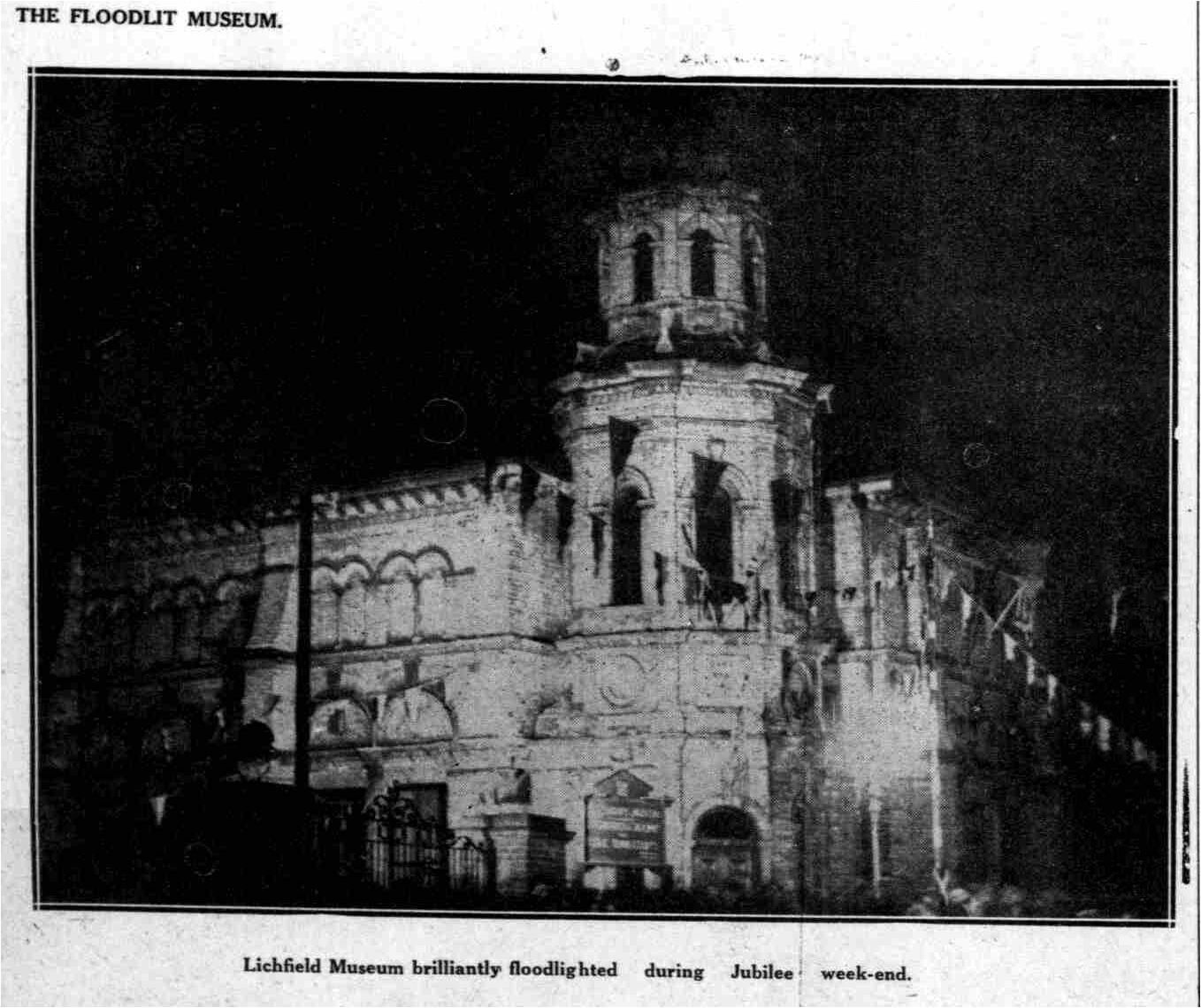
Floodlit Lichfield Museum and Free Library, Jubilee Celebrations 1936. Taken from Lichfield Mercury archive.

Floodlit Lichfield Museum and Free Library in Beacon Park, during Jubilee Celebrations 1935. Taken from Lichfield Mercury archive.

(1) A copy of which was lent to me recently – thank you Patti!

(2) Does anyone know where on Dam Street exactly?

Sources

Lichfield: Social and cultural activities’, A History of the County of Stafford: Volume 14: Lichfield (1990), pp. 159-170.

http://www.staffspasttrack.org.uk/

History West Midlands is proud to bring you Revolutionary Players: The people, ideas and innovations that shaped the modern world

http://www.birminghampost.co.uk/lifestyle/nostalgia/chris-upton-looks-back-lichfields-4027881

http://www.birminghampost.co.uk/lifestyle/nostalgia/crucifixion-clock-lichfield-museums-star-4053561

Bad Neighbours

Legend has it that in July 1403, two feuding neighbours from opposite sides of the River Trent set out to fight on opposite sides at the Battle of Shrewsbury. Sir William Handsacre was for the rebel Sir Henry ‘Hotspur’ Percy and loyal to King Henry IV was Sir Robert Mavesyn, whose name was said to derive from the French malvoisin meaning ‘dangerous neighbour’. At Bridge Meadow, near to the site of High Bridge, it’s believed that the paths of the two enemies crossed, as did their swords. Living up to his name, Mavesyn killed Handsacre but his victory was short-lived and he met his end at the Battle of Shrewsbury, ‘standing with the King and fighting by his side even unto death’, if the epitaph on his tombstone in the church of St Nicholas at Mavesyn Ridware is to be believed.

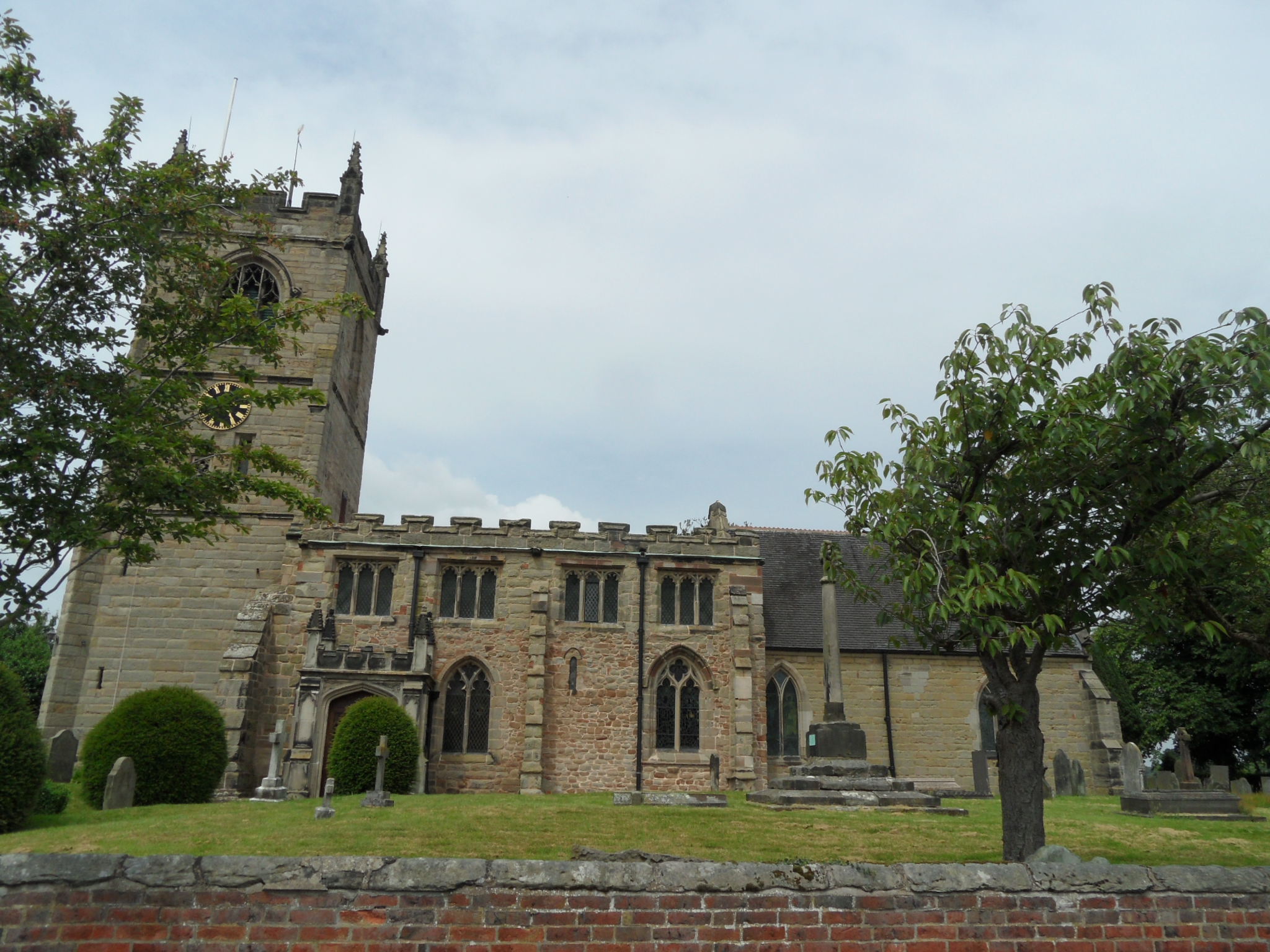
The church dates to the mid-twelfth century and stands near to the site of the manor house, which Sir Robert would have once called home. The medieval house was replaced in the early eighteenth century by what William Pitt described in 1817 as, ‘a convenient box, pleasantly situated for a summer residence’. However, still in existence and visible from the churchyard is the ancient timber framed gatehouse, built using trees felled in late 1391 or before the spring of 1392, according to dendrochronology.

SAM_1511

The Church of St Nicholas, Mavesyn Ridware

The old gatehouse at Mavesyn Ridware, seen from the churchyard of St Nicholas

The old gatehouse at Mavesyn Ridware, from the churchyard of St Nicholas

The final resting place of Sir William is unknown but in 1866, William Painter of The Red Lion Inn at Handsacre wrote a letter on the matter to George Griffith, author of ‘The Two Houses: A Staffordshire Tragedy’, a dramatic work based on the events of 1403. According to Mr Painter, when the church of St John the Baptist in Armitage was rebuilt in the mid-nineteenth century, a stone coffin was discovered in the north wall. Inside was a skeleton, with a full set of teeth and a sword. Local tradition had it that these were the mortal remains of Sir William Handsacre. (1)

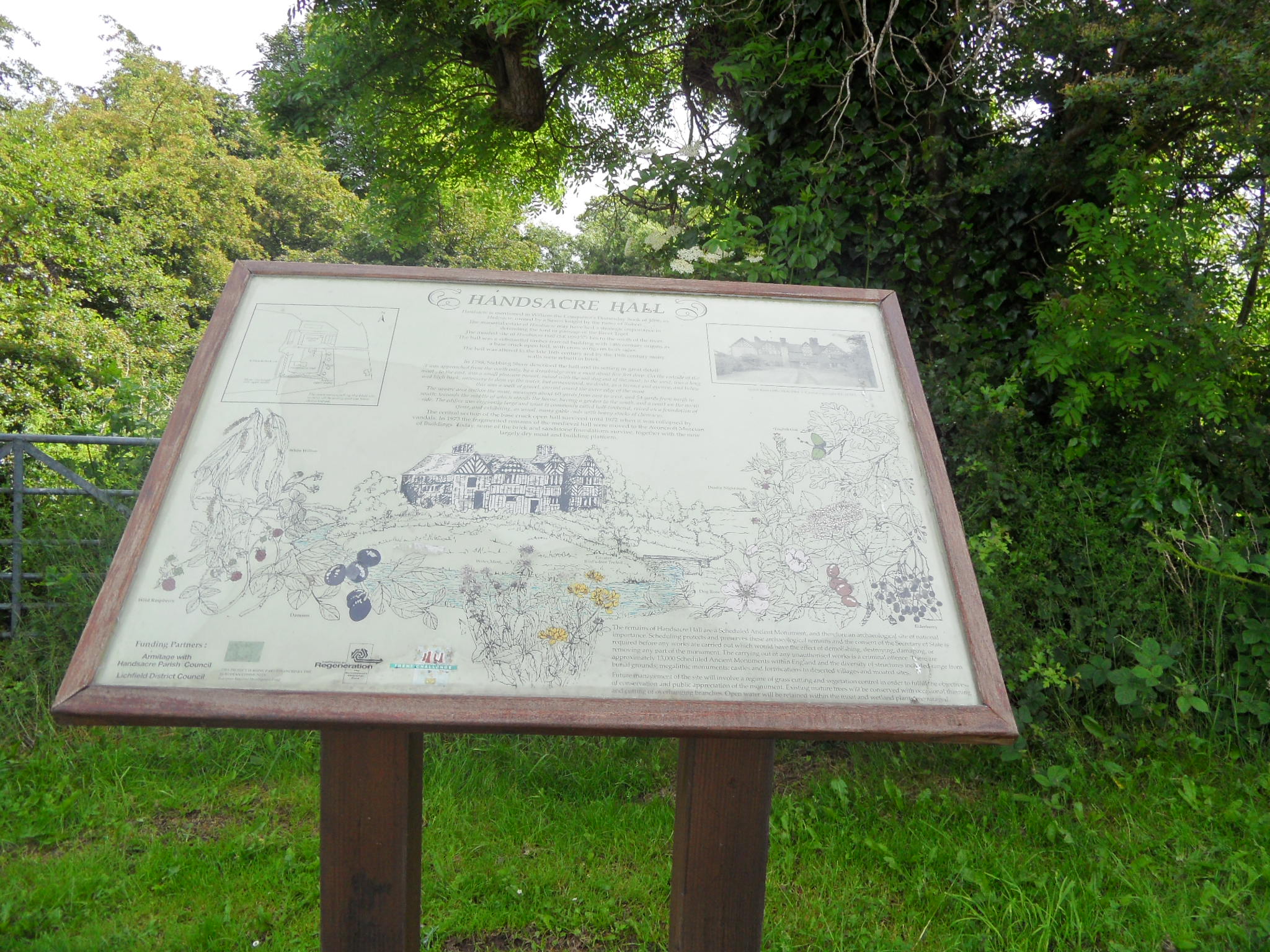
In 1972, Sir William must have turned in his grave (whether in St John’s or elsewhere) when vandals destroyed much of his former home, Handsacre Hall. In a bid to preserve what remained, I understand that the surviving fragments were moved to Avoncroft Museum in Bromsgrove, where again dendrochronology was used to date the timbers, giving a suggested date of around 1310, with some reused timbers from an earlier hall. According to the report by the Staffordshire Archaeological Society, the house had been derelict for at least six years prior to this and a photograph of the building taken around this time can be found on Staffordshire Past Track here. In its heyday it looked like this.  

SAM_1629

Information board at the site of Handsacre Hall

Nowadays the site is a Scheduled Ancient Monument, still surrounded by a moat, ten metres wide and four feet deep, but also by a housing estate. It’s said that on the island in the centre there are visible brick and sandstone remains and no doubt there is plenty of evidence of past lives at the hall below ground. Visiting in high summer, the only thing I could see (and feel unfortunately), were stinging nettles. Will be interesting to see what a return visit in winter will reveal.

Part of the moat which once surrounded Handsacre Hall

Part of the moat which once surrounded Handsacre Hall. And nettles. Lots of nettles…

Sources

Staffordshire Archaeological and Historical Society Volume XV Transactionf for 1973/4 – Stanley R. Jones Handsacre Hall, Armitage: a note on its destruction

http://ridwarehistory.yolasite.com/mavesyn.php

Staffordshire HER 09638

Greater Medieval Houses of England and Wales, 1300 – 1500: Volume 2 by Anthony Emery

A topographical history of Staffordshire by William Pitt.

Heads and Tales

Just outside of Lichfield, in the village of Wall, are the remains of the Roman settlement of Letocetum, a latinized version of an Iron Age place name meaning ‘grey wood’. The foundations of the bath house and guest house (or mansio), established here to provide rest and recuperation and a change of horses to those travelling along Watling Street, are still visible.  As you’d expect, some fascinating archaeological finds have been unearthed at the site, giving us a glimpse of what life in Letocetum was like almost two thousand years ago. Many of these are displayed in the site museum, including my favourite – a carved stone, discovered built into the foundations of the mansio, along with seven others, which I suspect not many people even realise exist.

Stone on display at Wall museum, featuring two carved heads and what's thought to be a shield.

Carved stone on display at Wall museum, featuring two carved heads and what’s thought to be a shield.

The carving seems to show two horned heads facing each other, with a circular object, interpreted as a shield, to their right. Heads also appear on some of the other stones found alongside it.  One depicts a figure with a club in one hand, and a severed head or skull at its feet. Another features a head in what may be some sort of niche and a fourth has a head with an open mouth, that may suggest it is screaming.

Carved onto a fifth stone are two ‘warrior’ figures with shields, stood side by side. A pattern of sorts around their legs has been interpreted as representing water. A second pair of figures, enclosed in a frame or box of some sort lie at right angles to these ‘warriors’. Two further stones have inscriptions, or at least partial inscriptions CUINTI…CI and DDBRUTI, and on the eighth stone is a carving which resembles a Christian cross, although it may be a pagan symbol representing the sun.

All but one of the stones were built into the foundations of the mansio in an inverted position, and there is a theory that they were originally part of a Romano-British shrine dedicated to a native god or gods (the names of whom may be recorded on those inscripted stones), which was demolished sometime around the building of the mansio. The reason for the shrine’s demolition at this stage is unclear, but it has been suggested that it may have been replaced by a yet to be discovered temple dedicated to a Roman god built elsewhere on the site. Incorporating the stones upside down suggests that the native gods represented by the carvings were still respected, and perhaps even feared by the builders of the mansio – I understand that inverting an object was thought to neutralise its power.

There is also a ninth carved stone, found separately from the others, in a hypocaust in the north east of the mansio. It appears to depict a phallus, and was inserted after construction to provide additional protection for the building.

Unfortunately, the stone with the ‘cross’ has disappeared and no photographs appear to exist. The other stones are kept at Birmingham Museum and Art Gallery but photographs of them can be found in the eleventh report of excavations at Wall, included in Volume XXI of the Staffordshire Archaeological and Historical Society transactions for 1979-80. Along with all of the Society’s other transactions, this is accessible online to members (it’s well worth joining if you are interested in the area’s archaeology).  I haven’t got around to asking for permission to use the photographs here, and so in an attempt to stay on the right side of copyright law, whilst trying to give a better idea of what the carvings on the stones look like, here are some drawings I did of them. Apologies to archaeologists and artists everywhere.

Carved stone 1

carved stone 2

carved stone 3

carved stone 4

I’m not drawing the ninth stone. You can probably work out what that one looks like for yourselves….
This all fits quite nicely (albeit unintentionally!) with the theme of ‘Hidden Histories’ for this year’s heritage weekend in Lichfield (20th/21st September). If you are interested in finding out more about the story of Wall, and hearing about some of the other archaeological discoveries made here, there is free guided walk around the village led by the Friends of Letocetum on Sunday 21st September.  The walk is free and open to everyone, and will be starting out from the the village car park at 10.30am.

 Sources

Staffordshire Archaeological and Historical Society Transactions for 1979 -80 Volume XX1

Something for the Weekend

Chatting to a friend last weekend about everything that goes on in Lichfield made me realise that I do take some of it for granted. Then, a few days later, another friend chastised me for being rubbish at promoting things, even events I’m involved in myself! So, influenced/shamed by both of them, here’s a quick run down of some of the history related goings-on in and around Lichfield this weekend.

Sheriff's Ride passing the pinfold, 2013

Sheriff’s Ride passing the pinfold, 2013

On Saturday morning, the Sheriff of Lichfield will set off with a party of horses and riders to perambulate the city’s boundary. This has happened on the Feast of the Nativity of the Blessed Virgin Mary (or on the nearest Saturday at least), every year since 1553 when Queen Mary made Lichfield a separate county with its own Sheriff, as a way of saying thanks for all the support during that game of thrones business.

Alterntive Sheriff's Ride 2013

Alternative Sheriff’s Ride 2013

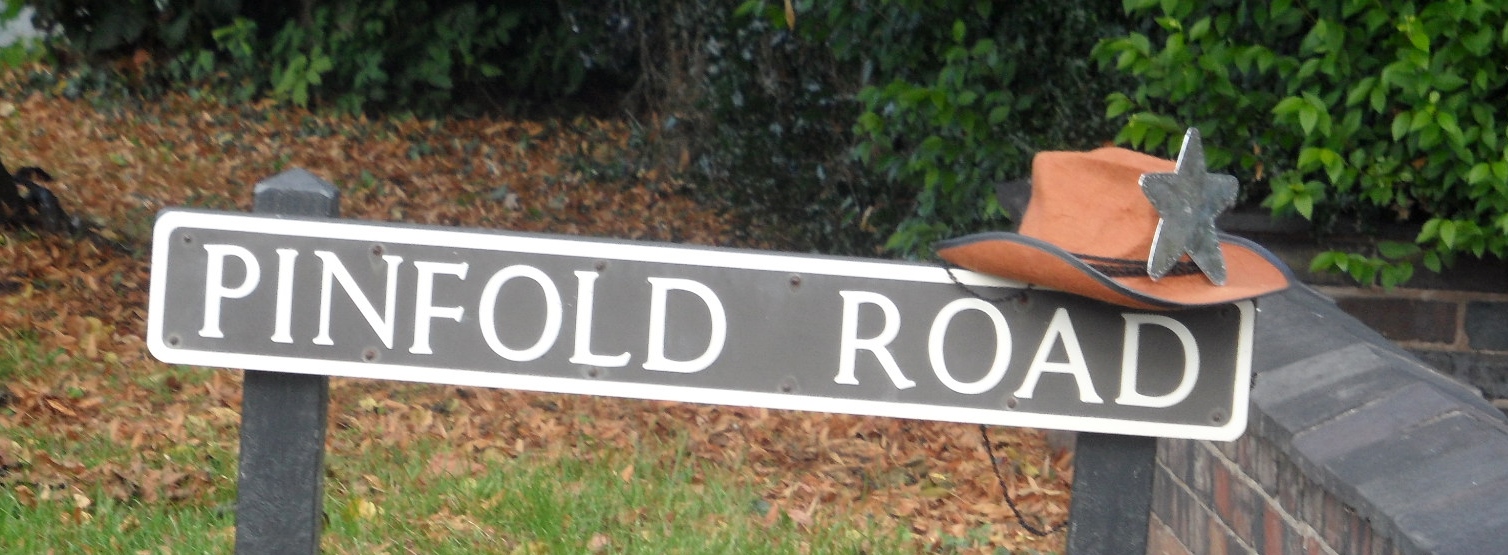
Pinfold Rd

Once the traditional Sheriff’s Ride has passed by and headed up Cross in Hand Lane, a group of us will be setting off from the Beacon Street pinfold in the opposite direction on the Alternative Sheriff’s Ride, which has happened every year since 2013 when my friend Lichwheeld had the idea and thought, ‘Well, why not?!’. At around four miles, the alternative ride will be considerably shorter than the current circuit of twenty miles, which has increased from the sixteen miles described in the 1800s by Thomas Harwood, as follows:

It begins at a place called the Cross and Hand near the end of a street there called Bacon street and from thence goeth northward along the lane leading to Longdon Church unto a little lane at the further side of Oakenfields and so along that little cross lands unto another lane that leadeth from Lichfield to King’s Bromley and then along that lane towards Lichfield unto a little lane lying between the Grange Ground and Collin’s Hill Field commonly called the Circuit lane unto the further end of it betwixt two fields the one called Hic-filius and the other Piper’s Croft and so over across a lane that leadeth from Lichfield to Elmhurst and then into another little lane between Stichbrooke Ground and Gifforde’s Crofte and so along that little lane to a green lane at the further side of the Lady being the land of Zachary Babington Esquire and down that lane to a called Pone’s Brook and so over that brook into another lane called Stepping Stones lane and so along that lane taking in the land of Richard Dyott Esq Pone’s Fields unto a lane leading from Lichfield to Curborough Somerville so along that lane towards Lichfield until you come to the upper end of the grounds called Scott’s Orchard and then leaving that lane turn into a field of Lichfield called Whisich at a stilt going into the fields called Browne’s Fields and so taking in the field clled Whisich then go by the closes called Browne’s Fields Hedge unto the grounds called God’s Croft Hedge and so along that hedge taking in the field called Whisich lane called Goslinge’s lane and along Goslinge’s Lane unto a lane called Matthew Coal Lane and so over across that lane into a field called Cross field at or near an elm tree and so along a head land about the middle of Cressfield unto the nearer end of Gorsty Bank into the lane leading from Lichfield to a cross way called Burton turnings and from thence along Ikenield street taking in Spear Hill and Boley unto a cross way leading from Lichfield to Whittington and so along that lane towards Whittington unto the south end of Austin’s Coat Grounds then turning upon the left hand at that brook to a gate going into Fulfin Grounds unto the moors called Dernford Moors and so along by the hedge of those moors unto the nether side of Dernford Mill stream and so going by the mill door to the pool dam and going along by the pool and the brook taking in Horslade and a meadow belonging to Freeford House unto a bridge called Freeford Bridge in a lane leading from Lichfield to Tamworth and so from that bridge up the sandy lane to Freeford House and along that lane to the corner of the meadow and then turning into Bispells at the corner of the meadow and so going by the meadow hedge until you come to the brook that runneth to Freeford Bridge and so going up a little pool taking in all Bispells unto a ford called Baltrex ford and then entering into Old field turn up the left hand to the brook that runs from Freeford Pool and so along that brook to Freeford Pool and along by the pool and the brook that comes from Swynfen Mill until you come into the lane that leads from Swynfen unto the mill and so along that lane to a gate that leads from Lichfield unto Swynfen called Old Field Gate and then not coming in at that gate but going to the corner of the hedge adjoining to Cley Lands come in at a gap and taking in all Old field come by the demesnes of Swynfen unto a place called Long bridge and so entering into a little lane between Long furlong and Long bridge grounds leading to Well crofts and so taking in all Well crofts along by the Knowlc Leasowes being the Hospital Land unto Ikeneld street and so along Ikeneld street unto the further side of a close called Gorsty Leasowe and leaving the hedge on the left hand taking in that close going along by that hedge leading to Hare house Ground and so along that hedge unto the top of Dean’s Slade taking in all Hare house Ground northward enter into Park field leaving the hedge on the right hand and so following that hedge unto a little lane at Aldershawe that comes down that lane to the gate and through the gate then turn upon the left hand by Aldershawe Hedge taking in the barn and so go into the Wheat Close leaving the hedge on the left hand unto the road called the Fosse way up to the top of Mickle hill then crossing over Pipe green along an old decayed cart way into a lane end that leads to Pipe grange lane to the further side of Padwell’s and so taking in Padwell’s leaving the hedge on the left hand to a little lane that leadeth into Ashfield leaving the hedge on the left hand into the grounds called Lammas Grounds and leaving the hedge on the left hand and so into Lemondsley then following the brook to Pipe green gate and so along the brook in Pipe green into a little lane that butteth upon the lane that leadeth from Lichfield to Pipe and crossing that lane into Smithfield at the corner of Abnell Hedge and so taking in all Smithfield leaving Abnell Ground on the left hand unto the Cross and Hand where it began

All you need to join in is a roadworthy bike and a sense of humour. I’m not sure if we’ll be visiting God’s Croft Hedge or Hic-filius on our ride, but I do know that we’ll be stopping off at a secret location for tea and cake half way around, and finishing up in the beer garden of the George and Dragon. The traditional ride will arrive back in the city via Beacon St around 6.15pm, about the time that Beacon Park will be filling up with people and their picnic rugs, ready for the free Proms in the Park concert, organised by Lichfield District Council.

The horns are kept in the church of St Nicholas

The horns are kept in the church of St Nicholas

At eight o’clock on Monday morning (8th September), the current generation of Abbots Bromley horn dancers will collect their thousand year old reindeer antlers from St Nicholas, beginning a ten mile journey around the village and out to Blithfield Hall, before returning to the church twelve hours later. Whether the dance began as a pagan fertility ritual or is to do with hunting rights, no-one really knows but the mystery surrounding its origins is part of the tradition’s appeal.  Last year, I watched the dance as darkness fell in the village.

Horn Dance 1

This year, I’ll be spectating at Blithfield Hall at midday, along with the other commoners being kept off the lawns below the Ha-Ha, to ensure I’m back in time for our Lichfield Discovered ‘Weeping Angels’ talk that evening.

We may not have David Tennant, but we do have public historian David Moore to talk to us about the symbolism in Victorian cemeteries. We also have custard creams. The talk starts at 7pm, at St Mary’s in the Market Square, Lichfield. We don’t charge, but we do make a voluntary collection which we donate to the centre for use of the room.

Weeping Angel (c) David Moore

Weeping Angel (c) David Moore

There’s plenty more happening in the weeks to come, but for now, enjoy the weekend in Lichfield and please share any photos you take during it with us for our new Lichfield Discovered photo project ‘A Year in Lichfield‘. Email them to ayearinlichfield@yahoo.com, or share them on Twitter (@lichdiscovered) or on Facebook.


Gaol Sentences

In the churchyard at St Chad’s in Lichfield there’s a gravestone belonging to John Prickett who died in March 1832, at the age of 63. According to the inscription, he was ‘thirty Years keeper of the Goal in this City’.

John Prickett's grave at St Chad's, Lichfield

John Prickett’s grave at St Chad’s, Lichfield

Clearly, Mr Prickett’s epitaph is not referring to a Peter Shilton-esque stint in a number one jersey for Lichfield City FC, so has the stonemason made a spelling mistake? Not exactly….

In Dr Johnson’s dictionary (I used the online version), the entry for ‘gaol’ is as follows: GAOL (gaol Welsh; geole French) A prison; a place of confinement. It is always pronounced and too often written jail and sometimes goal.  John Ash includes a separate entry for ‘goal’ in his ‘New and Complete Dictionary of the English Language’ in 1775 defining it as ‘gaol or jail’, with a note that this is the incorrect spelling (1).

Incorrect it may have been, but this spelling of the word as ‘goal’ crops up frequently in old newspapers (including the Newcastle Courant newspaper on 22nd February 1716 who reported that ‘A Brazier in Holburn is committed to Chelmsford Goal for robbing on the highway in the County of Essex’ and closer to home in April 1832, the Staffordshire Advertiser listed the people committed to Stafford Goal) and is also in evidence above the door of the Shire Hall in Nottingham, underneath a later amendment to the more usual spelling.

County Gaol, Shire Hall, Nottingham. (Alan Murray-Rust) / CC BY-SA 2.0

By 1801, around the time Mr Prickett was handed the keys, Lichfield Gaol had fourteen cells but during the nineteenth century doesn’t appear to have ever reached anything like full capacity. In a report submitted to the government regarding the proposed Gaols Act of 1823, John Prickett stated, ‘The small number of Prisoners at this time in this Gaol and the smallness of the Prison render it difficult to introduce the Regulations required by the new Act and many of them cannot be acted upon in a Prison on so small a scale’. A report to the House of Commons in 1835 said ‘It frequently happens that there are no prisoners at all but three or four may be taken as the daily average’ and between January 1st and December 31st 1839, only 34 people were admitted (including two debtors).

Perhaps one of the reasons for the low numbers of inmates is that they kept escaping. Some, like Smith and Cotterell in March 1837, used the classic sheets tied together method, and climbed over the wall into the yard of the George IV pub next door. Others were less conventional – in April 1890, Harry Oliver climbed up into a ventilator space above his cell and crawled beneath ‘the floor of the volunteer armoury above’, before dropping ten feet into the yard of the George IV.  Perhaps the greatest escape happened on Mr Prickett’s watch (who, in this instance, was obviously not watching) in July 1820 when it was reported that ‘the whole of the prisoners in the county gaol of Lichfield, six in number, made their escape’.

No escaping for him...

No escaping for him…

You can find out more about the place that they were escaping from by reading the reports written by the Inspector of Prisons after visiting in 1839 and 1847 and the Old Guildhall Cells are open on Saturdays until September for you to visit yourself (more info here). If you happen to spot any of the former residents’ initials and names, ‘cut deep into the woodwork’, as noted by the Inspector, please let me know!   

prison door

Notes

(1) On the subject of mistakes, it’s worth mentioning the howler that John Ash made when compiling his dictionary. Johnson had included the word ‘curmudgeon’ in his dictionary, and suggested that it was derived from a pronunciation of ‘coeur mechant’, information that he noted he had received ‘Fr. an unknown correspondent’. Ash, clearly taking his definition straight from Johnson’s, took the abbreviation Fr. to mean ‘French’ rather than ‘From’, and so ended up with his entry for curmudgeon suggesting that it derived from the French for ‘unknown correspondent’. Ash’s dictionary is also famous for being the first to include definitions for the F-word and C-word in English, words that may well have been uttered when Ash realised his error…

Sources:

‘Lichfield: Town government’, A History of the County of Stafford: Volume 14: Lichfield(1990), pp. 73-87

Noah Webster and the American Dictionary by David Micklethwait

http://johnsonsdictionaryonline.com/

Ale Tales

One of the many lost pubs that John Gallagher found for us on the brilliant Lichfield Discovered tour he led on Monday was the former Windsor Castle on Dam Street (1). There is a great story about this pub, which J W Jackson shared in his Lichfield Mercury column in 1939. I feel like I should take it with a pinch of salted peanuts, but it’s worth sharing again here.

‘Its (the Windsor Castle’s) backyard runs along the back of the workshops of Messrs R Bridgeman and Son, the well-known ecclesiastical sculptors, and it appears, years ago, the carvers in order to obtain liquid refreshment without leaving their work, ingeniously removed several bricks from the wall which separated the shop from the Windsor Castle, and through the aperture received bottles of stout or beer from the licensee (a lady at that time) at a certain time each morning and then replaced the bricks. This arrangement worked very smoothly for a long time until one morning the late Mr R Bridgeman brought a visitor into the shop to see the sculptors at work just at the time when the ‘refreshment’ was due and, of course, the men could not remove the loose bricks. Suddenly, a voice sounded clearly through from the other side of the wall, ‘Now, then you b___s, don’t you want your porter this morning?’ Mr Bridgeman, who had his back to the men at that moment, swung around quickly and taking in the situation shouted ‘Joe, come here at once and block up this hole and use cement’. (Joe was Joe Stokes who lived for many years in the little old cottage which still stands in Quonian’s Lane, adjoining the offices)’.

Mr Jackson goes on to describe how the workers got around this setback by bringing bottles into the workshop in their wheelbarrows, storing the empties in their tool chests until the coast was clear, and then returning them to the establishment for a refill.

The former 'Windsor Castle' public house

The former ‘Windsor Castle’ public house

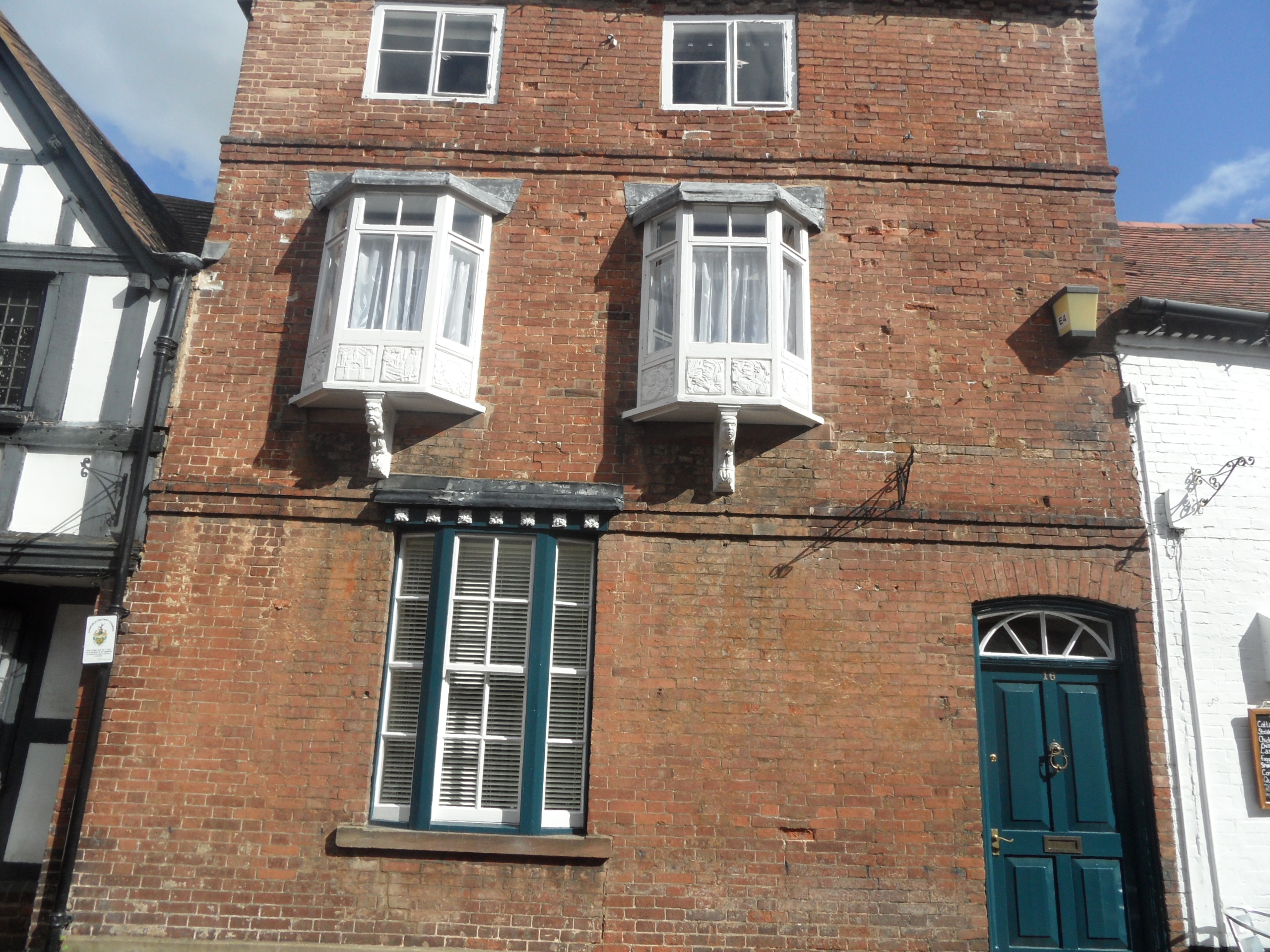
Mr Jackson refers to the Windsor Castle as Lichfield’s oldest licensed house, a claim which I was puzzled by after reading in the official listed building description that the property only dates back to the ‘mid to late 18thc with late 19thc alterations’. However, by delving into Lichfield’s District Council’s online planning records, I have found a survey of the building (2) carried out around seven years ago, which suggests that part of the building may in fact date back to the 16thc. According to the surveyors, the original building would have been a simple one room wide structure running north/south along Dam St. The current facade was added in the early 19thc and it’s thought that the height of the roof was increased and the oriel windows added at this time too (although I’m sure John showed us a photograph of the pub without these windows on? Can anyone else remember?)

Whenever they were added, those windows feature a curious and seemingly eclectic collection of carvings.  I’m not even sure what some of them are supposed to be, but in Lichfield’s very own pub quiz version of ‘Only Connect‘, I give you a man with a fish, a man drinking beer, some sort of castle, Lichfield Cathedral and an owl, a man composing music (possibly the same man as the one with the fish?) and a building with some foliage. Are they telling a tale of some sort, and if so, what is it?

windsor castle 5

windsor castle carvings

windsor castle carvings 4windsor castle carvings 2

windsor castle arvings 3

Notes:

1) A great write up of the walk can be found here, together with some photographs of the other pubs we visited on the night.
2)Something else I noticed on the survey were references to, ‘inappropriate repair works undertaken to the brickworks using a cement based mortar’, which, in view of how the Bridgeman workers’ cheeky ruse came to an end, made me smile.

Sources:

Lichfield Mercury Archive
Smiths Gore Condition Survey, 16 Dam Street, Lichfield (08/00186/LBC)

Well Wishers

I’ve written previously about how the appearance (and apparently, the actual location!) of St Chad’s well has changed over the years here, but I’ve recently found some contemporary accounts of the well’s previous incarnation – a ‘vertical tube built of engineering bricks, covered with a kind of gloomy sentry-box of stone’, which had apparently become so neglected in the 1940s that only a few inches of stagnant water covered in a green scum remained in the bottom of the pool. (1)

In November 1946, the Bishop of Stafford lamented that the well had once been a place of great pilgrimage but had fallen into a state of neglect and considerable disrepair and in April 1948, E Sutton, a former caretaker of the well, described it as having degenerated into a wishing well. A few weeks later, Mr Sutton submitted a further letter to the Mercury, advising, ‘I have again visited the site and found it in a worse state than on my visit there last Autumn. Then boards covered the Well. These are now removed and the Well is full of rubbish, among brick-bats and wood being a worn out coal bag! I noticed too, among the bricks and stonework lying around in wild confusion the ancient ‘St Chad’s Stone’, which the historian Leland, writing of his visit to the Well some four hundred years ago, states was then believed to be the very stone upon St Chad stood in the icy water as an act of penance, it then being the bottom of the Well. When the small building was erected over the Well in Stuart times, this stone was incorporated into the building, no doubt in order to preserve it. Many hundreds of hands have been placed upon it, mostly with reverence, since. It now lies among the rubbish, one corner broken. A fitting symbol of the ideals of 1948!’ (2)

St Chads Well

St Chad’s Well today

Saint Chad's c.1915. Taken from Wikipedia

Saint Chad’s Well c.1915. Taken from Wikipedia

I’m intrigued by this reference to ‘the ancient St Chad’s stone’. When James Rawson described the site prior to his restoration in the 1830s, he noted that, ‘the well-basin had become filled up with mud and filth; and on top of this impurity a stone had been placed, which was described as the identical stone on which Saint Chad used to kneel and pray!’. Despite Rawson’s apparent scepticism about these claims, was he somehow persuaded to use this stone in his new well structure, thereby perpetuating the myth? I’d love to see what went on in those discussions and I’d really like to know what happened to this legendary stone. St Chad may not have been anywhere near it, but the fact that people believed he had should have made it worth saving for posterity’s sake.
Water in the well

Water in the well

Unfortunately for Mr Sutton, the restoration of the well did not put a stop to people using St Chad’s Well for wishes, as evidenced by the layer of coins that still glint beneath the water, tossed in at some point over the last half century or so. It’s often suggested that this is the continuation of a ritual that our ancestors were carrying out a long, long time before St Chad arrived in Lichfield. Some things change. Some stay the same.
Notes

(1) The octagonal stone well structure erected by Rawson in the 1830s, as described by the Lichfield Mercury on May 6th 1949!

(2) A little off topic, but it’s amusing to see that it’s not just nowadays that letters appear in the Lichfield Mercury suggesting that society is going to hell in a handcart. Once again, some things stay the same…

A Grave Matter

Recently, someone told me that there were some interesting gravestones at Holy Cross Catholic church on Upper Saint John St. As David Moore is on the lookout for examples of symbolism in the city’s churchyards for his upcoming Lichfield Discovered talk on the subject in September, I went to take a look.

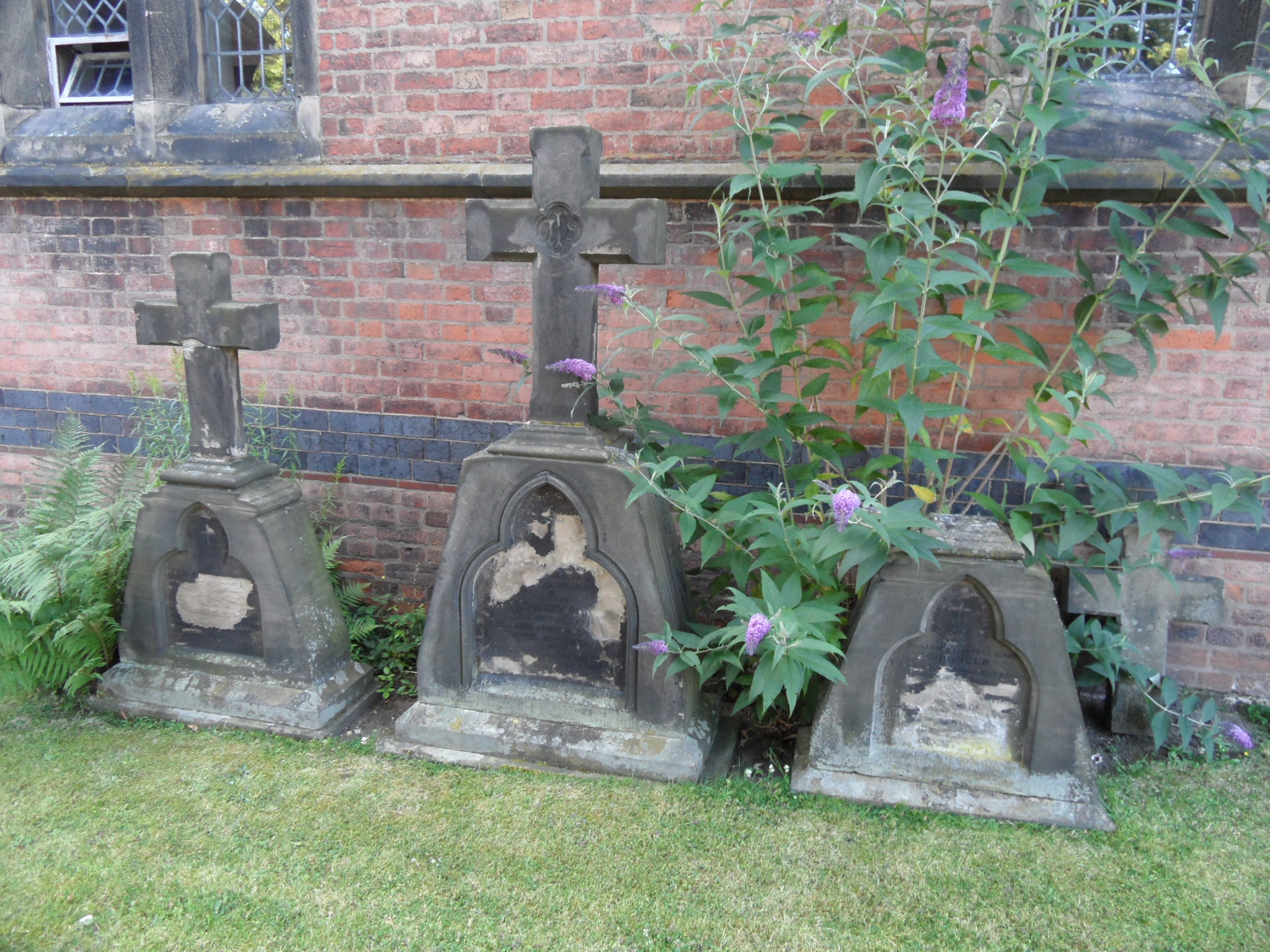
Initially, I thought there had been a mistake as I couldn’t see any gravestones at all, but tucked around the side of the church I found just the three of them, side by side.

SAM_2123

The inscriptions are worn but the names are still legible. Names that I recognised at once. Around this time last year,  I wrote about the Corfield family who lost their lives when a fire swept through their home and business premises in Market Street in January 1873 (see here) and how rumour and legend had grown up around the tragedy.  It’s not so much the symbolism that is interesting here but the additional inscription on the middle stone – ‘Refused admission into St Michael’s Churchyard’. What does this mean exactly? It seems to contradict the Lichfield Mercury report from January 18th 1873 that,

‘The remains of the seven members of the family were conveyed in three hearses to St Michael’s Church-yard on Thursday afternoon and laid together in a square grave. The whole of the burial service was read at the grave by the Rector, the Rev J J Serjeantson; the burial service according to the Roman Catholic ritual, to which community the deceased belonged, had been read over the bodies by the Catholic priest at the Guildhall on Wednesday evening. The bodies were not taken in the church’.

All I can think is that it was these memorial stones which were not admitted into the churchyard at St Michael’s? Any thoughts or comments would be welcome.

SAM_2124

SAM_2125

Daisy, Daisy

Recently, I’ve spent more time in churches than ever before in my life (with the possible exception of the Summer of 2004, when I went to so many weddings that I was able to recite 1 Corinthians 13 off by heart). When I was younger, history for me was all about the castles. Churches were boring. The only remotely interesting thing about them was that, with their crenellations, some of them looked a bit like castles. Now I know that they can tell stories just as good as any castle, but you just need to know where to look.

SAM_1851

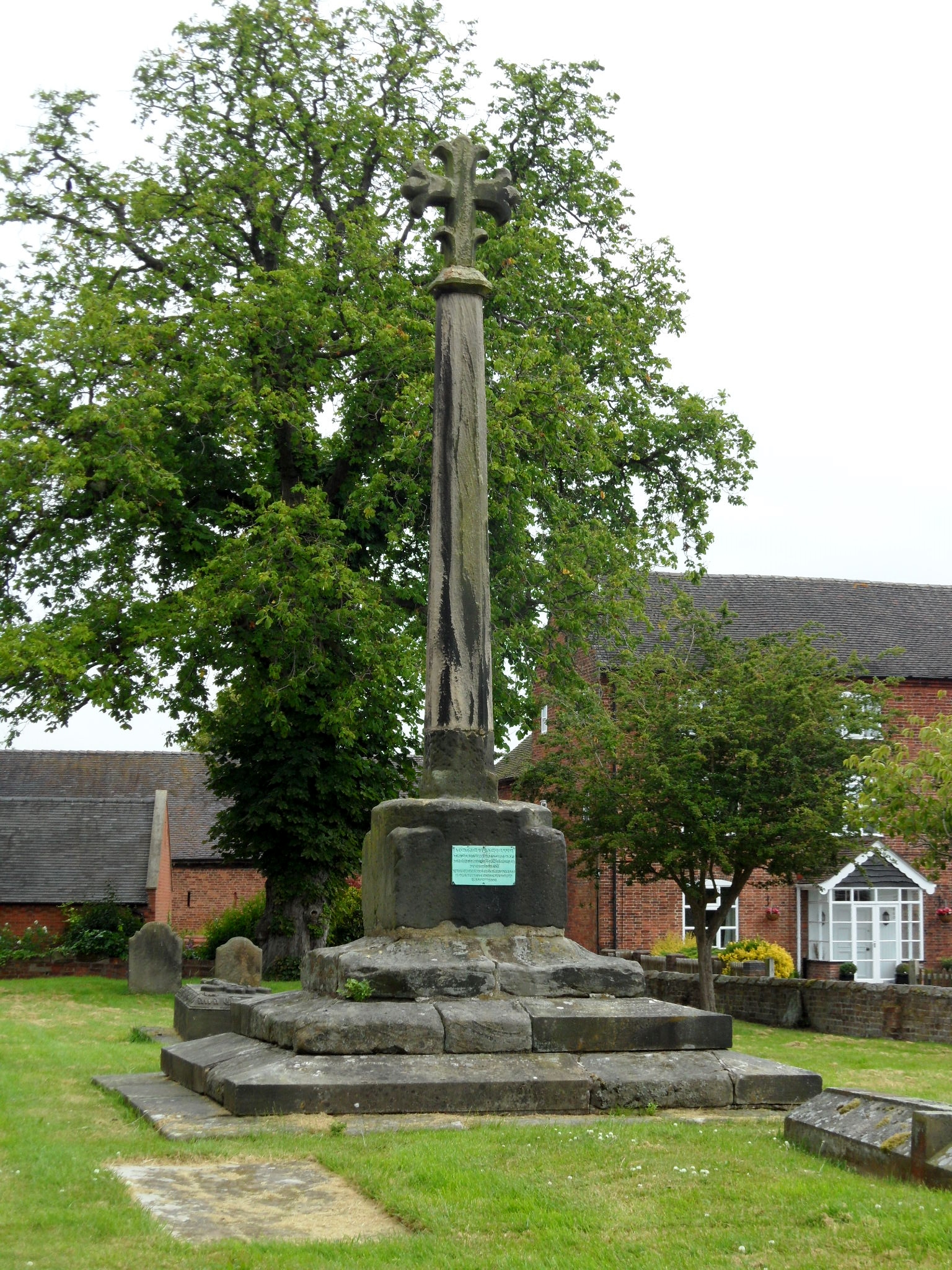
Before even stepping inside All Saints in Kings Bromley, there are plenty of interesting tales. ‘Lady Godiva’s’ cross in the churchyard, originally dates back to the 14th century, but was restored in 1897.

SAM_1842

I was delighted but intrigued to see a reference to one of my childhood heroines here. The story I knew as a little girl was that Godiva pleaded with her husband Leofric, Earl of Mercia, to reduce the taxes he imposed on the people of Coventry. Leofric tried calling her bluff by saying he would do so, if she rode through the marketplace in the buff. Unfortunately for him, his wife not only had compassion, but also really, really long hair which according to Roger of Wendover who first recorded the story, ‘covered the whole of her body like a veil’, as she climbed onto her horse and successfully carried out her legendary protest. The connection with Kings Bromley is that Godiva and Leofric had a summer residence or hunting lodge here, where Leofric died in 1057 and may well have been involved with an earlier church which could have stood on this site.

SAM_1844

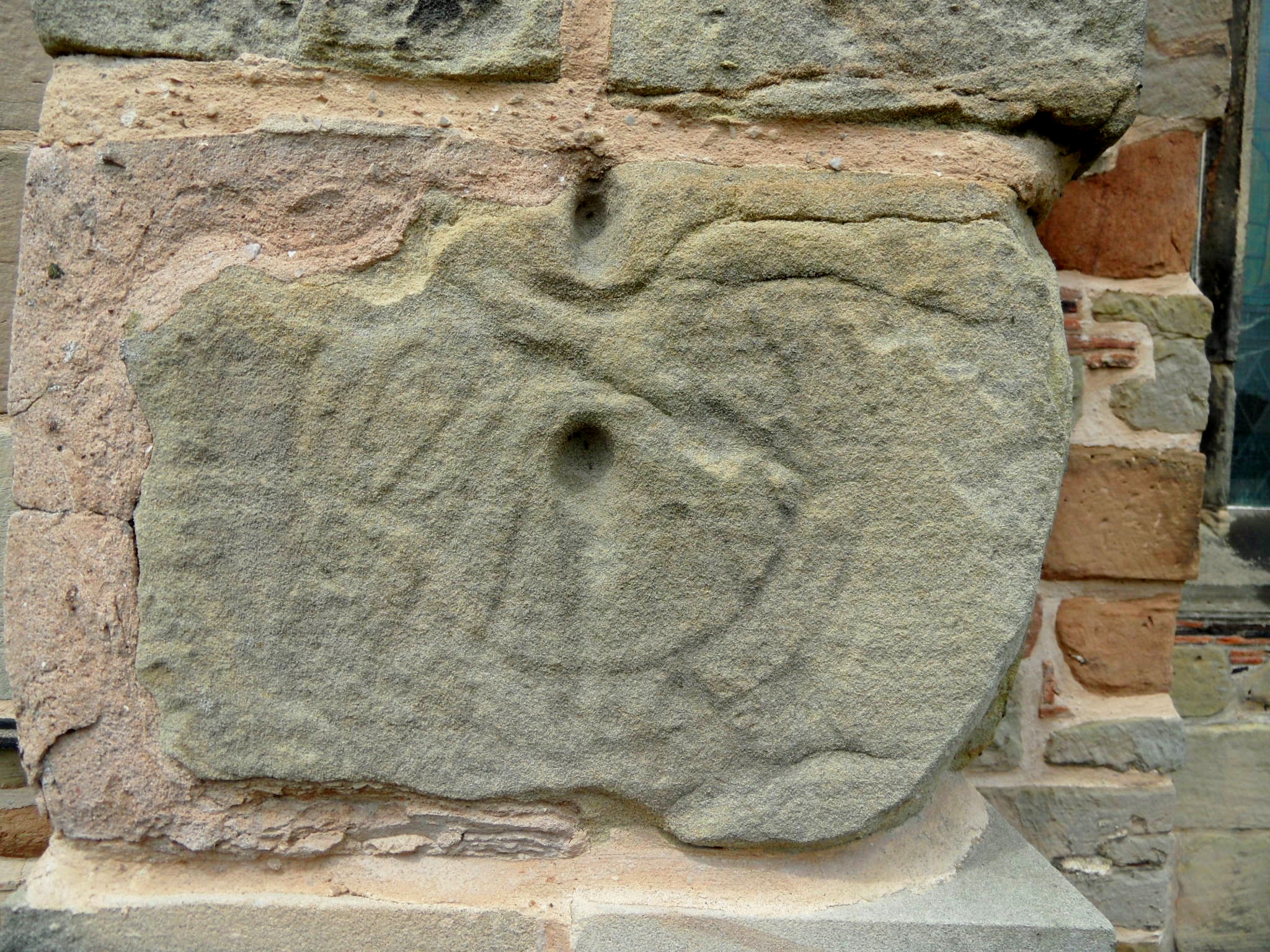
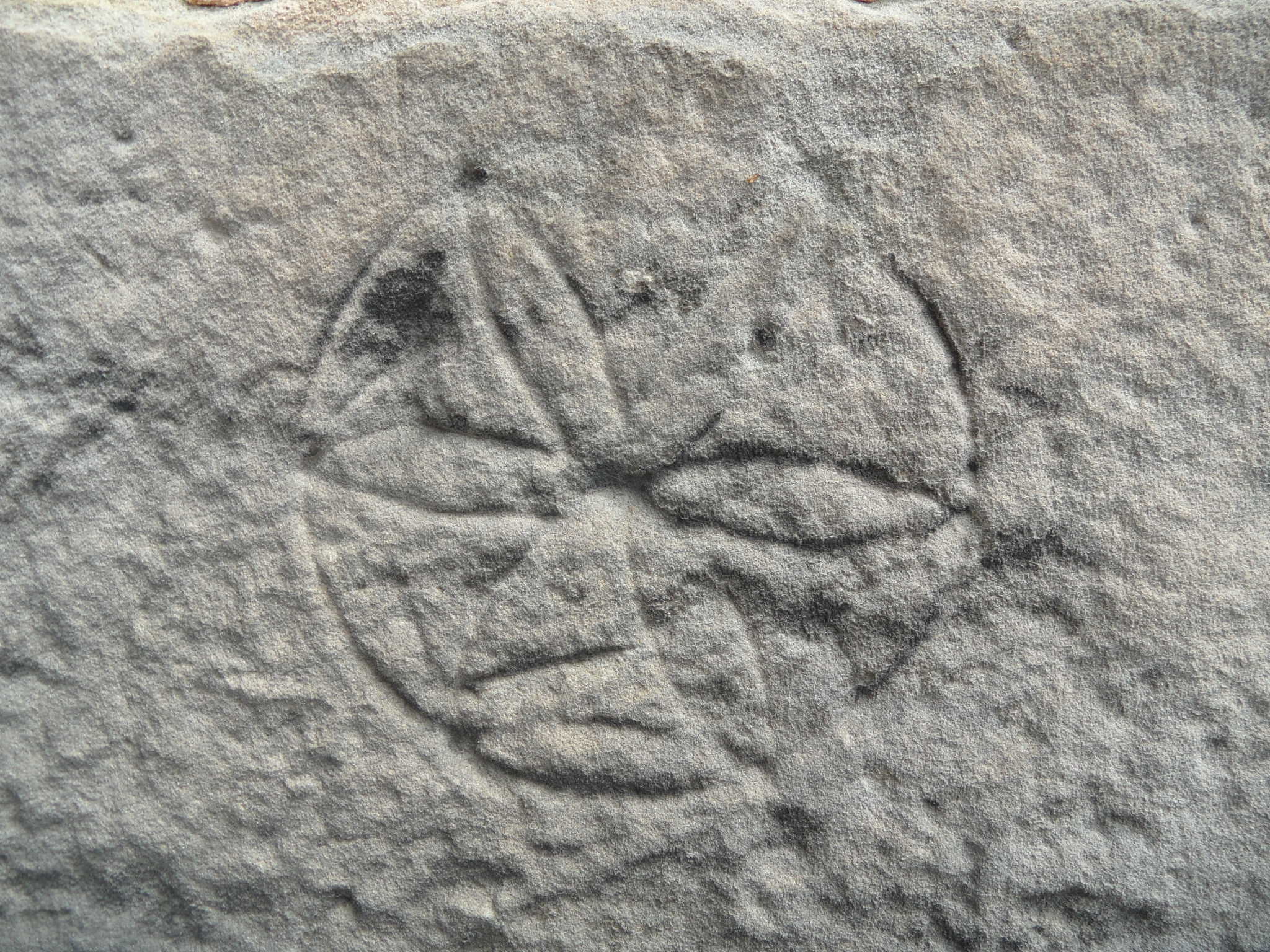
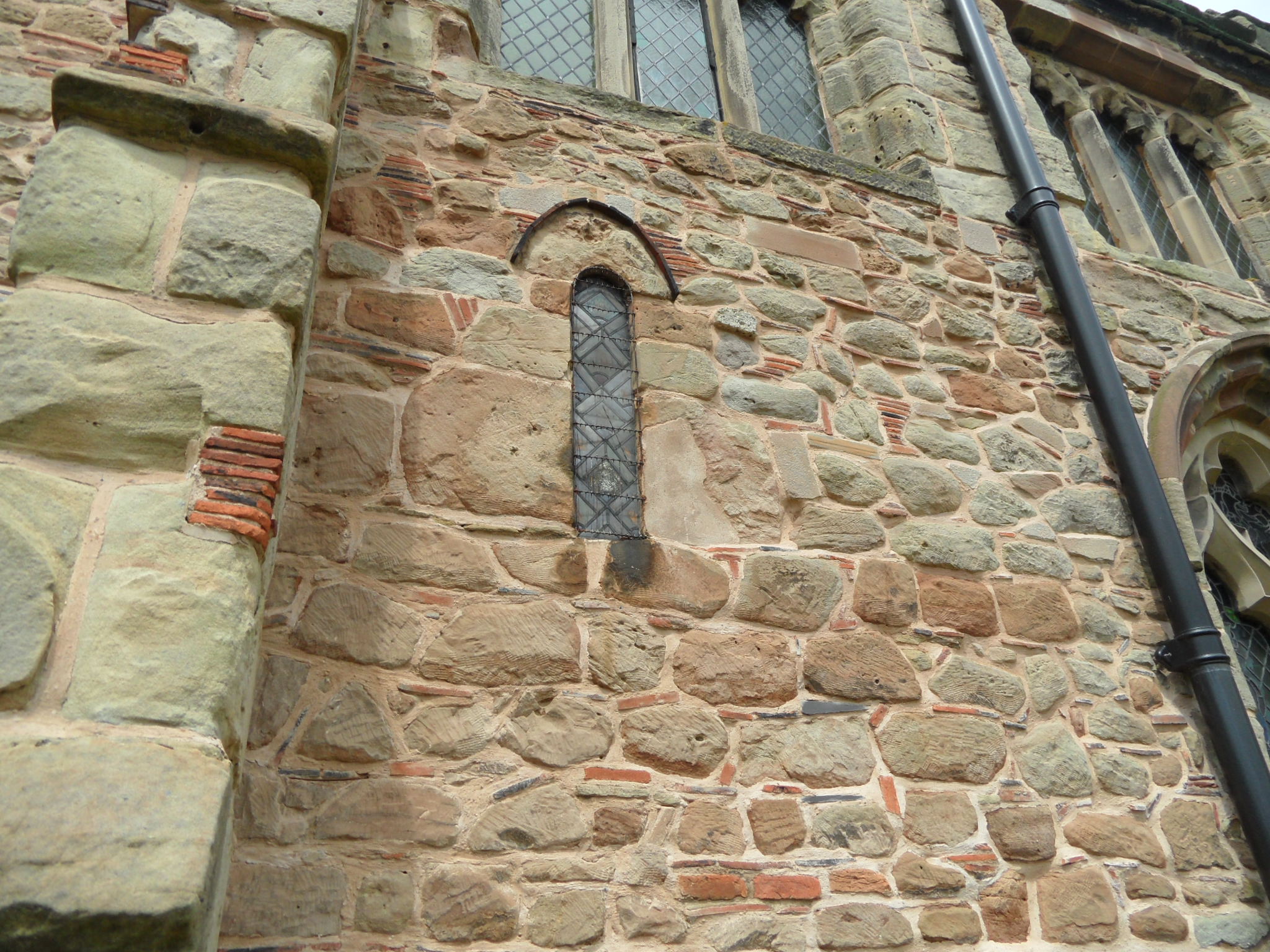
Unlike others I’ve seen recently, I’m pleased to say the church itself hasn’t been fully restored by those pesky Victorians, but has a range of architectural styles and features dating back to at least the eleventh century, but possibly even earlier than that – the HER description says that this is an Anglo-Saxon wall, and somewhere within it there is possibly even a Romano-British brick. On a buttress near to this ancient wall is a medieval scratch dial which, with the assistance of the sun, would once have helped the priest be on time for mass. On the buttress in-between the porch and the sixteenth century tower there is another carving, but unlike the scratch dial, no-one is quite sure of its significance.

SAM_1845

The daisy wheel carving is described as a mason’s mark in the churches information sheet. Although this is the first I’ve seen, this symbol regularly crops up on old buildings, especially churches. Whilst some believe these carvings have a practical function, others believe they were carved for good luck or protection against evil spirits.

SAM_1846

On a bit of a tangent, on the subject of childhood and daisies and folklore, I did wonder about some of the little rituals surrounding these flowers that we unthinkingly carried out as kids. The name is thought to come from the old English ‘Daes Eage’ meaning ‘day’s eye’, and refers to the way the flower opens and closes with sunlight. I’ve read that wearing daisy chains was thought to protect you from being abducted by fairies (must work, I’m still here!) and that one of its folk names is ‘Measure of Love’, from the game where you pull off the petals one by one, chanting, ‘He loves me, he loves me not’. Apparently, there is another less risky version of this game in which you chant, ‘He loves me, he loves me lots’. If only someone had told me this at the time, I wouldn’t have had to cheat so much.

SAM_1858

Anyway, as it says in those half remembered lines from Corinthians, I’ve put away childish things. Well, most of them anyway….

SAM_1866

Sources

http://www.medievalgraffitisurrey.org/circles.html