Mercian Murders

There are fields full of Cavaliers and Roundheads, still fighting over the fate of England. Roman soldiers marching along the roads they built. Tragic Tudor queens, often minus their heads. And you can’t move for Victorian phantoms, presumably conjured up from all of those seances they were holding. What does seem to be in short supply in this spectred isle however are the ghosts of Saxons.
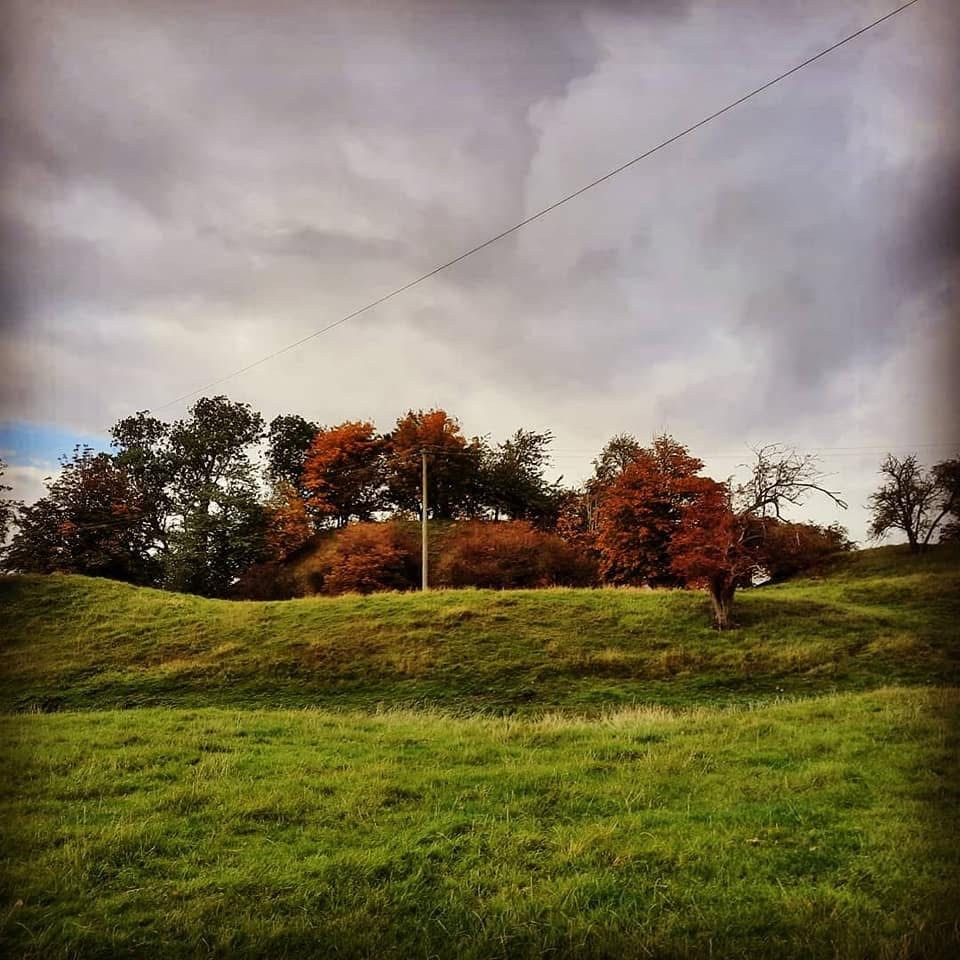
If somewhere was going to be haunted by a Saxon spirit, it would be Seckington. The Saxon Chronicle states that in 755, ‘Æthelbald, king of the Mercians, was slain at Seckington and his body lies at Repton‘. The account of the assassination is minimal but accounts say he was betrayed by his own bodyguards, some suggesting that his successor, Beornred of Mercia, was behind the treachery.
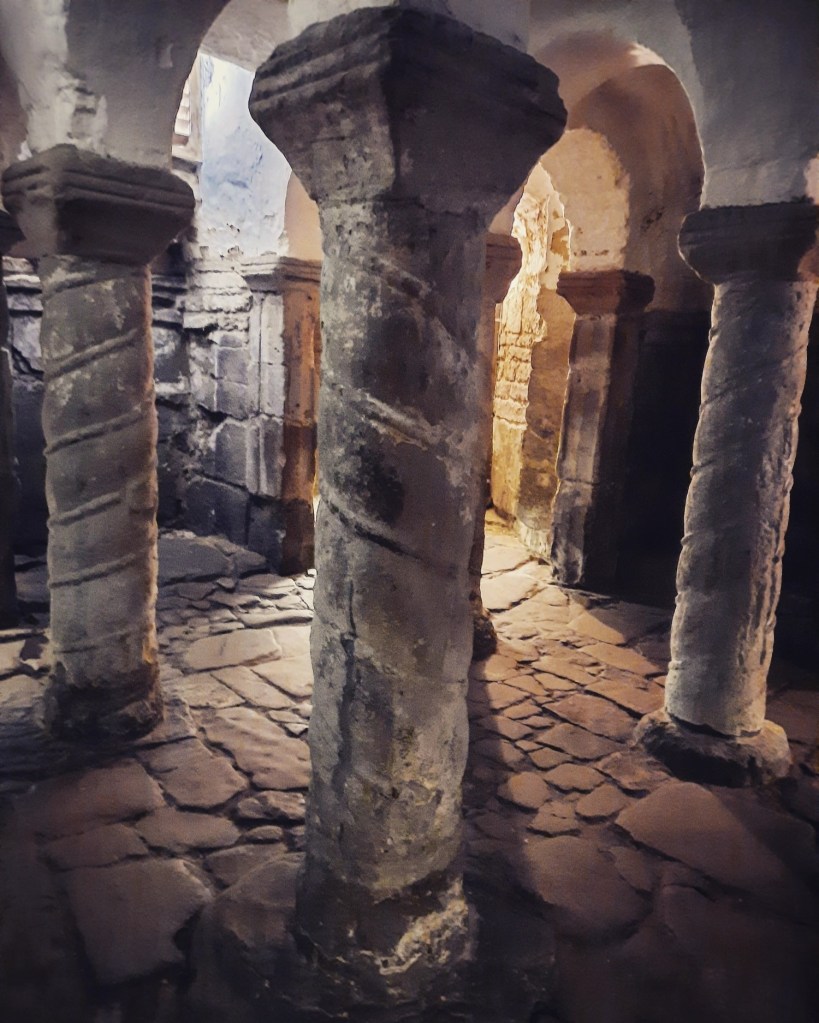
The crypt at Repton

After Æthelbald’s death, Beornred seized the Mercian throne. Little is known about him and within a year, Æthelbald’s cousin Offa launched his own claim to the throne and most likely offed him in the process. By contrast, there is much to be said about Offa, but as I started on the subject of murder, let’s continue on that theme.
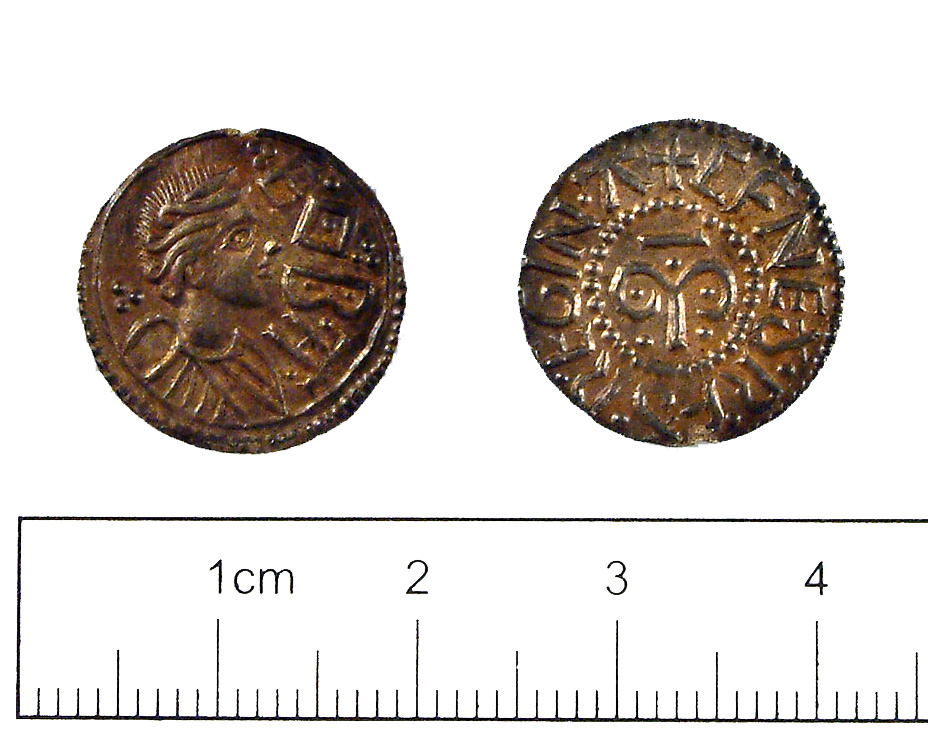
Penny depicting Cynethryth, Queen of Mercia.
(C) The Portable Antiquities Scheme

A marriage between King Æthelberht of East Anglia and one of the daughters of Offa and Cynethryth of Mercia was arranged to take place at a palace on Sutton Walls in Herefordshire. Yet before the bridegroom could make it to the altar and pledge his hand in marriage, he was beheaded. The Anglo-Saxon Chronicle attributes the deed to Offa. By the twelfth century there’s a shift in narrative and blame to Cynethryth. Was she really the wicked queen she is depicted as by chroniclers like Roger of Wendover or was it a cynical attempt to wash at least some of the blood off Offa’s hands? We know Cynethryth was powerful, her name appearing on charters and her face appearing on coins. Perhaps there’s an element of medieval misogyny involved in the tarnishing of her image? After Offa died in 796, Cynethryth took holy orders and became the abbess of a monastery at Cookham. In 2021, archaeologists found the foundations of this abbey alongside Cookham church and further excavations may even find the final resting place of this misrepresented Mercian queen.

We’ve wandered a long way from Lichfield so let’s end our journey much closer to home. In 716, King Ceolred of Mercia was buried at the Cathedral, despite the fact that he had died at a feast, ‘gibbering with demons and cursing the priests of God’. St Boniface believed him to have been possessed by a demon but I strongly suspect he was poisoned. I’d be very interested to see if his successor Æthelbald was on the guest list, bringing us a full and vicious circle back to the beginning of this post.
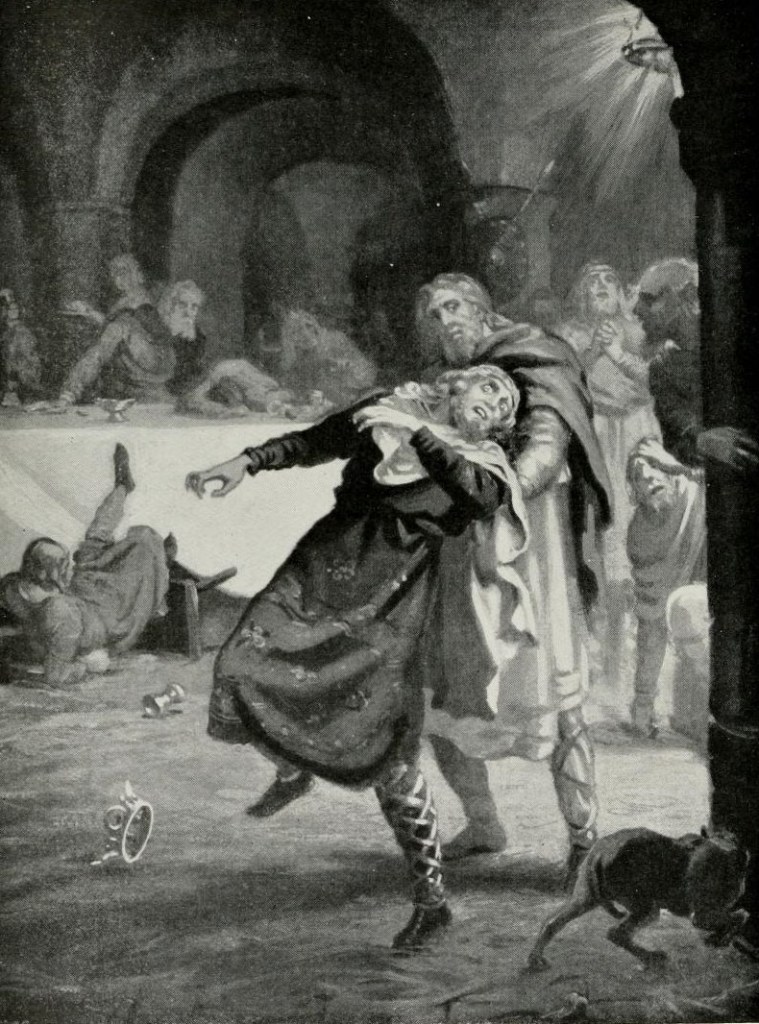
Black and white print of an oil panting by Margaret Dovaston depicting King Celored of Mercia smitten with madness

Sources:

The wanderings of a pen and pencil by F. P. Palmer

https://www.suttonwalls.co.uk/fact-pages

Women of Power in Anglo-Saxon England, Annie Whitehead

The Accidental Villa at Acton

The plan was to spend the day foraging for folklore in the villages to the west of Stafford but we accidentally ended up at Acton Trussell and then found out that archaeologists had accidentally found a Roman villa underneath the local church.

In the 1970s, a local archaeology group started to wonder why the church of St James was built someway outside the village. Clearly the two women we asked for directions to the church who after asking, ‘What church?’ then sent us in entirely the wrong direction, thought it should have been nearer to the village too. The obvious assumption was that the centre of Acton Trussell has shifted over the years but when fieldwalking between the church and village produced just a scattering of late medieval pottery, this seemed unlikely. What did start showing up however was evidence that there had been Roman activity at the site. Several sherds of pottery and two coins from the 3rd century posed a new question. What were the Romans doing here?

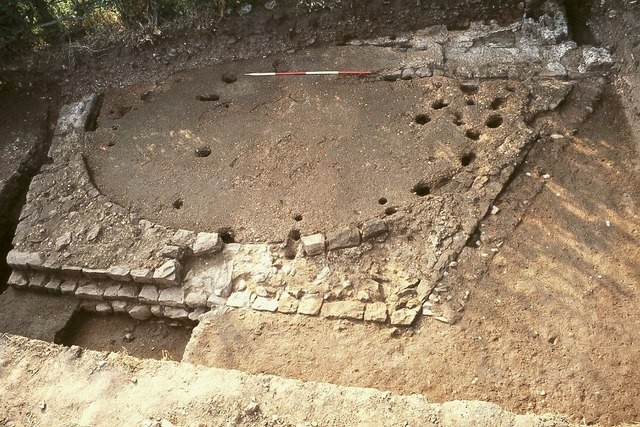
To the south of the St James, the field-walkers found fragments of roof tiles, suggesting the source of the Roman remains was somewhere near the churchyard. and then an excavation which began in May 1984 revealed that the church of St James and its graveyard actually stood upon the site of a Romano-British villa. Was this just a coincidence or could there be some sort of deliberate continuity here?

© Tony Habberley (cc-by-sa/2.0) geograph.org.uk/p/3242311
Late 2nd C. Apsidal wing of Roman Villa, taken Friday, 5 July, 1985

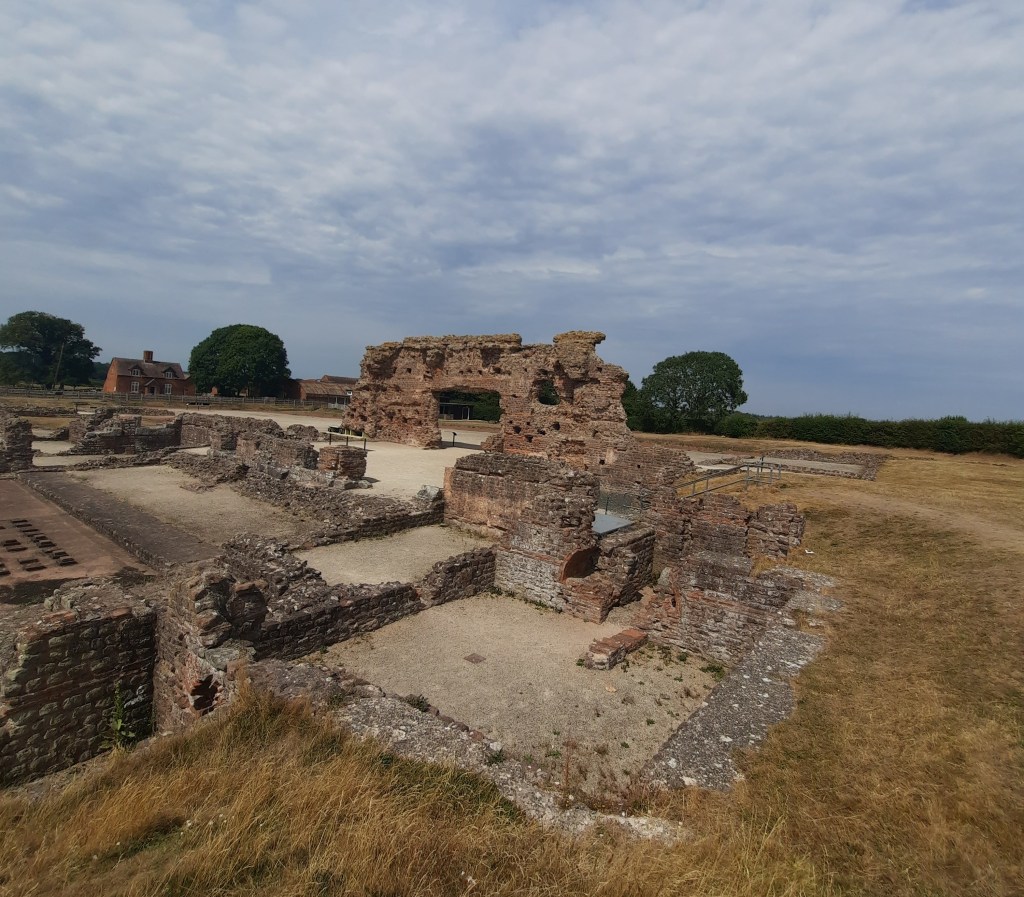
It’s not unknown for Roman sites to have been converted to Christianity. I was at Wroxeter in the summer and read that part of the Roman complex at Viriconium may have been adapted for use as an early church. It’s not watertight but the availability of a cold plunge pool in the frigadarium and bodies found nearby hint that the baths may have been used for those two Christian bookends of baptism and burial.

Wroxeter Roman City

This brings me back down the A5, and makes me wonder about Wall, where there are clues that Letocetum may have been home to an early Christian community. Again, evidence is mostly circumstantial but the most convincing argument comes in the form of a long lost bronze bowl with a Chi-Ro symbol on it. It was discovered in a grave in 1922 along with 30 coins dating to the 4th century and one of the 1st century and exhibited by Mr F Jackson at Wroxeter at a meeting of the Birmingham Archaeological Society. Afterwards it disappeared. and is now probably in a private collection but it belongs in a museum (yes, I have been watching Indiana Jones over the Christmas holiday). Thankfully, the other physical evidence that Christians once worshipped at Wall is in a museum. Well, in the Birmingham Museum Collection Centre anyway. Amidst stones carved with heads and horns, believed to have come from a Romano-British shrine local to Letocetum and rebuilt into the walls at Wall, was a stone carved with a cross.

Archaeologist Jim Gould suggests stylistically the cross most likely belongs to the period of the 6th to 9th century, which would tie it into the time-frame of the tantalising verse that is, ‘The Death Song of Cynddylan’ which recalls three battles fought by Prince Cynddylan of Powys. One of these was at a place called ‘Caer Luitcoed’, which translates to ‘the fortified grey wood’ or, as everyone now calls, Lichfield. Here’s a translation of the relevant part of the poem:

Before Lichfield they caused gore beneath the ravens and fierce attack
Lime-white shields were shattered before the sons of Cynddylan.
I shall lament until I would be in the land of my resting place for the slaying of Cynddylan, famed among chieftains.
Grandeur in battle, extensive spoils
Moriel bore off before Lichfield
1500 cattle from the front of battle,
80 stallions and equal harness.
The chief bishop wretched in his four-cornered house
The book clutching monks did not protect
those who fell in the battle before the splendid warrior.

The relevance to a possible early Christian community in the area are those book-grasping monks and the bishop in his four cornered house. According to Jim Gould, written evidence can also be found in Eddius Stephanus’ Life of Bishop Wilfrid which suggests that there was some sort of church and monastery in the area before St Chad set up alongside the spring at Stowe. Wulfhere, King of Mercia between 657 and 674, gave lands to Bishop Wilfred to found monasteries at existing holy places deserted by British Christians.

It wouldn’t be a complete leap of faith to imagine this could have included Lichfield, would it?

https://historicengland.org.uk/images-books/photos/item/AO56/208/8

https://actontrussellromanvilla.weebly.com/

https://www.wallromansitefriendsofletocetum.co.uk/index.asp?pageid=709225

https://romaninscriptionsofbritain.org/inscriptions/2415.64

The Archaeology of Roman Letocetum (Wall, Staffordshire), Implications of the proposed West Midlands Northern Relief Road, Draft for Consultation, County Planning and Development Department Staffordshire County Council

Gould, J 1993. ‘Lichfield before St Chad’, in Medieval Archaeology and Architecture at
Lichfield (ed J Maddison), Brit Archaeol Assoc Conference Trans 13, 1–10, Leeds: Maney Publishing

Heaven and Earth

Without wishing to state the obvious, this blog is called Lichfield Lore. Sometimes I’m worried that I might go too far (in a geographical rather than controversial sense) but although I’ve overstepped the Lichfield boundary from time to time, I have at least remained in Staffordshire. Until now.

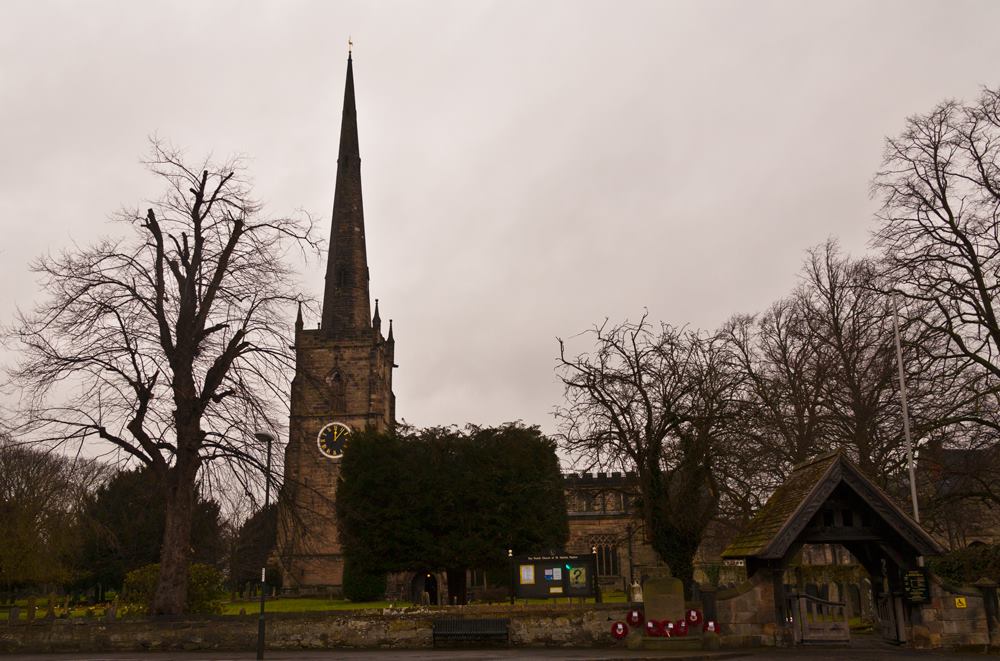
Last month, a group of us from Lichfield Discovered, crossed the border into Derbyshire to visit Repton which, between the seventh and ninth centuries, had been one of the main residences of of the Mercian royal family. In 653AD, Peada, son of the pagan King Penda converted to Christianity in order to marry Alhflæd (sp?), the daughter of King Oswy of Northumbria. To help him to convert the rest of the kingdom, he employed four monks from Lindisfarne  – Adda, Betti, Cedd and Diuma, the latter of whom would become the first Bishop of Mercia (1). However, Peada and Alhflæd do not appear to have been a match made in Heaven nor Neorxnawang. The Venerable Bede reported in his Historia Ecclesiastica that Peada was murdered in 656AD “wickedly killed by the treachery, as is said, of his wife during the very time of celebrating Easter”. 

Church of St Wystan, Repton. Photo by David Moore

Church of St Wystan, Repton. Photo by David Moore

Rather fitting then that it was death which brought us to the ‘cradle of Christianity in the Midlands’. Although Peada is not buried here, the eighth century Anglo-Saxon crypt beneath the church was used as a mausoleum for later members of the Mercian royal family, including King Æthelbald ( ‘treacherously murdered at night by his own bodyguards’ says Bede), King Wiglaf (cause of death unknown) and his grandson Wigstan (murdered by a family member, who he objected to marrying his widowed mother. Seems his concerns were well-founded). The exact place where Wigstan was scalped is not known (Wistow in Leicestershire and Wistanstow in Shropshire both have claims) but wherever it was, it’s said that on the anniversary of his death each year, human hair grows from the earth at the spot where his blood was spilt (2). This supposed phenomenon and other miracles, led to the canonization of Wigstan, who became known as St Wystan. The crypt became a place of pilgrimage and the church above it took his name.

The crypt at Repton. Photo by David Moore.

The crypt at Repton. Photo by David Moore.

In the early eleventh century, King Cnut ordered the holy bones to be moved to Evesham Abbey and in the centuries which followed, the entrances to the crypt were sealed and its existence forgotten until 1779, when someone digging a grave for the headmaster of Repton School broke through the vaulting and fell into it. We made our entrance in a rather more conventional way.

crypt stairs

Down to the crypt and into the eighth century. Photo by David Moore.

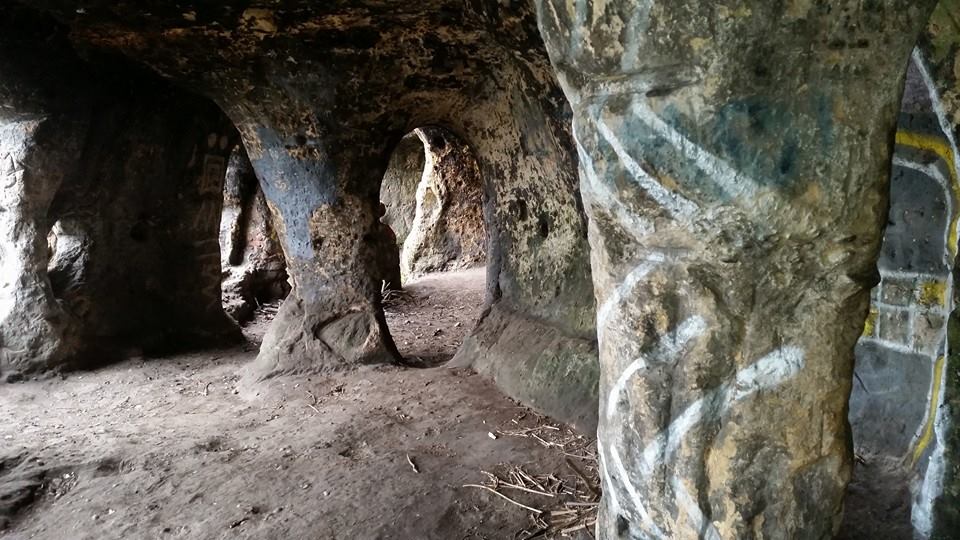
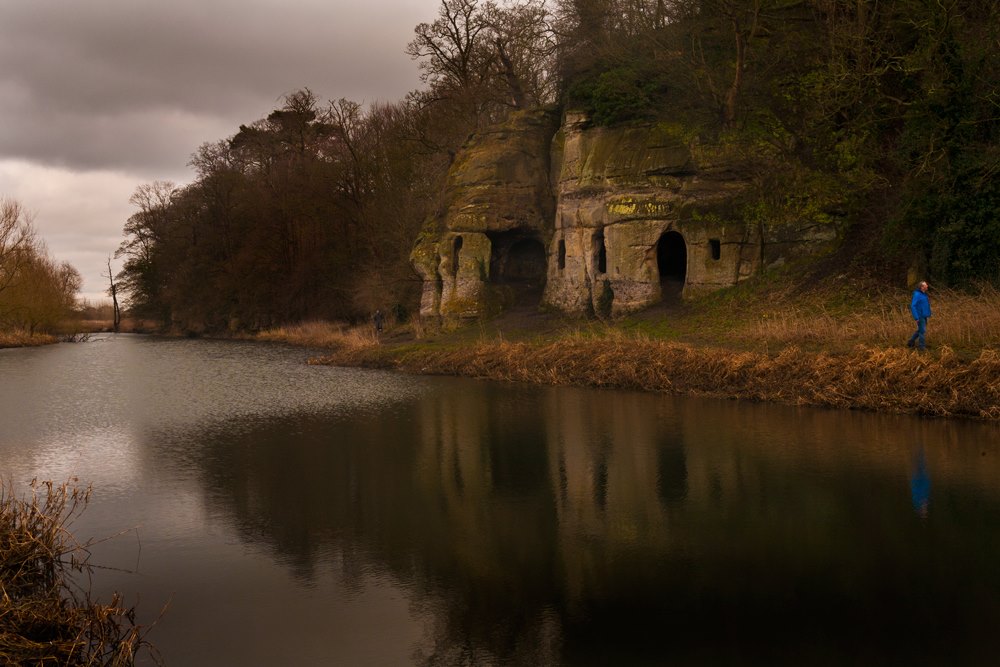
From Repton, we headed to the Anchor Church, four connected caves alongside the River Trent, which both nature and humans had a hand in forming. I confess that the time I should have spent on the logistics of the trip was instead spent at the Whippet Inn, and so it took a bit of finding with just a postcode to guide us. However, when we did finally arrive we were pleased to see that, although thick with mud, the often flooded path that would take us to the ‘church’ was just about passable.

Inside the caves. Photo by Andy Walker.

Inside the caves. Photo by Andy Walker.

Legend has it that in the sixth or seventh century, the caves were occupied by a hermit, who spent his time here going to the river to pray. Later, the caves were supposedly inhabited by a monk called Bernard who spent his last days here, repenting for his part in the deception which persuaded returning crusader Hugh de Burdett that his wife Johanne had been unfaithful. The story goes that Hugh cut off her left hand, leaving her to bleed to death over the altar cloth she’d been embroidering for him using her own hair (what’s with the hair obsession around here?).  On a more cheerful note, in the eighteenth century, Sir Francis Burdett (presumably one of Hugh’s descendants) used the caves and riverbanks as a venue for picnics, as shall we when we visit again in the Summer.

The Anchor Church near Ingleby. Photo by David Moore.

The Anchor Church near Ingleby. Photo by David Moore.

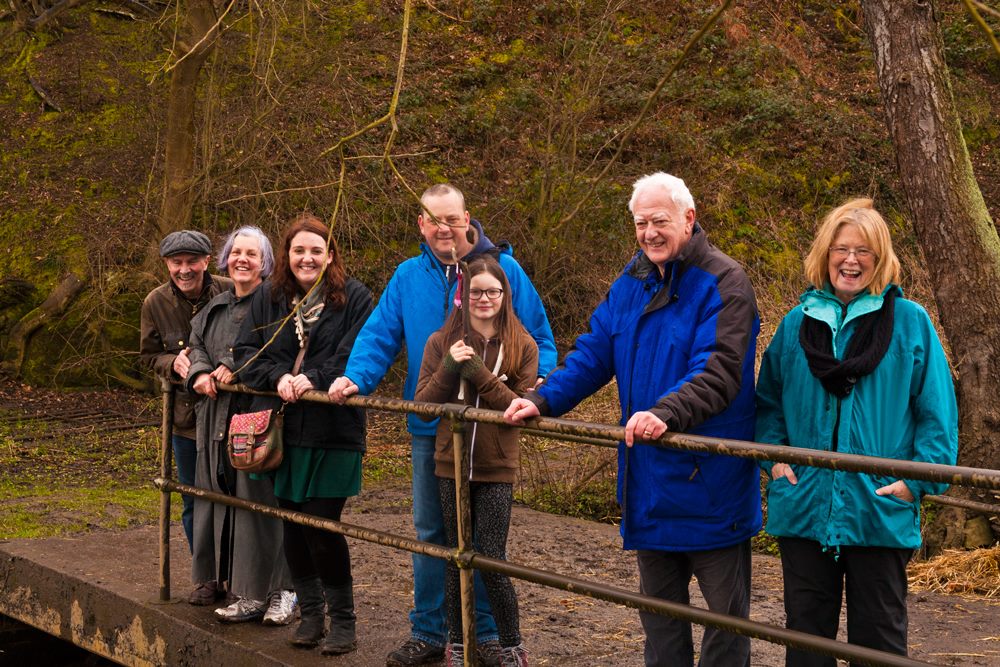
On our way back to the cars, there was a blood-curdling scream. Had one of our party met with the ghost of Johanne searching for her lost hand or had they lost their footing and fallen victim to the mud?  No, Carol just had something in her shoe. One of those funny at the time but you really had to be there moments admittedly, but I mention it because this is what I remember first and most fondly when I think of our trip. I love places for their stories and their connections to the people of the past, but even more so for the memories made by visiting them with people in the here and now.

repton group

Looking for pirahanas in the River Trent. Photo by David Moore.

Notes

(1) In 669, Chad, brother of Cedd and the fourth Bishop of Mercia moved the See from Repton to Lichfield (phew, it is relevant to Lichfield after all!)

(2) There’s another Lichfield Discovered trip right there. Who is free on the first of June? We’ll have to split up though, gang….

(3) Another Lichfield link – in 1364 an armed mob at Repton attacked the Bishop of Lichfield and the Prior. Actually, finding places with a tenuous link to Lichfield could be a whole blog post in its own.

References

http://www.reptonchurch.org.uk/

Repton and its Neighbourhood by F C Hipkins

The Oxford Dictionary of Saints by David Hugh Farmer

http://jimjarratt.co.uk/follies/page57.html

Click to access anchor_a3.pdf