There are fields full of Cavaliers and Roundheads, still fighting over the fate of England. Roman soldiers marching along the roads they built. Tragic Tudor queens, often minus their heads. And you can’t move for Victorian phantoms, presumably conjured up from all of those seances they were holding. What does seem to be in short supply in this spectred isle however are the ghosts of Saxons.
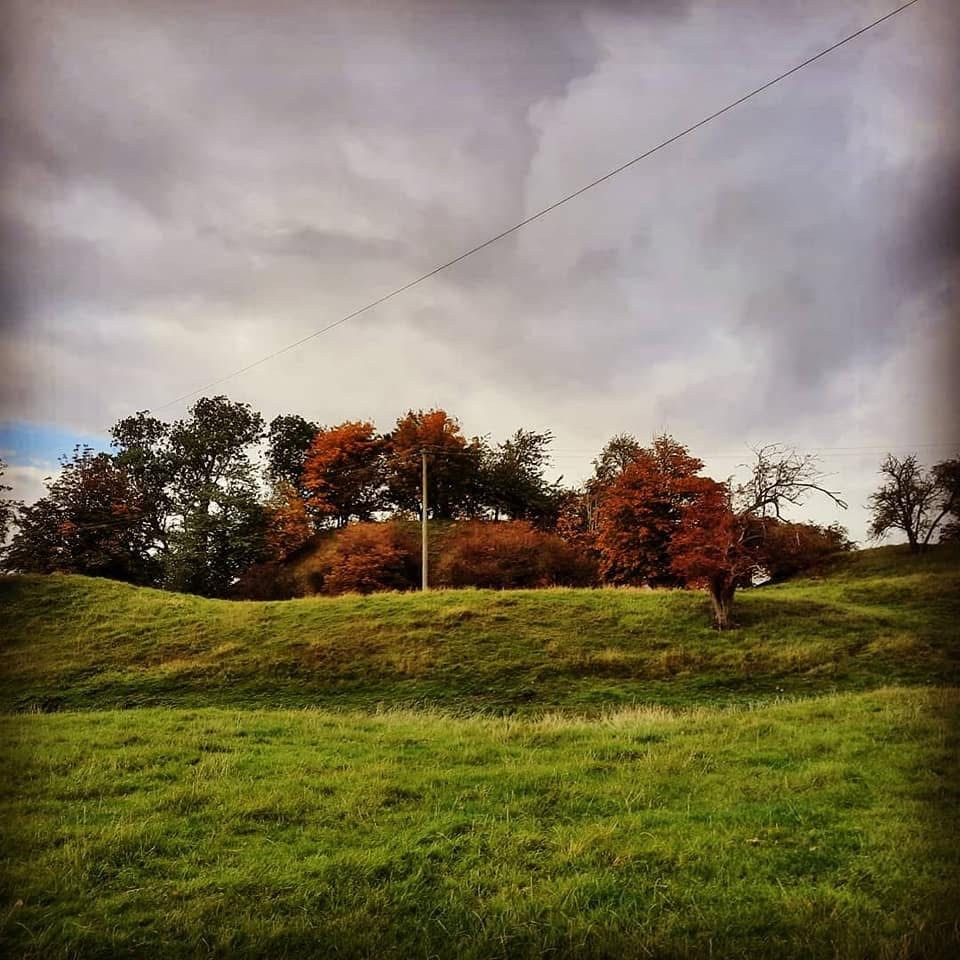
If somewhere was going to be haunted by a Saxon spirit, it would be Seckington. The Saxon Chronicle states that in 755, ‘Æthelbald, king of the Mercians, was slain at Seckington and his body lies at Repton‘. The account of the assassination is minimal but accounts say he was betrayed by his own bodyguards, some suggesting that his successor, Beornred of Mercia, was behind the treachery.
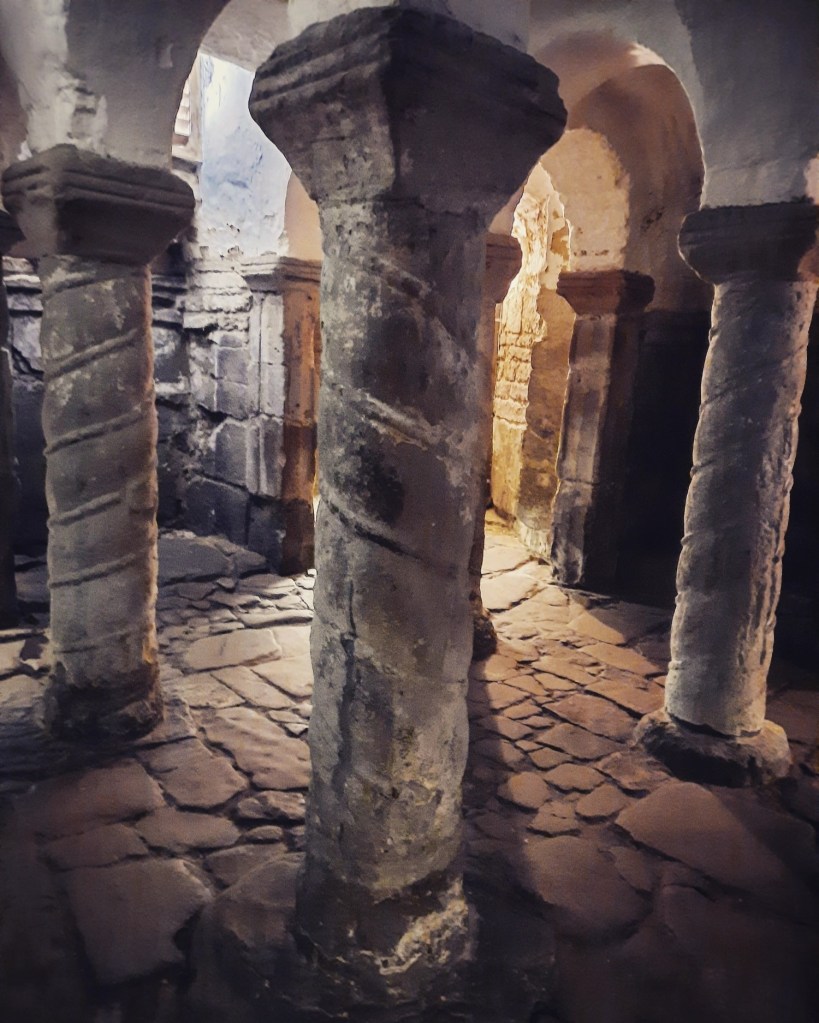
The crypt at Repton
After Æthelbald’s death, Beornred seized the Mercian throne. Little is known about him and within a year, Æthelbald’s cousin Offa launched his own claim to the throne and most likely offed him in the process. By contrast, there is much to be said about Offa, but as I started on the subject of murder, let’s continue on that theme.
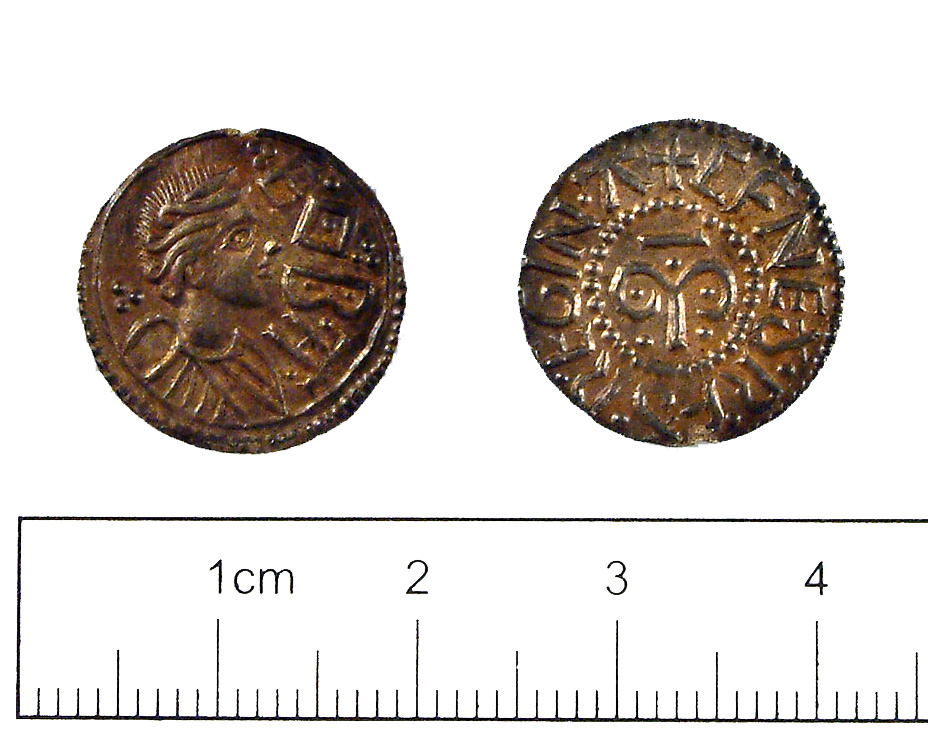
Penny depicting Cynethryth, Queen of Mercia. (C) The Portable Antiquities Scheme
A marriage between King Æthelberht of East Anglia and one of the daughters of Offa and Cynethryth of Mercia was arranged to take place at a palace on Sutton Walls in Herefordshire. Yet before the bridegroom could make it to the altar and pledge his hand in marriage, he was beheaded. The Anglo-Saxon Chronicle attributes the deed to Offa. By the twelfth century there’s a shift in narrative and blame to Cynethryth. Was she really the wicked queen she is depicted as by chroniclers like Roger of Wendover or was it a cynical attempt to wash at least some of the blood off Offa’s hands? We know Cynethryth was powerful, her name appearing on charters and her face appearing on coins. Perhaps there’s an element of medieval misogyny involved in the tarnishing of her image? After Offa died in 796, Cynethryth took holy orders and became the abbess of a monastery at Cookham. In 2021, archaeologists found the foundations of this abbey alongside Cookham church and further excavations may even find the final resting place of this misrepresented Mercian queen.
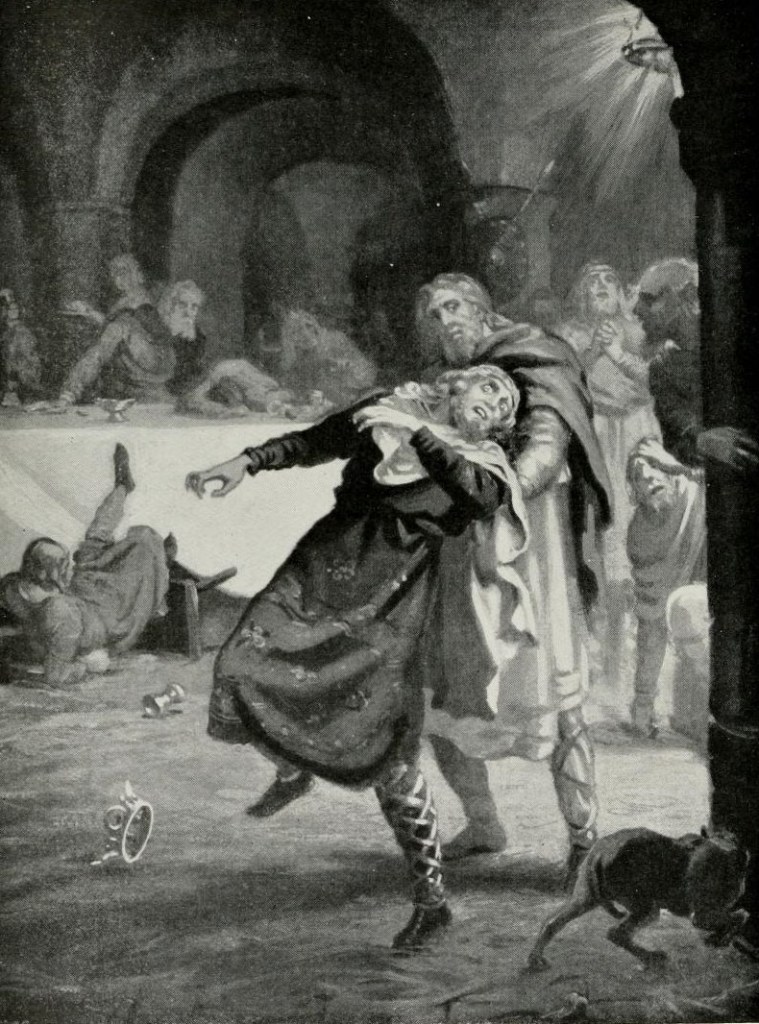
We’ve wandered a long way from Lichfield so let’s end our journey much closer to home. In 716, King Ceolred of Mercia was buried at the Cathedral, despite the fact that he had died at a feast, ‘gibbering with demons and cursing the priests of God’. St Boniface believed him to have been possessed by a demon but I strongly suspect he was poisoned. I’d be very interested to see if his successor Æthelbald was on the guest list, bringing us a full and vicious circle back to the beginning of this post.
Black and white print of an oil panting by Margaret Dovaston depicting King Celored of Mercia smitten with madness
Sources:
The wanderings of a pen and pencil by F. P. Palmer
There are many reasons one might visit a pub. To sample the fare, to enjoy an ale, to meet with companions. I went to the Dog and Doublet because it’s named after a murder. Or a dog wearing a jacket. Either way, I headed to the village of Sandon in Staffordshire, in my mystery machine (which looks a lot like a Toyota Avensis) to do a bit of investigating.
The first possible explanation for the pub’s name is that a former landlord was murdered by robbers and his faithful hound found the corpse. In what sounds like a gothic horror version of Lassie, he took his master’s blood-stained doublet back to the inn and then led a search party back to the body. The second less gory story says that a travelling fair came to Sandon and its star act was a performing pooch in a little jacket. The villagers thought he was such a good boy they decided to name their pub after him. A dog in a doublet was clearly a novelty back then. Nowadays I see some canines out walking in Leomansley Woods who have better wardrobes than I do.
The current building dates to 1906, and is described as having been erected by the Earl of Harrowby on a site adjoining that of the original. The tithe map seems to show that there was an inn there back in 1838, but it was known as the Packhorse. It’s all a bit confusing, even before you’ve had a drink, but I think I understand what happened with these hostelries. There was definitely a Dog and Doublet in the village dating back to at least the mid-18th century as I’ve found a reference for it in Aris’s Birmingham Gazettee. It seems to have stood on the other side of the road, at a place now known as Sandon Lodge and/or Erdeswicke House. When Sandon Hall burned down in the summer of 1848, the Earl of Harrowby made it his temporary family home, and had the pub sign moved to the Packhorse which presumably was also renamed at this point. He didn’t relocate the resident ghost though, as a man described as wearing brown clothes and a small wig and believed to be a former landlord, was still reported to be haunting his old hostelry in the 1950s.
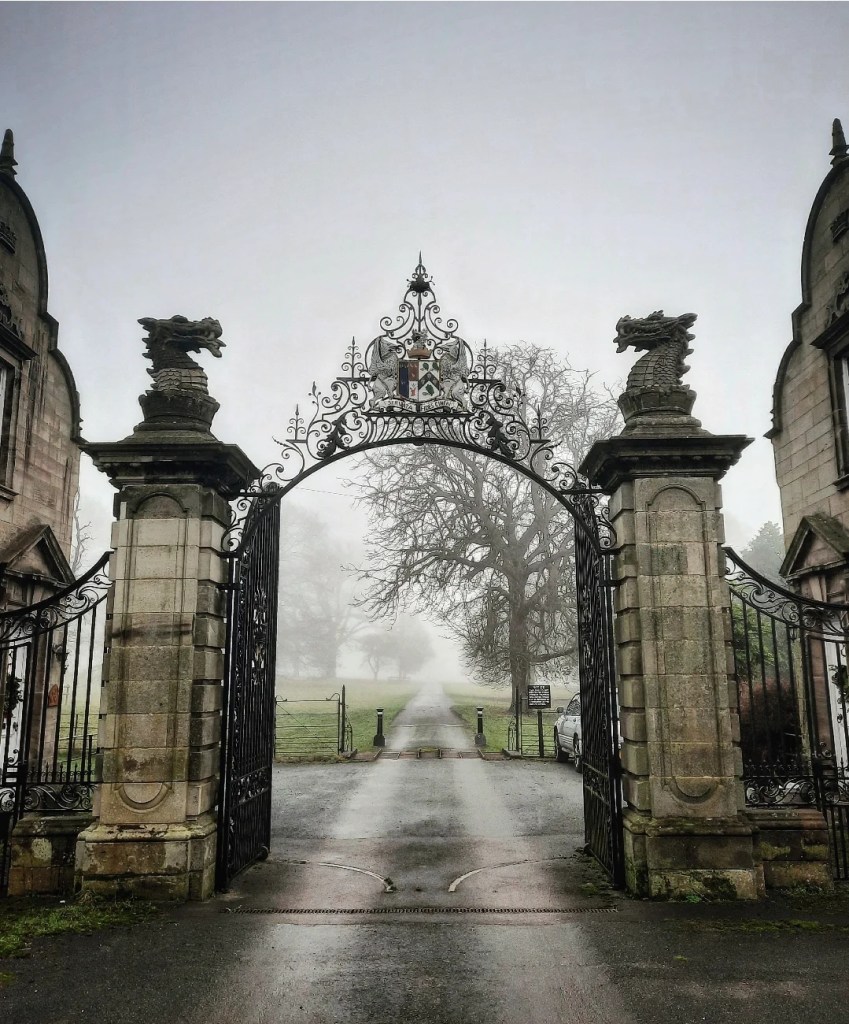
The gates to Sandon Hall
This information comes from Sam Berrisford, a former chairman of the Parish Council, who lived in part of Sandon Lodge. He also mentions an overgrown circular bowling green in the grounds of the old inn, which he suggested was Elizabethan. According to the listed building description, the oldest parts are 17th century and so certainly old enough that tales of parliamentarian troops draining quart pots and plunging their heads into vats of beer in the inn’s cellar prior to the Battle of Hopton Heath could be true. If so, it’s no wonder the Royalists defeated them eh? (put down your swords Roundheads, I’m just jesting. I know the outcome of the only Civil War battle to take place on Staffordshire soil isn’t that straightforward).
During its 18th century coaching inn days the hospitality of the hostelry was renowned and, in the absence of Trip Advisor, a satisfied customer is said to have scratched this verse onto one of the smoke-room windows of the old pub.
‘Most travellers to whom these roads are known Would rather stay at Sandon than Stone Good chaises, horses, treatment and good wines, They always meet with at James Ballantine’s’.
Not everyone met with such a cordial welcome from Mr Ballantine however. There’s a story his daughter eloped with a young man and that when the boy broke into the inn to collect some of her belongings, Ballatine was there waiting for him. He handed his estranged son-in-law over to the law and the lad was hanged for theft. It’s said that on the night of the execution, a crowd of villagers surrounded the inn, chanting the 69th psalm and cursing James Ballantine. Possibly related to this family drama is a second verse that the Staffordshire Advertiser says was scratched into another of the inn’s windows which read, ‘Let the man that hates peace, and endeavours to trouble it, Be hung up by the neck, like this dog in the doublet’.
Whitehall, Beacon St. Once the Coach & Horses inn
Whether the story of Sandon’s star cross’d lovers is true I don’t yet know but I have found out that James Ballantine and his wife Catherine had six daughters in total. One of them was called Ann and in November 1779 she married Alderman John Fern, an eminent Wine and Brandy Merchant from Lichfield. So far, so respectable but then you learn the groom was sixty-two years old and Ann only twenty-one. I believe they’d have lived at Whitehall on Beacon Street in, another former inn with an intriguing past. Fern died in Lichfield on 16th February 1801 and his short obituary in the Whitehall Evening Post, refers to him as the ‘Father of the Corporation of that city’. Although surely he was old enough to be its Grandad…
Back to the Dog though and by December 1802, the landlord there was Mr Tomlinson who was paid a visit by a swindler, who may have been enticed by the Trip Advisor review for good horses in the window. He had, ‘very much the appearance of a gentleman aged about forty years, five feet eight or nine, dark curled hair, smooth face, smiling countenance and had on a dark mixture cloth coat, with one of his boots patched across the toe’. He arrived in a post-chaise from Cheadle and claimed to have left his horse at Leek due to the bad weather, asking for a horse for the following morning to take him to the banking house of Messrs Stevenson and Co. Inevitably, that was the last Mr Tomlinson saw of his horse and when enquiries were made at the bank in Stafford, it probably didn’t come as a shock that no such person had been there. A five guinea reward was offered by Tomlinson, along with ten pounds from ye olde neighbourhood watch scheme, the Sandon Association for Prosecuting Felons.
To the church. Let’s not split up eh gang?
And so it turns out there there are far more than two tales at the Dog and Doublet even if some of them are just shaggy dog stories. I’m not quite ready to fire up the Toyota Avensis and leave Sandon just yet though. There’s a mystery up at the church that needs solving…
Sources:
Birmingham Weekly Post 20th October 1950
Stone – The History of a Market Town, Norman A Cope
It’s the first day of Autumn today, meaning yesterday was the last day of Summer and it definitely went out with a bang. The storm seems to have subsided a little but the pounding rain continues its bleak fall and so I’m virtually visiting Streethay this afternoon. The village sits on the Roman Ryknild Street, just beyond the boundary of Lichfield City and, most appropriately given the weather, it’s a place with some watery links that I want to explore.
The Anchor Inn, had already been boarded up for two years when I took this photo in February 2017.
The new housing estates springing up around the outskirts of Lichfield are certainly controversial but one positive development at Streethay, is the arrival of Bod. I’m a big fan of the Titanic brewery bar and I do wonder whether this new influx of people would have kept Streethay’s previous pub ‘The Anchor’ afloat, if it had happened sooner. It was not to be however, and it closed in January 2015.
At Bod, I found a tiny mermaid swimming in a glass of porter….(with apologies to Eliza Carthy) Created by Louise from Under a Pewter Sky.
The building still survives and is now occupied by an Osteopathy Clinic and apartments but let’s go back in time to those days when it still served as an inn. It was clearly in existence by November 1848 when an inquest was held there on the body of Henry Crutchley, a fourteen year old lad who died after climbing onto an engine and slipping beneath the wheels of the wagons it was pulling, but was rebuilt around 1906, when the Lichfield Brewery Company was granted permission on the basis that ‘the house was in a most dilapidated condition and it was impossible to repair it’. I’ve yet to find a photo of its former form but I have found a reference in 1779 to a public house ‘known by the sign of the Queen’s Head’ which stood on the turnpike from Lichfield to Burton at Streethay and I’m wondering if this might be an earlier name. There are also mentions of a inn known as The Dog, around the same time and I’d like to sniff out where exactly that was.
In the Lichfield Mercury in 1972 an advert for the Anchor appeared with a curious reference to the ‘Klondyke Bar’, inviting you to enjoy your drink, ‘in the pleasant atmosphere of the Gold Rush’. One of the new apartments built in the grounds of the Anchor has been named after this, with the estate agents’ details explaining it was named after the ‘large wooden drinking hut’. Now I was given many nicknames by my brother when we were growing up, and one of them was ‘Klondyke Kate’. Whilst I’d like to think it was based on American vaudeville actress who provided inspiration for Scrooge McDuck’s girlfriend, I suspect it was more likely a reference to the British female wrestler. The Anchor’s Klondyke however is clearly a reference to the gold in them thar Canadian hills in the 1890s and was decorated with old photos and posters and, erm, pheasants, in a bid to recreate a prospectors’ bar. Much more of a mystery is why a bar on the outskirts of Lichfield chose it as a theme. In May 1979, the new licensees Norma and George Wolley presumably asked themselves the same question and relaunched the annexe bar as ‘The Mainbrace’. The hut itself had originally been a first world war army hut and this brings us nicely to a really interesting period in the pub’s history.
During the Second World War, the pub was frequented by personnel from RAF Lichfield. Jean Smith, in an interview with Adam Purcell, described how she and fellow WAAFs would stop off for a half a pint there on the way back home to their quarters on the opposite side of the road. On winter nights, when it was announced that flights had been cancelled due to fog and rain, the women would get their gladrags on and head out to the inn. Soon, the sound of bikes being propped against the wall of the pub would be heard as the lads from the aerodrome arrived at The Anchor, and the grounded pilots would soon be filling the air with cigarette smoke and tunes from the piano. The full interview with Jean can be found here and it’s a fascinating read, which really captures what the atmosphere was like for those young people living their lives in Lichfield, surrounded by the ever present threat of death.
This post was actually intended to be a deep dive into the village as a whole but I’ve got a bit overboard with the history of the Anchor Pub and so we’ll have to return to Streethay and its moated manor and plunge pool, the brewery and the canal wharf, and the lost hamlet of Morughale another day because we’ve only just dipped our toe in…
Brewery Row, once home to workers from the Trent Valley Brewery