Appeal of Bells

If you heard the bells of St Michael’s ringing out late yesterday afternoon, you were listening to the launch of a restoration fund for the bells, which are in need of essential maintenance work.

According to the churchwardens accounts, the bells have been rung in the past to mark important national occasions, and in the bell tower there are plaques commemorating some of these and more locally significant events.

The blue plaque commemorates the ringing of bells for the marriage of Charles & Diana; the brown one commemorates a farewell peal for the retirement of Prebendary P Howard in 1947

Bell Tower steps

After negotiating the narrow and windy staircase back down into the church, I had a look around the rest of this lovely building. According to the listed building description, although the church is thought to be 13th century in origin (with a 14thc tower), much of the building dates back to the restoration of 1842/3 by Thomas Johnson. However, the church history booklet (a snip at £1.50!) suggests that whilst the church had undoubtedly needed some restoration work at this time, much of this work was  unnecessary and things of historic interest may have been lost. The booklet goes on to say that some of the restoration work was undone at the end of the 19thc.

Royal coat of arms(1711) above the chancel

The royal arms, as seen above the chancel, are from 1711, and replaced an earlier version. I’ve read that after the reformation, anglican churches were encouraged to display the royal coat of arms somewhere prominent, reminding people that the monarch was also head of the Church of England. The custom of displaying the royal arms continued until Victorian times, but these days can be found in only around 15% of churches. You can read more about the Churches Conservation Trust’s guide to Royal Arms in English churches here.

Having previously read that the Marquis of Donegal had erected a spacious family mausoleum near the chancel, I have to confess I was a little disappointed to find no trace at all of the ostentatious Chichesters of Fisherwick Hall. However, the church booklet explained that the rabbit infested mausoleum had been replaced by a stokehold in the 1842/3 restoration, and the bones buried elsewhere. Seems like none of Donegal’s buildings were destined to last long….

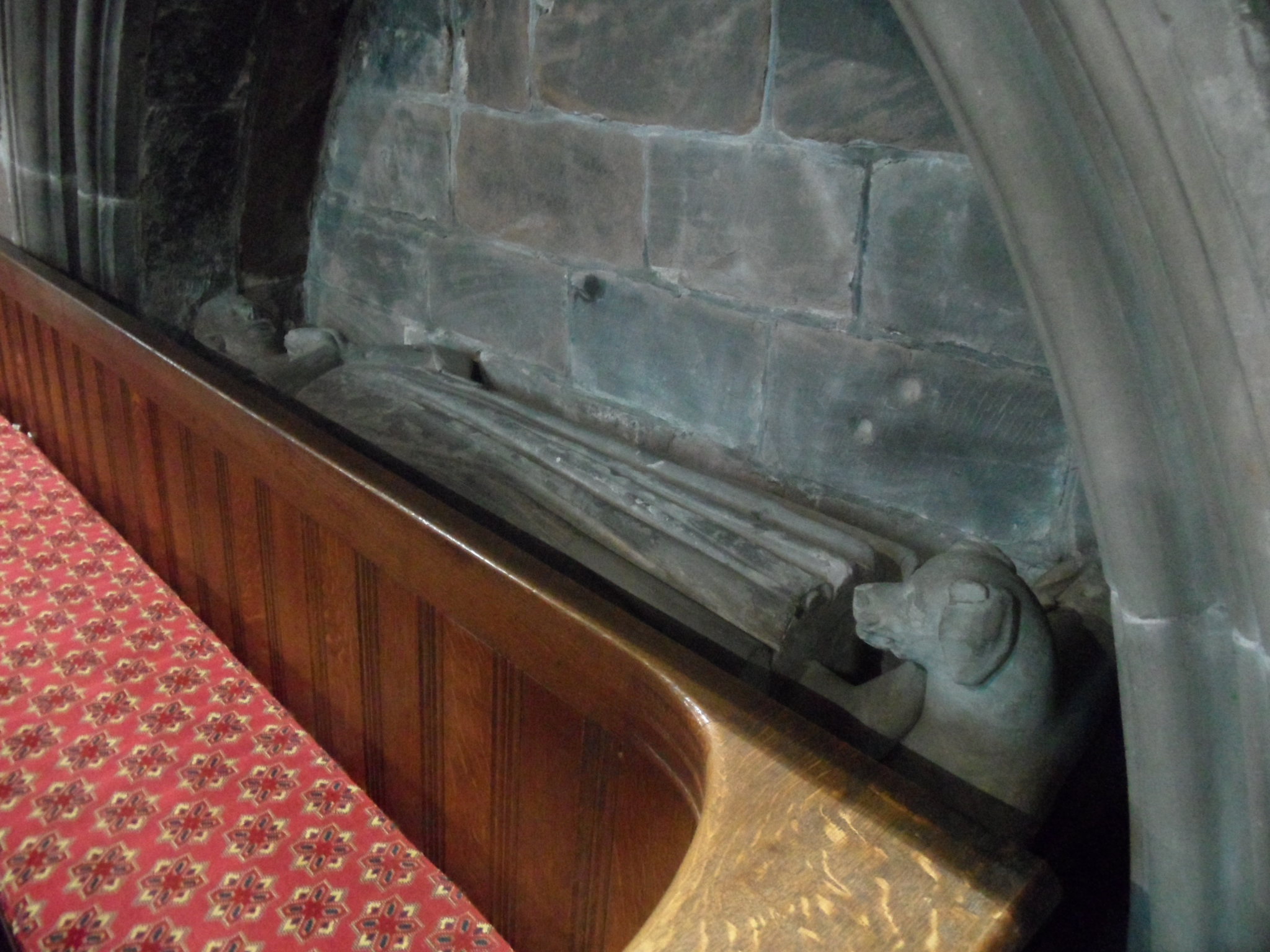
The chap below fared a little better than Donegal. Whilst his bones also ended up elsewhere, his effigy survived the ‘restoration’ and is behind a bench in the chancel. It’s thought to be William de Walton who endowed the church with land and died around 1344. I particularly like the inclusion of the faithful dog watching over his master in death.

One man & his dog – William de Walton’s effigy

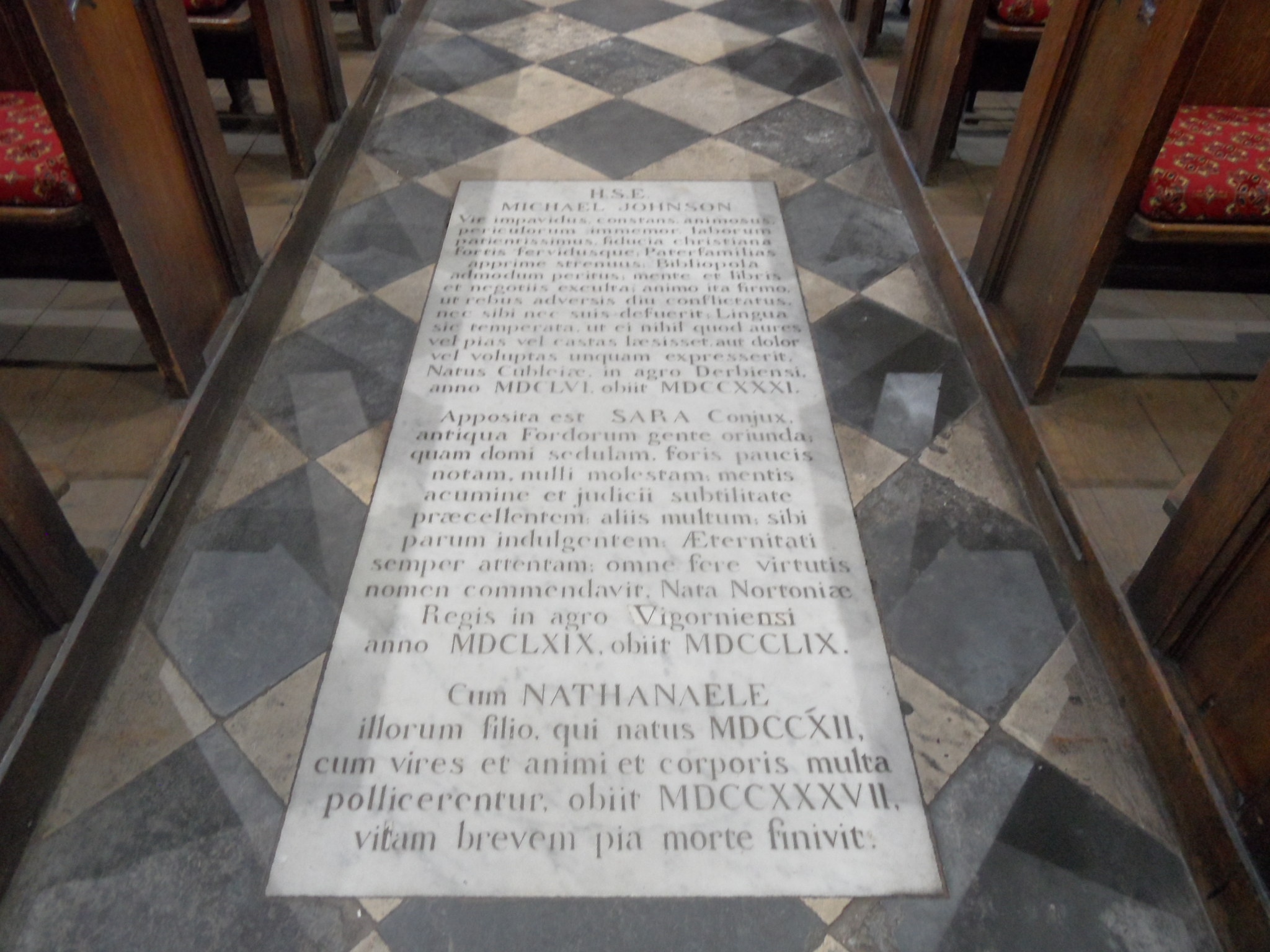
The church has several other monuments, including most famously, that of Samuel Johnson’s mother, father and brother.

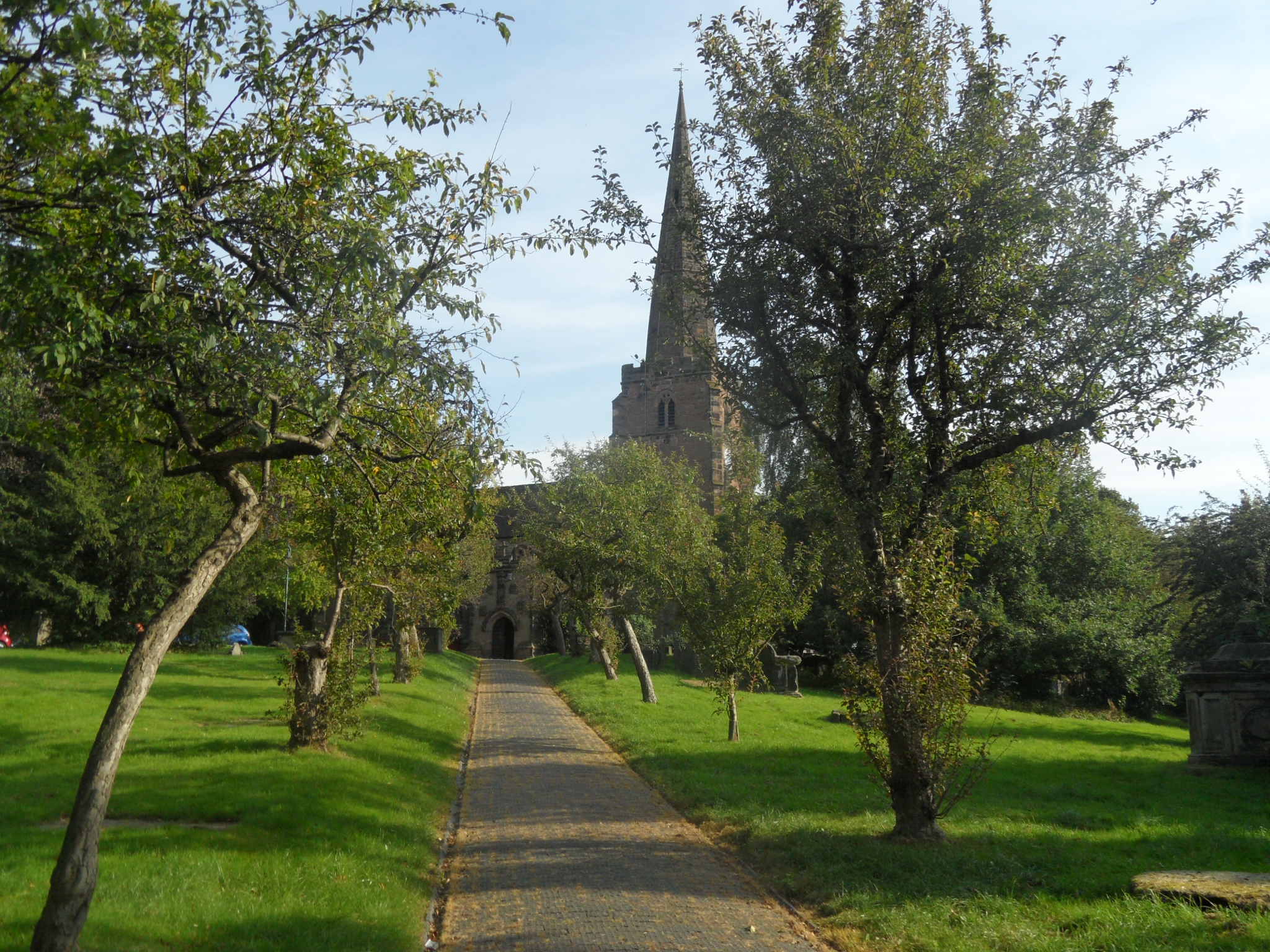
Back outside in the churchyard,  a woman approached me and asked ‘Are you thinking the same as me?’. Actually I wasn’t, because whilst I was thinking about missing bones, the woman was thinking about missing apples. Apparently in previous years, rich windfall pickings were to be had from the trees growing alongside the footpath. This year it was hard to spot a single fruit.

Peals but no peel

One thing I read in the history booklet, which I’d love to hear people’s thoughts on,  is that around the year 2000, a pump was installed to keep the crypt from flooding. I read in an archaeology report that ‘St Michael’s is a low hill with natural springs’. Could this have anything to do with the flooding?  I’ll explore this ancient burial ground in a post of its own. In the meantime, perhaps we could get the University of Leicester involved in a hunt for William de Walton and the Marquis of Donegal. They seem quite good at that sort of thing…..

Part of the 9 acres making up St Michael’s churchyard

Sources:

St Michael’s Church. Lichfield – A Short History by Rev Carpenter 1947

A short account of the city and close of Lichfield – Thomas George Lomax, John Chappel Woodhouse & William Newling

Archaeological Desktop Survey OSA Report No. OSAO6DTO2 (Onsite Archaeology January 2006)

Bell Vista

A while ago, I wrote about the architect Thomas Johnson and how he had been involved in the restoration of the church of St Michael on Greenhill in 1842/3. In the newspaper archive, I found a report of a meeting of parishioners held at the church, prior to these restoration works.

The article is a bit blurry and hard to read but after much squinting it seems that there was concern that the church was at risk of ‘being reduced to ruins’ and that the churchwardens had appointed Mr Johnson to assess the extent of the dilapidations.  His diagnosis was that the roof, ceiling, spire and a portion of the walls were so unsafe that a large sum of money would be needed to keep up the building. The parishioners expressed their surprise at how bad the situation was. To illustrate just how bad things had got, it was revealed that rabbits had managed to get into the mausoleum of the Marquis of Donegal (he of Fisherwick) and were breeding in the coffins. The outcome was that the land owning parishioners agreed to increase their rates to pay for the necessary work which according to the County History included

 “the reroofing of the nave, the repair of the side aisles and the nave clerestory, the reintroduction of Perpendicular windows in the north aisle, the rebuilding of the north porch, and the remodelling of the south aisle with new buttresses and a south door in place of a window. The gallery was removed. The mausoleum and the vestry room were replaced by a stokehold over which a clergy vestry was built with doors into the chancel and the south aisle; an organ loft was built over the vestry”.

St Michael’s above Stowe Pool

I have never been into the church myself. However, I notice via facebook that the church will be open for viewing tomorrow (between 3pm & 5.30pm) during the launch of the Bell Restoration Fund. You can find out more on their facebook page here and you can read the great article Annette Rubery wrote about the fund here.

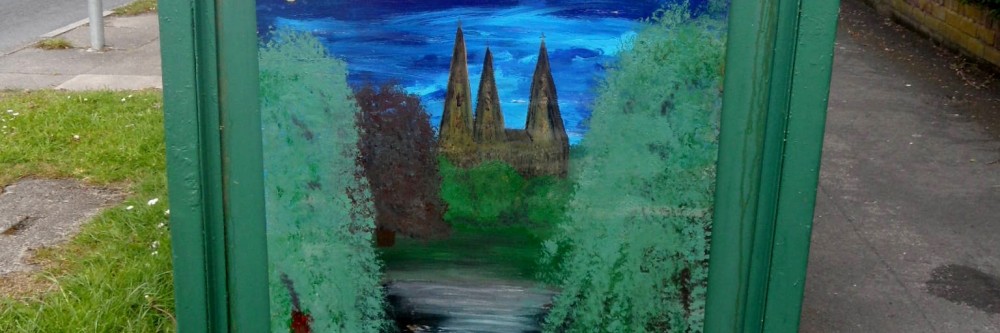
The church is of course featured on the ward banner for this part of Lichfield (along with what I had assumed was the Greenhill Bower House, although looking at it again now I’m not so sure…)

Although I’ve never been inside the church, I have been to the churchyard. With claims on Wikipedia that it could be a Mercian tribal necropolis, the site of one of the earliest settlements in Lichfield or the burial place of followers of St Amphibalus, it certainly merits a post of its own one day!

Steps leading up to the churchyard

Edit: I’ve just been thinking about the building on the ward flag, below the church. Could it in fact be the gateway to the old Lichfield Union Workhouse (subsequently St Michael’s Hospital).

Sources:

Lichfield Mercury Archive

Lichfield: Churches’, A History of the County of Stafford: Volume 14: Lichfield (1990), pp. 134-155


Sheriffs Ride…I walk!

I understand that for about 330 years, Lichfield was not just a city, it was a county, one of 18 towns and cities in England which gained county corporate  status at one time or another, for a variety of reasons e.g. Poole became a county separate to Dorset for reasons involving piracy! Lichfield’s status was granted by Mary I, apparently as a reward to the city for support during the Duke of Northumberland‘s rebellion.

A perambulation of the border of the city had been taking place since 1548, when Lichfield was made a city in Edward VI’s charter. However, that was carried out in view of the Sheriff of Staffordshire. Queen Mary’s charter, gave Lichfield the privilege of having its own Sheriff, who took over the perambulating duties and began the tradition of the Sheriff’s Ride which still takes place every September, on the Saturday nearest to the Nativity of the Blessed Mary. This year, it’s this Saturday (8th September).

According to the county history, the earliest records of Lichfield’s boundaries date back to the late 1700s (although older records of surrounding places indicate that changes in the borders have occurred over the years, particularly in the north and west). For those wondering, Lichfield is no longer a county, it reverted back to being part of Staffordshire in 1888.

Sheriff’s Ride, 1908. Taken from Lichfield DC flickr stream.

Thomas Harwood wrote in 1806,

The boundaries of the city of Lichfield according to ancient writings are a circuit of about sixteen miles.

Unfortunately, he doesn’t say where they are from, or just how ancient these writings are. However, it’s still interesting to read these ‘ancient writings’, not least because of the place names, familiar and not so that crop up along the route. (Some of the spellings are pretty interesting too!)

It begins at a place called the Cross and Hand near the end of a street there called Bacon street and from thence goeth northward along the lane leading to Longdon Church unto a little lane * at the further side of Oakenfields and so along that little cross lands unto another lane that leadeth from Lichfield to King’s Bromley and then along that lane towards Lichfield unto a little lane lying between the Grange Ground and Collin’s Hill Field commonly called the Circuit lane unto the further end of it betwixt two fields the one called Hic-filius and the other Piper’s Croft and so over across a lane that leadeth from Lichfield to Elmhurst and then into another little lane between Stichbrooke Ground and Gifforde’s Crofte and so along that little lane to a green lane at the further side of the Lady being the land of Zachary Babington Esquire and down that lane to a called Pone’s Brook and so over that brook into another lane called Stepping Stones lane and so along that lane taking in the land of Richard Dyott Esq Pone’s Fields unto a lane leading from Lichfield to Curborough Somerville so along that lane towards Lichfield until you come to the upper end of the grounds called Scott’s Orchard and then leaving that lane turn into a field of Lichfield called Whisich at a stilt going into the fields called Browne’s Fields and so taking in the field clled Whisich then go by the closes called Browne’s Fields Hedge unto the grounds called God’s Croft Hedge and so along that hedge taking in the field called Whisich lane called Goslinge’s lane and along Goslinge’s Lane unto a lane called Matthew Coal Lane and so over across that lane into a field called Cross field at or near an elm tree and so along a head land about the middle of Cressfield unto the nearer end of Gorsty Bank into the lane leading from Lichfield to a cross way called Burton turnings and from thence along Ikenield street taking in Spear Hill and Boley unto a cross way leading from Lichfield to Whittington and so along that lane towards Whittington unto the south end of Austin’s Coat Grounds then turning upon the left hand at that brook to a gate going into Fulfin Grounds unto the moors called Dernford Moors and so along by the hedge of those moors unto the nether side of Dernford Mill stream and so going by the mill door to the pool dam and going along by the pool and the brook taking in Horslade and a meadow belonging to Freeford House unto a bridge called Freeford Bridge in a lane leading from Lichfield to Tamworth and so from that bridge up the sandy lane to Freeford House and along that lane to the corner of the meadow and then turning into Bispells at the corner of the meadow and so going by the meadow hedge until you come to the brook that runneth to Freeford Bridge and so going up a little pool taking in all Bispells unto a ford called Baltrex ford and then entering into Old field turn up the left hand to the brook that runs from Freeford Pool and so along that brook to Freeford Pool and along by the pool and the brook that comes from Swynfen Mill until you come into the lane that leads from Swynfen unto the mill and so along that lane to a gate that leads from Lichfield unto Swynfen called Old Field Gate and then not coming in at that gate but going to the corner of the hedge adjoining to Cley Lands come in at a gap and taking in all Old field come by the demesnes of Swynfen unto a place called Long bridge and so entering into a little lane between Long furlong and Long bridge grounds leading to Well crofts and so taking in all Well crofts along by the Knowlc Leasowes being the Hospital Land unto Ikeneld street and so along Ikeneld street unto the further side of a close called Gorsty Leasowe and leaving the hedge on the left hand taking in that close going along by that hedge leading to Hare house Ground and so along that hedge unto the top of Dean’s Slade taking in all Hare house Ground northward enter into Park field leaving the hedge on the right hand and so following that hedge unto a little lane at Aldershawe that comes down that lane to the gate and through the gate then turn upon the left hand by Aldershawe Hedge taking in the barn and so go into the Wheat Close leaving the hedge on the left hand unto the road called the Fosse way up to the top of Mickle hill then crossing over Pipe green along an old decayed cart way into a lane end that leads to Pipe grange lane to the further side of Padwell’s and so taking in Padwell’s leaving the hedge on the left hand to a little lane that leadeth into Ashfield leaving the hedge on the left hand into the grounds called Lammas Grounds and leaving the hedge on the left hand and so into Lemondsley then following the brook to Pipe green gate and so along the brook in Pipe green into a little lane that butteth upon the lane that leadeth from Lichfield to Pipe and crossing that lane into Smithfield at the corner of Abnell Hedge and so taking in all Smithfield leaving Abnell Ground on the left hand unto the Cross and Hand where it began

*now Featherbed Lane

The ride now begins at the Guildhall, rather than Cross in Hand Lane but I’ve always thought it would be great to do the journey described above, looking out for the place names and landscape features mentioned (and potentially getting very lost, as some of them used in the directions may no longer exist!). As I don’t have a horse (my equine experience  consists only of  a few pony trekking expeditions, one of which ended in me being bitten by one in Cumbria), it’s a journey to make on foot, and probably in stages.  I have recently made a start but rather pathetically only got as far as Featherbed Lane. Only another 15 1/2 or so miles to go then. Just as well I’m not the Sheriff of Lichfield.

Cross in Hand Lane

Sources:

http://www.lichfield.gov.uk/events.ihtml

Lichfield: The place and street names, population and boundaries ‘, A History of the County of Stafford: Volume 14: Lichfield (1990), pp. 37-42. URL: http://www.british-history.ac.uk/report.aspx?compid=42340

The History & Antiquities of the Church & City of Lichfield, Thomas Harwood 1806

Hollow Earth

One of the most popular posts on the blog has been The Lichfield Underground. It seems people are fascinated by the unseen part of the city, the potential of what could be beneath their feet as they walk the streets.

Captivating, yet slightly scary….

It was this fascination with tales of the underground that started the chain of events culminating in the formation of Museufy, a group made up of myself and my friends Mark and Magdalena – two creative, innovative people that it’s a joy to collaborate with.  The aim of the group is to create alternative ways of collectively exploring history and interacting with our surroundings. We have a website where you can read our manifesto and find out about some of the projects we are working on.

One of these is ‘Hollow Earth Mapping’, a project in which we want to create a way to document underground spaces, mixing together reality and rumours.  We’re asking anyone who already contributed to The Lichfield Underground post via the comments section, or anyone else who has a story, to share them on our flickr page.  It will be a chance to look at  familiar surroundings through the fascinating, captivating and slightly scary world of the underground.

As the stories are shared, the underground spaces will be cut out, creating a hollow space on the map.   The flickr group will be a place for discussion about the stories, and the possibilities that might follow the creation of the map…..

Fools & Hobby Horses

The Abbots Bromley Horn Dance takes place each year on Wakes Monday (the first Monday following the first Sunday after 4th September), which means that this year it will be on 10th September.

As far as I can gather, the horn dance is one of those traditions where no-one is quite sure what it’s all about. There are six dancers carrying reindeer antlers, a fool, a hobby horse, Maid Marian, a boy with a bow and arrow, an accordion player & a triangle player. The horns are collected from the church of St Nicholas at 8am and are returned 12 hours later after the participants have danced around the village and out to Blithfield Hall. According to the horn dance of Abbots Bromley website, when one of the horns was damaged in 1976, a piece was sent to be carbon dated. It was found to date back to 1065 (plus or minus 80 years) although the general consensus is that this doesn’t really help to date the dance itself.

I’m ashamed to say that every year I’ve planned to go and watch the dance, but haven’t made it for one reason or another. I have been to the village on several non-horn dance occasions though and it is a lovely place.  However, Mr J Carver, in his 1779 book ‘The Universal Traveller’ wasn’t impressed , saying,

It stands at the distance of a hundred and twenty eight miles from London but contains nothing worthy of note

(Lichfield fares a little better. In Mr Carver’s opinion, ‘It is a long, straggling place but has some handsome houses’).

Walking through the village, to my 21st century eyes, practically every building looks worthy of note. Amongst many others, there’s the Butter Cross (or Burger Cross as a practical joker would have it in 2002), the Goat’s Head Inn (which is thought to date back to the early 1600s, with possibly even older cellars and of course, a secret passage story!) and Almshouses (above the doors are the Bagot family arms and the inscription Deo et Igenis DDD Lamberius Bagot Arm Anno 1705).

The Butter Cross, The Goats Head Inn & St Nicholas Church

View of St Nicholas, where the horns are displayed throughout the year.

Church of St Nicholas, from the High St

Almshouses

A couple of years ago the BBC made a programme about folk dancing in England and you can see the clip about the horn dance here. There are also some photographs of the tradition taking place in the 1930s here on the Staffordshire Past Track website.

I believe that the horns never leave the parish boundary (when not in use they are stored in the church of St Nicholas) although the dance can be performed elsewhere (another set of antlers is used on these occasions). I’ve also just discovered that this year the third annual Abbots Bromliad will take place in California, where they are hoping to beat their own record for most people dancing the horn dance at once (144 in 2010). You can even order your own set of acrylic antlers for $20 to help you feel the part! Hmmm, I wonder what the postage & packaging would be to get a pair sent to Lichfield….and would they get here in time to wear on the 10th September?

Seriously, we’re lucky to live so near to a place where one of the country’s best known (and possibly one of the oldest) traditions takes place and I really must make an effort to go this year to see it for myself.


Paper Flowers

As you walk through the archway into the chapel of St Betram, in the Church of the Holy Cross, IIam in Staffordshire, you notice these.


They are Maidens’ Garlands and relatively few churches in England are thought to have surviving examples. It’s thought they may have been used during the funeral service of an unmarried woman, but there is evidence in other parts of the country that they may have been made for young men too.  Further information can be found in this article in the Birmingham Post a few years ago, but most importantly there is the work undertaken by Rosie Morris who as a child saw garlands hanging from hooks in her church in Shropshire and wondered what they were. Years later having been unable to find much information on them, decided to make them the subject of her dissertation and later Phd. Rosie’s website on Maidens’ Garlands is here.

Not only do I think the garlands and the stories attached to them are of interest, I also really like the idea that Rosie’s curiosity for an object she saw as a child led to her doing such great work to research and share this tradition.

Cross County

Looking for ancient crosses in Lichfield, has so far lead only to hints of their existence – a one line reference in an old book here, a placename there. Nothing concrete (or should I say stone?).  So imagine how happy I was when I visited Ilam Park yesterday and found that were two thought to date back to the 10thc standing in the churchyard with a third shaft incorporated into the church wall…..

Church of the Holy Cross, Ilam, Staffs


…..and imagine how much I kicked myself when I got home and found out there was yet another stone, known as ‘The Battle Stone’, located in the grounds of Ilam Hall that I had missed!

However, as a consolation, I learnt at home that this spring near to the church is thought by some to be St Bertram’s Well (although others place this on a hillside near to the village).

St Bertram’s Well?

The Shrine of St Bertram (also known as St Bertelin or maybe Beorhthelm of Stafford) is inside the church. As you might expect, there is more than one account of St Bertram’s life. The most well known version seems to be the tragic story that he was a Mercian Prince whose wife gave birth to a child in a forest. The wife and baby were killed by wolves and St Bertram became a hermit near to Ilam, It’s thought this story might be represented on the churches font, which dates back to around the 12thc.

You can decide for yourself, if you look at this website on Romanesque sculpture, which gives a detailed description of the font, together with photos.

However, Stafford Borough Council have this version on their website, which doesn’t feature the tragic part of the legend.

The legend of St Bertelin derives from the 14th century account of him by Capgrave in his ‘Nova Legenda Anglie’, retold by Dr Robert Plot in his ‘Natural History of Staffordshire’ (1686). He is reputed to have been the son of the Mercian prince, the friend and disciple of St Guthlac who, after St Guthlac’s death c 700, continued his holy vocation on the islet of Betheney now Stafford. Here, he remained until forced to retreat from the ill-will of jealous detractors, when he repaired to Ilam, in Dovedale, Derbyshire where ultimately he died. His burial place in Ilam church was once a place of pilgrimage.

His burial place still seems to be a place where people come, not just seeking out history like me, but for spiritual reasons. As you can see from the photo of the shrine, prayers (I didn’t read them) and candles are still left there.

I have found a copy of the ‘Nova Legenda Anglie’, but as my Latin only stretched to ‘Caecilius est pater’, I need a bit of time alone with google translate.  So, I’ll leave the legend of St Bertram/Bertelin there for now other than to say that it’s believed that the remains of St Bertelin’s chapel in Stafford were excavated in the 1950s and they discovered part of a 1,000 year old cross. And this one is made of wood!

Ilam, Stafford and I’ve seen references to existing crosses in Wolverhampton, Leek, Chebsey (between Eccleshall & Stafford), amongst other places. With the discovery of the ‘Battlestone’ in Ilam (the one that I missed!) in the foundations of a cottage, during a restoration in 1840, I’m still clinging to the hope that at least a fragment of one survives somewhere in Lichfield!

Sources:

http://www.heritagegateway.org.uk/gateway/

http://list.english-heritage.org.uk/ (Entry numbers 1038113, 1012654, 1012653,

Corpus of Romanesque Sculpture in Britain & Island http://www.crsbi.ac.uk/index.html

http://www.geograph.org.uk/photo/705619

http://www.megalithic.co.uk/ (St Bertram’s Well http://www.megalithic.co.uk/article.php?sid=14731)

http://www.staffordbc.gov.uk/in-touch-with-the-past

Dig Days of Summer

Dig the Abbey is a community archaeology project, running over two consecutive summers, where volunteers (many of them local people) are excavating the site of Polesworth Abbey alongside professional archaeologists.

I went along to a Dig the Abbey 2011 tour last summer, not knowing what to expect. I found it so interesting that I was really looking forward to going again this year & took some friends, to see what kind of new discoveries had been made. We weren’t disappointed. Despite the rain, community archaeologist Tim Upson-Smith gave us a great tour of the site and answered all of our many, many questions (they weren’t just about just about the dig at Polesworth but they did all relate to archaeology!).

Amongst other things, we saw in situ medieval floor tiles, a medieval toilet (and learned what a useful find this is!) and a vessel (on which you could see the thumbprints of the potter that crafted it) lifted from the earth just that day. We learned a little about the procedure for the discovery of human remains and how they are dated. We heard about how the discovery of some structures in the trenches has answered questions about how the Abbey would have once looked, but how the discovery of others has created yet more questions.   We were made really nice cups of tea while we waited for the rain to give over a little!  We were so enthralled we forgot to take any photos! Luckily, the dig has its own regularly updated website, with photographs of the finds, maps of the trenches and news reports.

We’re definitely going back again towards the end of the dig. It hardly needs to be said but, if you have an interest in history or archaeology, I highly recommend going and taking a tour yourself. It took us around 30 minutes to get there from Lichfield (but that included unintentionally taking the scenic route through Tamworth town centre!).

Tours run every day of the dig at 2.15pm (1) The final tours will be on Saturday 8th and Sunday 9th of September, to coincide with the Open Heritage weekend (2). For more information, visit www.digtheabbey.co.uk

Notes:

(1) Monday to Friday (until 7th September) Saturday (25th August and 1st September)

(2) Please note that the heritage weekend here in Lichfield takes place on 22nd -23rd September, to coincide with the Johnson Birthday celebrations. I don’t want to confuse anyone!


Another Johnson

Davidson House on Upper St John St was once home to another Johnson from Lichfield. Thomas Johnson, an architect lived here from 1834 and ran his business, Johnson & Son from here until his death in 1853. I understand that Thomas Johnson jnr went on to work with James Trubshaw, and married his eldest daughter.


Although people might not have heard of Johnson and Son they will probably know some of the buildings they were involved with. Below are some examples of their Lichfield work, and it seems that they also worked on buildings further afield.

Christ Church, circa 1850 (from wikipedia)

Corn Exchange Lichfield (from LDC flickr stream)

The Old Grammar School, C18 rear
wing, school room and front wall of c1849, by Thomas Johnson
and Son of Lichfield

Back to Davidson House and I’ve read that it was the home of the South Staffordshire Regiment Old Comrades Association and the South Staffordshire Regiment Museum collection from 1938 until 1963, when it was moved to its current site at Whittington. The name ‘Davidson House’ apparently relates to  Brigadier-General Charles Steer Davidson who donated the property to the regiment.

As ever, plenty of questions. Did the Johnsons employ local people? What about the rest of the family? Where did their materials come from? Who was it built for originally.  Who owned the house between the Johnsons and the Brigadier-General? Who was Charles Steer Davidson? What happened when the museum left and what is the future for it? It looks like it needs a bit of TLC right now, with its boarded up windows and crumbling stonework. There’s a book ‘Staffordshire and the Gothic Revival’ by Michael J Fisher that I’d like to have a look at to find out more about the Johnsons and their contemporaries.

There’s still plenty more to find out about Davidson House and its inhabitants but I like how by finding out a little about one Lichfield building,  I’ve found out more about some of the others too. And they just happen to be some of my favourites!

Sources:

http://www.britishlistedbuildings.co.uk

http://staffordshireregimentmuseum.com/


Stumped

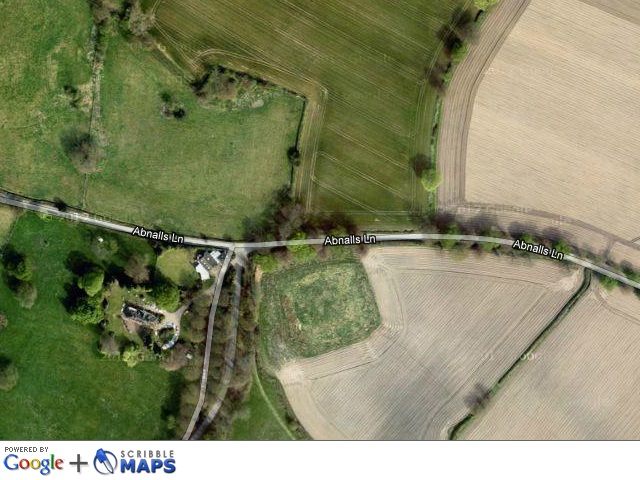
I had an email from Pat telling me there was a lump on the side of the A51, near to the junction with Abnalls Lane.  I assumed that it was an old tree stump, but Pat thinks it might be something more than that, and recalls seeing some stone there last year.

I went and had a closer look. Pat said in his comment on the Cross City post, the lump is covered in vegetation, but there is likely to be something solid underneath, as the grass is cut around it. I took a few photos and then the self -conciousness of being stood on a busy A-road taking photos of a grassy lump got the better of me and I headed back up Abnalls Lane.

So, does anyone else know anything about this, or do we just have to wait until the grass dies away in the Autumn to get a better look?!

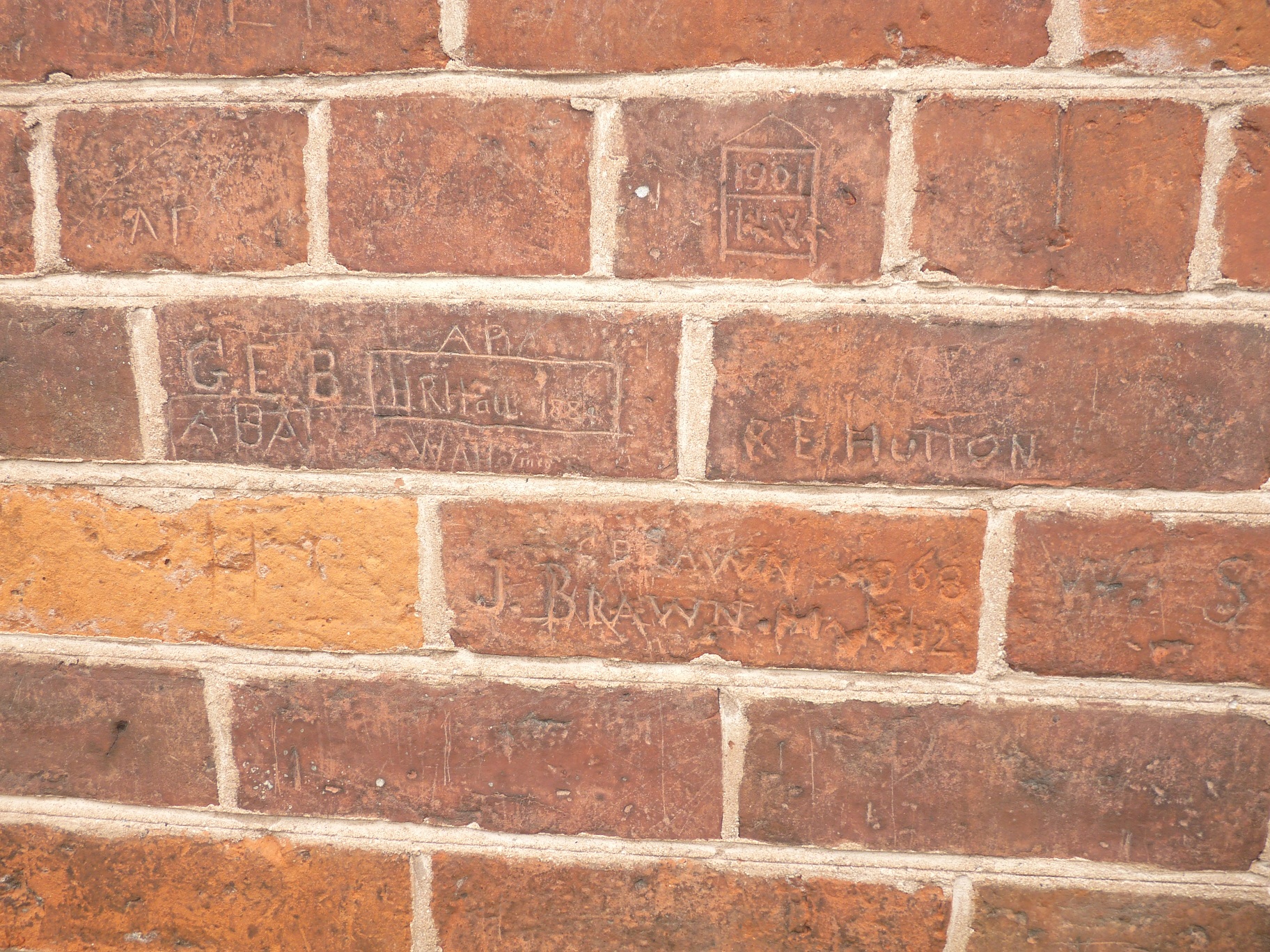
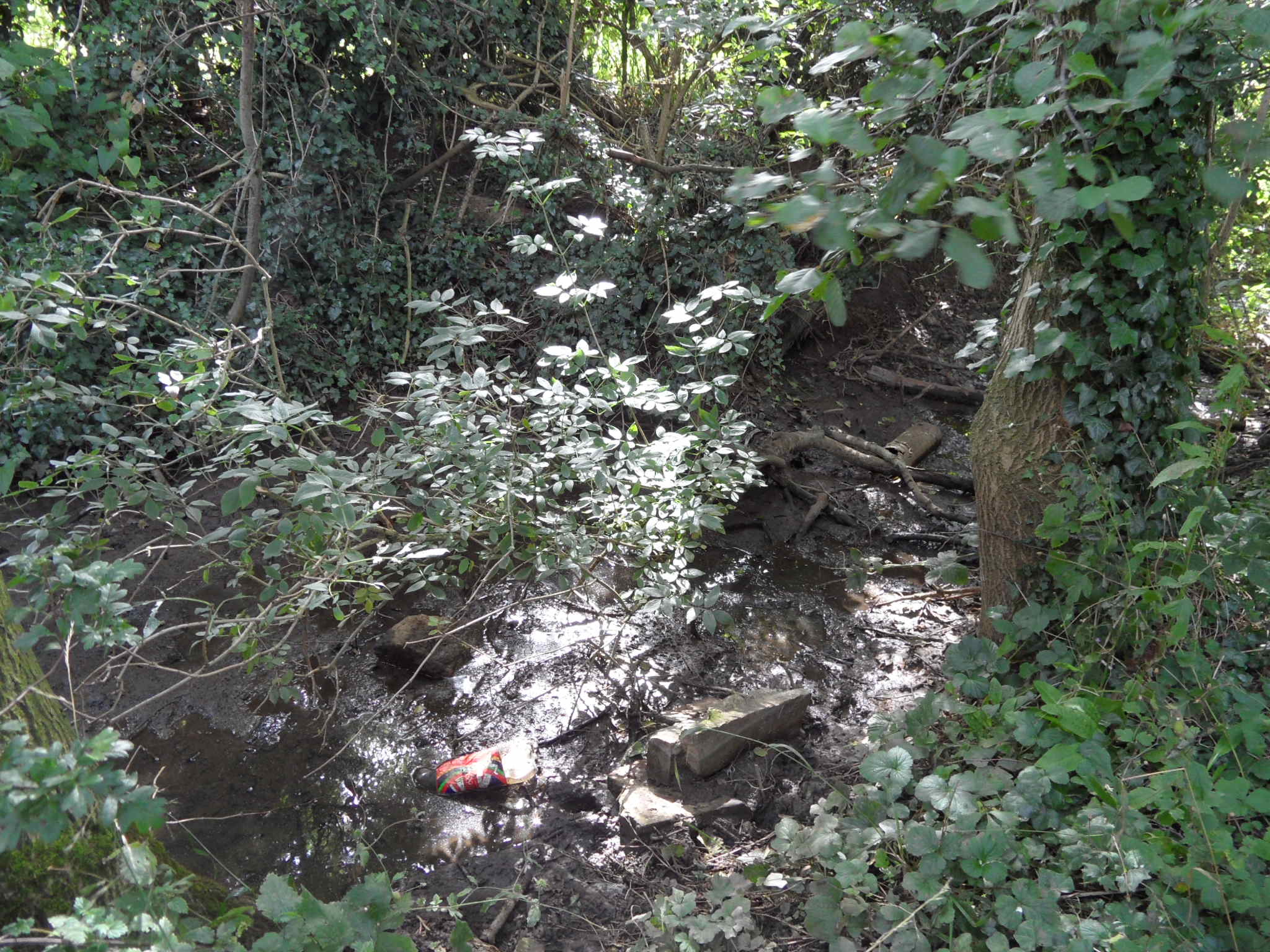
In the meantime, it’s worth taking a trip up Abnalls Lane. In parts, it’s thought to be a holloway, and at times you’re surrounded by hedgerows, tree roots and sandstone, with carved names and dripping water.  It takes you past the site of one of Lichfield’s Scheduled Ancient Monuments – a moated site on the edge of Pipe Green and over the border into Burntwood.  It also passes nearby the site of Erasmus Darwin’s botanical garden, although unfortunately the site is not open to the public.

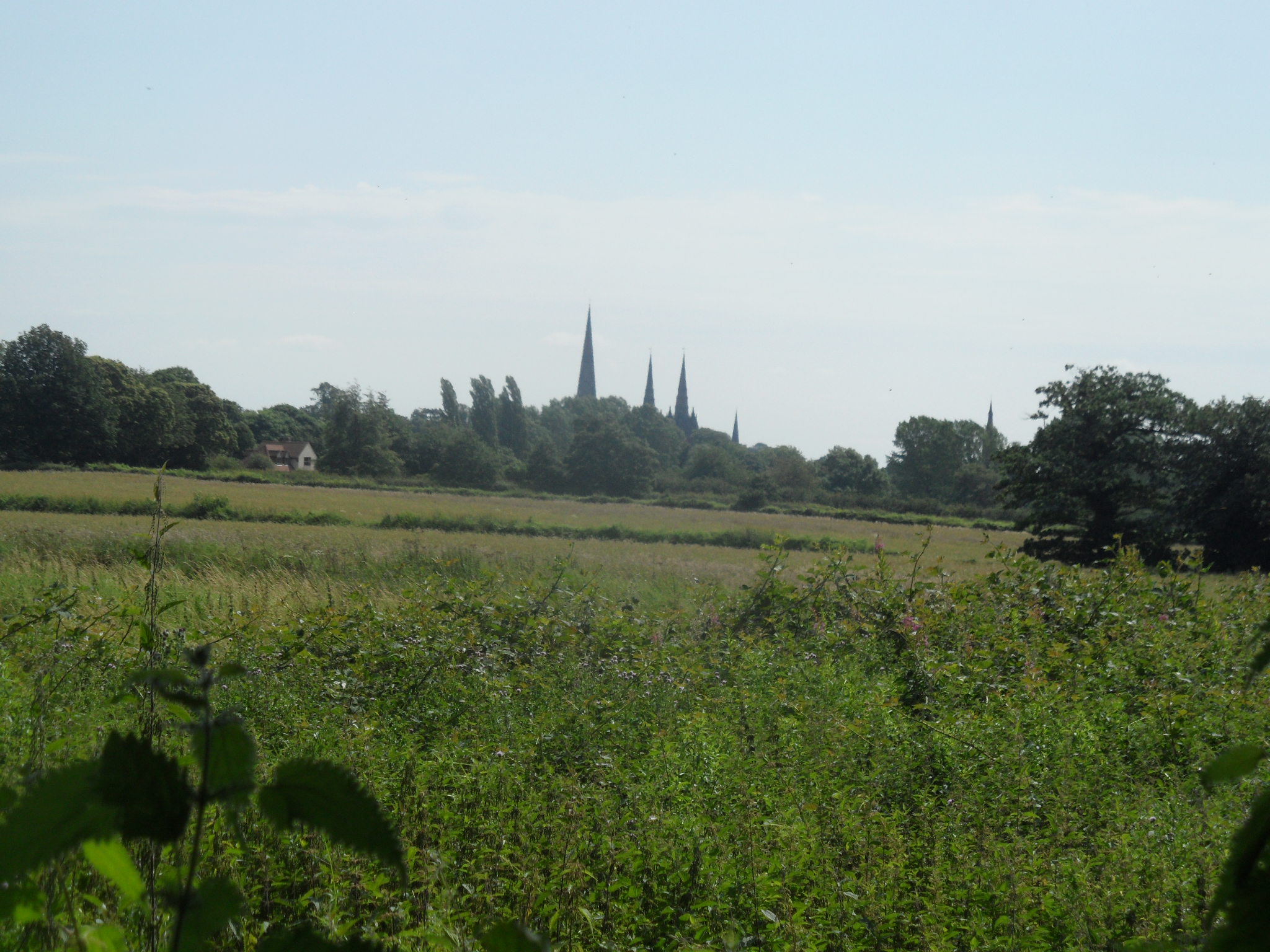
Spires of Lichfield from moated site at Abnalls Lane on the Lichfield/Burntwood Boundary

Interestingly, a section on Burntwood in the History of the County of  Stafford says that,

The road, now Abnalls Lane, was known as Pipe Lane at least between 1464 and 1683.  The point where it goes over the boundary was described in 1597 as ‘the place where the broken cross in Pipe Lane stood’; a ditch at Broken Cross was mentioned in 1467.

Is this one of the crosses already counted in Cross City, or a different one? 

Also, on the subject of research into stone things, at the end of Abnalls Lane, there are some interesting names – The Roche and Hobstonehill (according to the History of the County of Stafford, the placename ‘Hobbestone’ was mentioned in 1392).   

I think I need to spend my summer holidays at Lichfield Record Office.

Sources:

‘Townships: Burntwood’, A History of the County of Stafford: Volume 14: Lichfield (1990), pp. 195-205. URL: http://www.british-history.ac.uk/report.aspx?compid=42356  Date accessed: 27 July 2012.