Crime Scenery

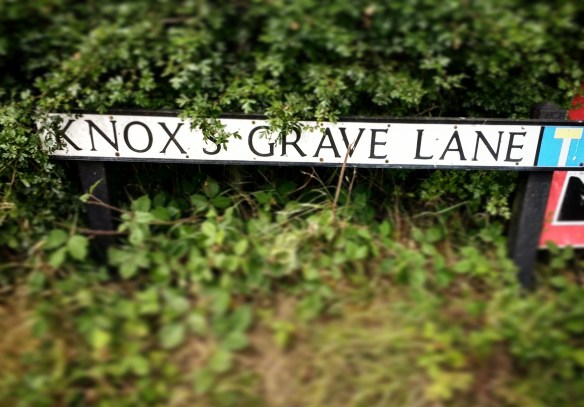
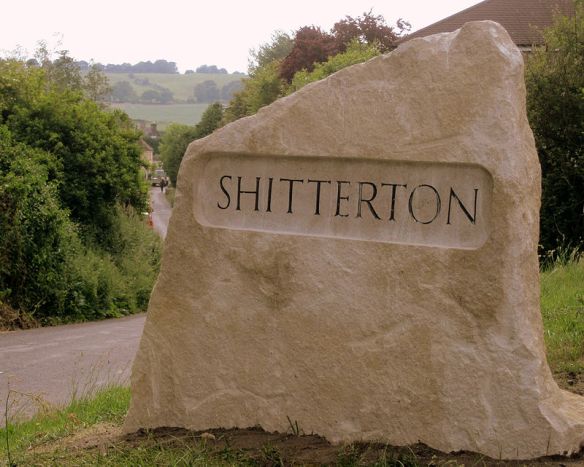
I know. It’s been a while. You don’t know what I did this summer but I’d quite like to confess. There have been visits to gibbets, wells, shrines, mausoleums, derelict churches, ruined abbeys, tunnels and places with names which sound a bit rude. It’s less about serious history and more about a series of stories told by the landscape that surrounds us. Sometimes you have to listen very carefully to hear them (especially over the sound of my friend Jacky eating crisps), sometimes they shout in your face via an interpretation board funded by the parish council.  If you’re sitting comfortably*, then I’ll begin by sharing** evidence from some of the crime related activities we’ve been getting up to.

*unlike another friend Eddie the time we visited an old priory and had to stick him in the back of a van
**unlike Jacky with her crisps

Once upon a time, there was a little girl called Katie. When she grew up she wanted to be Mavis Cruet from Willo the Wisp. For a short while, she lived in Coleshill in North Warwickshire and almost everyday she’d walk past the town’s pillory. At the time she didn’t realise that it was a rare example combining three methods of corporal punishment i.e. stocks, a pillory AND a whipping post, and was last used in 1863, but she was curious all the same.

coleshill-pillory-michael-garlick

Coleshill Pillory by Michael Garlick from geography.org.uk http://creativecommons.org/licenses/by-sa/2.0/

Many years passed and in August 2016,  Katie was visiting her parents in Stone in Staffordshire when she turned off too early towards Hilderstone. This was in no way down to her lack of navigational skills, there was a tree obscuring the ‘Hilder’ bit of the sign. Around the corner was a patch of grass with a set of stocks.

Stocks just after Hilderstone turning on A51 near Stone

Stocks just after Hilderstone turning on A51 near Stone

Despite extensive research (doing a google search), she couldn’t find any information on them. Katie hadn’t grown up to be Mavis Cruet, but she had continued to be curious. How many more sets of stocks were there around the country? Had anyone ever recorded them? Who had been publicly humiliated and punished here and what were the reasons? Our towns and cities are filled with monuments to the so-called great and good of society. Are these our monuments to those considered petty and bad who lived on its fringes? And so, after musing over these thoughts with friend Patti who already had a knowledge of and interest in this area, they decided to set up a discussion group called ‘Offending Histories’, with the aim of finding remaining physical evidence of crime and punishment across the Midlands and telling the sort of stories in which no one lives happily. Ever after or otherwise.

In just a month, we’ve already started to record a fascinating range of sites and objects. Here are some samples of the more local examples.

The old gaol cells in Lichfield have an example of a Scold's Bridle or brank on display. There's an excellent article from the Museum of Witchcraft and Magic exploring the history of these vile items here - http://museumofwitchcraftandmagic.co.uk/…/object-of-the-mo…/). Of particular interest is the following reference,

The old gaol cells in Lichfield have an example of a scold’s bridle or brank on display. There’s an excellent article from the Museum of Witchcraft and Magic exploring the history of these vile items here. Of particular interest is the following reference, “In 1789, the brank was used in Lichfield. A local farmer enclosed a woman’s head “to silence her clamorous Tongue” and led her round a field while boys and girls “hooted at her” “Nobody pitied her because she was very much disliked by her neighbours.”

Outside St Michael's church is the relocated headstone of the last three men to be executed in the city. On 1st June 1810, Neve, Jackson & Weightman were taken by cart from the city gaol & publicly hanged for forgery at the city gallows (where Tamworth St, Upper St John St & the London Road cross). Interesting that at some point, the word 'hanged' appears to have been obliterated from the monument. Although this appears to be the only marker to executed criminals buried here, the church register records the names of others who were executed and buried e.g. John Wilson Sept 23rd 1583 and John Walle and Robert Hodgson described as prisoners executed and buried on 13 October 1587.

Outside St Michael’s church is the relocated headstone of the last three men to be executed in the city. On 1st June 1810, Neve, Jackson & Weightman were taken by cart from the city gaol & publicly hanged for forgery at the city gallows (where Tamworth St, Upper St John St & the London Road cross). Interesting that at some point, the word ‘hanged’ appears to have been obliterated from the monument. Although this appears to be the only marker to executed criminals buried here, the church register records the names of others e.g. John Wilson on Sept 23rd 1583 and, John Walle and Robert Hodgson described as prisoners executed and buried on 13 October 1587.

Patti pointed out this example of a sanctuary knocker on a door in Elford church, dating to circa 1450AD. By touchin the knocker, a fugitive from the law could be given sanctuary in the church for a period of time. If they made it that far. One example given by Karl Shoemaker in his book 'Sanctuary and Crime in the Middle Ages' tells of Elyas, a chaplain imprisoned in Staffordshire to await trial for murder, who 'killed the gaoler's attendant, escaped from the prison & fled towards the church'. The gaoler & others from Staffordshire pursued him and cut off his head before he could reach the church'. Another example comes from Colton History Society - in 1270 Nicholas son of William De Colton stabbed Adam, son of Hereward in a brawl; he fled to the church and took sanctuary. Claiming sanctuary was abolished 1623.

At St Peter’s in Elford, Patti pointed out this example of a sanctuary knocker on a door dating to circa 1450AD. By touching the knocker, a fugitive from the law could be given sanctuary in the church for a period of time (this seems to have been forty days which is a nice biblical number) . If they made it that far. One example given by Karl Shoemaker in his book ‘Sanctuary and Crime in the Middle Ages’ tells of Elyas, a chaplain imprisoned in Staffordshire to await trial for murder, who ‘killed the gaoler’s attendant, escaped from the prison & fled towards the church’. The gaoler & others from Staffordshire pursued him and cut off his head before he could reach the church’. Another example comes from Colton History Society – in 1270 Nicholas son of William De Colton stabbed Adam, son of Hereward in a brawl and fled to the church where he took sanctuary. Claiming sanctuary was officially abolished in 1623.

The Bilstone Gibbet Post, Leicestershire. Erected in March 1801 to display the body of local man John Massey, executed for murdering his wife Lydia and attemping to murder his step- daughter. Massey's headless skeleton, wrapped in chains, remained hanging from the post for seventeen years, his skull apparently being used as a candle holder in a pub in Atherstone. In the early twentieth century, the post was a venue for religious meetings but today, there are rumours of more unusual behaviour taking place here.

The Bilstone Gibbet Post, Leicestershire. Erected in March 1801 to display the body of local man John Massey, executed for murdering his wife Lydia and attempting to murder his step- daughter. Massey’s headless skeleton, wrapped in chains, remained hanging from the post for seventeen years, his skull apparently being used as a candle holder in a pub in Atherstone. In the early twentieth century, the post was a venue for religious meetings but today, there are rumours of more unusual behaviour taking place here.

Unable to find much on this pillor outside the Cock Inn at Stowe by Chartley, but it does appear to have been relocated here at some point.

Pillory outside the Cock Inn at Stowe by Chartley. Appears to have been relocated here at some point as not shown on early 19thc photographs of the pub

It is a dark subject at times but there are lighter moments too. Currently providing wry amusement is the question of how, and indeed why, was a seventeenth century cucking stool stolen from the church of St Edward at Leek? A meta-criminal mastermind at work? It’s very much an ongoing exploration and if you are interested or better yet, have something to contribute, and aren’t offended by an element of gallows humour, please do join our Offending History group here

St Giles and St Michael

St Giles is the patron saint of lepers and surely it’s no coincidence that there was a medieval hospital at nearby Freeford caring for those unfortunates suffering from the disease.  Less readily explicable is the short lived name change at the end of the ninteenth century when, according to the Whittington History Society, the church was known as St Matthew’s for around twenty years, before reverting back to St Giles in the 1890s.

Whittington church

The church history guide, handed to me by two kind ladies who found me loitering outside and invited me in, condenses eight hundred (ish) years of history into four paragraphs. Quality not quantity. It tells how a church has stood on this site since the thirteenth century, built with red sandstone from nearby Hopwas Woods.

Hopwas quarry.jpg

The edge of Hopwas Woods as seen from the canal.  There is a suggestion that stone for ecclesiastical purposed was quarried from an area of the woods given the tongue in cheek name of ‘The Devil’s Dressing Room’

The only original part standing today is the base of the tower, with the nave being rebuilt in 1761 following a fire and the chancel added in the 1880s. The Jacobean oak pulpit, installed here in 1922, was originally donated to Lichfield Cathedral in 1671. One hundred and eighteen years later it was moved to St Peter’s at Elford  but was discarded when that church was renovated in 1848 and lay disused in the stables of Elford Hall until a new home was found at St Giles. Apparently, at some point in this game of pass the pulpit, the Cathedral made enquiries about getting it back but obviously nothing ever came of this.

Whittington stained glass

More recycling can be found in the north and south windows of the chancel, where there are fragments of medieval painted glass thought to originate from the Benedictine Abbey at Burton. Presumably it was brought here following the dissolution but exactly why and how I don’t know, so if anyone fancies looking into Whittington’s windows in more depth, please do.

Whittington organ

Then, up on the balcony, there’s an organ, paid for by public subscription as a memorial to sixteen villagers killed in WW1. The brass plate at the front is inscribed with the name of the fallen and was made from a shell case brought from Mons battlefield. The church registers also records other WW1 deaths, with several servicemen from the military hospital at the nearby barracks and one from Brocton Camp at Cannock Chase buried here in late 1918, their deaths possibly related to the Spanish Influenza pandemic of that year.

whittington graveyard

One unexpected celebrity burial here is Thomas Spencer, co-founder of Marks and Spencer, who came to live in Whittington to pursue his love of farming after retiring from the partnership which began on 28th September 1894, when he invested £300 into a business owned by Michael Marks. The church hall is named after him, built with funding from the retailer in 1984. Just as a bit of background, Marks had started out working as a pedlar selling wares from a bag and from this he went on to open a market stalls in Leeds, which became known as the Penny Bazaar. The stall featured the poster ‘Don’t ask the price, its a penny’. I suspect plenty still did, a tradition still carried on in Poundland today (other single price retailers are available but this one gets a mention as it started up the road in Burton).  The St Michaels brand was introduced by chairman Simon Marks to honour his father, who came to this country as an immigrant from Belarus with little money or English and founded a British Institution.

whittington thomas spencer hall.jpg

We can’t talk about St Giles without mentioning the hospice, established at the vicarage in 1983, when Reverend Paul Bothwell decided to do something to improve care for local people living with terminal illnesses.   In its first year, there were 167 patients, today it cares and support for around 500 people a week. The free nursing and medical care provided by St Giles costs around £9 million every year. Only a third of this comes from the government, the rest is down to us. Now, it just so happens that I know of two trainer botherers top people who took part in a fun run on Sunday to help raise funds for St Giles. Normally, all I ask for on this blog is for people to tell me if they’ve seen a bit of Fisherwick Hall lying around or for an explanation as to why there’s a fibreglass elephant in Cannock town centre (and, ‘Well that’s just Cannock for you’ will not suffice!). Today however I’m going to ask you to consider making a donation to this amazing local charity. They ran 5km, the only steps you need to take are to get your credit card out and donate a couple of quid here.

whittington church 2

Sources:

http://www.stgileshospice.com/history.html

Click to access whs-church-booklet-with-plan.pdf


Higher Ground

As these things go, the highest village in England is a decent title to have. Far better than being say the wettest place (1) or the most haunted village (2). Yet, it appears wherever there there’s a superlative at stake, there will always be controversy and more often than not a good story to go along with it.  Just ask the good people of Burntwood about their park.

Flash village sign

Someone at Visit Cumbria was presumably high on Kendal Mint Cake when they wrote that Nenthead  in their county was England’s highest village.  The title belongs to Flash, Staffordshire, 1,518ft above sea level, and they have the paper sign to prove it.  The official village sign goes one step further however, proclaiming Flash to be the highest village in Britain, a claim disputed by Scotland’s highest village Wanlockhead. However in 2007 the BBC One show intervened and declared the Staffordshire village was indeed the higher of the two and perfectly entitled to look down on its Scottish rival. (3)

Flash villageElsewhere on t’internet, you will see the bold statement that there is no doubt that the Methodist Church in Flash is the highest in the country. However, the chapel has been converted to a residential property (it’s rather lovely and currently up for sale). Is a deconsecrated church still a church? Perhaps we should ask the people in charge of the second highest Methodist Church in England what they think….

Flash methodist church.jpg
To even begin contemplating whether the New Inn at Flash is the highest pub in Britain, England or even Staffordshire, I’d need a stiff drink  but sadly on my visit, the pub was closed (although only for the afternoon). Instead I had to be content with Flash’s other watering hole i.e. the village well, dressed every year (the 2016 blessing will take place at 2.30pm on 18th June ) as is the custom in these parts.

Flash villag well

Flash’s well dressing tradition is a recent one, an addition to the annual and much older teapot parade, surely the highest teapot parade in the country. Ok, the only teapot parade in the country. It celebrates the village’s friendly society, established in 1846 to provide for residents who had fallen on hard times and only dissolved in the 1990s. The name is believed to derive from the vessel used to collect and hold the funds until someone needed them. There’s a fantastic write up and photographs here by the wonderful Pixy Led who attended the festivities in 2014.

Flash pub sign

New Inn Flash.jpg

Although several people have started singing this when I’ve mentioned the village name, the traditional or folk etymology relates to something rather less heroic. A villainous looking character appears on the pub sign, and represents the gang who supposedly set up presses here making counterfeit or ‘flash’ money.  However, in David Horovitz’s invaluable survey of Staffordshire place names, he suggests the place name likely derives from a Scandinavian word meaning a swamp, or a pool of water. As a folklore loving linguist I shall sit on the fence.  And if the fence is in Flash it might be the highest fence in Britain…ok, I’ll stop now.

Flash cat

The highest cat and the highest Kate in the country. Possibly.


Notes

(1) There is indeed a good story about this. Earlier this year, the village of Eglwyswrw in South Wales had had rain for 83 consecutive days and were just six days short of the record set by Eallabus, Scotland in 1923. It was national news. The Telegraph reported on it imaginatively illustrating an article on a wet place in Wales with an umbrella and a sheep and even had a timer counting down the days, hours and seconds until Eglwyswrw claimed the soggy crown from the Scots but it was not to be and so Eallabus retains the title.

(2) A title awarded by the Guinness Book of Records in 1989 as it has twelve ghosts. Or more accurately perhaps, twelve ghost stories.

(3) Whilst on the subject please let’s take a few moments to think about Bwlchgwyn which erected signs announcing it was the highest village in Wales, but later discovered it is only the third highest. And yes, the Telegraph, the Metro and numerous others have already done the ‘left feeling low’ pun. Bet they wish they’d made their sign out of paper…


Dark Water

In Hans Christian Andersen’s fairy tale, the Little Mermaid lives, ‘Far out in the ocean, where the water is as blue as the prettiest cornflower, and as clear as crystal”. Our Staffordshire mermaid lives in Blake Mere high up in the Peak District, where the water is as black as the local peat, and as murky as the truth behind this classic bit of local folklore.

At midnight, the Blake Mere mermaid rises from her pool to entice single men travelling along the road between Leek and Buxton to a watery grave. Some say that animals refuse to drink there, sensing this malevolent presence in the dark water. Others insist the pool is bottomless, although I certainly wouldn’t call it that after seeing a man skinny dipping in there.  As it was around two in the afternoon, he presumably hadn’t been lured in by the siren’s call. To be honest, even if she’d been singing her heart out he’d probably not have heard her anyway as she’d  have been drowned out by the sound of my kids arguing about crisps.

Black Mere Pool

Black Mere Pool. Not always bottomless

One version of the mermaid’s tale is that a sailor from the nearby village of Thorncliffe fell in love with her and brought her back to landlocked Staffordshire from the sea like a goldfish won at a fair. This may explain her animosity towards single men. A more sinister explanation for her presence is that she was once a young woman who rejected the advances of a local man called Joshua Linnet. Hell hath no fury like a man scorned and he accused her of being a witch, convincing some of the other locals to drown her in the pool. Three days later he was found dead in the water, his face clawed to pieces.

Of course, I don’t believe in mermaids but I also don’t believe that such stories emerge from out of the blue. In 1679, a woman was murdered by a man who overheard her talking about the money she’d earned from selling lace at Leek and followed her home over the moors where he attacked and robbed her, throwing her body into Blake Mere. The pool was also the scene of an attempted murder, undated but described in detail by Robert Plot in his Natural History of Staffordshire (1686). However, in recounting events, Plot makes no mention of the mermaid folklore and I can’t help but wonder if someone took the true events which took place here and reworked them into a legend.

Mermaid Inn

The Mermaid Inn. And yes I will be looking up where and what ‘Royal Cottage’ is

But who and why? There is a reported sighting of the mermaid in the mid nineteenth century when locals apparently began to drain the pool in an attempt to discover whether it truly was bottomless. Their antics supposedly incurred the wrath of the watery wraith, causing her to get up from her lakebed before midnight for once to warn them that she’d flood nearby Leek and Leekfrith if they didn’t stop immediately.  It seems to have been around this time that The Mermaid Inn got its name and somewhere within its walls the legend of the eponymous creature has been inscribed.

She calls on you to greet her
Combing her dripping crown
And if you go to greet her
She ups and drags you down

I suspect the story may have been a clever PR stunt by the landlord possibly in cahoots with the locals (I’d happily say I saw a mermaid in Minster Pool if Suzie at The Drum offered me free beer). Or perhaps I’m being a cynical southerner and strange things really do happen up in the wild and mysterious north…..  These days The Mermaid Inn is self catering accommodation and so you’ll have to go elsewhere if you want to drink like a fish. I headed for Flash and what’s probably the highest pub in England. Other drinking establishments are available (as I found out when that was shut too, albeit it only for the afternoon).


Taylor Made

Whilst I’ve been in Wolverhampton attempting to master the phonemic alphabet and the forty four sounds of spoken English, things have been a bit quiet here on lɪtʃˌfiːld lɔː However, the exams are over and my final assignment for the second year has been handed in (note to those who say I leave things to the last minute, I actually had a good seven minutes to spare) and so a summer of stone gazing awaits.

My first ride out of the season took me to Barton Under Needwood and specifically to St James, the only church in Staffordshire to be built in the Tudor period I believe. According to Greenslade, it stands on the site of the cottage where founder Dr John Taylor was born in 1480(ish), the eldest of triplets. The story of the Taylor triplets is well known although several versions exist.  In perhaps the most romantic of these, King Henry VII was hunting in Needwood Forest when he became separated from his companions. He stopped off at a small cottage to seek directions back to Tutbury Castle and found that the couple living there were the parents of three strong healthy triplets. Perhaps a more likely story is that three surviving triplets were presented to the King as, if not quite a miracle, something that may have appeared close to one in those days when between a third and a half of children didn’t make it to their fifth birthday (the King would himself go on to lose three children in their infancy). What is certain is that Henry took it upon himself to be responsible for the boys’ education. In John’s case, there is note in the Royal Privy purse expenses of 1498 ‘for the wages of the King’s Scoler John Taillor at Oxenford’. A career in the church and as civil servant followed, with John eventually holding the position of Master of the Rolls between 1527 and 1534. It may sound like he was in charge of the King’s packed lunches but it was actually the third most senior judicial position in the country.

The tower of St James at Barton under Needwood

The tower of St James at Barton under Needwood

Taylor’s initials can be found on the church tower alongside the year 1517, when work commenced at St James (then dedicated to Mary Magdalene). Work was completed in 1533, and Taylor died the following year. However, his final resting place is elsewhere. John Stow’s survey of London in 1598 records it as being at St Anthony’s Hospital in London. However, there is a suggestion that the intention was for it to be here at St James which would have brought the local lad done good’s life full circle. Pevsner suggests that a blank arch in the north wall of the chancel may have been designed to house his tomb although why this never came to be is unknown. Another gap or three, based on the reading I’ve done so far, is what became of the other Taylor triplets Rowland and Nathaniel Taylor and also their elder sister Elizabeth, denied the opportunities of her brothers as she was not a) a triplet or b) male. How does her life compare to theirs? Taylor’s tale may be well known, but it seems to me to that the story of Barton’s most famous son and his family is far from being all sewn up.

Above this blocked doorway at St James is the coat of arms of John Taylor. Look closely and you'll se it features three little heads, representing John and his brothers.

Above this blocked doorway at St James is the coat of arms of John Taylor. Look closely and you’ll see it features three little heads, representing John and his brothers.

Greenslade, M (1996) Catholic Staffordshire Gracewing:Leominster


Heaven Knows I’m Misericords Now

The introduction to the guidebook for Holy Trinity at Eccleshall includes the following modern version of Psalm 84 Verse 10,  “I’d rather scrub the floors in the house of my God than be honoured as a guest in the palace of sin”.

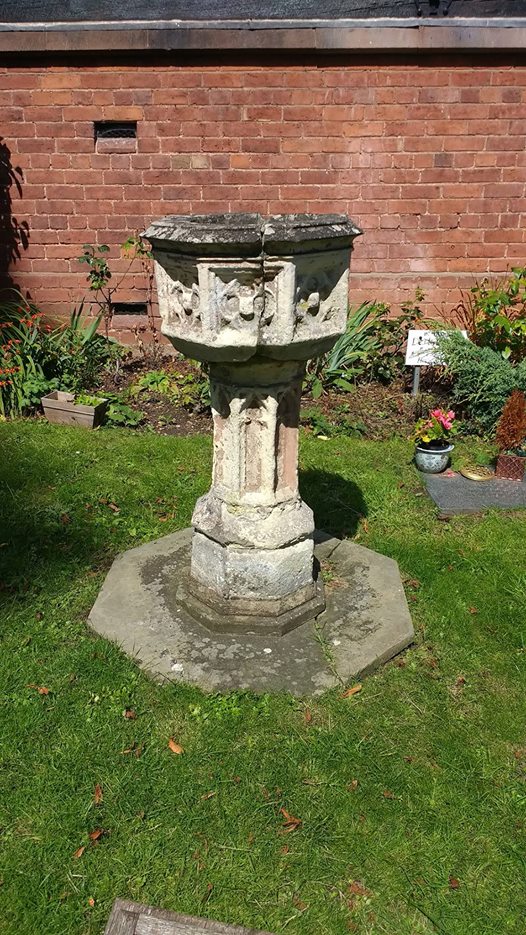
Thirteenth century sandstone font and some plumped up cushions

Appropriate then that my brilliant friend Patti Wills and I had inadvertently visited on the day the church was being spring cleaned. I may have had to climb over a vaccum cleaner to see a stone effigy at at the entrance to the tower but the bonus was that parts of the church that wouldn’t normally have been open were. And in addition, there were some very nice people there to point out the locations of the tombs of the Bishops of Lichfield who are buried here.

eccleshall church

Near the altar are the tombs of William Overton (1525 – 1609) who was responsible for bringing French glassmakers to the area, with furnaces set up in the nearby Bishop’s Wood and James Bowstead (1801 – 1843) the former Bishop of Sodor (I honestly thought this was a made up place in Thomas the Tank Engine until now) and Man who became the Bishop of Lichfield (but not Coventry) in 1840. Extra information given on a card in the church (which I almost stole after getting distracted by some fossils) includes the slightly odd story that his mother’s grave states that she once prophesised that James would become the Bishop of two Sees. Think that warrants further investigation.

Ooops

I promise I took it back!

In the Choir Vestry, relocated from the Chantry, is the tomb of Thomas Bentham (1513 – 1578) who became the first Bishop of Lichfield under Elizabeth I and also the first who was a married man. There are also two fragments of a Saxon preaching cross, one featuring two figures separated by a tree and the other, a man and a horse. The pair of figures on the former have been interpreted by some as Adam and Eve alongside the Tree of Life and the figure on the latter as a possible early representation of St Chad, who was of course the first Bishop of Lichfield. Although there is little other evidence at present, the presence of the cross and the name Eccleshall itself suggest that there may have been an early Christian community here. According to Horovitz, the Eccles element of the name derives from the Welsh word for exactly that.

Eccleshall anglo saxon carving

John Lonsdale (1788 – 1867), the last Bishop of Lichfield to live in Eccleshall Castle, has a commemorative tablet on the south wall of the Chancel and is buried in the churchyard here although he also has an effigy in Lichfield Cathedral. I’m also assuming that Robert Wright, the Bishop who died at Eccleshall Castle in September 1643 and whose burial was delayed as the castle was under siege from the parliamentarians, was eventually laid to rest somewhere here too. According to the church guide, this stone was once thought to have been his badly worn effigy but as it has been dated to a much earlier period that can’t be Wright. Sorry right.

stone effigy eccleshall

Over in the Old Baptistry, one of those areas of the church which is usually locked but was open for dusting, is the tomb of Bishop Richard Samson (c.1470 – 1554) who gained favour with Henry VIII thanks to his support for the King’s divorce from Catherine of Aragon. On top of the tomb someone has carved the outline of a hand complete with a bracelet (as on the porch of Longdon Church here).

hand carving eccleshall

We were excited about this graffiti find and so was the man with the duster when we told him about it. In the Baptistry, there are also three medieval misericords from the old choir stalls displayed on the wall here, each with images that hint at stories and imagery that possibly wouldn’t be found in Psalm 84 or anywhere else in the Bible.  Patti told me that due to their purpose in life it was deemed inappropriate to decorate misericords with saints and angels and other religious imagery. Instead, the craftsmen were given a free reign, carving everyday, humorous or folkloric scenes of a far more earthy than heavenly nature. If any of you are regulars at the palace of sin and can tell us the meaning behind any of these carvings, Patti and I will be eternally grateful. Note: You can count. I’ve only included two of the three because the photo of the third has come out as a blurry bit of wood. I blame the polish fumes.

eccleshall misericord

misericord

References:

Holy Trinity Church Eccleshall, A Guide

Horovitz, D. (2003) A Survey and Analysis of the Place-Names of Staffordshire

The awesome knowledge of Patti Wills

Eccleshall EUS Report (2012) Staffordshire County Council

Lichfield ‘The Cathedral’ A History of the County of Stafford : Volume 14 Lichfield ed M W Greenslade (1990)

Women’s Writes

Last week, on International Women’s Day, one of my brilliant friends Patti shared an article with me on Facebook. It’s not all about pictures of dogs that look like muffins you know. The article was an interview with proper historian Dr Bettany Hughes on the subject of why women were written out of history. Dr Hughes points out women only occupy around 0.5% of recorded history despite making up 50% of the population. It’s a fascinating article but what really stood out for me was this sentence,

“We need to actively look for women’s stories, and put them back into the historical narrative, there are so many women that should be household names but just aren’t”.

After reading this, I thought of Eleanor Davies whose story I first became aware of at Christmas, when reading Peter Ackroyd’s book on the Civil War.  Eleanor, a fervent anti-papist, believed she was a prophet and that she could predict events in England based on anagrams she found in the Bible and specifically, the Book of Daniel and Revelation. She even managed to create an anagram from her own name – ‘Reveal O Daniel’ – which she considered evidence of her gift (although this form of prophecy was later mocked when at one of her trials it was discovered that another anagram of her name was ‘Never Soe Mad a Ladie’). I’ve been holding out on this intriguing woman until I felt I could do her greater justice. But perhaps saying nothing about her, rather than sharing what I do know about her, however incomplete, is a bigger injustice.

Eleanor Davies (from www.ancestry.com)

Eleanor Davies (from http://www.ancestry.com)

Given that I dabble in local history a bit, I was surprised that I hadn’t come across Eleanor before. Although frequently in trouble for publishing her prophecies in the form of pamphlets, both with her husbands and with the authorities, it was here in Lichfield where she embarked on her one instance of direct action. At Michaelmas 1636, Eleanor moved from The Angel into the Cathedral Close to live with Susan Walker. Eleanor, Susan, and another local woman called Marie Noble, were said to have spent a lot of time discussing religion and went everyday to the Cathedral to protest against the seating arrangements which gave priority based on social rank and office, by sitting in the seats reserved for gentlewomen and the wives of the bishop, dean and canons. According to Esther Cope’s biography, there is no record of what specifically led Eleanor and the other women to protest but we do know that Eleanor wrote to the Bishop to express her disapproval about whatever it was. When no reply was received, she took her protest to the next level, sprinkling the new altar hangings at the Cathedral with a mixture of tar, pitch and puddle water and sitting on the bishop’s throne where she declared herself ‘primate and metropolitan’.  On hearing of this, the Privy Council ordered that she be sent to Bedlam without trial, although Eleanor actually remained here in the city until mid February as the messengers bringing the order were delayed by bad weather. According to Cope, both Susan Walker and Marie Noble were also later prosecuted for ‘discussing religion’.

Events in Lichfield are clearly a significant chapter in the complex story of Eleanor Davies (1) Going back to Bettany Hughes’ views on putting women back into the historical narrative wherever possible, perhaps Eleanor Davies, and indeed Susan Walker and Marie Noble, should be also be included as a significant chapter in the story of Lichfield?

Notes & References

(1) I’ve focused here on Eleanor Davies’ time in Lichfield for obvious reasons but I highly recommend reading the journal article by Esther Cope “Eleanor Davies Never Soe Mad a Ladie” for a more detailed look at her life, and it can be found online here 

The Prophetic Writings of Lady Eleanor Davies

Cope, E S. (1993) Handmaid of the Holy Spirit: Dame Eleanor Davies, Never Soe Mad a Ladie Michigan:University of Michigan Press

Cope, E S Dame. Eleanor Davies Never Soe Made a Ladie? Huntingdon Library Quarterly 50(2) 133 0 144

Soul Sister

Friend and well hunting expert Pixy Led described Nun’s Well at Cannock Wood as being, “…perhaps the most hidden of all the springs and wells I have investigated”, and it was only thanks to his post about the site on his brilliant Holy and Healing Wells blog that this well hunting amateur was able to locate it. Between Pixy’s and my visits, it appears the site has been tidied up considerably and this is my attempt to do the same historywise, purely to satisfy my own curiosity.  It’s much more appealing than sorting out the cupboard under the stairs. Or cleaning for the Queen.

nuns well board

Nun’s Well is a spring rising in a chamber cut from rock with a sixteenth century Tudor style brickwork arch. Legend has it that the well has healing powers, specifically for sore eyes, and takes its name from a nun who was murdered there. Centuries after she was pushed to her death, two farm labourers discovered her earthly remains in the sealed up well and her ghost materialised before them. As Pixy points out on his blog, however, two of the best known works on Staffordshire folklore don’t even mention the well let alone its resident spirit.  I have found a reference in Robert Garner’s 1844 Natural History of the County of Stafford, which also doesn’t mention the ghost story but does offer an alternative explanation of how the well got its name,

“To descend to more recent times we lately visited a spot where one of our early monastic institutions was placed, Redmore, from which the nuns were soon removed to Polesworth because the gay cavaliers riding that way to hunt on Cannock Chase spoiled their devotions. With some trouble we found the solitary quadrangular site not far from Gentleshaw in some low ground embosomed in a wood through which a brook flows now ochrey from the scoriae of an ancient smelting place above and here also is a well considered medicinal and still called the nun’s well”.

It’s still not an entirely satisfactory version of events though (although there’s something undeniably satisfying about seeing something described as being embosomed in a wood. Must be the logophile in me).

nunswell sign

There does appear to have to have been a monastic institution near to the well. Records show that in 1141, King Stephen granted land at Radmore or Red Moor to two hermits called Clement and Hervey and their companions. Frequent disturbances from passing foresters, rather than gay cavaliers, interrupted the quiet contemplations of Clement, Hervey and co, causing them to ask Empress Matilda if she could find them somewhere a bit quieter. It’s recorded that she agreed to this on the condition that their religious house be converted to the Cistercian order. It seems the hermits kept their part of the deal, and the retreat became a Cistercian abbey but according to the History of the County of Warwick, the foresters continued to cause problems. As soon as Henry II ascended the throne in 1154, the now Cistercian Monks petitioned him to transfer them to his manor at Stoneleigh. Henry did so and traces of the original abbey can still be found at Stoneleigh Abbey, now a grand country house.

Whether anything of the original abbey remains at Radmore is where things get really messy. Ordnance Survey maps of the area from the 1880s onwards show the site of a priory near to the well (see the 1949 map incorporated in Brownhills Bob’s post on Gentleshaw Reservoir here). According to Walsall place names expert and tricycle rider Duignan this is actually a muck up on behalf of the surveyors who, “… have mistaken furnace slag for ancient ruins (of the abbey)”.  What he found on the site was, “heaps of furnace slag, evidently of great antiquity, with 300-400 year old oak tress standing on and beside the slag”. It seems from the description of the site given by Historic England that that these could mark the site of a medieval bloomery or iron furnace. A medieval moated site also exists in the vicinity and there are suggestions that this is the site of a royal lodge established by Henry II shortly after the monks moved on to pastures quieter. As Staffordshire County Council’s Historic Environment Character Assessment report says, ‘the precise location of the abbey is unknown, but it is believe to have stood near Courtbank Coverts near Cannock Wood where a scheduled moated site and bloomery survive’.

nuns well fence

So, in the area we have a moated site, a hunting lodge, iron working and a short-lived abbey (somewhere) but how and where does the nun fit in to all this? Duignan suggests the name arose as the land was owned by the nunnery at Farewell. I read an interesting line in the History of the County of Stafford’s section on the Abbey at Radmore which says, ‘King Stephen granted Radmore, probably between 1135 and 1139, to Clement, Hervey, and their companions as the site for a hermitage…Bishop Roger de Clinton confirmed this grant and gave the hermits permission to follow any rule they wished and to receive and instruct any holy women who came to them after adopting a rule”. That suggests to me that there may have been holy women here at Radmoor…nuns? Hardly the most watertight of etymological explanations I know but then I don’t think Duignan’s is that convincing either. Is it? Although Nun’s Well is not technically a wishing well, please do feel free to throw in your two pence worth.

nunswell water


Sources:

G C Baugh, W L Cowie, J C Dickinson, Duggan A P, A K B Evans, R H Evans, Una C Hannam, P Heath, D A Johnston, Hilda Johnstone, Ann J Kettle, J L Kirby, R Mansfield and A Saltman, ‘Houses of Cistercian monks: The abbey of Radmore’, in A History of the County of Stafford: Volume 3, ed. M W Greenslade and R B Pugh (London, 1970), p. 225 http://www.british-history.ac.uk/vch/staffs/vol3/p225 [accessed 4 March 2016].

https://historicengland.org.uk/listing/the-list/list-entry/1003750

‘Parishes: Stoneleigh’, in A History of the County of Warwick: Volume 6, Knightlow Hundred, ed. L F Salzman (London, 1951), pp. 229-240 http://www.british-history.ac.uk/vch/warks/vol6/pp229-240 [accessed 7 February 2016].

http://cistercians.shef.ac.uk/abbeys/stoneleigh.php

Lock Inn

Last year, Christine Howles from the Lichfield and Hatherton Canal Restoration Trust and I spent a summer’s evening exploring the Fosseway section of the Lichfield canal. Sharing the photographs on our respective social media accounts generated so much interest that we decided to do it again but with more people and less vegetation.

Lichfield canal lock

Christine from LHCRT on our lock crusade

The walk was originally arranged for November but Storm Clodagh had other ideas and so it was on the Sunday after Christmas when sixty five of us gathered outside Sandfields Pumping Station. Dave Moore, stood in front of the door that the Lichfield Waterworks Trust should shortly be getting the long awaited keys to, reminded us all why this building and its contents are such an important part of our local and national heritage.

Kate & Dave Sandfields

Despite how this might look, I genuinely never tire of hearing Dave talk about Sandfields. Photograph by Eddie Strain.

Another part of Lichfield’s industrial past once stood somewhere near here, west of the Chesterfield Rd and causing ‘a great nuisance to the inhabitants of the city’, according to the vicar of St Mary’s in 1806. The ‘noisome and offensive’ bone house was described as being to the north of the Wyrley and Essington Canal. Are their histories intertwined in some way? Did the latter provide a transportation link or even a source of power for the former?  Whilst we try and flesh out the history of our bone house, it’s worth having a read about Antingham Bone Mill which stood on the North Walsham and Dilham Canal and appears to have been a similar establishment.

Sandfields Canal Walk 2

Heading along the original route of the canal. Photo by Steve Martin

From Sandfields, we followed the original line of the canal to the start of the Fosseway Heritage Tow Path Trail. At the site of Lock 19, demolished during the building of the Southern Bypass in 2008, LHCRT directors Peter Buck and Bob Williams described the vision that the Trust has for not only the restoration of the canal in this section but also the creation of a moorings site and a wildlife haven incorporating lowland heath and wetland areas.

Lock 19

At the site of the now demolished Lock 19, photo by Dave Moore LWT

It has been reported that a hearth and lead musket balls were found near  Lock 19, possibly dating to the Civil War. The source of lead for this mini munitions factory can be found a short way along the towpath, where Peter pointed out the headwall to a culvert carrying a pipe beneath the canal. Not just any old pipe though but one that supplied the city’s Crucifix Conduit with water from the Foulwell Springs at Aldershawe, granted by Henry Bellfounder to the Franciscan Friars in 1301. The original pipe is thought to have been made of alder but was later re-laid in lead which it seems those soldiers may have helped themselves to. In 1805, the lead pipe was replaced by a cast iron one made at the Butterley Company in Derby, brought into the city via the canal and offloaded at Gallows Wharf, just as the Herkenrode Glass, recently reinstalled at the Cathedral, had been two years prior.

Conduit site.jpg

Ferreting around up a historic pipe.

At Lock 18, the first site worked on by LHCRT and restored to commemorate the bicentenary of the opening of the canal in 1797, Peter and Bob told us more about the engineering feat that was accomplished here and across the country with tools no more sophisticated than a wheel barrow. Peter told us that during restoration work elsewhere on the route, a brick with a small thumbprint on it was discovered suggesting that children made up part of the workforce. The results of their labour may still be visible but I suspect the details of who they were, where they came from and how they lived, may have disappeared without trace.

Peter and Bob at Lock 18

Peter Buck and Bob Williams at Lock 18

This section of the Heritage Towpath Trail ends at Fosseway Lane. The bridge here was removed shortly after the canal was abandoned in 1954 and will need to be reconstructed as part of the restoration work. The cottage once occupied by the lock-keeper remains though and still displays the number plate ‘268’ allocated by the Birmingham Canal Navigation Company. We know that in 1923 the cottage was lived in by Mr and Mrs Cass as in October that year, the Lichfield Mercury reported that they had rescued a Hednesford butcher using a canal rake. Charles Peake was driving nine beasts from Tamworth when one broke away near the now demolished bridge. As Mr Peake chased the animal he fell 14ft into the lock. Fortunately, Mr and Mrs Cass heard his shouts and managed to fish him out. Though understandably shaken, Mr Peake was uninjured but the Mercury was concerned others may not be so lucky as on a dark night there was, ‘nothing to prevent anyone who doesn’t know the locality from leaving the road and walking, riding or driving straight into the lock’ and suggested that something should be done to make it safe on the basis that ,’one does not expect to be liable to fall into unprotected death traps in a civilized country’.

Lock 18 fence

An unprotected death trap no more. Photo by Dave Moore, LWT

The Lichfield to Walsall railway line also crosses Fosseway Lane. Although the last train passed by in 2003, the signal box dating back to 1875 remains, albeit in poor condition.

Fosseway signal box 3

Fosseway Signal Box, Dave Moore LWT

As we gathered on the crossing, I was able to tell people about its keeper Emily who kept watch here every night between 1946 and 1963, thanks to a wonderful article about her life and her work shared on Dave Cresswell’s Rail Blog (here) and Brownhills Bob’s Brownhills Blog (here)  a couple of years ago.

Fosseway signal box

“Keep Crossing Clear” Photo by Steve Martin

After trespassing on the railway we headed down Fosseway Lane, stopping just before the junction with Claypit Lane to see Sandfields Lodge, where a private lunatic asylum operated between 1818 and 1856.   A series of visits by commissioners in 1846 revealed series of deficiencies in the provision of care at the Sandfields Asylum (you can read a transcript of the Commissioners’ Report here) and it was finally closed in 1856 after having its licence revoked due to the poor conditions.  We know that the asylum was transferred here from St John Street and it may be related to the one established on that street  in 1775 by a physician named George Chadwick. More research is needed into this and perhaps also into the reasons why by 1788, Chadwick had confined his wife to her room on the basis that she was a ‘lunatic’.

Falkland Rd canalFrom Fosseway Lane we walked along Falkland Rd and the new route of the canal to the Birmingham Rd roundabout where a tunnel has been constructed and temporarily buried (see we really do have secret tunnels in Lichfield!).  After passing beneath the Birmingham Rd, the canal will cross under the Lichfield to Birmingham Cross City railway line via a new tunnel, scheduled to be constructed at Christmas 2017.

With the weather on the turn, the real ales and real fire at the Duke of Wellington beckoned. En-route we passed another old pub, now Redlock Cottage but once known as the Board and later as the Spotted Dog. At this stage though, it was an open pub we were all really interested in. We know the Welly was definitely an inn by 1818 when the landlord is listed as Thomas Summerfield but the early history is sketchy. I have seen it suggested here that it began life in the mid eighteenth century as a slaughter house and only later became an inn to take advantage of the passing trade brought by the canal.  It was of course the canal which had brought us here too, for beer, tea, crisps and dog biscuits (Doug the Dog definitely deserved his!). A fitting end to a great walk at the end a great year.

dog xmas tree

Doug the Dog doing battle with the Falklands Rd Christmas Tree. Both now Lichfield legends in their own right

Thanks to the Lichfield Waterworks Trust, the Lichfield and Hatherton Canal Restoration Trust, Steve Martin and Eddie Strain for the photographs and of course everyone who came along. Happy New Year and here’s to plenty more of this kind of thing in 2016. Make sure you follow us all on Twitter @lichdiscovered and @LHCRT1 and on Facebook here, here and here so you don’t miss out!

Sandfields crowd

Further reading:

http://www.british-history.ac.uk/vch/staffs/vol14/

History of the Trust

History of Sandfields Pumping Station – Cholera in the Black Country

Listed building entry for Sandfields Lodge

Explore the LHCRT Heritage Towpath Trail for yourself here


Bath Time

Although the waters at the Roman Baths in Bath were once known for their healing powers (the mythological Prince Bladud and his pigs are said to have been cured of leprosy after wallowing here in 863 BC), the water is now considered unsafe and is strictly off limits. This didn’t bother me in the slightest as I’d much rather be issued with an audio guide with commentary from Dr Alice Roberts than a fluffy white bathrobe.

The Great Bath at Bath

The Great Bath at Bath

The great bath is fed by a hot spring rising here at the rate of 1,170,000 litres a day and a temperature of 46 degrees Celsius. For our ancestors, the warm water gushing from the ground was the work of the gods. Even though I know the cause to be natural rather than supernatural, there was still something magical about watching vapour swirling up out of the bubbling, green-hued water into a torchlit, grey November afternoon. And it seems I’m not the only one the place has that kind of effect on. When the Romans arrived, the local goddess Sulis was already being worshipped here so they named the place after her, and built a new temple honouring both her and her Roman counterpart Minerva alongside the sacred spring.

Alongside the curing, a fair bit of cursing went on. One hundred and thirty prayers inscribed on sheets of lead or pewter were thrown into the spring between 200 and 400 AD. Many invoke the help of Sulis Minerva in seeking justice and revenge for heinous crimes such as the theft of a bathing tunic or gloves. The majority are in vernacular Latin, but one as yet untranslatable text is thought to be the only surviving example of an ancient British language. I quite like the thought that the only physical trace of something spoken thousands of years ago was not left by kings or queens but by one of the plebs like us, most likely complaining that their swimming costume had been nicked.

Curse tablets found in the Sacred Spring at Bath

Curse tablets found in the Sacred Spring at Bath

In 1727, the gilt bronze head of a statue of Sulis Minerva was discovered yet it’s not the face of the goddess which has become the symbol of Roman Bath but the face of the ‘gorgon’ found on the pediment outside her temple. And I have the fridge magnet to prove it. Re-discovered in 1790, and debated ever since, the ‘gorgon’s head’ is surrounded by a sea of symbolism including Tritons, a dolphin head shaped helmet, a star, an owl and two Victories. The ‘gorgon’ interpretation derives from the association of Minerva with Medusa and the supposed presence of a couple of snakes in the beard. Yes this ‘gorgon’ has a beard, which highlights the main problem with this explanation – gorgons are female whereas this is obviously the face of a man. It might be another example of the Romans combining a local god with of their own e.g. a classical gorgon and a British water god or could perhaps even be Neptune or Oceanus.

The so-called gorgon at Bath. I'm not convinced. But then I dropped Latin in the third year, so what do I know?

The so-called gorgon at Bath. I’m not convinced. But then I dropped Latin in the third year, so what do I know?

Other more easily identifiable gods found here include Jupiter and Bacchus whose images once formed part of the great altar where sacrifices were made. Post-sacrifice, the entrails of the animal were consulted by a haruspex (literal translation: gut-gazer) and we know there was one here in Aquae Sulis because the inscription on this stone reads ‘To the goddess Sul, Lucius Marcus, a grateful Haruspex, donated out of his devotion’. This is the only evidence we have of a priest in Britain who practised divination in this way, so it’s something of a rarity.  It has been suggested that whoever carved the stone wasn’t all that competent, originally missing out the ‘O’ from ‘Memor’ and also having to squeeze the letters ‘VSP’ after ‘the abbreviation HAR’. You’d think Lucius might have forseen these problems in the intestines.

The Haruspex Stone at Bath with the sacrificial altar behind

The Haruspex Stone at Bath with the sacrificial altar behind

Hopefully, all this talk of Romans at Bath will have whetted your appetite for something a little closer to home but just as exciting. Not only does our Roman site at Wall have carvings every bit as mysterious as those at Bath, evidence of Christianity in the area prior to St Chad’s arrival (in the form of  bronze bowl with a Chi-Rho symbol which you can see and read about here) and even rumours of our own statue of Minerva said to have been as big as a man, but not a man as it had a bust but also not a woman because it was wearing a soldier’s helmet. Unfortunately, it was used to fix a drain. If it ever existed in the first place that is.

Possibly one of the local gods at Letocetum. Found built into the walls of the Mansio at Wall.

Possibly one of the local gods at Letocetum. Found built into the walls of the Mansio at Wall.

This may represent a skull in a niche a la Roquepertuse or it may be another local god. We just don't know but it is fun speculating.

This may represent a skull in a niche a la Roquepertuse or it may be another local god. We just don’t know but it is fun speculating.

You can access the site of Letocetum all year round during daylight hours and the museum is open 11am to 4pm the last weekend of every month plus Bank Holidays between March and October. This Winter, the Friends of Letocetum have arranged a series of talks at Wall Village Hall starting on Wednesday 9th December with Dr Mike Hodder who will be talking about his own personal experiences as an archaeologist at Wall.

Further details of this and all other upcoming talks and events plus lots of other information about Letocetum can be found here on the website or there is a Facebook page here and you can follow @FndsofLetocetum on Twitter.

For anyone who would like to see the Gorgon’s Head but isn’t able to get to Bath, it will be coming to a lampost in Leomansley shortly along with a wobbly lobster. Details on request. And should anyone pinch it, I’ve got a curse ready.