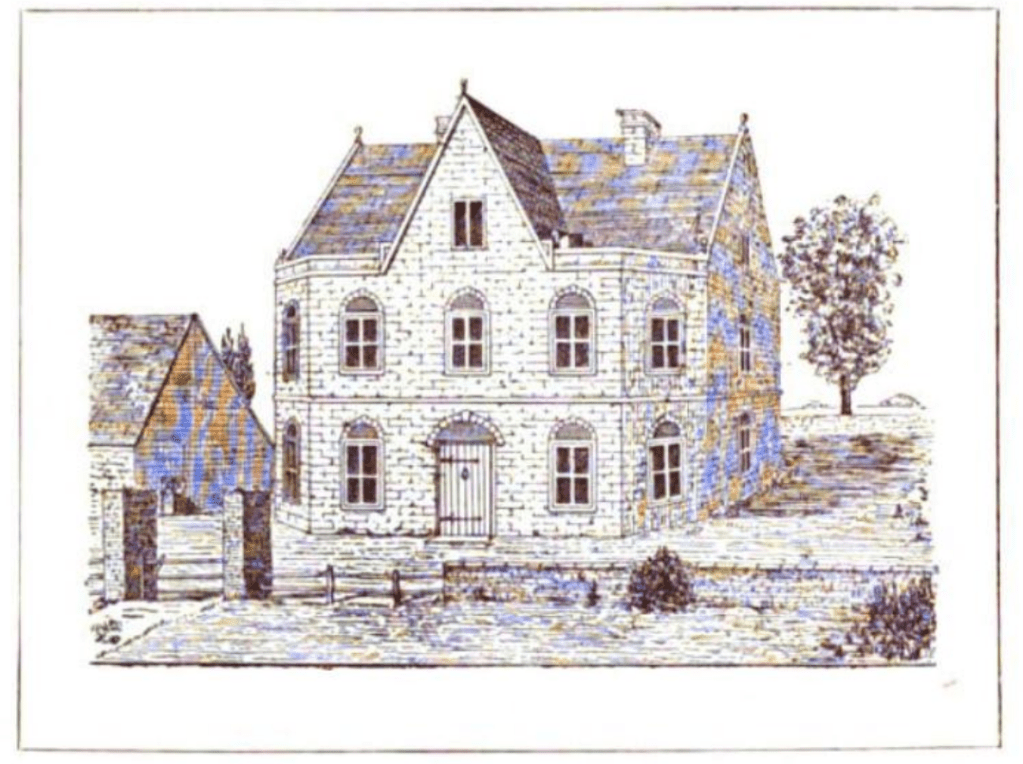
On our second visit to Papillon Hall, we’re going to step away from the tales of the infamous cursed footwear. Instead, let’s meet the man painted as the villain of the piece and his portrait, an artwork which appears to have had the power to scare the heebie-jeebies out of anyone who gazed upon it. Disclaimer – when I included an image of it in part I I did not know this. Please read at your own risk.
David Papillon was born in 1691, and was the grandson of the man who had originally built the hall earlier that century. Most biographies depict him as a respectable and upstanding gentleman but local folklore hints that there was a darker side to the man they called ‘Old Pamp’1.
Pamp was said to be something of a sorcerer with such a mesmerising gaze that he could bewitch people to the point that they were powerless to move. His portrait also appears to have possessed the same power. Sometimes visitors to the hall would stand and stare at it for long periods of time, seemingly incapable of turning away. Even more chilling are the stories that on some nights Pamp himself would actually step out from the artwork and roam the rooms of Papillon. One servant girl reported seeing him stood at the end of her bed wearing the same clothes as he did in the painting.
When the portrait was moved to Crowhurst Park near Hastings, Pamp’s ghost went with it. Bertha Tufnell, who was letting Crowhurst from his descendant Pelham Rawsthorn Papillon, saw Pamp standing in the drawing room as if he’d just climbed out of the painting. Following this he tried to materialise on several other occasions but Bertha worked out that reciting a prayer seemed to stop him from fully forming outside of his frame. As a more permanent solution she sent a desperate letter to Pelham and he arranged for the creepy canvas to be removed to his residence in Hastings.
An intriguing article appeared in the Market Harborough Advertiser in December 1946 with the author ‘FPS’ claiming that forty years ago he’d met a man who was on his way to Papillon Hall and tried to engage him in conversation. When he mentioned the famous infamous cursed footwear and the ghost of Pamp the man became visibly uncomfortable and reluctant to chat. FPS tired to reassure him that ghost stories were nonsense but this distressed the man even more. The man clutched the author’s arm, warning him to be careful as Old Pamp could get nasty and had a tendency to appear when people were dismissive. Undaunted, FPS joked that he’d like to see him so that he could ask about a painting he had which once used to hand in Papillon Hall.
A few months after this encounter on the Theddingworth to Lubenham Road, strange things began to happen at the home of FPS. It started with the Papillon painting falling to the ground with a crash. The cord was replaced, the nails secured and it was put back up again but the painting fell down a further three times. New fasteners were added to the frame, along with two brass chains and two lengths of copper wire, all separately fastened to hooks secured in the newly re-plugged wall. A length of hempen rope was also added for extra measure and FPS felt confident the painting would now stay put. Funnily enough, it did not.
The painting was left leaning against the wall and that night, FPS and his wife heard footsteps on the stairs and a bell ringing violently somewhere in the house. In the morning, another painting was found to have fallen. Things soon escalated from ‘a bit odd’ to ‘outright terrifying’, one night when a howling was heard outside the house. As the author and his wife discussed if the sound could be made by a dog, it came nearer. As FPS recalled,
“Description fails, words cannot express the unholy thing, it was vilely evil, blood-curdling, only someone or something in hellish torment could howl like that. It came still nearer and we could track the sound as ‘It’ approached the house. A moment later it seemed even still nearer, then, to our unspeakable horror we realised the ‘thing’ was in the house”.
FPS grabbed a candle and went downstairs. As he descended the house seemed filled with the sound but then came an unnatural silence. He could find nothing to account for the sound, though the dogs were cowering and staring at something invisible. Suddenly, a shriek cut through the silence, seeming to emit from the spot the dogs were staring at. They bolted from the room, with FPS not far behind them. Half-way across the hallway, the candle went out. In the darkness, the howl came again, this time from between his feet, before moving level with his head. Then he heard his wife shouting to him, ‘Quick! Quick! it’s on the stairs’, and managed to get back into the bedroom where he and his wife held the door fast until the howling ceased. He never heard it again. Perhaps David Papillon had made his point.
Incredibly, there is yet more of this mysterious story to share. There’s a line in the Market Harborough Advertiser which lends weight to the story that a skeleton was found when the hall was being renovated at the start of the twentieth century. In a review of the year 1903 it simply says ‘December 3 – a quantity of human bones were found at Papillon Hall’. Frustratingly, the newspaper archive does not appear to have digitalised the edition for December 3rd 1903 which presumably contains more details of the discovery. Elsewhere, there are suggestions that the hauntings relate to the pre-Papillon history of the site and involve a lepers’ hospital, a monk and some buried treasure. Then there are the experiences of Captain Frank Belville, who lived at the hall for a while and encountered not the terrifying presence of David Papillon but a spectral young woman, ‘silver and half-hooded’, who he chased often but never caught (why is this giving ‘Carry on Cursing’ vibes?). Oh, and there’s a magical well too.
There may be a part three to follow but I truly think there’s enough material here to turn this tale of cursed shoes and haunted paintings into a full length motion picture.
Notes
- This nickname strikes me as a little strange given he moved to Acrise Park in Kent following his marriage to Mary Keyser at the age of 26.
Sources
Ghosts and hauntings in and around Leicestershire by Andrew James Wright
Market Harborough Advertiser and Midland Mail
Leicester Daily Post
Reynolds’s Newspaper
Leicester Chronicle

