A Dance to the Music of Time

Hot on the hooves of Lichfield’s Sheriff’s Ride comes another ancient Staffordshire tradition – the Abbots Bromley Horn Dance. No one knows just how ancient though. The earliest written record of the dance seems to be from Dr Robert Plot’s ‘Natural History of Staffordshire’ in 1686, yet the reindeer antlers themselves have been carbon dated to around one thousand years ago.

The Horn Dance c.1900. Apparently the splendid costumes are a Victorian invention. The original costumes were made by the vicar’s daughters from old bed curtains! The latest set of costumes were created at the turn of the millenium. On the subject of costumes, I love that the man dressed as a woman is wearing his shirt and tie beneath his!
Image from Sir Benjamin Stone’s Pictures – Festivals, Ceremonies and Customs. Published by Cassell & Co. London. 1906 (taken from Wikipedia)

Last night, we arrived as the dancers were weaving their way around the back lanes of Abbots Bromley, and so we settled for a while in The Crown and awaited their return to the village green. Outside the crowds were entertained by the Lichfield Morris Men and the Beggars’ Oak Clog Dancers amongst others. Sitting there in the pub I saw horns everywhere – antlers on the village sign, antler inspired light fittings and, sitting on a bench opposite, a man wearing furry antlers. We rejoined the crowd, as the dancers made their way up the High Street, taking up their position outside the Crown to applause. At first it’s the horns that command your attention – they’re enormous (apparently, the largest set weighs over 25lbs). Then gradually your peripherary vision kicks in and you spot the other characters – a man dressed as a woman, the young boy shooting the hobby horse, over and over again and the musicians accompanied by a child playing the triangle. Fortunately, I managed to avoid the Fool and his fertility aiding pig’s bladder…

In ‘England in Particular’, the authors describe the dance as both unsettling and reassuring. I know what they mean. What you’re watching has a significance that no longer makes much sense to our modern eyes, its symbolism like some long forgotten language. Yet there’s also something very British and familiar about the occasion in the scout tent set up over on the green, selling curry to the beer drinking crowds chatting together beneath umbrellas.

If this is a pagan fertility ritual, it seems to get along well with Christianity these days. The horns are kept in St Nicholas’s church for 364 days a year, and before the horns are taken out on their annual excursion around the village there is a short blessing. The dance is performed outside the Abbots Bromley throughout the year but I understand that a second set of horns are kept for this purpose, these original horns never leave the village. There is a great story in a book on the dance by Jack Brown of the English Folk Dance and Song Society that I bought from the Oxfam bookshop. Apparently, in the 19th century, the dancers took a set of elk horns dancing in Burton and having consumed quite a lot of rum, managed to lose them. Some say the horns were stolen; others say the dancers decided they were too heavy and deposited them into the River Trent so they didn’t have to carry them all the way back to Abbots Bromley.

It’s fantastic to have such a unique tradition taking place just ten miles or so up the road from Lichfield and although I’ve popped a few (rubbish) photos on here to give you an idea, it goes with out saying that there’s nothing like going along and experiencing it for yourself. So, put it in your diary for the next Monday after the first Sunday after the fourth of September 2014!

Note – I could claim that the blurriness of the dancers and musicians on the following photographs is an artistic statement on the passage of time or something, but in actual fact they’re just really BAD photos! Anyway, the chap with furry antlers is on one of them which warrants its inclusion.

Sources:

England in Particular by Sue Clifford and Angela King

The Abbots Bromley Horn Dance by Jack Brown
Underneath The Arches

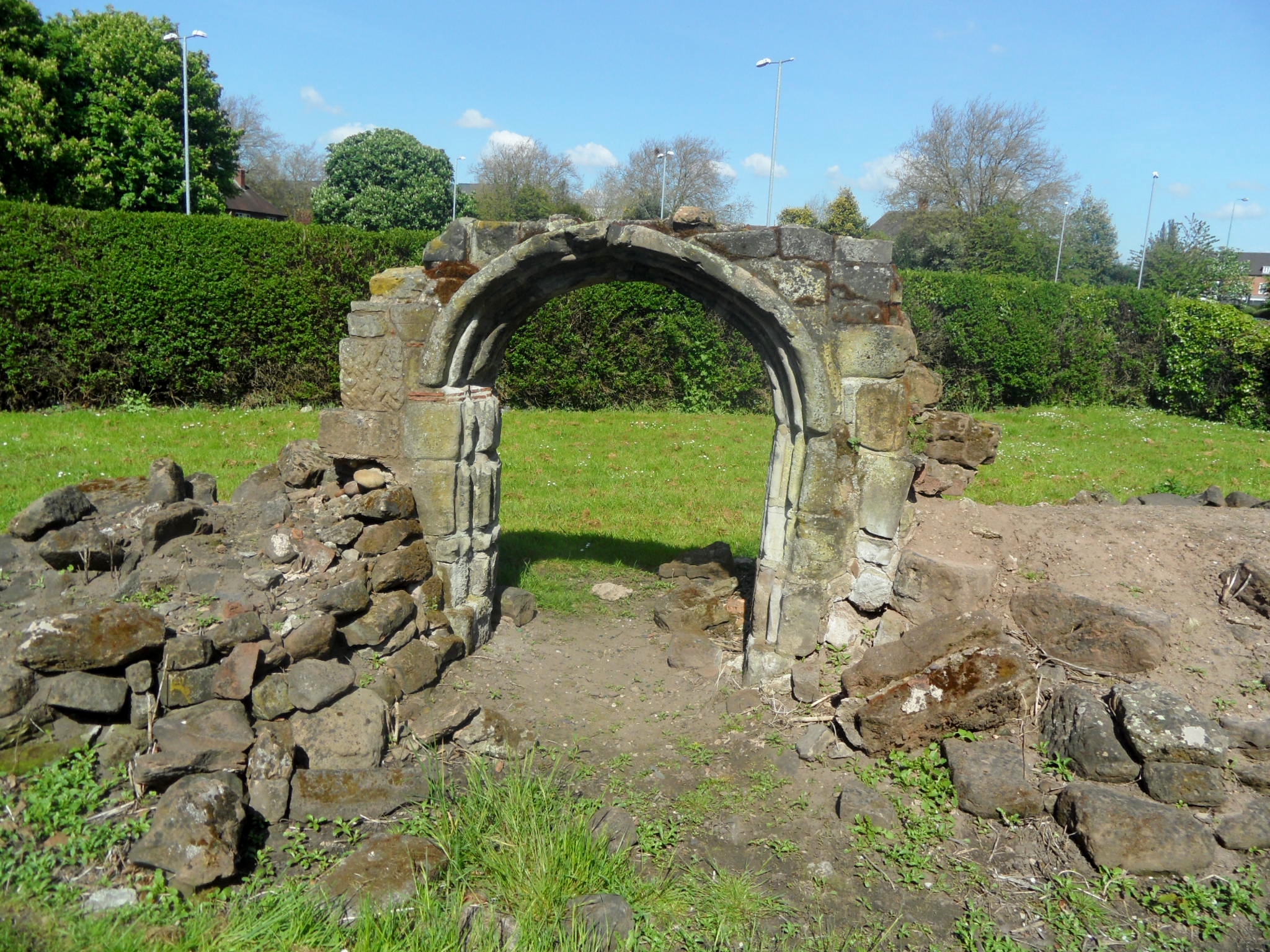
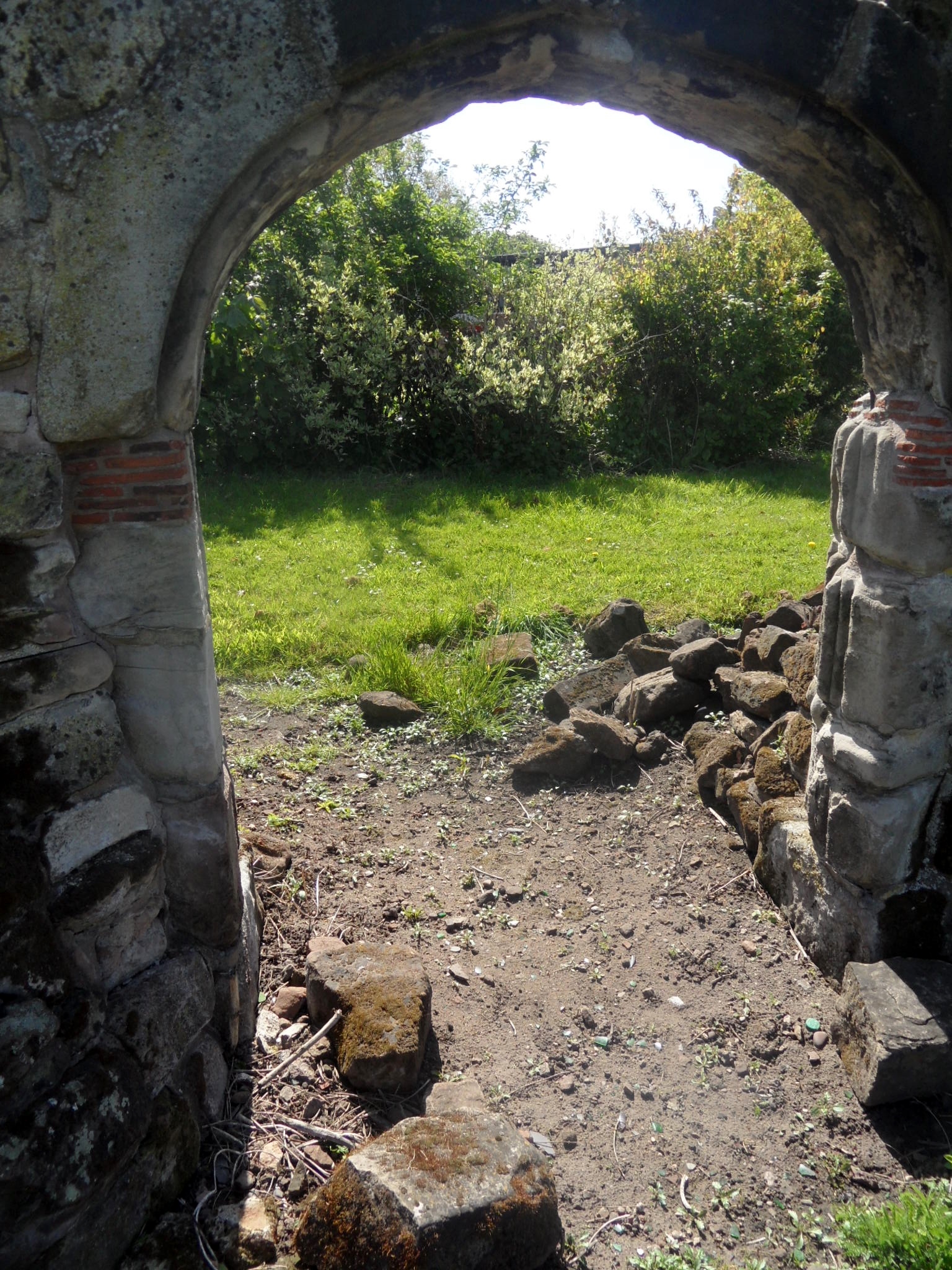
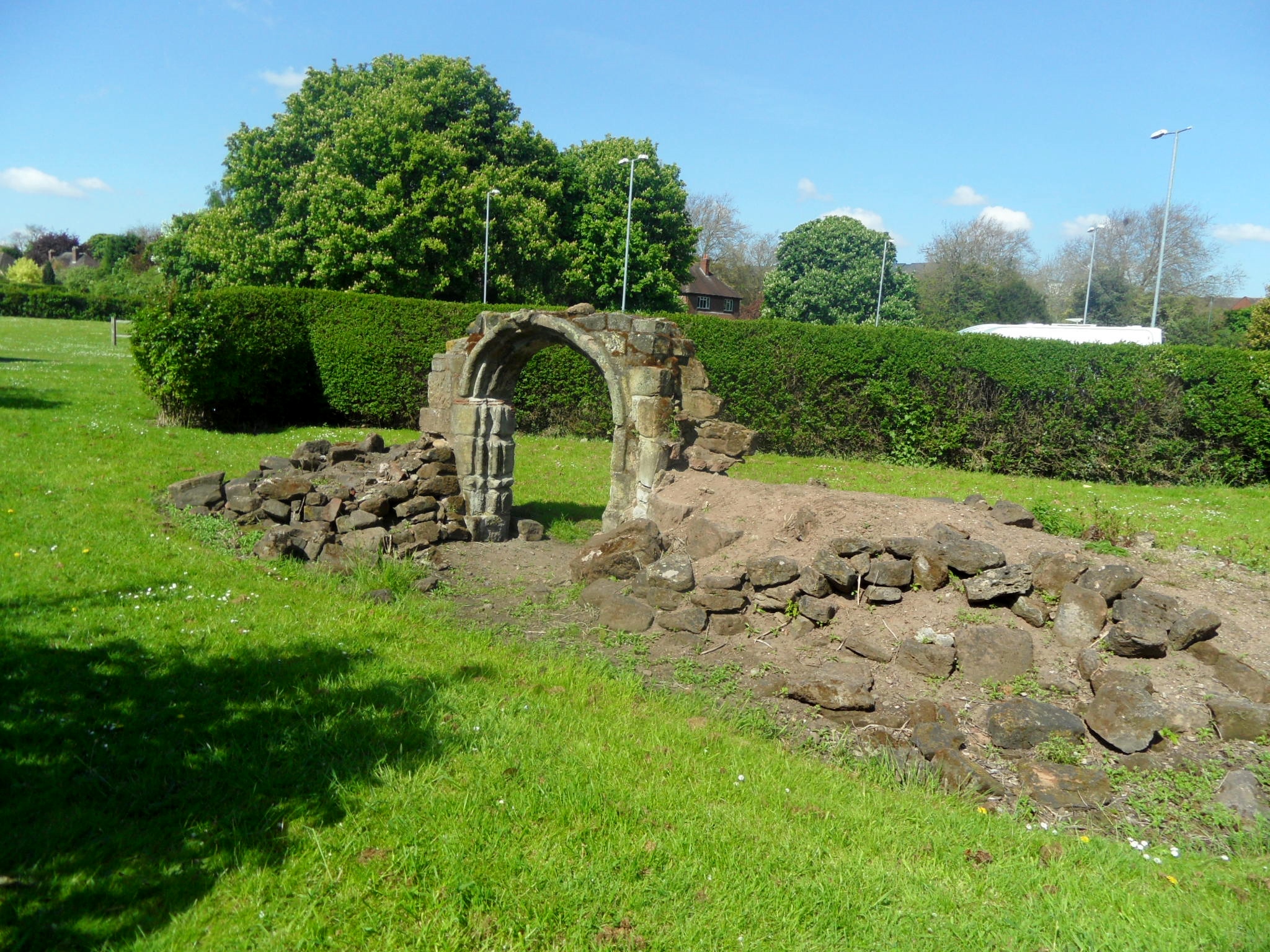
A stone arch stands in the grounds of the Lichfield Campus of South Staffs college and I’ve never been sure whether it is a folly, or part of the Franciscan Friary which once stood on the site. According to a book on the history of the Friary School (1), the arch was discovered in the walls of outbuildings taken down to make way for the new Friary Road in the 1920s. Apparently, it was incorporated into the staff entrance to the school, which used the buildings now occupied by the Library from the 1920s until the 1980s.  A former pupil describes the arch as standing on the lacrosse field during her time at the school. Inevitably, over the years the imagination of school children and the history of the site have combined to create legends and stories, including one about a ghostly monk that people are said to have seen passing through the arch.

Another intriguing discovery made nearby during the 1920s was the gravestone of Richard the Merchant. Actually, rediscovery would be a more accurate description, as the stone had first been uncovered in 1746, when a former owner of the Friary was laying the foundations for a garden wall.  Thankfully, sketches were made of the stone and its inscription as nowadays, its markings can be barely made out and the stone itself is even more hidden away now than when I wrote this post about it back in July 2011.

Tombstone of Richard the Merchant,now in the wall of Lichfield Library

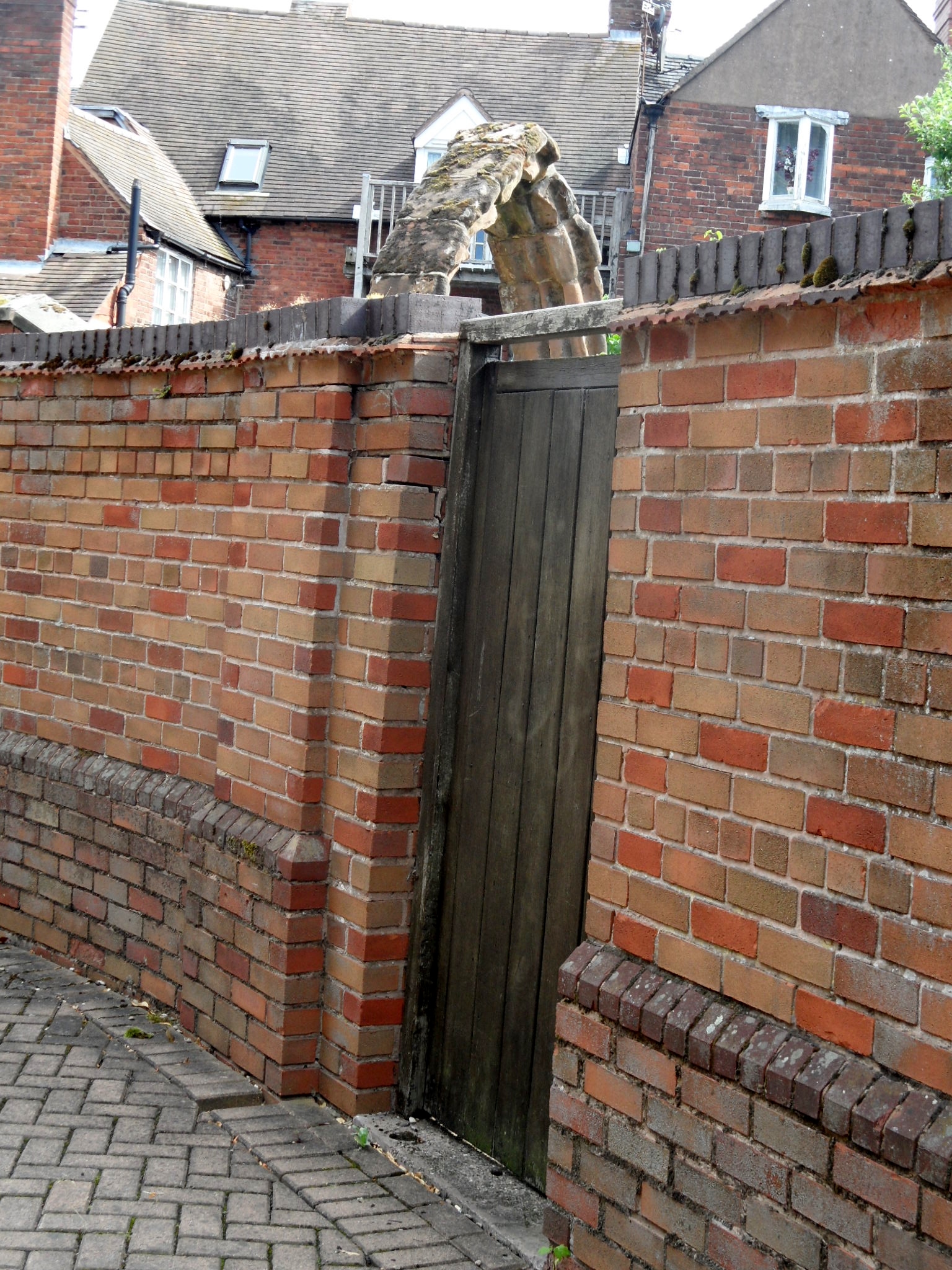
Today I was walking between Dam St and the Bird St car park (which I still call the Woolworth’s car park despite that shop not having been there for years), when I caught a glimpse of what seems to be another arch, over a garden wall which must belong to one of the properties on Dam St. Does anyone have any information on where this arch is from, and why it is here? And of course, if anyone has any stories of ghostly Lichfield residents walking through this one, please let us know!

Notes:

(1) The History of the Friary School, Helen Mullins 1981

(2) I suppose it would actually be a friar, rather than a monk (there is a difference!) but as we’re talking ghost stories here it’s probably not the place to worry too much about historical accurancy!

A Fleeting Present

A while back I wrote about Mr J W Jackson, the ghost hunting city librarian who wrote a local history column for the Lichfield Mercury in the 1930s and 40s. Last night I found an article about ‘dear old Beacon Street’, written by Mr Jackson in November 1943, in response to a letter from one of his old school friends who emigrated to Canada in 1870, at the age of twelve. Of course, in describing the changes that have taken place in seventy years, Mr Jackson gives us a glimpse of Beacon St in both his past and his present, which is actually now our past. Before things get too wibbley wobbley timey wimey, let’s move on to a summary of the changes Mr Jackson noted in Beacon Street over the seventy years leading up to 1943.

Mr Jackson says the old pinfold still remained but was hardly, if ever, used for its original purpose – in the past it frequently containing horses, cattle or sheep caught straying on the road and penned by official pinner, Watty Bevin.  Fifty yards away from the pinfold as you walked back towards the city there used to be an old iron pump where the children used to fill up the vinegar bottles they were taking home from Hagues in Beacon St, after enjoying a couple of sips.  The Anchor Inn kept by Billy Godwin had been cleared away and the field between the Inn and Smith’s Brewery was now the residential school. The brewery itself where the children took cans to be filled with barm had been converted into a foundry.

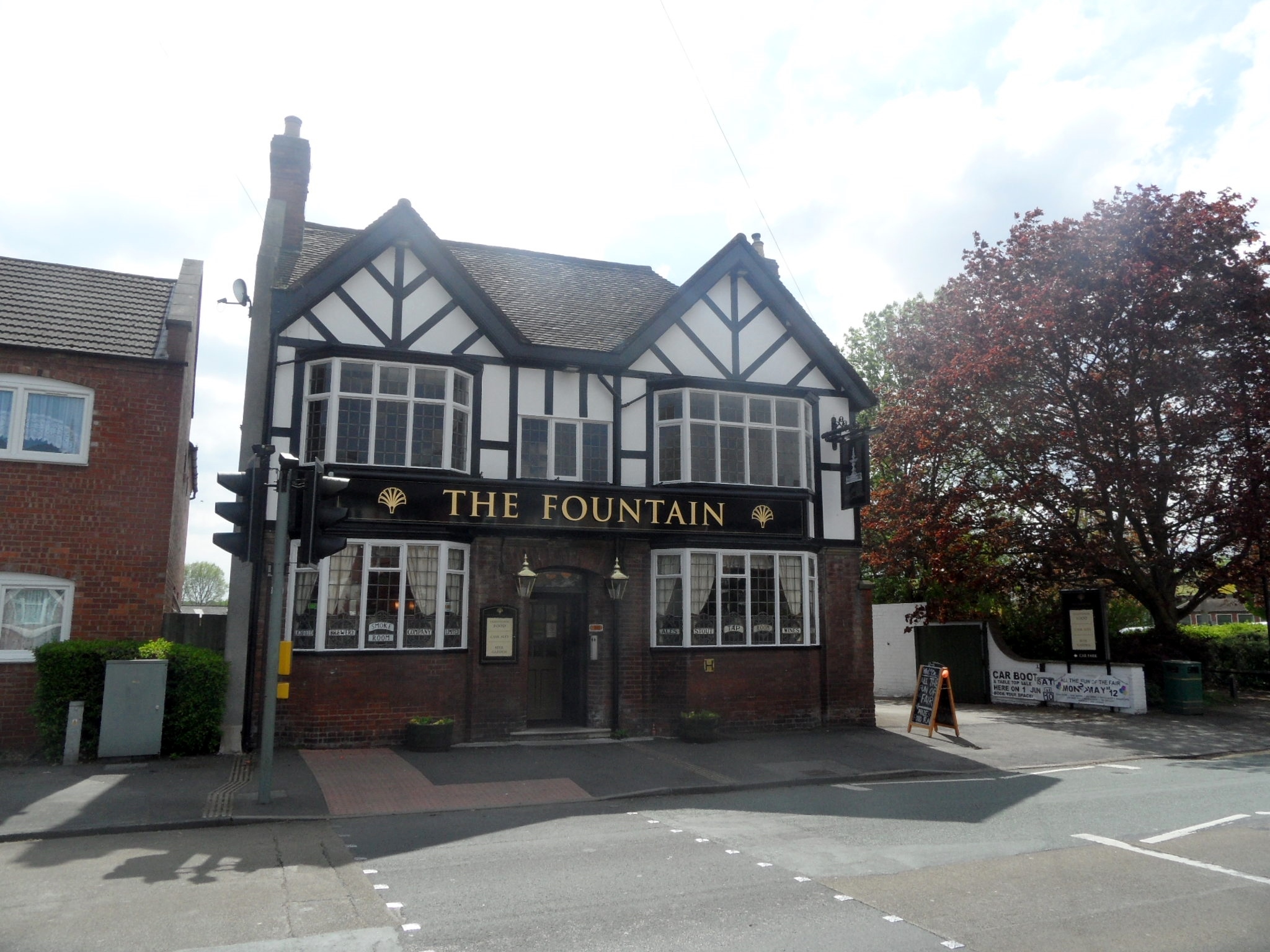
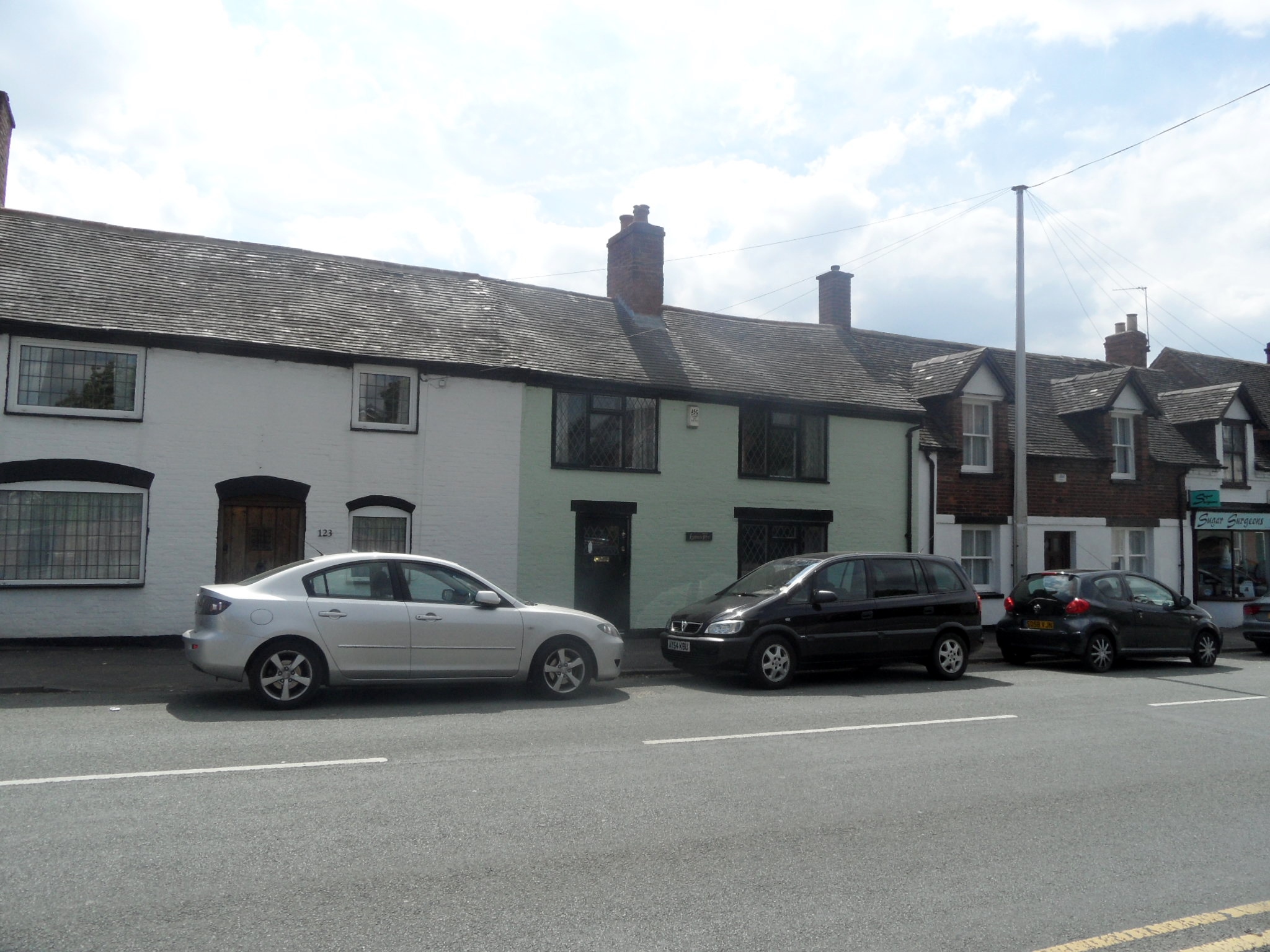
The Fountain Inn still remained  but visitors from the Black Country no longer came to play bowls on its lawns. The Lemon Tree Inn, kept by Sam Boston was now a house, as was the old butchers shop (kept by Mr Yeomans) and the Pheasant Inn previously kept by Mr Stone is also a house.  The wall shutting off Beacon Hall had been partly taken down and was now a garage and a residence. The old fashioned grocery shop at corner of Shaw Lane, owned by Mr Hall had been sold and replaced by a much larger shop, eventually becoming an antiques shop. Whitehall and Milley’s Hospital remained as they were in 1870 but the Free Library & Museum had been built near to the site of Griffith’s Brewery. (Note: Think this was probably earlier – Free Library & Museum built 1859?)

Green house was formerly the Lemon Tree Inn

The Angel Croft was described by Mr Jackson as ‘now a hostel’. The Old Beehive Inn had also been converted into a residence as had the Wheel Inn at the corner of Wheel Lane. The windmill where Mr Jackson played as a child was no longer in use but converted to a picturesque residence. Apparently the miller came in a considerable fortune and disappeared leaving everything as it stood and nothing was heard of him again.

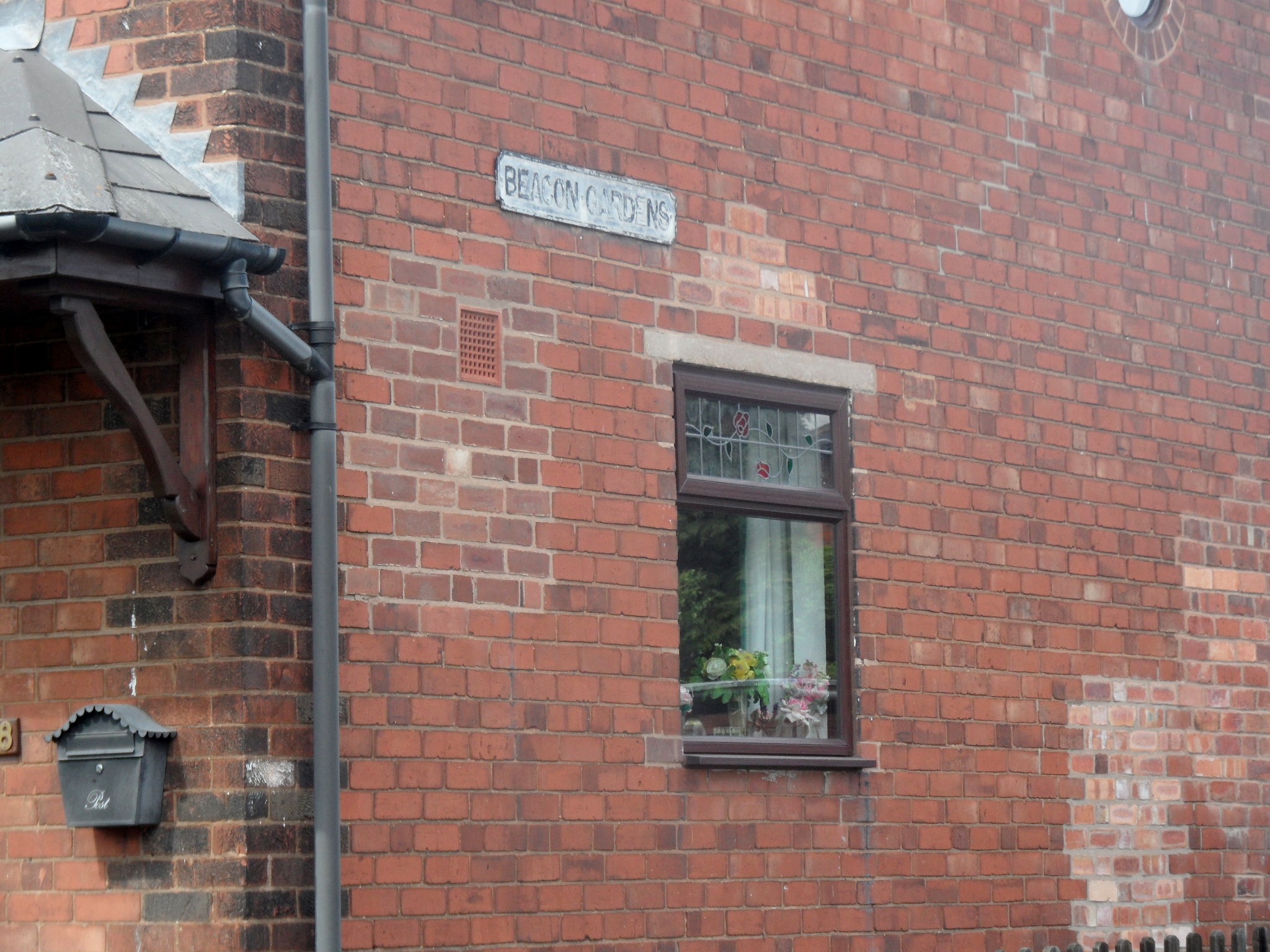
Beacon Gardens built 1925

Council houses known as Beacon Gardens had been built on the fields in front of the Fountain Inn. The old blacksmiths, where legend has it that a French man once took his dancing bear to be shod was still going strong.  The Feathers Inn was still licensed and the row of cottages adjoining was much the same. The Old St Chad’s Rectory garden and field had been built over, the new road known as Nether Beacon. By 1943, the wheelwrights shop on brow of Beacon Hill had long since disappeared but the Little George Inn still stood as did the George & Dragon.

Of course, we can also now compare Beacon St seventy years on from when Mr Jackson did his comparison. I took most of the photos on Sunday (before I found the article weirdly!). The old pinfold still remains, but I doubt anyone now even remembers it being used to lock up straying animals.

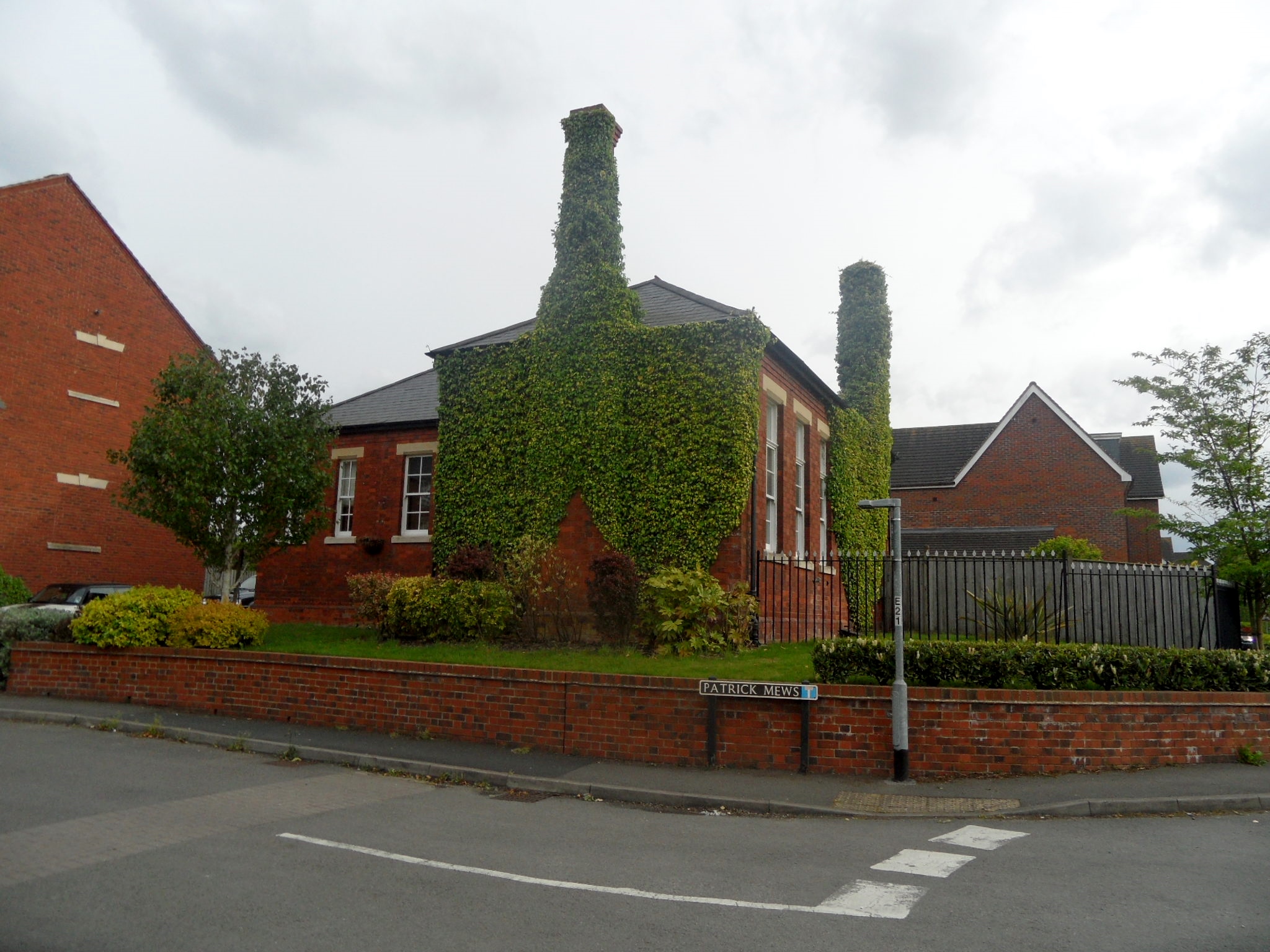
Beacon Street School Sanatorium

The residential school has now been converted into apartments and the site of the Foundry is now Morrison’s Supermarket. Funnily enough you can probably get barm, or something similar there once again, as I think it’s a type of yeast (as in the northern ‘Barm Cake’). The Fountain Inn is still open, and Milley’s Hospital and Whitehall are still there. The Free Library and Museum building is of course now used as the Registry Office. As we are all too aware the Angel Croft is still there, but for how much longer in its desperate state?

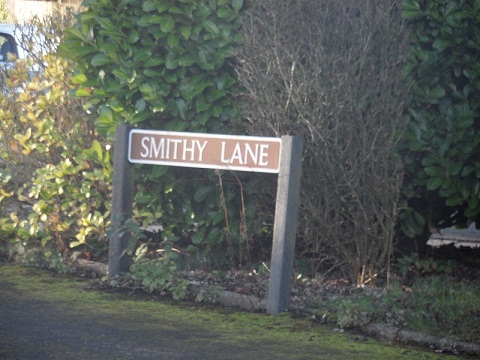
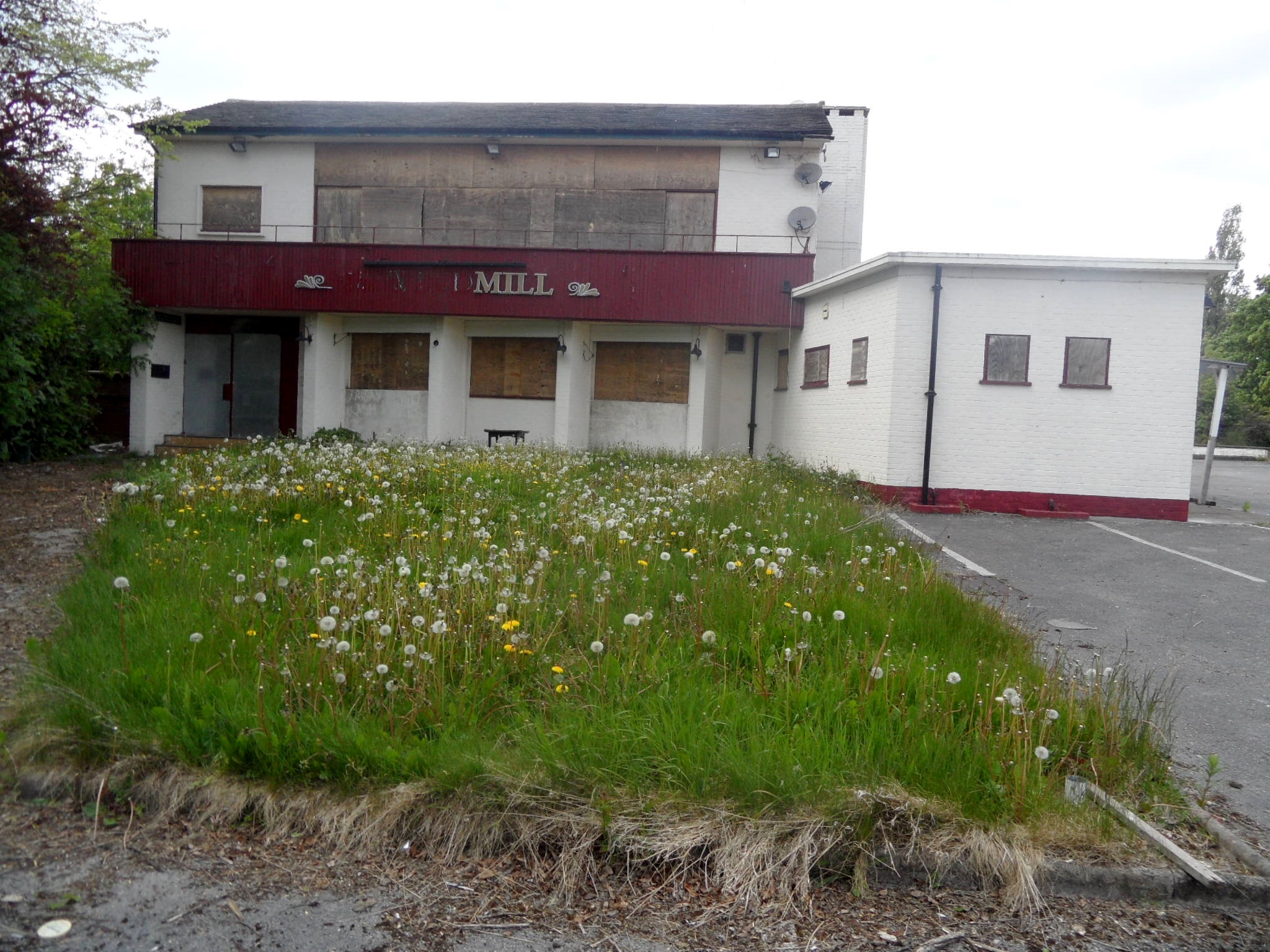
The blacksmiths has gone but is not altogether forgotten with road names ‘Forge Lane’ and ‘Smithy Lane’ to remind us. The Feathers Inn is still licensed but has now expanded into the row of cottages adjoining (for the record, I had a very nice jacket potato in the beer garden there on Bower Day this year). The George and Dragon, thankfully, still stands but the Little George is now a private, rather than public house. According to John Shaw’s Old Pubs of Lichfield, after WW2, the licence of the pub was transferred to the new pub on Wheel Lane, known as the Windmill. This ‘new’ pub which, wasn’t around in Mr Jackson’s time will probably not be around for much longer, as it is has been closed for some time and the site earmarked for development.

Mr Jackson’s article reminds me of the need for recording the everyday and the seemingly ordinary, as one day the present will be the past and what was once commonplace may no longer be.  I’m a big believer in using place names that reflect the history of a place, but on its own, a street sign for ‘Smithy Lane’ only tells you part of the story. Had Mr Jackson not added the story of the dancing bear’s shoes and the missing miller and his money to his reminiscences, they may well have been forgotten. “So what?” some may say, dismissing them as mere trivialities, but I disagree. I think stories matter.

Perhaps in seventy years time someone will look back at how Beacon St was in 2013. I wonder what will have changed and if we’ll have left them with any good stories?

Sources:
Lichfield Mercury archive
The Old Pubs of Lichfield, John Shaw

Pilgrims' Progress

In trying to find out more about the ferry that may have taken pilgrims across the water to the Cathedral, I came across an interesting description of what they may have found there on their arrival.

A document described as an ‘indenture chirograph’ (1), two feet five inches long and eleven inches wide, lists the goods found in the sacristy in 1345. A transcript of the original Latin is included in the ‘Collections for a History of Staffordshire 1886, Part II, Vol VI’, edited by the William Salt Society. Thankfully, there is also a translation alongside, so that I don’t have to fumble my way through using google translate! (2)

A tile and a simple portrait mark the place where Chad’s shrine once stood.

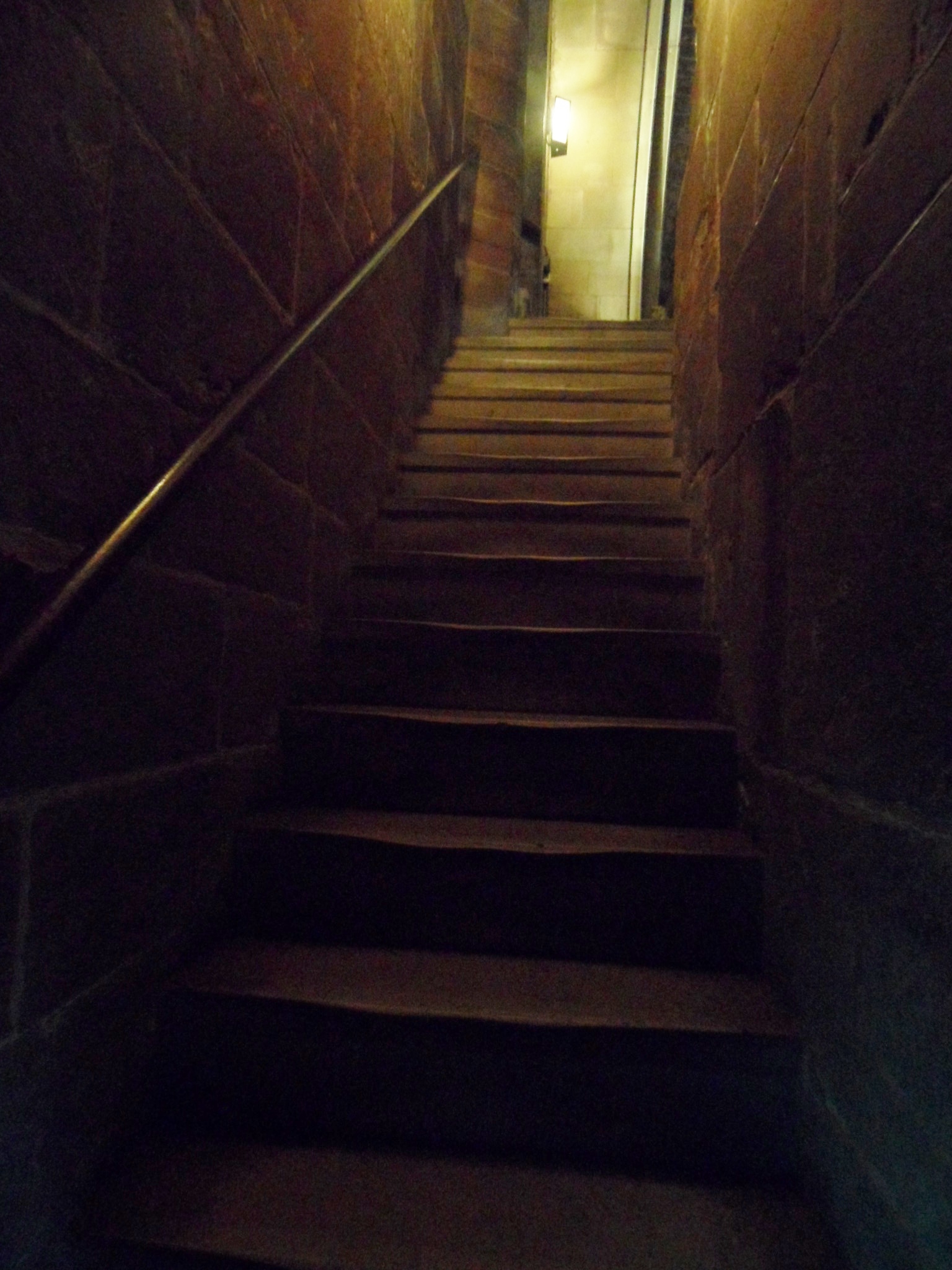
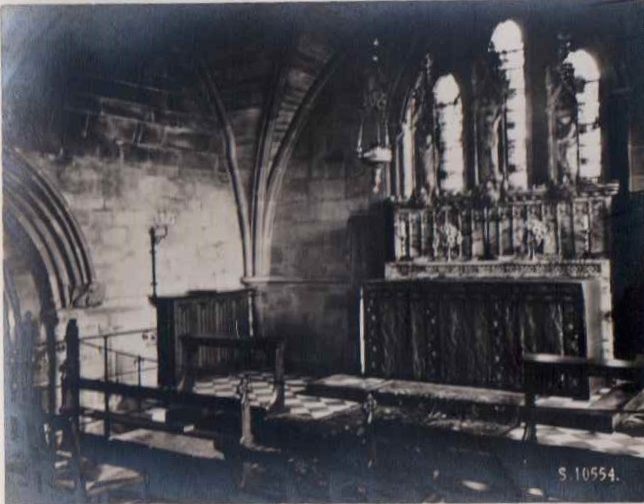
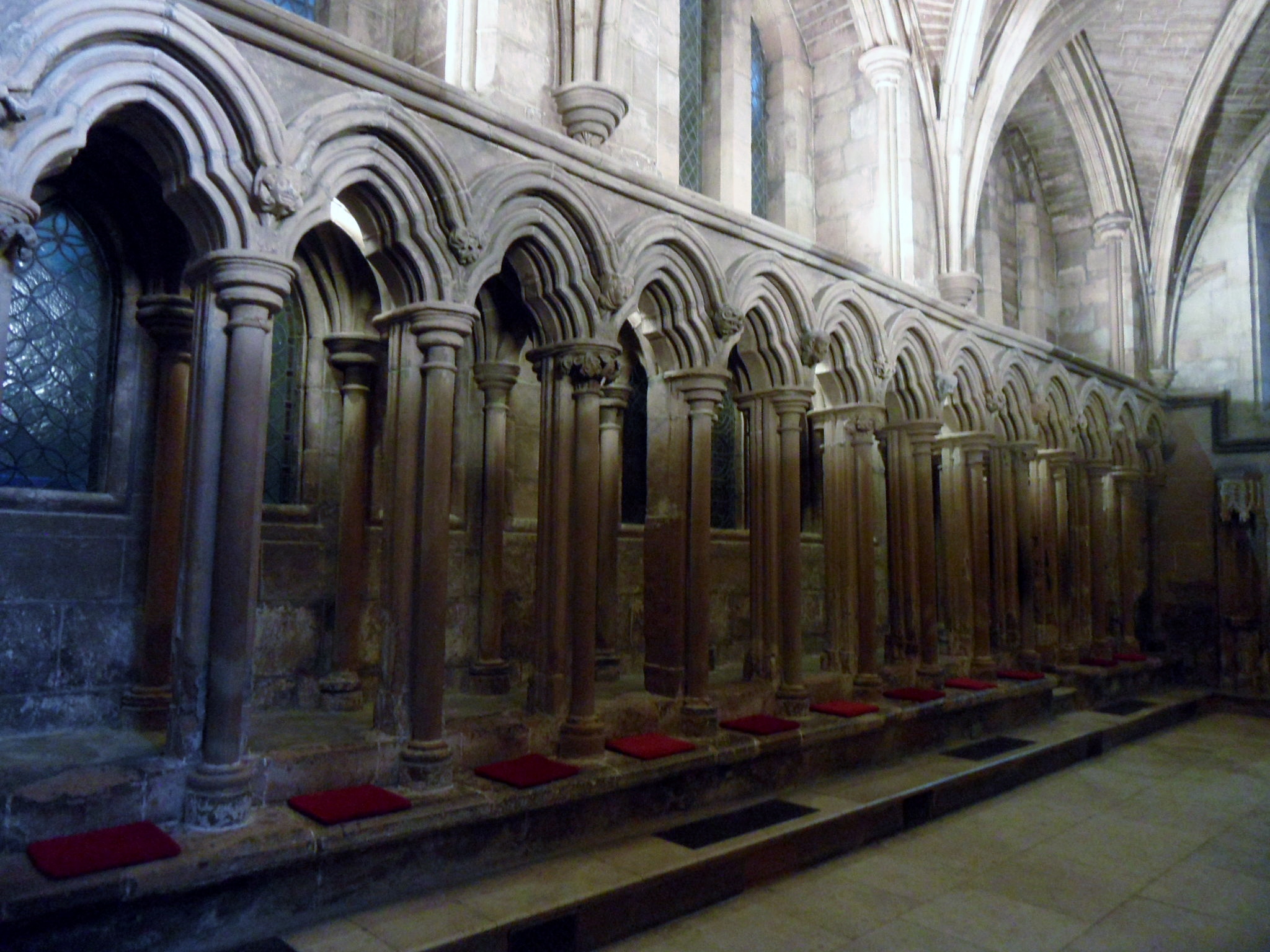
The first part of the inventory lists the various relics owned by the Cathedral, including of course those of Saint Chad. Chad died in 672AD and around 700AD his bones were moved to a new church, on or near to the site of the present Cathedral. It’s thought that the Lichfield Angel, discovered in 2003 whilst work was being carried out on the nave, may have been part of the original shrine, and that it may have been destroyed by Vikings. By the time the inventory was made in 1345, the holy bones seem to have been kept in several different places within the Cathedral. Chad’s skull was kept in the thirteenth century Saint Chad’s Head Chapel ‘in a painted wooden case’. The Cathedral website describes how initially pilgrims would ascend a staircase in the wall, walk around the head, and then exit down a second stairway which still exists today.

Staircase which pilgrims may have used to exit St Chad’s Head Chapel

An old photograph of St Chad’s Chapel

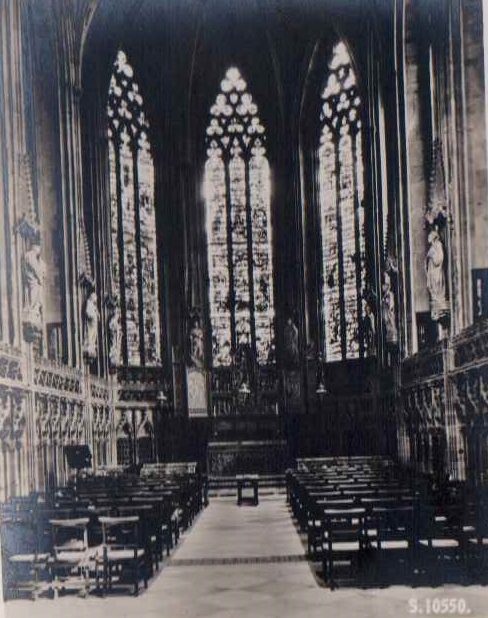
Eventually, due to the volume of traffic, one of the staircases was closed and the relic was shown to pilgrims from the balcony outside the chapel.  There is also mention of an arm of Blessed Chad, and other bones in a portable shrine, as well as the great shrine of St Chad. The latter was described as being decorated with statues and adorned with precious gifts and jewels and stood in the Lady Chapel of the Cathedral until the reformation. It’s believed that some of the Saint’s bones are now kept in the Roman Catholic Cathedral of St Chad’s in Birmingham, enshrined on 21 June 1841, the day that the Cathedral was consecrated. (3)

An old photo of the Lady Chapel

It wasn’t just the relics of Saint Chad that were owned by the Cathedral. Other items recorded in 1345 include:

Some of Mount Calvary and Golgotha, a piece of the rock standing upon which Jesus wept bitterly and wept over Jerusalem, some of the bones of the Eleven Thousand Virgins, part of the finger and cowl of St William, some of the bread of St Godric and some of the wood of the cross of St Peter

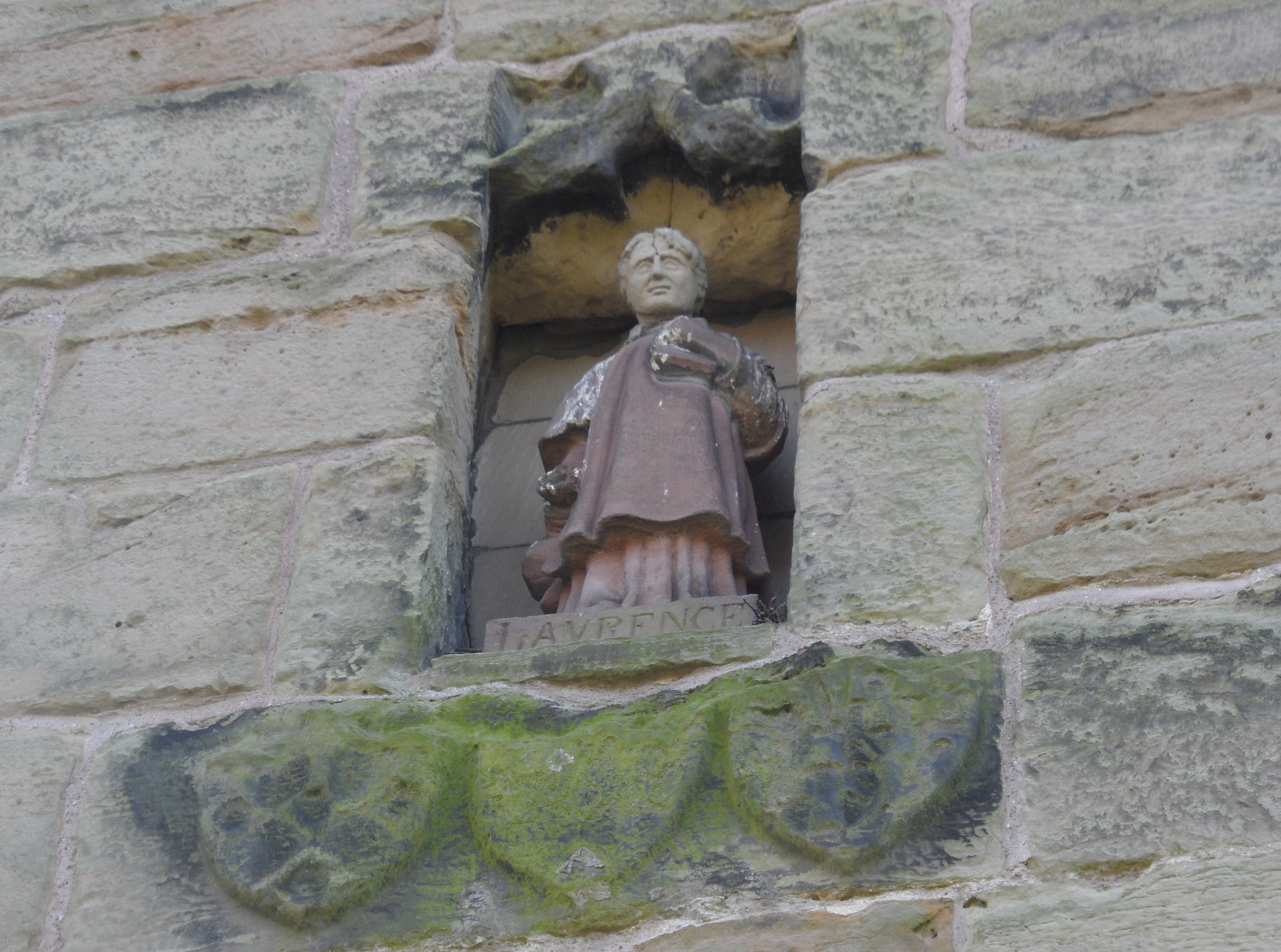
There were also said to be some of St Lawrence’s bones, part of his tomb and a piece of the gridiron he was executed on. (4) Interestingly, it’s said that at number 23, The Close, different coloured bricks have been used on the south wall to depict this this symbol of St Lawrence’s martyrdom. Since I read about this, I have a look every time I walk past, but as of yet, have not managed to spot it!

Statue of St Lawrence at the church named after him in Walton on Trent, which sits on the border between Staffordshire and Derbyshire

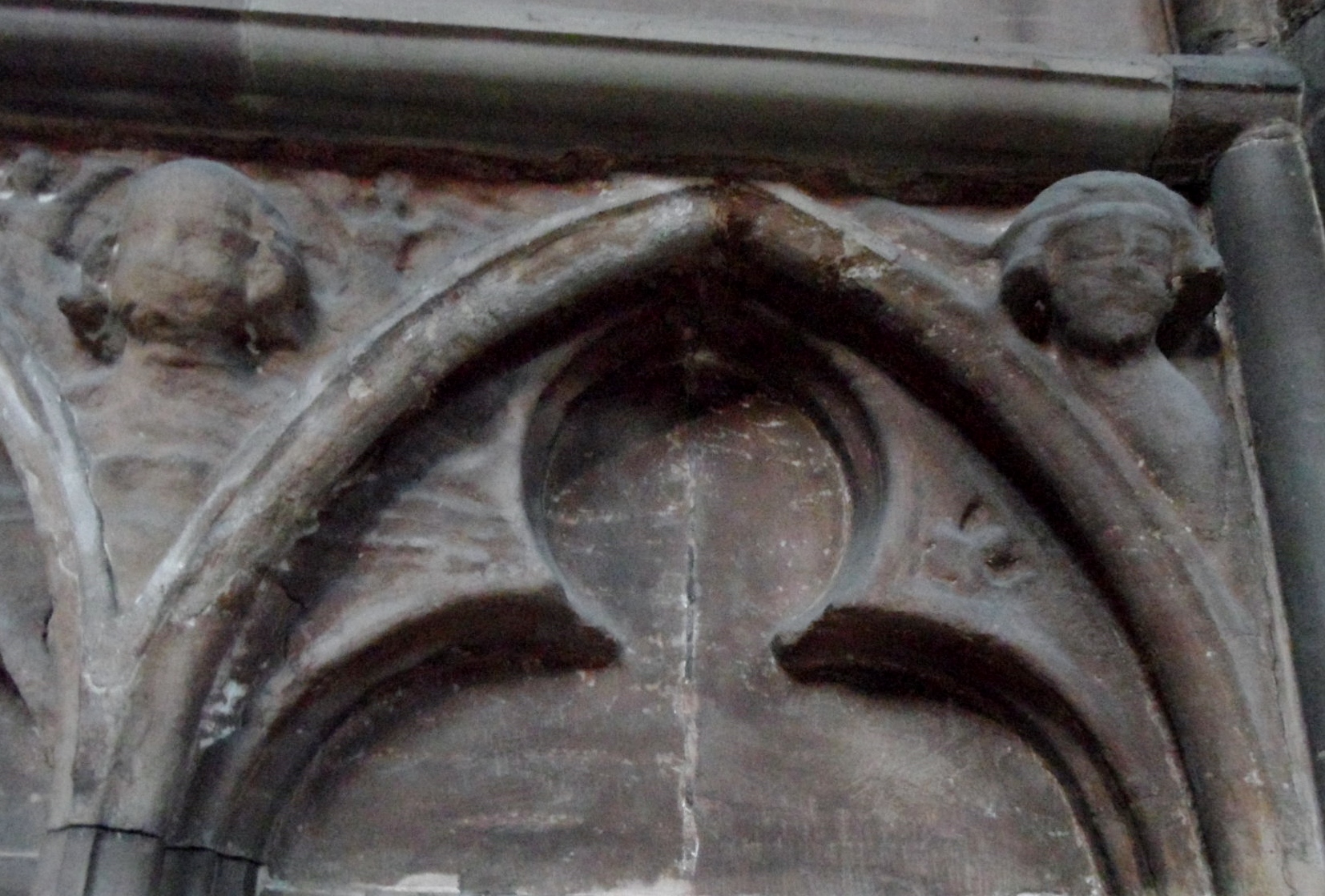
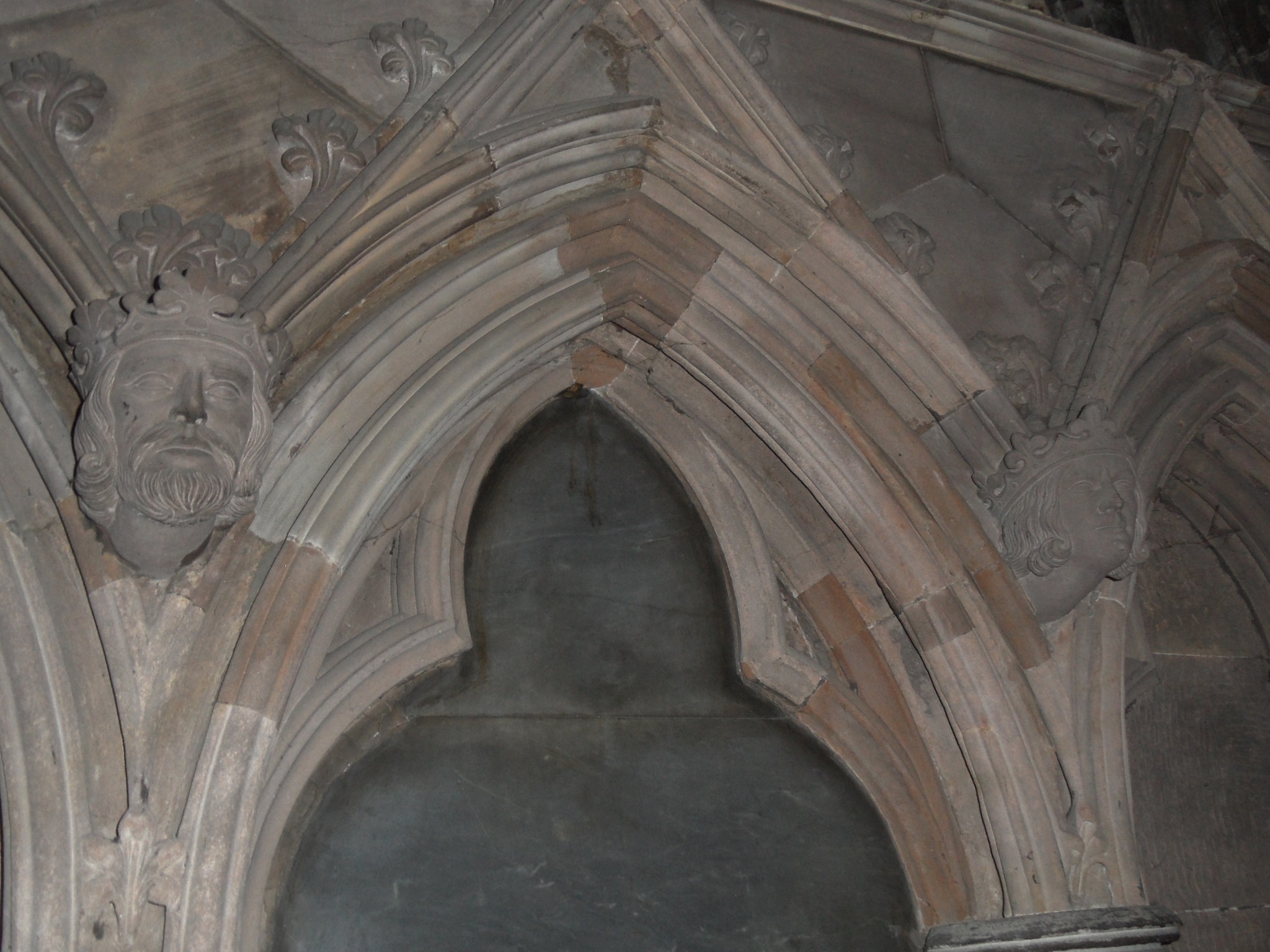
Saint Chad’s skull may be long gone but the pilgrims still come, and on certain occasions have their feet washed at the pedilavium, a medieval feature thought to be unique to Lichfield. There are also plenty of other heads to be found at Lichfield Cathedral. Some are scarred and defaced, whilst others have been restored. They are a reminder of the medieval craftsmen who created the church, those who tried to destroy it and those whose skills and labour restored Lichfield Cathedral to the mirabilis edificii that it is today (ok, I admit I used google translate for that one!).

The medieval pedilavium where pilgrims still sit to have their feet washed.

Notes:

1) I believe this refers to a document that would have been written in duplicate on the same piece of parchment, and then divided into two with a serrated edge, so that when both parts were brought back together and compared, you could be sure that each was genuine and not a forgery.

(2) A footnote says ‘This transcript and translation were originally undertaken for ‘The Journal of the Derbyshire Archaeological Society’, and are now reprinted after careful revision and correction. It was the joint work of W H St John Hope, FSA and the compiler of this catalogue’. Thanks very much folks!

(3) The relics of St Chad were apparently smuggled out of Lichfield after the reformation and eventually ended up in Birmingham, a journey of thirty miles that took 300 years! You can read more about that journey here. I don’t think anyone knows what happened to the other relics.

(4) In a nutshell the legend of St Lawrence is that he was a Deacon of Rome, and when asked by the Prefect of Rome to assemble the treasures of the church  for him,  he brought him the poor and suffering, stating it was they who were the true treasures of the church. The legend says he was executed by being roasted over a gridiron (but some say he was most likely beheaded).

Sources: 

Collections for a History of Staffordshire 1886, Part II, Vol VI’, edited by the William Salt Society

Lichfield Cathedral Website – http://www.lichfield-cathedral.org/History/the-gothic-cathedral.html

Lichfield: The cathedral close’, A History of the County of Stafford: Volume 14: Lichfield (1990), pp. 57-67

A Lost Place

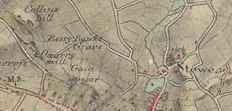
A couple of years ago, I learned that there had once been a place in Lichfield known as Bessy Banks Grave. Appearing on several old maps, the name is also referred to in a newspaper advertisement from 1914, but seems to have disappeared shortly afterwards. The plot of land was in The Dimbles area and I suspect that the name may have been lost when the council began building houses there in the early twentieth century.

Attempts to discover the story behind the name led to a poem written by Anna Seward for her friend Honora Sneyd, at the place known as Bessy Banks Grave, which Miss Seward refers to as ‘the grave of a suicide’.

“It suits the temper of my soul to pour
Fond, fruitless plaints beneath the lonely bower,
Here, in this silent glade, that childhood fears,
Where the love-desperate maid, of vanish’d years,
Slung her dire cord between the sister trees,
That slowly bend their branches to the breeze,
And shade the bank that screens her mouldering form,
From the swart Dog-Star, and the wintry storm….”

David Garrick also knew the place, adding that it was supposedly haunted and in 1805, John Jackson remarked that the spot was ‘once the famous rendezvous of lovers….now no more is remembered than that poor Betsy (sic) is said to have fallen victim to hapless love’.

After reading the original post, “Margaret” left a comment to say that she had found a poem called ‘The Circuit Lane’, in the 1859 book ‘Rustic Rhymes’, by Frederick Price. The Circuit Lane marked part of the boundary of Lichfield, as can be seen in the following extract which appears in several history books from the early nineteenth century:

“… and so along that little cross lands unto another lane that leadeth from Lichfield to King’s Bromley and then along that lane towards Lichfield unto a little lane lying between the Grange Ground and Collin’s Hill Field commonly called the Circuit lane unto the further end of it betwixt two fields the one called Hic filius and the other Piper’s Croft and so over across a lane that leadeth from Lichfield to Elmhurst and then into another little lane between Stichbrooke Ground and Gifforde’s Crofte and so along that little lane to a green lane at the further side of the Lady Leasowe being the land of Zachary Babington Esquire and down that lane to a brook called Pone’s Brook and so over that brook into another lane called Stepping stones lane…”

As well as painting a picture of a disappeared landscape, Frederick Price’s poem also refers to the lost story of Bessy Banks. The full poem is here, but I have included an excerpt below

Daisy, ladysmock, and kingcup,
And the broad-leaved flag so gay,
With which we in pride would prink up
Doorsteps on the first of May –
Where bright flies their wings are sunning
Where shells strangely marked are found
Where the rippling brook is running
In which Bessy Banks was drowned.

Pass we these, and onward pressing
Where o’er head tall elm trees wave,
‘Tween banks rich in Nature’s dressing
Till we come to Bessy’s grave:
Here four cross-roads meet; a green mound
Indicates her place of rest;
Few spots are more lone, I ween, found
On old England’s face imprest.

Hawthorn blossoms fall and slumber
O’er where the betrayed one lies –
One more victim to the number
Sung in great Hood’s ‘Bridge of Sighs’
The betrayer, in corruption,
Lies in fetid church-yard soil,
Where e’en earthworms meet destruction
Fit ‘last home’ for one so vile.

Hence the lane has been neglected
From that time : the rustic swain
Since that hour the road rejectes
Nor dare traverse it again
Burdocks, thistles, nettles, tansy,
And the nightshade flourish there;
But the primrose or the pansey
Scarce are known to blossom near.

You’ll notice that Price’s version of the story differs from the earlier one told by Anna Seward. Perhaps the clue to this lies in the reference Price makes to ‘Hood’s Bridge of Sighs’, relating to the poem by Thomas Hood, written in 1844 and said by the Victoria and Albert Museum to be a ‘classic stereotype of the harlot and her destiny‘?


A Stone's Throw Away

I recently read a great post about the map maker John Ogilby on Kate Shrewsday’s wonderful blog. In 1675, Mr Ogilby was the creator of the first ever British road atlas, and after reading Kate’s post, I took another look at the section of his map of the London to Chester road, as it passed over the Warwickshire border into Staffordshire and on through Lichfield. You can see the map here.

The majority of the place names are recognisable and in use today, albeit with some changes to the spelling –  Burowcop Hill, Cank Wood and Sutton Cofield amongst others.There are however a handful of names that appear to have been lost over the last three hundred or so years. One intriguing feature marked on the route is the ‘Bishop’s Heap of Stones’, eight miles or so from Lichfield, between Canwell Hall (or Sir Francis Lawley‘s Cannell Hall as it’s shown on the map) and Hints.

The name seems to refer to a literal heap of stones, and it seems there are at least two  possible explanations for why this pile of pebbles was associated with a bishop. Thomas Pennant, when writing about his journey from Chester to London, discovered a handwritten note in a copy of William Dugdale’s ‘Warwickshire’, added by Dugdale himself, which read as follows:

There is a common report (which passeth for currant amongst the vulgar) that the great heape of stones, which lyeth near the road way from Litchfeild towards Coleshill, upon Bassets heath, called the Bishops Stones, and those other lesser heapes, which lye in the valley below; were at first laid there in memorie of a bishop and his retinue, who were long since rob’d and killed, as they were travailing upon that way: but this is a meere fabulous storye: for upon an inquisition made in King James his time, concerning the extent of common upon that heath, betwixt Weeford and Sutton;there was an old woman, called old Bess of Blackbrooke, being then above an hundred yeares of age, who deposed (inter alia) that the Bishop of Exeter living then at Moore Hall: taking notice how troublesome such a number of pibble stones as then lay in the roade thereabouts, were to all passengers, caused them to be pickt up, and thus layd upon heapes

In 1769, in his book The History and Antiquities of Shenstone, in the County of Stafford, the Reverend Henry Sanders, gives a similar but more detailed explanation. Sanders says that a woman from Blackbrook came to the inquiry into the parish boundaries and testified that in the reign of Henry VIII, or just after, John Vesey, the Bishop of Exeter had decided to become a benefactor to his birthplace of Sutton Coldfield. Bishop Vesey obtained a charter of incorporation for the town, revived the market and also built a number of stone houses (1) as part of an attempt to create an industry manufacturing Kersey, as they did in Devon. Bess (I’m assuming that she is ‘the woman from Blackbrook’ Sanders refers to), also told how when the Bishop was at Sutton he was annoyed by the rolling pebbles on the road which caused travellers’ horses to stumble and sometimes fall and so he employed poor people to gather them and lay them in heaps. Sanders describes the position of these heaps as follows:

On the hollow way between Weeford Hills or rather between Swynfen and Canwell lie divers heaps and one great one at the top of the hill at Weeford park corner which according to the tradition of the country people were placed there in memory of a bishop of Lichfield who riding with many attendants was slain with those servants by robbers and that these heaps were where the bodies were found which agreeable to this account and to honest and accurate antiquaries is entirely fabulous

I also think these stories are fabulous, but I suspect not quite in the way that the Reverend meant! It seems the tale of the murdered bishop didn’t ever hold much weight, but what about the version given by the local centenarian (who sounds like a legend in her own right!)? Were the stones gathered by the poor at the request of a Bishop or did they serve another purpose?  It’s interesting that there may have been more than one heap. Piles of stones are of course found across the world, and have many meanings and significances. I suspect that the Bishop’s heaps of stones will have been swept away, perhaps gradually scattered back onto the roads from where they came. It’s interesting to think that even a humble pebble beneath your feet may once have been part of a much bigger story.

Notes:

1 You can see one of the stone houses built by Vesey here

2 Kersey was a coarse cloth, often used to make servants clothing, and although it takes its name from the village in Suffolk, I understand that in Vesey’s time it was Devon that was at the centre of the Kersey industry in England.


Bell Vista

A while ago, I wrote about the architect Thomas Johnson and how he had been involved in the restoration of the church of St Michael on Greenhill in 1842/3. In the newspaper archive, I found a report of a meeting of parishioners held at the church, prior to these restoration works.

The article is a bit blurry and hard to read but after much squinting it seems that there was concern that the church was at risk of ‘being reduced to ruins’ and that the churchwardens had appointed Mr Johnson to assess the extent of the dilapidations.  His diagnosis was that the roof, ceiling, spire and a portion of the walls were so unsafe that a large sum of money would be needed to keep up the building. The parishioners expressed their surprise at how bad the situation was. To illustrate just how bad things had got, it was revealed that rabbits had managed to get into the mausoleum of the Marquis of Donegal (he of Fisherwick) and were breeding in the coffins. The outcome was that the land owning parishioners agreed to increase their rates to pay for the necessary work which according to the County History included

 “the reroofing of the nave, the repair of the side aisles and the nave clerestory, the reintroduction of Perpendicular windows in the north aisle, the rebuilding of the north porch, and the remodelling of the south aisle with new buttresses and a south door in place of a window. The gallery was removed. The mausoleum and the vestry room were replaced by a stokehold over which a clergy vestry was built with doors into the chancel and the south aisle; an organ loft was built over the vestry”.

St Michael’s above Stowe Pool

I have never been into the church myself. However, I notice via facebook that the church will be open for viewing tomorrow (between 3pm & 5.30pm) during the launch of the Bell Restoration Fund. You can find out more on their facebook page here and you can read the great article Annette Rubery wrote about the fund here.

The church is of course featured on the ward banner for this part of Lichfield (along with what I had assumed was the Greenhill Bower House, although looking at it again now I’m not so sure…)

Although I’ve never been inside the church, I have been to the churchyard. With claims on Wikipedia that it could be a Mercian tribal necropolis, the site of one of the earliest settlements in Lichfield or the burial place of followers of St Amphibalus, it certainly merits a post of its own one day!

Steps leading up to the churchyard

Edit: I’ve just been thinking about the building on the ward flag, below the church. Could it in fact be the gateway to the old Lichfield Union Workhouse (subsequently St Michael’s Hospital).

Sources:

Lichfield Mercury Archive

Lichfield: Churches’, A History of the County of Stafford: Volume 14: Lichfield (1990), pp. 134-155


Hollow Earth

One of the most popular posts on the blog has been The Lichfield Underground. It seems people are fascinated by the unseen part of the city, the potential of what could be beneath their feet as they walk the streets.

Captivating, yet slightly scary….

It was this fascination with tales of the underground that started the chain of events culminating in the formation of Museufy, a group made up of myself and my friends Mark and Magdalena – two creative, innovative people that it’s a joy to collaborate with.  The aim of the group is to create alternative ways of collectively exploring history and interacting with our surroundings. We have a website where you can read our manifesto and find out about some of the projects we are working on.

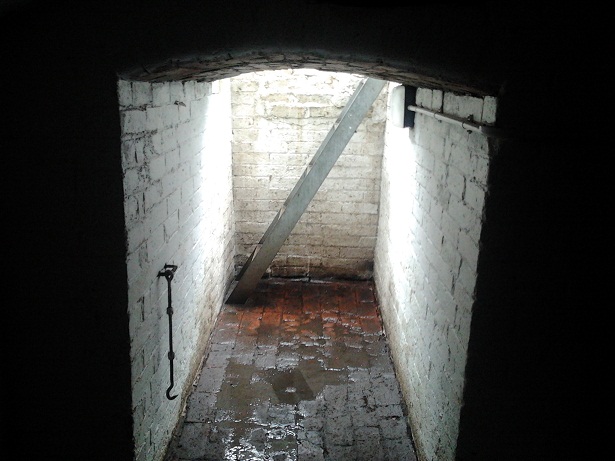
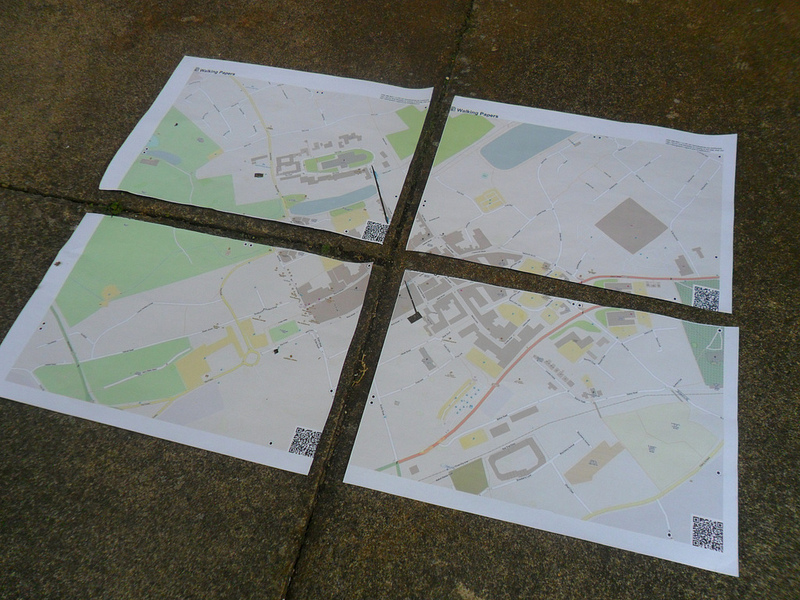
One of these is ‘Hollow Earth Mapping’, a project in which we want to create a way to document underground spaces, mixing together reality and rumours.  We’re asking anyone who already contributed to The Lichfield Underground post via the comments section, or anyone else who has a story, to share them on our flickr page.  It will be a chance to look at  familiar surroundings through the fascinating, captivating and slightly scary world of the underground.

As the stories are shared, the underground spaces will be cut out, creating a hollow space on the map.   The flickr group will be a place for discussion about the stories, and the possibilities that might follow the creation of the map…..

The Lichfield Underground

St Mary's House, The Close.

My introduction to Lichfield’s underground world came a couple of years ago, on the thoroughly enjoyable Gruesome & Ghostly City tour.

Then, back in January 2011, there was a series of great posts on TamworthTimeHikes about underground mysteries in Tamworth. As a result, information came to light (sorry!)about tunnels in Lichfield and Mark kindly passed the information on to me. Since then, tunnels have resurfaced several times (sorry again!), most recently in conversations with Vickie Sutton, Brownhills Bob , the folks at the BeaconStBlog, and as you may already have seen, in the comments section of the Monks Walk post. So, I thought I should finally get around to doing something on them! Here’s what I’ve heard/read/speculated about so far…..

1)      Under Sandford St

My first tunnel! Standing on the corner of Sandford St on a chilly October night we were told that tunnels led from that area to the Cathedral. In recent conversations on the Monks Walk post, ‘Born a Lichfeldian’ has contributed more to the story of the tunnel, suggesting that the tunnel also runs to The Friary.  You can read the discussion here.

2)      White Hall on Beacon St

In a book ‘Lichfield & its Cathedral’ by H Snowden Ward (1893) is the following description “From the cellars of the inn, an underground passage ran some distance and was popularly believed to terminate as St Chad’s Church. That is went so far is extremely unlikely, and what was its object or termination will never be known, for a few years ago the late owner of the White Hall caused the portion under that house to be filled up, and without having the passage explored through its whole length”.

Edit 15/11/2011

City librarian & historian J W Jackson (who I’ll introduce you properly to another time) noted in his weekly history column in the Lichfield Mercury of the 1930s that the tunnel under White Hall was dug out by a previous owner during the plague. Presumably he wished to go about his business without soming into contact with carriers of the disease or the bad air that some thought caused the plague at the time. Would be interesting to see if there are stories of any tunnels elsewhere being dug for this purpose?

3)      Under Dam St

Some information from googling,  that I think came may have originally come from the Staffs Books Shop that used to be on Dam St, says that there is speculation that a passage runs along Dam St from the Cathedral to the Guildhall, and was used as an escape route during the Civil War. In an 1819 book, ‘A Short Account of the Ancient & Modern State of the City & Close of Lichfield’, it says ‘A large subterraneous passage of stone, several feet beneath the surface, has been traced from the middle of Quonians Lane, under the houses on the west side of the street, for a considerable distance in the gardens; its use cannot now be ascertained.”

4)      St Mary’s House in The Close

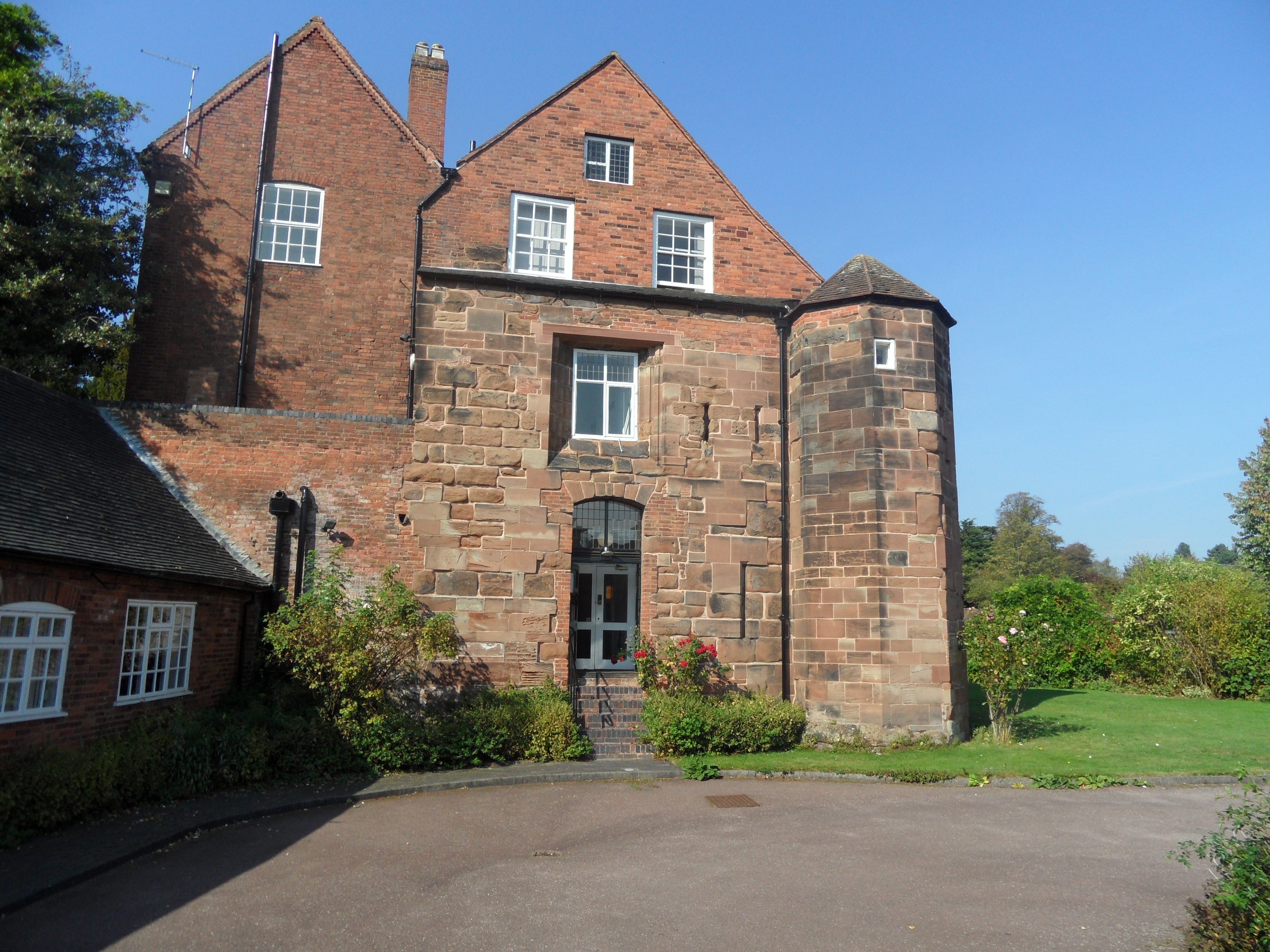
In the Lichfield Records Office there is a copy of Lomax’s Pictoral Book of Lichfield, edited by Alan J Bull. It describes St Mary’s House as the oldest house in Lichfield and says that the East & South walls are part of the original building which dates back to before 1321 and formed part of the Close’s defences – at the base the walls are 6ft thick and you can still see the arrowslits. The book goes on to say that tradition has it that below this building are underground passages leading to St Chad’s, White Hall, the Friary, St John’s Hospital and the Old Brewery on Sandford St.

5)     Beacon Street again!

Vickie’s Aunt remembers seeing a very large tunnel somewhere in the vicinity of Beacon St, which she describes as being whitewashed and large enough for a coach & horses to get through.

6)      Tudor Tea Rooms

On their own website, there is a description of a passage going from their cellars to the Cathedral. They speculate that it may have been dug out  during the Civil War. Apparently, the “passage has been followed for some distance in recent years, but is too dangerous to pursue further”

7)      Greenhill

A rumour of a tunnel behind a building on Greenhill, which used to be a pub called the Spread Eagle. (You can still see the archway for the coaches & the building is called ‘Spread Eagle House’).

As well as discussing tunnels, I’ve also been talking to people recently about the importance of stories & legends, like these. Do we really need to get to the truth or should we leave them be & enjoy them for what they are? I still haven’t made my mind up, so, I’ll leave it for you to decide in this case.

Therefore, this next part is a bit like a Choose your Own Adventure book (remember those? I used to have my fingers bookmarking about 5 different options at a time!). If you would like to investigate the truth behind Lichfield’s mysterious tunnels you could start by clicking here or exploring some old maps of Lichfield here. Just suggestions though, can’t guarantee you’ll find the answers!

If you’re happy to accept the stories as they are, then relax and perhaps go & make yourself a nice cup of tea 🙂

Edit:

I’ve been told about another tunnel by someone on Twitter – one between Gaia Lane and the Cathedral. Apparently it leads to a house that used to be used as a laundry/servants quarters. A relative of my tunnel informant has actually been in the tunnel, and says it is blocked off. We’re thinking laundry tunnel, servants passage – anyone else know anything?

Interestingly there was a daughter and mother,  Ellen Stone and a Mary Skelton, both described as a ‘Laundress’ living at Gaia Lane on the 1851 census. Going off topic somewhat, Ellen’s son Henry lived with them. He was illegitimate and there is some interesting speculation on who his Father may have been. You can read more at the Stone Family History site here.

Edit: 10/3/2012

I’ve come across a scribbled note I made some time ago which says there is a tunnel underneath Farewell Church. Interestingly, there is a work of semi- fiction set at the nunnery that preceded the church. The story is set at the time of the dissolution of the monasteries and is called ‘A Tale of Fairwell’. The last scene of the book is set in ‘the subterranean vaults of Fairwell Priory’.

Also, Hanch Hall has a confirmed underground passage of some description – the listed building description says there are ‘extensive brick vaulted cellars with vaulted passage or drainage channel leading into the park’.

The Grave of Poor Bessy Banks

I spotted a place labelled Bessy Banks’ Grave on the 1815 Ordnance Survey drawing of Lichfield by Robert Dawson 1815.

Immediately, I thought of the story of Kitty Jay on Dartmoor. A little investigation has revealed a few details. In ‘History of the City and Cathedral of Lichfield’ by John Jackson (1805), I found the following;

“…of Betsy Banks grave* once the famous rendezvous of lovers….now no more is remembered than that poor Betsy is said to have fallen victim to hapless love.

*there is a spot in a field in Lichfield still distinguished by that name”

Anna Seward wrote to her friend Honora Sneyd about the place in a letter dated May 1772, that she described as ‘Written in a summer evening from the grave of a suicide’. I’ve only included the first part as its quite long.

“It suits the temper of my soul to pour
Fond, fruitless plaints beneath the lonely bower,
Here, in this silent glade, that childhood fears,
Where the love-desperate maid, of vanish’d years,
Slung her dire cord between the sister trees,
That slowly bend their branches to the breeze,
And shade the bank that screens her mouldering form,
From the swart Dog-Star, and the wintry storm….”

Another reference can be found in one of David Garrick’s letters.  He wrote that “the name Dimble is given to a sunken road leading north from Lichfield past a spot, supposedly haunted called Betty Honks Grave. Two sister trees form an elegant arch over a stream”.

By 1791, it was found that the sister trees had been recently cut down.

So who was Bessy Banks, did she really exist? If so, is her grave still there, now unmarked and unremembered?

Edit 5/9/2011

I recently had the St Chad’s tithe map (1849) out in Lichfield Record Office, looking for something else. A whole plot of land is listed as ‘Bessy Banks’. Born a Lichfeldian has kindly worked out where the stream in this area would have been. Taking into account this and the tithe map it seems that ‘Bessy Banks’ was somewhere in the region between Dimbles Lane and Greencroft.
John Jackson’s description suggects that in 1805 the story is already an old one. It does seem a fairly well-known tale, to have actual places on maps marked after it, as well as being mentioned by Garrick (albeit with the name Betty Honks!) & Seward.  Was it just a made-up story, or did it arise from actual events? I wonder when (and why?) the people of Lichfield stopped telling the story? Or could there even still be people who could tell us the tragedy of Lichfield’s ‘love-desperate maid?’

Edit: 15/4/2012

A notice in the Lichfield Mercury 20th February 1914 lists a lot for sale as garden land, known as Bessy Banks, adjoining a plot of arable land let by T Chapman and located next to Gaiafields House and Gaia Fields Cottage.