What’s in a name? Quite a lot actually, Juliet bab. The authors of ‘England in Particular’, a book that has been one of the biggest influences in my wonderings and wanderings over the years (second perhaps only to the Ladybird book of castles) describe it perfectly. Names carry resonances and secrets.

I’ve got an urge to do something that combines my love of linguistics and local history by exploring the Midlands via its place names. I want to know why there is a Snailbeach in landlocked Shropshire, how an Anglo-Saxon god clung on in Wednesbury in the West Midlands, and whether Foul End in Warwickshire was as bad as it sounds.
My interest in place names associated with death was brought to life several years ago when looking at a map of Lichfield from 1815 and spotting a place called ‘Bessy Banks Grave’. I’ve written at length on this lost name and the story behind it here.

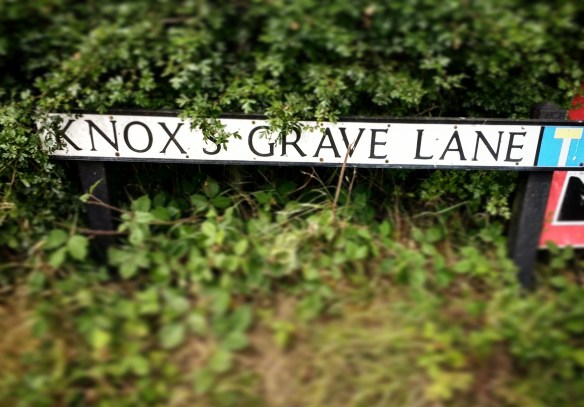
Just up the road in Tamworth is Knox’s Grave Lane. The locally accepted story behind the name seems to be that Knox was a footpad who preyed on travellers passing through the country lanes around Hopwas Woods. His criminal career came to an end when he attempted to hold up a stage coach on route to Ashby but was arrested by the four army officers who were on board. Knox was hanged three days later, and his body gibbeted somewhere at the junction of Flats Lane and Watling Street. His poor parents, in all senses of the word, cut down his body and buried it near to their cottage on the lane. Apocryphal or authentic?
In his invaluable PhD thesis, ‘A survey and analysis of the place names of Staffordshire’, David Horovitz includes a section on those which appear to be associated with corpses. These include Dead Woman’s Grave (supposedly after a woman who hanged herself in a skein of wool and was buried at crossroads two miles to the west of Codsall) and Dead Lad’s Grave at the junction of Birches Barn Rd and Trysull Rd, three miles south west of Wolverhampton. There was also a Dead Knave to the north of Sedgley, a Dead Man’s Lane in Newcastle Under Lyme, and Alice Hurst’s Grave, in the vicinity of Rolleston, near Burton on Trent.
However, Horovitz warns that popular etymology has led to that some names being corrupted, giving the example of a place called Dimsdale near Newcastle under Lyme being altered to Deadmans Dale in the early nineteenth century. Another Dimmins Dale on Cannock Chase also seems to have been sensationalised around the same time, and was known as ‘Demons Dale’ for a while.
Lichfield was of course believed to mean ‘the Field of the Dead’ for centuries. The actual meaning is now accepted to be something along the lines of ‘the field near the grey wood’, although not by all and the field of the dead interpretation lives on. In his article on Names and Identity, Botolov Helleland of the University of Oslo says it’s possible to listen to place names as voices from the past. The British and the Anglo-Saxons are telling us that, for them, significance lay in the location of the settlement near a grey wood but it was a legendary field of slaughtered martyrs which resonated with those who came after them.
At the heart of what I want to do is to use place names as a way of trying to make sense of people’s sense of place and both real and fake etymologies, whether accidental or contrived to deliberately to change the story of a place, are a part of this human geography. I’ll be starting a new blog to cover all this after I get back from my holiday near Shitterton, which sits on a brook which flows into the River Piddle in Dorset and frequently appears on lists of Britain’s rudest place names. Go ahead and snigger as I did when I found out, but actually it brings more to the discussion than just a bit of light relief amidst all the death. In the nineteenth century, those delicate Victorians attempted to change the name to Sitterton, which is an example of etymology that says a lot more about people than it does about a place. Although some locals apparently still prefer the sanitised version of the village name, most are proud of their earthy origins, so much so that they decided to have it set in a ton and half of stone after the ‘official’ village sign was stolen for the umpteenth time. “We thought, ‘Let’s see them try and take that away in the back of a Ford Fiesta'”, explained the chair of the parish council. Might get it in the boot of a Leomansley Tractor though….
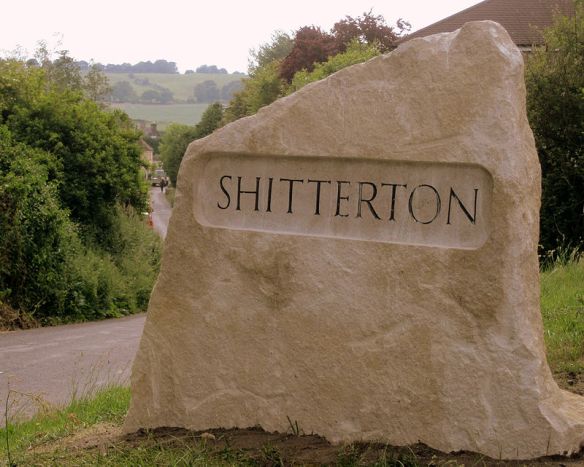
Taken from Wikipedia
References
Helleland, B. Ore, C_E, & Wikstrøm, S (eds.) Names and Identities ,Oslo Studies in Language 4(2), 2012. 95–116.
Horovitz, D. (2003) A survey and analysis of the place-names of Staffordshire, PhD thesis: University of Nottingham
King, A & Clifford, S. (2006) England in Particular: A Celebration of the Commonplace, the Local, the Vernacular and the Distinctive, Hodder and Stoughton: London
http://www.telegraph.co.uk/news/newstopics/howaboutthat/7906091/Shitterton-and-a-sign-of-the-times.html




















 Lichfield Lore
