Land of the Faroes

We’re really lucky to have a good range of independent shops and businesses, both in the centre of Lichfield, and in the surrounding area and it’s great to hear that another unique shop is opening next week.

Opening on Tuesday 3rd July, at the Heart of the Country shopping village at Swinfen, Faroe Born will be selling 100% Faroese wool clothing, accessories, yarn and more. All Faroe Born garments are machine-knitted or woven and then fulled according to traditional methods. This procedure ensures that the garment is wind and water resistant while it maintains its soft and warm texture. With the ‘summer’ we’re having, that sounds incredibly appealing! The shop will also be selling a range of cutlery and tableware. The shop belongs to Ian, a great supporter of this blog and all things Lichfield!

As if all that wasn’t enough, they also have one of the cutest logos around. Meet Sirri the Sheep!


A View from the Bridge

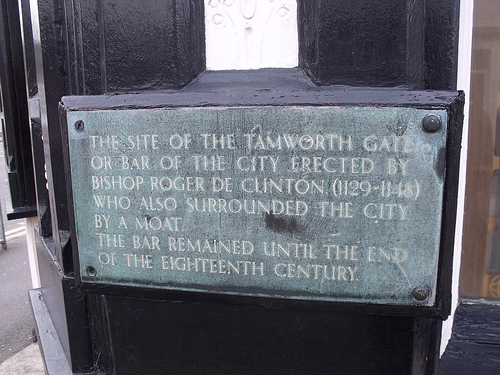
A quick trip to the shop turned into a two hour walk, a good proportion of which was spend in the Stowe area of Lichfield. I found the plaque marking the approximate site of the old gate or barr into the city and then I remembered that the Cruck House was nearby.

Cruck House


Site of Stowe Gate, end of George Lane/Lombard St

Stowe Gate plaque

 I wanted to get over to Stowe Pool, to see if there were any water lilies this year and crossed over using the bridge,  something I hadn’t ever done in 8 years of living in Lichfield!

View from the bridge


The rooftops of Stowe


Willows


There were water lilies in the pool although possibly not as many as there were the same time last year. Whether this is because the sun has gone awol this year, I don’t know. I didn’t spot any nests amongst them either. This might be as they’ve chosen to move onto the specially built wildfowl islands built in the centre of the pool instead!

June 2012


June 2011


Back to the ward banners in the Guildhall and I think that Stowe’s is the one showing St Chad’s cross, relating to the fact that St Chad’s Church and St Chad’s well are found inside this ward.

Although the Stowe St gate is long gone,  I do get a sense of being outside the city here. It’s a wonderful place to explore and enjoy. One of the definitions I’ve seen for the placename Stowe is ‘meeting place’, and from my lookout point up on the bridge I saw children playing, people out for a walk and couples sat talking. If you ever get the chance to join them, you should.

Tree following: Midsummer

Even though it feels as if it’s barely begun, it’s already Midsummer and the lane next to the church is now green and leafy. Lovely as it is, this is probably the least interesting time for the lane.

Fallen elderflowers and other petals lie scattered like confetti from nearby Christ Church.

Alongside them are Midsummer reminders of Autumn.

The holes in the tree still hold a fascination for me. I put my hand in and took some more photos of the inside, with irrational thoughts of the Boca della Verita at the back of my mind.


Bit of a Bore

Last night in the Horse & Jockey on Sandford Street, the Holden’s Golden Glow and the football were in full flow. The former was definitely more satisfying than the latter. As Spain made their millionth pass around the forty minutes mark, my mind started to wander. It wandered back to Bore St, where I was still trying to work out which of the ward banners belonged to this Lichfield ward and why (some of the name plaques underneath the flags were obscured when I went back to check).

Bore St ward banner?


It dawned on me that this flag showed the city maces, which are used in civic processions and date from 1664 and 1690. The centre of civic events in Lichfield is of course the Guildhall on Bore St where of course the flag is hanging. So I should probably  have worked this one out a bit quicker!

The maces being carried in the 2012 Lichfield Bower procession


Whilst we’re on the subject of football, what about the golden balls of the Lombard St ward banner? I didn’t know until now but Lombard is another name for a pawn broker, and of course this type of business has long been identified by this symbol. Wikipedia explains that the concept originated in the Lombardy region of Italy.

Lombard St was once known as Stowe St infra barras (i.e. the part of Stowe St inside the barrs (or gate) of the city). Did the name change occur when this kind of business was set up in the street? Or is there another reason?

Lombard Ward banner

Hospital Ward

In 1781, John Snape carried out a census of Lichfield, making a list of the different wards of the city in the process. The wards are as follows: Bacon St (now Beacon St), Bird St, Sandford St, Sandford St below the water, St John’s St, St John’s St above the bars, Sadler St (now Market St), Bore St, Wade St, Dam St, Tamworth St, Lombard St, Stow St and Greenhill.

I think that these are the wards depicted by the flags hanging from the ceiling of the Guildhall, discussed here in my previous post. Now that I’ve finally made it back into the Guildhall to check which flag corresponds with which ward, I’m going to take each one in turn, trying to discover the significance of the design on each flag. Some I’m pretty sure of, others I’m really not (I’m talking about you Sandford St below the water ward!)


Photo from Ell Brown via flickr

 I’m starting with the flag that represents St John’s ward. Not only is it my favourite of the banners, it’s also seasonal with the feast of St John’s (or Midsummer’s Day) on 24th June. St John St gets its name from The Hospital of St John The Baptist (the place with the chimmneys!). The design from the flag is also on the board outside St John’s chapel, but what does it represent? The yellow flowers must be St John’s Wort, associated both with the saint and midsummer. What are the flowers growing around though?  Well, it’s taken a lot of googling but I think that it’s St Anthony’s Cross (also known as the Cross of Tau), often associated with St Francis. This possibly explains its inclusion, as the site of the Franciscan Friary lies within this ward . Part of the old Friary wall can still be seen on St John St.

Please feel free to join in with the speculation on this and any of the other flags that follow!

Photo of St John’s board from Ell Brown’s Lichfield Group photo set on his flickr stream, included with thanks.

A Flag Post

Hanging in the main hall of Lichfield’s Guildhall are banners representing the city’s wards. I’ve read on an information sheet about the Guildhall that these flags were created in 1975, by students from Lichfield’s School of Art. However, I’m wondering if they are based on anything earlier or if they are just recent(ish) designs? It does seem possible that each ward may have had its own symbol in the past – talking about The Court of Array in 1805, Thomas Harwood said,

“The public officers of the city attend and various processions are made by the constables and dozeners of each ward who in these processions anciently bore tutelary saints but which are now converted into garlands of flowers or emblems of their trade”.


Now, I had written down which flag in the Guildhall related to which ward on a piece of paper but I left it at the pub over the jubilee weekend (Ye Olde Windmill in Gentleshaw where I had a lovely steak & ale pie.  In fact, as the name suggests there is a ruined old windmill in the grounds, so the pub probably deserves a post of its own). I’ve been back to the Guildhall several times since, but haven’t been able to get into the main hall for one reason or another.

I can remember all but two. I think. Some are definitely more obvious than others. I reckon the best thing to do is put the photos up and see if anyone has any ideas about which flag relates to which ward and why. In the meantime I’ll try and get back to the Guildhall to make another list and hold onto it this time!  

.


By the way, there is no flag for Leomansley, so I’ll just have to design my own. If anyone from the Lichfield School of Art Class of 1975 wants to get in touch to give me a hand with this, or to share the story of how the other banners came to be made,  that would be fantastic!

(1) History, Gazeteeer & Directory of Staffordshire William White 1834

A Short Account of the City & Close of Lichfield’ by Thomas George Lomax, John Chappel Woodhouse, William Newling (1819)

Lichfield: Town government, A History of the County of Stafford: Volume 14: Lichfield (1990), pp. 73-87


In defence of Lichfield

As I mentioned in the last post about the West Gate, some other remnants of the Close’s medieval defences are visible.  I’ve marked the ones I know about, on the map below, with a bit of information on each. I’m sure there’s probably more, and we could probably work out where the other defences were, but it’s a start!

1. Site of the West Gate – see previous post here

2. Remains of North East Tower & ditch. A scheduled monument, sometimes known as the Bishop’s Tower, this was part of the original, medieval bishop’s palace. The pastscape record can be seen here. A description of the tower and how it fitted into the rest of the palace can be found in several books on the Cathedral & Close (1) and is based on a plan that was held in the Bodleian Library (is it still there?). A plan drawn from this can also be found here.

At the north east corner was a tower fifty two feet high and each of its ten sides thirteen feet on the outside. It was called the bishop’s tower and the ruins yet remain. Adjoining this tower was a square room with stone stairs leading to the top on the north west of which was an apartment with a cellar underneath twenty two feet in breadth and sixty three feet in length. The bishop’s lodging room was forty feet by thirty two with a leaden roof and cellar underneath. On the north side of this room was a large chimney piece opposite to which a door led to the dining room sixty feet long and thirty broad. At the east end was a door opening into the second tower which consisted of five squares eleven feet in width and thirty two in height. There were two apartments each twenty feet by seven separated from each other by the large hall chimney, , the lady’s chamber…the brewhouse…and the kitchen.


 3. St Mary’s House. Incorporates a turret and part of the Close wall on the east and south side. Not only are there are arrow slits, but there are also rumours of a secret tunnel down below….Actually, it’s not that secret as loads of people seem to have heard about it.

 4. Remains of Eastern Tower of South East Gate. This description comes from the ‘Lichfield: The cathedral close’, A History of the County of Stafford: Volume 14: Lichfield

The gate built by Langton at the south-east corner of the Close had two towers. The eastern one, whose base was excavated in the late 1980s, was a half-octagon with 12-ft. sides. The western tower was presumably of similar dimension. The gate had a portcullis in 1376.  There was a drawbridge, still in existence in the earlier 18th century, which crossed the outflow of water from Minster Pool, and also a wicket for pedestrians. The gate was removed in the mid 18th century in order to improve access for coaches into the Close.


There’s also this bit of wall behind the Chapters coffee shop, which provoked a bit of discussion on Brownhills Bob’s Brownhills Blog, and with Annette Rubery. Especially about what that recess is!

While I was having a flick through googlebooks trying to find information on the subject, I came across an interesting snippet. Adrian Pettifer, in ‘English Castles: A County Guide’ makes the point that that unlike the majority of cathedral cities, there was no wall around the city of Lichfield as a whole.

So whilst the Close was protected by a strong wall, a ditch, 50ft towers, drawbridges and portcullises (when you put it like that it really does sound like a castle!), what did the rest of the city have? Well, there was a ditch. It’s thought even this was used more for controlling traders coming in and out of the city, than for defences. An archaeological dig carried out on the Lichfield District Council carpark in Frog Lane, also confirmed that the ditch was used as the city dump and found a variety of material, including it appears, the dog from Funnybones. There were gates too, the positions of which are still marked by plaques. Again, though it’s thought these might not have been defensive. I think the ditch and the gates deserve a post of their own, so I’ll come back to them another time.

Credit: Ell Brown (taken from flickr photostream)

This will also give me time to think about my latest question (one I’m sure has been thought about and answered by clever people already!). Was the city of Lichfield defended, along with the Close? And if not, then why not? Of course, if anyone has any ideas about this in the meantime, please let me know!

Footnootes:

(1) This particular description is taken from ‘A short account of the city and close of Lichfield by Thomas George Lomax, John Chappel Woodhouse, William Newling

(2) Thanks to this website http://gatehouse-gazetteer.info/English%20sites/3329.html for pointing me in the direction of some great links.

(3) I’ve also used this book From: ‘Lichfield: The cathedral close’, A History of the County of Stafford: Volume 14: Lichfield (1990)

West Side Story

The view of the Cathedral as you turn from Beacon St into the Close, must be one of the most photographed in Lichfield. It’s stunning. However, if you can tear your eyes away from the spectacular west front of the Cathedral, there’s something else here that I think is rather special.

Remains of the West Gate.

Sandwiched between two houses are the remains of the West Gate, dating back to the early fourteenth century. The rest of the gate was demolished in 1800, as Thomas Harwood describes, “…that noble gate at the west entrance into the Close, a beautiful structure worthy of its munificent founder and which in April 1800 was with a barbarous taste, pulled down, and the materials applied to lay the foundation of a pile of new buildings for the residence of necessitous widows of clergymen”. (The new buildings Mr Harwood describes is Newton’s College opposite. If this is true it’s a bit more house old recycling!).

In the same book, Harwood mentions the gate again saying,”At the entrance into the close on the west stood the beautiful gate which was built by Bishop Langton in the early part of the fourteenth century. It was a very strong a double gate with portcullis of great strength and majesty. The strong tower over the gate was finished in the time of Bishop Northburgh, the successor of Langton. This noble structure which had unimpaired during the revolution of five centuries and had withstood the destructive ravages of civil war was pulled down in April 1800 to widen the road into the Close”

Personally I’m a big fan of crumbling, old bricks, but if the gate had remained then, we wouldn’t be treated to that amazing view. Whether the decision to demolish the gate was barbarous or not, all we have now are these remaining stones and the descriptions, together with some maps and drawings.  The rest is down to our imagination….

The Lichfield District Council flickr stream has this image.

Taken from Lichfield District Council flickr group

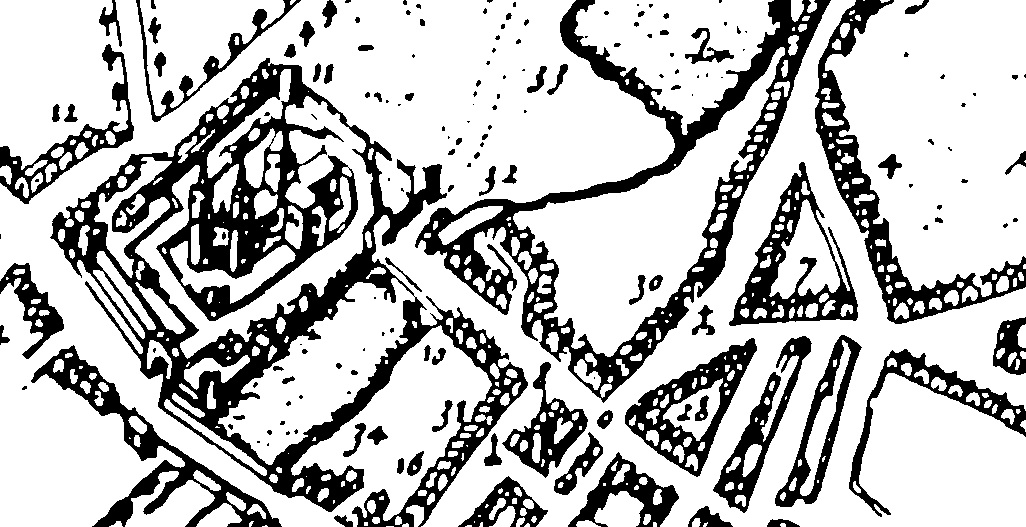
On the Staffordshire Past Track website, you can also see a view of the gate published in 1805. Still a ruin, but in slightly better repair than the previous image. There’s another image here , this time from further away showing how the gate fitted into the area around the Close. This ‘ancient view’ of the Close, seems to be an artist’s impression from 1805 to show how the Close would have looked surrounded by its protective walls, gates and towers. John Speed’s 1610 map also shows the defences, including the gate.

1610 map of Lichfield

I’d like to explore the other remaining fragments of the defences, but for now I’ve got enough questions about this part to be going on with! Why leave this portion of wall   – why not demolish the whole thing? On the wall itself, why do some of the stones have dimples on (I bet there is a technical term for this!) Were materials really used for Newton’s College?

And what about that door! What’s behind there? Who was the last person to go in there (and did they ever come out again!). Why is there a door there at all? To access the ‘strong’ tower in Harwood’s descriptions?  Most importantly, where do they keep the key and could they open it for the Heritage Weekend?!

Edit: Take a look at the comments section – some of the questions have already been answered by Nigel, Managing Director of Lichfield Lock & Key, up on Church St and Pat, who seems to know a thing or two about old bricks!

Sources

The History & Antiquities of the Church and City of Lichfield – Thomas Harwood

Lichfield: The cathedral close – A History of the County of Stafford: Volume 14: Lichfield (1990), pp. 57-67. URL: http://www.british-history.ac.uk/report.aspx?compid=42343

Lost in the Woods

Whenever I see an object out of place it intrigues me.  I’m not talking litter here, I mean the things that are dropped by accident, things that are left behind. Lost property. Things that might (or might not!) interest future archaeologists if they were to discover them in a couple of centuries time.  I want to know the story behind them, who they belonged to & how they ended up lost, but I realise that I might be on my own with this one! 

I’ve put together a gallery of things found on the path past Leomansley Wood to Pipe Green and on the Green itself.

Lost by a horse, found by a friend. Brownhills Bob told me that it's not that old. Still lucky though!


Dropped by someone in need of a lucky horseshoe? Or on the way home from the fair?

Lost whilst blackberrying?


Dropped after an impromptu paddle in the brook?


See above!


In the rough. Not sure Leomansley Wood makes a great fairway.

Or a great rugby pitch either.

I guess the robber escaped from the cop.


The remnants of an overenthusiastic dog's toy?

I would ask people to send me photographs of things they’ve found, but I appreciate that I might be the only person in Lichfield who goes around taking photographs of old socks!


House Old Recycling

With a long awaited cafe & kiosk opening in Beacon Park this week, it reminded me that I wanted to have a look at the reuse of old buildings parts in Lichfield.

The connection? Well, the new Chandlers Cafe is in the 1930’s mock tudor building on the edge of Beacon Park. According to a plaque, it incorporates materials from the old Friary. I’d love to find some records that confirm whether or not this is true and if so,  how this came to be.

The provenance of the nearby balustrade running around Beacon Park is more of a mystery. Both Annette Rubery and myself have so far drawn a blank when attempting to discover its origins. Did this start life elsewhere?

More information is available on the balustrade running around the Garden of Remembrance opposite, albeit a little contradictory. The listed building description suggests that the balustrade came from Moxhull Hall in Wishaw, although Lichfield DC’s website disagrees, saying that it came from Shenstone Court, and that it’s the stone lions on the pillars that come from  Moxhull Hall. Does anyone know any different?

If the balustrade is from Shenstone Court, then its not the only bit of that old house we’re supposed to have made use of here in Lichfield! The portico at the entrance to the site of the Friary is also said to have been salvaged from the demolition of the Cooper Family mansion. However, according to the Lichfield Council Conservation Area Document, this is one of ‘countless unsubstantiated stories about the portico coming from important buildings in the Lichfield area and ‘it is equally possible that it was made in 1937’. I think this might be another one for further investigation!

Finally, for this post at least, there’s the Old Stables in The Close (formerly the Visitors Study Centre). These belonged to Bishop Hacket’s now demolished house which stood on this site until 1799.   Material from the remains of the walls of The Close, from the heavily damaged, original Bishops Palace, and possibly even the Cathedral itself are thought to have been used during construction of these buildings, which are alongside Chapters Restaurant.

I’m sure there must be more in Lichfield –  I’ve even seen garden walls built with what looks like the remnants of old buildings. If anyone knows of any more examples,  I’d love to hear. In the meantime, I’ve heard that there may be more parts of Fisherwick Hall to track down….

Sources: http://www.lichfielddc.gov.uk/downloads/file/375/lichfield_conservation_area_document

http://www.pmsa.org.uk/national-recording-project/

http://en.wikipedia.org/wiki/Bishop’s_Palace,_Lichfield

http://www.british-history.ac.uk/report.aspx?compid=42343#s3


http://www.british-history.ac.uk/report.aspx?compid=42344#s7