Bridge under troubled water

Sometimes you don’t have to look too deep into your past to find the parts of it that have shaped you. On a childhood trip to Cardigan Bay, I remember my imagination being captured by the story of a lost kingdom beneath the waves and sitting at the water’s edge hoping to hear the peals of its sunken bells. I didn’t really know what folklore was back then but something about the story obviously chimed with me.

These memories came flooding back as I read about how Blithfield Reservoir had been created in the 1940s by South Staffs water on land belonging to the Bagot family. Farmland, trees and lanes were submerged along with a mill and bridges.  It might not be the kingdom of Cantre’r Gwaelod  but Blithfield has it’s own legends. A local history book, ‘Around Rugeley from Old Photographs’ by Joan Anslow has a picture from the late 1940s of three women and a man stood on Kitty Fisher’s Bridge, one of the structures that has now disappeared below the water.

https://books.google.co.uk/books?id=1EWIAwAAQBAJ&lpg=PT141&dq=kitty%20fisher’s%20bridge&pg=PT141&output=embed

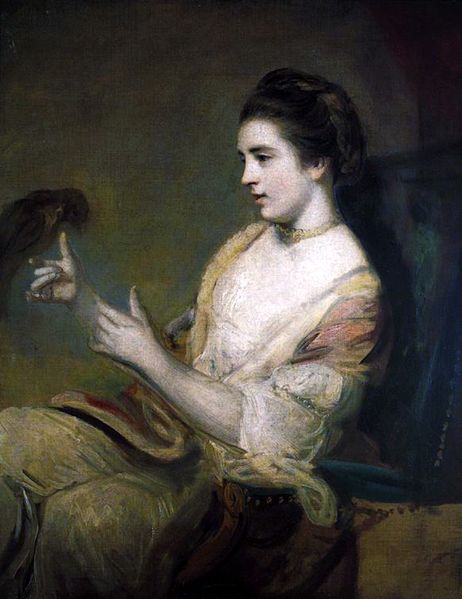
According to local folklore, Kitty Fisher’s bridge (and the brook it spans) was named after a young woman who threw herself from it. Of course I knew Kitty Fisher as the character in one of my childhood rhymes but until now had no idea that it was probably referring to a famous whore. This came shortly after another nursery rhyme related revelation – I was rocked to my foundations when I read a theory that in the verse about a much more famous bridge, ‘my fair lady’ might been a human sacrifice. We shall return to this anon.

Kitty Fisher and parrot by Sir Joshua Reynolds 1763/4
(Taken from Wikipedia)

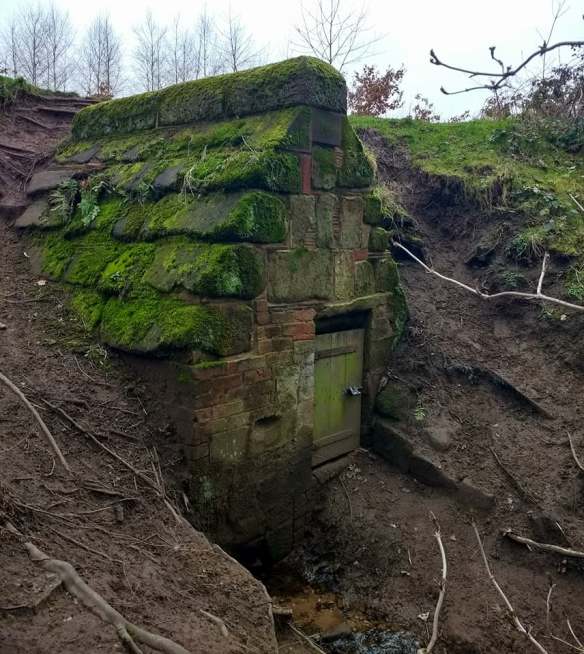
As I was trying to wade through the folklore with my friend Patti, what should pop up on Facebook but a post from Staffordshire Past Track saying that photos of Blithfield Reservoir during the drought of 2002 had recently been added to the online collection. Amongst the structures which re-emerged is a bridge, much dilapidated but still identifiable by its arch. Comparing this with the photo from ‘Around Rugeley’, I would suggest this might be what remains of Kitty Fisher’s Bridge.

Blithfield Reservoir in drought conditions

Blithfield Reservoir in drought conditionsView Full Resource on Staffordshire Past Track

Sadly however, any hard evidence for the origins of its name seems to have sunk without trace.

Sources:

Many thanks to the folks at South Staffs Water Archive

Around Rugeley from old photographs by Jean Anslow

Click to access the-history-of-blithfield-reservoir-2016-final.pdf

The Depths of Winter

Something happens to me once the clock strikes 12 on 25th December.  Maybe it’s a response to the sugar rush that comes from stealing the kids’ selection boxes, but my thoughts turn away from those Christmas lights to the darker side of local history.

Ooops

I always take my ghost stories and legends with a decent pinch of salt and if they’re served with a measure of good humour too, so much the better. As such, I was delighted to discover a story in the Lichfield Mercury from Friday 2nd September 1932, called ‘The Haunted Secret Passage of Lilleshall’.

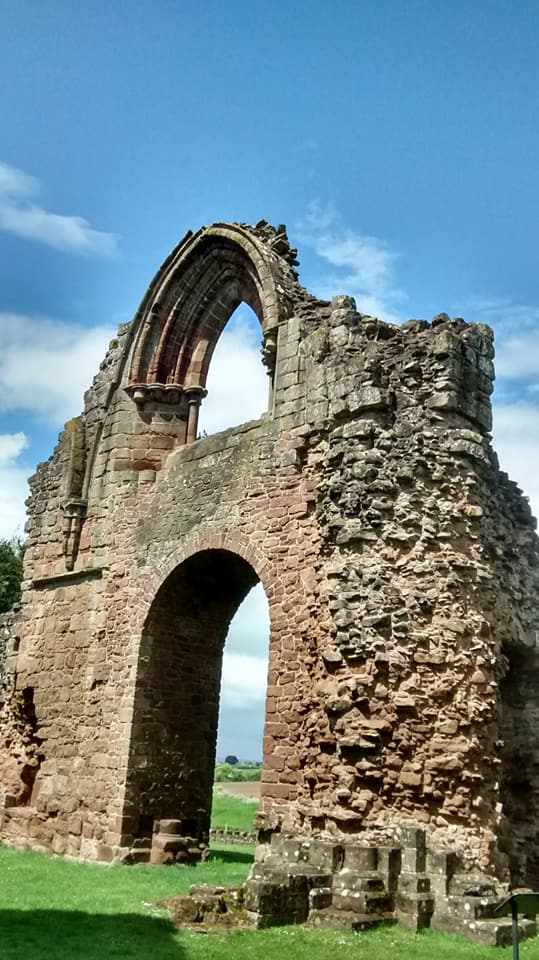
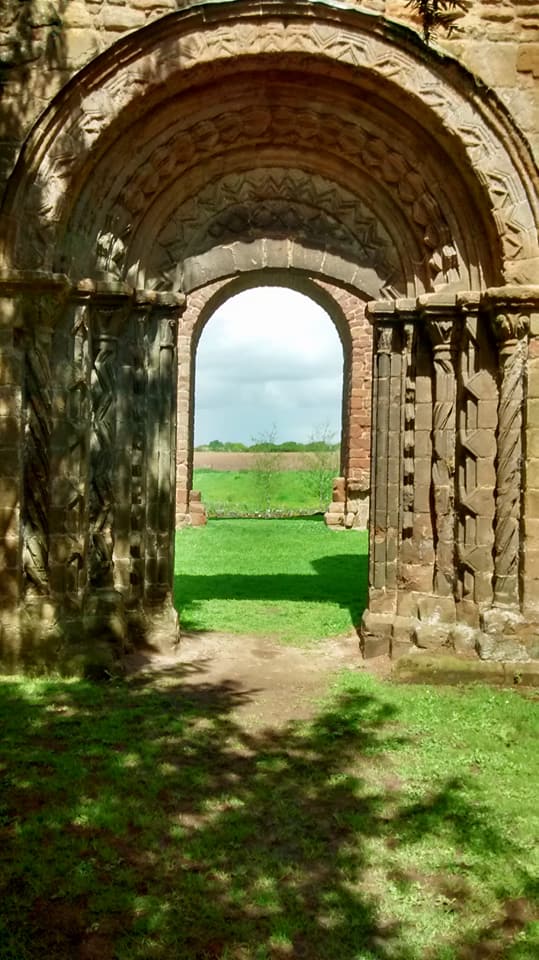
In what sounds like my ideal night out, a group of archaeologists and diviners congregated in a candle lit vault next to the so-called dungeon at Lilleshall Abbey. As they waited to hear if diggers had located an underground tunnel, ‘the sounds of the shovels and picks ‘awoke eerie echoes in the leper’s cell above’.  The reason for the gathering, according to the BBC’s Domesday Reloaded site, was that in 1928 a caretaker and his family had moved into a cottage on the site and heard ghostly moaning from beneath the Abbey. At first, they attributed the sounds to the men working at Lilleshall Colliery. However, when it was discovered that the mine didn’t extend as far as the Abbey, and the son reported seeing a shadowy figure and the sounds of the pages of a book being turned, they began to suspect a more unearthly cause. A £50 prize was promised by the estate agent to anyone who could locate the subterranean passage the noises were believed to be coming from and people began turning up to try and solve the mystery in a variety of idiosyncratic ways. These included a man with a hazel twig he manipulated between his fingers, a white bearded professor, who refused to communicate with anyone and ‘went around the ruins with a little toffee hammer, sounding the ground at various places’ and an old tutor of the Duke of Sutherland, whose family owned the Abbey until 1917, who was relying on his memory to tell him where the entrance to the tunnel was.

The ruins of Lilleshall Abbey

A psychic dental surgeon from Birmingham agreed to spend a night in the dungeon. Surely if anyone was going to find an old cavity, it would be him? However, as dawn broke the following morning, he was nowhere to be found, having fled in terror. Two young men who spent the night in one of the old Abbey cells reported ghostly footsteps and ‘a monk with a high-pitched voice saying prayers in a foreign language’. Although to be honest, that could just have been the frit Brummie dentist running away.

Lilleshall Abbey

The shenanigans also involved a Mr Noel Buxton, a member of the Cambridge Antiquarian Society, who declared he was prepared to stay on-site until the tunnel was found. I didn’t see him when I visited with friends last summer, so perhaps that means it was… The reports at the time are ambiguous – in the Birmingham Gazette on Friday 26th August 1932 it was reported that in a vault next to a dungeon, a diviner received a violent shock which led to the discovery of an underground passage. However, the estate agent said it had not yet been decided whether or not it was the tunnel they were looking for.

Diviner: OMG I did it! I found an underground tunnel!
Estate Agent: Yes…but is it the right underground tunnel?
Diviner: Yes. It is a tunnel and it is underground. Now give me my £50.
Estate Agent: Yes but if it was the right tunnel it would have ghostly monks in and as you can see, this one is phantom friar free. Sorry old chap, better luck next time. Um, please put the stick down…

So, whilst the competition and the talk of haunted dungeons were a clever bit of marketing to attract tourism, it’s fair to say that the notion of a underground tunnel at Lilleshall was not entirely without foundation. As well as the diviner’s discovery, in June 1886, in Eddowes’s Journal, and General Advertiser for Shropshire, and the Principality of Wales, a correspondent writes that his mother, then aged 75, visited the Abbey as a girl and remembered stories of an underground passage said to run from the Abbey to Longford Church, or Longford Hall,  and that once a heavy cart passing over Longford Fields broke into it, but ‘it was not explored on account of the air in it being so foul’. Was this the same tunnel that tuned up in the 1930s?

Lilleshall Abbey

I am genuinely fascinated by the idea of secret tunnels and subterranean passages because everyone else is so fascinated by them! As we’ve discussed before on the blog, Lichfield is apparently riddled with them (as is pretty much every city, town and village in the country) if the stories are to be believed. And that’s the £50 question – are they?

Notes

  1. Fascinating article here from November 2017 about how ten out of twelve water companies in the UK use water dowsing to find leaks and pipes https://www.theguardian.com/business/2017/nov/21/uk-water-firms-admit-using-divining-rods-to-find-leaks-and-pipes
  2. I am available for secret tunnel hunting – you do not have to pay me £50 and I can supply my own toffee hammer too.


Never now to grow old

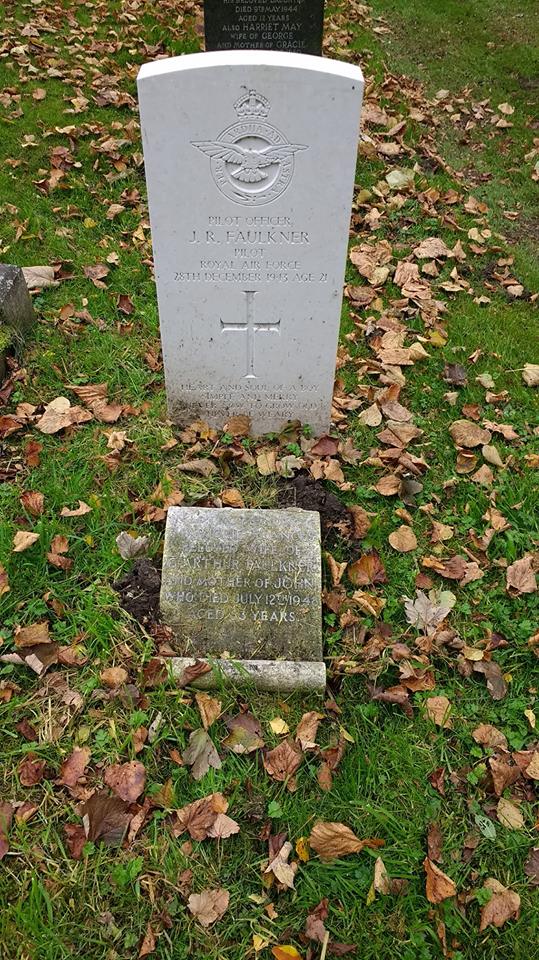
On 28th December 1943, John Russell Faulkner of 504 Squadron was killed aged 21. What caused his death and whether there is a connection with the death of fellow squadron member Philip Dawkins Bailey on the same date is not known. Whilst Flying Officer Bailey is buried in Dorking Cemetery, with 61 other identified casualties from the First and Second World Wars, Pilot Officer Faulkner was interred at Christ Church in Lichfield and is the only war grave in the cemetery.

John’s short obituary in the Lichfield Mercury on the last day of 1943 reads:

On Active Service
FAULKNER – On December 28th 1943, Flight Sergeant Pilot John Russell, RAFVR, most dearly loved only child of Mr and Mrs GA Faulkner, Lloyds Bank House, Handsworth and dear fiancee of Diane Combe-Robinson, aged 21. No letters please. Funeral at Christ Church, Lichfield, Saturday 3.30

Why was John buried at Christ Church given that his parents were in Handsworth? The connection soon became clear after finding an announcement in the Lichfield Mercury relating to John’s birth in April 1922 and giving his mother’s maiden name – Tuke. This led to the discovery of a further announcement relating to George Arthur Faulkner, eldest son of Mr and Mrs Faulkner of Beacon Street marrying Majorie Frances (Madge) Tuke, second daughter of the late Herbert H Tuke and Mrs Tuke of the Walsall Road in November 1917 at Christ Church.

On July 12th 1948, Madge Tuke died at her home in Handsworth and was buried alongside her boy at Christ Church.

When I think of John Russell Faulkner, and so many like him, I think of the opening lines from this anonymous poem:

Not – How did he die? But – How did he live?
Not – What did he gain? But – What did he give?

Christ Church, December 2017


Love Thy Neighbour

Today I’ve been to Slitting Mill, ironing out some of the details relating to the industry that once dominated this small village near Rugeley. Whilst I forge ahead with my research on that, here’s a quick bit of quirkiness to enjoy.

St John the Baptist, Slitting Mill

The village’s church, St John the Baptist, is semi-detached. Unusual perhaps, but far from unique as I discovered when I rashly pondered in public if it was the only semi-detached church in the country. Turns out its not even the only semi-detached church in Staffordshire. It’s been pointed out to me that there are in fact two to be found in a place called Lichfield. St John’s in ye olde city is of course attached to its almshouses, and the listed building description for Holy Cross on Upper St John St describes it as ‘Church of Holy Cross and attached Presbytery and School’. We’ll just blame my over-excitement about Christmas, ok?

St John’s Hospital, Lichfield. Taken from Wikipedia, photo by Nessy-Pic

Holy Cross church and ATTACHED Presbytery

In my defence, both of those are buildings related to the church. At St John’s in Slitting Mill however, the neighbouring property is a private residence. It wasn’t always though – in 1871, the church was built onto the village infant school which was later demolished (although a portion of it remains as part of the church) and a new house built on the site around the 1970s. I’m not sure why at this point, the two buildings were not put asunder?

It seems I’m beginning to amass enough material here to start a ‘semi-detached churches of Instagram’ account. Any further offerings?

References:
http://www.ljw.co.uk/slittingmill/the_church.htm

Taking the air

Almost a year has passed since a group of us got together in St Stephen’s Church, Fradley to talk about how we could record and tell the stories of RAF Lichfield, Staffordshire’s busiest World War Two airfield.

One of the most interesting challenges for me is sifting out fact from fiction. People may think the realms of folklore with its fantastical beasts and quirky customs is a whimsical world away from stiff upper lips and smart uniforms, but airfields have their own rich mythologies. I’d no idea until recently that the RAF even had their own monsters – gremlins were mischievous creatures who hung out in hangars, ready to wreak havoc with aircraft and cause all kinds of technical trouble.

Taken from Wikipedia

In an RAF twist on legends of buried treasure, parts of old aircraft are rumoured to be buried beneath the fields of Fradley. At one of the recent meetings we heard a story from a villager about a plane losing control and hitting an oak tree before crashing into farmland, its engine still supposedly embedded in the ground. We’ve tried (and so far failed) to identify the oak tree and even if we were to, is it likely that this kind of debris would have just been left to rust in a field? After a bit of reading, I’m leaning towards maybe. Earlier this year, a Danish teenager decided he’d investigate a story told to him by his grandfather about a German plane which had crashed on moorland in December 1944. Using metal detectors, Daniel, his friends and his Dad discovered the remains of the aircraft, including its Daimler-Benz engine, and the remains of the pilot with condoms, ammunition, a diary, ration coupons, cigarettes and a wallet emblazoned with a swastika in his jacket pocket. The full story is here. Regarding Fradley specifically, I found an interesting comment on the Airfield Research group forum, which I hope the person who posted it doesn’t mind me sharing here.

“As a member of 1206 Sqn back in early 70’s we had a talk from one of our civvy instructors who had been at the base during the war. He told us of a Wellington that had crash-landed just outside the field and had blown up early next morning killing several fire crew members. We visited the spot and found a large crater, in the bottom of this there were large amounts of RAF related debris, on digging deeper we found a Wellington seat, control column, various instruments….. we came back on the Midland Red bus lugging the seat with us. The items formed part of the relic collection we set up in the ATC hut in Cherry Orchard…….. All this material was apparently thrown away by later C.O. during some tidy up campaign…
My father was stationed at RAF Fradley in early 50’s and he told me the site of the crater was used as one of many rubbish tipping places around the base….. as MT driver he would have known where these were. It explained a lot of the RAF pottery and other debris we found on the surface. The site was close to the Go-Kart track and unfortunately the crater was filled in sometime back in the late 1980’s……..
As for buried aircraft parts on the field……….. those rumours were about in the early 70’s, I talked to a lot of locals and ex-RAF from the base who set up home in Lichfield area…….. never met anyone who had ever seen such pits being dug or items being sent there. Spent hundreds of hours as a kid scouring the area, never found anything apart from the crater site and what I believe was a jet crash site in some woods with aircraft cockpit parts scattered around

It is a fact that after the war, RAF Lichfield was used to break up aircraft including 900 Typhoons, 500 Liberators and 150 Fortresses. I found an article in the Lichfield Mercury on 14th April 1950 about a scrap dealer from Upper Gornal who had been charged with stealing four Oxford aircraft fuel tanks and two engine cowlings, whilst contracted to removed scrap from eight Mosquitos. ‘For security reasons’ (such as?), the latter had to be burned before the metal scrap was collected. The crime had been committed in the area of the airfield known as ‘the graveyard’, but did this literally refer to a place where craft were buried? And if so, are they still there?

Another story about RAF Lichfield is that one pilot overshot the runway and landed in the Trent and Mersey Canal. I’ve heard it from three separate sources but did this actually happen here or is it a story that has been transposed to Fradley? We know at RAF Wheaton Aston,  a P-47 Thunderbolt of the 495 Fighter Training Group crashed into the Shropshire Union Canal as there is photographic evidence but to illustrate how unreliable local stories can be, the banks of the Shroppie canal between bridges 20 and 21 are said to be haunted by the pilot who lost his life in the crash. Except he didn’t –  the only fatalities on this occasion were two cows because they, ahem, didn’t moove out of the way quick enough.  I love stories but we have to take our oral history with a pinch of salt for that very reason – so does everyone else! There’s a book called ‘The Storytelling Animal’ by Jonathan Gottschall that I’ve just found out about which puts forward theories about why humans like stories and why we favour are those which stretch the truth. Perhaps I’ll come back to this once I’ve read it but I’m veering wildly off course myself, and so back to Fradley, and something a little more tangible.

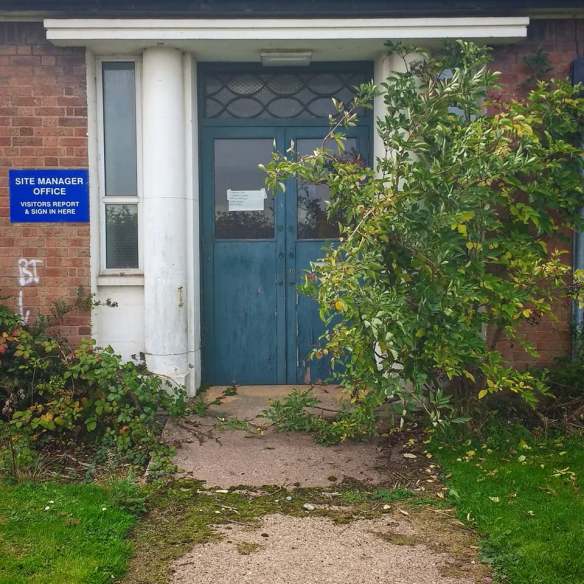
Along with the rest of the heritage group, earlier this month I was lucky enough to have been given access to several old airfield buildings which survive on the site of Palletways, at the industrial estate now known as Fradley Park. There are also two underground bunkers nearby, almost invisible beneath vegetation but winter should reveal more and a return trip may be in order. I featured some of the other surviving buildings of RAF Lichfield, including bomb stores, in this post here.

Entrance to the guard room. Interestingly, this is where the scrap metal dealer who took the Oxford parts was taken for questioning

Entrance to HQ office

Inside of of the surviving hangars, now used by Palletway

The door says messroom but it’s in the building described on maps as the Guard Room – was this usual?

I’ve seen this described both as the mortuary and also, as a gas decontamination building. Perhaps it had a dual purpose?

As at so many other airfields, there are some that say ghosts walk here. I don’t believe they do, but that doesn’t mean that the presence of those who lived, and those who died here isn’t felt in other ways.  Our group is committed to continuing to record the stories of this place and its people. We meet on the third Monday of each month at 7.30pm at St Stephen’s Church in Fradley, and our next meeting is Monday 20th November, and anyone with an interest in the history of RAF Lichfield is very welcome to come and get involved.

Pictures of who?

A box of photographs arrived in the post. Discovered in a house clearance down south somewhere, they were sent to me on the basis that there appeared to be a Lichfield connection. The clue came from a photograph of the Friary School, that at a very rough guess appears to date to the mid-twentieth century.

Sifting through the photographs reminded me of the days spent as a little girl, looking through the mostly colourless snaps of my own family. They were kept in an old biscuit tin, and the faint smell of its original contents would waft out each time the lid was removed. ‘Who is that?’ I’d ask, and my Grandad would tell me the stories of the people in the tin, as I sipped tea made with sterilised milk.

I’ve joked before that every old family photo album includes a picture of men sat in deckchairs in their suits, a young man in uniform, a matronly lady holding on to her skirt on the promenade of some windswept seaside town and people standing proudly by a new car that’d now be displayed at classic vehicle shows. However, looking through this box, the poses might be familiar but the faces are not. This is not my family, and so I’d really like to find it a proper home.

We have a possible connection the to Friary School and Lichfield District Council. The two photographs of the building have ‘Frosts Shop, Wednesfield, August 15th 1954’ written on the back, and our final piece of evidence is an ID card for ME Price who worked for Staffordshire Police.  If anyone can help with my enquiries, please do get in touch.


Hospital Round

A short and sweet post this evening. Which is kind of apt given it has a link to the Cadbury family.

I found myself at the Royal Orthopaedic Hospital in Birmingham today. After dropping my patient off, I spotted this intriguing building. It’s part of a house known as The Woodlands, donated to the institution by George Cadbury in 1907. It’s such an unusual structure and whoever compiled the listing building text agreed. It describes it as being a later addition to the main house, which dates to around 1840, and an ‘…unexplained circular painted brick structure with circular windows with leaded lights, dentilled brick frieze and low conical roof’.

The Woodlands, Royal Orthopaedic

I think it’s quirky and fascinating but I can’t tell you much more about it! I’d love to hear people’s thoughts on it though – did it have a specific purpose do we think, or is its design purely aesthetic? Maybe the city of Birmingham just has a thing about buildings of this shape….

Rotunda

Sources:

http://www.roh.nhs.uk/about-us/our-heritage


Pills ‘n’ Chills and Deli Bakes

Yesterday I was in Tamworth for the summer food festival, enjoying excellent locally produced pork pies, sausage rolls and blue cheese.

After a gentle stroll around the town, I hopped back into the car and headed to Hopwas for a forage. For once, my walk took me along the canal in the opposite direction to the woods, a decision which may have been influenced by having read about a disused and reputedly haunted cemetery on Hints Road.

The graveyard once belonged to Hopwas Chapel, built in 1836 and dedicated to St John, and its resident ghost is said to be a small boy who can be seen by children (but not by a childish 39 year old it seems). The chapel was pulled down in the 1880s, as it was ‘full, small and inconvenient’, and replaced by the gorgeous St Chad’s Church up on the hill. A drawing of the old chapel can be seen here on the Stafforshire Past Track site. The old font survived and stands outside the new church, and the chapel’s bell still tolls in St Chad’s tower.  According to a report in the Tamworth Herald on Saturday 16th April 1898, the holy table from St John’s was made use of in the new Workhouse chapel.

St Chad’s, Hopwas, dedicated and opened in 1881

The old font from St John’s Chapel

Nearby, I found a cottage with the best name ever, which fitted in perfectly with the theme of the day, followed by a pill box in a field alongside the River Tame.

Too well guarded by nettles to even attempt to take a look inside, I plan to return as part of a much longer pill box walk along this section of the Western Command Stop Line Number 5 in winter. If I eat as much as I did at the summer festival, on the way home from the Tamworth Christmas food festival would probably be a good time….


Sources:

Click to access A%20Look%20Around%20St%20Chads.pdf

Photosynthesis

Been catching up on messages (I’m sorry if I still owe you a reply!) and saw I’d recently received a lovely email from Claire who leads a volunteer group called the Heritage Gardeners in Glenside, New Zealand. Claire told me that the group had recently planted a tree in honour of Joan, their longest living gardener. The tree is a copper beech, chosen as Joan has fond memories of one in Lichfield at The Friary, where she attended school between 1938 and 1948. On the Glenside blog, it describes how Joan recalled the school being next to an ancient hairpin shaped path known as the Monks Walk and having to pass a huge and beautiful copper beech tree on a lawn to get there. Joan also recalled how the tree’s catkins were painted gold and silver and used as decorations at Christmas. You can read the full blog post here

Of course, Claire was wondering whether Joan’s original copper beech was still standing 70 years on and 12,000 miles away, and if anyone knows the history of it. The first question I could answer immediately. Well, after a five minute drive to the Friary anyway.

Copper Beech, The Friary

The lawn is now a car park but from Joan’s description this seems to be the right tree. I will send the photographs to Claire and Joan to be sure, as there was another beech tree at the edge of Monks Walk which was lost to a fungus known as Meripilus Giganteus back in 2011, and replaced by a walnut tree.

old-tree-monks-walk

The remains of the diseased beech tree in 2011

As to the history of the tree, it was surely planted by one of the former owners of the Friary, which had become a private estate following the dissolution of the Franciscan Friary in 1538. In 1920, the estate was gifted to the city by Sir Richard Cooper and the following year, a girls’ school took up residence.  It was renamed the Friary in 1926, and the school was based at the site until 1975, when the school relocated to Eastern Avenue, and there are some wonderful memories of the school on the comments on this post.

Mysterious photos!

According to my daughter, receiving a mysterious box of photographs in the post, ‘is how horror films start’…

By coincidence, I received a mysterious box of old photographs in the post a couple of weeks ago. They’d been found during a house clearance and though there are very few clues as to who the people in them are, there are a few which suggest there is some connection to Lichfield, including an school photograph of The Friary which looks as though it dates to the mid-twentieth century.

It’s proving incredibly difficult to photograph, probably because it’s been rolled up in a box for half a century, and so I’m just posting a couple of sections here, to see if anyone can date it more accurately or add anything at this stage. It really would be quite a coincidence if it dated to Joan’s time at the school! When I have better light and more patience, I will post the whole thing, along with the other mystery photographs as I’d love to be able to find a proper home for this box of memories. At the moment however, I’m stumped…

Friary School 1Friary school 5

Friary school 3

Human Remains

What’s in a name? Quite a lot actually, Juliet bab. The authors of ‘England in Particular’, a book that has been one of the biggest influences in my wonderings and wanderings over the years (second perhaps only to the Ladybird book of castles) describe it perfectly. Names carry resonances and secrets.

I’ve got an urge to do something that combines my love of linguistics and local history by exploring the Midlands via its place names. I want to know why there is a Snailbeach in landlocked Shropshire, how an Anglo-Saxon god clung on in Wednesbury in the West Midlands, and whether Foul End in Warwickshire was as bad as it sounds.

My interest in place names associated with death was brought to life several years ago when looking at a map of Lichfield from 1815 and spotting a place called ‘Bessy Banks Grave’. I’ve written at length on this lost name and the story behind it here.

Just up the road in Tamworth is Knox’s Grave Lane. The locally accepted story behind the name seems to be that Knox was a footpad who preyed on travellers passing through the country lanes around Hopwas Woods. His criminal career came to an end when he attempted to hold up a stage coach on route to Ashby but was arrested by the four army officers who were on board. Knox was hanged three days later, and his body gibbeted somewhere at the junction of Flats Lane and Watling Street. His poor parents, in all senses of the word, cut down his body and buried it near to their cottage on the lane. Apocryphal or authentic?

In his invaluable PhD thesis, ‘A survey and analysis of the place names of Staffordshire’, David Horovitz includes a section on those which appear to be associated with corpses. These include Dead Woman’s Grave (supposedly after a woman who hanged herself in a skein of wool and was buried at crossroads two miles to the west of Codsall) and Dead Lad’s Grave at the junction of Birches Barn Rd and Trysull Rd, three miles south west of Wolverhampton. There was also a Dead Knave to the north of Sedgley, a Dead Man’s Lane in Newcastle Under Lyme, and Alice Hurst’s Grave, in the vicinity of Rolleston, near Burton on Trent.

However, Horovitz warns that popular etymology has led to that some names being corrupted, giving the example of  a place called Dimsdale near Newcastle under Lyme being altered to Deadmans Dale in the early nineteenth century. Another Dimmins Dale on Cannock Chase also seems to have been sensationalised around the same time, and was known as ‘Demons Dale’ for a while.

Lichfield was of course believed to mean ‘the Field of the Dead’ for centuries. The actual meaning is now accepted to be something along the lines of ‘the field near the grey wood’, although not by all and the field of the dead interpretation lives on. In his article on Names and Identity, Botolov Helleland of the University of Oslo says it’s possible to listen to place names as voices from the past. The British and the Anglo-Saxons are telling us that, for them, significance lay in the location of the settlement near a grey wood but it was a legendary field of slaughtered martyrs which resonated with those who came after them.

At the heart of what I want to do is to use place names as a way of trying to make sense of people’s sense of place and both real and fake etymologies, whether accidental or contrived to deliberately to change the story of a place, are a part of this human geography. I’ll be starting a new blog to cover all this after I get back from my holiday near Shitterton, which sits on a brook which flows into the River Piddle in Dorset and frequently appears on lists of Britain’s rudest place names.   Go ahead and snigger as I did when I found out, but actually it brings more to the discussion than just a bit of light relief amidst all the death. In the nineteenth century, those delicate Victorians attempted to change the name to Sitterton, which is an example of etymology that says a lot more about people than it does about a place. Although some locals apparently still prefer the sanitised version of the village name, most are proud of their earthy origins, so much so that they decided to have it set in a ton and half of stone after the ‘official’ village sign was stolen for the umpteenth time. “We thought, ‘Let’s see them try and take that away in the back of a Ford Fiesta'”, explained the chair of the parish council. Might get it in the boot of a Leomansley Tractor though….

Taken from Wikipedia

References

Helleland, B. Ore, C_E,  & Wikstrøm, S (eds.) Names and Identities ,Oslo Studies in Language 4(2), 2012. 95–116.

Horovitz, D. (2003) A survey and analysis of the place-names of Staffordshire, PhD thesis: University of Nottingham

King, A & Clifford, S. (2006) England in Particular: A Celebration of the Commonplace, the Local, the Vernacular and the Distinctive, Hodder and Stoughton: London

http://www.telegraph.co.uk/news/newstopics/howaboutthat/7906091/Shitterton-and-a-sign-of-the-times.html