The Faces of Christ Church

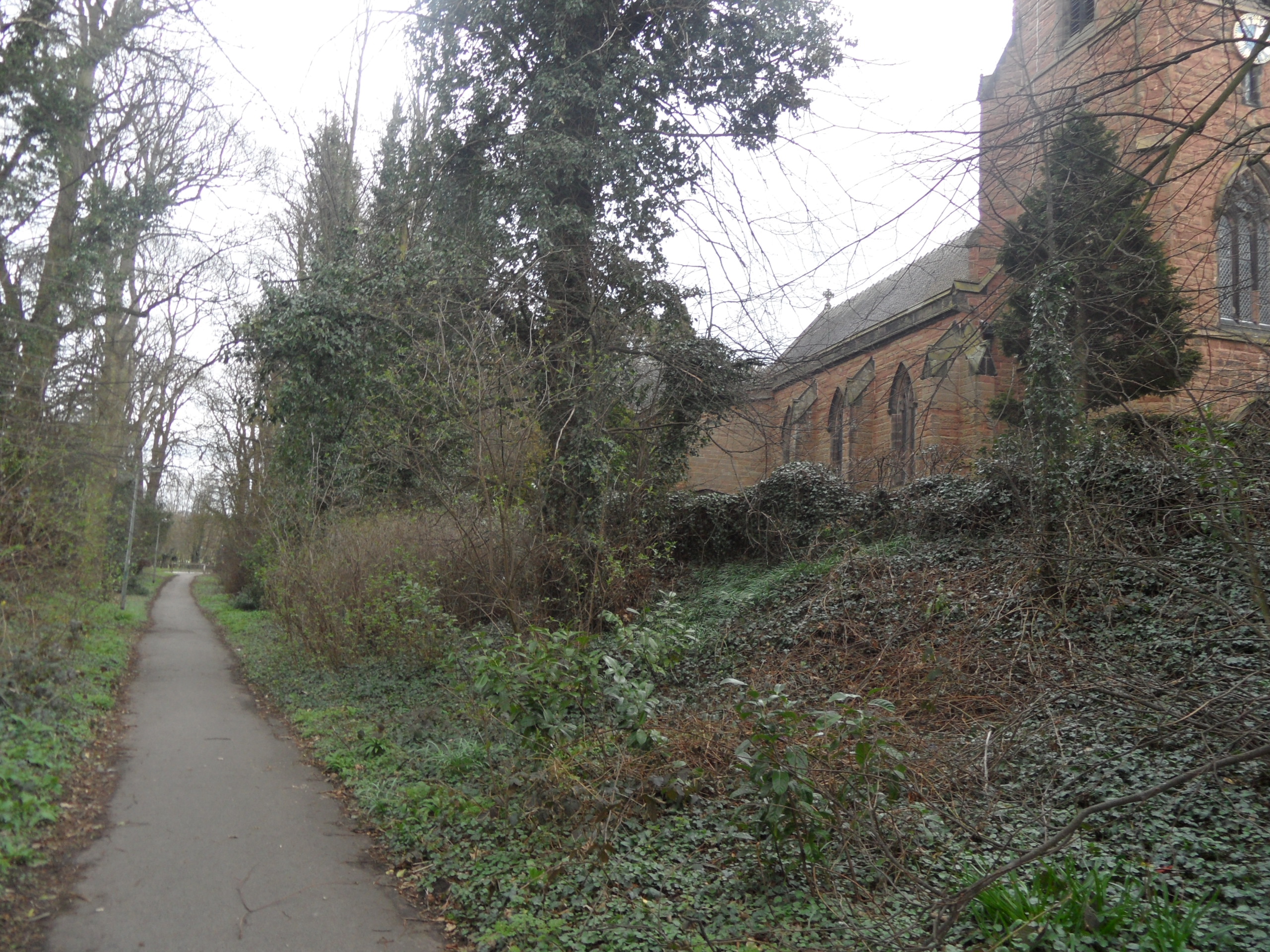
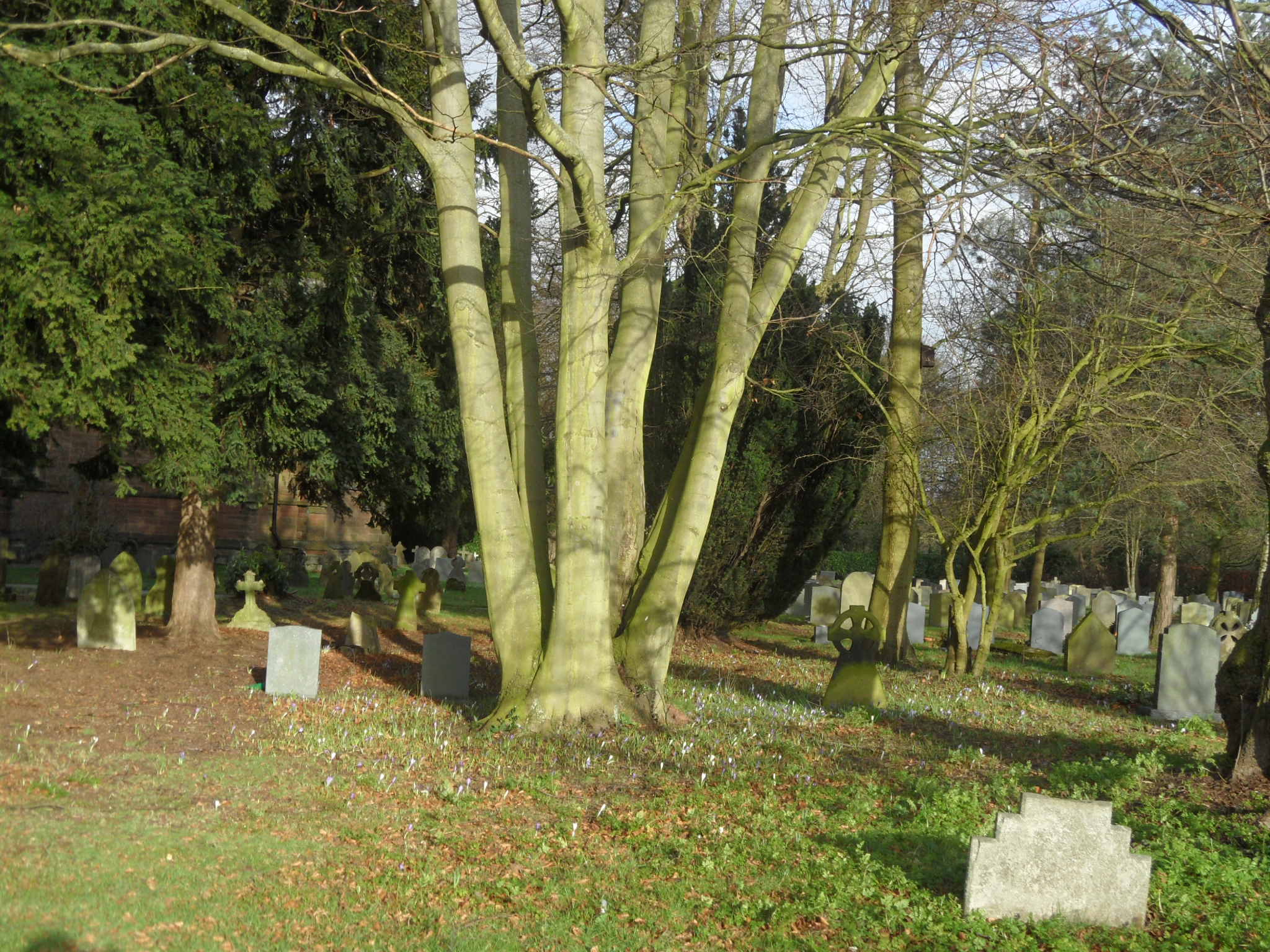
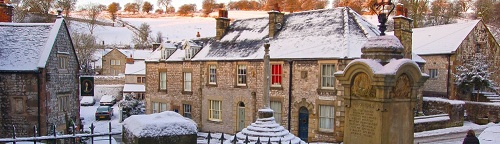
I visited Christ Church on a numbingly cold and drab January afternoon, and I welcomed the sight of the first crocuses and snowdrops beginning to appear amongst the stones erected as memorials to those who once lived here in the parish.

Of course, memorials can take different forms and the blue clock on the tower is dedicated to the memory of Sarah Worthington, of Maple Hayes, presented by her husband Albert Octavius of the Burton brewing company. (1)

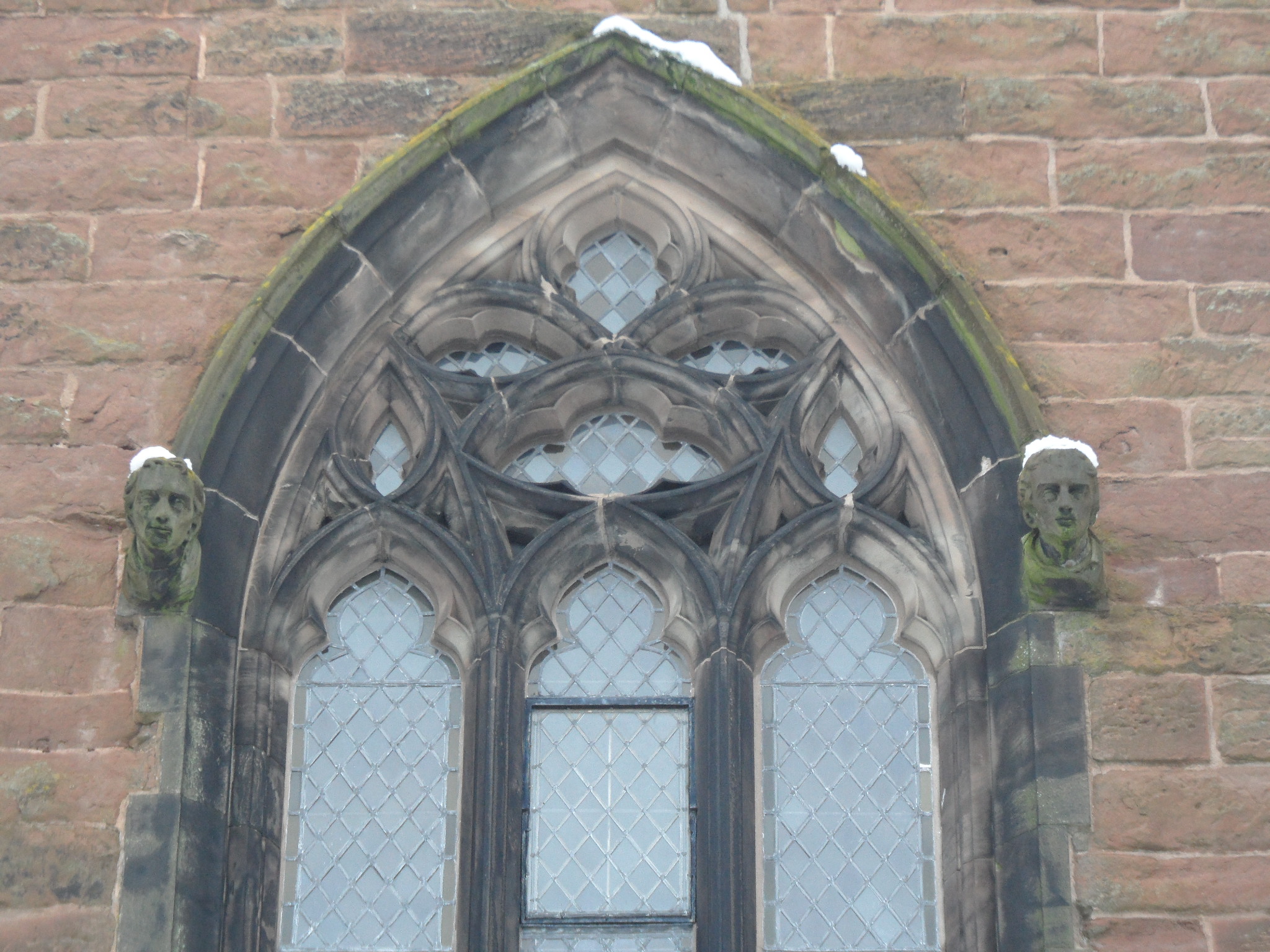
As you look at the clock face, on either side of the window below you notice faces of a different kind. On closer inspection, more of these faces can be found all around the church and I’ve included a few examples below.

The church was built in 1847, in the Gothic Revival style, and so I imagine the architect Thomas Johnson (of Davidson House, St John St) included them to emulate the corbel heads found in medieval churches (a good example and explanation can be seen on the V&A website here). This might explain what they are, and why they are here, but not necessarily who they are! (3)

As I stood thinking about the faces, someone arrived to unlock the church door. I explained that I’d been looking at the stone heads and was told that there are more inside and was invited in. Apparently, despite being the subject of much debate, no-one quite knows the story behind them. One suggestion that has been put forward is that they are benefactors of the church. Two of the chest tombs behind the church belong to Ellen Jane Hinckley, the founder of the church and her husband Richard Hinckley, who gave land in the corner of their Beacon Place estate on which to build the church. (2) Are they also here at their church in stone form? Is the portrait of Thomas Johnson the architect or the church’s first curate Thomas Alfred Bangham to be found here? Do they depict people who used to live in the parish or are these heads in fact creations from inside the head of the stonemason?!

Inside, the majority of corbel heads are in and around the chancel, which has the most stunning ceiling. Although this is not my first time inside the church, it is the first time I’ve been in and concentrated solely on the building, rather than what is going on within it.  It hardly needs pointing out that my photos do it no justice whatsoever, but they do at least give some idea of the beautiful murals painted for the church’s Golden Jubilee by Pre-Raphaelite artist John Dixon Batten in 1897,  and the reredos, designed by GF Bodley and carved by the sculptors Bridgemans of Lichfield (a discovery of both a new word and a new example of Bridgemans’ work for me!). (4)

I made my way back outside down the aisle, laid with original Minton tiles (5).

The day should have seemed even greyer after the rich, warm colours of the church but with a copy of the newly purchased and brilliantly researched ‘History of Christ Church’ in my bag and the knowledge that such treasures were to be found on my doorstep, it actually felt considerably brighter.

Edit 10/02/2013 Good news! There’s a sign outside Christ Church saying that there is an open day on 9th March – a great opportunity to go and visit this lovely church for yourself. By then, there may even be some spring flowers and wild garlic in the lane alongside which is a nice thought, when you’re sat typing with snow drifting down outside the window. More details here

Notes

(1) The clock was made by John Smith and Sons of Derby a business founded in 1856. Whilst the firm is still going strong, the original headquarters were at risk as these photos and a news story from February 2011 (read here) show. I’d be interested to know what the current state of the building is? Also, it’s not only the clock we have the county of Derbyshire to thank for! The church’s Millenium Gates were created by David Tucker, a master Blacksmith from Derbyshire, that I wrote about here

(2) The third of the Hinckley Tombs belongs to Mrs Hinckley’s son from her second marriage to Hugh Dyke Acland. Mrs Hinckley’s daughters from her first marriage, are the girls depicted in Francis Chantrey’s sculpture known as ‘The Sleeping Children’ as Lichfield Cathedral

Hinckley Tombs, Christ Church

(3) In a 1950s edition of Life magazine, I came across an interesting article about Southwell Minster in Nottinghamshire. Their old carved heads had eroded badly, and so a stonemason was enlisted to restore them. However, rather than recreate the old images, he carved new images of people associated with the church at that time including a bell ringer, the clock winder, a dog whipper (actually in charge of the grounds) and the youngest member of the church choir (who would now be in his 60s). You can read the article and see the photos here 

(4) I believe that Bodley and Bridgemans also collaborated on the South African war monument in Duncombe Place, York, which is where the sailor on the wall of Lichfield Registry Office was originally destined for but was apparently rejected  for being too warlike.

(5) Between 1844 and 1858, Herbert Minton donated tiles to 46 Staffordshire churches & parsonages. More information can be found in the report ‘Minton Tiles in the Churches of Staffordshire’, carried out by Lynn Pearson for the Tiles and Architectural Ceramics Society. At the time of the report in the year 2000, amongst others, there were also examples at St Mary’s, Aldridge, possibly St James’ Church, Brownhills (though covered) and St Peter’s, Elford. An online version of the report with photographs can be found here 

Sources:

Christ Church Lichfield – A History by Ursula Frances Turner, later revisions Robert Hazel, Julia Baker and Larry Ridout

Public Sculpture of Staffordshire and the Black Country – George Thomas Noszlopy and Fiona Waterhouse

Fallen Angel

I’m certainly not the first person to write about the deteriorating condition of the Angel Croft hotel, and I suspect that I won’t be the last – it doesn’t look like it will be relinquishing its place on the English Heritage at Risk register any time soon.

Personally, I have no connection with the building, I’ve never even been inside. As awful as it sounds, I can barely remember the days when it actually was a hotel.  It seems to have taken on a new identity as a case study in decaying grandeur, about which regrets are expressed and rumours abound, but about which no one seems to know quite what to do.

Of course other people will have memories of the Angel Croft – a wedding reception,  a work do, a meeting, a reunion dinner, or even a weekend stay. Walking through The Close recently, I saw this plaque on a bench, and it reminded me of an intriguing story I’d seen on the subject of the Angel Croft and memories a while back.

It features on a blog about a man’s research into his great uncle Jack Purcell’ s time in the Royal Australian Air Force. Jack Purcell was posted to RAF Fradley and in the collection of his documents handed down to his great nephew Adam Purcell was a postcard of a view across Minster Pool marked with a small ‘x’. Adam believes the cross could be marking the Angel Croft Hotel… you can read the whole post in full here.

It’s a fascinating story, but also a good reminder that it’s not only buildings that are  vulnerable to the ravages of time, but memories too. Of course, it’s important to preserve architecture of note, but I have to ask, what are we doing to preserve the memories and stories that make buildings so much more than an entry on a list or register?

Note – I hope Adam Purcell doesn’t mind me featuring the story of his Great Uncle’s time in Lichfield. I shall contact him.


Passing Time

Happy New Year! A couple of days ago, many of us will have seen in 2013 to the bongs of Big Ben. Rather appropriately, Gareth Thomas from Lichfield District Council has found another fantastic document in his treasure trove, relating to our very own clock tower here in Lichfield, said to have been inspired by that famous London landmark. Gareth, in his characteristic generosity, has scanned it on and sent it over for me to share here. A while back I did another post on the Clock Tower (which you can read here), and it’s fantastic when more parts of the jigsaw come to light!

Entitled ‘ Agreement for sale and purchase of the Clock Tower situated in Saint John Street in the City of Lichfield’, the document describes how on 24th August 1927, the Lichfield Conduit Lands Trustees (some of their names will be familiar I’m sure!) agreed to sell the Clock Tower to the Mayor Alderman and Citizens of the City of Lichfield for £50. One of my favourite parts is where it states that:

‘any coins or other articles of value or antiquity which may be discovered shall be considered the property of the Trustees and shall be handed over to the Warden immediately they are found (sic)’

I wonder if they did find anything? And if so, did they hand it over?!

A plaque recording this event can be found on the Clock Tower:

The document can be seen by clicking on the PDF links below (it was too big to add as one whole document!)

Clock 1

Clock 2

Clock 3

Clock 4

As you may know,  the Clock Tower was erected in 1863, making it 150 years old this year. I think it would be fantastic if, as a celebration, we could give people  a closer look at the tower that they pass by and the clock that they hear each day, by opening it up to the public (I did go up Birmingham’s ‘Big Brum’ clock tower once so I don’t think it’s too harebrained an idea).

Here is a bona fide harebrained idea though – what about starting a new tradition of seeing in the New Year with the bongs of the Lichfield Clock Tower? I wonder if there are any records of people doing this in the past, when we didn’t have Jools Holland on the tellybox to see in the New Year with. Shall we make a date then?  New Year’s Eve 2013 in the Festival Gardens. I’ll bring some party poppers….

Sources:

http://www.lichfielddc.gov.uk/info/200161/tourism/760/heritage_trail/9

http://en.wikipedia.org/wiki/Lichfield_Clock_Tower

Gareth Thomas and his magical storeroom 😉

ExpLore – Lanes Around Leomansley

Walking is such a pleasure. I get seriously itchy feet if deprived for more than a day or so, and my spirits are always lifted after a good old trudge around. Exploring somewhere for the first time is fantastic, but I also love to walk around the places I know. It somehow gives me feel warm and comfortable feeling, like a favourite old cardigan. And of course, sometimes there can be surprises up even the most familiar sleeve…

I’ve decided I’d like to try and put some walks here so that people can get out and explore for themselves.  One of my best loved walks is of course around Leomansley, so here’s a walk around the lanes that I hope you’ll enjoy doing for yourself. Naturally,  I always encourage straying from the path to investigate something that looks interesting. Getting lost is part of the fun!

Lanes Around Leomansley

The map below gives a rough idea of the route, which is about 2km (depending on how many diversions you take!). I’ve marked some of the points that I think are of interest but of course there may be other things…….Below the map is a PDF with a written version of the route, giving information about each of the points. Hope you enjoy it, I’d like to hear how you get on!

Lanes Around Leomansley walk


Adooration

By now you’ve probably opened all of the doors on your advent calendar. So here are a few more (although I’m afraid there’s no chocolate). What’s behind these doors? Some we know already, as they are already open to the public.  What about those that aren’t though? Can we open more doors in 2013?

Whilst there’s no doubt that curiosity is one of the reasons I (and I’m sure others!) would like to have a look behind these doors, there are some nobler reasons I promise!  Behind closed doors, things can deteriorate or become lost, without us even knowing that they existed in the first place. Opening these doors allows us to explore and learn and question. It helps us to feel connected to a place, to each other and to all those who have walked through those doors previously.

Things are moving in the right direction. The gaol cells reopened again this yearGareth Thomas, from Lichfield District Council, showed us behind the doors of the council offices and regularly shares the deeds and maps he finds in his magical strongroom. Another important development, that will hopefully gain more momentum in the new year is Dave Moore’s vision regarding the future of Sandfields Pumping Station, a building that’s not only part of Lichfield’s history, but also that of the Black Country and South Staffordshire. Something I would like to see next year is more buildings open for the Heritage Weekend in September (at least), more community involvement in our history, improved access to local history resources, and of course more people getting out there exploring their surroundings, finding out what it is that matters to and interests them.

So that’s my rallying cry for 2013, more on this in the new year, but for now, I’d like to say thank you to everyone who has commented and got involved with this blog in 2012, and of course have a very, Merry Christmas!

Familiar Looking

Always happy to be distracted from shopping, I had a wander down Quonians Lane to take a photo of a door (that’s a whole different post!).  Everyone loves Quonians Lane with its strange name and its carvings and plaques. Annette Rubery wrote a lovely piece about it back in May, which you can read here.  I love Quonians Lane too, although now my visits are tinged with sadness that the company, whose workers created these wonderful objects and many more across the city, the county and the country, is no more.

I saw the triangular roof of a small outbuilding above the brick wall and went to have a look, thinking it would be quite interesting in its own right. It was a lovely surprise to find these two marble statues stood in the doorways. If you want to see them for yourselves, go down Quonians Lane, and just after you get to the headless angel take a right, through the wall.

So the moral of this story once again is what I say in my ‘About Lichfield Lore‘ spiel.  “Go out and have a look at what’s around you. Then when you’ve done that, go back and have another look!”  I believe this more with each day I do this blog. I think that you can make new discoveries in the same place, depending on a whole range of things including the weather, your mood, what you’re thinking about at the time, the time of day or year or who you’re with. Actually I might change that to include having a smell/touch/listen too. Not sure about taste because I’m not sure I should be encouraging the kind of thing this young man got up to here…..

Anyway, today is a perfect day for me to bang on about this, as it’s the day we heard the news that around ninety further objects had been found at the Staffordshire Hoard site, three years after the original discovery was made. If that doesn’t convince you of the merits of having at least a second look, then I don’t know what will….


Time On Our Hands

On my way to do some Christmas shopping in Lichfield,  I went to Beacon Park to see our new old friend Erasmus Darwin properly now that the crowds had dispersed. I thought it would just be me and the good doctor this Saturday lunchtime, but in fact there were already people reading the plaque, when I arrived and another small group turned up whilst I was there. I touched the shell in Darwin’s hand, and continued over to The Close, as with all the talk of water and conduits recently, I also wanted to have another look at the old pump outside the Cathedral.

Wall of Bishop’s Palace, North East corner of The Close

I then continued my walk north of the Cathedral, along the wall of the Bishop’s Palace, wondering about the provenance of the stone used to build it. In the north east corner of The Close, next to a pile of old grass cuttings and leaves, I peered over into what would have been the old ditch surrounding The Close. Something on one of the worn sandstone blocks caught my eye. Graffiti carved into the wall! Was there any more? Retracing my steps back along the wall I found several more examples.

Unfortunately, most of the markings either aren’t dated, or the dates have weathered away. So we are left with a series of initials, and not much else to work with. They may have been carved within weeks of each other or centuries apart. They may belong to pupils of the school, or they may belong to someone passing by with time on their hands. All that we really know, is that at various points in time, people decided to make their presence known in this quiet corner of The Close

One of the only legible dates on the wall. 188?

The listed building description for the wall (which can be found here) tells us that it’s probably over 300 years old. I haven’t yet been able to find where the stone was quarried from but the variation in colour and texture is beautiful. (Yes, I touched this too!)

The wall dates back to the rebuilding of the Bishops Palace in 1687. The original palace sustained severe damage in the Civil War and since then has actually only been the residence of the Bishop of Lichfield for a relatively short period. Bishop Selwyn took up residence in the 1860s and just under a hundred years later, in 1953, Bishop Reeve moved into a house on the south side of The Close. Since then the Palace has been part of Lichfield Cathedral School.

I have a photograph of the Bishop’s Palace from the back, but not the front. I do wonder about my thought process sometimes…

Of course, if anyone has any insights or information, please do get in touch. If it was you that stood here and added your initials to this old wall, I’d love to know when and why. However, I think that sometimes we have to accept that we will never know all the answers and just enjoy the time spent asking the questions.

Sources:

Lichfield: The cathedral close’, A History of the County of Stafford: Volume 14: Lichfield (1990), pp. 57-67

Everything From Shells

Despite the bitter cold, a large crowd gathered in the Museum Gardens around a figure enveloped in green velvet.

Once the poems, songs and speeches had concluded, local artist Peter Walker’s bronze statue of Erasmus Darwin was unveiled to applause.

Recently, I read a wonderful post by Susan Ward on her Staffordshire Bred blog which reminded me of the importance of the sense of touch, when connecting with something.  I was so pleased to hear that the scallop shell Erasmus Darwin holds in his left hand is not only an important symbol of his beliefs and his work on evolution, but is also there to be touched. This is not a hands off statue and I hope that people will touch it, that it will be a well-loved part of the city and that stories will grow up around it.

Those days are still ahead of us – the sun has not even set on the statue’s first day in the Museum Gardens yet (although judging by the temperature in the park today, I’m not convinced it actually rose in the first place!).

The statue belongs to the people of Lichfield, but today belongs to Erasmus Darwin and Peter Walker.

Water Tower

I pass by the Clock Tower at the Friary several times a week and in the stillness of the night, I can hear it chime, slightly out of synch with the Christ Church clock. According to Annette Rubery‘s wonderful new book, Lichfield Now and Then, the tower was built in 1863 to mark the 300th anniversary of the Conduit Lands Trust. When the new Friary Rd was built, the tower was moved to its present location. The Wikipedia entry here has some photos of it in its original site at the junction of Bird St and Bore St. The Staffordshire Past Track has some great photos of the tower being dismantled, including one of the bells being lowered down (is this one of those I can hear?).

The tower was originally built over the site of an ancient water conduit, known as the Crucifix conduit. Some say this name came from a crucifix on top, others say it derived from its location near to The Friary.  Back in 1865*, someone called CW wrote in to ‘Notes and Queries’ (a publication resembling a magazine, but actually sold under the description of ‘A Medium of Inter-Communication for Literary Men, General Readers, etc’!) on the subject:

At Lichfield is a structure The Crucifix Conduit. It has been rebuilt within the last few years and now there is a plain cross on the top. Did the original have a crucifix? Was the crucifix, if any, destroyed in Puritan times?  Is there any drawing of the building in existence And if so where can see it?

A literary man (or possibly a general reader!) replied as follows:

The old conduit at the Friary gate does not appear have been surmounted with a crucifix but was so called from Crucifix being the name of the locality on which stood. Gregorius Stoneing receiver of the rents of possessions of the Fryars Minors of Lichfield after dissolution thereof in his account in the court of Augmentation answered, and so was charged with, and the rent of a certain water course within the compass circuit of the late house of Fryars aforesaid running from Poolefurlonge to Lichfield street, viz to a certain called the Crucifix demised to John Weston at the will of the Lord. (Shaw’s Staffordshire  1820) A engraving of the old crucifix conduit will be found A Short Account of the Ancient and Modern State Lichfield 1819′.

A quick search on the invaluable googlebooks finds that book, and as promised, a drawing of the crucifix as it looked in 1819.

I had thought that the Crucifix conduit was no longer in use by the time the clock tower was built – the listed building description says it was built over the ‘redundant conduit’. However, different accounts suggest that the conduit was still used as a public water supply beyond this date.  The County History says ‘In 1863 it (the Crucifix Conduit) was adapted as the base of a clock tower designed in a Romanesque style by Joseph Potter the younger, but the conduit continued in use’.This probably explains why what look like drinking fountains can be seen built into this section of the tower!

I find this next bit confusing and am happy to be corrected! What I understand is that the water came from a spring at Aldershaw. In 1301, Henry Bellfounder granted the Fransican monks the right to built a conduit head over the spring, and to pipe the water to the Friary. He apparently did this for motives of charity and for the sake of his and his ancestors’ souls’ health.  Although it seems the water was supposed to be for the friars’ use only, a public conduit was built outside the Friary gates.  When the Friary was dissolved in the mid-16th century, I understand that the Conduit Lands Trust took over the responsibility for maintaining the water supply to Lichfield when the spring at Aldershaw was granted to the ‘Burgesses, Citizens and Commonalty’ of the City of Lichfield. A fountain marks the approximate site of the original public conduit (and of course the later clock tower) near to  the library and record office. Although the water is no longer suitable for drinking, it serves as a symbolic reminder of the water supply that was once available here.

A stone conduit head dating back to 1811 can apparently still be found over the spring at Aldershaw. The spring was known as Foulwell which may not sound like the most appealing place to get water from, but as BrownhillsBob explained to me that the name ‘foul’ is most likely to mean ‘obstructed’ in this context. What’s also interesting is that the well seems to have an alternative name – Donniwell, which crops up in some transcriptions of old documents (dating back to the 4th year of the reign of Edward VI which would be 1551. I think.) that Thomas Harwood made in 1806.

Funnily enough, searching to find an interpretation of the name lead me back to another edition of ‘Notes and Queries’, (this earlier issue from 1855 was described as a ‘Medium of Inter-Communication between for Literary Men AND Artists, Antiquaries, Genealogists etc). Someone else had questioned the meaning of Donniwell in relation to the spring near Lichdfield, and received the following answer from WLN of Bath.

The word Donni or Donny in Donniwell is merely the old Keltic (sic) vocable don (otherwise on or an), water,  with the diminutive y, and signifies the little stream or brook The word is still retained in the name of the rivers Don in Yorkshire, the Don which falls into the sea at Aberdeen, another Don in county Antrim Ireland, and in the Don in Russia. Hence, too, the Keltic name for the Danube, Donau, latinised Danubius. There is also Donnyland in Essex and the two rivers Oney in Salop and Herts, Honiton or Onyton in Devon and the Uny in Cornwall are all different forms of the same root.

I might offer many other illustrations but will refer only to the same word in the primitive nomenclature of Palestine the Dan which, with the later Hebrew prefix Jor (river) we now by a double pleonasm, call the river Jordan

So there’s one idea…..anyone have any other ideas of where this name may have derived from?

Coincidentally yet appropriately, today is the 8th December, the Feast of the Conception of St. Mary, the date on which two wardens were appointed each year to keep the conduits and watercourses of Lichfield’s water supply in repair.  I also like the idea that the chiming bells of the Clock Tower provide an appropriate, yet coincidental link to the name and occupation of the man who originally gave the spring at Aldershaw which fed the conduit (at least I think its coincidental….). I also find it interesting that back in the mid 19th century people were asking similar questions to the ones that I’m asking today. It seems it’s not just me that is fascinated by the idea of springs, wells, conduits and water in general!

Now I know a little more about where the water came from, and where it went to, I’d like to know more the inbetween part i.e. the actual route of the water. That also goes for the conduit between Pipe Hill and the Cathedral Close too. As it looks unlikely that I’ll be able to go looking for the conduit head at Aldershaw (it’s on private property) as I did with the one at at Pipe Hill, I shall have to concentrate instead on tracking down the archaeology reports and journals that reveal more about our medieval conduits,  at Lichfield Record Office.

Also, for more about the Friary, Gareth Thomas has added some original deeds and plans to his blog All About Lichfield.

*This date is a little strange as the Clock Tower was built in 1863. Perhaps the letter was written before this time and not published until 1865.

Edit: 10/12/12

I’ve just been reading part of The History of the South Staffordshire Water Works Company. This suggests that a public water conduit of some description, pre-dates the granting of the spring at Aldershaw to the Friars. Apparently, there was a public conduit in the early 13thc, and there are also references in the Cathedral records to a Conduit St, and a conduit in the high street.  Are these are connected to the Crucifix conduit or separate? And where did this water come from?

The document also gives some really interesting information on the pipes themselves. It says that originally wooden pipes were used (bored tree trunks). It refers to a document from 1707, that says the pipes ‘being made of alder had become rotten, leaky and in decay and accordingly taken up and replaced by leaden pipes’. Interesting that the pipes were made of Alder, and the water came from Aldershaw. It also says that in 1801, the Conduit Lands Trust replaced a small gauge lead conduit from Aldershaw with a larger diameter cast iron main, which enabled a greater volume of water to be carried to the City. It also gives this interesting information on what happened when supply started to exceed demand.

By 1821, Aldershaw was proving to be inadequate source and a scheme was devised to supplement the spring’s supply, by collecting the surface water from Tunstalls Pool, the Moggs and other pools and diverting water into the common conduits. When the situation worsened in the mid 1850’s, the trustees acquired the Trunkfield Mill and Reservoir and a pumping engine was installed to increase the supply. In 1868 the supply of Aldershaw yielded 15,000 gallons a day. Trunkfield supplied 160,000 gallons a day, all of which was pumped to Crucifix Conduit. Water was provided to fifty seven public pumps, thirteen standpipes and public taps, thirty fire hydrants and three hundred and forty three houses.

The document isn’t too specific about their sources, so having to take what they say on face value for now. Lots more reading to do I think….Luckily for me, local historian Clive Roberts is going to send me some information he has on the Conduit Lands Trust!

Sources:

Lichfield Then and Now Annette Rubery

A short account of the city and close of Lichfield by Thomas George Lomax, John Chappel Woodhouse, William Newling

The History & Antiquities of the City of Lichfield by Thomas Harwood (1806)

Lichfield: Public services’, A History of the County of Stafford: Volume 14: Lichfield(1990), pp. 95-109

Water Technology in the Middle Ages: Cities, Monasteries, and Waterworks after the Roman Empire by Roberta J Magnusson

Walsall Road, Lichfield, Staffordshire. A Report on an Archaeological Evaluation
Marches Archaeology Lyonshall : Marches Archaeology, 2000, 18pp, figs, tabs
Work undertaken by: Marches Archaeology

History of the city and cathedral of Lichfield by John Jackson

Notes and Queries 12th Volume 1855

Notes and Queries 3rd Series Volume 8, 1865

Halfpenny For Your Thoughts

There’s a saying ‘It’s what is on the inside that counts…’, and it’s rather appropriate for describing Frank Halfpenny Hall, a plain and unassuming building half way up George Lane. The hall is home to the wonderful Abacus Pre-School, and inside is a place full of colour and music, imagination and laughter.

Frank Halfpenny Hall, George Lane, Lichfield

People have many fond memories of the hall. Responses to requests for information on  the Lichfield Facebook group show that this is a building that’s been an important part of the community over the years. People talked about attending Sunday school there, still having the ‘Peter and Jane Go to School’ book from their last day at playgroup, eating school dinners there when at St Chad’s school and regular jumble sales being hosted. It was even the venue for one woman’s wedding reception!

The hall is named after Frank Halfpenny, a Labour councillor, who I believe went on to become Lichfield’s first Labour mayor in 1965. He was the Sheriff of Lichfield, when war broke out in 1939 and the photograph below shows him maintaining the tradition of the Sheriff’s ride that September, accompanied by just one other rider.

Frank Halfpenny ensuring the tradition of the Sheriff’s Ride is maintained. Photograph used with thanks to Annette Rubery http://www.annetterubery.co.uk/

Cllr Halfpenny bought the hall and in 1958, donated it to the Lichfield and Tamworth Constituency Labour Party. I’ve been told that the hall was used as the Labour Party HQ during the two general elections of 1974 (in May the Conservative Party held the Lichfield and Tamworth seat but lost it to Labour in the October election later that year). It had originally been built as a Primitive Methodist Chapel in 1848 and a map from 1884 shows it had 130 seats for the congregation. It the 1930s, it was used by the Salvation Army.

Sources:

Lichfield: Town government’, A History of the County of Stafford: Volume 14: Lichfield(1990), pp. 73-87

Lichfield: Roman Catholicism and Protestant nonconformity’, A History of the County of Stafford: Volume 14: Lichfield (1990), pp. 155-159

http://en.wikipedia.org/wiki/Lichfield_and_Tamworth_(UK_Parliament_constituency)