Christ Church Open Day

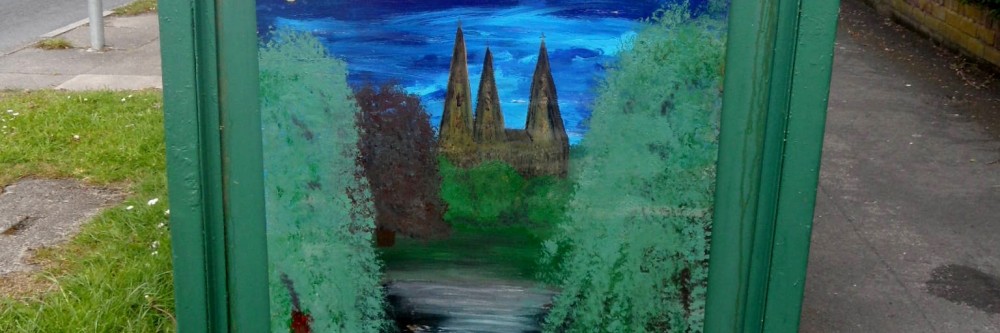
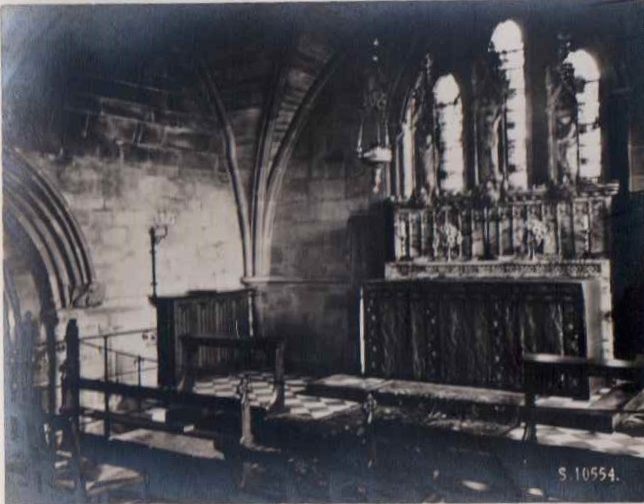
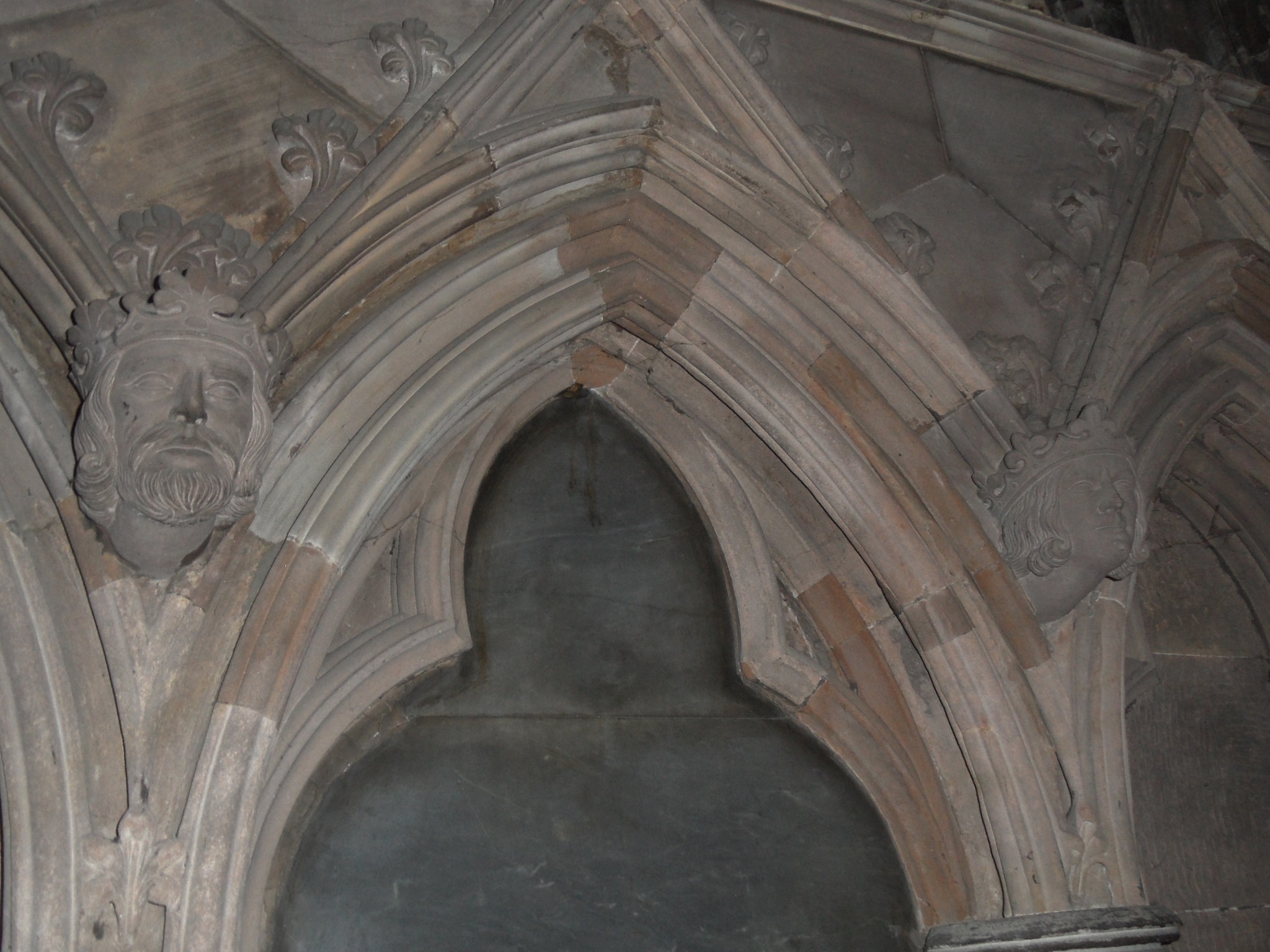
I’m delighted to see that Christ Church, Lichfield is having an open day. On Saturday 9th March, between 10am and 4pm, visitors will be able to explore this wonderful Victorian building and its architectural features, including the lovely chancel ceiling, original Minton tiles and stained glass, with the help of local history enthusiasts.

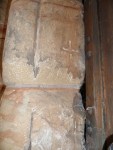
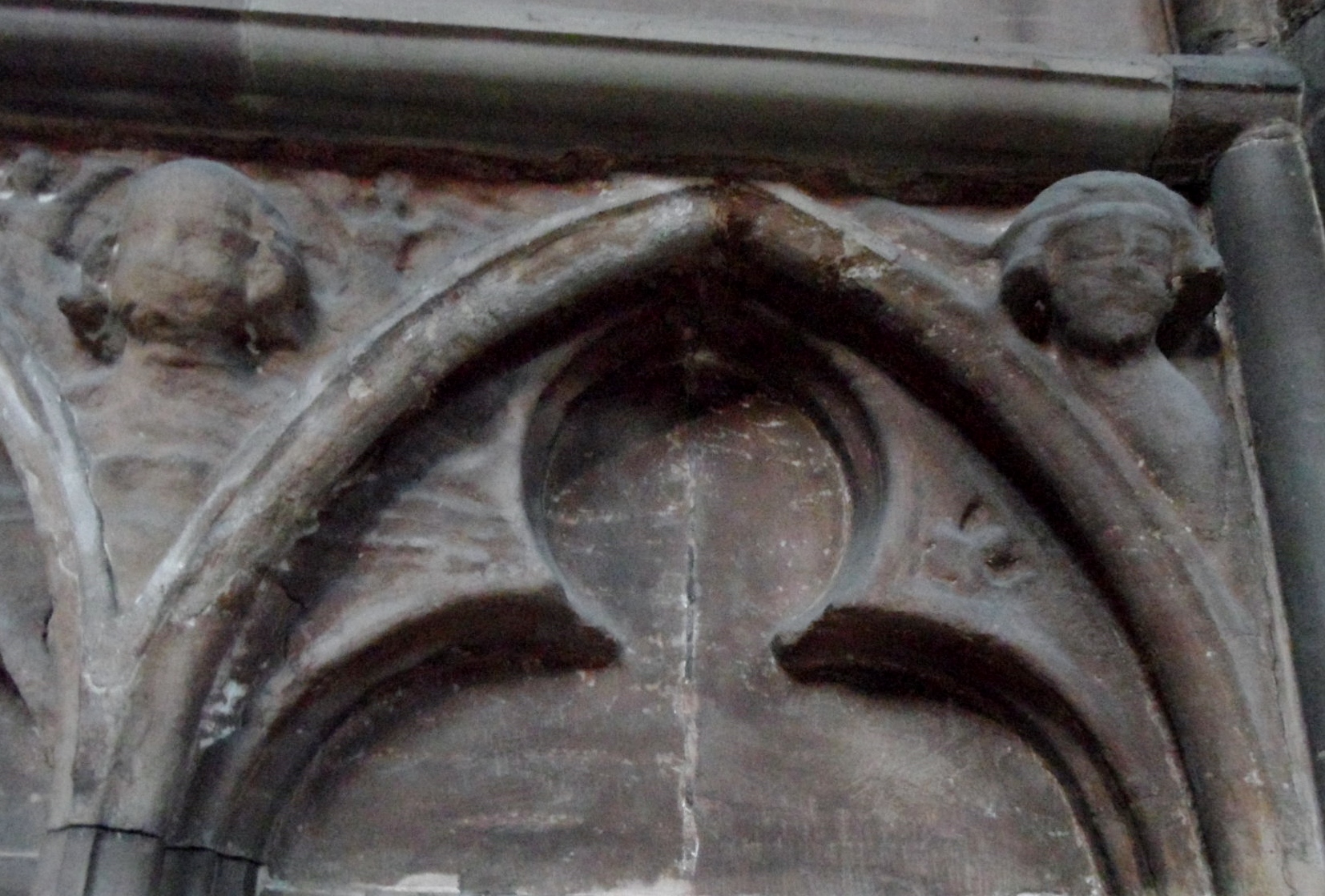
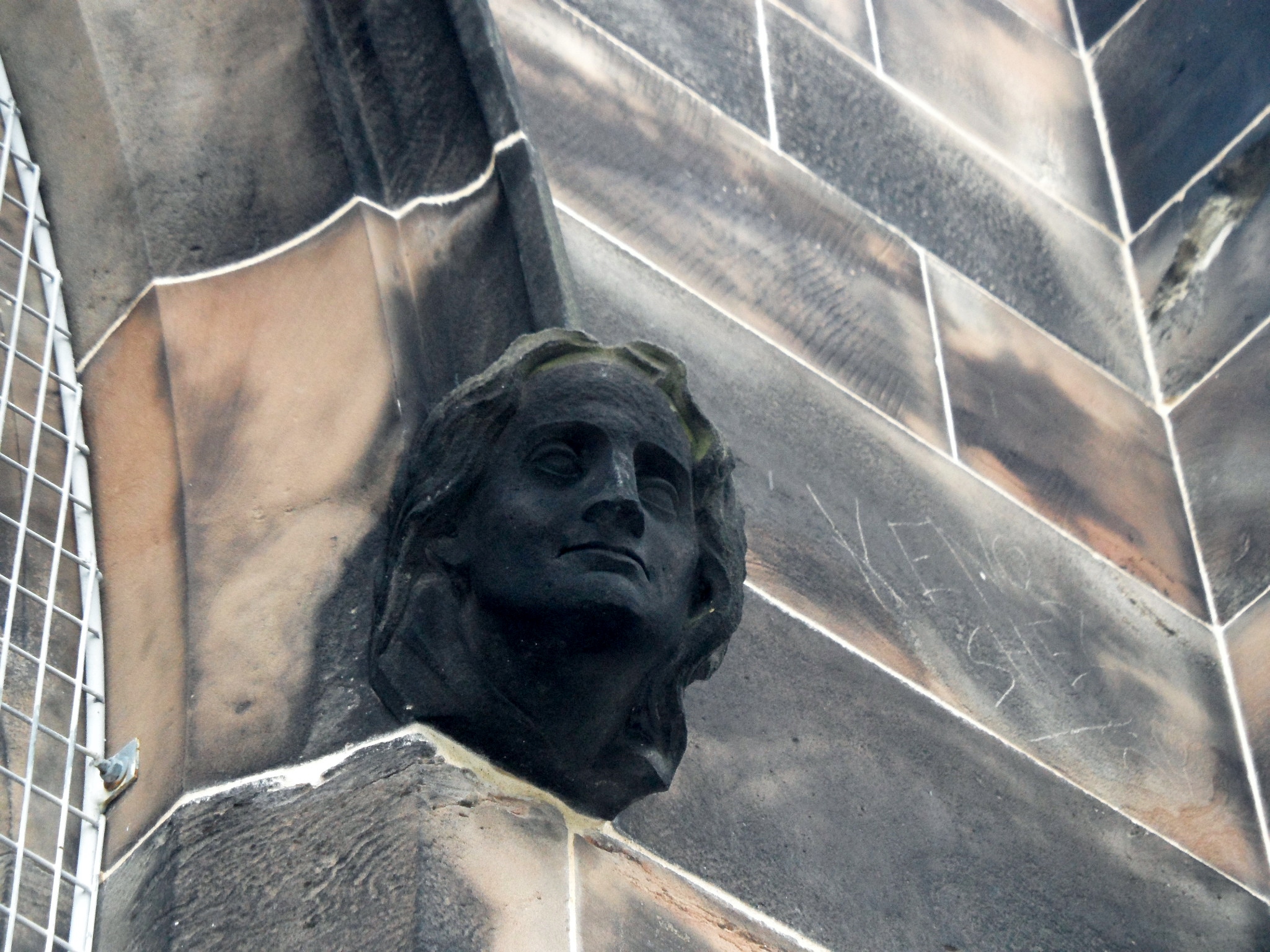
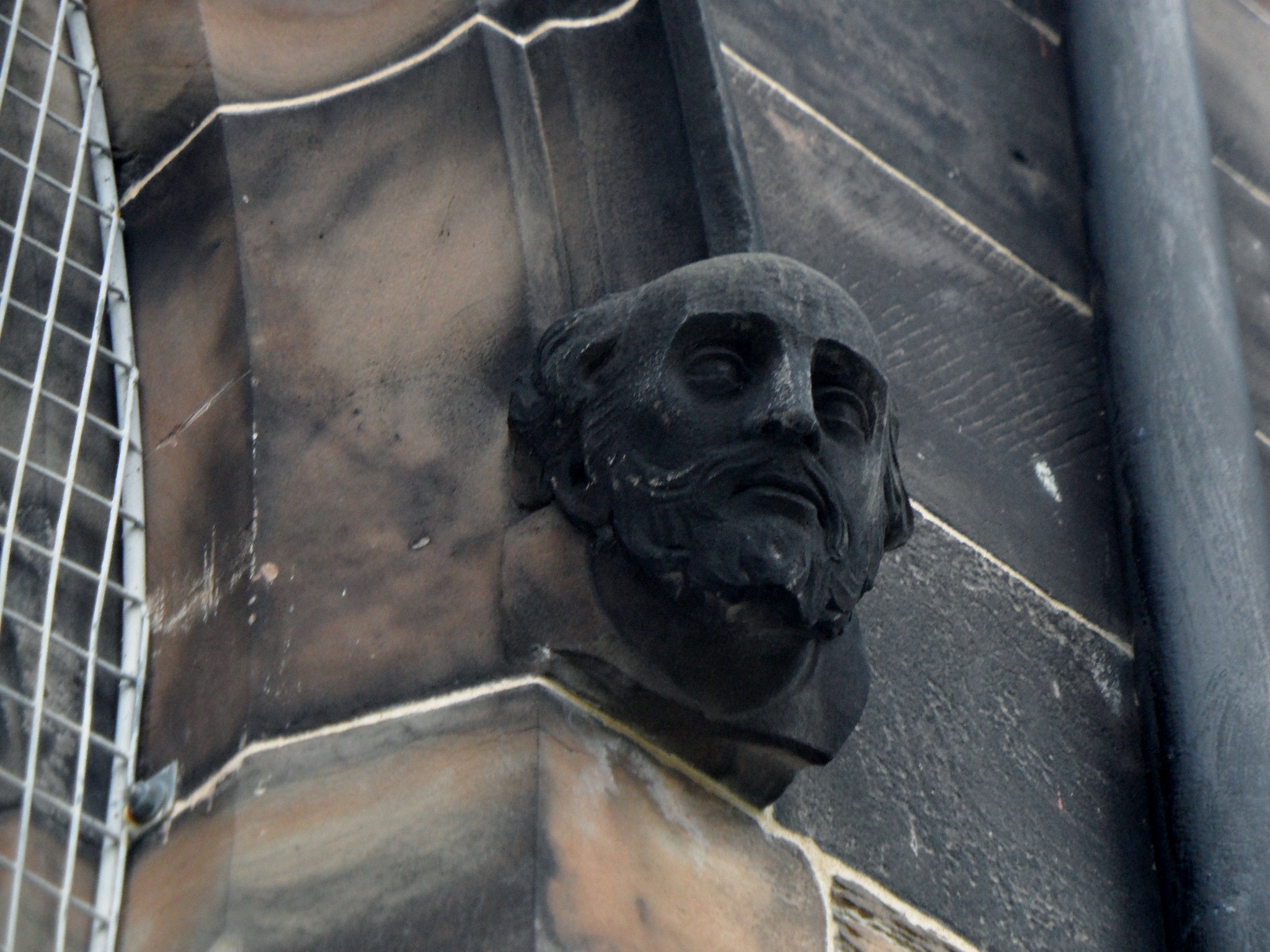
The grounds are lovely at this time of year, and a quick check of my photographs from last March tells me that the wild garlic and daffodils should be coming through in the lane alongside the church, so don’t forget to have a look outside as well as in.  There are also the intriguing stone heads around the inside and outside the building, that I wrote about back in January and am still none the wiser about (although I did see some very similar ones at St Michael’s –  a church that Thomas Johnson the architect was involved in restoring a few years before her started work here at Christ Church)!

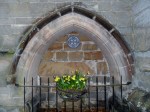
The open day is being run by the new Friends of Christ Church, a group whose aim is to support the preservation, conservation and enhancement of the church and its grounds. I understand that anyone who becomes a member will receive an annual newsletter with details of upcoming events and projects to get involved in, and also a copy of the excellent book “Christchurch: A History”, which tells the story of the church, and the associated buildings in the area such as Christ Church School, The Old Vicarage, the cottage in the churchyard and Beacon Place (gone but not without a trace….).

More information can be found at www.christchurch-lichfield.org.uk/events or by email friendsofccl@btinternet.com.


A Storm Brewing

A comment from Mrs P on an earlier post about the City Brewery on the Birmingham Rd revealed another unhappy chapter in the story of Lichfield’s brewing industry.

In 1900, in many towns and cities across the north and west of the country, there was a huge rise in cases of what was originally thought to be alcohol related neuritis. Eventually doctors in Manchester, one of the worst hit places, began to suspect that alcohol may not be the cause.  After discovering arsenic in samples of local beer these suspicions were confirmed – people were in fact being poisoned.

There were thought be around six thousand cases of poisoning across the country, of which at least seventy were fatal.  On February 15th 1901 The Mercury reported that ninety one cases were discovered in the Lichfield urban district but there were no fatalities.

Samples from the City Brewery on the Birmingham Rd and the Lichfield Brewery on Upper St John St were taken. These tests showed that whilst beer from the City Brewery was arsenic free, the poison was present in beer brewed by the Lichfield Brewery.  Along with the other affected breweries across the country, they had been using contaminated brewing sugar from Bostock & Co of Liverpool. The sugar had been produced using sulphuric acid designed for industrial use, rather than of a food grade quality.  Bostock & Co blamed their supplier – a Leeds company called Nicholson & Son, whose defence was that Bostock & Co had not specified the need for ‘pure’ acid.

Offices of the former Lichfield Brewery, Upper St John St

Unsurprisingly, the City Brewery and another local rival, the Old Brewery on Sandford St were keen to inform consumers that their beers were arsenic free and took out large adverts in the Mercury announcing this. The Lichfield Brewery used the local press for a damage limitation exercise. On 12th December 1900, they printed the certificate that the public analyst and consulting chemist Dr Bostock Hill had issued to them from his laboratory in the Unity Buildings on Temple St, Birmingham, which included the following statement:

Gentlemen – I beg to report that I have analysed the three samples of Ales, and one of Stout, received from you on the 11th instant and find them to be PURE AND FREE FROM ARSENIC OR OTHER DELETERIOUS MATTER

Dr Bostock Hill’s opinion was also reported in the Mercury – he believed the brewery was not to blame and was instead a victim of circumstance. The report also praises the brewery for their honesty and openness in dealing with the matter noting that,

‘the strain on the executive has naturally been considerable, but it is in process (sic) of being completely relieved, The ordinary shareholders may possibly experience a slight temporary depression in the value of their holdings – nothing more; for the position of the company is now so secure, owing to its large reserve fund that the incident can only have a temporary effect, especially in view of the fact that it is one over which they had, under the circumstances, not the slightest control …despite the loss, the commercial value, importance and position of the Lichfield Brewery Company is quite unshaken’.

It seems the ‘considerable strain’ on the executive was relieved and the Lichfield Brewery continued for another thirty or so years, until Ind Coope & Allsopp Ltd took over the brewery and its 198 licensed houses in 1935.  So far, I have not been able to find a report into the strain on the health or livelihoods of those actually poisoned by the arsenical beer.

For a much fuller account of how events unfolded across the country, please read the article ‘Death in the beer-glass: the Manchester arsenic-in-beer epidemic of 1900-1 and the long-term poisoning of beer‘ by Matthew Copping. It also makes some very interesting points regarding how in addition to the complacency of the brewing industry, prejudice and stereotyping of those affected (mainly the working class) may also have contributed to these terrible events.

In the article, Matthew Copping describes the arsenic poisoning episode as a wake up call for those at fault, a phrase that’s has been heard again in recent days, due to the ongoing enquiry into contaminated meat. The timing of this post is actually coincidental (isn’t it, Mrs P?) and I don’t want to try too hard to draw parallels between these two events, separated by over a century. However, I think it is fair to say that, as in 1900, the public has been let down by complacency and broken systems once again.

Sources

Click to access poison.pdf

The Arsenic Century:How Victorian Britain was Poisoned at Home, Work, and Play by James C. Whorton

http://www.weasteheritagetrail.co.uk/salford-people/biographies/entry/the-salford-poisoned-beer-scandal.htm

Friars on the Run

On Monday morning we’ll learn if human remains found beneath a car park in Leicester are those of Richard III, buried in the city’s Greyfriars church after his defeat at Bosworth in 1485.

Archaeological Dig Open Day at Greyfriars Leicester. 8th September 2012.
Image by RobinLeicester, Wikimedia Commons.

Naturally, the possible discovery of England’s lost king has generated a huge amount of interest and last week I had an email from someone in Lichfield who has been doing some background reading on the subject. In trying to find out more about the story of Greyfriars and King Richard III, they found that the Greyfriars were also linked to King Richard II. The reason for the email was to see if anyone knew anything more about the role of Lichfield in the story, as per the the following passage from the ‘History of the County of Leicestershire’.

The sympathies of the Leicester Franciscans for Richard II brought serious consequences upon the friary in 1402. A Franciscan declared to Henry IV that he and ten other friars of the house at Leicester, together with a master of divinity, had conspired in favour of the deposed Richard. In consequence eight Franciscans of Leicester, with the master of divinity, were arrested and brought to London for trial. The remaining two friars escaped. After two juries had failed to convict, a third jury found the prisoners guilty, and they were executed. Two other Franciscans from Leicester, presumably the two who had at first escaped, were executed at Lichfield about the same time.  In 1402, at a general chapter of the Franciscans held at Leicester, it was forbidden to any of the Order to speak against the king.


My anonymous correspondent wondered why the friars were executed here in Lichfield? What had brought them here in the first place, and was there any sympathy for them or Richard II amongst the Franciscan population here?

Remains of North Wall of Nave of Lichfield’s Franciscan Friary.

Other sources expand on the story a little to tell us that it was Prince Henry, the future Henry V (or at least members of his household) who caught and beheaded the friars at Lichfield. Our own county history tells us that in 1402, Henry IV had ‘ordered knights, squires, and yeomen from various parts of the country to meet him at Lichfield for his campaign against Owain Glyn Dŵr‘. This explains perhaps in part why the friars came to be executed here, but if there’s anyone who can add anything further to this story of fugitive Leicester friars in Lichfield, it’d be great to hear from you.

Notes:

A programme called ‘Richard III:The King in the Car Park’ will be shown on Channel 4 at 9pm on Monday 4th February.

Talking of archaeology digs in car parks, I believe that the report on the Friary Outer is due out anytime now – as far as I’m aware Victorian cellars and medieval pottery were the main discoveries. Of course, everyone knows that if you want to find lost kings in Lichfield, it’s Borrowcop you need to investigate….

Richard II visited Lichfield several times. Most famously he spent Christmas in 1397 at the Bishops Palace, returning to the city two years later as a prisoner of his cousin Henry Bolingbroke, soon to be Henry IV.
Edit 4/2/2013 – I probably don’t need to tell you this but it’s been confirmed beyond any reasonable doubt that it is him! King Richard the Third’s remains will now be interred at Leicester Cathedral. I believe there may be a link between this story and Elford too?

Sources:

Friaries: Friaries in Leicester’, A History of the County of Leicestershire: Volume 2(1954), pp. 33-35. URL: http://www.british-history.ac.uk/report.aspx?compid=38172

Historical Dictionary of Late Medieval England, 1272-1485, page 212 edited by Ronald H. Fritze and William Baxter Robison

Lichfield: History to c.1500′, A History of the County of Stafford: Volume 14: Lichfield(1990), pp. 4-14. URL: http://www.british-history.ac.uk/report.aspx?compid=42336

All The Small Things

Tomorrow’s walk will be different to today’s walk….I have walked past Christ Church three times in as many weeks. Each time was different. The first was a bleak midwinter day, the biting cold numbing my fingers as I photographed the stone heads around the church. By the second, the scene had changed and even the heads were capped in snow.

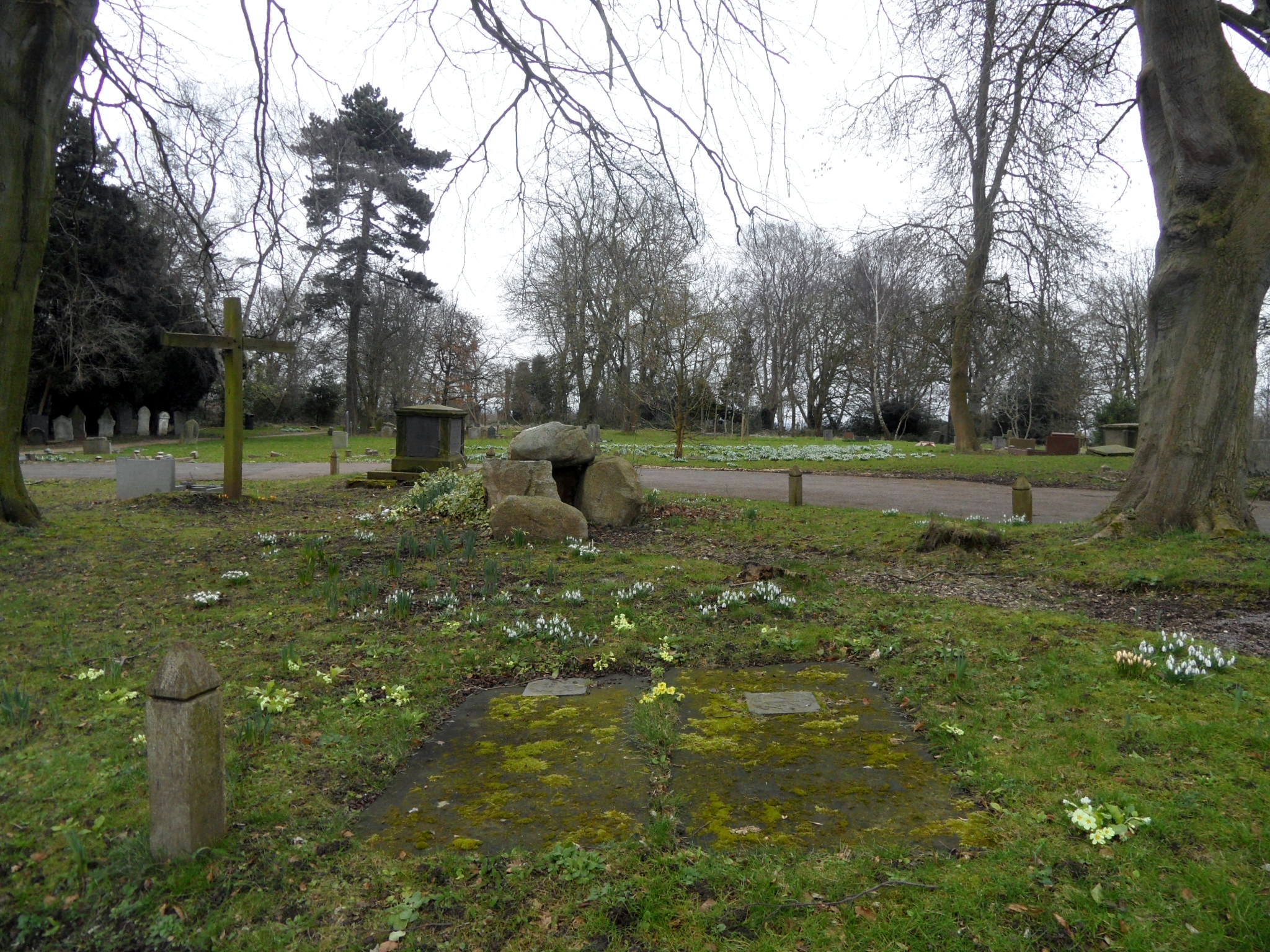
Whether somehow related to the snow or whether the weather was incidental, numbers on the reverse of head stones that I had previously passed were suddenly evident where I had never noticed them before. Interesting that only two of the several stones I could see from the road had numbers on them, so I’m guessing that they were some sort of reference mark made by the stone mason? Naturally, we look to the inscriptions on the front of headstones for information, but can the back sometimes tell us something as well?

On my third visit yesterday, the snow has been replaced by snowdrops and crocuses, the first flowers of the year and a welcome reminder after last week’s mini ice age that spring is on its way (I know we’re not out of the winter woods yet, but I’m optimistic!).

Another weather and season influenced walk was up Abnalls Lane on a wet and windy day.  Tipping my head back to gather my hair in a pony tail to stop it blowing in my eyes caused me to look up and notice fungi growing half way up a tree up high on a bank that may have been missed on a calm and sunny wander. On the same walk the bareness of winter revealed some sort of post in a hedge (I have no idea what this is – some sort of utilities marker?)

The light was poor and Abnalls Lane was more of a stream in places. With the amount of cars passing, it was only a matter of time before I ended up soaked or worse….so I changed my route. Later, outside the derelict Sandyway Farm, a pub known as the Royal Oak for the first half of the nineteenth century, one of the bricks had worked its way free of the decaying shell and lay under brambles alongside the Walsall Rd. I understand that the stamp ‘NCB Hamstead’ means it came from brickworks at the Hamstead Colliery in Birmingham, when it was part of the National Coal Board.

Is the C the wrong way around or is it me?

Admittedly, all of the above are small things but whether small things help you to build a bigger picture of the place you live in or even if they just make you smile, I think they’re worth noticing.


These Routes Were Made for Walking

Last weekend I had an email telling me about a history project over at Bonsall, a village in the Peak District. The Heritage Lottery Fund has awarded them an All Our Stories grant to create six walking trails and accompanying illustrated leaflets, each focusing on different aspects of the village’s history. Getting people involved in the exploration and the celebration of their history is key to the Bonsall project – the trails and leaflets will be researched and developed by the people of the village themselves. To further encourage participation from the community, a programme of talks, workshops, visits and film shows has been put together.  You can follow the progress of the project by following their blog here and the trails will be launched on Sunday 12th May 2013. I’m already planning to visit in the summer, to discover more about the landscape and stories of a place shaped by mining and mills.

Header from the Bonsall History Blog – A walk through history

Walking trails are a gentle guide, holding your hand as they show you around, but always happy to let go and allow you to make your own discoveries. One of the beauties of exploring places in this way is that even when following the same trails, your walk will be different to my walk, and tomorrow’s walk will be different to today’s.

It’s always inspiring to see what’s going on elsewhere, be it in Bonsall, or the Black Country or anywhere else a wider range of people are encouraged to get involved with telling the stories of a wider range of people and places. Looking at things from a different perspective opens your eyes to possibilities in the place you live in and offers suggestions on how you might listen to the untold stories that surround you. Exploring new places is always a pleasure, but finding new ways of exploring familiar places can be just as rewarding.


Burning Questions

Before moving on to the Trent Valley Brewery, I’ve found a little more information to share on the City Brewery, regarding what happened on the night of the fire, and in the aftermath.

The Maltings survived the fire that destroyed the majority of the City Brewery in 1916.

At a Lichfield City Council meeting in November 1916, two versions of events were heard by those present. The report by Mr Salford, Captain of the City Fire Brigade, had already been accepted by the General Purposes Committee who told the meeting that they were satisfied with the work and conduct of the brigade, and proposed that the report, which I’ve summarised below, be adopted.

At quarter past five on the morning of 25th October 1916, the police telephoned him to say that the City Brewery was on fire. On hearing the news he turned out and met Fireman Gilbert in Lombard St, who was on his way to tell the Captain and the horsemen that they were needed. His own alarm bell had not rung, as it was out of order.  On arriving at the Fire Station, some of the crew had already left with the hose cart and so, with the help of two others, he attached horses to the engine. On arriving at the Birmingham Rd, it seemed to the fire had been burning for some time. The engine was set up to work from the City Brewery basin of the canal with two lines of hoses, one of which was used inside the malt house (half of which was saved), and the other used to protect the boiler room (also saved). At some point, other crews arrived  and though they battled hard against the fire in other parts of the brewery, it was beyond saving. The Captain believed that even if the other brigades had arrived at the same time as the City Brigade, the outcome would still have been the same, as the fire had already taken too much of a hold. A third line was set up at a hydrant in the brewery yard, but as the pressure was poor it was useless when trying to tackle the blaze in the high buildings and so was used on the wooden buildings between the brewery and the railway line, which were damaged but saved.

The other brigades in attendance left in the afternoon, with the Lichfield City Brigade returning to the Fire Station at 6.30pm. The Captain then returned at 8 o’clock to check the premises and was satisfied that it was safe. However, early the next morning, he received a call to say that something was burning at the brewery. This turned out to be one of the vats on the top floor and again, the poor pressure from the hydrant hindered the operation. However,the Captain didn’t believe it worthwhile getting the steamer out and left them (the brewery employees?) the standpipe and hose.

The main fire was thought to have started in the grinding room. Only one man was on duty and the Captain considered this insufficient cover. He also felt that there should have been a means for them to telephone for help immediately, without having to call for others to telephone and lose valuable time.

Other members of the Council weren’t so quick to accept the report and questioned the delay in responding, the lack of water pressure, and the out of order fire bell. The most critical of those present at the meeting, perhaps unsurprisingly, was Alderman Thomas Andrews, the City Brewery’s Managing Director. Despite initially claiming that he didn’t want to say too much, as he felt too strongly, the account he gave of the fire called into question the effectiveness of the Brigade (at one point Mr Andrews went as far as to call them ‘absolutely useless’). To summarise Mr Andrews’ version of events:

On discovering the fire, the man at the brewery told the cashier to call the police. An initial call was made at 4.45 am but due to difficulties getting through, a second call had to be made at 5.15 am. Mr Andrews admitted that as he had not been notified of the fire until just before 6 o’clock, much of his version of events was based on what he’d heard from others, but believed that it could be substantiated.  He’d been told that the brigade arrived around quarter to or ten to six and then there were delays in getting to work as the hose burst two or three times. It had also been reported to him that at this time there was ‘absolutely no discipline or method’ amongst the fire brigade.  Mr Andrews believed that if the Captain had followed his advice and sent his men into the brewery building to fight the advancing fire (something the Captain had refused to allow), then it would have been saved. He rejected the Captain’s claims that the brigade had saved the malt house, suggesting that that the hoses had only been turned onto this building at his and another brewery employee’s suggestion. Had it not been for this and the fact that the head maltster had gone inside to fight the advancing flames (with a rope around his waist in case he was overcome by fumes), then in his opinion, the malt house would also have been lost.  

The Deputy Mayor acknowledged that Mr Andrews’ statements called for very serious consideration, but gave the brigade credit for doing everything within the means at their disposal, event though their means were absolutely inadequate! He considered half an hour to turn out reasonable, in view of the fact they were an amateur brigade but believed that the telephone call issues had lead to an unfortunate loss of time. Another of those present, Lord Charnwood, was concerned in relation to the telephone service, and  the fact that there had been a serious allegation as to a mistake of judgement by the Captain (although believed that no doubt he had done his best). He suggested that a small sub-committee should be set up to examine the facts in more detail. Some of those present suggested there should be an independent enquiry, and other expressed concern that any members of the General Purposes Committee taking part in the enquiry may be biased towards their brigade’s captain. Eventually it was decided that the committee be made up of councillors, with the findings of the report presented to the whole Council (at a later date, an independent enquiry was deemed more appropriate after all).

I have found a report from the Annual Meeting of the shareholders of the City Brewery held in December 1916. The Chair, Mr H J C Winterton, stated that, due to the difficulties in rebuilding at the present time, it was difficult to know what the future had in store. The Ministry of Munitions had expressed their desire to protect and repair the partially destroyed buildings and he hoped that if manufacturing was able to resume at an early enough date, the company’s losses would be very slight.

We of course know that what the future had in store.  The City Brewery was never rebuilt and what remained was sold to Wolverhampton and Dudley Breweries in 1917. The maltings remained operational until 2005, and is in the process of being converted to apartments.

I haven’t yet been able to find anything on the outcome of the enquiry, so I am unsure as to whether or not the Captain of the City Fire Brigade was found to be negligent in his duties. However, surely true negligence and error of judgement would have been to send ill-equipped men into a burning building (even with the ‘precaution’ of a rope around the waist!). The brewery may have been lost that night, but thankfully, lives were not.

Youth Hostelling With….

I’ve had an email from Nick, who is looking for information of Lichfield’s Youth Hostels as he’s doing a talk on the subject.

Apart from a photo of a Lichfield Youth Hostel badge (showing the Cathedral!), all I can find is a list of dates from Wikipedia, showing that there was a hostel in Lichfield from 1937 to 1939, 1940 to 1941 and then from 1944 to 1973. We know that there was one on the Birmingham Rd (where Magnet is) and that this was once the Regional Office, but whether the earlier ones were here or elsewhere is uncertain.

If there is anyone out there who has any memories or photographs of the YHA in Lichfield that they are happy to share, please get in touch and I’ll pass your information on to Nick.

Thanks!


Thirsty Work

My efforts to find out more about the City Brewery (Lichfield) Co were rewarded this week when I came across the work of Alfred Barnard. Between 1889 and 1891, Mr Barnard toured more than 100 breweries recording his visits and research across four epic volumes known as ‘The Noted Breweries of Great Britain and Ireland.

Happily, Mr Barnard considered two of our breweries here in Lichfield to be noted – the aforementioned City Brewery Company, and the Trent Valley Brewery Company (which I shall cover in another post). Although by and large, both breweries have disappeared, we can still take a look at these buildings through Mr Barnard’s eyes (though sadly not his tastebuds).

And so to the City Brewery in 1891, seventeen years old and,

‘a stately block of red-brick buildings, five storeys high…..built on the Company’s own freehold land, facing the South Staffordshire Railway, from which a siding has been planned, and will shortly be constructed. Immediately at the back of the brew house there is a small harbour on the Birmingham Canal, together with a wharf and warehouse, so that the brewery possesses every convenience for land and water carriage’.

The malt house (which survives today) is about to be built to the right of the West Brewery Yard and on-site there is also:

– a well, 70 feet deep from where water is pumped up to a reservoir in the roof of the brew house.

– a washing out shed, where the casks are cleaned, next to a cooperage employing four men

–  a horse-chop room (just to clarify this was where food for the horses was prepared!)

– new model stables with six stalls, each with a Staffordshire blue-brick manger and across the yard, the head horse keeper’s house and old stables with eighteen stalls (plus a further three for travellers ‘nags’)

– a dray shed that accommodates twelve drays

–  the  brewery foreman’s house and other cottages for workers behind the cask washing department

–  a store for maturing old ales, a blacksmith’s shop and a carriage house on the wharf

–  general offices near the main entrance, just past the engine-room (with a horizontal engine of fifteen horse power and two Cornish steel boilers).

– a bottling department where ales and stouts are bottled for the firm’s public houses (there is a further bottling store at St Mary’s Chambers in the city).

– the manager’s house with an adjoining two storey building containing a counting-house, cashiers office, a manager’s office and a board-room.

Mr Barnard doesn’t record the names of those who live and work at the City Brewery, together with their families, but of course the census helps us with this (the one below is for 1891, the year of the visit).

As discussed in earlier posts, most of the brewery was lost to a fire in the early hours of an October morning in 1916. After burning for ten hours, all that was saved the malt house and the manager’s house and offices (I think this is on the left of the picture. Today it is divided into three houses). Seventy men lost their job, and possibly some of them lost their homes.

I’ve been thinking about the visual differences of the scene today, but of course the sounds and smells have also disappeared. Would there have been a malty aroma mingling in the air with the smoke from the chimneys, and the trains? The sound of horses hooves and the noise of the engine room? As for a taste of the City Brewery, all that’s left now are the empty bottles that turn up in collections across the world, and so we shall have to take Mr Barnard’s word for it that the East India Pale Ale was ‘pleasant to the taste, bright and invigorating, and well-flavoured with the hop’, that the bitter ale was ‘clean to the palate, of light-specific gravity, sparkling as champagne, and highly suitable for family use’, that the XXX old ales were the most suitable drink for a working man, and the stout, although heavy was wholesome and nutritious. Cheers, Mr Barnard!

Notes

This was Mr Barnard’s follow up to his earlier tour of every whisky distillery in the UK – 162 in all.

The remaining houses and offices together with the malt house can be seen from the Birmingham Rd, next to Magnet.

Huge hat tip to Steve Williams and his blog here as this is where I discovered that the four volumes were available on line.

I have only included a fraction of the information given by Mr Barnard. Anyone who wishes to read the accounts for themselves (there is a lot more detail on the brewing process for example), or to look at some of the other breweries included, can find it here on the Ask About Ireland website

Route Canal

Following on from yesterday’s post, I had an email from David Moore pointing me in the direction of an aerial photograph of the canal running past Sandfields Pumping Station. You can see it on his flickr stream here, and you can also see lots of other great images, including my own personal favourite photograph – the Sandfields staff in 1893 here. Please go and take a look! If you do manage to rejoin me at some point, here’s a fairly recent aerial view of the pumping station, plus some photos I took myself in summer this year. I thought that the canal was in front of the building (I know, I’m an idiot sometimes!), but clearly it ran parallel to the railway line on the opposite side of the pumping station. (On that note, it would be interesting to explore the relationship between all of these elements  of the landscape – the canal, the brewery, the railway, Sandfields etc).

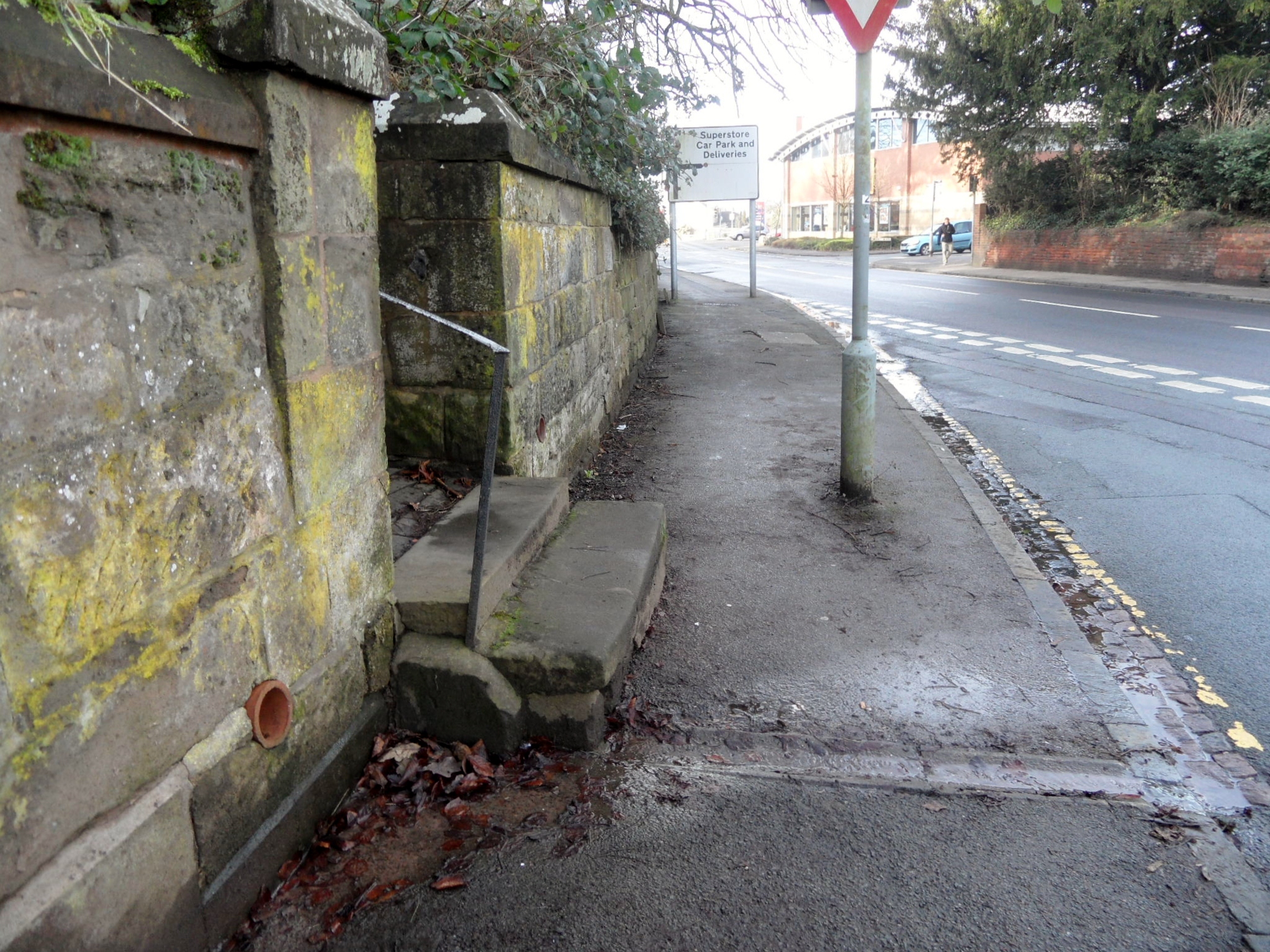
The last photograph doesn’t show anything to do with the route of the canal, but I’ve included it because if you looked at David’s photograph of the Sandfields workers in 1893, you might recognise the steps! If you haven’t been over to David’s website on the history and future of Sandfields yet, you can find it here – please do go and take a look now. David’s also going to hopefully add some more photographs of the canal later and I thank him for all his help in steering me in the right direction!

Finally, I’d also like to mention that Philip John has let me know that the route of the Lichfield Canal has been mapped by the volunteers at the OpenStreetMap project that he’s involved in. There are mobile apps too, so when I attempt to follow the route of the canal beyond Sandfields, I can download one of these to stop me going too curly wurly!

Concrete Evidence

Due to a vague notion I had that canals had to follow a straight line, my previous attempt to follow the route of the Wyrley & Essington canal from the London Rd bridge to Sandfields Pumping Station had not been a resounding success. Determined to find the stretch of the Curly Wyrley (the canal’s nickname derived from the way it, ahem, doesn’t follow a straight line) that I’d missed,  I had a walk along the Birmingham Rd. Near to the Duke of Wellington, half a canal bridge and two modern street names – ‘Wyrley Close’ and ‘Essington Close – confirmed that this had once been part of the route of the canal between Shortbutts Lane and Sandfields.

Canal where?

Essington Close and Wyrley Close to the left as you look at the photo.

Standing in Essington Close looking back up the line of the canal towards the bridge.

In fact, I’d already been over the bridge plenty of times before but just never taken any notice of the clues staring me in the face. My excuse is that my head is always turned the other way, ready to look out for the old Maltings on the other side of the road.

Lichfield Maltings

One of my first friends in Lichfield used to live on the site.  One of our favourite topics of conversation, inevitably, was the history of the building we could see from her house, especially on those occasions when my friend had chatted with one of the employees and was able to regale me with tales of burning buildings, footsteps and orchards.  Through these chats and a bit of reading, we discovered that the malthouse had belonged to The City Brewery Company (Lichfield). In October 1916, a fire destroyed most of the brewery leaving only this building, and the red brick brewery manager’s house and offices (see my earlier post on the fire here). Shortly afterwards, Wolverhampton & Dudley Breweries took over the site.

What we didn’t appreciate enough at the time is that as we were scouring the archives for events that took place nearly a century ago, history was also happening right there under our noses – in 2004, this was one of only six remaining operational floor maltings in the country.The following year, it closed and the building was eventually purchased by a propery developer. Thanks to a Historic Building Assessment and photographs from urban explorers, the architectural features of the building have been documented. However, I wish we’d have talked to more people and asked more questions and recorded the first hand experiences of people doing a job that would very shortly cease to exist, in a building that would soon no longer be used for its primary purpose. You live and learn….

After standing unused for several years, scaffolding now surrounds the malthouse, and the adjoining modern shed has now gone. This could be an indication that the building’s transformation from industrial to residential use is now underway.  It seems to me that giving new life to an old building like this is a good way to balance the need to protect the past and the need to look to the future.  I hope that wherever possible the old features that tell the story of the building’s old life are retained, as recommended by the Historic Building Consultant’s assessment.

On the opposite side of the road to the Maltings, I followed a drive that lead under a railway bridge to some rusting gates. Until I got home and looked at an old map, I had no idea that this had formerly been a concrete works. Back in 1986, the Domesday project recorded that this was once the site of Bison Concrete. Unlike the canal and the maltings, I can see no reference to the site’s recent history. Maybe the time when we celebrate concrete is still to come…

I think that those of us that don’t have the nerve to explore & photograph the inside of derelict buildings or the necessary funds to pay for the physical restoration of a building, do have another weapon that we can employ in the defence of our history – the ability to listen.

The three places I visited above are all a part of Lichfield’s industrial heritage. On my way over to them, I passed a fourth – Sandfields Pumping Station. David Moore is gaining a lot of support for his campaign to safeguard this overlooked yet important part of our social and industrial history. You can listen to what he has to say by visiting his blog here!

Notes

I think my research could also be described as a bit ‘curly wurly’ as I never seem to be able to resist taking the scenic route instead of going from A to B. When I was on the Domesday site, I read some of the other entries for the Birmingham Rd area and the one that especially caught my eye was ‘Shire Horses – Lichfield’, with an accompanying photograph of said horses emerging from stables on the Birmingham Rd. Does anyone know anything about these in addition to the short description here?

On a final curly wurly note, this tree on the Birmingham Rd looks like it has teeth.  The one next to it doesn’t, so I’m not sure why…

Bark worse than its bite?

Sources:

http://www.english-heritage.org.uk/publications/maltings