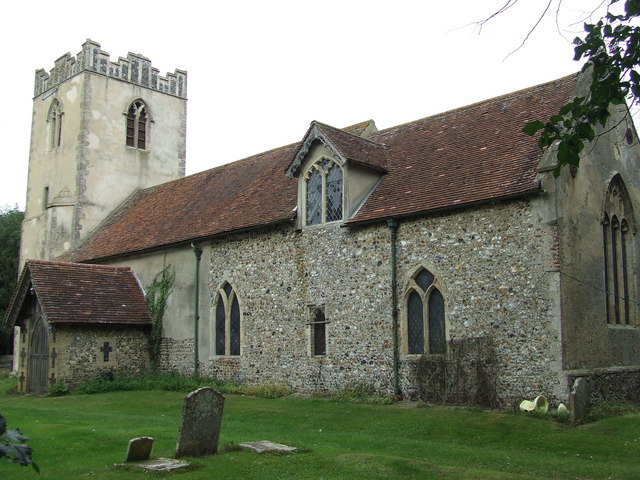
We are over half way through October and I don’t feel like I have indulged in anywhere near enough spookiness as I should have this year. I’m going to try and play creepy catch-up starting with the bizarre burial of Charles Blood at Church Leigh nr Uttoxeter, which took place while the village was cut off after a snowstorm in March 1909.
Once the funeral service had concluded & the mourners dispersed, the sexton, Edward Alcock, was filling in the grave of Charles Blood when he became aware of a knocking, seemingly coming from inside the coffin below him. He described it as the sound of someone rapping on an empty box and counted twenty taps in total, loud at first but gradually becoming fainter. Concerned the poor man had been buried alive, he called over to his brother Harry to fetch Samuel Hollins the undertaker. As the small group of mystified men stood together in the snowy churchyard, they received instructions from the rector in his warm bed, to raise the coffin from the cold grave and carry it into the church. It was something of a struggle due to the corpulent nature of the corpse within but eventually they managed to manoeuvre it. Once inside the chancel, the undertaker unscrewed the lid. It was immediately clear that there were no signs of life and nothing to suggest anything sinister was afoot. The only change was that the hands, originally placed on the deceased’s stomach, were now lying by his sides. A doctor’s assistant from Tean who was passing by the church yard was called in to confirm that Charles Blood was definitely dead and that he definitely had been when he was placed in the coffin.
Weirdly, when the coffin was lowered back into the earth, the tapping began again although this time Charles Blood was left to lie in peace. Well, it would have been peaceful apart from the tapping.
The undertaker’s explanation of the mystery was that the unnerving noises were caused by compressed air in the coffin. He dismissed the suggestion that it was earth falling on the wood, as the taps were too regular. The sexton had no rational explanation for the strange sounds, having buried hundreds of bodies before without incident. It seems he may have suspected a supernatural cause for the sounds as it’s reported that after the strange affair, he would walk a mile out of his way at night to avoid the churchyard. He wasn’t alone. Some of the more superstitious villagers at Church Leigh were convinced it was a sign of some impending disaster.
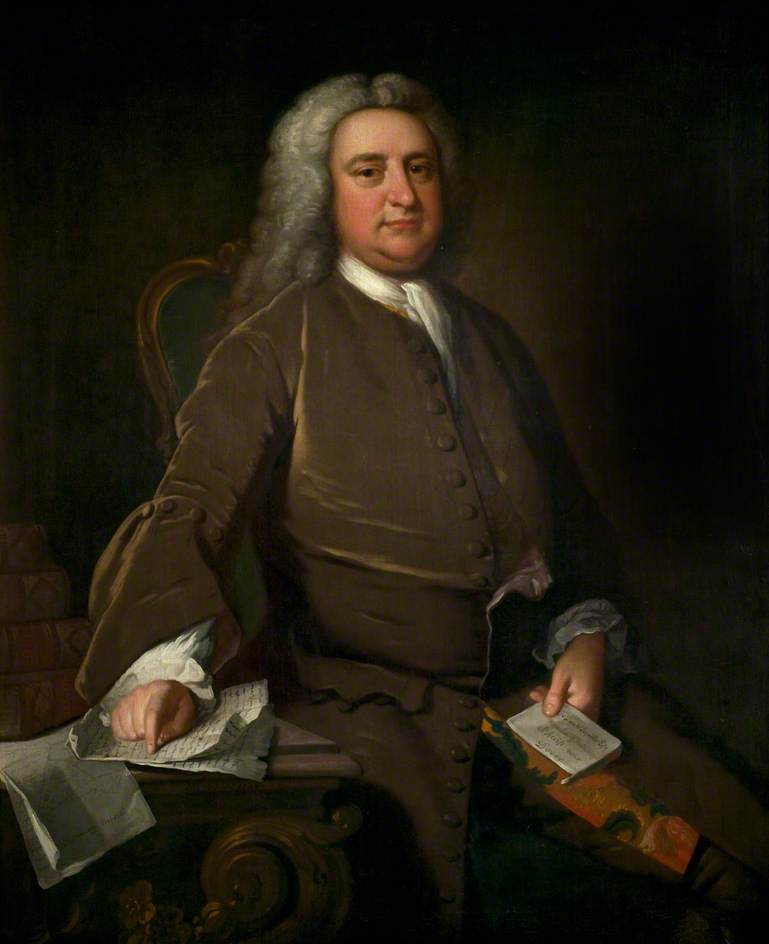
I’ve been to visit the churchyard but couldn’t see, or hear, the grave of Charles Blood. I reckon this chap knows more that he is letting on though…
Perhaps it’s the autumnal feeling the air has acquired after such a scorching summer but I had a bit of a panic that the devil might be spitting on the blackberries earlier than Michaelmas Day this year. So, I dug the Tupperware out from the back of the cupboard for its annual outing and headed over to Pipe Green.
Let’s get ready to crumble!
It was meagre pickings for the first half an hour and my mind wandered back to the brimming bowls of berries I used to collect in my grandad’s back garden in Birmingham. It never occurred to me at the time but the bushes must have been remnants of the fields of farmland that the council house was built on in the 1920s, near the intriguingly named ‘Madcap’ (or ‘Madcat’) Lane, now known as something far more sensible. Even in 1947, the Evening Dispatch acknowledged that Madcap Lane sounded much jollier than sober Graham Road.
Trying to workout where the name comes is driving me mad
Happily, the bushes at the Abnalls Lane end of Pipe Green were much more fruitful. Once my crumble ingredients had been collected, my thoughts shifted once more to something else I’ve been gathering here over the years. Ghost stories.
I found this first one way back in 2011, in the early days of the blog. It was relayed by local historian JW Jackson via his local history column in the Lichfield Mercury around the mid-twentieth century as follows, “Half a century ago considerable alarm was caused by reports of a spectre being seen by various passers-by at belated hours. The writer personally visited (at midnight when ghosts are said to appear) on several occasions but after patiently waiting saw nothing of a spectral character further than weird forms in the trees and bushes in the dim light, and on one occasion the gentle waving of a white nightgown pegged on a clothes line”.
I know that the ghost turning out to be someone’s pyjamas is something of an anti-climax but believe me, I’ve heard others since which will give you nightmares…
As alluded to above, my childhood was spent foraging in South Yardley and so I didn’t grow up around here. Someone who did told me how she and the other local kids would scare themselves silly with stories of a weeping lady in white, wandering the woods and lanes of Leomansley. I was also told of another woeful woman who was seen standing at the side of the road by a motorist. He gave her a lift to a pub in Burntwood and, as he watched her walk inside, thought he should probably check she was ok given how distressed she was when he dropped her off. Inside, there was no sign of her and the customers confirmed no-one had entered the pub before him. I didn’t think to ask the storyteller if she was wearing white.
Can you spot the face?
A local undertaker told me of the time that his brother was walking up Abnalls Lane and heard the approaching footsteps of someone behind him. He slowed to let the person pass by but instead he felt whoever, or whatever, it was pass straight through him. Over at Cross in Hand Lane, where two houses were being knocked into one, one of the builders saw a man in an old-fashioned country smock entering the property through what had been a doorway, recently blocked up and replaced by a window.
The most haunting story I’ve heard about these holloways is the experience a man had after a shift at the Nelson Inn, Cresswell Green. In the car park, he found the owner’s two dog whining and pawing at his car. He shooed them away, got in and drove off down the dark lanes. As he approached Abnalls Lane, the atmosphere in the car inexplicably turned icy. When he glanced into his rearview mirror he saw an elderly man, wearing an worn overcoat tied at the waist with a rope belt, sitting silently in the back. He barely had time to register what he was seeing before his phantom passenger seemed to slide sideways, off the seat and out of the car.
I shall leave you with one final story. North Lane, now nothing more than a footpath across a field linking Cross in Hand Lane with the Stafford Road, was said to be haunted by a man who had hanged himself on an oak tree there. Could this be linked to a man called Gratrex, whose death was reported by the Aris’s Birmingham Gazette on Wednesday 7th September 1763? According to the announcement, an inquest found him guilty of felo-de-se and he was buried in the highway in Lichfield. It doesn’t specify which one but such burials normally took place at a crossroads near to a parish boundary and so it is possible that the remains of this poor soul lie somewhere near here at the edge of the city.
Have I ever experienced anything myself? Not here no, but elsewhere. Those are tales for another time though…
It took me a while to find the wishing stone at Pye Green and it’s taken me even longer to write up what I found about the tale behind it on here. This story appeared in an old newspaper, told to the writer by a ‘greybeard’, one of the descendants of a family of Cannock Chase foresters, and I’ve taken the liberty of retelling it in my own words.
During the English Civil War, the Wishing Stone was the place where a young soldier and one of the daughters of the Cannock Chase foresters would meet. One day the soldier was called away to fight for the King at Worcester and left his lover with a promise to return. Every day that followed, she would wait at the stone for him and those passing her on the old packhorse route known as Blake St would hear her wishing for his return. Weeks passed by and one evening, when she didn’t return home, her father went looking for her. The local women suggested he try the stone and that’s where he found her, lips no longer wishing for her soldier to return but blue and still. The local women speculated whether it was the cold or a broken heart that took her in the end. When the soldier returned and asked where he could find her, ‘her body is in Cannock churchyard’ the local women replied, ‘but her soul is at the place we now call the Wishing Stone’.
Centuries later, if you stand at the stone and listen carefully, you can hear what sounds like a voice saying ‘I wish, I wish, I wish’. It might just be the wind blowing through the trees which surround the stone but the local women will tell you otherwise.
Newton Road Rail Station opened 1837. Closed 1945
Two summers ago, I went to find another wishing stone over Walsall way (yes, I really do need to work on writing stuff up sooner). It’s described as being by a stile in a field leading to Newton Road Old Station on the London and North Western Railway. Folklore says all true lovers who step on the stone will have whatever they wish for come true in twelve months and a day. According to the author of the article in the Walsall Advertiser, you would often find love sick couples loitering around the place but all I could see was cows. I think the stone is on the opposite side of the River Tame to where I was but I wasn’t willing to wade over, even for a wish. I am hoping to go back tomorrow however, as I want to find an aqueduct with a haunted patch of grass and the ruins of the priory alongside the eponymous Sand Well. Is it a wishing well though?
I love a tomb with a tale attached and the churchyard at Sandon delivered. An article in the Staffordshire Sentinel in December 1955, talks of, ‘a grave, said to be that of a highwayman who met his death at Sandon. Certainly the curious shape of a horse and rider on the gravestone would bear out this legend’. A misty winter’s morning, in the dead days of last December, provided the ideal conditions to seek it out and, as the fog swirled around our feet, we found it. Sadly, those curious shapes are now encrusted with lichen and much-weathered by the sixty-nine winters which have passed since the description in the Sentinel was published.
Six months on and I’m still trying to solve the mystery of the so-called highwayman’s headstone. A figure lays stricken on the floor, a man leaning over with his hand on their heart. Whether he’s trying to slay or save them isn’t obvious. To the right, two men stand look-out and at the back is a riderless horse. There’s a church in the carving but as it has a spire this can’t be Sandon, which does not. I’m describing it from a photo taken in 1965 ago which is in the Historic England collection. Unfortunately, their copyright rules don’t allow me to share it here for you to see yourself although I have contacted them to see if I can get permission.
The inscriptions on the tomb are as follows:
To the Memory of Ann the Wife of BRYAN WARD who departed this life March 19th 1807 Aged 65 Years
BRYAN WARD of Smallrice, Gent who departed this life February XX 1809 Aged 74
Anna Maria their daughter died September 15th 1797
Something else is written below the inscriptions for both Ann and Bryan but was illegible even on the 1965 photo.
The All Saints parish register has the entries for Mr Brian Ward’s burial on 23rd February 1809 and five year old Anna Maria Ward’s burial on 15th September 1797. Neither has a note attached to suggest there was anything unusual or untoward about their deaths. I’m sure that had there been, the Vicar of Sandon would have included something as above the entry of Anna Maria’s is a record of the burial of Michael Tams supplemented to say he was drowned in the River Trent on the 25 Evening of December.
The burial record for Anne Maria Ward on 15th September 1797
What I can’t find in the Sandon register is a record of the burial of Ann Ward in 1807. In fact, I can’t find any record of her burial at all.
I’m starting to suspect that the curious carving at Sandon might depict the death of Ann Ward in someway but if she wasn’t buried beneath it here at All Saints, then where is she? Are we going to be able to solve the mystery and rewrite the local legend of The Highwayman’s Grave?
The story of Beaudesert Hall features an incredible cast of characters. There’s Lady Florence Paget, the ‘Pocket Venus’ who eloped with her lover Henry Hastings, and married him on the very same day she was supposed to wed his best friend, Henry Chaplin. More famously, there’s Toppy aka The Dancing Marquess, and a film about the decadent 5th Marquess of Anglesey, ‘Madfabulous‘, has just been shown at Cannes. And of course, there is the first Marquess of Anglesey, who rests in peace in a crypt below Lichfield Cathedral (and no, I’m not going to make any missing leg jokes). For me though, it’s the beginning of Beaudesert and its (sort of) end that has captured my imagination most thanks to a fabulous guided walk and talk there last weekend with my friend JP.
Some of the most substantial remains still standing date back to the 15th century, when the place belonged to the Bishops of Lichfield. They christened it the ‘Beautiful Wilderness’, inspired by the surrounding countryside of Cannock Chase. The story of how it came into their possession is still unfolding and the idea that Beaudesert, first mentioned in the 13th century, may also be connected to two other nearby sites is an intriguing possibility. And how does the mysterious Nun’s Well fit into all of this?
At Cannock Wood, a hermitage was established by King Stephen c.1130, which later became a short lived Cistercian Abbey dedicated to St Mary. Tired of being taken advantage of by the local foresters, the monks begged their benefactor, Henry II, to find their somewhere they could pray in peace. He agreed and swapped the site with what then became Stoneleigh Abbey. King Henry was happy with the exchange and turned Radmore, or Red Moor, into a royal hunting lodge. Despite the site of the Abbey being marked on maps, and evidence of a moated site, WH Duignan, the Walsall solicitor and antiquarian, cast doubt on the location suggesting heaps of furnace slag had been mistaken for ancient ruins. He believed the Abbey had instead stood within the ramparts of Castle Ring, where the foundations of a small building are still visible, although this has more recently been interpretated as another medieval hunting lodge.
Beaudesert belonged to the Bishop until the Reformation when Sir William Paget was given the house by Henry VIII. Paget had risen from humble beginnings to become a key member of the king’s court, thanks to his ability rather than ancestory. Many sources speculate he was the son of a nail maker in Wednesbury but what is certain is that this self-made man managed to keep his head, both physically and politically, throughout the turbulent times of the Tudor monarchs. The property stayed in the ownership of the Pagets until the 6th Marquess of Anglesey made the difficult decision to dispose of his Staffordshire seat in. In the end, he couldn’t even give it away and so the place was sold off piecemeal.
If you’ve read this blog before, you’ll know I have a fascination with what becomes of the fixtures and fittings of a lost country house and there are some tantalising trails to follow from Beaudesert. Pitman, writing for The Friends of Cannock Chase, described seeing, ‘Oak floors, decorative plaster ceilings, Jacobean overmantels, fire grates and irons of ancient dates, (and) marble bathroom equipment’, being dismantled by, ‘the bargain-maker’s men’. Many of these items were bought up by Sir Edward and Ursula Hayward and shipped down under to Carrick Hill House in Adelaide, including the Waterloo staircase, so named for the portrait of the 1st Marquess which hung above it. Oak from the Long Gallery went to Birmingham, where the City Council intended, ‘to keep it ready for use when occasion arises’. Did the Beaudesert panelling ever make it into a Brummie building? With the help of a local councillor, I’ve found a house in Armitage which was once a game larder on the estate and there are stories that more of the stonework found its way to Hanch Hall and to the collection of a man who kept curiosities in a disused rail station in Sutton Coldfield. (Yes, the temptation to go off track and delve further into this has been immense!).
According to the Staffordshire Advertiser, reporting on the sale in July 1935, buyers had 28 days to remove their new property. The demolition firm then had two years to, ‘clear the site, it being understood that he demolishes the building to the ground level and leave the site in a reasonably level and neat condition’. As we know, they never quite succeeded and thanks to the firm becoming bankrupt, some of Beaudesert Hall still survives, ready for another chapter in its long and eventful history. To uncover the full story so far, I can’t recommend enough that you book yourself onto a tour and let the experts guide you around this beautiful wilderness.
There’s a tiny chapel in Tamworth, hidden behind streets of houses. Much of its history is a mystery but there are records showing that the Spital Chapel of St James was erected by Robert Marmion of Tamworth Castle c. 1274. There was a suggestion the chapel had been built the site of an earlier structure and in July 1968 a group of girls from Perrycroft School carried out an excavation there, under the expert eye of archaeologist Jim Gould, in the hope of finding evidence of Saxon origins. What they actually found was something of a surprise.
In a shallow grave, on the north side of the chapel, the skeleton of a middle-aged woman, aged between 40 and 50 was unearthed. Perhaps even more surprising was that the remains of two children were found laying across the woman’s pelvis. There was no trace of a shroud and the burial was on the north side of the chapel. Given that the land surrounding the chapel was not known to have been consecrated, or ever used as a burial ground, it was suggested that this may be an illicit internment of impoverished individuals.
I have different tools at my disposal to that team of teenage girls and they’ve enabled me to find several more skeletons at the Spital Chapel. In October 1914, the Tamworth Herald reported two lots of human remains were found to the south of the chapel when gas pipes were being laid. One was near the door, the other near the chancel wall and again, both were found not far from the surface. The report says they were reinterred on the spot and, unless anyone knows differently, there is nothing to suggest they aren’t still there.
Delving even further back into the newspaper archive, I found that in May 1870, an inquest was held on two skeletons found at The Spittals, a now demolished Victorian house, which once stood near the chapel. Adding to the intrigue is a letter from Edith Heath, published by the Coleshill Chronicle in 1968, recalling how she had often visited a woman called Dorothy Clarson who lived on Wiggington Rd in a house called Belbroughton, built by her father. Miss Clarson had claimed that when workmen were digging foundations for a wall of the house, the body of a man wearing chainmail had been uncovered. Apparently, the then Vicar of Tamworth was sent for to say a prayer and lay the body reverently to rest. Reading between the lines, it seems this skeletal soldier may also still lie somewhere near to the chapel.
The letter goes on to say that Belbroughton was haunted by a Grey Lady, who also walked a path which once led to a lost orchard. Whether this adds or subtracts to the reliability of Miss Clarson’s account, is something you can make your own mind up about but for me, the story that a spectre haunts the Spital Chapel site is the cherry on the cake.
The history books suggest the Spital was originally a chantry chapel, built so that prayers could be said here to save the soul of Robert Marmion of Tamworth Castle. However, there is a belief amongst Tamworth folk that the chapel was used as some sort of Pest House, or isolation hospital during times of plague which may account for the presence of burials. The dedication to St James also suggests at some point it may have been a stop-off on a pilgrimage route. Could it be that those buried here are pilgrims who never completed their journey? I’m obviously no expert but now we know that the burials unearthed in 1968 were not isolated, the theory that they were an illicit burial seems a little less convincing. Perhaps analysis of some of the skeletons, if they do still lie beneath, might be be able to tell us more about who they were, when they died and why they were laid to rest here.
Sources G C Baugh, W L Cowie, J C Dickinson, Duggan A P, A K B Evans, R H Evans, Una C Hannam, P Heath, D A Johnson, Hilda Johnstone, Ann J Kettle, J L Kirby, R Mansfield, A Saltman, ‘Hospitals: Tamworth, St James’, in A History of the County of Stafford: Volume 3, ed. M W Greenslade, R B Pugh (London, 1970), British History Onlinehttps://www.british-history.ac.uk/vch/staffs/vol3/pp294-296 [accessed 4 May 2025]
I’ve long contemplated the idea of writing semi-fiction, taking inspiration from the legends and folklore I love and bringing in elements of my own story telling and experiences. Would it work though, I’ve wondered? Well, I’ve finally concluded that there is only one way to find out….
This is my first attempt. Please be gentle with me.
In 1974, a group of children were spooked by the sight of a figure in white rising from a grave in the churchyard of St James, Aldon on their way home from youth club. There was no indication of which grave it was in the newspaper report which had intrigued Felicity Murray and when she arrived at Aldon church on a warm July afternoon in 2021, she found no clues. The cemetery contained the usual assortment of Victorian tombs, any one of which could have been a contender for those strange events explained away as a trick of the light fifty years prior.
After taking a few photographs of the carvings on the church doorway, Felicity took a moment to sit in the sunshine on the bench outside. On hearing the sound of horses’ hooves, she looked up from her phone and the message she was sending and noticed a funeral cortege approaching the church gates. The two black horses adorned with blue and white plumes and ribbons and pulling a Victorian hearse made for a fine sight but feeling uncomfortable as an uninvited onlooker, Felicity decided to leave the churchyard before the mourners began to get out of their cars. As she slipped out of the gate, Felicity muttered an awkward apology to the female undertaker but received no acknowledgement.
Felicity’s own car was parked just around the corner and as she pulled out of the space, she thought she’d take another look at the horses as she drove past the church. Yet on turning the corner, the horses were no-where to be seen. Neither was the hearse, the undertaker, the mourners’ cars. Nothing was there to indicate the presence of a funeral and the church doors remained shut. Getting back to her car had taken just minutes and even with the greatest efficiency, there was surely no way everyone was already inside.
As a bemused Felicity drove home, she tried to rationalise the experience. Perhaps the church had been a stop off on someone’s last journey and their final destination had been elsewhere? Maybe she’d catch up with cortege a little further up the road. Even the idea that she’d witnessed something paranormal, perhaps the replaying of a past funeral or a time slip crossed her mind but no. Despite the vintage touch of the horse-drawn hearse, every other element had been indisputably contemporary, especially the female undertaker. Distracted by her thoughts, Felicity didn’t notice the cyclist as she pulled out of a junction until it was too late.
The funeral of Jack Sharp took place at St James, Aldon on a warm July afternoon. He was brought to the church in a hearse pulled by two black horses, each adorned with blue and white plumes and ribbons, the colours of his favourite football team. On arriving, the undertaker thought for a brief moment that she’d seen a woman sitting outside the church door but concluded that it must have been a trick of the light.
Charlotte Sophia Burne, the first woman to become president of the Folklore Society, once said of Staffordshire, ‘It is comparatively an ordinary occurrence for this or that lately deceased person to ‘come again’ after death’.
I can’t help but wonder if she’d heard of the post-mortem wanderings of Preston Moore and his father in the village of Weston, near Stafford. A book called ‘Phantasms of the Living’, contains the following account from a Mrs J Bennett written in 1882 about the eerie events of 13th April 1860.
“My daughter Annie and I had been drinking tea with the late Mrs Smith and Miss Moore, and talking about their brother Preston being very ill and not expected to recover, and were returning home in the evening when between the little wicket which opens out of the Vicarage field and Mrs Newbould’s house, we met the identical man in face, form and figure, dressed as he was always wont; slouched hat, old frock coat, open in front, knee-breeches and gaiters, with a long stick. He passed so near us that we shrank aside to make way for him. As soon as we got to Mrs Newbould’s she exclaimed, ‘So Preston Moore is dead!’, when we both exclaimed, ‘Oh no, we have just seen him!’. We found, in fact, that he had died about half an hour before he appeared to us’.
Something wicked this way comes
Mrs Bennett was adamant that it could not have been a case of mistaken identity. According to her, ‘We cannot call to mind anyone at all resembling the individual in question; his appearance, dress and gait were utterly unlike anyone else residing in or about the neighbourhood’. More intriguing details emerged during psychical researcher Eleanor Sidgwick’s interview with Mrs Bennett. There was apparently something forbidding about Preston Moore and his sister Miss Moore was also considered odd. Preston may also have had a thing for Mrs Bennett. He once bought her pansies pinched from a neighbouring gentleman’s garden and another time, cauliflowers, also illegitimately acquired. Perhaps I should have saved this story for Valentines Day? ‘Roses are red, violets are blue, here are some vegetables, I’ve stolen for you. Violets are blue, roses are red, I’ll still be around, even after I’m dead’.
A lovely pub. We will definitely come again.
The story as it stands is strange enough but reader, there is a twist in this tale of a dead man walking. An article in the Staffordshire Advertiser in 1901 claims that Preston Moore was not the first of his family to ‘come again’ after his death. There was a legend in the local area that his father’s shade had roamed up and down the road between Stowe and Weston, until locals decided it had had enough exercise and it was time to exorcise this restless spirit. It was laid in a bottle and bricked up in the cellar of the Saracen’s Head Inn to remain there, ‘whilst holly and ivy are green’. It seems that during his life Mr Moore senior may have been the landlord at the inn making the real horror here the idea of being trapped in your workplace for eternity.
She wouldn’t let it lie!
Obviously my good friend Jacky and I went to investigate, by which I mean we popped into the pub for a coffee and pretended we’d found the bottle containing the spirit of Mr Moore on a shelf nearby where we sitting. I am convinced there’s more to be found out about the mysterious Moore family which may explain why the family seem to have been at the centre of village superstition. In the meantime, if you work at the pub, would you pop into the cellar and see if you can find where the old landlord lies? We should have asked but we didn’t have the bottle…
Sources
Staffordshire Folk and the Lore, Charlotte Sophia Burne
Phantasms of the Living, Edmund Gurney, FWH Myers and Frank Podmore
There are many reasons one might visit a pub. To sample the fare, to enjoy an ale, to meet with companions. I went to the Dog and Doublet because it’s named after a murder. Or a dog wearing a jacket. Either way, I headed to the village of Sandon in Staffordshire, in my mystery machine (which looks a lot like a Toyota Avensis) to do a bit of investigating.
The first possible explanation for the pub’s name is that a former landlord was murdered by robbers and his faithful hound found the corpse. In what sounds like a gothic horror version of Lassie, he took his master’s blood-stained doublet back to the inn and then led a search party back to the body. The second less gory story says that a travelling fair came to Sandon and its star act was a performing pooch in a little jacket. The villagers thought he was such a good boy they decided to name their pub after him. A dog in a doublet was clearly a novelty back then. Nowadays I see some canines out walking in Leomansley Woods who have better wardrobes than I do.
The current building dates to 1906, and is described as having been erected by the Earl of Harrowby on a site adjoining that of the original. The tithe map seems to show that there was an inn there back in 1838, but it was known as the Packhorse. It’s all a bit confusing, even before you’ve had a drink, but I think I understand what happened with these hostelries. There was definitely a Dog and Doublet in the village dating back to at least the mid-18th century as I’ve found a reference for it in Aris’s Birmingham Gazettee. It seems to have stood on the other side of the road, at a place now known as Sandon Lodge and/or Erdeswicke House. When Sandon Hall burned down in the summer of 1848, the Earl of Harrowby made it his temporary family home, and had the pub sign moved to the Packhorse which presumably was also renamed at this point. He didn’t relocate the resident ghost though, as a man described as wearing brown clothes and a small wig and believed to be a former landlord, was still reported to be haunting his old hostelry in the 1950s.
The gates to Sandon Hall
This information comes from Sam Berrisford, a former chairman of the Parish Council, who lived in part of Sandon Lodge. He also mentions an overgrown circular bowling green in the grounds of the old inn, which he suggested was Elizabethan. According to the listed building description, the oldest parts are 17th century and so certainly old enough that tales of parliamentarian troops draining quart pots and plunging their heads into vats of beer in the inn’s cellar prior to the Battle of Hopton Heath could be true. If so, it’s no wonder the Royalists defeated them eh? (put down your swords Roundheads, I’m just jesting. I know the outcome of the only Civil War battle to take place on Staffordshire soil isn’t that straightforward).
During its 18th century coaching inn days the hospitality of the hostelry was renowned and, in the absence of Trip Advisor, a satisfied customer is said to have scratched this verse onto one of the smoke-room windows of the old pub.
‘Most travellers to whom these roads are known Would rather stay at Sandon than Stone Good chaises, horses, treatment and good wines, They always meet with at James Ballantine’s’.
Not everyone met with such a cordial welcome from Mr Ballantine however. There’s a story his daughter eloped with a young man and that when the boy broke into the inn to collect some of her belongings, Ballatine was there waiting for him. He handed his estranged son-in-law over to the law and the lad was hanged for theft. It’s said that on the night of the execution, a crowd of villagers surrounded the inn, chanting the 69th psalm and cursing James Ballantine. Possibly related to this family drama is a second verse that the Staffordshire Advertiser says was scratched into another of the inn’s windows which read, ‘Let the man that hates peace, and endeavours to trouble it, Be hung up by the neck, like this dog in the doublet’.
Whitehall, Beacon St. Once the Coach & Horses inn
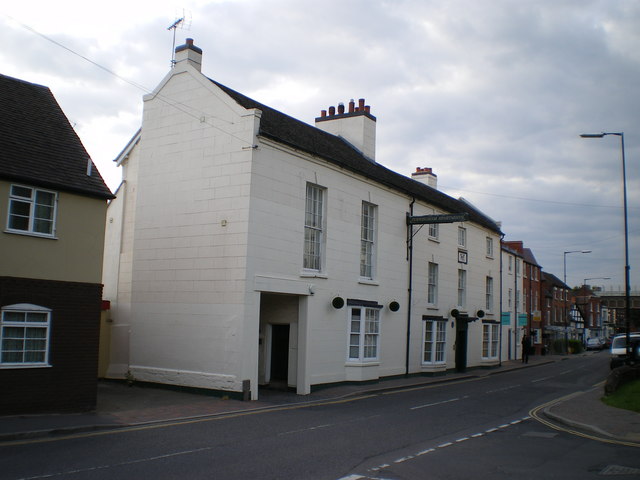
Whether the story of Sandon’s star cross’d lovers is true I don’t yet know but I have found out that James Ballantine and his wife Catherine had six daughters in total. One of them was called Ann and in November 1779 she married Alderman John Fern, an eminent Wine and Brandy Merchant from Lichfield. So far, so respectable but then you learn the groom was sixty-two years old and Ann only twenty-one. I believe they’d have lived at Whitehall on Beacon Street in, another former inn with an intriguing past. Fern died in Lichfield on 16th February 1801 and his short obituary in the Whitehall Evening Post, refers to him as the ‘Father of the Corporation of that city’. Although surely he was old enough to be its Grandad…
Back to the Dog though and by December 1802, the landlord there was Mr Tomlinson who was paid a visit by a swindler, who may have been enticed by the Trip Advisor review for good horses in the window. He had, ‘very much the appearance of a gentleman aged about forty years, five feet eight or nine, dark curled hair, smooth face, smiling countenance and had on a dark mixture cloth coat, with one of his boots patched across the toe’. He arrived in a post-chaise from Cheadle and claimed to have left his horse at Leek due to the bad weather, asking for a horse for the following morning to take him to the banking house of Messrs Stevenson and Co. Inevitably, that was the last Mr Tomlinson saw of his horse and when enquiries were made at the bank in Stafford, it probably didn’t come as a shock that no such person had been there. A five guinea reward was offered by Tomlinson, along with ten pounds from ye olde neighbourhood watch scheme, the Sandon Association for Prosecuting Felons.
To the church. Let’s not split up eh gang?
And so it turns out there there are far more than two tales at the Dog and Doublet even if some of them are just shaggy dog stories. I’m not quite ready to fire up the Toyota Avensis and leave Sandon just yet though. There’s a mystery up at the church that needs solving…
Sources:
Birmingham Weekly Post 20th October 1950
Stone – The History of a Market Town, Norman A Cope
Afternoon tea at Weston Hall is my annual festive treat and though we didn’t spot any ghosts of governments past in the form of the MP from Stone eating scones again this year, plenty of other spectres are still present here.
Scones and spooks is my idea of heaven
The Jacobean hall is said to be so haunted that when it was used by the ATS in World War Two, there’s a story that the women stationed there opted to sleep outside in tents rather than risk meeting the legendary Grey Lady. It seems a less effective strategy when you learn that the wraiths of Weston Hall are not confined within its walls. A Green Lady walks up the stones steps to the entrance, a White Lady rushes across the nearby road and disappears into a hedge during a full moon and the sounds of a ghostly carriage and horses can be heard pulling up outside on the gravel, despite the driveway having been long paved over.
Stairway to heaven
Given there are so many ghosts, the house must surely have had a colourful history but details of its original owners are a little sketchy. In Henry Edward Chetwyn-Stapylton’s book on the Chetwynds of Ingestre, he suggests Weston was built by Lady Dorothy Devereux, youngest daughter of the former favourite of Elizabeth I, and William Stafford of Batherwyke, her second husband. He notes that Robert Plot says she was living there at the time he wrote his History of Staffordshire in 1686 but as she died in 1636 he must have been mistaken. Unless she’s the Grey Lady and it’s her ghost he saw…
Seems a bit scary on the outside but lovely on the inside. Just like me 😉
A later owner, Francis Lycett died there on the evening of 6th May 1792 from a fractured skull, a few days after falling down the stairs at The Falcon Inn at Stone. One of his spurs had caught on his great coat. I have read elsewhere on the internet that Francis is an ancestor of fellow Brummie (but not fellow comedian) Joe Lycett but haven’t yet been able to substantiate this.
By 1818, the hall was described as a farmhouse in a rather neglected state in the Staffordshire General and Commercial Directory. In the early twentieth century, the property was used as a pauper asylum by Staffordshire County Council to relieve overcrowding at Stafford. There were 45 female patients in August 1908 but again information is scarce. Afterwards it was allegedly sold to pay gambling debts and converted into flats. An application to convert the property to a nursing home in 1991 was abandoned and the hall stood derelict until Paul Reynolds rescued and restored the building a few years later.
The Falcon at Stone, where Francis Lycett had a fateful trip
For me it’s not so much generic stories of women in white (or grey, or green) that float my ghost ship, but something with more substance. An event in the past which may help to explains why there may be a perception of paranormal activity. When the hall was reopened as a hotel in the 1990s, staff reported tables being cleared, glasses being collected and ashtrays being emptied by an unknown entity. I can’t help but wonder if there’s a link here to the tragic events of March 1945 when a twenty five year old mess orderly in the canteen was accidentally killed when she was shot through the chest by an eighteen year old private in charge of a detachment of German POWs working at Weston Hall.
I’ll be haunting somewhere around here
Whoever it is that haunts Weston Hall, there are far worse places to spend your afterlife. In fact I love it so much that in years to come there may be reports of another female phantom who turns up at Christmas and sits by the fire stuffing herself with scones.
Sources
Paranormal Staffordhire, Anthony Poulton-Smith
Staffordshire Newsletter 4th October 1996
Stafford Post 21st March 1996
Staffordshire Sentinel 23rd July 1985
Staffordshire Newsletter 19th November 1976
Staffordshire Sentinel 6th July 1945
The Gentlemans Magazine and Historical Chronicle 1792