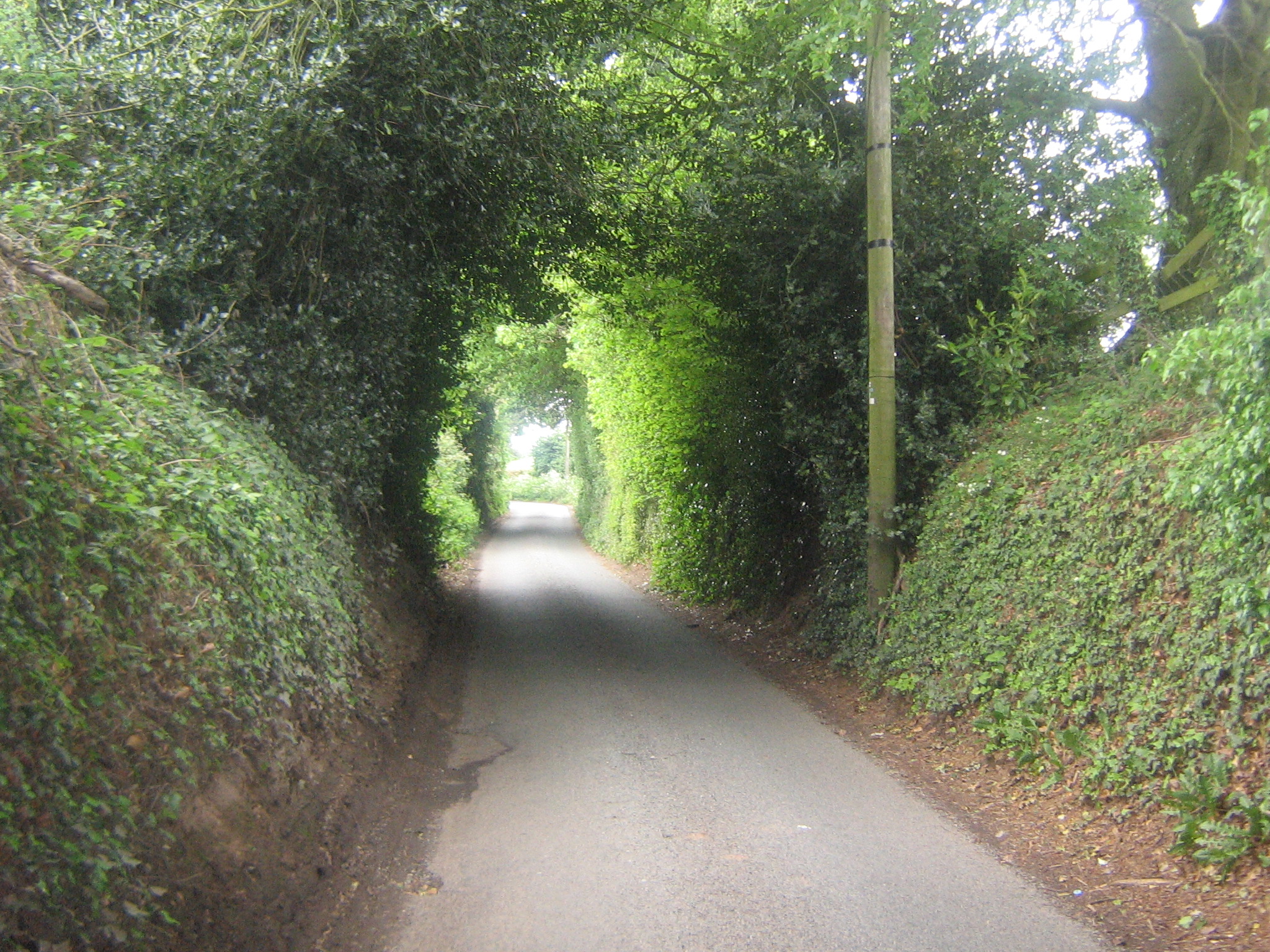
Knaves Castle

One of the great thing about doing this blog is that whilst looking for one thing, you find ten other things! It’s amazing how many fascinating things are on your doorstep, or just down the A5 in this case. Until recently, I had never heard of Knaves Castle, but now that I have, I’m intrigued as to what this was. It seems that this question has puzzled people over the centuries.

Back in 1794, in ‘The History and Antiquities of Shenstone’, Rev Henry Sanders wrote that Dr Plot believed that Knaves Castle was a place to watch travellers safely cross ‘this heath, formerly all wood and much infested with robberies’…'(for) which the passengers allowed some small gratuity’.  In complete contrast, he reported that another of Dr Plot’s theories was that ‘the robbers themselves harboured in this place’ and hence the name Knaves Castle.  Rev Sanders’ own opinion is that ‘though there remain no signs of a fort, it seems very likely to have been one to guard strangers passing over so wild and dreary a country as Cannoc Wood is at present; much more was it such formerly, when full of woods and thickets’. I’m assuming that he is referring to Dr Robert Plot who wrote a ‘Natural History of Staffordshire’ in 1686 which included a map showing Knaves Castle (this can be seen on the Staffordshire Past Track website.

In 1870-72, John Marius Wilson’s Imperial Gazetteer of England and Wales, saysTraces of a Roman camp, called Knave’s Castle, are to the N of the village’ (the village referred to is Ogley Hay).

According to ‘Notes on Staffordshire Place Names’ by WH Duignan of Walsall, earthworks and tumuli are often called castles.  The book states that the tumulus is now almost obliterated and enclosed in a garden, but that sixty years ago was very plain (the book was written in 1902, so ’60 years ago’ would have been the 1840s).

Knave’s Castle is a kilometre west of the Staffordshire Hoard findsite, but Della Hooke from the University of Birmingham, in her paper ‘The Landscape of the Staffordshire Hoard’, casts doubt on the description of Knave’s Castle as a tumulus and believes that it is no more than a raised natural hillock.

The English Heritage description of the site can be at found at the Pastscape website.

Unfortunately, no there are no physical remains of  Knaves Castle.  Was it really a Roman earthwork, a hideout for robbers or just a hill?

Update: Since originally doing this post earlier this year, I have since come across an excellent and much more in depth post on Knaves Castle on The Gatehouse website.  The post concludes that Knaves Castle was an artificial earthwork, albeit one that may have developed from a natural feature.

Milling about in Leomansley

Leomansley grew up around the mill built by John Hartwell in 1791, on the edge of Pipe Green. Pipe Green was a meadow which had originally been left to the poor widows of Beacon St as pasture for their geese and was being used as common land.(1) As compensation for cutting a watercourse through the green, Hartwell made an agreement to give the poor inhabitants of Beacon St 10 shillings worth of bread each year.(2) Probably a lot of dough in those days….

Bullocks on Pipe Green


Anyone who has been for a walk over there will know that Pipe Green is home to around 12 bullocks.  I remember there being an advert in the Lichfield Mercury a few years ago, asking for someone to graze their herd there
. It’s still owned by Pipe Green Trust, which is made up of residents of Beacon St.

Back to the mill, and in 1841, the census shows several Leomansley residents working as wool combers or spinners. I’m wondering if the row of cottages on Christchurch between Leomansley Wood and the Old Vicarage (Easter Hill) were purpose built for the mill’s employees? It appears that some of these people moved on once the mill closed around 1860, as on the 1881 census, several of the properties in ‘Old Leomansley’ are listed as ‘uninhabited’.

On the subject of employment, the 1881 census also shows several men employed in railway related work. In fact men from three neighbouring households were all platelayers and there was also a signal man and a coal heaver in the area. I’ve found a great post about platelayers and what their work involved at turniprail.blogspot.com. Once again, I’m speculating, but I wonder if the Leomansley platelayers were responsible for the Sandfields stretch of track on the Lichfield to Walsall line, which opened in 1849 and would have been just across the fields (which are now the Darwin Park estate). There is a photo from 1924 of the track at Sandfields on the South Staffs Railway website as well as plenty of other fantastic photos and other interesting things!

Sources:

1) History of the Cathedral & City of Lichfield by John Jackson 2) A Short Account of the City and Close of Lichfield by Thomas George Lomax, John Chappel Woodhouse and William Newling 3) ‘Lichfield: Economic history’, A History of the County of Stafford: Volume 14:Lichfield (1990)

Pomology

Now, I know it’s not apple season, but I couldn’t wait until August!  I have found a couple of old books on the internet (thank you google books!) devoted to Pomology, in which each apple with its sometimes fabulous name, is described in a manner reminiscent of fine wines.

Listed amongst the hundreds of different varieties, such as Bigg’s Nonesuch, Poorman’s Profit and Cornish Aromatic  I found the Elford Pippin. Described as an excellent dessert apple, it was a round, medium sized fruit with yellowish green skin, with markings of russet on the shaded side and red stripes on the closest to the sun side. It had a yellow, tender, crisp flesh with a fine, brisk, sugary and vinous flavour.

The Pomological Society tells us “it was raised at Elford, near Lichfield, where it is a very popular variety, and to which locality it is at present chiefly confined”. As with so many tradtional varieties, it is no more.
Not only did Elford have its own variety of apple, it also had its own rhubarb – according to gardening tomes it was one of the most valuable varieties of rhubarb and was raised by Mr. William Buck, gardener to the Honourable Fulke Greville Howard, at the Elford estate. The green-fingered Mr Buck also grew a seedling grape (described as tolerably good), from seed sown in January 1821, and exhibited on the 1st of October 1822.
In the 19th century, in some parts of Lichfield, market gardening was a thriving industry. According to J Martin, Fisherwick Park gardens regularly sent cabbage, broccoli, asparagus and fruit to Birmingham and London in the early 1800s and the County History tells us that by the mid-century, there were 68 market gardeners in Lichfield delivering their produce by horse and cart to the neighbouring Black Country markets. I’ve been told that the land around the old City Brewery, and gardens on the Walsall Rd and Christchurch Lane were used for growing produce.
Green fields from Pipe Hill
Though it’s not famed for its fresh produce as somewhere like Evesham is (the fruit and vegetable basket of England, as their tourist office calls it!), there is still a fair bit grown in the Lichfield area. We’ve always been to Coulter Lane Fruit Farm for PYO berries and yesterday, I picked up my first fantastic vegetable box from the Woodhouse Community Farm scheme (which was part of the old Elford estate!). A few days ago I read on the Lichfield Blog that local growers won an award for their parsnips and the fields around Leomansley are full of potatoes and other crops.  I’m no evangelist about such matters but I do think we should try to support local food growers directly, so that neither they nor us are entirely dependent on supermarkets (though I do use them a fair bit). So go on, pop down to Coulter Lane & treat yourself to some strawberries, or order a box from Woodhouse farm.  Every little helps….
Sources:
The Apple and its Varieties by Robert Hogg, Vice-President of the British Pomological Society 1859
A Guide to the Orchard & Fruit Garden by George Lindley, John Lindley
The Social and Economic Origins of the Vale of Evesham Market Gardening Industry by J M MARTIN
An Encyclopedia of Gardening  by John Claudius Loudon
‘Lichfield: Economic history’, A History of the County of Stafford: Volume 14: Lichfield (1990),

Miss Seward's Prize Enigma

Anna Seward’s will, was said to have contained a riddle, with instructions to her executors to pay £50 to the first person to provide the correct solution. The enigma ended with the verse:

Now, if your nobler spirit can divine
A corresponding word for every line,
By all these letters clearly shall be shown,
An ancient City of no small renown.

In a compilation of Thomas Sedgwick Whalley’s Journals and Correspondence, there is a letter from Mrs Whalley, to her husband in 1816, enquiring whether he had been told the solution to the rebus by Miss Seward, as someone had managed to make the word ‘Litchfield’ but she had not heard whether the executors had agreed the claim. The editor of the compilation has added a footnote.  He asked a friend to find out more about the enigma. On January 31st 1863, the friend wrote to tell him that “ having been carefully through both the will and the codicils, which are very lengthy….there is nothing in either which in any way refers to “an enigma” which could be so construed”. Reuben Percy claimed the enigma was a shortened copy of a puzzle published in the Gentleman’s Magazine in March 1757, attributed to Lord Chesterfield. A solution offered by Solyman Brown was IEROSOLUMA, which I think is Greek name for Jerusalem.  You can find various versions of the enigma, and the solution, on Google Books. If, as it seems, The Swan of Lichfield’s will did not contain the ‘enigma’, it would be interesting to discover where the story originated.

Sources
Gleanings from the Harvest Fields of Literature – Charles Carroll Bombaugh Relics of Literature – Reuben PercyAn Essay on American Poetry – Solyman Brown
Journals & Correspondence – by Thomas Sedgwick Whalley, ed. Rev Hill Wickham

Kings of Lichfield

Borrowcop Gazebo
Down yon meridian fields afar
When Mercia led her chiefs to war,
Fell in one hour three monarchs brave,
And Lichfield’s bower protects their grave.
Her stately spires amidst the skies
Ting’d by the orient sun arise,
With golden vanes invite the gale,—
Triumphant ladies of the vale!
Extract from Needwood Forest by Francis Noel Clark Monday

Over the centuries, there has been a succession of structures on Borrowcop Hill.  There’s the (possible) Saxon Fort mentioned in my Lichfield Castle post; something called the Temple in the late 1600s; an arbour in the 1720s replaced by a summerhouse and finally the Gazebo that is still there today.  It was also the site of beacons, lit to warn of invasions. It’s hardly surprising given the views.

Lichfield tradition says Borrowcop is the final resting place of three Christian Kings, slain together with their outclassed army by the Romans in the time of the heathen Emperor Diocletian (around 288AD).  In John Jackson’s version of the legend, the bodies of the Kings were, “burnt and heaped upon a hill, according to the ancient custom of burial after a battle, and covered with a mound of earth, or tumulus, where, probably if dug into, the urns and ashes will be still discovered”.  However, a series of explorations have found no evidence of burials, although an anonymous source from 1819 is recorded as saying Erasmus Darwin recovered burnt fragments of bone from the site.
The legend gave rise to the theory that Lichfield meant ‘Field of the Dead’.  Perhaps being far more evocative than the currently accepted explanation for the name of ‘common pasture beside grey wood’, the ‘Field of the Dead’ theory still persists today.
Lichfield was incorporated by the protestant King Edward VI in 1548.  The following year, the city corporation chose to depict the ‘Martyrs’ legend on the city seal.  It’s been suggested that the corporation was keen to disassociate Lichfield from the Catholic connotations of St Chad. (The Victoria County History tells us that a previous seal is believed to have been a Bishop (presumably St Chad), with two angels either side and the Cathedral in the background).
You can still find the ‘Three Kings’ seal on the St John St railway bridge.  The legend is also portrayed on the the Martyrs Plaque, which originally adorned the front of the old Guildhall in 1707. The plaque was moved to a rockery in Beacon Park after the Guildhall’s victorian restoration.  After years of decay, the plaque was restored in 2010 and now stands in the Rose Gardens in Beacon Park.
St John’s railway bridge
Martyrs Plaque, Beacon Park (from Wikipedia)


Sources:
History of the City & Cathedral of Lichfield by John Jackson
English Heritage Past Scape
‘Lichfield: Town government’, A History of the County of Stafford: Volume 14: Lichfield (1990)
Public Sculpture of Staffordshire & the Black Country by George Thomas Noszlopy, Fiona Waterhouse

South Staffordshire Archaeological & History Society Transactions

One Sweet Apple…..

On my way up to Borrowcop Hill,  a house name jumped out at me  – Sweet Apple Cottage. Unlike its neighbours, it made no obvious allusion to its surroundings. It’s here on Borrowcop Lane.

Sweet Apple Cottage, Borrowcop Lane

The name is on the kind of plaque you often see on similar Victorian houses, together with the date of 1883, so I don’t think it’s a case of more recent owners just choosing a quaint name.
My first thoughts were perhaps it referenced an orchard.  However, a search on google has turned up one possible clue.  A place called Sweet Apple Court elsewhere in the country was named after a man called Sweetapple.  It’s apparently a Saxon surname, one that I’d never heard of until today.  So was there a Sweetapple in Lichfield that gave his unusual name to this house?  Or is there another explanation?

Pinfolds in Lichfield

Last night on Twitter, I was complaining about slugs snacking on my tomato plants. Down at the allotments, we are all in competition with rabbits, pigeons and field mice as to who gets to the fruit and veg first. Thankfully, I do not also have to contend with cattle, as people in years gone by did! Stray animals were a serious threat to food production and so pinfolds and pounds were erected, where the rogue livestock could be impounded. The animals would be released to their owners on payment of a fine, although there were stories of animals mysteriously disappearing from the pounds overnight….!  In England in Particular’s section on pinfolds, they liken the animals to today’s wrongly parked cars! (1)

Here in Lichfield in the 1500s, the person responsible for rounding up and impounding the animals was the ‘Warden of the Fields’. By the mid 1600s, the job title had changed to ‘Pinner’. Two Pinners were elected in Lichfield, with one taking responsibility for St Chad’s parish and the other St Michael’s parish. They were appointed at the ancient manorial court of St George,  which still takes place every year.

We are lucky to have a well preserved pinfold here in Lichfield, located at Pinfold Road (where else?), where Beacon St becomes the Stafford Rd. The listed building description says the present structure dates to the 18th century, but that it has earlier origins. According to the County History, there was an earlier pinfold in Beacon Street by 1645, near the corner of the later Anson Avenue.  This was removed in 1809 and replaced by the Stafford Rd pinfold.

The County History also says that another pinfold stood at Greenhill in 1498 and it is thought it was relocated in the early 19th century to the junction of Broad Lane and Boley Lane. I have had a look at www.old-maps.co.uk and the Boley pinfold can be seen on a 1955 map of Lichfield, but has disappeared by 1966.  Sadly, no trace of it exists. The Greenhill pinfold can still be seen on John Snape’s 1781 plan of Lichfield .


The terms pounds and pinfolds both seem to be used interchangeably in Lichfield, although pounds is the more common of the two. A fantastic website called Pounds and Pinfolds has been set up, the intention of which “is to raise awareness of these modest buildings by identifying all of the surviving examples, recording their location and condition and encouraging their restoration or preservation”. Our pinfold doesn’t feature on the National Register that the website is compiling, so I’m sending details over to them for inclusion.


This little fellow must have been rounded up last night….

Sources

1.England in Particular by Sue Clifford & Angela King
2. www.thurgartonhistory.co.uk
3.
History of the County of Stafford: Volume 14: Lichfield (1990)
4.www.lichfield.gov.uk

For what the bell tolls…

Easter Hill is the former vicarage of Christ Church at Leomansley built in the 1840s, around the same time as the church.  The older front part of the house is divided into flats and the rear, added later, is now a separate house.
What has always puzzled me is the bell on the left side of the building, under the eaves.

I have always assumed the bell had a religious use e.g. to call people to church, but couldn’t understand why this would be necessary.  Christ Church has always had a bell and it is easily within earshot of its flock.  In 1851 there were only 27 households in Leomansley.  However, BrownhillsBob came up with the suggestion that it could be a firebell, used to alert the local brigade and distinct from the church bell.  Bob has informed me there is such a bell on the council house at Brownhills.  This secular use seems much more likely and definitely warrants investigation.

If anyone else has any suggestions as to what the bell could have been for, please let me know!


Lichfield Castle

Lichfield Castle isn’t a spectacular ruin like Kenilworth nor a well-preserved motte and bailey like Tamworth. Our castle is a conundrum and the mystery of where it stood has intrigued people for centuries.

Almost 500 years ago John Leland wrote that there had been a castle of ancient time in the south end of the town, but that nothing remained.  He noted that there was a place called Castle Field , where there were dykes, but concluded that it was more likely that the castle would have stood in the Close, with the ground being somewhat castle-like.

Remains of North East Tower, as seen from Gaia Lane

Richard II spent Christmas 1397, in Lichfield Castle, consuming 200 tuns of wine and 2000 oxen.Two years later, the King’s fortunes had changed and he was imprisoned in Lichfield on route from Chester to London.Some accounts just say he was incarcerated in Lichfield Castle, others specify a tower in the Close and the County History of Stafford, says that the Richard was held in the Archdeacon of Chester’s house in Beacon Street. J Gould’s report on Lichfield Archaeology & Development says that if King Richard was imprisoned in the fortified Close, it would most likely have been in the North East tower, the footings of which can be still be seen. The tower was said to have been 52 feet high, 20 foot above the rest of the buildings.In some versions of the story it is reported that an unsuccessful attempt was made to escape through a window!

To add to my confusion, Thomas Harwood wrote in his History of Lichfield, that King Richard spent Christmas in the Close and that later he was imprisoned in the magnificent tower in the Close, built by Bishop Clinton. However, in Sampson Erdeswick’s Survey of Staffordshire (which I understand was written in the late 16th Century, with a version edited by Thomas Harwood published in the 1844) both the castle and Bishop Clinton’s fortifications are listed, seemingly as two separate entities ‘The castle, in which Ric. II. kept his Christmas in 1397, and in which, two years afterwards, he was confined; the city walls; bishop Clinton’s costly fortifications ; with the beautiful western gate, are all levelled. The castle stood on an eminence on the south side of Tamworth-street, the site of which is now occupied by small houses and gardens”.

The case for the Tamworth Street site seems to consist of the place names in that area (Castle Dyke, Castle Field (historic)) and (rather tenuously) a large amount of ox bones dug up in the 1800s in nearby ‘Oxenbury Field’ that were said to be the remains of Richard’s Christmas feast. It seems traces of old stonework found in this area were locally considered proof of a castle here but a report by the South Staffordshire Archaeological & Historical Society (SSAHS) discounts these as merely the cellars of domestic buildings.

English Heritage’s description of Lichfield Castle on Pastscape also says that no evidence was found by field investigators in the Tamworth St area, in 1958 or 1974. One explanation given to the placenames found in the area, is that they relate to an Anglo-Saxon fort on Borrowcop Hill. The description also includes the opinion of a Phillip Davis* on the matter “There is some doubt as to whether a castle existed in Lichfield. However, the tradition of a castle in the town is a very strong one. My personal view is that there was a timber castle of some sort in the town in the early 12th century (probably started at the same time as Tamworth and Stafford, i.e. circa 1070) but that the work by Clinton was probably done on the Cathedral Close, and the castle was basically defunct at this time.”

So, it seems there could have been two castles, with references to each becoming confused and muddled over the years.It seems the castle relating to King Richard was the fortified Close and there may also have been an Anglo-Saxon castle.As ever, this raises more questions.Why did the original Lichfield Castle vanish, yet Tamworth’s and Stafford’s castles still stand strong today?Was it abandoned after the fortification of the Close or before? Did it stand on Borrowcop Hill?The mystery of Lichfield Castle continues….

*I’m assuming this is the same Phillip Davis from  The Gatehouse Website

Sources:

Lichfield Close in the Middle Ages by William Beresford

The Reliquary and illustrated archaeologist vol 7

The Itinerary of John Leland in or about the years 1535-1543.

Lichfield: The cathedral close’, A History of the County of Stafford: Volume 14: Lichfield

SSAHS Transactions (1981-82)

Lichfield Archaeology & Development by Jim Gould FSA

History and Antiquity of the Church and City of Lichfield by Thomas Harwood

Erdeswick’s Survey of Staffordshire
http://www.pastscape.org.uk

The Wychnor Flitch

Home for many years to the Levett family of Lichfield, Wychnor Hall is also home to an unusual marital custom that began in the reign of Edward III.  A couple, still happily married after a year and a day, could go to the hall, accompanied by some neighbours, who were prepared to testify to their marital bliss.

After the husband had sworn under oath that he ‘would not have changed for none other, farer ne fowler, richer ne powrer, ne for none other descended of gretter lynage, slepyng ne waking, at noo tyme; and if the seid X were sole, and I sole, I wolde take her to be my wife before all the wymen of the worlde, of what condytions soevere they be, good or evyle, as helpe me God, and his seyntys, and this flesh, and all fleshes’, the couple were presented with a flitch of bacon (which I understand is half a pig).

Apparently, the records show that only three couples were ever awarded the bacon.  The first couple argued so much over it on the way out, they had to give it striaght back!  The second couple hadn’t seen each other since their wedding day, as the husband was a seaman.  It’s said that the third couple were ‘a good-natured man and his dumb wife’.Thomas Pennant writing in the 1780s noted that ‘the flitch has remained untouched, from the first century of its institution to the present: and we are credibly informed, that the late and present worthy owners of the manor were deterred from entering into the holy state, through the dread of not obtaining a single rasher from their own bacon’.   However, in Horace Walpole’s letter to the Countess of Aylesbury, on Aug. 23, 1760 he states that ‘it is thirty years since the flitch was claimed’.

According to The Spectator in 1714, one hungry couple applied soon after their honeymoon.  However, it was deemed that insufficient time since their marriage had elapsed and they were sent away with just one rasher of bacon for their troubles.   I’m assuming things went a bit wrong for them, as they didn’t return to claim the full flitch.

The Wychnor Flitch by LadyJake (2008)

By the second half of the 18th century, the flitch was symbolic – a picture carved into the wood above the fireplace, in the main hall.  Apparently it still hangs there, as can be seen on  this photo, found on ladyJake’s Flickr photostream, which she has kindly given me permission to use here.

A Survey of Staffordshire, containing the antiquities of that county by Sampson Erdeswick
The Spectator 1714
Thomas Pennant’s Journey from Chester to London (from Vision of Britain website)