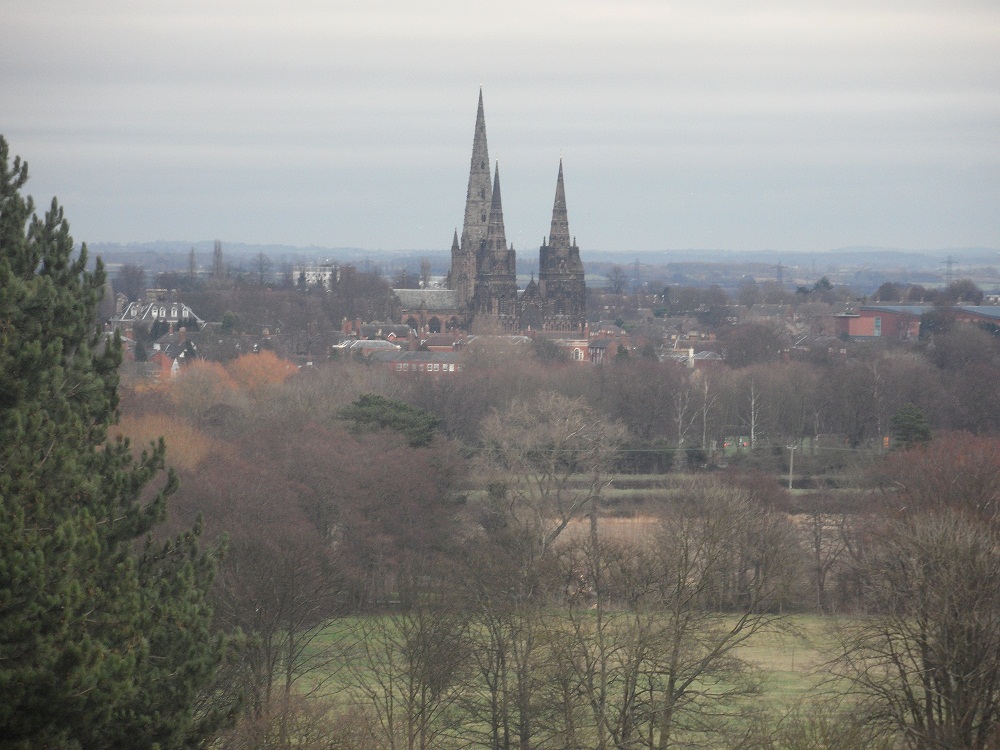
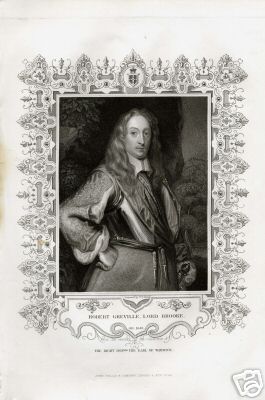
Paths that Cross

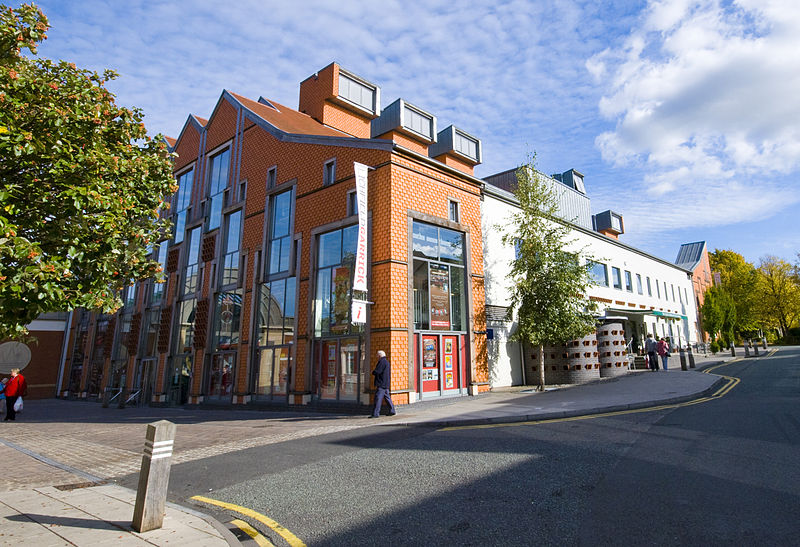
On my way to pick up some tickets from the Garrick the other day, I passed Lichfield Library. I couldn’t resist popping in to have a quick peek at the local history section to see if they had any more information on the history on the grammar school,  following on from Gareth’s graffiti photographs.  (They did. A whole book in fact and I’ve updated the post accordingly!). So inevitably, my quick peek turned into two hours.

There was an added bonus to the visit too. Anyone who read my Cross City and Cross County posts will know that I was hoping there would be an ancient cross somewhere in Lichfield. Well, I finally found one! Actually that’s a fib. What I found is a photograph in a book of archaeologists finding one. A decorated cross shaft was discovered built into the foundations of the north wall of the nave of Lichfield Cathedral. It’s thought to be Saxon or Saxo-Norman, and could be a surviving remnant of the earlier church on the site. I wish I could share a photograph here, but all I can do is tell you that it’s on plate 1 in the ‘South Staffordshire Archaeological and Historical Society Transactions 1980-1981 Volume XXII’ book, on the local history shelves at the library!.

I have a confession to make. Generally, I’ve thought that places like the Cathedral are so well known, there’s nothing much left to say. Yet, now I recognise that this was wrong. Whether it’s the magnificent discovery of the Lichfield Angel in 2003, the downright curious tale of a live frog embedded in one of the stones used to repair the Cathedral during the restoration*, or rolls of parchment, beer and tobacco found in the gilded balls on the top of the central spire – the Cathedral, as everywhere, is made of stories, as much as it is made of stone. There are those we know well, those we don’t, and those that haven’t even been told yet.  We need to make sure we  are listening, just as Gareth was when he discovered and questioned that graffiti on the walls of the old Grammar school.

*I’m not making this up…..but someone else may well have been!

In defence of Lichfield

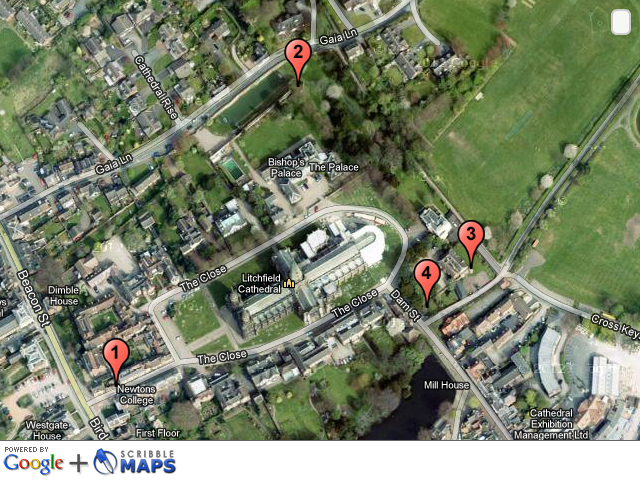
As I mentioned in the last post about the West Gate, some other remnants of the Close’s medieval defences are visible.  I’ve marked the ones I know about, on the map below, with a bit of information on each. I’m sure there’s probably more, and we could probably work out where the other defences were, but it’s a start!

1. Site of the West Gate – see previous post here

2. Remains of North East Tower & ditch. A scheduled monument, sometimes known as the Bishop’s Tower, this was part of the original, medieval bishop’s palace. The pastscape record can be seen here. A description of the tower and how it fitted into the rest of the palace can be found in several books on the Cathedral & Close (1) and is based on a plan that was held in the Bodleian Library (is it still there?). A plan drawn from this can also be found here.

At the north east corner was a tower fifty two feet high and each of its ten sides thirteen feet on the outside. It was called the bishop’s tower and the ruins yet remain. Adjoining this tower was a square room with stone stairs leading to the top on the north west of which was an apartment with a cellar underneath twenty two feet in breadth and sixty three feet in length. The bishop’s lodging room was forty feet by thirty two with a leaden roof and cellar underneath. On the north side of this room was a large chimney piece opposite to which a door led to the dining room sixty feet long and thirty broad. At the east end was a door opening into the second tower which consisted of five squares eleven feet in width and thirty two in height. There were two apartments each twenty feet by seven separated from each other by the large hall chimney, , the lady’s chamber…the brewhouse…and the kitchen.
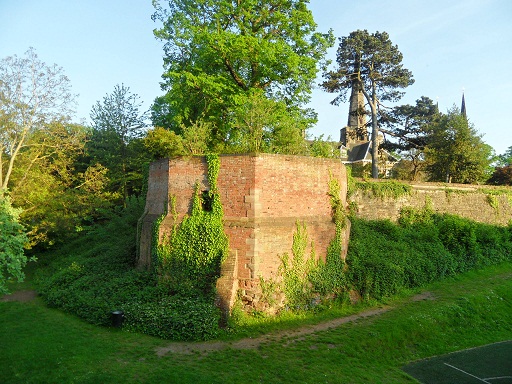
 

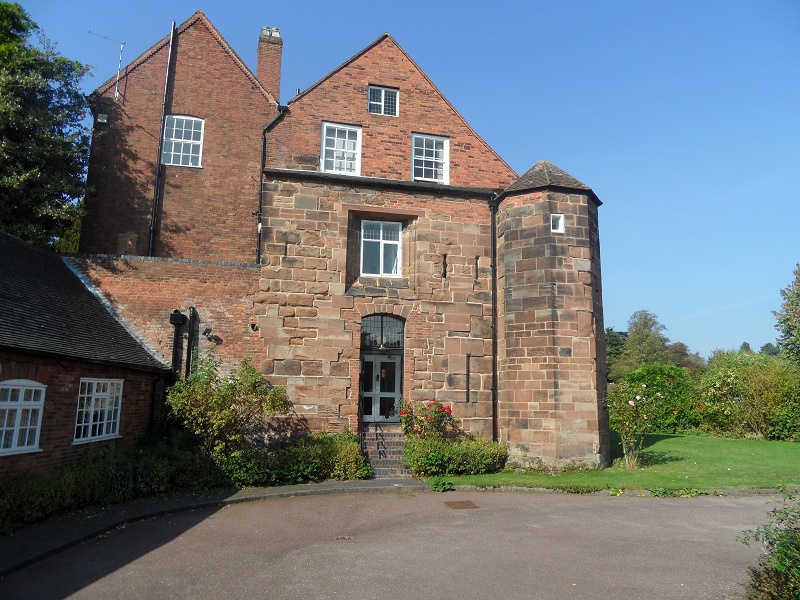
 3. St Mary’s House. Incorporates a turret and part of the Close wall on the east and south side. Not only are there are arrow slits, but there are also rumours of a secret tunnel down below….Actually, it’s not that secret as loads of people seem to have heard about it.
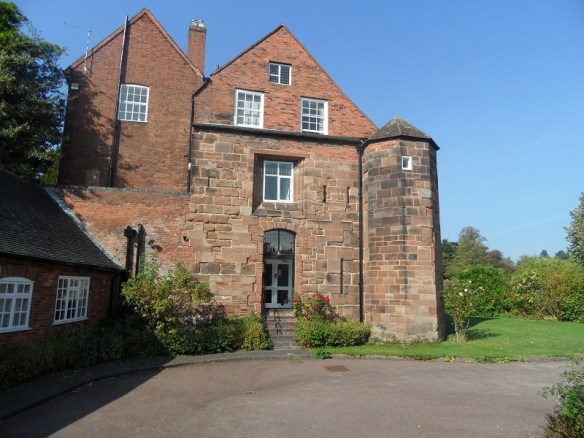
 4. Remains of Eastern Tower of South East Gate. This description comes from the ‘Lichfield: The cathedral close’, A History of the County of Stafford: Volume 14: Lichfield

The gate built by Langton at the south-east corner of the Close had two towers. The eastern one, whose base was excavated in the late 1980s, was a half-octagon with 12-ft. sides. The western tower was presumably of similar dimension. The gate had a portcullis in 1376.  There was a drawbridge, still in existence in the earlier 18th century, which crossed the outflow of water from Minster Pool, and also a wicket for pedestrians. The gate was removed in the mid 18th century in order to improve access for coaches into the Close.
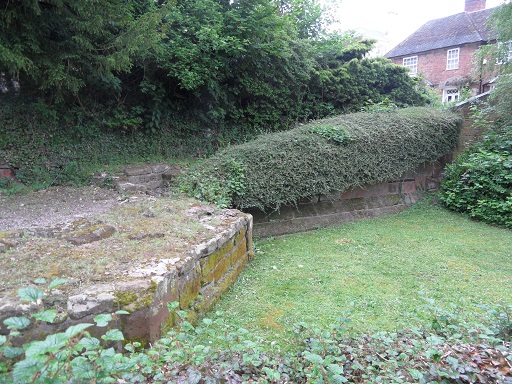
 

There’s also this bit of wall behind the Chapters coffee shop, which provoked a bit of discussion on Brownhills Bob’s Brownhills Blog, and with Annette Rubery. Especially about what that recess is!
While I was having a flick through googlebooks trying to find information on the subject, I came across an interesting snippet. Adrian Pettifer, in ‘English Castles: A County Guide’ makes the point that that unlike the majority of cathedral cities, there was no wall around the city of Lichfield as a whole.

So whilst the Close was protected by a strong wall, a ditch, 50ft towers, drawbridges and portcullises (when you put it like that it really does sound like a castle!), what did the rest of the city have? Well, there was a ditch. It’s thought even this was used more for controlling traders coming in and out of the city, than for defences. An archaeological dig carried out on the Lichfield District Council carpark in Frog Lane, also confirmed that the ditch was used as the city dump and found a variety of material, including it appears, the dog from Funnybones. There were gates too, the positions of which are still marked by plaques. Again, though it’s thought these might not have been defensive. I think the ditch and the gates deserve a post of their own, so I’ll come back to them another time.
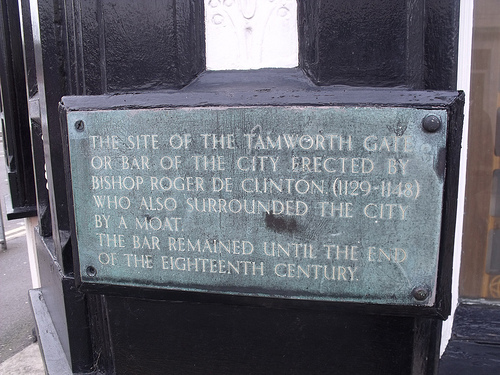
Credit: Ell Brown (taken from flickr photostream)

This will also give me time to think about my latest question (one I’m sure has been thought about and answered by clever people already!). Was the city of Lichfield defended, along with the Close? And if not, then why not? Of course, if anyone has any ideas about this in the meantime, please let me know!

Footnootes:

(1) This particular description is taken from ‘A short account of the city and close of Lichfield by Thomas George Lomax, John Chappel Woodhouse, William Newling

(2) Thanks to this website http://gatehouse-gazetteer.info/English%20sites/3329.html for pointing me in the direction of some great links.

(3) I’ve also used this book From: ‘Lichfield: The cathedral close’, A History of the County of Stafford: Volume 14: Lichfield (1990)
West Side Story

The view of the Cathedral as you turn from Beacon St into the Close, must be one of the most photographed in Lichfield. It’s stunning. However, if you can tear your eyes away from the spectacular west front of the Cathedral, there’s something else here that I think is rather special.

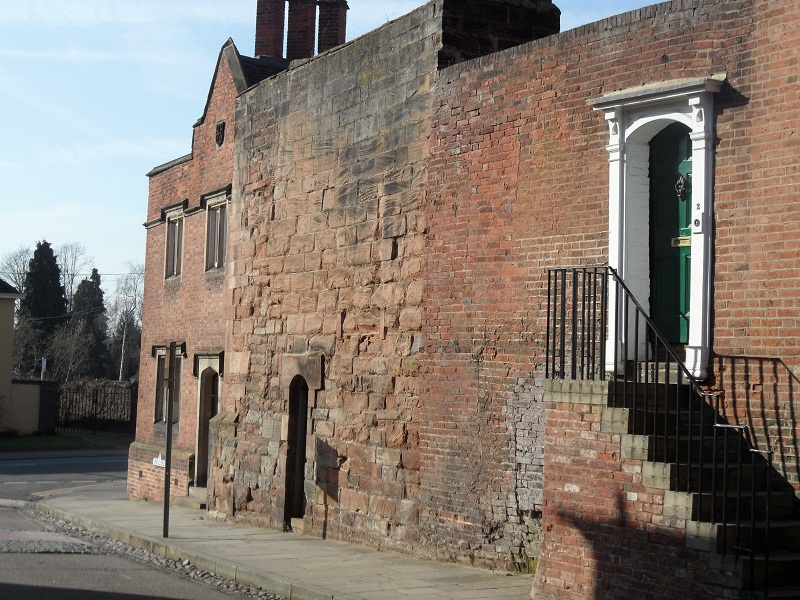
Remains of the West Gate.

Sandwiched between two houses are the remains of the West Gate, dating back to the early fourteenth century. The rest of the gate was demolished in 1800, as Thomas Harwood describes, “…that noble gate at the west entrance into the Close, a beautiful structure worthy of its munificent founder and which in April 1800 was with a barbarous taste, pulled down, and the materials applied to lay the foundation of a pile of new buildings for the residence of necessitous widows of clergymen”. (The new buildings Mr Harwood describes is Newton’s College opposite. If this is true it’s a bit more house old recycling!).

In the same book, Harwood mentions the gate again saying,”At the entrance into the close on the west stood the beautiful gate which was built by Bishop Langton in the early part of the fourteenth century. It was a very strong a double gate with portcullis of great strength and majesty. The strong tower over the gate was finished in the time of Bishop Northburgh, the successor of Langton. This noble structure which had unimpaired during the revolution of five centuries and had withstood the destructive ravages of civil war was pulled down in April 1800 to widen the road into the Close”

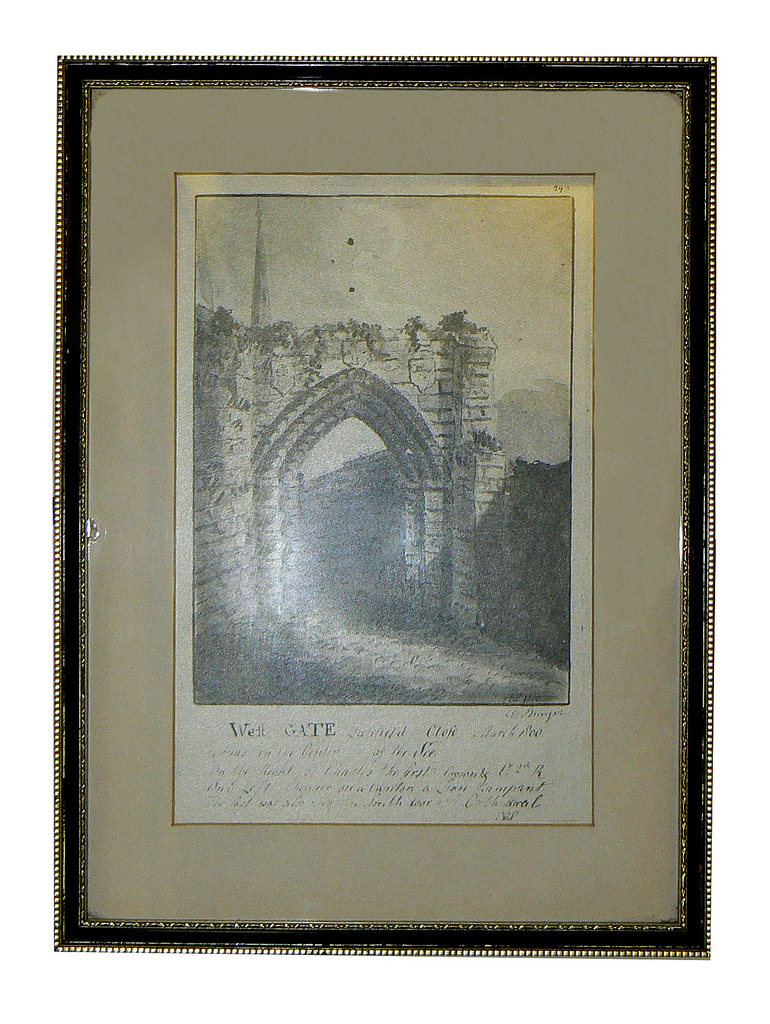
Personally I’m a big fan of crumbling, old bricks, but if the gate had remained then, we wouldn’t be treated to that amazing view. Whether the decision to demolish the gate was barbarous or not, all we have now are these remaining stones and the descriptions, together with some maps and drawings.  The rest is down to our imagination….

The Lichfield District Council flickr stream has this image.

Taken from Lichfield District Council flickr group

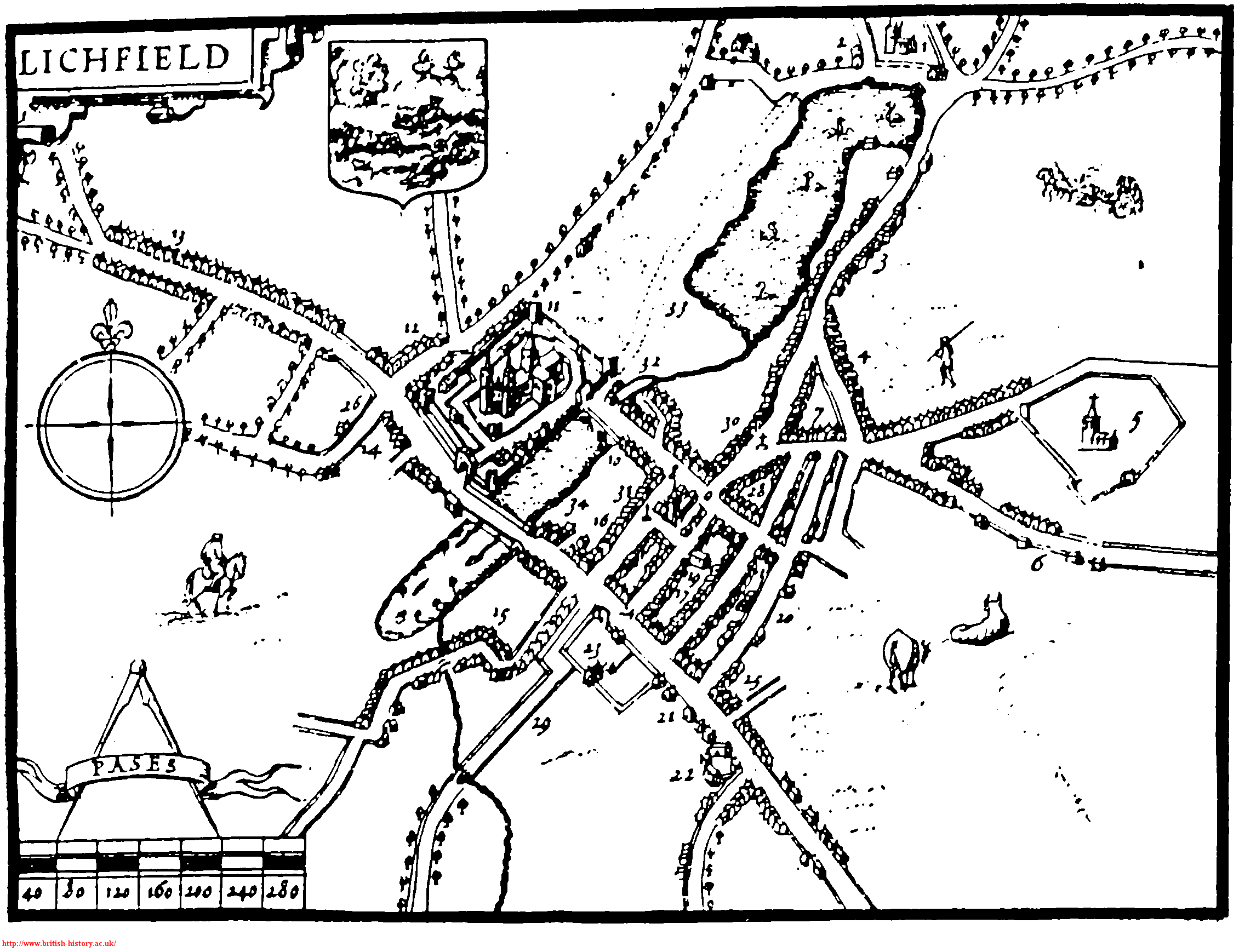
On the Staffordshire Past Track website, you can also see a view of the gate published in 1805. Still a ruin, but in slightly better repair than the previous image. There’s another image here , this time from further away showing how the gate fitted into the area around the Close. This ‘ancient view’ of the Close, seems to be an artist’s impression from 1805 to show how the Close would have looked surrounded by its protective walls, gates and towers. John Speed’s 1610 map also shows the defences, including the gate.

1610 map of Lichfield

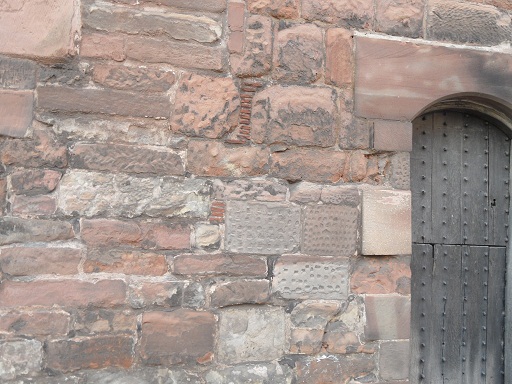
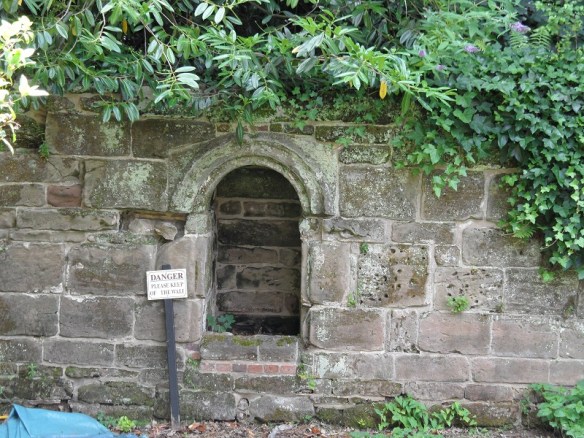
I’d like to explore the other remaining fragments of the defences, but for now I’ve got enough questions about this part to be going on with! Why leave this portion of wall   – why not demolish the whole thing? On the wall itself, why do some of the stones have dimples on (I bet there is a technical term for this!) Were materials really used for Newton’s College?

And what about that door! What’s behind there? Who was the last person to go in there (and did they ever come out again!). Why is there a door there at all? To access the ‘strong’ tower in Harwood’s descriptions?  Most importantly, where do they keep the key and could they open it for the Heritage Weekend?!

Edit: Take a look at the comments section – some of the questions have already been answered by Nigel, Managing Director of Lichfield Lock & Key, up on Church St and Pat, who seems to know a thing or two about old bricks!

Sources

The History & Antiquities of the Church and City of Lichfield – Thomas Harwood

Lichfield: The cathedral close – A History of the County of Stafford: Volume 14: Lichfield (1990), pp. 57-67. URL: http://www.british-history.ac.uk/report.aspx?compid=42343

House Old Recycling

With a long awaited cafe & kiosk opening in Beacon Park this week, it reminded me that I wanted to have a look at the reuse of old buildings parts in Lichfield.

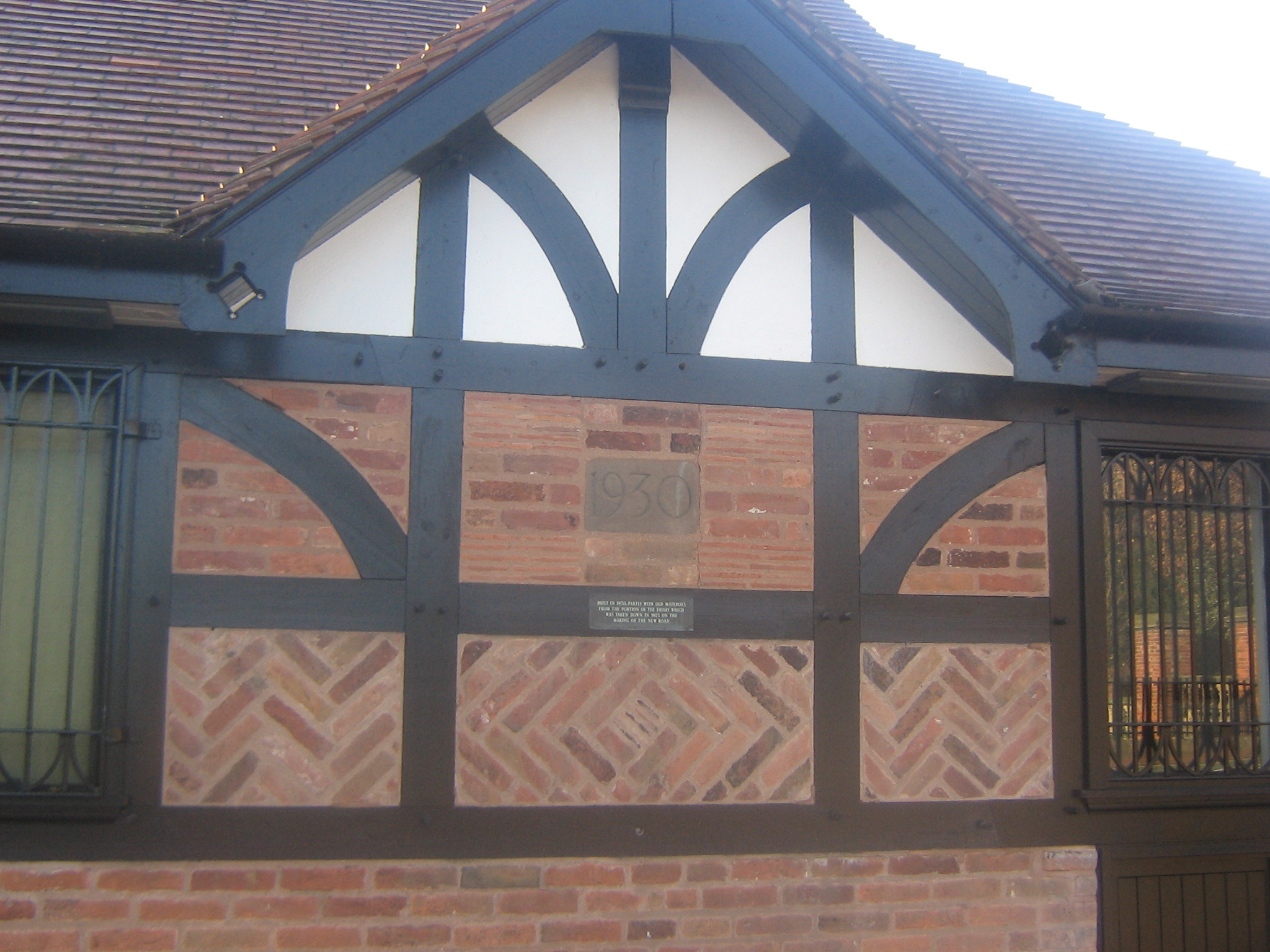
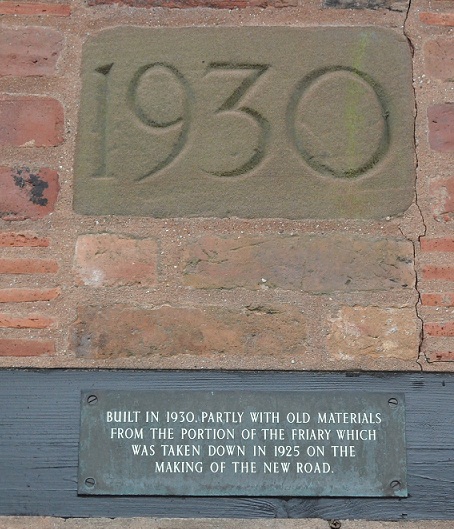
The connection? Well, the new Chandlers Cafe is in the 1930’s mock tudor building on the edge of Beacon Park. According to a plaque, it incorporates materials from the old Friary. I’d love to find some records that confirm whether or not this is true and if so,  how this came to be.

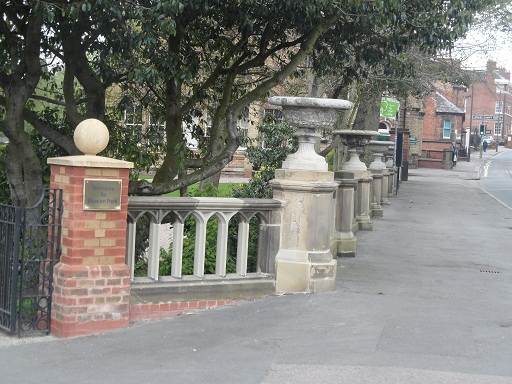
The provenance of the nearby balustrade running around Beacon Park is more of a mystery. Both Annette Rubery and myself have so far drawn a blank when attempting to discover its origins. Did this start life elsewhere?

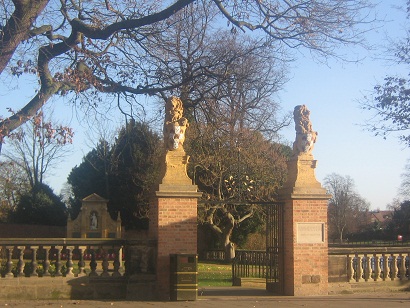
More information is available on the balustrade running around the Garden of Remembrance opposite, albeit a little contradictory. The listed building description suggests that the balustrade came from Moxhull Hall in Wishaw, although Lichfield DC’s website disagrees, saying that it came from Shenstone Court, and that it’s the stone lions on the pillars that come from  Moxhull Hall. Does anyone know any different?

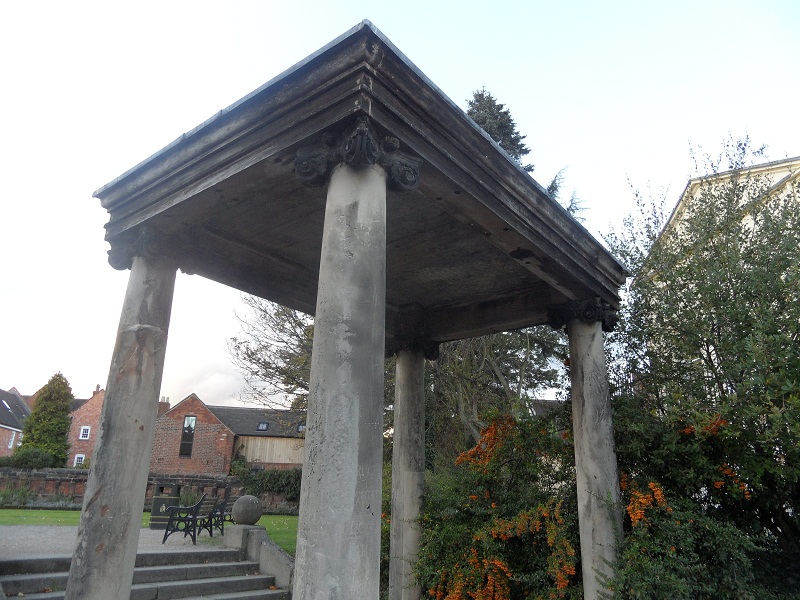
If the balustrade is from Shenstone Court, then its not the only bit of that old house we’re supposed to have made use of here in Lichfield! The portico at the entrance to the site of the Friary is also said to have been salvaged from the demolition of the Cooper Family mansion. However, according to the Lichfield Council Conservation Area Document, this is one of ‘countless unsubstantiated stories about the portico coming from important buildings in the Lichfield area and ‘it is equally possible that it was made in 1937’. I think this might be another one for further investigation!

Finally, for this post at least, there’s the Old Stables in The Close (formerly the Visitors Study Centre). These belonged to Bishop Hacket’s now demolished house which stood on this site until 1799.   Material from the remains of the walls of The Close, from the heavily damaged, original Bishops Palace, and possibly even the Cathedral itself are thought to have been used during construction of these buildings, which are alongside Chapters Restaurant.

I’m sure there must be more in Lichfield –  I’ve even seen garden walls built with what looks like the remnants of old buildings. If anyone knows of any more examples,  I’d love to hear. In the meantime, I’ve heard that there may be more parts of Fisherwick Hall to track down….

Sources: http://www.lichfielddc.gov.uk/downloads/file/375/lichfield_conservation_area_document

http://www.pmsa.org.uk/national-recording-project/

http://en.wikipedia.org/wiki/Bishop’s_Palace,_Lichfield

http://www.british-history.ac.uk/report.aspx?compid=42343#s3


http://www.british-history.ac.uk/report.aspx?compid=42344#s7

Back to the Future

In the March 15th 1907 edition of the Lichfield Mercury, there’s an article written by Clifford Mackay entitled ‘Lichfield in 2007 – A Dream of the Future’. Old Ben Wallace, a Lichfield cobbler, takes a trip through the city streets and discovers how things have changed over one hundred years.

Here’s a heavily abridged version, so that you can see for yourself where Mr Mackay got it right (a new theatre called ‘The Garrick’, new houses, mixed schools), got it wrong (a tube station at the Friary, a model Venetian village hiring out gondolas) and sometimes got it very wrong indeed (meeting visitors from Mars on the way to Minster pool).

New houses, a large new theatre of varieties, and an entire renovation of the Market, now Dr Johnson’s Square, are amongst other things which come before his astonished eyes, besides a tremendous building called the ‘Royal Garrick’ Theatre, many shops bearing familiar names but entirely rebuilt, and all the streets reconstructed on an absolutely novel, yet excellent plan.

Garrick Theatre by Bs0u10e01 (image taken from Wikipedia)

….the old man noticed the date of the year – 2007- for the first time he also sees one of the airships from London come in. A tube station now stands at the Friary corner, and a large new hotel – the Savoy- has been erected. Sandford St is now a magnificent thoroughfare, and the ‘George’ and ‘Swan’ hotels have also been rebuilt. They encounter some of the visitors from Mars, and arrive at Minster pool, which has undergone great changes. The two pools, Minster and Stowe have been purchased by the council and now form magnificent pleasure lakes. The former is now illuminated every night, while a band plays from the wonderful new stand erected in the middle

They visit Elysia – the large new pleasure gardens formed out of the late Museum Gardens and Recreation Grounds, and take a trip round in a gondola hired from the model Venetian village

Museum Gardens early 20thc

Inevitably, old Ben finds himself at the Cathedral and it’s here where you begin to wonder if there is more of a point to this article than just a bit of fun. I don’t know enough about the protestant religion to comment but amongst other things, Ben the cobbler is told that,

 The church had grown very worldly – it was neither one thing nor the other – so it had to be purged. It was disestablished and set to rule itself, with the result that many parsons came to believe that after all they were not the demi-gods and worldly magnates that some of them imagined themselves to be. These people here took the lead and set the example to the rest of England – and it was quickly followed everywhere. They gave up their large houses and went to live in smallest ones(the bishop giving his up to be a hospital for the poor and needy)

…..the people are religious as anything – it is a reality to us and not a sham. The Cathedral is packed every Sunday, at all services too, it’s hard to get a seat.

Soon though whatever point is being made, has been made and Ben finds himself

…close to the new marvel, which stood in the field before the Stowe Pool….raised in five lofty square iron towers, nearly sixty feet in height, one being at each corner, and one in the middle was a gigantic platform…..Inside each of ther four corner towers the old man could distinguish lifts ascending from, and descending to the ground floor. Tethered to one of the sides her engines still throbbing, and having an indication with the word Aberdeen printed on it, affixed to its side, lay a huge aeroplane.

Away from the Cathedral Ben is surprised to learn  about the changes in another religion –  Lichfield City FC are doing well having won the English Cup seven times, fielding four international players and getting an an average gate of gate of 12 to 14,000 per match. Of course,the Lichfield manager does it for the love of the game and the reputation of the City rather than as a money making concern.

Ben also learns that the grammar school has been moved from its position near Borrowcop Hill due to drainage issues and that,

…all the schools are mixed in England now. Girls and boys all work together…its a splendid system

At the end of the walk it all goes a bit ‘Life on Mars‘ as old Ben is knocked down by a car on Wade St. But of course, as with all the best stories, it turns out to be just a dream, and he wakes back in his workshop back in 1907.

I know that a prediction of the year 2007, made a hundred years previous is a bit of an  easy target.  I’m sure if I were to make predictions here and now about the year 2112, it would be mostly ridiculous. Could we predict the next 50 or even the next 10 years? In looking to the future of Lichfield, would it reveal anything about our present? Maybe we should give it go. It’d give future generations a good laugh if nothing else. Any volunteers?


Statuesque

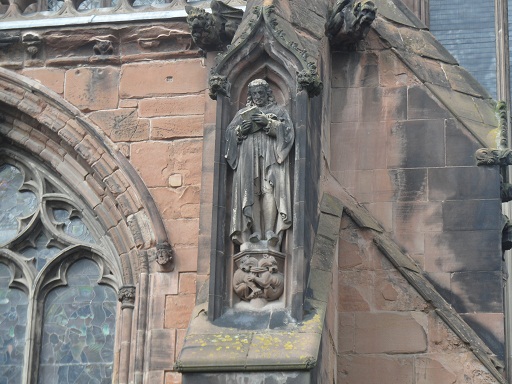
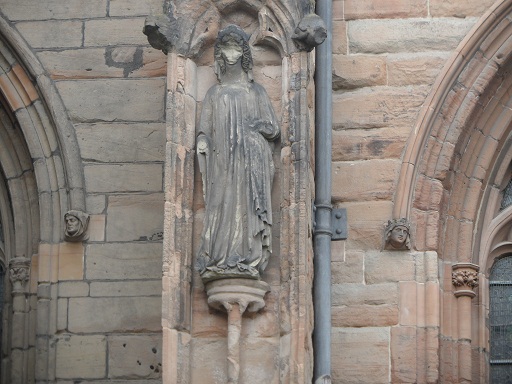
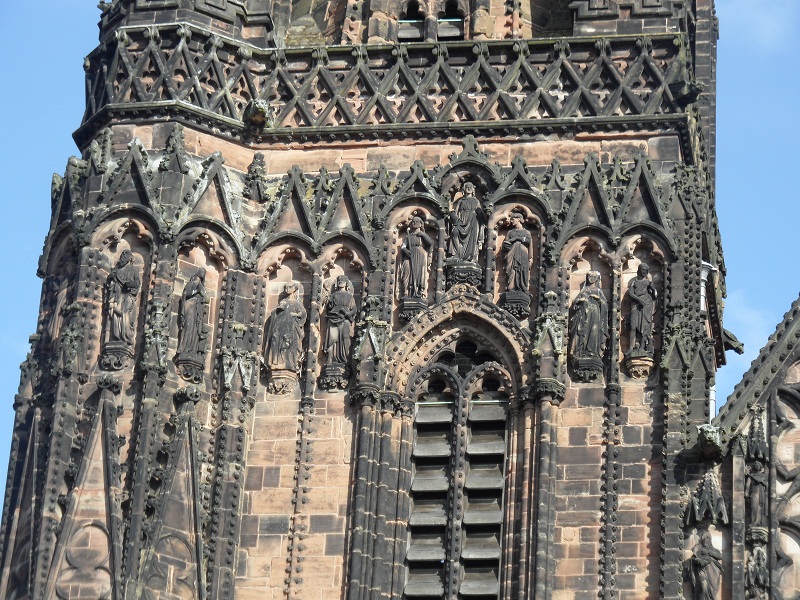
Walking home last Monday I took a detour past the Cathedral to have another look for the remaining five original, medieval statues.  I was pretty sure that I’d found two on the northwest tower –  one nameless woman next to Eve and another to the left of Deborah. The Victorian statues tend to have names on their pedestals. There’s an old photograph of the western front of the Cathedral pre-restoration on the English Heritage Viewfinder website, which you can see here. It shows the front looking strangely bare – above the row of kings only the niches containing the few remaining original statues are filled.

Medieval statue?, Deborah, Rachel, Rebekah, Sarah, Medieval statue?, Eve

According to a comment someone left on here, there are other statues on the other side of the north west tower. Unfortunately, my timing wasn’t great as someone was cutting the grass alongside the tower and a Midlands Today van had not long pulled up nearby and were making preparations to film (I later found out they were there to cover the Olympic Torch route story). As I didn’t fancy making a cameo appearance, dodging the mower in the background of a news report, I took a hasty few photos of the tower and carried on around the back of the Cathedral.  Stupidly, I didn’t check them before I got home and it’s not easy to make out much.  Another trip is in order….

Affix quality control sticker here

The medieval statue hunt continued as I walked around, in case one had sneaked in somewhere other than the northwest tower. I found Christopher Wren, Elias Ashmole and Dr Johnson amongst others along the way.

“The world is not yet exhausted; let me see something tomorrow which I never saw before” said Dr Johnson.

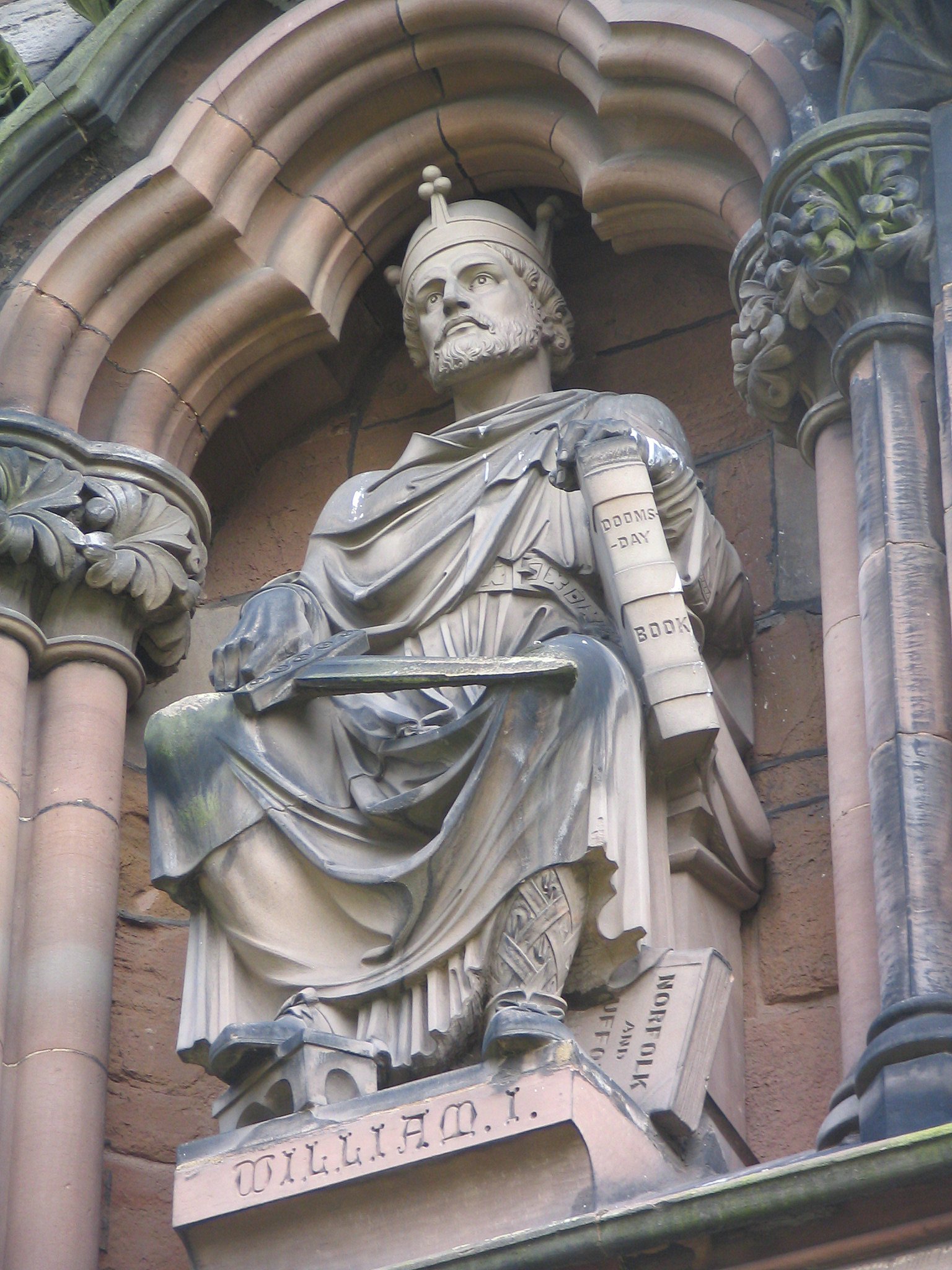
Most of the statues are accompanied by something symbolic – Johnson of course has his dictionary.  It’s the same for the kings (e.g. William the Conqueror holds the Domesday Book) and the biblical characters (I knew nothing about Deborah, but according to wikipedia she was a prophet and a judge and delivered her verdicts near a palm tree which explains why there’s one behind her statue).  I was wondering about Eve? Surely that’s an apple near her foot but what is she holding in her hand?  Imagine if you someone was to create a statue of you and they had to sum up your life with an object or two!

Image taken from Wikipedia

Just past Dr Johnson and his big, papery thing is another statue.  She has no name and as far as I can see there is no clue to her identity. I’m speculating, but is this one of the many statues destroyed or defaced by the parliamentary troops during the Civil War?   Most of the other damaged statues were removed – where did they end up I wonder? I came across some great photos of a figure of Christ on Aidan McRae Thomson’s flickrstream at a church in Swynnerton, Staffordshire together with an interesting theory that the statue originated from Lichfield Cathedral. If anyone else has any theories or even evidence of where the statues ended up, I’d love to hear them!

I have to confess that for me, sometimes the Cathedral is just there, part of the scenery as I go about the city. However, there are other times when, either by chance (catching the light a certain way) or by design (medieval statue hunting), the Cathedral commands my full attention and once again, I am reminded of what an incredible building this is, and the skill and talent of the craftspeople who made it so.

I Spy….

David Evans, who does some great work over on BrownhillsBob’s Brownhills Blog, has set a challenge! There are two photos below, and David wonders whether anyone knows where in Lichfield each of them were taken.

Where is this?


We have a clue for this one! 'A cut(let) above the rest, perhaps?'

As Pat recently sent me an email about the remaining medieval statues on the Cathedral, this seems like a good subject for a third question! I’ve read that there are five original statues on the north west tower. Has anyone ever identified which they are? I think I’d hazard a guess that there are two of them on the following photo, but I’d be interested to know what others think.


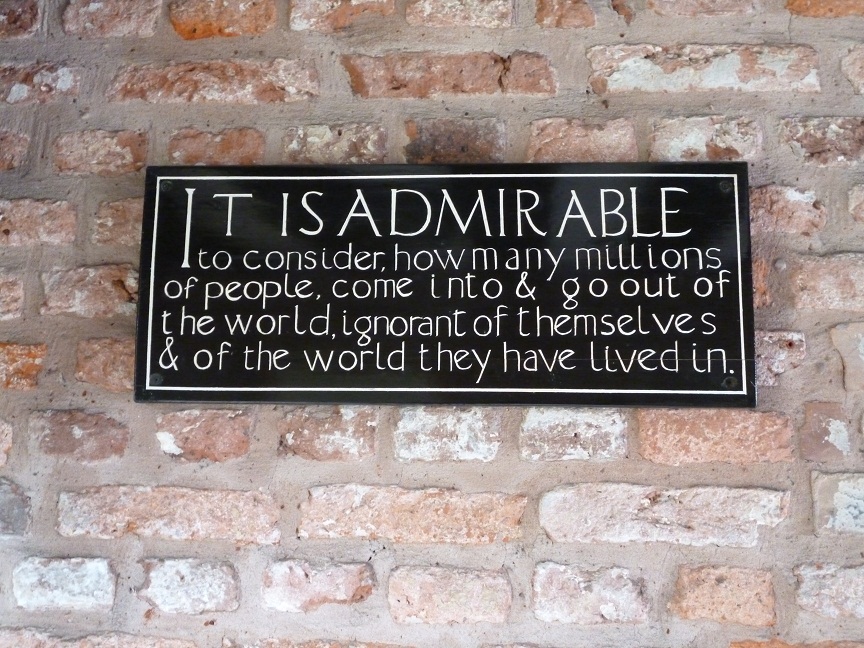
Thanks to David for contributing these photos, and encouraging us to keep our eyes open and not being one of the millions, as referred to on that sign!

Source:

Public sculpture of Staffordshire and the Black Country by George Thomas Noszlopy, Fiona Waterhouse

Discovery Channel

After fifty-five weeks, four failed attempts and roping in several members of my family I finally found the medieval conduit head up at Pipe Hall Farm in Burntwood. You know though, you wait all year for a conduit head & then two turn up…..

A little background first. From 1160 until 1969 water was carried one and a half miles from springs in the Pipe area of Burntwood to the Cathedral Close via a conduit. At the source, a cistern was cut into the rock and a small brick building was erected over the source to keep the water clean and healthy. (2) This medieval conduit-head was in use for the majority of the time, but was temporarily replaced by a brick conduit between 1780 and 1821*. After an incredible 809 years, it was decided that it should carry water no more as it was constantly being damaged by ploughing and having to be fixed by Bridgeman’s employees (hope you appreciate the irony of this Vickie Sutton!) (3)

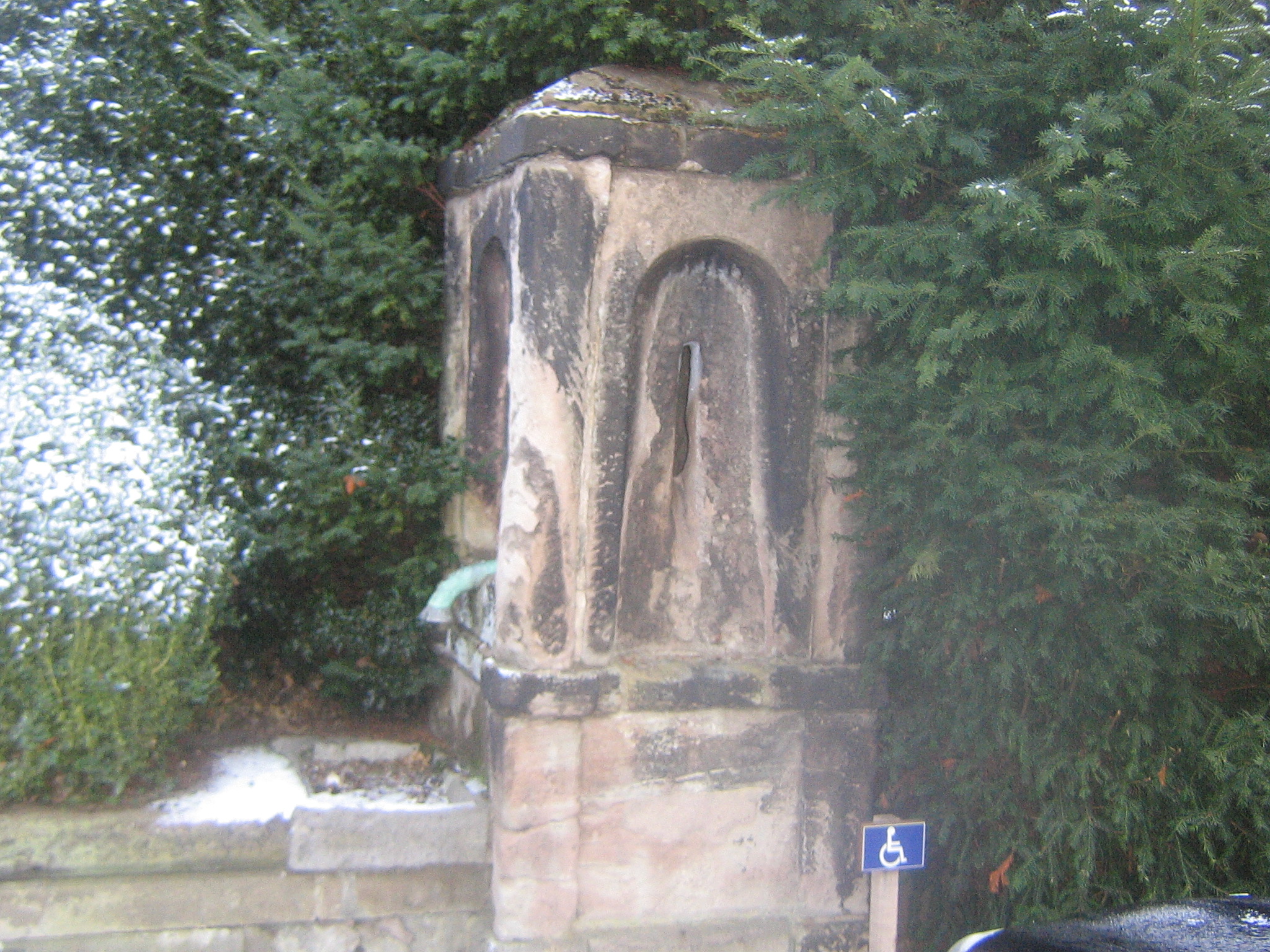
This pump outside the Cathedral replaced the Close’s conduit head in 1786

As water pipes go, this one had a pretty eventful life. Although the conduit itself was later known as Moses, it’s thought it gave the name ‘Pipe’ to the whole area.(4) It was vandalised by Lord & Lady Stanley, until King Henry VII stepped in in 1489 and told them to behave. In the early 16th century, washerwomen drawing water at the Cathedral end were said to be scandalising residents of the Close and during the Civil War it was inevitably stripped of lead by soldiers.(5)

In December 2010, around the same time I started this blog, I made it my mission to find the Medieval Conduit Head.  I went to the wrong woods twice. Then I went to the correct woods twice but looked in the wrong place. This time, I gathered a team of explorers aka my family and at the noticeboard in the Pipe Hall Farm car park I gave them their orders. ‘This’, I said pointing to a helpful map & photo, ‘is what we are looking for and we are not leaving here until we find it’. After an initial search proved fruitless we split up. Mr G spotted some bricks and on closer inspection we were sure we’d found the 18th century replacement brick conduit head.

Not medieval but still a conduit head!Close up there’s a visible date. 1755?

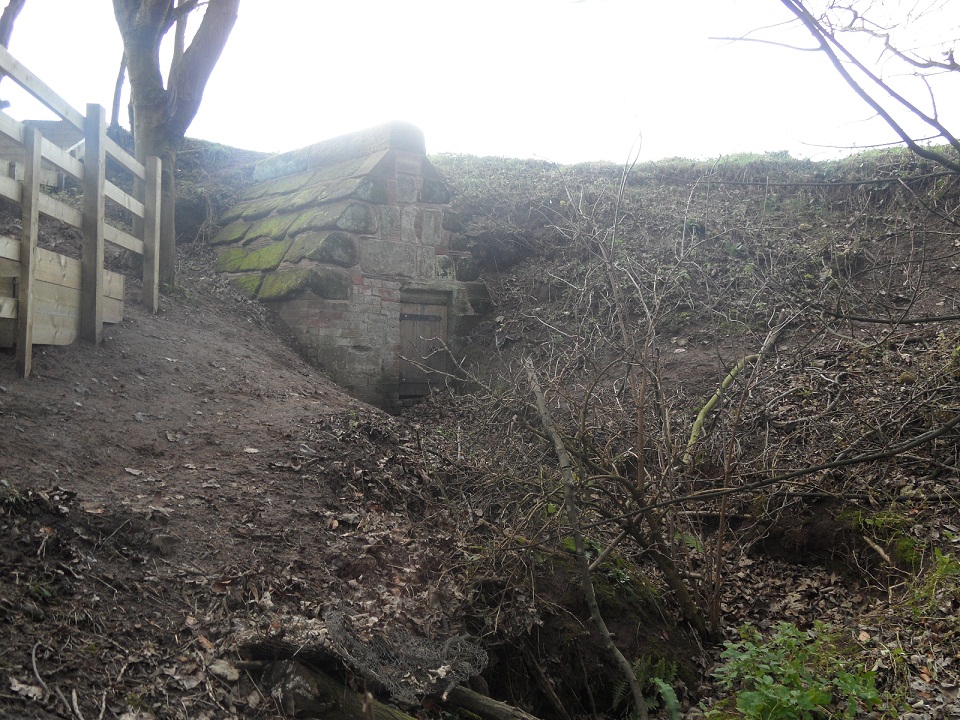
Cheered by this discovery, we went to find the others. My Mum wasn’t far away and told us a little further on she had spotted steps leading down to something and had sent my Dad to investigate. This had to be it.  I called to ask him if he’d found anything. ‘There’s this. I wasn’t sure if this was it or not?’ he said deadly serious, whilst stood next to a small building identical to the one in the photo.  ‘Yes Dad’, I said ‘Yes it is’. We celebrated with a cup of tea, enjoying the views of Lichfield from the hill.

The Medieval Conduit Head. As found by my Dad.


The channel making its way to the Close


…..to here.

Footnotes:

It seems ridiculous to say but both Conduit Heads are actually really easy to find. They are actually just off a main path running alongside the Jubilee Wood. You can even see the medieval one from this path.  => I was almost looking too hard. And I can’t read maps.

The Medieval Conduit Head was included on the 2008 English Heritage ‘At Risk’ register where its condition was said to be ‘poor’ but was removed from the list in 2010 after its restoration.

Pipe Hall Farm was recently included in the Guardian’s 10 best woods & forests for wheelchairs & buggies.

The date on the brick conduit head appears to be 1755, could this mean this conduit was in use for longer than previously thought?

I understand that the water that went to the other city wells & pumps (such as the Crucifix Conduit outside the Library and Records Office) came from a different source i.e. Aldershawe

Sources:
(1)Lichfield: Public services’, A History of the County of Stafford: Volume 14: Lichfield (1990), pp. 95-109. URL: http://www.british-history.ac.uk/report.aspx?compid=42348

(2)Water Technology in the Middle Ages: Cities, Monasteries & Waterworks after the Roman Empire by Roberta J Magnusson

(3) Annals of a Century: Bridgeman’s of Lichfield, 1878-1978 by Owen Keyte

(4) Notes on Staffordshire Placenames WH Duignan

(5) English Heritage at Risk Register 2008 and 2009