Features and Reviews

Hopefully, anyone reading the blog recently has found the old graffiti interesting. I know that Gareth and I, and (for a few days at least!) a large broadcasting corporation did. After all of the excitement, I thought it was time for a bit of musing….

The discoveries (or perhaps rediscoveries is more accurate) in the Lichfield District Council offices got me thinking about the potential for other ‘unseen’ history out there. There’s unseen in the sense of being hidden away from view –  in attics, down pub cellars and down the bottom of the garden. However, I also think that something in plain view can be unseen –  people may pass by everyday, but no longer see what’s actually there or the potential of it, due to familiarity. During discussions about the graffiti, someone said to me, “I’ve walked past that graffiti loads of times and never even thought about it”.
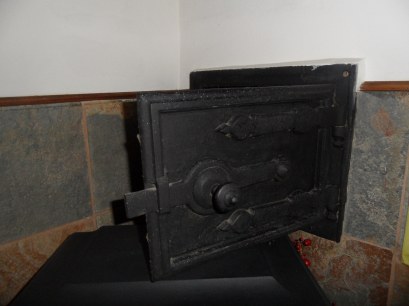
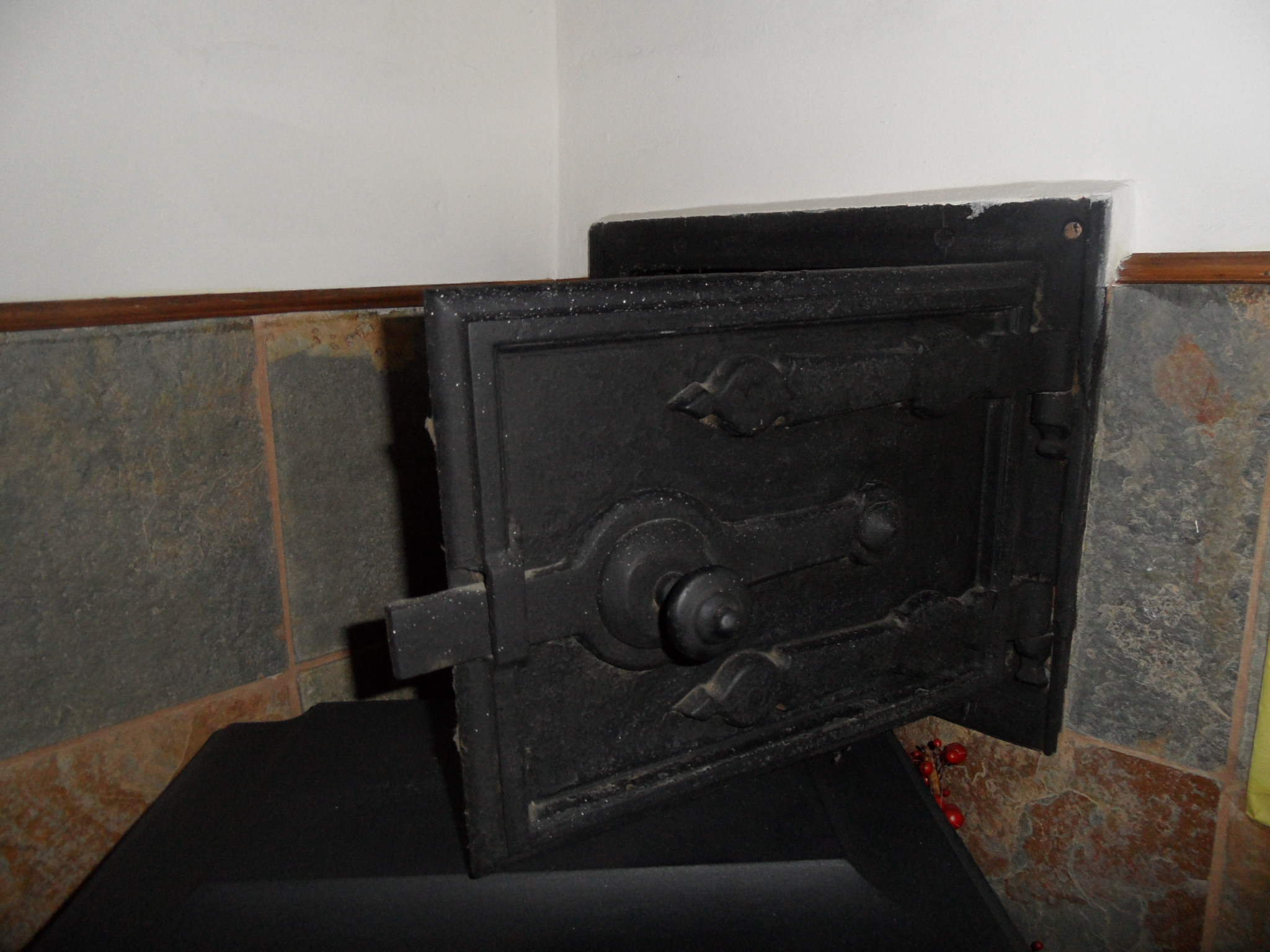
The bread oven above is in the house of someone I know. I remember them buying the property years ago and excitedly telling me after their first viewing with the estate agent, “It has an old bread oven!”. When they moved in we all keen to peer inside but prior to taking the photo, it was last interacted with as part of an Easter Egg hunt.  However, taking the photo to show a friend, sparked a whole new conversation about the oven. Was it original? If so, would this have been the kitchen? Wasn’t it once divided into two houses? How was it laid out back then? Why was the house built in the first place? And so on….My point is, sometimes, we need to look with a fresh pair of eyes to see what’s in front of our nose.

I don’t think that the history in question even has to be a specific feature like the bread oven. I find the traces of people’s everyday lives fascinating. I visited a house in The Close last Christmas. Unfortunately, I hadn’t had nearly enough mulled wine to pluck up the courage to ask if I could take photos, so I’ll have to describe it. There were stone steps down into the cellar, worn away in the centre by centuries worth of footsteps. There were attic beams with layers of fading wallpaper still clinging to them up in the attic. To describe the place as ‘lived in’ would be an understatement.  The next question inevitably is ‘lived in by who’? Actually, photos wouldn’t really have done the place justice anyway because it was more than a visual thing. You wanted to touch, as well as see. ….

I’m really hoping that Lichfield District Council open their offices up for the next heritage weekend, so that people get to look around what was one the Old Grammar School for themselves. I’m not suggesting people throw the doors of their homes open to the public, but perhaps if we want to explore the history of the city and all its inhabitants, we sometimes need to look at the ‘normal’ buildings and places, where people lived and worked, and still do! I’m by no means detracting from those special, extraordinary buildings like the Cathedral, just saying that sometimes it might be worth looking again a little closer to home.
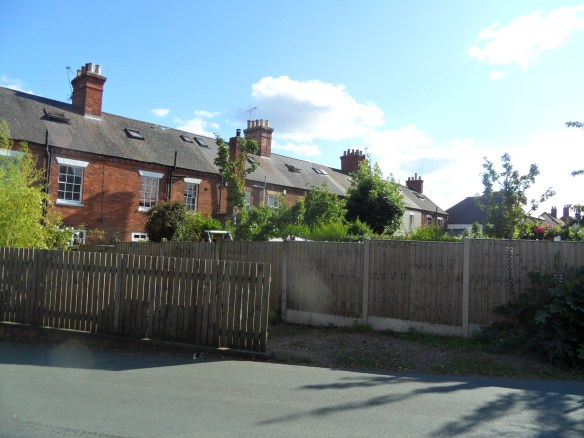
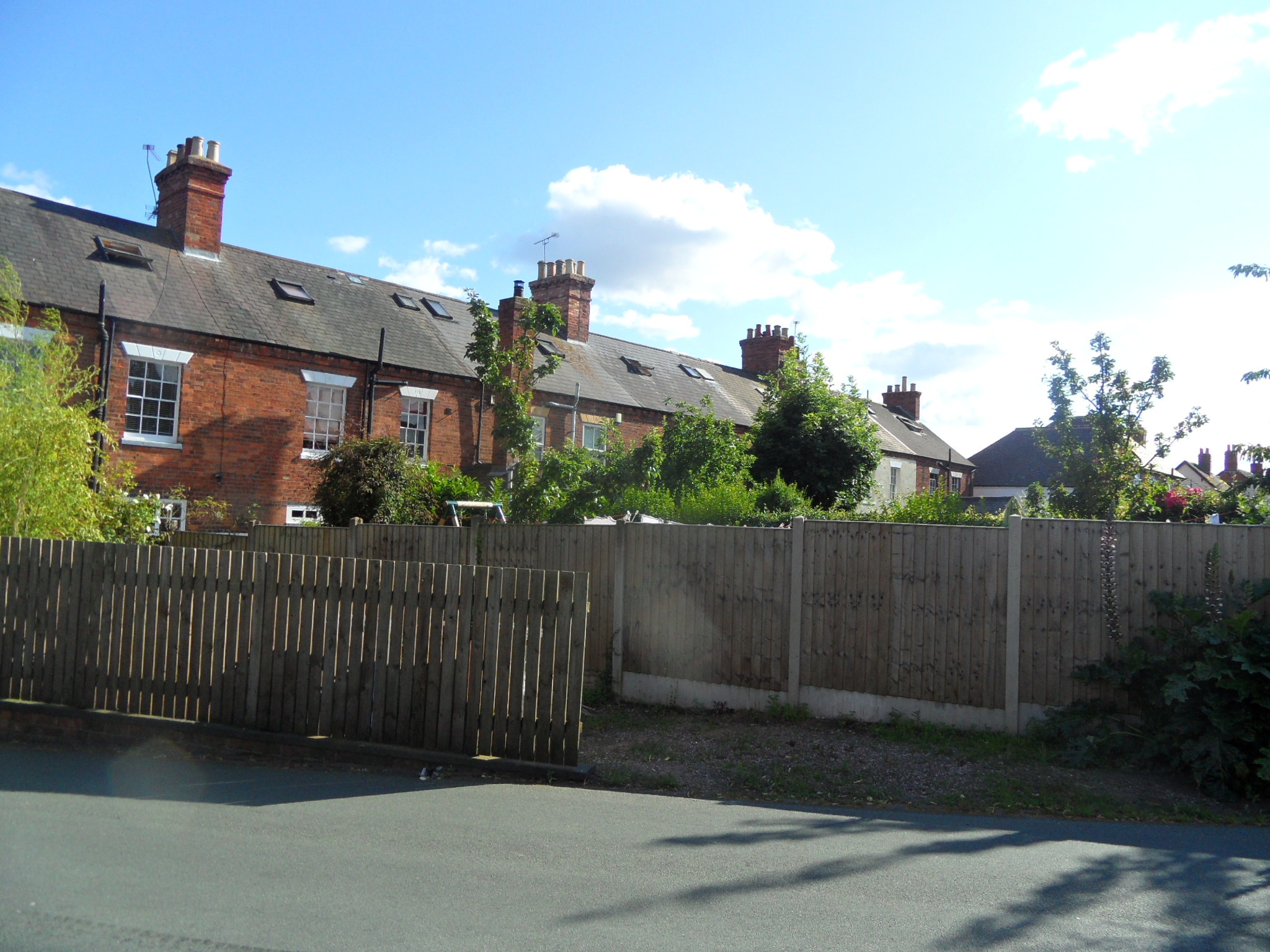
One of these terraced houses in Leomansley still has a tall chimmney at the back. An old washroom?
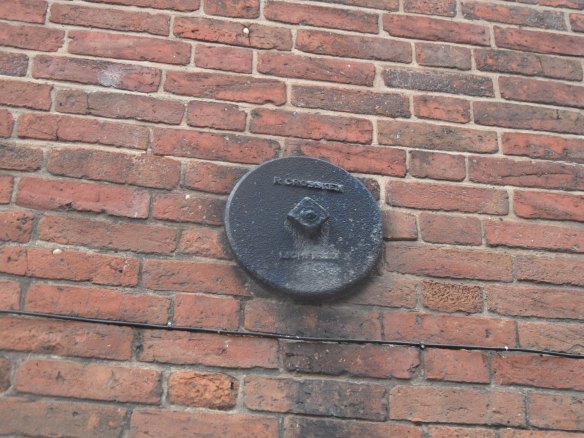
A wall brace on Greenhill. Does that say R Crosskex? Who was that? See edit below.


A selection of objects found in the garden Of Vicky Sutton’s Nan’s house near to Beacon Park (not including the pink flowery plate!).
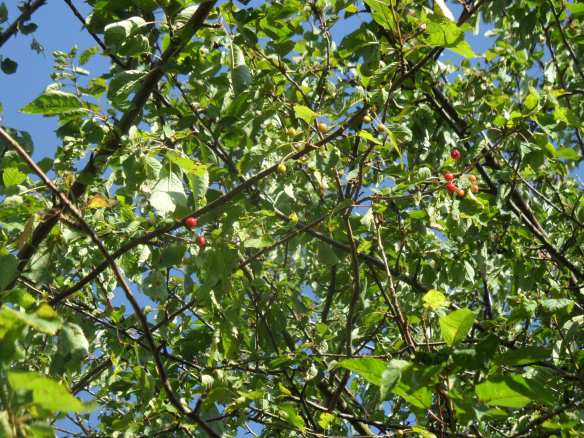
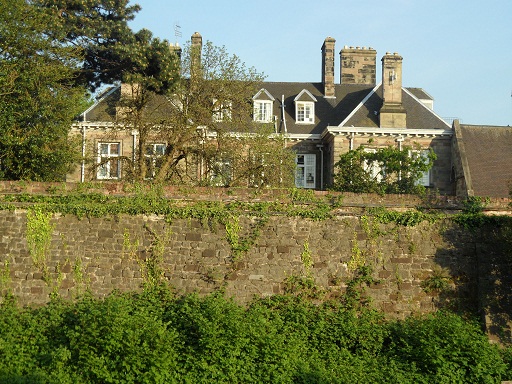
The remains of a cherry orchard can still be found near…Cherry Orchard!

Edit:

After I woke up properly, I realised this actually said R Crosskey. I found a book about Henry William Crosskey, a geologist and Unitarian minister from Lewes (1) and found that his younger brother, Rowland Crosskey came to Lichfield as an apprentice ironmonger. He emigrated to Australia for a while and then,  after he returned to England, he started a business in Birmingham. Afterwards, he took over the Lichfield firm where he had served his apprenticeship. In 1868 he became Mayor of Lichfield and donated a civic sword to the City (Is this the one still used in processions today?).  He died in 1890. From census records, it looks like his home and business premises were initially in Market St. In 1888, he was in Bore St, trading as a ‘Military Camp and Store Furnisher’ with premises on the Burton Rd in partnership with Charles John Corrie. Also, just as a point of interest, Rowland was his Mother’s maiden name.


(1)Henry William Crosskey, LL.D., F.C.S. : his life and work by Richard Agland Armstrong; with chapters by E. F. M. MacCarthy and Charles Lapworth. http://www.ebooksread.com/authors-eng/e-f-m-maccarthy-richard-acland-armstrong.shtml

(2) London Gazette 1888
 

Paths that Cross

On my way to pick up some tickets from the Garrick the other day, I passed Lichfield Library. I couldn’t resist popping in to have a quick peek at the local history section to see if they had any more information on the history on the grammar school,  following on from Gareth’s graffiti photographs.  (They did. A whole book in fact and I’ve updated the post accordingly!). So inevitably, my quick peek turned into two hours.

There was an added bonus to the visit too. Anyone who read my Cross City and Cross County posts will know that I was hoping there would be an ancient cross somewhere in Lichfield. Well, I finally found one! Actually that’s a fib. What I found is a photograph in a book of archaeologists finding one. A decorated cross shaft was discovered built into the foundations of the north wall of the nave of Lichfield Cathedral. It’s thought to be Saxon or Saxo-Norman, and could be a surviving remnant of the earlier church on the site. I wish I could share a photograph here, but all I can do is tell you that it’s on plate 1 in the ‘South Staffordshire Archaeological and Historical Society Transactions 1980-1981 Volume XXII’ book, on the local history shelves at the library!.

I have a confession to make. Generally, I’ve thought that places like the Cathedral are so well known, there’s nothing much left to say. Yet, now I recognise that this was wrong. Whether it’s the magnificent discovery of the Lichfield Angel in 2003, the downright curious tale of a live frog embedded in one of the stones used to repair the Cathedral during the restoration*, or rolls of parchment, beer and tobacco found in the gilded balls on the top of the central spire – the Cathedral, as everywhere, is made of stories, as much as it is made of stone. There are those we know well, those we don’t, and those that haven’t even been told yet.  We need to make sure we  are listening, just as Gareth was when he discovered and questioned that graffiti on the walls of the old Grammar school.

*I’m not making this up…..but someone else may well have been!

The Grave of Poor Bessy Banks

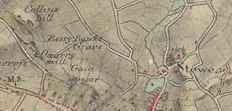
I spotted a place labelled Bessy Banks’ Grave on the 1815 Ordnance Survey drawing of Lichfield by Robert Dawson 1815.

Immediately, I thought of the story of Kitty Jay on Dartmoor. A little investigation has revealed a few details. In ‘History of the City and Cathedral of Lichfield’ by John Jackson (1805), I found the following;

“…of Betsy Banks grave* once the famous rendezvous of lovers….now no more is remembered than that poor Betsy is said to have fallen victim to hapless love.

*there is a spot in a field in Lichfield still distinguished by that name”

Anna Seward wrote to her friend Honora Sneyd about the place in a letter dated May 1772, that she described as ‘Written in a summer evening from the grave of a suicide’. I’ve only included the first part as its quite long.

“It suits the temper of my soul to pour
Fond, fruitless plaints beneath the lonely bower,
Here, in this silent glade, that childhood fears,
Where the love-desperate maid, of vanish’d years,
Slung her dire cord between the sister trees,
That slowly bend their branches to the breeze,
And shade the bank that screens her mouldering form,
From the swart Dog-Star, and the wintry storm….”

Another reference can be found in one of David Garrick’s letters.  He wrote that “the name Dimble is given to a sunken road leading north from Lichfield past a spot, supposedly haunted called Betty Honks Grave. Two sister trees form an elegant arch over a stream”.

By 1791, it was found that the sister trees had been recently cut down.

So who was Bessy Banks, did she really exist? If so, is her grave still there, now unmarked and unremembered?

Edit 5/9/2011

I recently had the St Chad’s tithe map (1849) out in Lichfield Record Office, looking for something else. A whole plot of land is listed as ‘Bessy Banks’. Born a Lichfeldian has kindly worked out where the stream in this area would have been. Taking into account this and the tithe map it seems that ‘Bessy Banks’ was somewhere in the region between Dimbles Lane and Greencroft.
John Jackson’s description suggects that in 1805 the story is already an old one. It does seem a fairly well-known tale, to have actual places on maps marked after it, as well as being mentioned by Garrick (albeit with the name Betty Honks!) & Seward.  Was it just a made-up story, or did it arise from actual events? I wonder when (and why?) the people of Lichfield stopped telling the story? Or could there even still be people who could tell us the tragedy of Lichfield’s ‘love-desperate maid?’

Edit: 15/4/2012

A notice in the Lichfield Mercury 20th February 1914 lists a lot for sale as garden land, known as Bessy Banks, adjoining a plot of arable land let by T Chapman and located next to Gaiafields House and Gaia Fields Cottage.