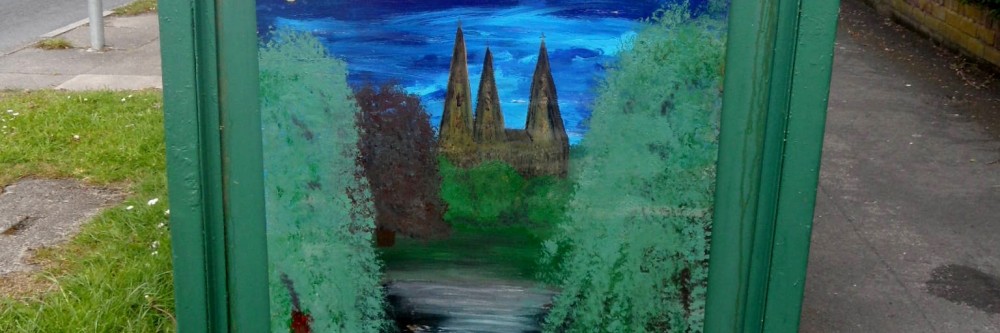
Muckley Corner is my least favourite place to be at 7am on a weekday morning. Thankfully I now have a few weeks off from trying to negotiate this unholy island and some time to take a look at its history.
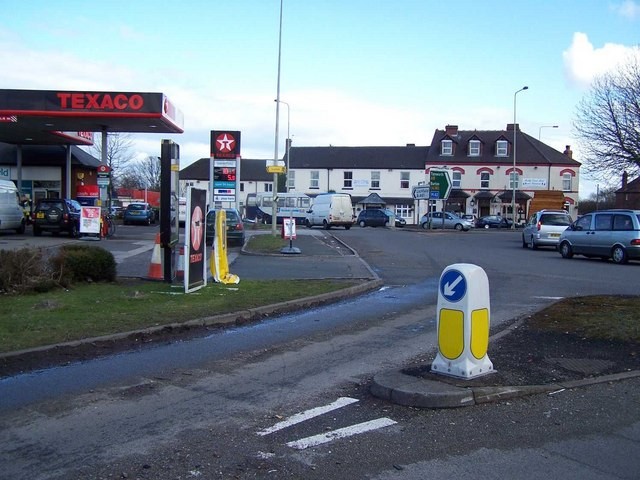
I already had several questions in mind about Muckley, ranging from the pedestrian, ‘When did the corner actually become a roundabout?’ to the less prosaic, ‘Was there once an ancient burial mound here?’. However, during the course of my corner-based investigations, another question has also emerged. There is a reference to Richard Key’s Coach and Horses at Muckley Corner in the Birmingham Gazette in 1766. The reference relates to an incident when some butchers accidentally left behind a heifer after visiting Fazeley Fair. The question here is not how the heck do you forget you brought a cow to the pub and neither is it were the butchers ever reunited with their bovine? It’s actually was the Coach and Horses mentioned a predecessor of the Muckley Corner House Inn? Records held at the Staffordshire History Centre show it was called the New Inn, then Muckley House, and later Muckley Corner House and there’s a hint that a drinking establishment was in existence here in the mid- seventeenth century. Katherine Reeves, the wife of Humphrey Reeves, was to appear at the Lichfield Quarter Sessions in January 1642, and in the meantime, keep the peace towards Anne Bull of Pipehill. Humphrey is listed as a victualler which suggests he may have been an innkeeper.
A further name change saw it called ‘The Olde Corner House Hotel’ in its final years and I can vaguely remember the place being open when I first moved to Lichfield back in 2004 and being an Italian restaurant for a while. Thankfully we do not need to rely solely on my murky memories as my old mucka, the legendary Brownhills Bob, documented the establishment’s demise on his blog. It closed in Summer 2009 and is now residential properties and apparently the HQ of Planet Ice. I’m not quite sure what in the Torvil and Dean that’s all about.
There’s a sad story relating to how the replacement of stagecoaches by steam engines displaced some people in February 1864. John Brooks, described as a former driver of the Chester Mail until it was driven off the road, was charged by PC John Hobbs with being found in a hovel in Burntwood and resisting the police. Whilst in custody on the road, Brooks said he could not and would not walk without something to drink. Hobbs took him into a pub and bought him a pint of beer. The magistrates were reported to be sorry for the poor fellow having a good laugh at his broad tales about old times. Not sorry enough not to fine him 1s and costs however.
I’ve already mentioned a couple of cases but there is much more to be done about the links Muckley Corner has to the law because there seems to have been a police station there from the 1860s and in the 19th century century, petty sessions were held at the inn itself. There are even rumours of a lock-up to detain the miscreants of Muckley.
It’s a diversion too far for now though as I want to get back to my original questions. All I can find is out about the first though is that the island idea was first proposed in 1953 following a dreadful accident which saw thirteen people hospitalised but I can’t quite pin down the actual date when it was constructed. And as to whether there was once an ancient burial mound here? All I can present is some circumstantial evidence.
In The Midland Antiquarian edited by William Fowler Carter in 1882, it claims that, ‘In early deeds Muckley Corner is called Mucklow. It is situated on Watling Street where it is crossed by the main road from Walsall to Lichfield which was made about 150 years ago; the addition ‘Corner’ was then probably given to it. I think the derivation clearly – AS Mucel; ME mikel, mukel, mockel, great and low, a mound or tumulus – great mound. There is no tumulus to be seen, nor is there any record of one known to me, but many ancient lows have been carted away for agricultural purposes or for repairing. roads About 50 years ago Muckley Corner stood on the boundary of Cannock Chase, and the country to the south was open common’.
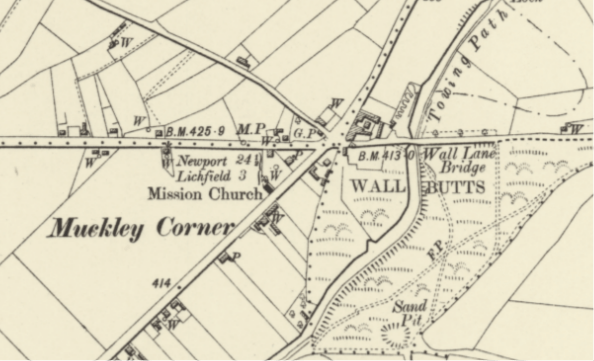
If etymology isn’t enough, then there are several other landmarks marked on old maps and in street names in the vicinity which give us a glimpse of an ancient landscape that is now mostly lost. I can’t prove there was a burial mound at Muckley Corner but I think I can prove there is the potential for there to have been one. The irony is you’re going to have come along and negotiate that unholy island with me so buckle up folks.
Sources
Aris’s Birmingham Gazette – Monday 03 November 1766.
Staffordshire Advertiser – Saturday 23 February 1811
Staffordshire Record Office document Q/SR/249/69

