If ever there was an instance of picking on the wrong person, it was at Fenton Toll Gate on a January morning in 1834. Mr Dawes, a surgeon from Stoke on Trent, was walking back home from Lane End, later to become known as Longton, when he passed three men. One of them raised their arm and struck him in the face, knocking him to the ground. As Mr Dawes lay stunned, the man began to rifle through his pockets whilst the two others assisted with this daylight robbery. As the surgeon regained his senses, he started to shout, ‘Murder!’ but one of the thieving trio place his hand across his mouth to silence him.
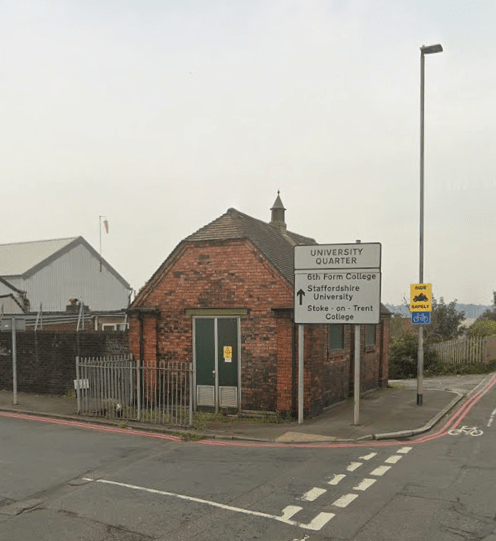
I think this might be the site of the Fenton Toll Gate (taken from Google maps). I also think the Sixth Form College the sign here points to was the first purpose built sixth form college in the UK which is nothing to do with this story but is a great bit of Staffordshire history,
Dawes saw an opportunity to defend himself and managed to bite down on the man’s forefinger. The more he struggled, the harder Dawes held on. Eventually, the failed footpad managed to escape but left part of his finger in the jaws of Dawes.
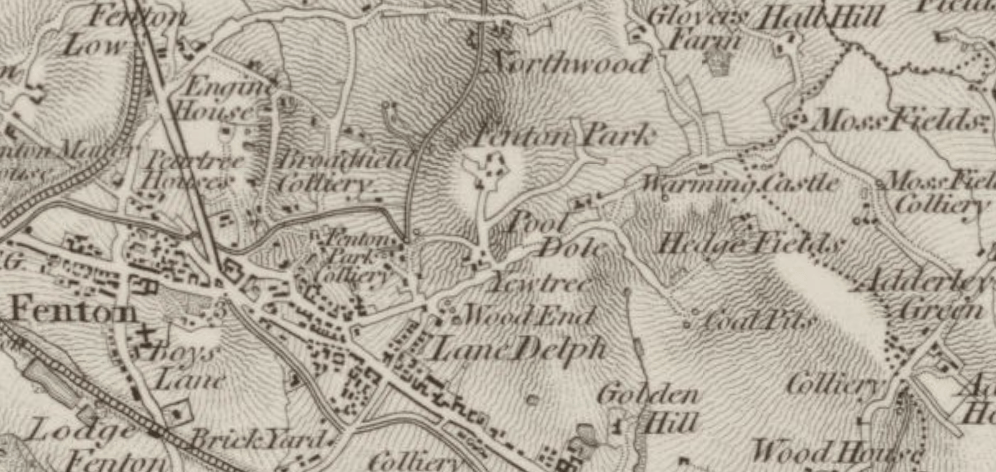
Lane Delph, where the Evans Bros. came to the end of the road. Think we need to continue on our journey to the intriguing sounding Warming Castle however
When another Stokie surgeon called Mr Chadwick heard of the attempted robbery, he tipped off the police that he has just attended to a collier who was missing the end of his index finger and pointed them in the direction of the Evans brothers of Lane Delph. Apprehended at the their residence, the missing finger (carefully preserved by Dawes in a bottle of spirits) was found to be a match for Charles Evans’ manual wound and they were arrested. Out of shear desperation at the trial, he claimed he had cut it off when carving mutton in a public house but, despite their denial of any wrongdoing, the Evans brothers were nailed and sentenced to 14 years transportation. Who needs fingerprints when you have the actual finger?
What became of their accomplice and perhaps more interestingly, the incriminating index finger, remains a mystery. Is this body of evidence still preserved in a bottle of spirits somewhere on a shelf in Stoke?
I’m reading the memoirs of a man named William Purcell Witcutt. Like me he had connections to both Birmingham and Staffordshire, and was fascinated by folklore. Unlike me, he was an protestant vicar who converted to Catholicism before being exiled to the furthest outpost of the Diocese for the crime of commenting on the corrupt nature of many medieval priests. Yes, they sent him to Leek.
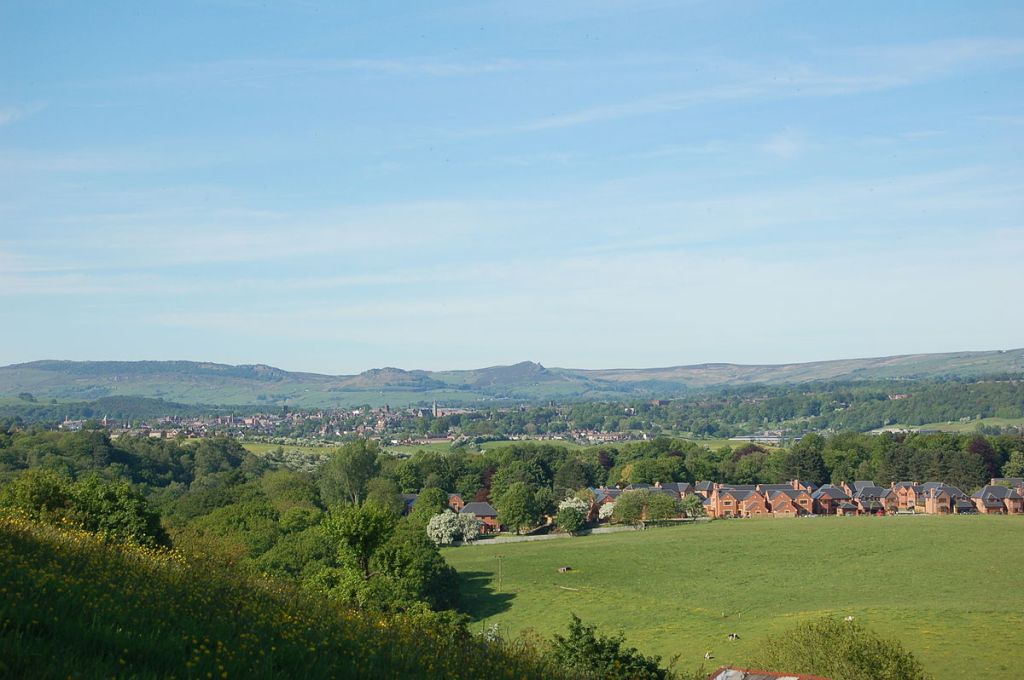
In his book, ‘Return to Reality’ there is a chapter called ‘The Valley of Phantoms’, in which he describes how, ‘Leek lay hidden in mist and woods in the middle distance, and one of the older boys tried to convince me that it was invisible from the air. Leek will never be bombed said he, and quoted with assurance the prophecy that there would come a time when, ‘there will be no safety in the land save ‘twixt Mow Cop and Morridge’.
No I can definitely see it
Witcutt was soon to find plenty more superstition in this Staffordshire Moorland town. It seemed to him that the valley and moors around it swarmed with ghosts and bogies, which people still believed in. There was the Headless Horseman, or in Leek dialect, ‘a man on an ‘oss without yed on, an awful gory sight’, and nearby was a Black Dog who guarded the graves of those who died a violent death. According to Witcutt, the Queen of the Leek demons was the Mermaid of Black Mere, who I wrote about many years ago here. A new story to me was that of ‘Ball Haye Jack’, a little grey man whose appearance in front of one of the mills was believed to bring bad luck. One curious custom Witcutt noted was that on seeing his collar, the girls and women who worked in the mills would touch the factory railings, a somewhat unsettling reaction given it seems to be linked to the superstition that touching iron would protect against the power of a sorcerer.
One of the strangest spots Witcutt writes about is the Coombes Valley, When he visited in May 1940 he found a farmer planting potatoes and as the man sowed his spuds, he shared stories of the valley. At a place nearby, the spectre of a murdered man was said to ride up and down the ridge. Once seven priests came to lay him but all but one of the gathered fathers fled. The final man standing held up a stone in the brook, dismissing the pleas of the phantom for mercy, and laid him beneath the rock. The process appears to have been unsuccessful however and so the dead man rode out once more. This next time he was laid beneath a hawthorn tree at a place known very appropriately as Spirit Hole. Even that was only sort of successful though as he still haunts the valley, although now in far less malevolent form of a bird heard singing as the night falls at the Spirit Hole. The stone which had failed to keep the ghost grounded was still there when Witcutt visited (and I believe it still is), and according to the farmer it had once been a stone of sacrifice.
No wonder the valley is full of phantoms.
Source: WITCUTT, W.P. Return to reality, Macmillan, 1955.
It took me a while to find the wishing stone at Pye Green and it’s taken me even longer to write up what I found about the tale behind it on here. This story appeared in an old newspaper, told to the writer by a ‘greybeard’, one of the descendants of a family of Cannock Chase foresters, and I’ve taken the liberty of retelling it in my own words.
During the English Civil War, the Wishing Stone was the place where a young soldier and one of the daughters of the Cannock Chase foresters would meet. One day the soldier was called away to fight for the King at Worcester and left his lover with a promise to return. Every day that followed, she would wait at the stone for him and those passing her on the old packhorse route known as Blake St would hear her wishing for his return. Weeks passed by and one evening, when she didn’t return home, her father went looking for her. The local women suggested he try the stone and that’s where he found her, lips no longer wishing for her soldier to return but blue and still. The local women speculated whether it was the cold or a broken heart that took her in the end. When the soldier returned and asked where he could find her, ‘her body is in Cannock churchyard’ the local women replied, ‘but her soul is at the place we now call the Wishing Stone’.
Centuries later, if you stand at the stone and listen carefully, you can hear what sounds like a voice saying ‘I wish, I wish, I wish’. It might just be the wind blowing through the trees which surround the stone but the local women will tell you otherwise.
Newton Road Rail Station opened 1837. Closed 1945
Two summers ago, I went to find another wishing stone over Walsall way (yes, I really do need to work on writing stuff up sooner). It’s described as being by a stile in a field leading to Newton Road Old Station on the London and North Western Railway. Folklore says all true lovers who step on the stone will have whatever they wish for come true in twelve months and a day. According to the author of the article in the Walsall Advertiser, you would often find love sick couples loitering around the place but all I could see was cows. I think the stone is on the opposite side of the River Tame to where I was but I wasn’t willing to wade over, even for a wish. I am hoping to go back tomorrow however, as I want to find an aqueduct with a haunted patch of grass and the ruins of the priory alongside the eponymous Sand Well. Is it a wishing well though?
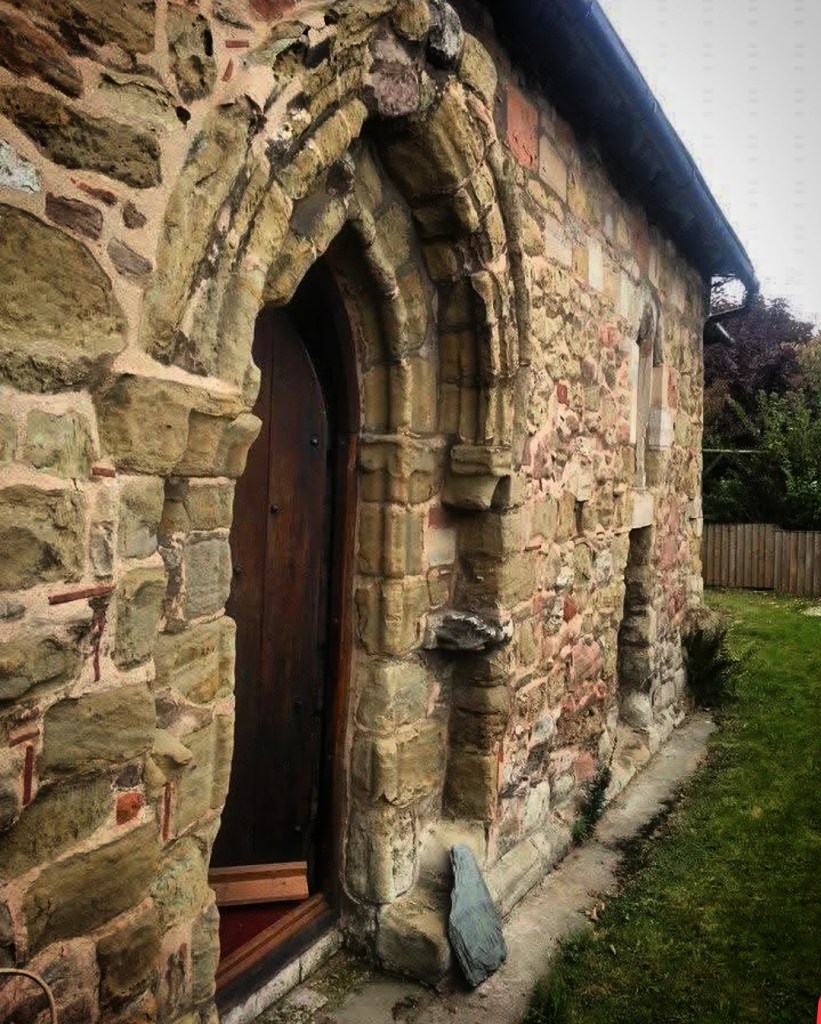
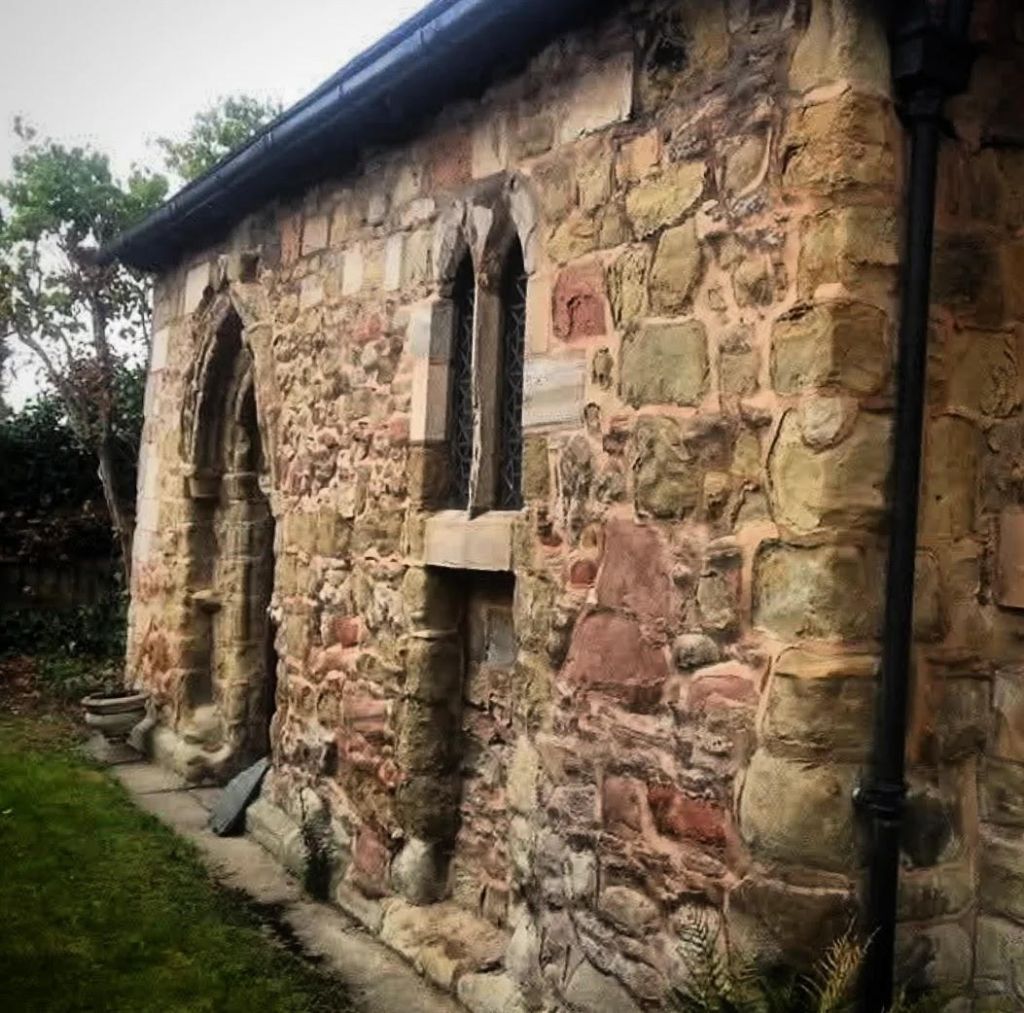
There’s a tiny chapel in Tamworth, hidden behind streets of houses. Much of its history is a mystery but there are records showing that the Spital Chapel of St James was erected by Robert Marmion of Tamworth Castle c. 1274. There was a suggestion the chapel had been built the site of an earlier structure and in July 1968 a group of girls from Perrycroft School carried out an excavation there, under the expert eye of archaeologist Jim Gould, in the hope of finding evidence of Saxon origins. What they actually found was something of a surprise.
In a shallow grave, on the north side of the chapel, the skeleton of a middle-aged woman, aged between 40 and 50 was unearthed. Perhaps even more surprising was that the remains of two children were found laying across the woman’s pelvis. There was no trace of a shroud and the burial was on the north side of the chapel. Given that the land surrounding the chapel was not known to have been consecrated, or ever used as a burial ground, it was suggested that this may be an illicit internment of impoverished individuals.
I have different tools at my disposal to that team of teenage girls and they’ve enabled me to find several more skeletons at the Spital Chapel. In October 1914, the Tamworth Herald reported two lots of human remains were found to the south of the chapel when gas pipes were being laid. One was near the door, the other near the chancel wall and again, both were found not far from the surface. The report says they were reinterred on the spot and, unless anyone knows differently, there is nothing to suggest they aren’t still there.
Delving even further back into the newspaper archive, I found that in May 1870, an inquest was held on two skeletons found at The Spittals, a now demolished Victorian house, which once stood near the chapel. Adding to the intrigue is a letter from Edith Heath, published by the Coleshill Chronicle in 1968, recalling how she had often visited a woman called Dorothy Clarson who lived on Wiggington Rd in a house called Belbroughton, built by her father. Miss Clarson had claimed that when workmen were digging foundations for a wall of the house, the body of a man wearing chainmail had been uncovered. Apparently, the then Vicar of Tamworth was sent for to say a prayer and lay the body reverently to rest. Reading between the lines, it seems this skeletal soldier may also still lie somewhere near to the chapel.
The letter goes on to say that Belbroughton was haunted by a Grey Lady, who also walked a path which once led to a lost orchard. Whether this adds or subtracts to the reliability of Miss Clarson’s account, is something you can make your own mind up about but for me, the story that a spectre haunts the Spital Chapel site is the cherry on the cake.
The history books suggest the Spital was originally a chantry chapel, built so that prayers could be said here to save the soul of Robert Marmion of Tamworth Castle. However, there is a belief amongst Tamworth folk that the chapel was used as some sort of Pest House, or isolation hospital during times of plague which may account for the presence of burials. The dedication to St James also suggests at some point it may have been a stop-off on a pilgrimage route. Could it be that those buried here are pilgrims who never completed their journey? I’m obviously no expert but now we know that the burials unearthed in 1968 were not isolated, the theory that they were an illicit burial seems a little less convincing. Perhaps analysis of some of the skeletons, if they do still lie beneath, might be be able to tell us more about who they were, when they died and why they were laid to rest here.
Sources G C Baugh, W L Cowie, J C Dickinson, Duggan A P, A K B Evans, R H Evans, Una C Hannam, P Heath, D A Johnson, Hilda Johnstone, Ann J Kettle, J L Kirby, R Mansfield, A Saltman, ‘Hospitals: Tamworth, St James’, in A History of the County of Stafford: Volume 3, ed. M W Greenslade, R B Pugh (London, 1970), British History Onlinehttps://www.british-history.ac.uk/vch/staffs/vol3/pp294-296 [accessed 4 May 2025]
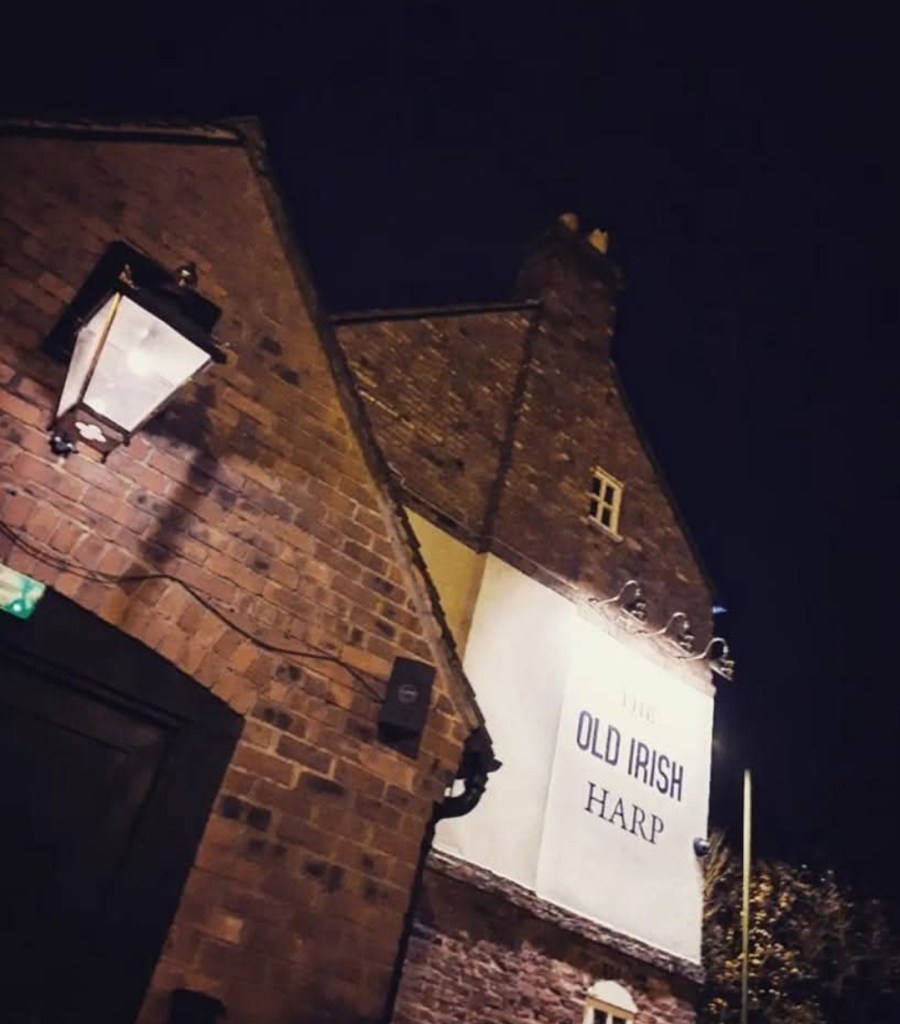
I feared from the looks on my family’s faces that my interest in the macabre may have gone too far when I happened to mention during a meal at the Old Irish Harp that an inquest on the body of a genteelly dressed woman found ‘wilfully murdered’ in a wood near Sutton Coldfield had taken place not far from where we were sat, albeit 250 years prior. I thought perhaps it was time to find a different hobby. Embroidery perhaps? A pleasant pastime for sure, but turns out that for me it’s no substitute for finding and sharing a ripping yarn. And now that we’ve established that I am beyond all redemption, I want to regale you with a post about crime and punishment on the mean streets of Staffordshire.
Back when the inquest took place it was just known as the ‘Irish Harp’.
On the evening of 26th October 1764, a little after 8 o’clock in the evening, Mr Thomas Hurdman of Alrewas was stopped by a footpad opposite St Michael’s churchyard. The Aris’s Birmingham Gazette cryptically reported the rogue was suspected to be a W_____ C_____ of Greenhill. I’m not sure why such nominal secrecy though, when they also published a description of him in the same report (not yet 20, about 5 feet 5 inches high, wide mouthed and wearing his own hair, if not altered, which was brown and short cut’). Despite being caught by one of the city’s constables, WC managed to quite literally give him the slip by sliding out of his coat, and legging it out of Lichfield in a linen frock. His freedom (and any semblance of anonymity) was short-lived however. In March the following year, newspaper reports reveal that the ID of WC was William Cobb and that he’d been sentenced by the High Steward of Lichfield, Fettiplace Nott, to be transported for his assault on Thomas Hurdman and making many violent threats of murder.
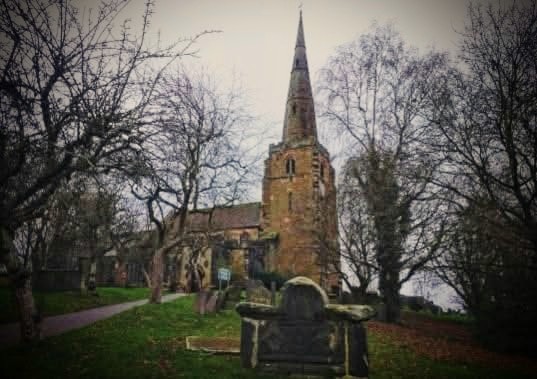
St Michael’s Lichfield is the graveyard for some who went to the gallows
Ashmoor Brook, up Cross in Hand Lane, was the scene of another robbery which went awry. In Lichfield March 1833, a notorious local character known as Crib Meacham, a name apparently derived from his success in various pugilistic encounters, was charged with robbing a Mr Lees of Stoneywell. According to Lees, Meacham was one of a gang of four who attacked him and his wife. The pair were in possession of a large sum of money but it was Mrs Lees who was holding the purse strings at the time and the thieves had allowed her to run away. She soon returned with assistance and it was the robbers turn to run, leaving a gagged Mr Lees unharmed but relieved of his relatively empty purse and hat. Meacham was arrested later that evening but as of yet, I cannot tell you anymore about him, neither the fights which earned him his nickname in the past nor the fate he earned from his part in the robbery.
Cross in Hand Lane is only just outside Lichfield but must have felt like the back of beyond travelling through here after dark
I can tell, however, tell you much more about Robert Lander aka Bradbury a cordwainer of Milford near Stafford who robbed Solomon Barnett, a wax chandler of Liverpool in March 1798. The newspaper reports at the time give not only a physical description (Lander was a stout built man, 5ft 5 inches, 25 years of age wearing a blue coat, a striped fancy coloured waistcoat, and thickest breeches, torn upon the left thigh and patched upon both the knees). It also gives his villain origin story, starting at his childhood home of Haywood near Stafford. When his Dad died, he inherited a few hundred pounds. At the age of 21 he got turned down for a job at the Board of Excise and so went to work for a gentleman in the wine and spirit trade instead. This, it seems, may have been the start of his downfall. During his employment he is said to have remained in a permanent state of intoxication, eventually absconding and taking with him a watch belonging to his master. He sold it at Stafford where he enlisted into a Regiment of Foot but ended up, somewhat ironically, in the shoe making business. This didn’t last long either and neither did his subsequent enlistment into four other regiments. His career in crime also came to an abrupt end when he was found guilty of the robbery of Solomon Barnett and sentenced to death at the Stafford Assize. When the judge prayed that the Lord would have mercy on his soul, it was reported Lander replied, ‘G__d d___n you and the gallows too. I care for neither’. I assume he said it in full but that his blasphemy was censored by the Chester Chronicle. He was executed in August 1798 and the parish register of St Mary’s Stafford records that, along with Edward Kidson, Robert Lander alias Bradbury was executed _ _ _ _ _ _ _.
These are all true crime stories, but it would’t be Lichfield Lore without a bit of folklore would it folks? You’ll be relieved to know I’m not going to go down the Turpin turnpike road but I am going to give a dishonorable mention to Tom ‘Artful’ Arnott, a highwayman who was supposedly executed, gibbeted and, eventually, buried at this crossroads in Cannock.
Although Arnott’s grave is marked on old maps there are no records of anyone of that name ever being executed. Intriguingly though, there is a record of a Thomas Arnott being buried on 1st September 1777 at St Luke’s in Cannock. Clearly a man can’t be buried in two places at once but it’s the right kind of era and area. Then there’s a Thomas Arnott mentioned in Aris’s Birmingham Gazette in October 1792 for absconding from his master’s service in Birmingham. Intriguingly, after given a description of him (35 years old, five feet five inches, marked with the Small Pox, dark lank hair, and lightly made, wearing a blue coat), it mentions that prior to his work as a stamp, press, lathe and die maker, he had been employed as a forger. Do they mean the criminal variety and if so, does this strengthen the case for him being our Tom? Just to add an extra layer of intrigue, there was yet another absconding Thomas Arnott, who was apprenticed to a Whitesmith in Worcester but ran away on 5th April 1803. He’s described as 5 feet two inches, black curled hair, wearing a blue coat with yellow buttons, a green striped cashmere waistcoat with yellow buttons and dark velveteen breeches. In that outfit, if he did become a highwayman, he’d have been a very dandy one indeed. Could any of these be the legendary Arnott? Did he even exist in the first place? All I do know is that this story is one T__B__C__________.
Arnott’s Grave. Unless it turns out to be at St Luke’s Cannock.
Sources Aris’s Birmingham Gazette 5th November 1764
It seems apt that on St Andrew’s Day, I have a story for you which features both a Robert Burns poem and the one time president of the Walsall Burns Club. These events took place one hundred and fifty years ago this week and I will warn you in advance that it’s a bleak early winter’s tale, with no festive cheer to be found.
On 24th November 1874, a young Billy Meikle1 arrived in Alrewas on the first train of the day from Walsall. Snow had fallen overnight and the wintery dawn was just breaking as he passed the Paul Pry Inn2 with its sign hanging from a tree opposite. There were groans coming from the inside the old village lock-up and a howling hound outside was awaiting his master’s release. Billy then continued via the George and Dragon and the Navigation Inn (now the Delhi Divan restaurant) as he headed towards Yoxall via the Kings Bromley Road to collect the accounts of customers for the drapers business he worked for.
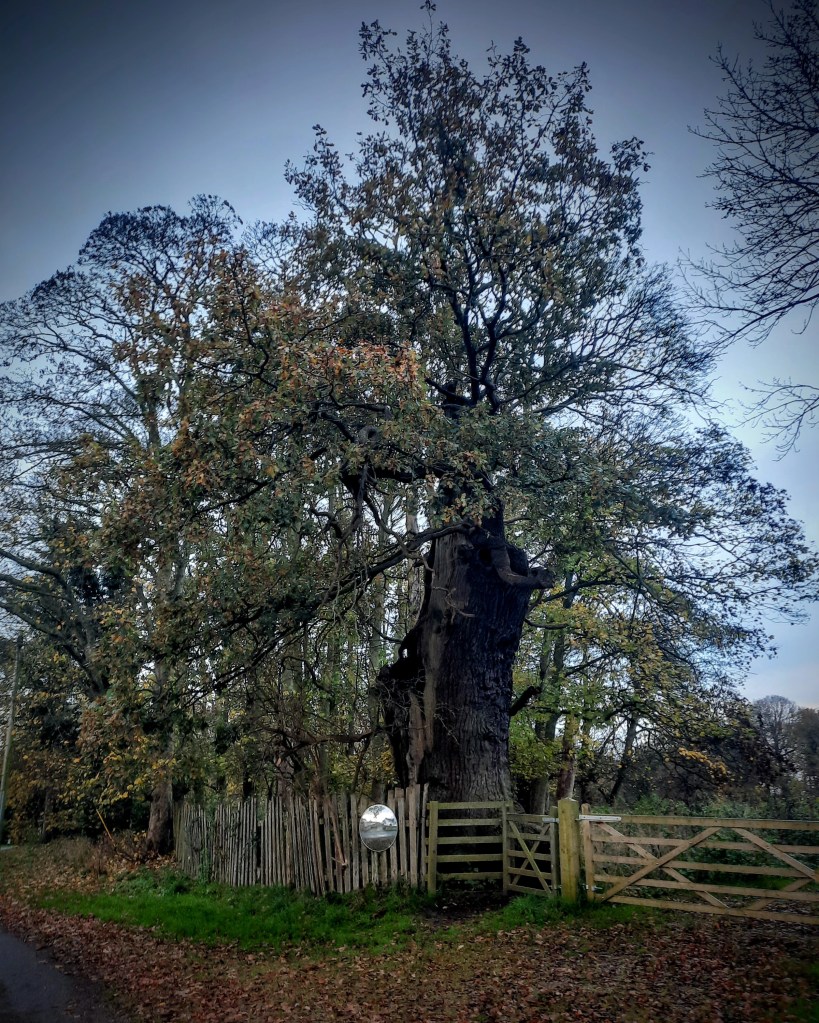
I believe this may be the tree near to where those terrible events took place 150 years ago
When he arrived at Yoxall he found the village in a state of frenzied excitement, following the news that murder had taken place the previous day. At every house he called at he heard the story of how Mrs Kidd had been killed by a vagrant at nearby Hoar Cross because the man had demanded 3d and she had only 2d to give him. Meikle was told the murder had taken place at a large tree, the location easily identifiable as the locals had scraped away the snow to see the pool of blood beneath it. As night fell, he set out in the moonlight to find the sinister spot for himself, but as he approached the tree where the tragedy took place, he lost his nerve and ran back to Yoxall.
The Golden Cup, Yoxall where the drinks still flow although I suspect step dancing on the ceiling is a thing of the past
Unfortunately, the Golden Cup Inn where he was supposed to be staying was perhaps not the sanctuary he was hoping for. Mrs Badkins, who kept the local stationers shop, told him that the landlord had been drinking since his his wife had left him and had borrowed a gun, suggesting that staying at the Crown may be a safer option. Meikle did not heed her advice and took his chances at the Cup. On the day of the inquest on Mrs Kidds’ body, the tap room was flowing with talk of murder, both the very recent and historic. According to Meikle, things took a turn for the better when a man named Ned Dukes stood on his head on a table and sang a song about the world being upside down whilst he did a step dance on the ceiling. Personally, I’d have rather carried on talking about murders. At 10 pm time was called and the customers went home, ‘full of drink and murder’. Meikle was left alone with the landlord and his daughter and together they ate soup, bread and cheese. At several points during the supper, the landlord got up to investigate invisible things in the dark corners of the room. Eventually, bed was suggested and Billy was shown to his room which had been partitioned off from the club room. Despite thoughts of the landlord and his gun, Meikle drifted off to sleep. At 2am he heard the clock at St Peter’s chime but fell back to sleep. Soon after however, he was woken again by a terrible crash and peered from beneath his bedclothes to see the landlord stood in the room, candle in one hand, gun in the other.
Both men had thought the crash had been caused by the other firing shots but Billy assured the landlord he had no gun. The men then realised the crash they’d heard resulted from the partition between rooms falling down and both of them returned to their beds.
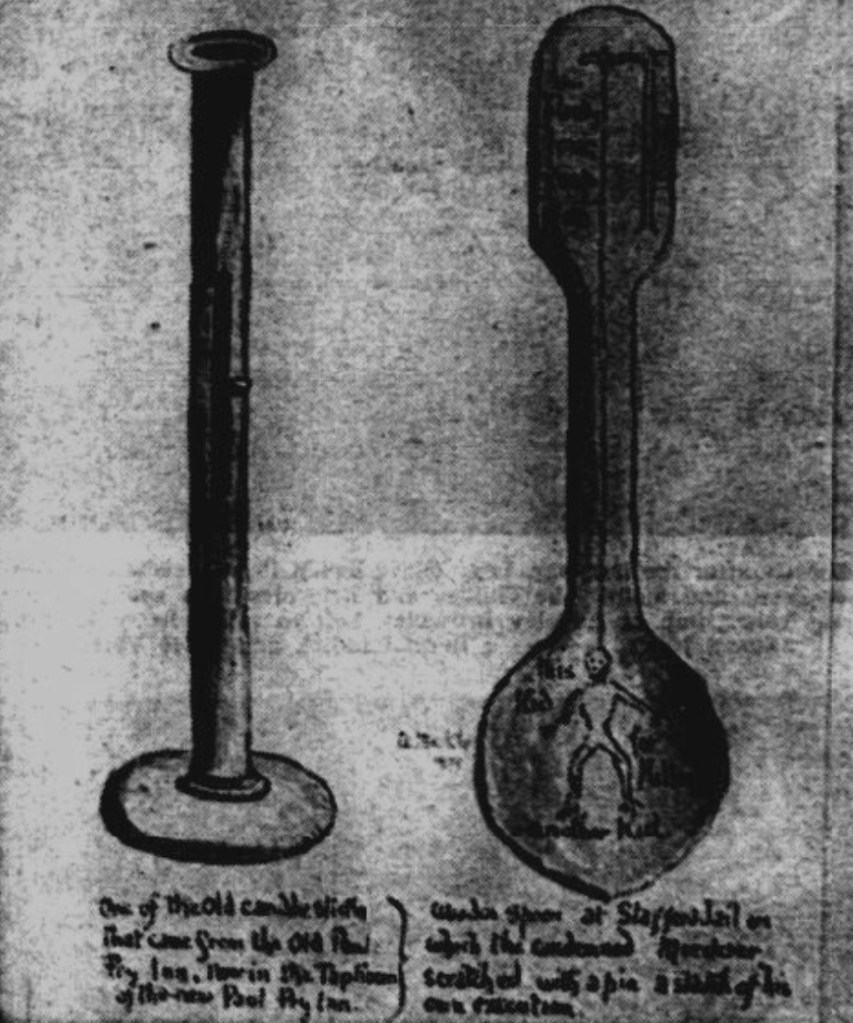
Billy Meikle’s sketches of a candlestick from the old Paul Pry Inn and the sinister spoon Taylor carved in Stafford Gaol
Meikle says the murderer of Mrs Kidd was arrested several weeks later. He was caught in a trap laid by the police who knew he was unable to resist singing a love song called The Thorn, based on a poem by Robert Burns. Pianists were planted in every pub in the East Staffordshire area, with instructions that they should play the song at regular intervals. The snare was a success and the murderer was arrested mid-song and later sentenced to death. Meikle says he scratched a figure of a man being hanged onto the wooden spoon he ate his final meal with along with the words ‘A bloody long drop for this kid for killing another ‘Kidd’.
It’s an incredible story but I suspect Billy Meikle’s account of events may not be altogether accurate. What is without doubt is that at the Stafford Assizes in December 1874, Robert Taylor, a 21 year old miner from Wigan was found guilty of the wilful murder of Mary Kidd on 23rd November in the parish of Yoxall. The main witness was her neighbour Sarah Ann Hollis, an eight year old girl who had gone with her. Sarah said that as they approached the wood, they saw Taylor and had a brief conversation with him. He followed them and asked for half a crown, and Mrs Kidd replied she did not have that amount but gave him 2d. Taylor then grabbed her and cut her throat with his pen knife. The sound of approaching cart wheels scared him away and may well have saved Sarah’s life.
Was Taylor trapped by a tune though? It seems the murderer was caught in a much more orthodox manner. Newspaper reports say that after visiting the murder scene, near to the new church at Hoar Cross and on the main road from Yoxall to Sudbury, Superintendent Bowen searched for the murder all night. Eventually he overtook him on the road to Burton, followed him into a shop and, recognising him from Sarah’s description, arrested him. Taylor’s clothes were examined and his shirt sleeves, trousers and coat were found to be saturated with blood. Traces of blood and bloody hand prints matching his were also found on the gate he escaped across towards Yoxall Lodge.
When the charges were read, Taylor replied with a smile, ‘I plead guilty to all that’. It was remarked that from the time Taylor was arrested until the time he stepped onto the scaffold, Taylor appeared to treat the whole thing as a joke, displaying no remorse. He commented to someone that he had no family or friends and didn’t care what happened to him. At Stafford Gaol, he attended services in the chapel on Sundays and on Christmas Day, sitting in the same pew where William Palmer had once sat. During the service the chaplain asked the congregation to pray for Robert Taylor, now lying under the sentence of death. His final weeks were spent in a cell with a straw mattress and his only visitor was a woman from his native Wigan who suspected Taylor to be her long-missing but still loved husband. The chaplain allowed her into the cell but after taking a good look at Taylor she declared that this was not her husband and headed back up north, no doubt much relieved. Robert Taylor really was alone in this world.
Taylor was executed within the walls of Stafford Gaol on the last day of 1874, just after the clock had struck eight o’clock. The morning is reported as being clear and bitterly cold. A couple of hundred people had congregated in the road near the gaol, drawn no doubt from the same morbid curiosity which drove me to write this post. Taylor’s final words to the executioner were ‘Snap me off quick’. He did.
Notes:
1 – Billy Meikle was a fascinating character with many interests including local history, photography and sketching scenes from the world around him. As mentioned above, he was also involved in the Walsall Burns Club. You can read more about him here.
2 – The Paul Pry Hotel in Alrewas stood on what is now the A38 and was demolished when the road was widened c.1960. I have read that a former landlord used to show punters a brace of pistols which had once been the property of a highway man said to frequent the inn.
Sources:
Rugeley Times 28th December 1968
Edinburgh Evening News 11th December 1874
County Advertiser & Herald for Staffordshire and Worcestershire
Armed with a bag of Werther’s Originals and a vague plan about finding the site of Boudica’s final battle against the Romans, my friend (and countrywoman) and I headed down the A5 towards Atherstone.
Boudica’s burial place is one of Britain’s great mysteries. I thought for years that the warrior queen rested beneath a platform of Kings Cross Station but clearly I was on the wrong track. There is no trace of her there, or anywhere else for that matter, although plenty of places have been mooted as a possibility. Ever since Richard III was found under that car park, perhaps people are more comfortable putting forward their own research into such things. Even somewhere they flog burgers in Birmingham is apparently a contender for the final resting place of the scourge of the Roman Empire. If she genuinely is here, they really ought to consider changing the name to ‘Queen’s Norton’. Let’s be honest, it wouldn’t be the first time a significant piece of history has been linked to the foundations of a local fast food restaurant in the West Midlands. There are two Mummies beneath what was once another MaccyDs in Tamworth.
Despite several sites laying claim to being the scene of Boudica’s last battle, no archaeological evidence has turned up at any of them either. Claims have instead been based on descriptions of the battle ground from two Roman historians, Tacitus and Cassius Dio. It’s described as somewhere within a defile (a steep sided narrow gorge) with a wood behind it and open countryside in front of it, chosen to prevent ambushes from Boudica’s warriors. In 2004, archaeologist Jim Gould wrote an article in which he says the description of the site given by Tacitus is much too vague for positive identification. He believed it would never be identified on the ground, in the absence of an archaeological discovery.
One of the chief contenders is Mancetter, on the outskirts of Atherstone, or Manduessedum as it was known in Boudica’s time. If it is ever proved, then they ought to consider changing the name to ‘Womancetter’ but I think we are going to have to defile that thought away for now.
What we do have archaeological evidence of at Mancetter is a Roman fort, now occupied by the site of the church and manor house. As we stood nosing in at the gate of the latter, the gardener appeared and told us it dated back to the fourteenth century and had a priest hide and a secret tunnel leading to the church. Despite my enthusiasm for stories of this kind, experience tells me these architectural features often turn out to be a cupboard or a cellar. In this case however, it seems he may not have been leading us up the garden path. Well not entirely. According to the Atherstone News and Herald in June 1956, in what’s now known as the ‘Martyr’s Bedroom’, an escape route led to the roof via a sliding panel in, ahem, a cupboard
The manor was the home of the Protestant Glover brothers John, William and Robert. In 1555, the Bishop of Lichfield issued a warrant for their arrest but by the time the Mayor of Coventry arrived with men to carry out the orders two of the trio had escaped. Robert had been unable to flee as he was ill and was taken from his sick bed to Coventry and then to Lichfield where he dined at the Swan before being removed to a cell alongside a dungeon. I suspect this would have been the ‘church prison’, as described by Thomas Harwood which seems to have been underneath what’s now Number One, The Close, rather than the gaol at the Guildhall.
Robert Glover was burned at the stake in Coventry on 19th September 1555. His brother John eluded capture but died of an ague after living in the woods for some months. The Biishop’s Chancellor, Anthony Draycot was not about to let the whole business of him being a protestant lie though, informing the vicar that his body should be dug up and thrown over the churchyard wall. When the vicar pointed out that after six weeks the body stank and finding men willing to undertake the task would be tricky, Draycot instead ordered him to wait for 12 months and then throw the skeleton over the wall into the public highway. The third brother William also suffered post-death disgrace being refused a Christian burial in the town of Wem in Shropshire, his corpse instead being dragged by horses to a nearby field and buried there in unhallowed ground. Just in case a priest hole and secret tunnel haven’t given you your fill of folklore, you should know that Robert Glover’s ghost haunts the room from which he was taken.
Next door to the Glovers lived another Mancetter martyr, Joyce Lewis, who was burned at the stake in Lichfield on 18th December 1557. Despite a plaque in the Market Square recording this dark chapter of the city’s history I knew very little of her story until now. It seems Joyce fought to the death to defend her beliefs, asking the friends who visited her in prison how she might behave so, ‘her death might be more glorious to the name of God, comfortable to his people, and also most discomfortable unto the enemies of God’. The night before her execution she refused the offer of two priests to hear her confession and after fainting on route to the Market Square and being given a cup of water, she used it to drink to ‘the abolishment of papistry’. According to Foxe’s Book of Martyrs, ‘a great number, specially the women of that town, did drink with her; which afterward were put to open penance in the church by the cruel papists, for drinking with her’. I believe open penance would have been some sort of public punishment.
I may not have found the site of Boudica’s battleground on my journey up the A5 but it did lead me to the story of Joyce Lewis’s last stand much closer to home and how her final moments were spent surrounded by the solidarity of the women of Lichfield.
Our city churchyards are full of those Lichfeldians who have left us. There are gaol keepers and executed prisoners, civil war soldiers and WW2 airmen, paupers and presumably, somewhere, plague victims (although that’s a whole other line of enquiry). Yet there are also others, denied the right to a Christian burial, laid to rest in unhallowed ground.
I’ve written before about Bessy Banks and the tragic tale of Lichfield’s ‘love-desperate maid’. The story seems to have been well known in the 17th and 18th centuries, being written about by both Anna Seward and David Garrick, and the place name ‘Bessy Banks’ Grave’ survived until the start of the 20th century, when the supposedly haunted spot was built on as the area around Dimbles Lane, once a ‘sunken road leading north from Lichfield’, was developed. Ironically, given that Bessy appears to have been denied a Christian burial and instead interred at a crossroads for taking her own life, her grave now seems to lie within the grounds of a Catholic church. Unfortunately, there are no records of any remains being uncovered on the site when St Peter and St Paul was built which may have answered at least some questions about Bessy and her story.
1815 Map of Lichfield showing Bessy Banks Grave
At other Lichfield locations, we have the opposite problem – skeletons without a story. In 1862, workmen digging the foundations of a building at the warehouse of the Griffiths Brewery on St John Street, adjoining the South Staffordshire Railway, found the bones of ‘a full-grown person’, which ‘had been there for many years’, about four feet from the surface. As the newspaper reports that only the head and arms were removed, I can only conclude that the remainder of the remains remain there.
A burial place at the old brewery
Then, in February 1967, a skeleton believed to be around four hundred years old, turned up four feet down from the existing ground level during excavations at the new shopping precinct at Castle Dyke. Most of the bones were crumbled but the teeth were in a good condition. So good in fact that the site foreman said, ‘I would have been pleased to own them’. What became of the body and its nice set of gnashers is unknown.
Could either body belong to a man named Gratrex, found hanging in Lichfield on Wednesday 7th September 1763 and buried in the highway after the Coroner’s Inquest issued a verdict of ‘felo de se’? If not, it seems there maybe another skeleton lying somewhere beneath the streets of Lichfield still to be unearthed.
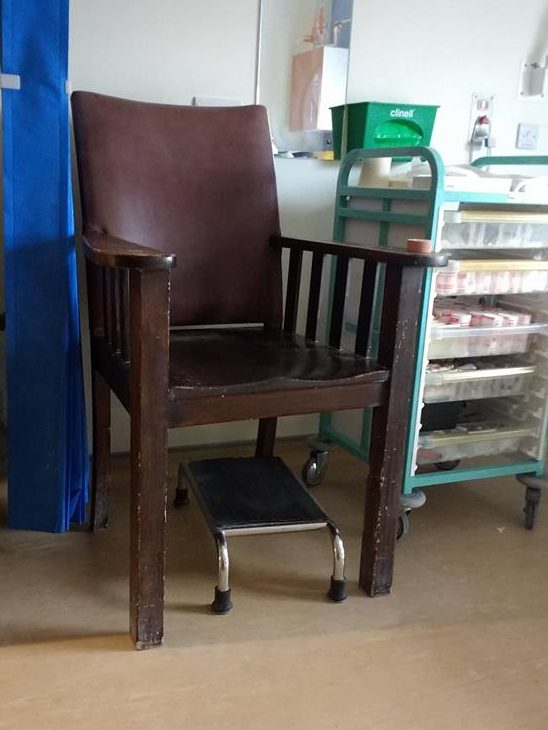
One of the highlights of this weekend’s coronation, appearances from Floella Benjamin and the Grim Reaper through the arched door aside, was The Coronation Chair. It is possibly the most famous piece of furniture in existence, rivalled only by Lichfield’s Victoria Hospital Chair now in the Samuel Johnson Minor Injuries Unit. Royalist or not, there is something rather thrilling about a graffiti and bomb scarred throne on which the behinds of thirty eight kings and queens, and the rump of Oliver Cromwell, have sat.
A big chair for the NHS. Hip hip hooray!
Even more ancient than the chair is is the ‘Stone of Destiny’ it was built to incorporate. The sandstone block, used for centuries as the crowning seat of Scottish kings, was stolen by Edward I in 1296 and only officially returned to the people of Scotland seven hundred years later. Many myths, legends and rumours surround the stone’s origin and its authenticity but today there’s another mysterious coronation seat somewhere in Staffordshire that I want to investigate.
Are you sitting comfortably? Then we’ll begin.
In September 1959, the Western Mail carried a story about a seat-shaped stone, located in the grounds of Blithfield Hall, Staffordshire. Visitors to the hall were told it was the ‘Welsh Coronation Stone’, which caused a great deal of confusion in Cardiff as nobody knew whether a Welsh Coronation Stone was actually a thing or not. An official at the Welsh Folk Museum was also non-committal given, ‘It is one thing to have a Stone and another thing to have a stone around which a story or tradition may have arisen’. It seems there was also reticence to discuss such monumental matters here in Staffordshire for fear of the stone being returned to its rightful home. All that could be established was that the family heirloom/national treasure had arrived at Blithfield in the 1920s.
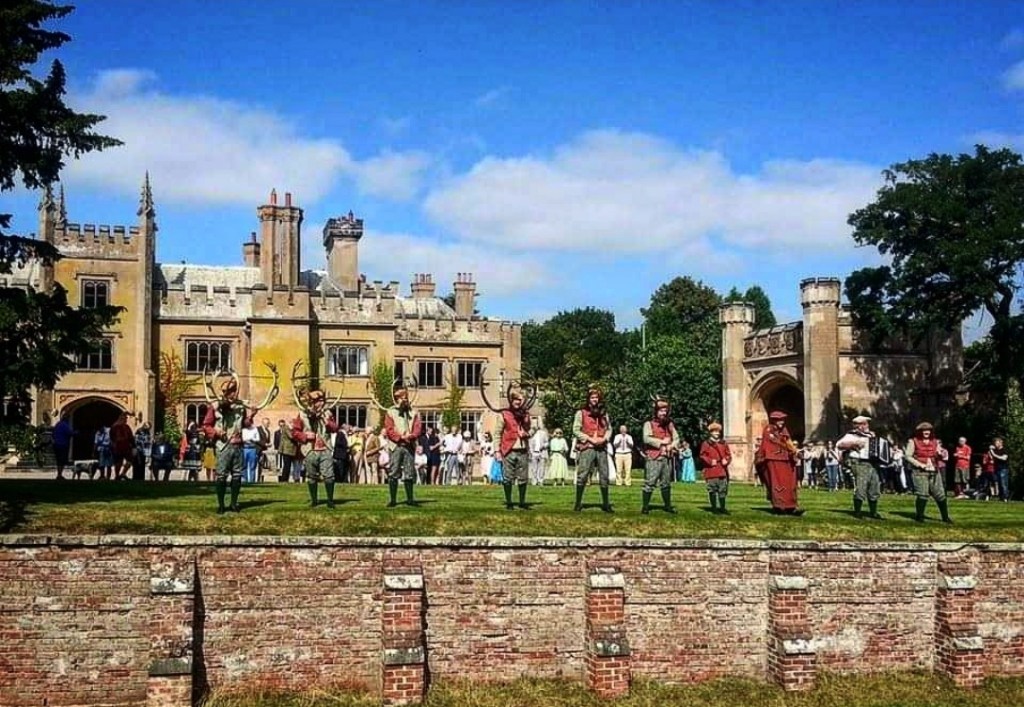
Dancing kings aka the Abbots Bromley Horn Dancers on the lawn on Blithfield Hall
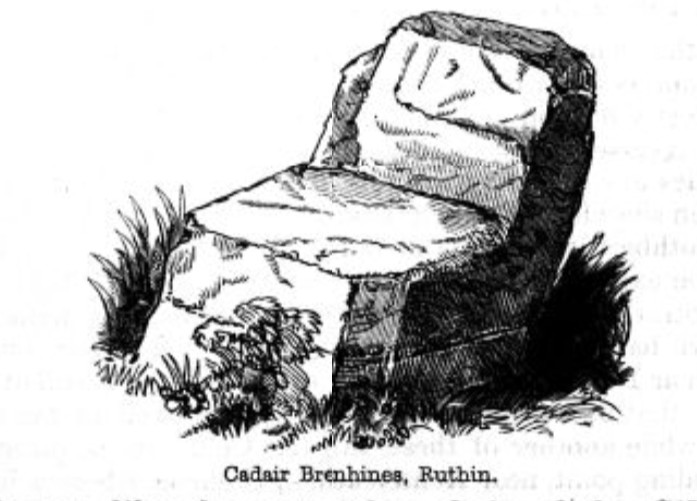
Ten years on, around the time of Charles’ investiture as Prince of Wales in the Summer of 69, another reference to the stone appeared in the Rugeley Times. The then headmaster of Hill Ridware School is pictured in the hall’s inner courtyard looking at what the newspaper describes as ‘the Welsh equivalent of the Scottish Stone of Scone’ and ‘the seat on which early Welsh kings were crowned’. It says it came from the Bagot’s estate near Ruthin called ‘Pool Park’ and a virtual visit there via the Ruthin Local History Society reveals that a ceremonial ‘coronation stone’ dating to the 5th or 6th century is mentioned in the estate’s 1928 sales catalogue, which fits in with the date of the Blithfield stone’s arrival in Staffordshire. The society give the Welsh name of the stone as ‘Cadair y Frenhines’ (The Queen’s Throne) and says it was brought down from ‘Llys y Frenhines’ (The Queen’s Court) in the early 19th century, along with another ancient monument with Ogham and Latin inscriptions (1). The latter was moved to the museum in Cardiff in 1936 and replaced by a replica at its unoriginal location at Pool Park but according to the history society, the whereabouts of the Queen’s Throne is now ‘unknown’.
Claim of thrones
I’m certain that this missing stone is the one described as being at Blithfield but so many questions remain. Fifty plus years later, is the monument even still at the hall? Was it ever really used to crown queens, or indeed kings, or did it gain this reputation through Georgian whimsy and the fact it looks a bit like a chair? Hopefully if the royal chair is still to be found in the courtyard at Blithfield, the true backside story of The Queen’s Throne might finally be revealed.
(1) In defence of Bagot, the chair was rescued from one of his tenants who had been using it as a horse block. Sadly, its said that the tenant simply went and fetched another ‘old stone’ in its place.
Many people are familiar with the story of John Neve, William Weightman and James Jackson, the last men to be hanged in Lichfield on 1 June 1810, for the crime of forgery. Their shared headstone can be seen tucked away under the tower at St Michael’s, although they are buried elsewhere in the churchyard in a now unmarked a communal grave. One particularly poignant postscript to these events is that after his execution, the friends of John Neve commissioned three mourning rings to be made, each with an inscription to his memory and containing a lock of his hair. I wonder whether it was these same friends who erected a headstone as to my knowledge there are no memorials to any of the other executed criminals buried here?
Amongst them is another tragic trio, Thomas Nailor, Ralph Greenfield and William Chetland who met the same end for the same crime at the same place on 13th April 1801. Prior to their execution, two of the men had attempted to escape from Lichfield gaol by filing through their irons and putting them back together with shoe maker’s wax. Their cunning plan had been to knock down the gaoler when he came to lock them up for the night and they would have gotten away with it had it not been for pesky Joseph Vaughton, a private in the 38th regiment of foot, to whom Nailor had given a pattern of the wrench he wanted making and a Bailiff called Mr Scott who discovered the file they had been using. Headstone they may not have but incredibly a tangible link to this execution does apparently exist. In 1947, the Town Clerk of Lichfield received a letter from a Mr Clayton W McCall of Canada to say a morbid memento had turned up in an antique shop in Vancouver in the form of a silver salver, ‘Presented by the Corporation of the City of Lichfield to Revd. Bapt. Jno. Proby, Vicar of St Mary’s, for his pious attention to three unhappy convicts who were executed in that City April 13th 1801’. However, as with the rings, its current location is unknown.
One very unhappy convict sentenced to be hanged at the gallows on 6th September 1782 was 62 year old William Davis who had been convicted of horse theft. The Derby Mercury, reported that in his final moments, David’s behaviour was bold, paying little attention to anything that was said to him. Then, just as the executioner was about to send him eternity, Davis threw himself from the cart with such force, that the rope snapped. After much confusion and delay, the rope was replaced and Davis’s last earthly words are recorded as having been, ‘This is murder indeed!’.
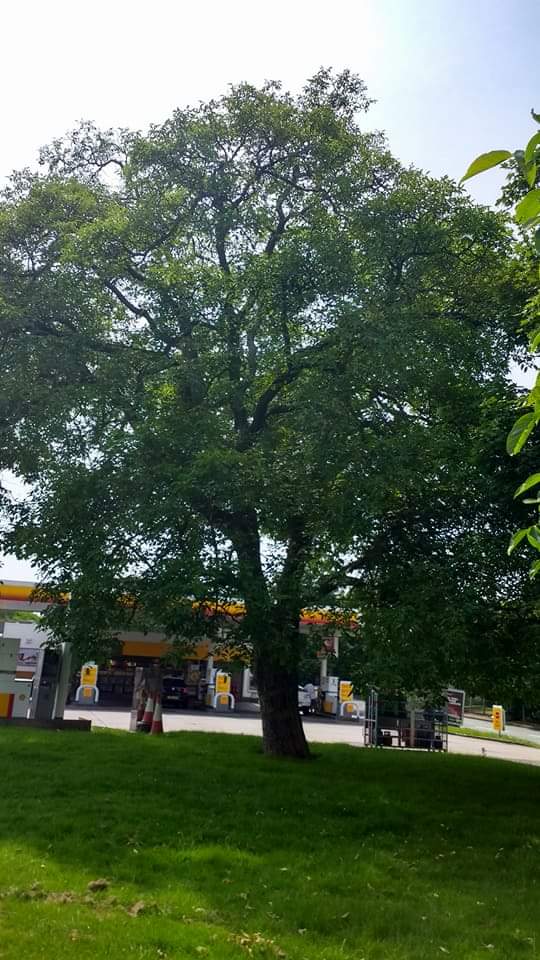
In 1935, the site of the old gallows was described as being ‘preserved and indicated to passers-by with an inscription recording its ghastly use in bygone days’. The area has developed significantly since then, but I was told by Janice Greaves, former Mayor and current Sheriff of Lichfield, that the exact spot where the gallows stood is now marked by a walnut tree growing on the patch of grass alongside the garage. There has been some discussion about what form the gallows actually took, but there is evidence to suggest that there was a permanent structure to which the cart carrying the condemned convicts would be brought. In Aris’s Birmingham Gazette it describes how ‘On Friday Night last, Richard Dyott Esq, who lives near Lichfield was going home from thence, he was stopp’d near the Gallows by two Footpads, who robb’d him of five Guineas, and in the Scuffle he lost his hat’.
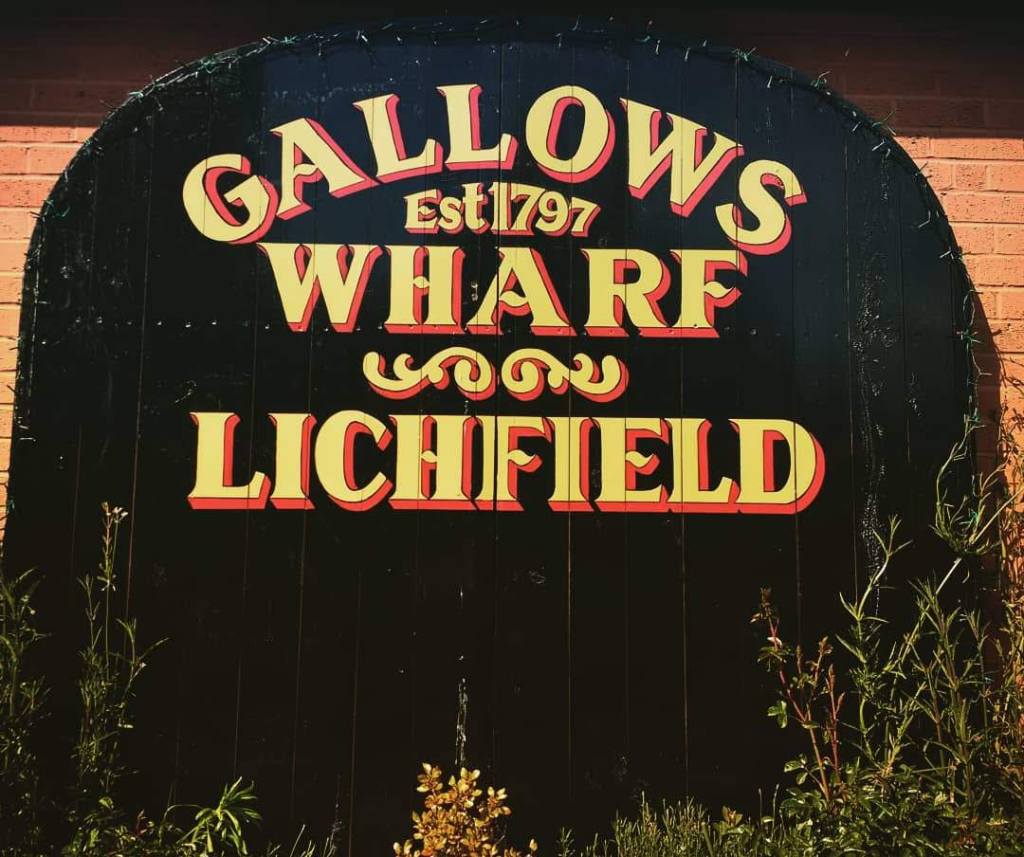
My plea to you this Halloween is to keep your eyes on Ebay for Neve’s mourning rings and the silver salver. If however you decide to take a wander over to Gallows Wharf in search of Richard Dyott’s hat, please be warned that an ex-executioner from centuries past appears to have been sentenced to linger at the spot and you may well feel a push from behind as he attempts to dispatch you to your doom.








 Lichfield Lore