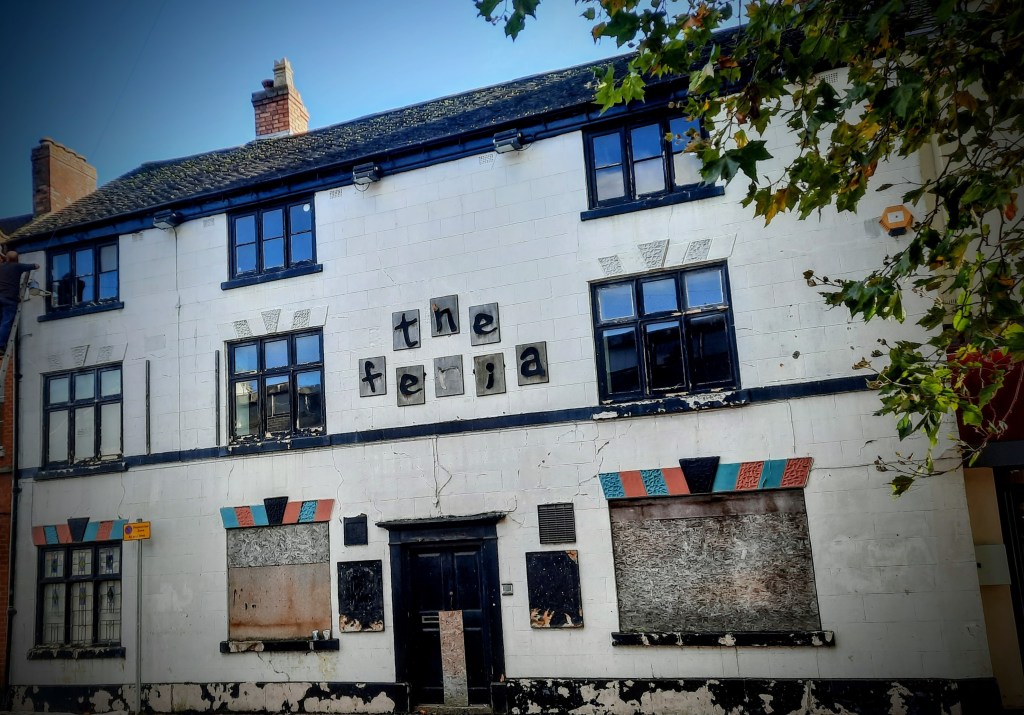
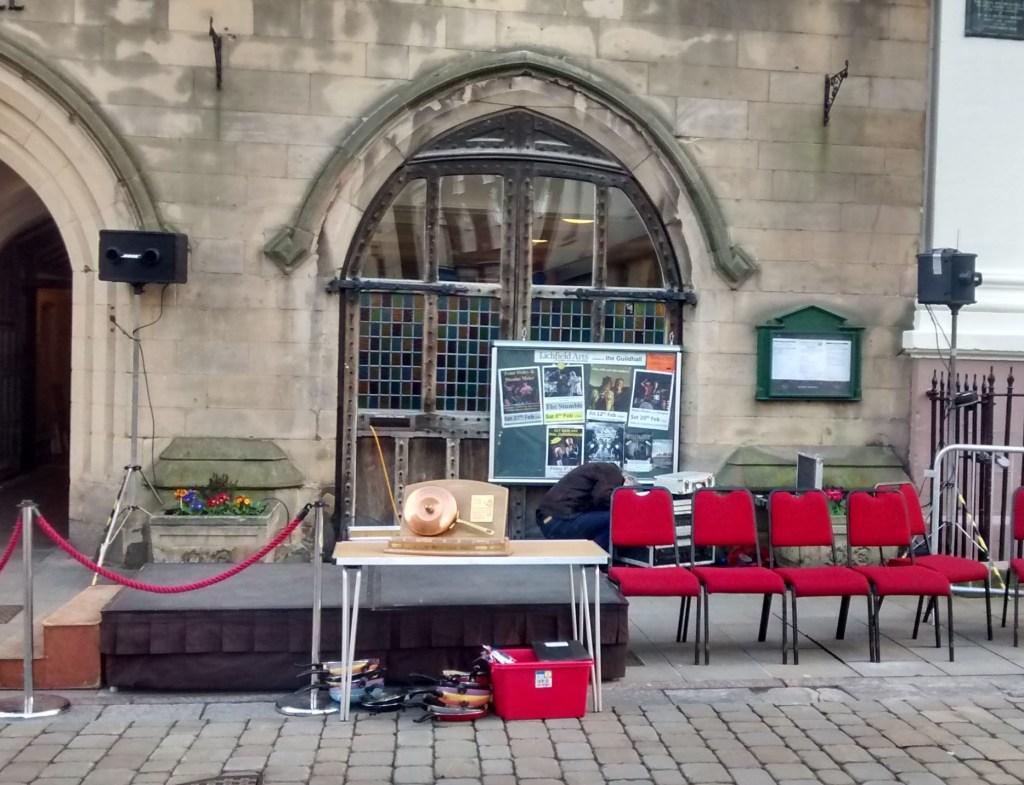
Here in Lichfield, Shrove Tuesday is celebrated with people dressed up as princesses, pirates or, um, slices of pizza racing along Bore Street as they flip pancakes. Visitors to the city tomorrow may see the old Price of Wales/Chameleon Bar/Feria and think its been boarded up as a precautionary measure in case the shrovetide shenanigans get out of hand but it’s actually just been left derelict for about twenty years.
A flipping disgrace
Somewhere they really do have to take such steps to protect their premises is up the A5 at Atherstone, where instead of pancake racing they play a truly hardcore game of football and have been doing so since 1199. Apparently, once the giant leather ball has been tossed into the crowds onto Long Street there are only two rules. One is that the ball must stay on Long Street. The other is that you can’t kill anyone. I told you it was hardcore (by comparison, the rules of the Lichfield Shrovetide Festivities include mandatory non-slip footwear and that at some point during the festivities the Mayor of Lichfield must be photographed in a spinning teacup on the Market Square).
Pandemonium (Lichfield style)
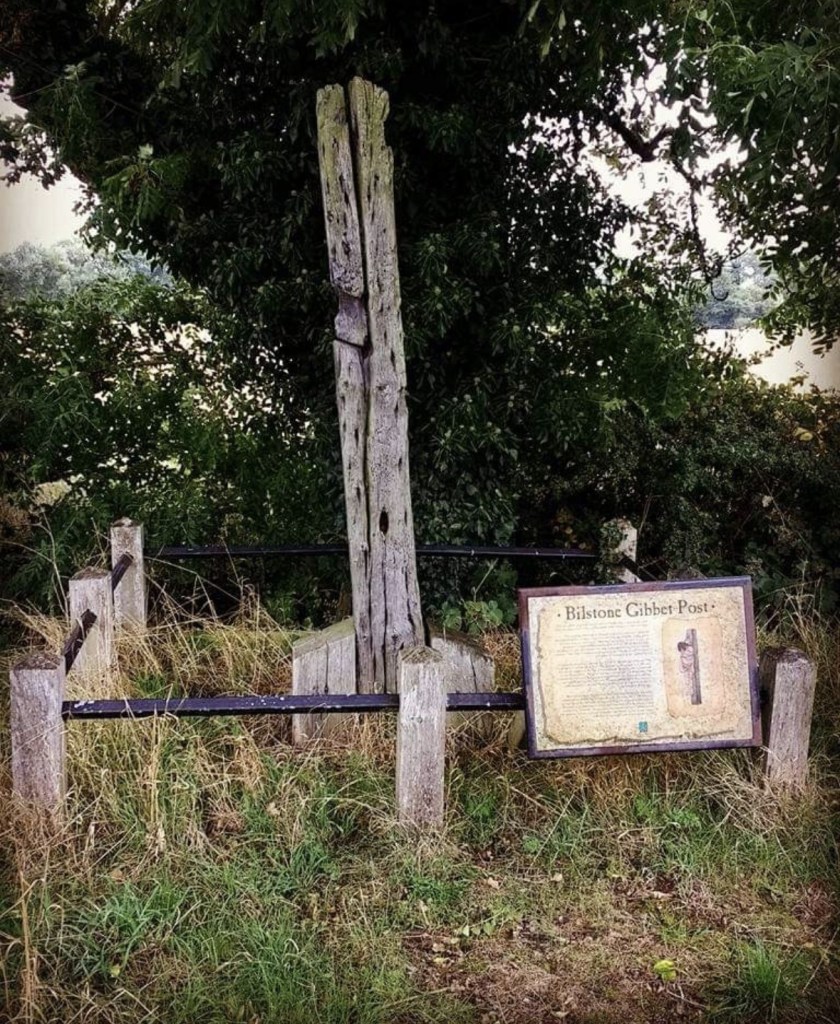
With this in mind, I am inclined to believe the following anecdote about the good folks of Atherstone. In February 1800, John Massey was executed for murder and his body was gibbeted at Bilstone, near the site where he committed his heinous crime. Eighteen years later, his rotting remains remained on display, and became quite the local tourist attraction for Atherstonians who would pop there for a picnic. Once they’d finished their food, they’d partake in that quaint old pastime of throwing stones at the murderer’s skeleton. Eventually, a grocer called Mr Peach knocked the skull from its boney shoulders and so the group of day-trippers took it back home to Atherstone with them. It seems Peach then presented this sinister souvenir as a gift to his local pub.
My grocer went Bilstone and all I got was this skull of a lousy murderer
I’ve read the skull was lined with silver and turned into a punchbowl. Other versions claim the cranium became a candle holder. Some say it was eventually stolen, others say it’s still kept in a secret safe in one of Atherstone’s ancient inns. If you know anything more, please give me a heads up. Finally, please do accept my apologies if I’ve put you off your pancakes.
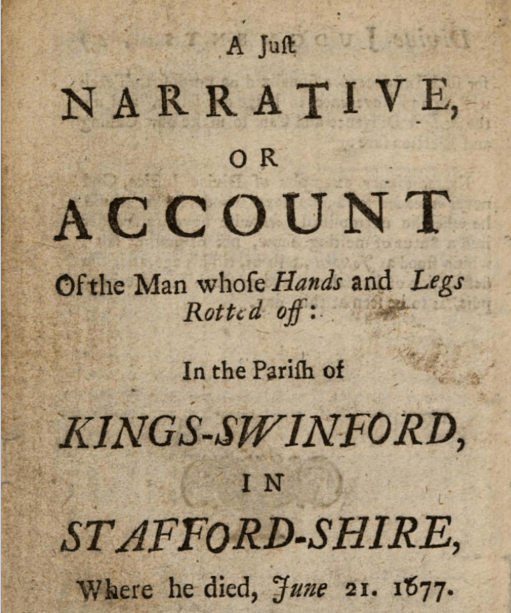
When John Duncalf was released from the House of Correction in Kingswinford in 1675, he swore he would never set his feet in the town again as long as he lived. It was a promise that was to become grimly prophetic.
On leaving Kingswinford, he embarked on a life of petty crime and sin. He would later confess to, ‘Idleness, Stealing, Cursing, Swearing, Drunkeness and Uncleanness with Women’, although he explained that he had not actually committed actual Fornication or Adultery with a woman except in the thoughts of his heart, and by lascivious words and gestures, whereby he had endeavoured to tempt them to lewdness in divers places. I think we can infer from this that his lack of lewd action was not for want of trying.
The chapter of crime he was to become truly infamous for was the theft of a bible. If he’d only read one of them, paying particular attention to the eight commandment, things could have turned out a lot differently. But, on 5th January 1677, Duncalf turned up on the doorstep of Grange Mill, masquerading as a beggar. It was the home of Margaret Babb and when she charitably invited him in for a drink to celebrate Twelfth Night, the bad man stole her good book.
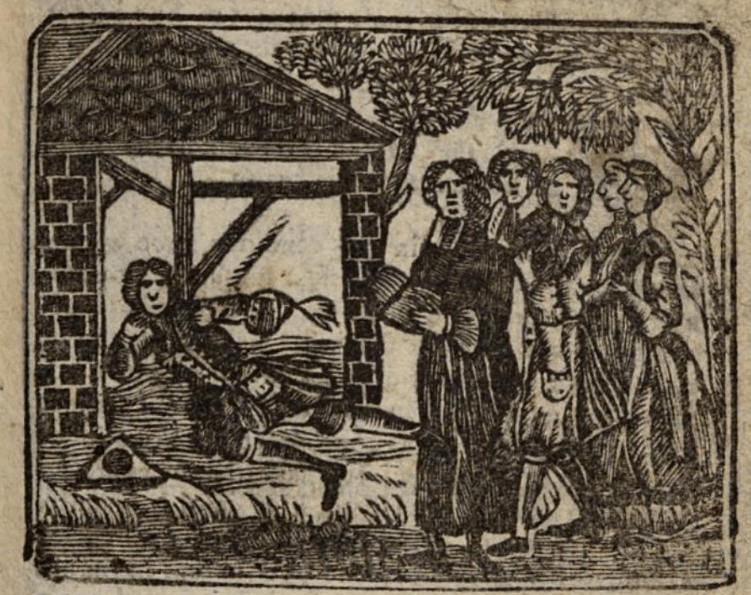
Duncalf stealing the Bible from Margaret Babb as she fetched him a drink. I’m not quite sure exactly what Mr Babb is doing. (Woodcut from Divine Judgement and Mercy Exemplified In a Variety of Surprising Instances)
Duncalf sold Babb’s Bible on to a maid at Heath Forge at Wombourne but its provenance was discovered and suspicion fell on Duncalf. He swore it wasn’t him apparently, ‘wishing his hands might rot off, if that were true’. It would turn out to be the second prescient statement Duncalf would make. Soon afterwards, the flesh around his wrists began to turn black. His ungodly wish was about to be granted.
A few weeks later, Duncalf was working in Dudley with a joiner called Thomas Osborn when he felt weak and faint and feverish. It was Shrove Tuesday and he headed home towards Codsall but collapsed in a barn at Perton Hall in Tettenhall en-route. After two days and two nights, he was discovered unable to walk and so was carried back to his last place of settlement. And so it was that John Duncalf found himself back in the town of Kingswinford but, just as he had sworn, without actually set foot in the place. He was taken in by a man called John Bennett and at first he was lodged in a barn belonging to the Three Crowns Inn on the Wolverhampton to Kidderminster Road. After a fortnight, he was taken to Bennett’s house in Wall Heath where his blackened flesh began to rise in lumps at his hands and wrists before beginning to decay.
A vicar visits Duncalf just before he’s about to lose his left hand (Woodcut from Divine Judgement and Mercy Exemplified In a Variety of Surprizing Instances)
The account I’ve read comes from James Illingworth, one of the clergymen who visited him amidst the crowds. He says that by the end of April, ‘many little Worms came out of the rotten flesh, such as are usually seen in the dead Corpes (sic)’. Many visitors also appeared, posies pressed to their nostrils to block out the putrid smell, hoping to see the man who they believed was being literally and directly punished by God for his sins. Despite everything, Duncalf did not appear to have learned his lesson. Illingworth heard him tell his keeper John Bennet that he wished his visitors’ noses might drop off and asked why he did not dash out their teeth to stop them from grinning at him.
Eventually, Duncalf asked for Margaret Babb to visit, and she came with the maid he had sold the stolen book to. He confessed his crime to them and asked their forgiveness, which both of them granted. When his hands rotted off, there was hope that penance had now been paid and that God would punish him no more. Yet, the suffering continued. By 8th May, both of his lower legs had fallen off at the knee, although he didn’t realise it until Bennett held them up to show him.
According to the Dudley Archives and Local History Service, the entry in the parish register at Kingswinford shows that John Duncalf was buried on 22nd June 1677, and is described as, ‘the man that did rott both hands & leggs’. The entry notes that he stole a bible, a charge, ‘he wickedly denyed with an imprecation, wishing that if he stole it his hands might rot of which afterwards they did in a miserable manner’. It adds that, ‘many people (I verily believe hundreds) saw him as hee lay with his hands & leggs rotting off, being a sad spectacle of God’s justice and anger’ and ends by saying it was registered as, ‘a certain trueth, to give warning to posterity to beware/ of false oathes’.
Clearly there is a certain trueth to this story which elevates the death of John Duncalf to more than mere folklore but what did cause his terrible demise if it wasn’t a punishment dished out via divine judgement?
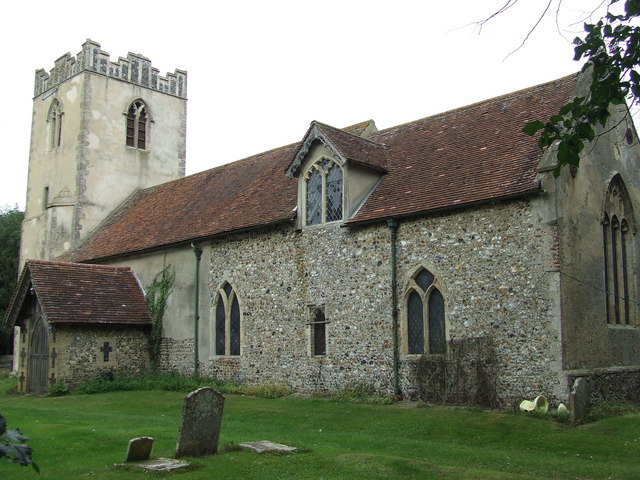
Keith Evans / St Nicholas Wattisham / CC BY-SA 2.0
A memorial in the tower (which you can see here around 13m20s in) and an entry in the parish register at the now disused church of St Nicholas at Wattisham in Suffolk describe the sad fate of the Downing family who all lost their feet in 1762, although four of them survived. I’ll spare you from the full gory details but belief amongst local people was that the poor family were victims of witchcraft. The local vicar Rev Bones (I kid you not) was not convinced and set out to ascertain the cause of their affliction sending several letters to the Royal Society who concluded the culprit was gangrenous ergotism caused by eating grains infected by the fungus Claviceps purpurea.
I’ve seen this ‘tragic ‘singular calamity’ as Rev Bones called it, described as the only recorded case of ergot poisoning in England. However, I strongly suspect that John Duncalf may have been another of its victims and possibly, had John Bennett and others sought medical attention for him rather than condemning him to be some sort of religious freak-show, he may even have survived.
I definitely wouldn’t swear on it though…
Sources
Ian Atherton (2022): ‘John Duncalf the Man that Did Rott Both Hands & Leggs’: Chronicle of a Staffordshire Death Retold in the Long Eighteenth Century, Midland History, DOI: 10.1080/0047729X.2022.2126237
I’m reading the memoirs of a man named William Purcell Witcutt. Like me he had connections to both Birmingham and Staffordshire, and was fascinated by folklore. Unlike me, he was an protestant vicar who converted to Catholicism before being exiled to the furthest outpost of the Diocese for the crime of commenting on the corrupt nature of many medieval priests. Yes, they sent him to Leek.
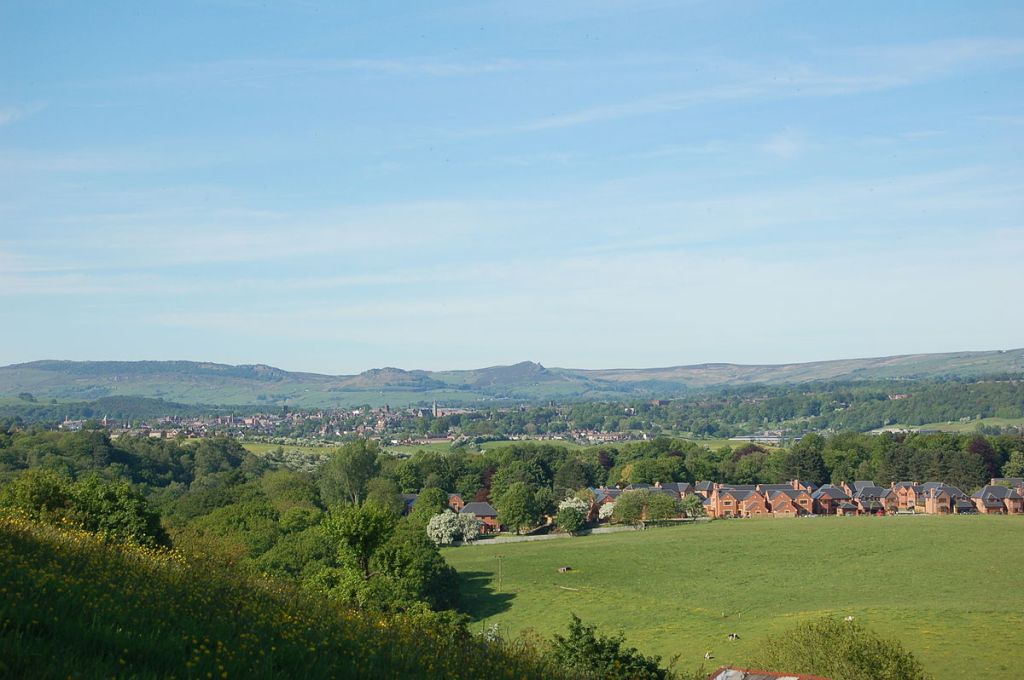
In his book, ‘Return to Reality’ there is a chapter called ‘The Valley of Phantoms’, in which he describes how, ‘Leek lay hidden in mist and woods in the middle distance, and one of the older boys tried to convince me that it was invisible from the air. Leek will never be bombed said he, and quoted with assurance the prophecy that there would come a time when, ‘there will be no safety in the land save ‘twixt Mow Cop and Morridge’.
No I can definitely see it
Witcutt was soon to find plenty more superstition in this Staffordshire Moorland town. It seemed to him that the valley and moors around it swarmed with ghosts and bogies, which people still believed in. There was the Headless Horseman, or in Leek dialect, ‘a man on an ‘oss without yed on, an awful gory sight’, and nearby was a Black Dog who guarded the graves of those who died a violent death. According to Witcutt, the Queen of the Leek demons was the Mermaid of Black Mere, who I wrote about many years ago here. A new story to me was that of ‘Ball Haye Jack’, a little grey man whose appearance in front of one of the mills was believed to bring bad luck. One curious custom Witcutt noted was that on seeing his collar, the girls and women who worked in the mills would touch the factory railings, a somewhat unsettling reaction given it seems to be linked to the superstition that touching iron would protect against the power of a sorcerer.
One of the strangest spots Witcutt writes about is the Coombes Valley, When he visited in May 1940 he found a farmer planting potatoes and as the man sowed his spuds, he shared stories of the valley. At a place nearby, the spectre of a murdered man was said to ride up and down the ridge. Once seven priests came to lay him but all but one of the gathered fathers fled. The final man standing held up a stone in the brook, dismissing the pleas of the phantom for mercy, and laid him beneath the rock. The process appears to have been unsuccessful however and so the dead man rode out once more. This next time he was laid beneath a hawthorn tree at a place known very appropriately as Spirit Hole. Even that was only sort of successful though as he still haunts the valley, although now in far less malevolent form of a bird heard singing as the night falls at the Spirit Hole. The stone which had failed to keep the ghost grounded was still there when Witcutt visited (and I believe it still is), and according to the farmer it had once been a stone of sacrifice.
No wonder the valley is full of phantoms.
Source: WITCUTT, W.P. Return to reality, Macmillan, 1955.
Three men, three deaths all seemingly linked. Somewhere in the story there must be a clue to tell us whether it was coincidence or if something creepier was at play here.
As the harvest of 1853 was gathered from the fields at Rownall in Staffordshire, Colonel Thomas Powys sat beneath the shade of a small oak tree, overseeing the work of the new labourers he had hired. Hours passed and day turned to dusk, but still Powys remained sat under the tree until Jack Shaw, one of the seasoned workers wandered over and found him in a state of insensibility, muttering the same phrases over and over. ‘And then another’, ‘Yet another’ and then, ‘The grass’.
Shaw shouted to the other men to stop their work in the meadow and together they carried the near comatose Captain back to his home Westwood Hall. The doctor was called for and when he arrived Powys was still saying those strange words. ‘And then another…then another…the grass’, although his voice was now not much more than a whisper. Soon afterwards, he was dead.
When Jack Shaw returned to the tree where the Captain had sat he noticed the grass where the man’s feet had rested had withered. Shaw’s son, telling the story to the Newcastle Under Lyme Times in October 1940, said he had witnessed it himself and that no grass would grow on the spots for some years after. Another odd detail about the death of Captain Powys is that when Mr Leese the coffin-maker was called to measure him for his coffin, he noticed that the corpse hadn’t stiffened and still hadn’t done so by the time it was placed in it.
The story would be strange enough as it stands but several years later another man died in the very same spot beneath the oak tree. Mr Yates, the tenant of the farm had felt faint and gone to sit in the shade. Just like the Captain before him, he had to be helped home and never recovered from what ever malady struck him that day. And just like the Captain, his corpse never stiffened.
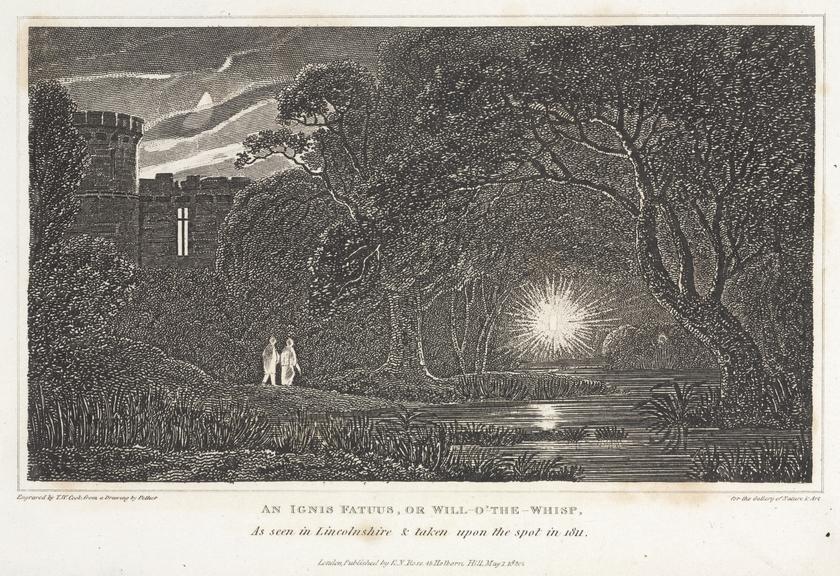
A man named Heath became a tenant of the farm and, one day whilst cutting rushes in the same meadow where the other men had been stricken, he too was taken ill and died shortly afterwards. Shaw Jnr could not confirm whether or not he had sat in the same spot as Powys and Yates prior to his demise but he does recall that Heath’s body remained flexible even as he was placed in his coffin. He adds that after each of the three men died, so one of the tree’s branches. Of course, there were theories from the locals. One was that all three had entered into some sort of trance and that they were still under it when they died. If true, it would make a strange story truly sinister as it suggests they may have been buried alive. Shaw Jnr’s own explanation was that all three contracted some sort of illness from the marshy ground at the end of the field. He had seen the will o’ th’ wisp there on several occasions and as the explanation for these eerie lights is that they are caused by the spontaneous combustion of gases, perhaps he was on to something?
I am a storyteller, not a scientist, and so I am asking any readers of this post to share their theories regarding the mystery of these three strange deaths in the Staffordshire Moorlands.
There’s folklore and there’s legendary
Sources
Newcastle-under-Lyme Times – Friday 04 October 1940
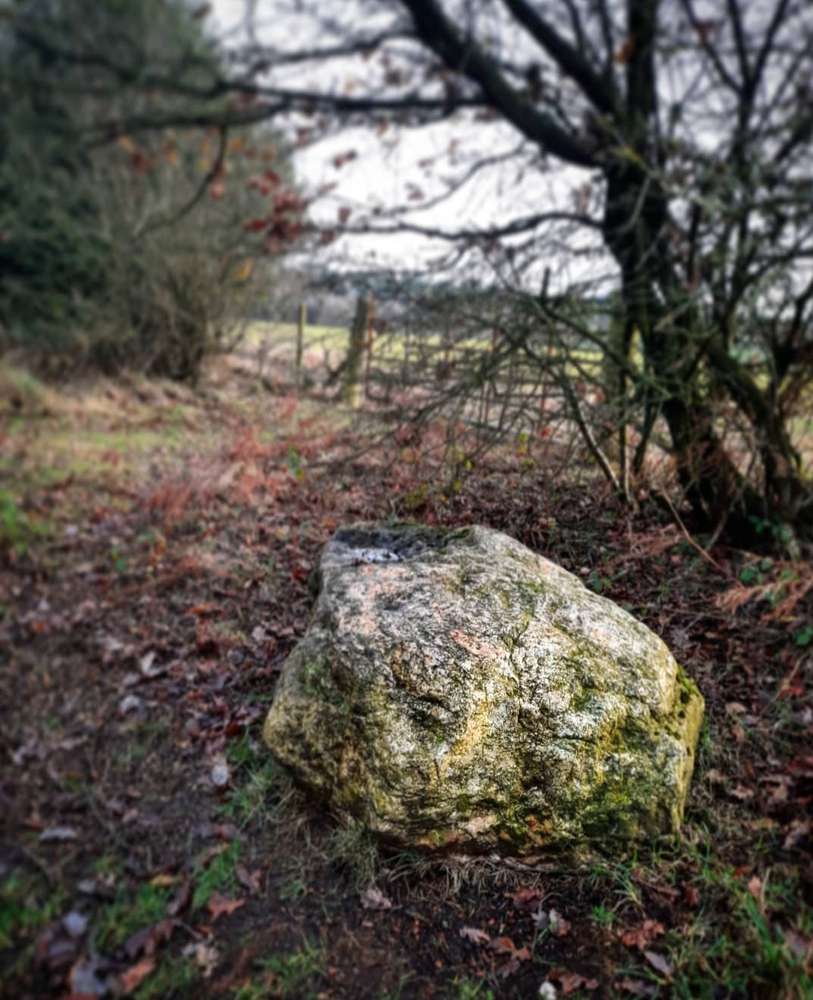
It took me a while to find the wishing stone at Pye Green and it’s taken me even longer to write up what I found about the tale behind it on here. This story appeared in an old newspaper, told to the writer by a ‘greybeard’, one of the descendants of a family of Cannock Chase foresters, and I’ve taken the liberty of retelling it in my own words.
During the English Civil War, the Wishing Stone was the place where a young soldier and one of the daughters of the Cannock Chase foresters would meet. One day the soldier was called away to fight for the King at Worcester and left his lover with a promise to return. Every day that followed, she would wait at the stone for him and those passing her on the old packhorse route known as Blake St would hear her wishing for his return. Weeks passed by and one evening, when she didn’t return home, her father went looking for her. The local women suggested he try the stone and that’s where he found her, lips no longer wishing for her soldier to return but blue and still. The local women speculated whether it was the cold or a broken heart that took her in the end. When the soldier returned and asked where he could find her, ‘her body is in Cannock churchyard’ the local women replied, ‘but her soul is at the place we now call the Wishing Stone’.
Centuries later, if you stand at the stone and listen carefully, you can hear what sounds like a voice saying ‘I wish, I wish, I wish’. It might just be the wind blowing through the trees which surround the stone but the local women will tell you otherwise.
Newton Road Rail Station opened 1837. Closed 1945
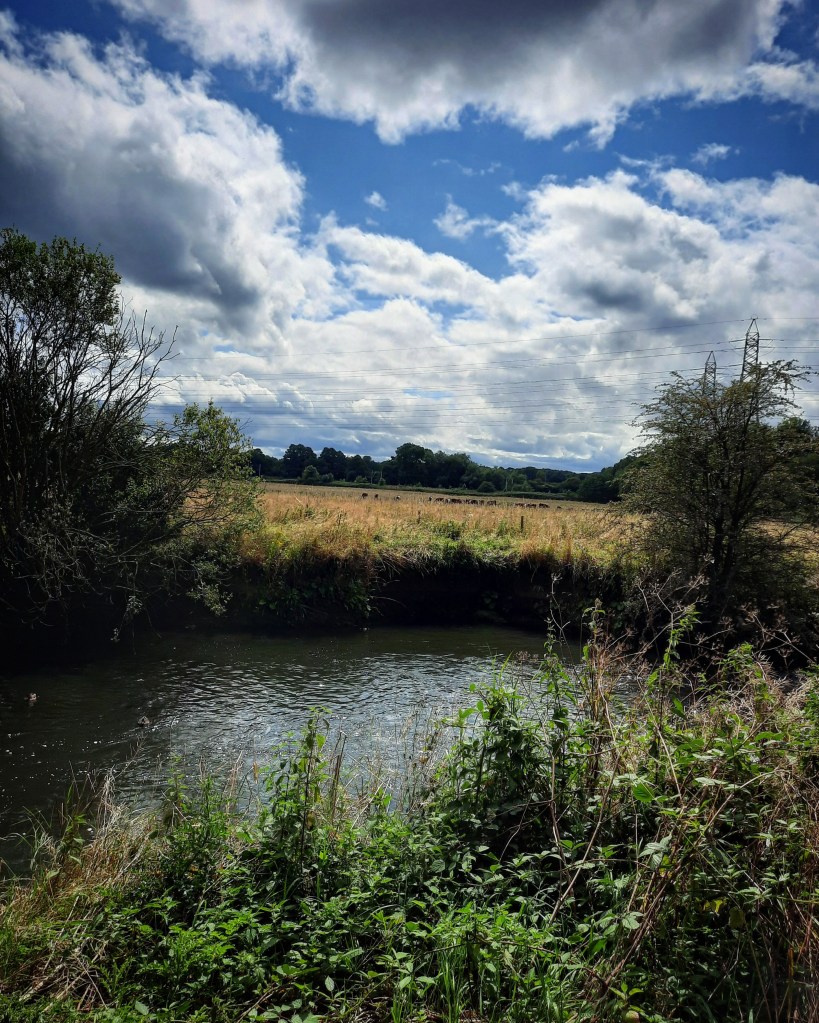
Two summers ago, I went to find another wishing stone over Walsall way (yes, I really do need to work on writing stuff up sooner). It’s described as being by a stile in a field leading to Newton Road Old Station on the London and North Western Railway. Folklore says all true lovers who step on the stone will have whatever they wish for come true in twelve months and a day. According to the author of the article in the Walsall Advertiser, you would often find love sick couples loitering around the place but all I could see was cows. I think the stone is on the opposite side of the River Tame to where I was but I wasn’t willing to wade over, even for a wish. I am hoping to go back tomorrow however, as I want to find an aqueduct with a haunted patch of grass and the ruins of the priory alongside the eponymous Sand Well. Is it a wishing well though?
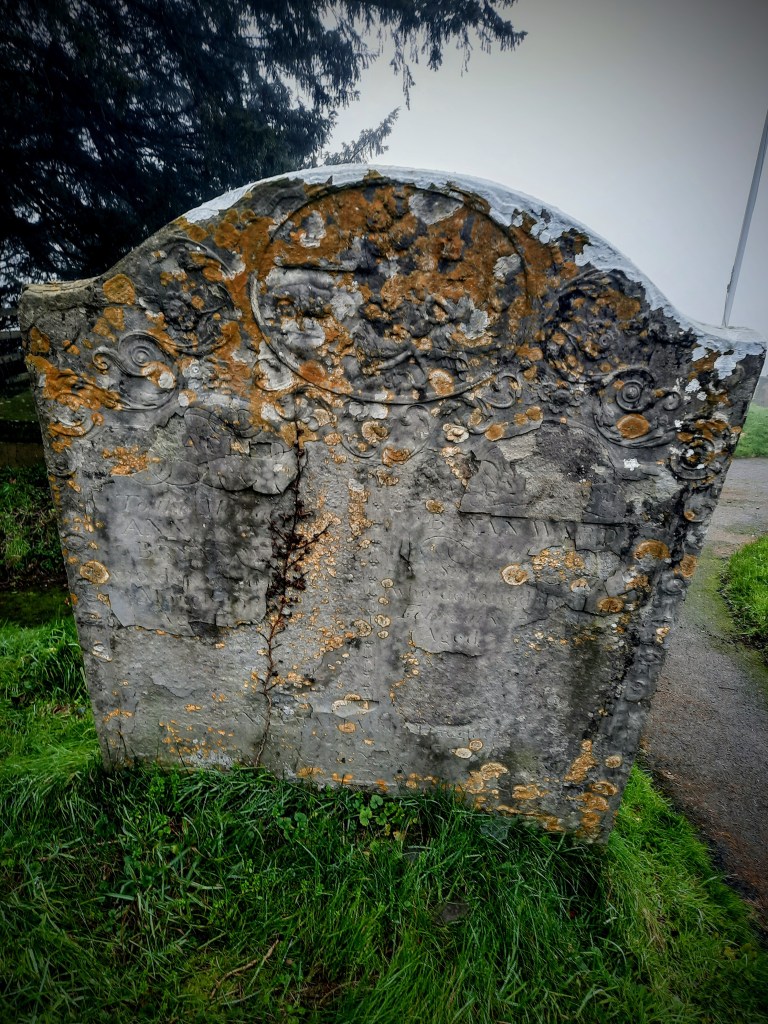
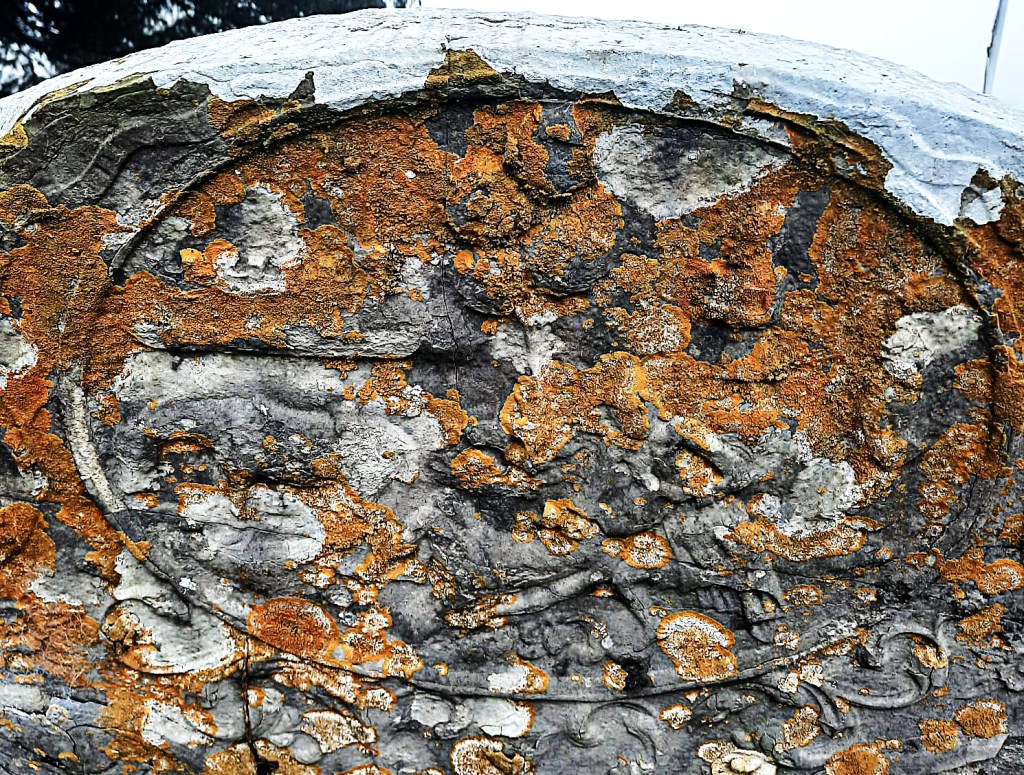
I love a tomb with a tale attached and the churchyard at Sandon delivered. An article in the Staffordshire Sentinel in December 1955, talks of, ‘a grave, said to be that of a highwayman who met his death at Sandon. Certainly the curious shape of a horse and rider on the gravestone would bear out this legend’. A misty winter’s morning, in the dead days of last December, provided the ideal conditions to seek it out and, as the fog swirled around our feet, we found it. Sadly, those curious shapes are now encrusted with lichen and much-weathered by the sixty-nine winters which have passed since the description in the Sentinel was published.
Six months on and I’m still trying to solve the mystery of the so-called highwayman’s headstone. A figure lays stricken on the floor, a man leaning over with his hand on their heart. Whether he’s trying to slay or save them isn’t obvious. To the right, two men stand look-out and at the back is a riderless horse. There’s a church in the carving but as it has a spire this can’t be Sandon, which does not. I’m describing it from a photo taken in 1965 ago which is in the Historic England collection. Unfortunately, their copyright rules don’t allow me to share it here for you to see yourself although I have contacted them to see if I can get permission.
The inscriptions on the tomb are as follows:
To the Memory of Ann the Wife of BRYAN WARD who departed this life March 19th 1807 Aged 65 Years
BRYAN WARD of Smallrice, Gent who departed this life February XX 1809 Aged 74
Anna Maria their daughter died September 15th 1797
Something else is written below the inscriptions for both Ann and Bryan but was illegible even on the 1965 photo.
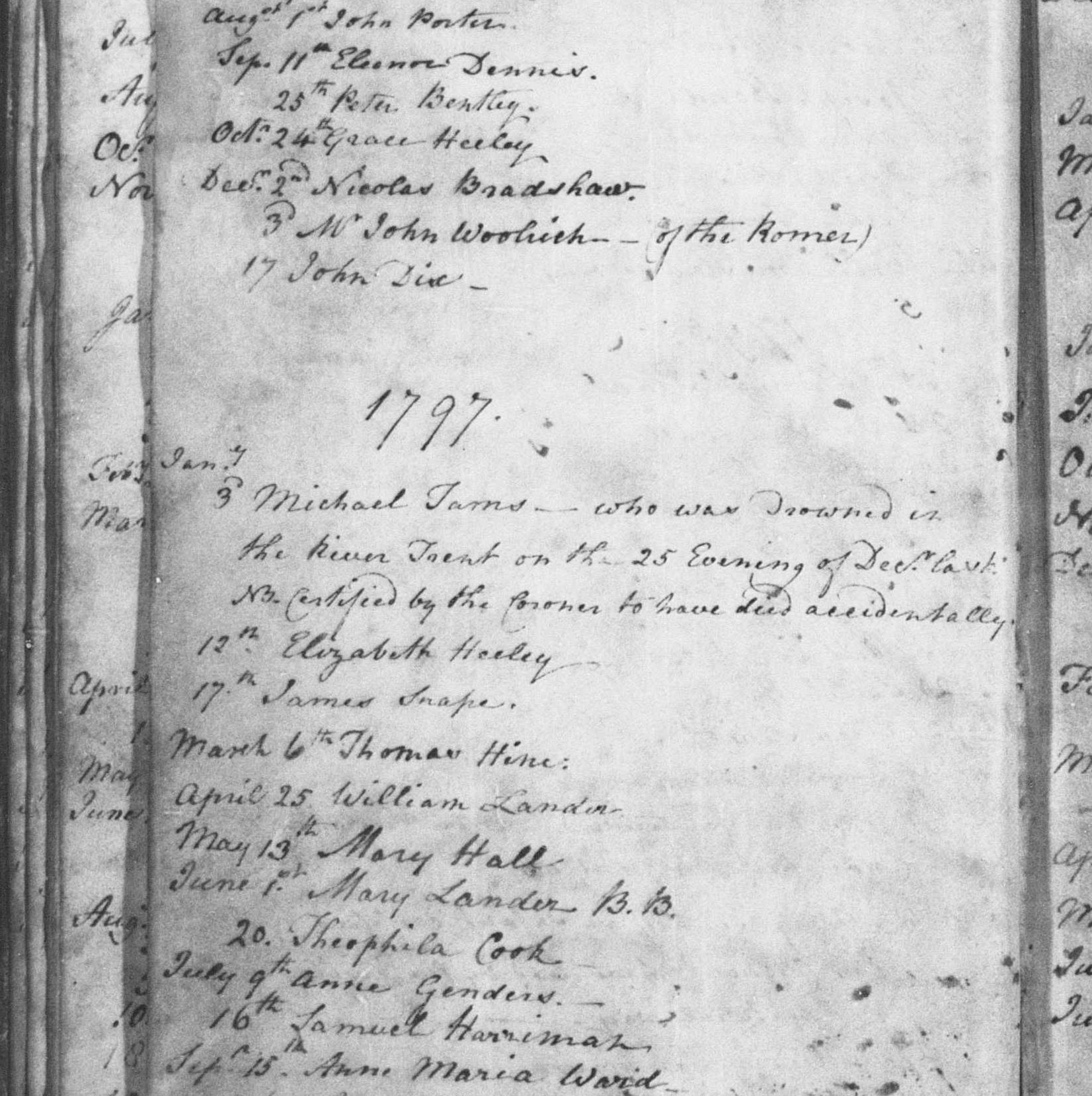
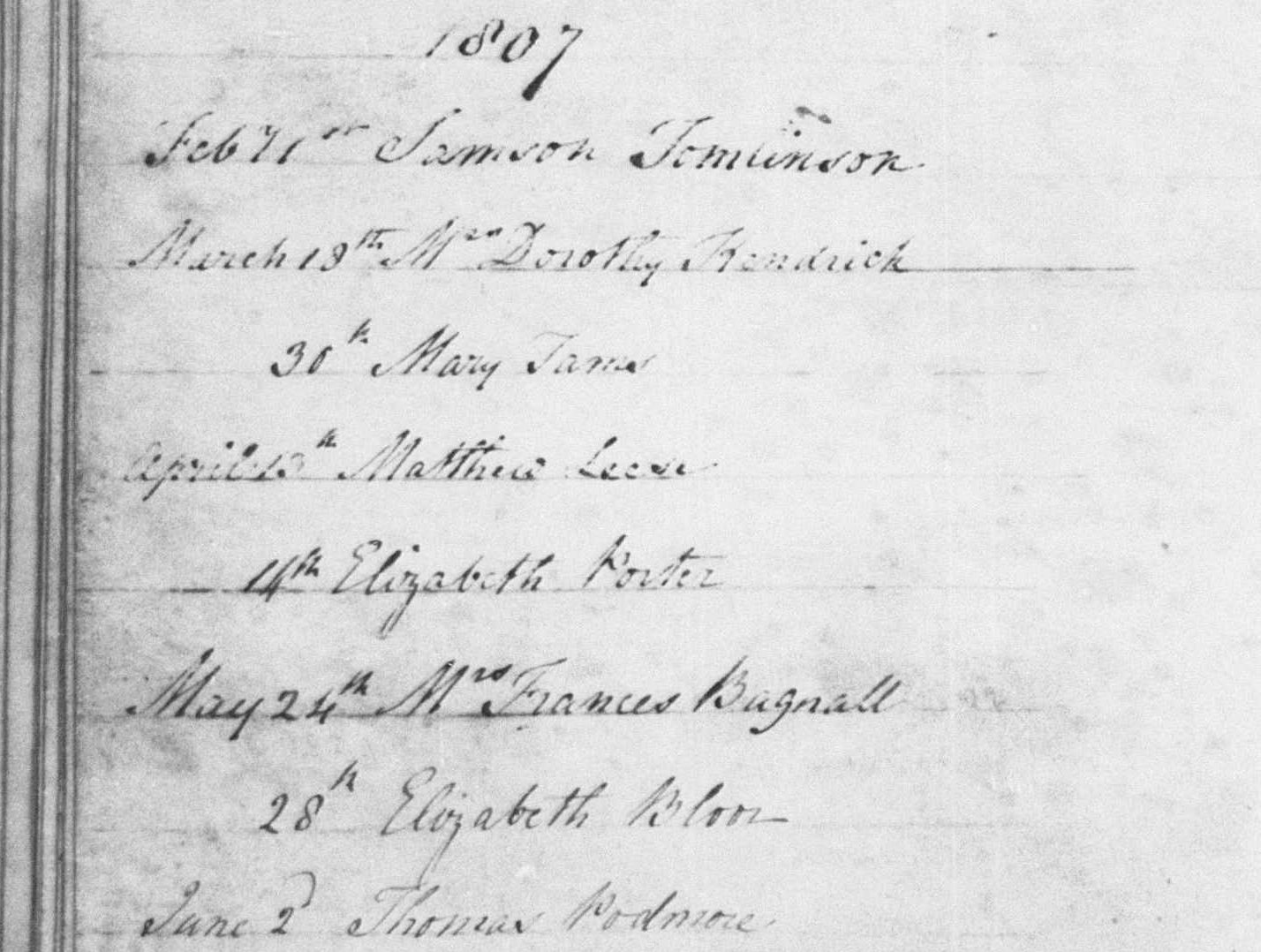
The All Saints parish register has the entries for Mr Brian Ward’s burial on 23rd February 1809 and five year old Anna Maria Ward’s burial on 15th September 1797. Neither has a note attached to suggest there was anything unusual or untoward about their deaths. I’m sure that had there been, the Vicar of Sandon would have included something as above the entry of Anna Maria’s is a record of the burial of Michael Tams supplemented to say he was drowned in the River Trent on the 25 Evening of December.
The burial record for Anne Maria Ward on 15th September 1797
What I can’t find in the Sandon register is a record of the burial of Ann Ward in 1807. In fact, I can’t find any record of her burial at all.
I’m starting to suspect that the curious carving at Sandon might depict the death of Ann Ward in someway but if she wasn’t buried beneath it here at All Saints, then where is she? Are we going to be able to solve the mystery and rewrite the local legend of The Highwayman’s Grave?
Charlotte Sophia Burne, the first woman to become president of the Folklore Society, once said of Staffordshire, ‘It is comparatively an ordinary occurrence for this or that lately deceased person to ‘come again’ after death’.
I can’t help but wonder if she’d heard of the post-mortem wanderings of Preston Moore and his father in the village of Weston, near Stafford. A book called ‘Phantasms of the Living’, contains the following account from a Mrs J Bennett written in 1882 about the eerie events of 13th April 1860.
“My daughter Annie and I had been drinking tea with the late Mrs Smith and Miss Moore, and talking about their brother Preston being very ill and not expected to recover, and were returning home in the evening when between the little wicket which opens out of the Vicarage field and Mrs Newbould’s house, we met the identical man in face, form and figure, dressed as he was always wont; slouched hat, old frock coat, open in front, knee-breeches and gaiters, with a long stick. He passed so near us that we shrank aside to make way for him. As soon as we got to Mrs Newbould’s she exclaimed, ‘So Preston Moore is dead!’, when we both exclaimed, ‘Oh no, we have just seen him!’. We found, in fact, that he had died about half an hour before he appeared to us’.
Something wicked this way comes
Mrs Bennett was adamant that it could not have been a case of mistaken identity. According to her, ‘We cannot call to mind anyone at all resembling the individual in question; his appearance, dress and gait were utterly unlike anyone else residing in or about the neighbourhood’. More intriguing details emerged during psychical researcher Eleanor Sidgwick’s interview with Mrs Bennett. There was apparently something forbidding about Preston Moore and his sister Miss Moore was also considered odd. Preston may also have had a thing for Mrs Bennett. He once bought her pansies pinched from a neighbouring gentleman’s garden and another time, cauliflowers, also illegitimately acquired. Perhaps I should have saved this story for Valentines Day? ‘Roses are red, violets are blue, here are some vegetables, I’ve stolen for you. Violets are blue, roses are red, I’ll still be around, even after I’m dead’.
A lovely pub. We will definitely come again.
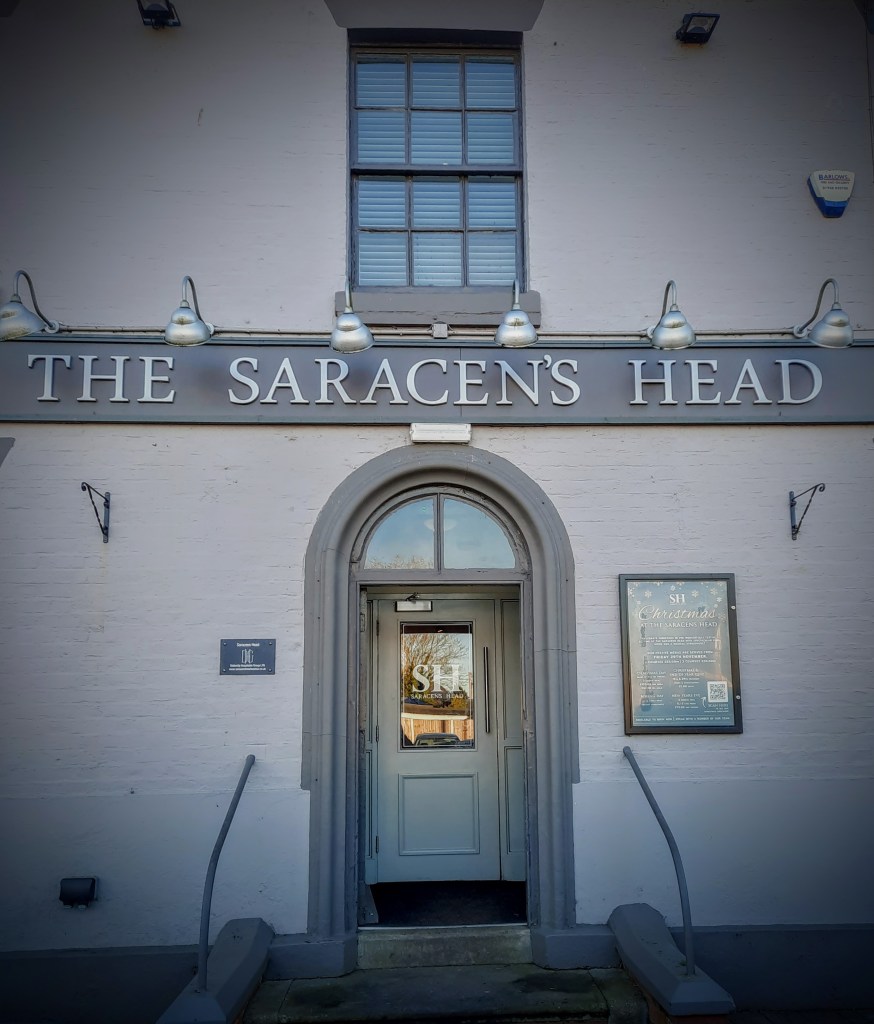
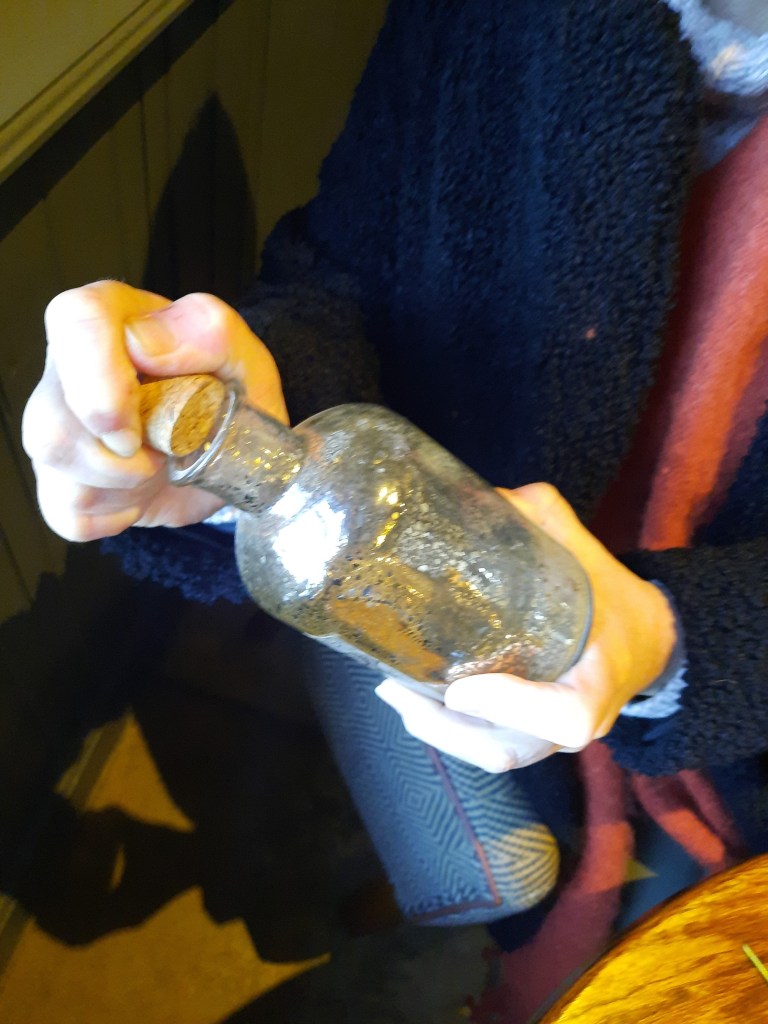
The story as it stands is strange enough but reader, there is a twist in this tale of a dead man walking. An article in the Staffordshire Advertiser in 1901 claims that Preston Moore was not the first of his family to ‘come again’ after his death. There was a legend in the local area that his father’s shade had roamed up and down the road between Stowe and Weston, until locals decided it had had enough exercise and it was time to exorcise this restless spirit. It was laid in a bottle and bricked up in the cellar of the Saracen’s Head Inn to remain there, ‘whilst holly and ivy are green’. It seems that during his life Mr Moore senior may have been the landlord at the inn making the real horror here the idea of being trapped in your workplace for eternity.
She wouldn’t let it lie!
Obviously my good friend Jacky and I went to investigate, by which I mean we popped into the pub for a coffee and pretended we’d found the bottle containing the spirit of Mr Moore on a shelf nearby where we sitting. I am convinced there’s more to be found out about the mysterious Moore family which may explain why the family seem to have been at the centre of village superstition. In the meantime, if you work at the pub, would you pop into the cellar and see if you can find where the old landlord lies? We should have asked but we didn’t have the bottle…
Sources
Staffordshire Folk and the Lore, Charlotte Sophia Burne
Phantasms of the Living, Edmund Gurney, FWH Myers and Frank Podmore
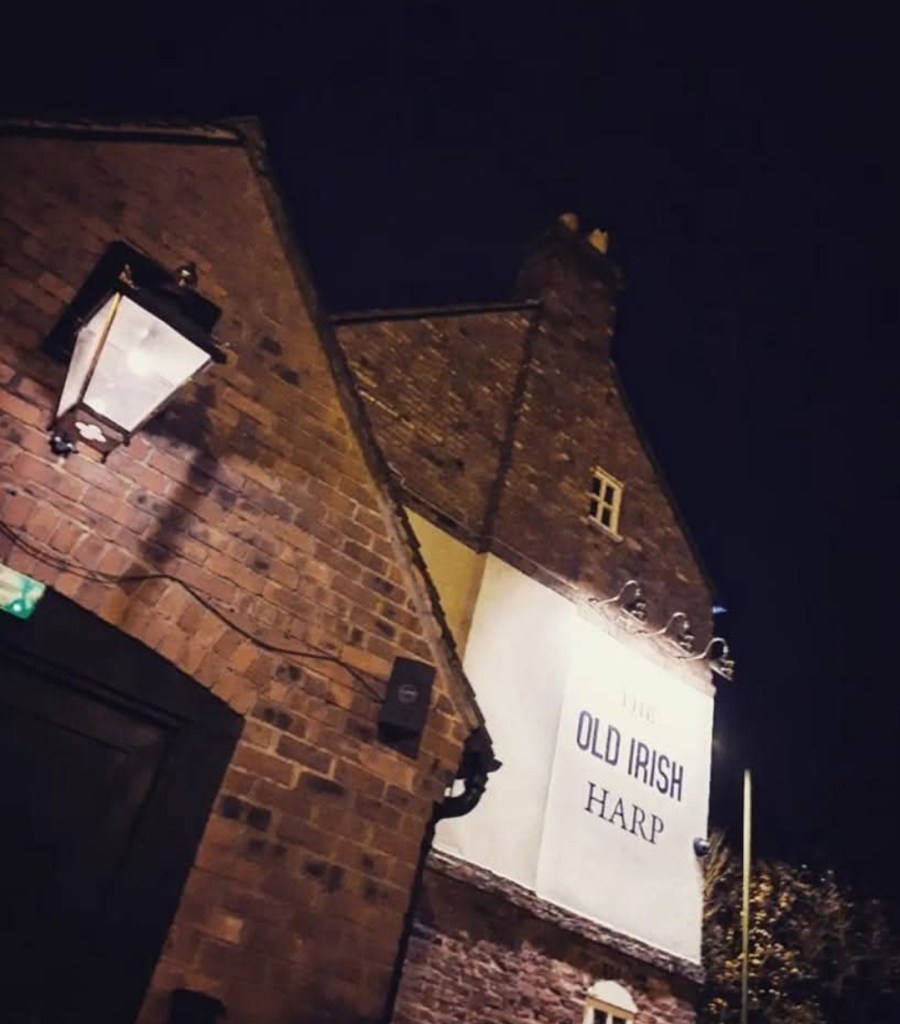
I feared from the looks on my family’s faces that my interest in the macabre may have gone too far when I happened to mention during a meal at the Old Irish Harp that an inquest on the body of a genteelly dressed woman found ‘wilfully murdered’ in a wood near Sutton Coldfield had taken place not far from where we were sat, albeit 250 years prior. I thought perhaps it was time to find a different hobby. Embroidery perhaps? A pleasant pastime for sure, but turns out that for me it’s no substitute for finding and sharing a ripping yarn. And now that we’ve established that I am beyond all redemption, I want to regale you with a post about crime and punishment on the mean streets of Staffordshire.
Back when the inquest took place it was just known as the ‘Irish Harp’.
On the evening of 26th October 1764, a little after 8 o’clock in the evening, Mr Thomas Hurdman of Alrewas was stopped by a footpad opposite St Michael’s churchyard. The Aris’s Birmingham Gazette cryptically reported the rogue was suspected to be a W_____ C_____ of Greenhill. I’m not sure why such nominal secrecy though, when they also published a description of him in the same report (not yet 20, about 5 feet 5 inches high, wide mouthed and wearing his own hair, if not altered, which was brown and short cut’). Despite being caught by one of the city’s constables, WC managed to quite literally give him the slip by sliding out of his coat, and legging it out of Lichfield in a linen frock. His freedom (and any semblance of anonymity) was short-lived however. In March the following year, newspaper reports reveal that the ID of WC was William Cobb and that he’d been sentenced by the High Steward of Lichfield, Fettiplace Nott, to be transported for his assault on Thomas Hurdman and making many violent threats of murder.
St Michael’s Lichfield is the graveyard for some who went to the gallows
Ashmoor Brook, up Cross in Hand Lane, was the scene of another robbery which went awry. In Lichfield March 1833, a notorious local character known as Crib Meacham, a name apparently derived from his success in various pugilistic encounters, was charged with robbing a Mr Lees of Stoneywell. According to Lees, Meacham was one of a gang of four who attacked him and his wife. The pair were in possession of a large sum of money but it was Mrs Lees who was holding the purse strings at the time and the thieves had allowed her to run away. She soon returned with assistance and it was the robbers turn to run, leaving a gagged Mr Lees unharmed but relieved of his relatively empty purse and hat. Meacham was arrested later that evening but as of yet, I cannot tell you anymore about him, neither the fights which earned him his nickname in the past nor the fate he earned from his part in the robbery.
Cross in Hand Lane is only just outside Lichfield but must have felt like the back of beyond travelling through here after dark
I can tell, however, tell you much more about Robert Lander aka Bradbury a cordwainer of Milford near Stafford who robbed Solomon Barnett, a wax chandler of Liverpool in March 1798. The newspaper reports at the time give not only a physical description (Lander was a stout built man, 5ft 5 inches, 25 years of age wearing a blue coat, a striped fancy coloured waistcoat, and thickest breeches, torn upon the left thigh and patched upon both the knees). It also gives his villain origin story, starting at his childhood home of Haywood near Stafford. When his Dad died, he inherited a few hundred pounds. At the age of 21 he got turned down for a job at the Board of Excise and so went to work for a gentleman in the wine and spirit trade instead. This, it seems, may have been the start of his downfall. During his employment he is said to have remained in a permanent state of intoxication, eventually absconding and taking with him a watch belonging to his master. He sold it at Stafford where he enlisted into a Regiment of Foot but ended up, somewhat ironically, in the shoe making business. This didn’t last long either and neither did his subsequent enlistment into four other regiments. His career in crime also came to an abrupt end when he was found guilty of the robbery of Solomon Barnett and sentenced to death at the Stafford Assize. When the judge prayed that the Lord would have mercy on his soul, it was reported Lander replied, ‘G__d d___n you and the gallows too. I care for neither’. I assume he said it in full but that his blasphemy was censored by the Chester Chronicle. He was executed in August 1798 and the parish register of St Mary’s Stafford records that, along with Edward Kidson, Robert Lander alias Bradbury was executed _ _ _ _ _ _ _.
These are all true crime stories, but it would’t be Lichfield Lore without a bit of folklore would it folks? You’ll be relieved to know I’m not going to go down the Turpin turnpike road but I am going to give a dishonorable mention to Tom ‘Artful’ Arnott, a highwayman who was supposedly executed, gibbeted and, eventually, buried at this crossroads in Cannock.
Although Arnott’s grave is marked on old maps there are no records of anyone of that name ever being executed. Intriguingly though, there is a record of a Thomas Arnott being buried on 1st September 1777 at St Luke’s in Cannock. Clearly a man can’t be buried in two places at once but it’s the right kind of era and area. Then there’s a Thomas Arnott mentioned in Aris’s Birmingham Gazette in October 1792 for absconding from his master’s service in Birmingham. Intriguingly, after given a description of him (35 years old, five feet five inches, marked with the Small Pox, dark lank hair, and lightly made, wearing a blue coat), it mentions that prior to his work as a stamp, press, lathe and die maker, he had been employed as a forger. Do they mean the criminal variety and if so, does this strengthen the case for him being our Tom? Just to add an extra layer of intrigue, there was yet another absconding Thomas Arnott, who was apprenticed to a Whitesmith in Worcester but ran away on 5th April 1803. He’s described as 5 feet two inches, black curled hair, wearing a blue coat with yellow buttons, a green striped cashmere waistcoat with yellow buttons and dark velveteen breeches. In that outfit, if he did become a highwayman, he’d have been a very dandy one indeed. Could any of these be the legendary Arnott? Did he even exist in the first place? All I do know is that this story is one T__B__C__________.
Arnott’s Grave. Unless it turns out to be at St Luke’s Cannock.
Sources Aris’s Birmingham Gazette 5th November 1764
It’s Sunday and it’s Spooky Season (or October as we used to call it) and so hey presto, I’ve written a post about unorthodox burials in this old city where magic may have been involved. I think you’ll like this. Not a lot, but you’ll like it (kids, ask your parents).
As a point of reference and, just to show I don’t just completely conjure things up, there’s a great paper by Roberta Gilchrist, which deals with the archaeology of magic in medieval burials. It outlines the norm for Christian interments at that time as being a body wrapped in a shroud and lacking a coffin, personal items and grave goods and also explains that around two percent of excavated burials are exceptional to this. Excitingly but perhaps unsurprisingly, it turns out that some of these intriguing inhumations have turned up in the Field of the Dead (or Lichfield as the authorities insist on calling it).
Lichfield Friary looking over to where bones were found below Bird Street
Amongst the fourteen burials found beneath what’s now the beer garden of the Brewhouse and Kitchen on Bird Street were the remains of three females, including a woman who lived in the mid-fourteenth century, described by archaeologist Mark Neal as being quite elderly and in poor health. The discovery of so many skeletons here suggests it was the location of the cemetery for Lichfield’s Fransican Friary and the presence of women raises some interesting questions about who was allowed to be buried here and what their role may have been. Most puzzling of all however was the discovery of a body found with a 2mm thick layer of charcoal beneath it. Research shows that such burials are mostly associated with people of note in the early medieval period and predate the founding of the Friary in 1230. Was this the site of a high status Saxon buried before the Franscicans arrived? It is of course possible that this funerary ritual was continued beyond the Saxon period here in Lichfield but could we be looking at a site with a history stretching back further than we thought? The history of the Grey Friars site suddenly seems very grey indeed…
The other burning question is of course, what was the significance of the charcoal? There are some intriguing possibilities ranging from the practical, where the charcoal layer was a way of absorbing bodily fluids during putrefaction, to some sort of post-humous purification ritual designed to save the soul after a life of sin and to stop the dead from returning to haunt the living. I don’t think I’ll ever look at a barbecue in quite the same way again.
Lichfield Cathedral. Pure magic.
Five further charcoal burials were found during excavations at Lichfield Cathedral, one of them inside a stone structure believed to have been part of the original Saxon church. One of those burials was that of a priest buried with something variously described as a hazel wand, rod or staff, as well as a cross of twigs, a chalice and patten and a eucharistic wafer. Yes the symbolism is strong with this one. Several theories exist regarding the presence of the wooden wand, including it being provided for protection as the priest made his final journey through the valley of the shadow of death. Perhaps the most peculiar burial here is that of a priest in an 11th century stone coffin which had an opening directly over where the mouth would be positioned. It’s been interpreted as a libation tube, where the living could make offerings of food and drink to their dead relative. It’s a pagan practice mostly associated with the Romans, and as yet, no-one has come up with a satisfying explanation for it being present in a place of Christian worship.
There are also an incredible 49 burials recorded at the Cathedral where white quartz stones have been found inside graves, and even clutched in the hands of the occupants. Again, the exact symbolism of these is unknown, but archaeologist Warwick Rodwell suggested the answer may lie in Revelation 2:17. This is a passage of the New Testament where a white stone with a new name written on it is given by Christ to his followers as symbol of forgiveness and an invitation to the afterlife. I think. It seems to make sense until you realise that people were incorporating these white pebbles into their funerary rituals long before Christianity existed. As we are on the subject of magic, can we also take a moment to appreciate that John who presents the video I’ve linked to looks like he might be an actual wizard.
St Michael’s on Greenhill is a place of many mysteries
A seemingly more recent, but no less bemusing burial was unearthed at St Michaels on Greenhill in 1852. Two gravediggers dug up the rotten fragments of an elm coffin and found that buried with the bones inside it was a bottle filled with a liquid believed to be urine. It has the feel of folk magic to me, particularly as in 2021, a similar discovery was made at the Trinity Burial Ground in Hull. We know that witch bottles were used to protect people from harm and that examples have been found buried in the foundations of buildings. Was this something similar, designed to protect the grave from robbers perhaps, or other less earthly threats? Or was it just a final drink for the coffin’s inhabitant to enjoy on their way to wherever they were headed to next?
I make no apologies for asking so many questions and being unable to answer any of them in this post. Time and time again, through writing this blog and being part of the Lichfield Discovered team, I realise that there is still so much to be uncovered and understood about the incredible history of this city. And for me? Well, that’s magic.
Sources: Lichfield Mercury 5th January 1990
1 Bird Street, Lichfield Report on a watching brief, Marches Archaeology Series 103, November 103
Charcoal Burial in Early Medieval England, James Holloway (2009)
Gilchrist, R. ORCID: https://orcid.org/0000-0002-1967-2558 (2008) Magic for the dead? The archaeology of magic in later medieval burials. Medieval Archaeology, 52. pp. 119-159
Jonsson, Kristina. “Burial Rods and Charcoal Graves: New Light on Old Burial Practices.” Viking and Medieval Scandinavia 3 (2007): 43–73. Web.
Community and Belief: the Development of Anglo-Saxon Christian Burial Practice, AD 700-1066, Alexandra Aversa Sheldon (2018)
I’m not organised enough to do an ‘On this day in history…’ type post and so I’ve just missed the 565th anniversary of the Battle of Blore Heath. However, as I know a couple of good stories about it, here’s an ‘on this Monday just gone in history’ post instead.
The tales take place away from the blood and gore of the battlefield, a mile up the road at Mucklestone, the most westerly parish in Staffordshire. Its name may derive from the OE ‘micel’ meaning large and ‘stan’ meaning stone and it seems likely this is linked to the presence of two monoliths known as the Devil’s Ring and Finger. Satan’s stones are believed to have originally been part of a chambered tomb and the ‘ring’ stone has a porthole, apparently large enough for a person to climb through, or be passed through. Some say to do so increases fertility. Having been erroneously told that several gaps on a traumatic caving expedition were big enough to get these child-bearing hips through, I’ll stick to two kids and a small amount of dignity thank you. Talking of children, there was also a belief that passing them through the circle several times would cure them of any ailments, which seems like a strangely wholesome thing for the devil to do. Much more in keeping with the name is the local legend that the stones mysteriously appeared at the spot after a girl was murdered here.
Queen Margaret of Anjou is said to have watched the Battle of Blore Heath from the church tower at Mucklestone. On seeing the standard of her Lancastrian commander Lord Audley fall (a cross marks the spot where he was slain), the queen knew defeat by the Yorkist army was imminent. In a fit of rage and frustration, she is said to have stamped her feet so hard that her footprints remained on the stone floor of the tower long after she fled to safety. This sounds preposterous I know but I do have a theory about this. The outline of shoes are often found carved into church roofs (I’ve yet to find a satisfactory explanation as to why) and if there was such graffiti on the church roof at St Mary’s in Mucklestone, someone may have decided that it fitted into the story very nicely. Obviously, if I’d got in touch with someone at the church to ask them if such graffiti existed to back up my theory that would have bee useful, but yeah, that thing about being organised…
Mucklestone church tower
The most well known element of the legend is that Margaret’s escape was aided by local blacksmith William Skelhorn who was ordered to reverse the shoes of the queen’s horse in an attempt to fool those who attempted to follow. His reward was to be beheaded on his own anvil, which can be found in the churchyard opposite the site of the smithy. Whether the execution was carried out on the orders of the queen to ensure Skelhorn’s silence, or by her enemies, as punishment for assisting her, depends on who is telling the story.
A 19th century forgery by the parish clerk?
It’s not the only instance of the old horseshoes-on-backwards-to-disguise-your-tracks ruse to be found. Amongst others, Robert the Bruce supposedly did it to escape from London after being betrayed there (with tracks going in the opposite direction to Scotland, presumably). Logically and practically it seems an unlikely tactic for Queen Margaret or anyone else to use, and is crying out for someone to do a myth-busting style experiment. I’ll volunteer to dress up as the queen and get on a horse if necessary. I’d look great in a crown and I’ve been pony trekking. Twice.
The thing about myths and legends is that it’s relatively easy to bust them if you try. Once this happens, there are several different ways to go. Either ignore the evidence and keep telling it anyway because why ruin a good story with facts. Dismiss it as a lot of nonsense and as having no value whatsoever. Or sit yourself comfortably somewhere between the two positions, enjoying it as a story in its own right but also exploring where it came from and why, who told it and if any nuggets of truth are actually contained within. The same themes and events turn up in our folklore time after time.
As with the horseshoe part of the myth, echoes of other aspects of the Mucklestone story can also be heard elsewhere. Over at Stoke Golding, in Leicestershire, local tradition has it that the villagers climbed onto the battlements of the church of St Margaret to watch the Battle of Bosworth on 22 August 1485, and later watched the Tudor King’s coronation at Crown Hill. Did someone draw on these stories and create one to put Mucklestone on the map? Could someone like William Skelhorn, directly descended from and carrying on the same trade as his 15th century ancestor and a parish clerk in the mid-19th century have forged his family into history? Not too far-rier fetched is it?





 Lichfield Lore