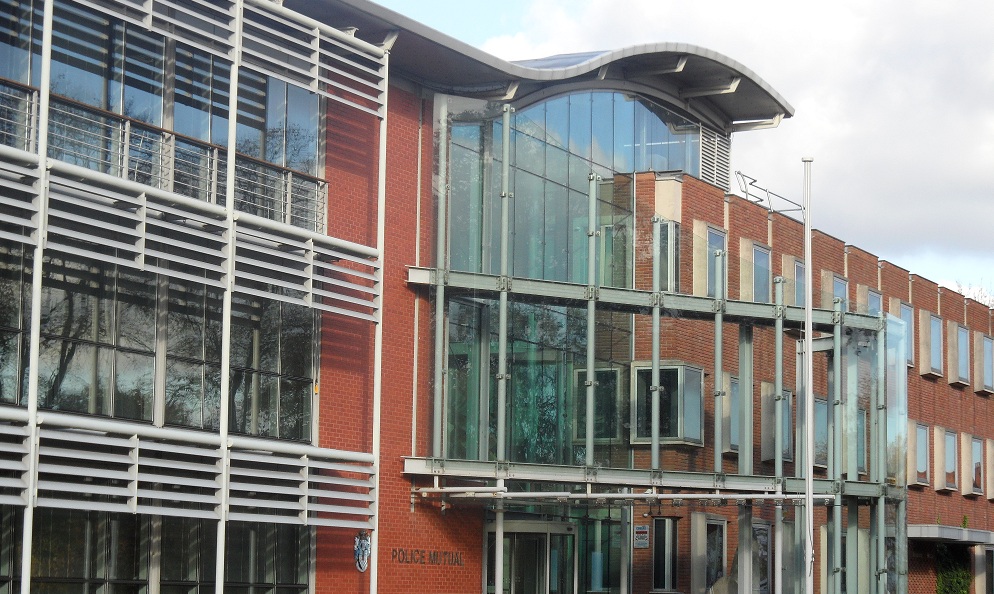
Standing Stones

Police Mutual is on my route into central Lichfield. It’s also our spec for watching the Bower procession (from where my parents always tut about the Festival Gardens being used as a car park, but I digress…..).

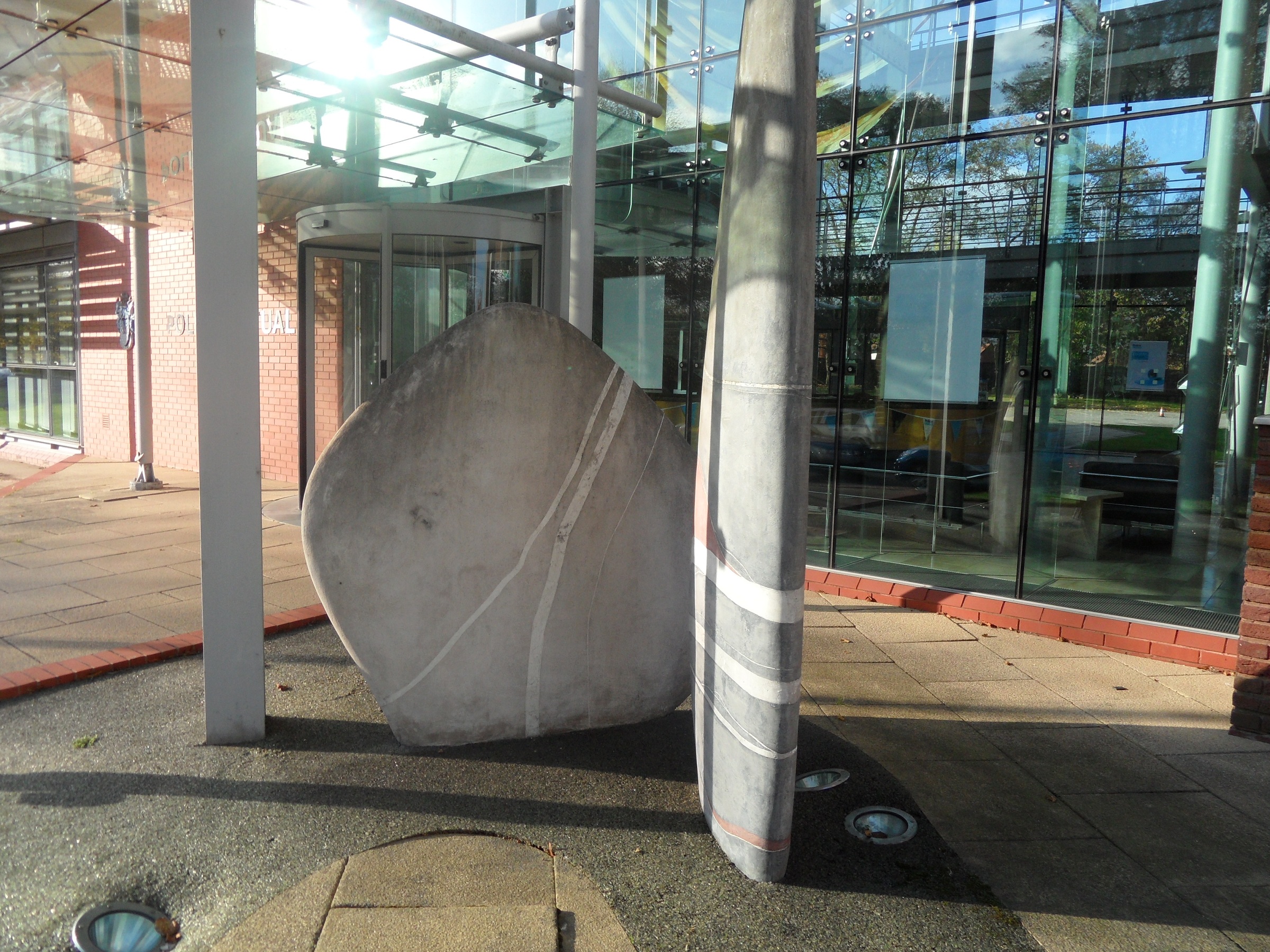
I always think of the sea when I look at the sculpture in the entrance. However, I’ve never gone up to the front door for a closer look. So whilst out for a walk on a Sunday, with the office closed, I decided to have a peep through the glass doors.

Standing Stones – Please DO NOT attempt to skim these across Minster Pool

On reflection it was probably a you had to be there moment, but at the time I was delighted to discover the stones weren’t actually behind glass. “They’re are outside! Look!”, I yelled to an unenthusiatic Mr G. I walked around the stones a couple of times, because I could! It’s fast becoming something of a cliche, but once again I found myself thinking, “All the times I’ve walked past here & I didn’t know!”. On my third or fourth lap, a man walking past gave me a bemused look (possibly thinking I’d come straight from the Queens Head) and Mr G was trying to shuffle off in the direction of Greggs. As there was no further clue to what the stones represented or their purpose,  I took a photo and followed.

Back home, I discovered that the sculpture is called ‘Standing Stones’, and is an abstract in glass fibre reinforced concrete, designed by Marcus Hole in 2000.  And the sea connection? Well,  they are supposed to be larger versions of the water-smoothed pebbles that, if you’re anything like me, you pick up on the beach for closer examination. Go and have a look at the giant Lichfield ones & see what you think….they’re outside you know!

As always, one thing leads to another, and it got me thinking more about public sculpture & art. I believe the most recent in Lichfield,  is said to be the “Formation of Poetry”, by Peter Walker (who coincidentally shares the name with the author of the PMAS book!). It was commissioned to celebrate Dr Johnson’s Tercentenary and can be found in the Tesco carpark.

The Formation of Poetry

Intriguingly though, Pat has told me about an artwork commissioned to celebrate the millenium in Lichfield, that seems to have disappeared. It looks like an angel and answers to the name ‘Vision & Youth’. Perhaps a bit of detective work is needed, which is quite appropriate as it was the Police Mutual book which started all this off 😉

Sources:

Public Sculpture of Staffordshire & the Black Country – George T Noszlopy & Fiona Waterhouse

http://www.malvern-net.co.uk/mal-net/m_biznes/carlytinkler/news/2000_12.htm

http://52weeksofart.com/main.php/2010/11/21/the-formation-of-poetry-model

Mutual Interest

Pat (who knows so much about Lichfield, that I think he should start his own blog!) was on holiday in Wales when he spotted a book about Lichfield’s very own Police Mutual Assurance Society (PMAS). The history of the friendly society was written by Peter N Walker, whose ‘Constable’ books published under the pen name Nicholas Rhea were made into the Heartbeat series. Pat very generously bought the book in the hope that it would be of interest, which it certainly has been.

PMAS, founded in 1866 is one of Lichfield’s biggest employers. The HQ, was built on former gasworks on Queen St by the Linford group, which up until its collapse in October this year was also one of Lichfield’s largest employers. Work started on the site in 1969, after the society outgrew its premises in Greenfield Crescent, Edgbaston, Birmingham where it had been since 1954.

The original part of the building was opened in 1970.

The orginal part of the building was opened in March 1970 by Princess Alexandra.  According to the Mercury, not many people knew that the building was to be called ‘Alexandra House’ until the princess arrived. Possibly today, not many people know why it’s called ‘Alexandra House’. However, on that cold spring day in Lichfield, there was much excitement about the Royal Visit from Princess Happiness as the Lichfield Mercury  christened her (which to be fair is catchier than her full title Her Royal Highness Princess Alexandra Helen Elizabeth Olga Christabel, The Honourable Lady Ogilvy, Royal Lady of the Most Noble Order of the Garter, Dame Grand Cross of the Royal Victorian Order). There was a band from the Junior Soldiers Company of Whittington Barracks, a marquee erected behind the new building and 2,000 cheering school children (who would be round about 50 now? Wonder if anyone remembers it?).

The building won praise from Lichfield Civic Society who crowned it ‘Best New Building’ 1972 saying the bold design had produced a building which invited entry and which looks as if something is happening inside. I think that’s interesting because I think that this kind of architecture is the kind most people would turn their noses up at today….
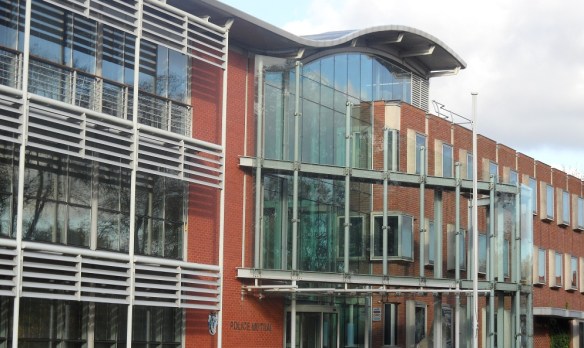
PMAS HQ was extended in 1990 & 2000

The PMAS HQ was extended in 1990 and again in 2000.  In 1990, originals from the Ladybird book ‘The Policeman’ were acquired and hung in the boardroom.

Mr Fabricant, MP for Lichfield,  once said in an interview with the Mercury, “I believe one of the most interesting modern buildings in the region is the Police Mutual building in Queen Street in Lichfield. Its modern extension is elegant and blends in well with its surroundings”.   I have to agree.  What will people think of it in years to come though?

So following on from this I’ve had a few rambling thoughts for another day….
I’m not ready to explore this just yet but at some point, I really would like to consider this idea of ‘future heritage’ and how opinions will shift on what is and what isn’t valuable & attractive.  Also, even if it isn’t ancient, pretty, haunted or associated with a famous inhabitant, I do think the history of anywhere people come together, like a workplace, is really important. Another interesting idea to explore is the impact of a workplace on a community? For example, when PMAS moved to Lichfield in 1954, many people apparently sold up in Brum & moved nearer to the new HQ. Also, how has the closure of Linford affected the city? I saw on twitter the other day that Wolverhampton Archives currently have an interesting project about local businesses in that area called ‘Taking Account of our Past’, which is definitely worth a look.

As ever, if any one has any thoughts, questions or comments on any of the above, I’d love to hear them 🙂 I do have a little bit more to add on PMAS HQ in relation to the stones at the entrance, which always remind me of the sea…..

Sources:

The Story of the Police Mutual Assurance Society by Peter N Walker
 

Fruit & Nut

Following on from the apple tree & walnut tree post, Pat (someone who makes a fantastic contribution to this blog via his comments & in other ways), got in touch to say that he knew of an almond tree in Lichfield.

I admit that I don’t know much about thses things, but to me that seems unusual. I associate almonds with warmer climates and so I didn’t expect one to be growing near to the Friary car park. However, there it was, boughs laden. With a lemon tree also growing nearby, perhaps this part of Lichfield has a mediterranean micro-climate?!

Something that I didn’t know until today was that almonds, are not true nuts, but are part of the ‘prunus’ family, together with apricots, cherries & peaches. The edible part of almonds is the seed, but only for the sweet variety. As Pat pointed out these almonds are likely to be wild, bitter almonds and therefore contain cyanide!   So, don’t get picking them to grind up into your Bakewell Tart …

Many thanks to Pat, for sharing this information.

Meripilus Giganteus & Wealhhnutu

Lorna from the Monks Walk Group has been in touch to say that unfortunately the beech tree in the gardens has been lost due to the Meripilus Giganteus fungus. The good news is that Staffordshire County Council is providing a walnut tree as a replacement.


I don’t know much about fungi or walnuts, so I did a quick bit of research. Apparently, Meripilus Gigantus also known as Giant Polypore is a common cause of death for mature beech trees. It seems we can’t even get our revenge on this fungus by eating it as, although not poisonous, it doesn’t taste particularly good.  However, it is sometimes eaten by mistake as it looks like the Hen of the Woods, which is a tasty, edible fungus (and very good in risotto according to Morgan from Walsall Wildlife!).

In one of my all time favourite books, ‘England in Particular’, the entry for walnuts tells us that the trees were originally brought to Britain by the Romans (the Old English was wealhhnutu which means ‘foreign nut’)and amongst other places were planted in monastery gardens, so it seems that Staffordshire County Council have made an appropriate choice!

A huge walnut wood was planted to the north-east of Ashby de la Zouch around 10 years ago. Jaguar Lount wood is the largest plantation of walnut trees in Britain and as you might guess from the name, the project was sponsored by Jaguar Cars and it includes an area where they are researching the the growth of different varieties for timber and for their nuts. You can see the Forestry Commission leaflet here.

Of course, it probably goes without saying that perhaps most importantly of all, walnuts are a crucial ingredient in Walnut Whips. Much tastier than Meripilus Gigantus.

Sources:
England in Particular – Sue Clifford & Angela King

Can I borrow £18k please?

Ian, who often makes a great contribution to this blog via the comments section,  has spotted something intriguing on ebay.

For £18,000 you can buy a statue of a prophet, said to originally be from Lichfield Cathedral.

The statue's orginal home?

Get your bid in here! http://www.ebay.co.uk/itm/Stone-Sculpture-Lichfield-Cathedral-statue-/350449588131?pt=UK_Antiques_Architecural_RL&hash=item51986c57a3

So of course, I want to know the story of the statue and my initial thoughts & questions are:

It was discovered 3 miles from Lichfield – I wonder where?

Who took it there and why?

I’m a bit confused by ‘dates to 1650’. Do they mean the statue was sculpted at this time, or comes from the Cathedral of this time?

Are there any other parts of the ‘old’ Cathedral anywhere else? For example, we know that most of the damaged statues on the West Front were taken down in 1744/1749.(1) What happened to them all?

Can anyone lend me £18,000 as I think this would look great in my garden?

Huge thanks to Ian for this great spot and it would be great to hear any theories anyone has about this prophet.


Sources:

(1)  ‘Lichfield: The cathedral’, A History of the County of Stafford: Volume 14: Lichfield (1990), pp. 47-57. URL: http://www.british-history.ac.uk/report.aspx?compid=42342  Date accessed: 03 November 2011.


Malus John Downie

I’ve been going on about the Elford Pippin since before the summer, but a few days ago I noticed this at the Friary by the Festival Gardens in Lichfield.

First raised in Whittington in 1875

Another local apple. Unlike the Elford Pippin this one is still around. Actually, I looked for its ‘rich, orange red fruits’ today (it’s in season in October) but I couldn’t find any evidence of the tree at the Festival Gardens. However,  you can still buy it from all good tree shops! It was apparently raised by a Mr E Holmes at Whittington & was named after his friend and fellow nurseryman John Downie.  I hear that the apples are the finest of all crabs – good to eat when ripe and make an excellent jelly.

It seems quite an appropriate day to do this post, as there is an association between apples & Halloween. Along with apple bobbing, I can also remember being told that if I peeled an apple and threw the peel over my shoulder it would show me the initial of who I’d marry. I seem to recall doing this several times over until I got the initial I wanted…..There was something about sticking apple pips to your face as well!

I had thought aboutdoing a post about spooky goings on in the area, mainly because I wanted to do a post with the title ‘Witchfield’ 😉 Sadly,  I ran out of time but if anyone does have any tales to share…….


Elford Revisited

The estate that Mr Paget handed over to Birmingham City Council in July 1936 was made up of over 600 acres, including the Hall & associated gardens, Home Farm inc. the Park, Cottages, Woodland and part of the River Tame. You can see Elford Hall circa 1790 to the left of the Chruch in the above picture and there are more recent photographs of the Hall on Staffordshire Pasttrack

According to the 1936 Estate Agent’s report, the Hall obtained water from various wells, although water was pumped to the ground floor of the house via a petrol engine (South Staffordshire Water Co was in the process of laying pipes in the village at the time and the agent recommends that the Hall be connected). Sewage was collected in cesspits. Lighting in the Hall’s 16 bedrooms and other rooms was still from oil lamps and candles, although a public electricity supply had recently arrived in the village.

One thing I’m interested in is the relationship Elford Hall & its owners had with the rest of the village. What effect did the unexpected decision to hand over the estate to a public body have on the villagers?  Perhaps a small hint of the role played by the Pagets can be seen in the meeting notes of the Elford Hall Committee held at Birmingham Council House on 17th Februrary 1937. It says:

“A communication was submitted from the Chairman of the Elford Village Hall Committee asking for a contribution from the council towards the coronation celebrations in Elford Village. The Chairman undertook to communicate with Mr Paget as to his action on the occasion of the silver jubilee. Decision deferred.”

Another thing I’ve been wondering about is what would have happened had Mr Paget kept Elford Hall? The England’s Lost Country Houses site lists over 50 demolished country houses in Staffordshire alone. Most disappeared after the First World War. Although of course eventually demolished in 1964,  Elford Hall is one of the longest surviving on the list. Would retention by the Paget family have ensured its survival or hastened its demise?

I’m off to one of Staffordshire’s surviving country houses on Tuesday. Shugborough Hall – offered to the National Trust in lieu of death duties on the death of the 4th Earl of Lichfield in 1960 and managed by Staffordshire County Council.

Elford, Fisherwick, Beacon Place, Drayton Manor or Shugborough – I’m finding the world of country houses and the families that dominated our area fascinating. The social and political changes that led if not to their complete demise, to a change in their use. And of course discovering the remaining fragments of those disappeared estates.

Actually, I am now regretting not watching Downton Abbey as research….

I Love Archives!

I just want to enthuse about archives for a moment. For example, the documents I looked at regarding Elford also included a huge amount of information on how the City of Birmingham prepared for WW2, how they coped during the war and also their VE day celebration plans. Alongside this momentous stuff, there are also incredibly human documents for example, letters documenting an argument between two members of the council, after one was sat next to someone he didn’t like at a dinner! Archives and Record Offices, whether in Birmingham or Lichfield or wherever hold such wide range of important and fascinating information. I’m also pleased to say that in my experience, I have received nothing but incredibly helpful and knowledgeable assistance when using these services. Please use them too, whether it’s family or local history you’re interested in. And then let me know what you found out because I’m nosey 😉

My got-a-cough-&-cold archives survival kit.On my way to Birmingham, I'd eaten half the soothers by Shenstone

War & Elford Hall – Updated

 I went to Birmingham archives today, to hopefully see some records that would reveal more about the now demolished Elford Hall, on the Tamworth/Lichfield border.

Why did I have to go into Birmingham to see the records of somewhere in Staffordshire? Well, the Elford Estate has been under the ownership of Birmingham City Council since 29th September 1936. It was given by Mr Francis Howard Paget for the ‘healthy recreation of the inhabitants of the City of Birmingham’. Mr Paget took the decision to donate his Staffordshire estate to a public body, after he witnessed his friend being blinded by a grenade in the trenches of WWI.

Council House, Birmingham.

The records I looked at today were the minutes of the Elford Hall committee meetings held at the Council House between July 1936 and June 1945. I may be wrong, but I get the impression that the committee which included the Lord Mayor of Birmingham, weren’t quite sure how to make best use of this generous gift, especially the Hall. There is talk of  the Municipal Officers Guild taking over house & gardens as a rest home for members of staff, or if not them the NUT. Whilst such decisions were being made, the Estate Agent’s report of December 1937 tells how the Hall was ‘being kept aired as far as possible. Some bedding & soft furnishinings stored.’ He also suggests that pensioners from the estate should be recruited as park keepers to look after the grounds, with the assistance of a woman from Fisherwick.

Elford Hall’s history had already been changed by one war and then a second, different conflict also left its mark. On 21st May 1937, almost 4,000 Basque children seeking refuge from the Spanish Civil war arrived in Britain. Some were eventually sent to Elford.  There are only a few mentions of this in the minutes – in the meeting notes dated 12th June 1939, the committee was reminded that since their last meeting, arrangements had been made, after consultation with Mr Paget to accommodate number of Spanish children at Elford Hall. Also, in December 1938, when an application for the hall to be used to house young German male refugees (who after agricultural training would be sent to Palestine) was rejected on the grounds it was fully occupied by Spanish children. However, it seems that by the time the committee went to visit in June 1939, the Hall was once again vacant. It was recorded that the Hall had sustained a considerable amount of damage.

Other subsequent applications for use (German/Czechoslovakian refugees and as a children’s hostel) were deemed unsuitable. On 17th July 1939, another suggestion – a convalescent home – was put forward. I imagine such discussions were interrupted by the declaration of war less than two months later. The only other reference I could find to the Estate during the period the records covered (June 1936 to June 1945) was in July 1940, when an allegation of trespass and damage to trees & fences by soldiers manning a searchlight at Elford was made. The Hall was demolished in 1964 but as I mentioned in my The Garden of Elford post, the walled garden and some of the associated buildings are in the process of being restored.

There wasn’t as much information on the Basque refugees as I had hoped. There is however some uncatalogued material held at the library which may add to the story and which I will seek out in the not too distant future.

Edit:

Whilst having a look at Mr Paget’s family tree, I found out that his daughter, Elizabeth Beatrice Rochfort-Boyd had been a prisoner of war at Camp Holmes in the Philipines. In September 1943 she wrote to her father, as can be seen here. Elizabeth was born in January 1913, making her around 30 years old at the time of her imprisonement. The Camp was liberated in February 1945.

Mr Francis Howard Paget died on 9 April 1945 aged 58 at his home in Kent.

Edit 2:

For context, I found a news report dated 28th April 1937 from The Guardian archive regarding the bombing of Guernica, which can be read here.

Also a 10 minute report from the Witness program on the BBC World Service, in which Snr. Hermino Martinez talks about his evacuation can be listened to here. This doesn’t directly relate to Elford but gives some idea of the experience of the Basque evacuees.

Also of interest is an article in The Black Country Bugle about the Basque children who stayed at Aldridge Lodge in Walsall. You can read it here.

Edit 3: A report in the Lichfield Mercury edition of August 13th 1937 describes a meeting of Elford Parish Council. The refugees were due to arrive at Elford in mid-August and the meeting records the concerns of the Council about the effect that housing the refugees in the Hall may have on the village.

Sources:

Elford Hall Sub-Committee Minutes 1936 to 1945

www.elfordhallgarden.org.uk/history

http://www.basquechildren.org

Drayton Manor

A few years ago, on a visit to Tamworth Castle, I discovered that Drayton Manor had been the home of former Prime Minister and founder of the modern police force, Sir Robert Peel. The story of Peel and his achievements and that of his descendants, who frittered away the estate until pretty much only the ivy-covered bell tower remained now holds far more appeal for me than any theme park but it wasn’t always that way…….

Pretty much all that remains of Peel’s Manor

Growing up in the West Midlands, Drayton Manor featured quite a lot in my childhood.  From a little girl, to going with my friends as a teenager on the Drayton Manor bus I have lots of memories of the place, but not all of them are happy…… I remember being aged 5, and really hating the Jungle Cruise, crying on my teacher’s lap after a hippo reared its ugly plastic head out of the water. Ten years later I was crying again, this time in my friend’s lap on the Skyflier, with people’s shoes and coins flying past me. It was probably themepark karma though as up until that point a group of friends and I had continuously shouted ‘Where are we?’ ‘Drayton Manor Park and Zooooo!’, as a homage to the TV advert of the time featuring Tommy Boyd (Wacaday?). We, and I suspect we alone, thought we were hilarious.   Everyone probably thought that the sound of me bawling my eyes out was preferable.

Buffalo Coaster 

I seem to recall spending a good proportion of the early years at Drayton Manor on the car park. We’d get about 5 ride tickets each (which equated to not much more than a go on the snake train) and when they were gone and we’d had a wander around the zoo, my Mum, to our disgust, would pop into the plant nursery, and then we’d have to spend the rest of the day making our own fun. Don’t be mistaken, if this sounds like one of those ‘ah, when I were a lass’ happy nostalgia trips, it’s not. I wanted more tickets and more goes on rides, not a game of swingball. Actually, what I really wanted was a wristband.

Not a family heirloom but a recent acquisition

Incidentally, Drayton Manor is said to be haunted by a gentleman said to be ‘Sir Bobby’, who according to a Drayton Manor press release can be seen standing looking woefully into the distance. Last time I went I did see a man in a top hat and old fashioned clothing walking about, but it was the Fat Controller from Thomas Land.

Maelstrom. Too scary for me, but not my little sister