The Skeletons of the Spital Chapel

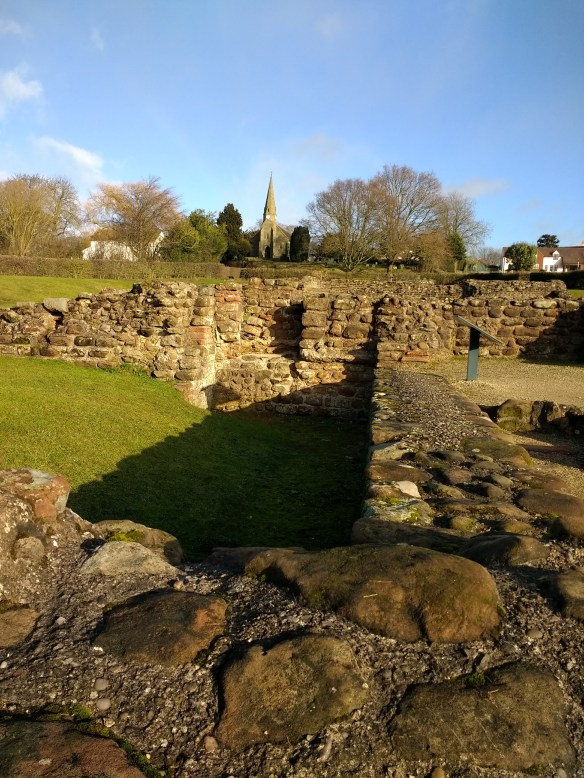
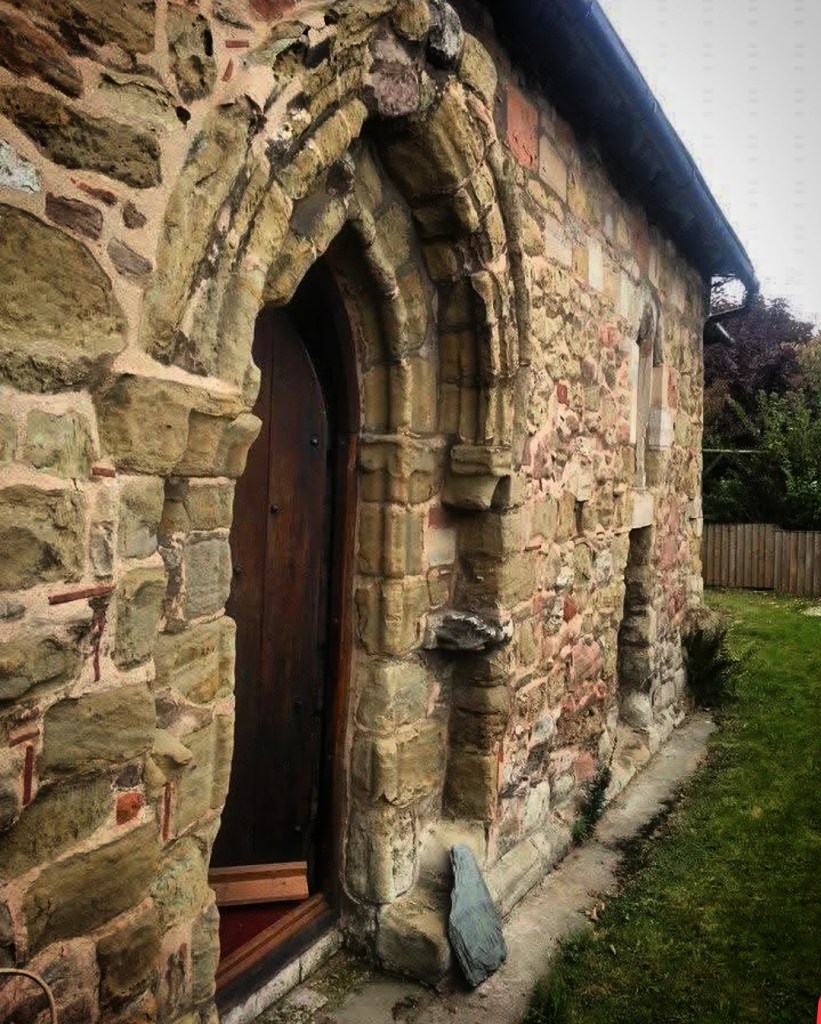
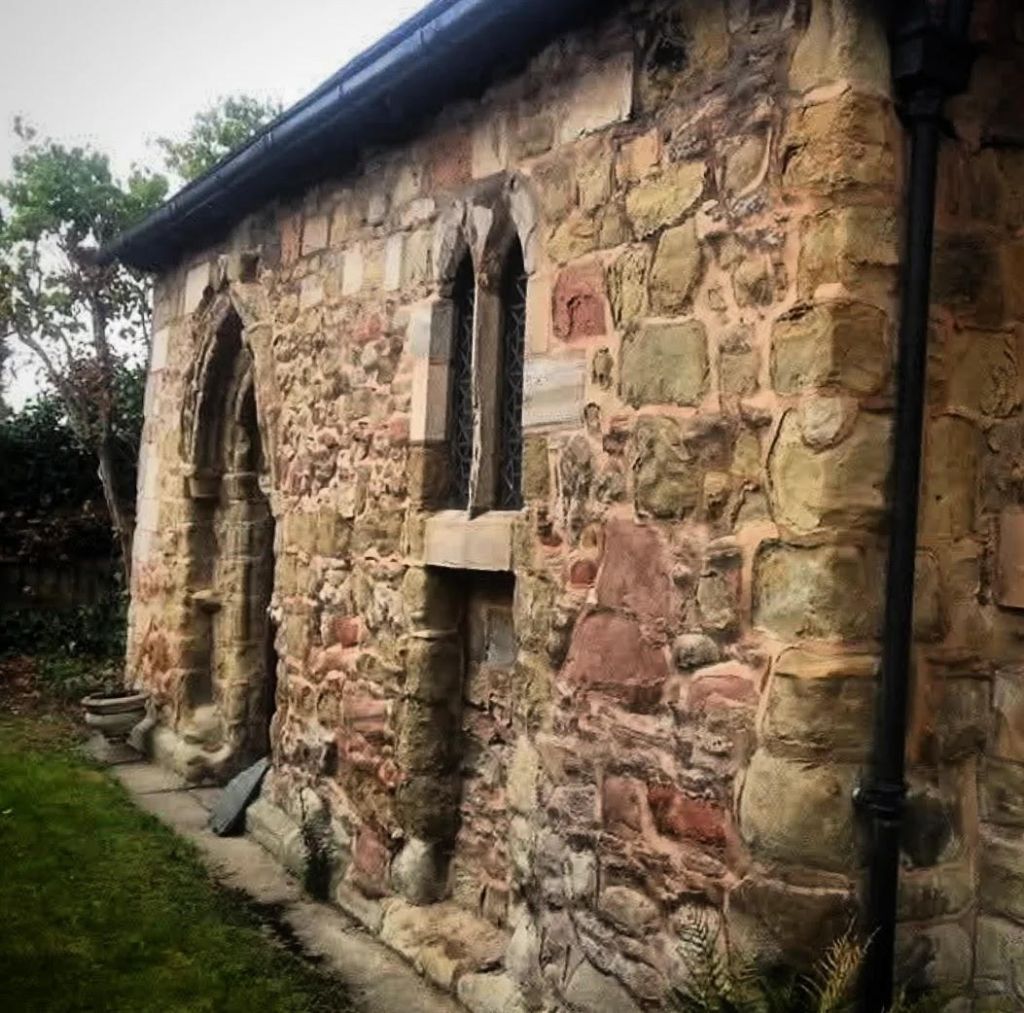
There’s a tiny chapel in Tamworth, hidden behind streets of houses. Much of its history is a mystery but there are records showing that the Spital Chapel of St James was erected by Robert Marmion of Tamworth Castle c. 1274. There was a suggestion the chapel had been built the site of an earlier structure and in July 1968 a group of girls from Perrycroft School carried out an excavation there, under the expert eye of archaeologist Jim Gould, in the hope of finding evidence of Saxon origins. What they actually found was something of a surprise.

In a shallow grave, on the north side of the chapel, the skeleton of a middle-aged woman, aged between 40 and 50 was unearthed. Perhaps even more surprising was that the remains of two children were found laying across the woman’s pelvis. There was no trace of a shroud and the burial was on the north side of the chapel. Given that the land surrounding the chapel was not known to have been consecrated, or ever used as a burial ground, it was suggested that this may be an illicit internment of impoverished individuals.

I have different tools at my disposal to that team of teenage girls and they’ve enabled me to find several more skeletons at the Spital Chapel. In October 1914, the Tamworth Herald reported two lots of human remains were found to the south of the chapel when gas pipes were being laid. One was near the door, the other near the chancel wall and again, both were found not far from the surface. The report says they were reinterred on the spot and, unless anyone knows differently, there is nothing to suggest they aren’t still there.

Delving even further back into the newspaper archive, I found that in May 1870, an inquest was held on two skeletons found at The Spittals, a now demolished Victorian house, which once stood near the chapel. Adding to the intrigue is a letter from Edith Heath, published by the Coleshill Chronicle in 1968, recalling how she had often visited a woman called Dorothy Clarson who lived on Wiggington Rd in a house called Belbroughton, built by her father. Miss Clarson had claimed that when workmen were digging foundations for a wall of the house, the body of a man wearing chainmail had been uncovered. Apparently, the then Vicar of Tamworth was sent for to say a prayer and lay the body reverently to rest. Reading between the lines, it seems this skeletal soldier may also still lie somewhere near to the chapel.

The letter goes on to say that Belbroughton was haunted by a Grey Lady, who also walked a path which once led to a lost orchard. Whether this adds or subtracts to the reliability of Miss Clarson’s account, is something you can make your own mind up about but for me, the story that a spectre haunts the Spital Chapel site is the cherry on the cake.

The history books suggest the Spital was originally a chantry chapel, built so that prayers could be said here to save the soul of Robert Marmion of Tamworth Castle. However, there is a belief amongst Tamworth folk that the chapel was used as some sort of Pest House, or isolation hospital during times of plague which may account for the presence of burials. The dedication to St James also suggests at some point it may have been a stop-off on a pilgrimage route. Could it be that those buried here are pilgrims who never completed their journey? I’m obviously no expert but now we know that the burials unearthed in 1968 were not isolated, the theory that they were an illicit burial seems a little less convincing. Perhaps analysis of some of the skeletons, if they do still lie beneath, might be be able to tell us more about who they were, when they died and why they were laid to rest here.

Sources
G C Baugh, W L Cowie, J C Dickinson, Duggan A P, A K B Evans, R H Evans, Una C Hannam, P Heath, D A Johnson, Hilda Johnstone, Ann J Kettle, J L Kirby, R Mansfield, A Saltman, ‘Hospitals: Tamworth, St James’, in A History of the County of Stafford: Volume 3, ed. M W Greenslade, R B Pugh (London, 1970), British History Online https://www.british-history.ac.uk/vch/staffs/vol3/pp294-296 [accessed 4 May 2025]

https://britishlistedbuildings.co.uk/101197039-spital-chapel-of-st-james-tamworth-spital-ward

Tamworth Herald 31st October 1914

Tamworth Herald 21st May 1870

SAHS Transactions Volume X

The Walking Dead of Weston

Charlotte Sophia Burne, the first woman to become president of the Folklore Society, once said of Staffordshire, ‘It is comparatively an ordinary occurrence for this or that lately deceased person to ‘come again’ after death’.

I can’t help but wonder if she’d heard of the post-mortem wanderings of Preston Moore and his father in the village of Weston, near Stafford. A book called ‘Phantasms of the Living’, contains the following account from a Mrs J Bennett written in 1882 about the eerie events of 13th April 1860.

“My daughter Annie and I had been drinking tea with the late Mrs Smith and Miss Moore, and talking about their brother Preston being very ill and not expected to recover, and were returning home in the evening when between the little wicket which opens out of the Vicarage field and Mrs Newbould’s house, we met the identical man in face, form and figure, dressed as he was always wont; slouched hat, old frock coat, open in front, knee-breeches and gaiters, with a long stick. He passed so near us that we shrank aside to make way for him. As soon as we got to Mrs Newbould’s she exclaimed, ‘So Preston Moore is dead!’, when we both exclaimed, ‘Oh no, we have just seen him!’. We found, in fact, that he had died about half an hour before he appeared to us’.

Something wicked this way comes

Mrs Bennett was adamant that it could not have been a case of mistaken identity. According to her, ‘We cannot call to mind anyone at all resembling the individual in question; his appearance, dress and gait were utterly unlike anyone else residing in or about the neighbourhood’. More intriguing details emerged during psychical researcher Eleanor Sidgwick’s interview with Mrs Bennett. There was apparently something forbidding about Preston Moore and his sister Miss Moore was also considered odd. Preston may also have had a thing for Mrs Bennett. He once bought her pansies pinched from a neighbouring gentleman’s garden and another time, cauliflowers, also illegitimately acquired. Perhaps I should have saved this story for Valentines Day? ‘Roses are red, violets are blue, here are some vegetables, I’ve stolen for you. Violets are blue, roses are red, I’ll still be around, even after I’m dead’.

A lovely pub. We will definitely come again.

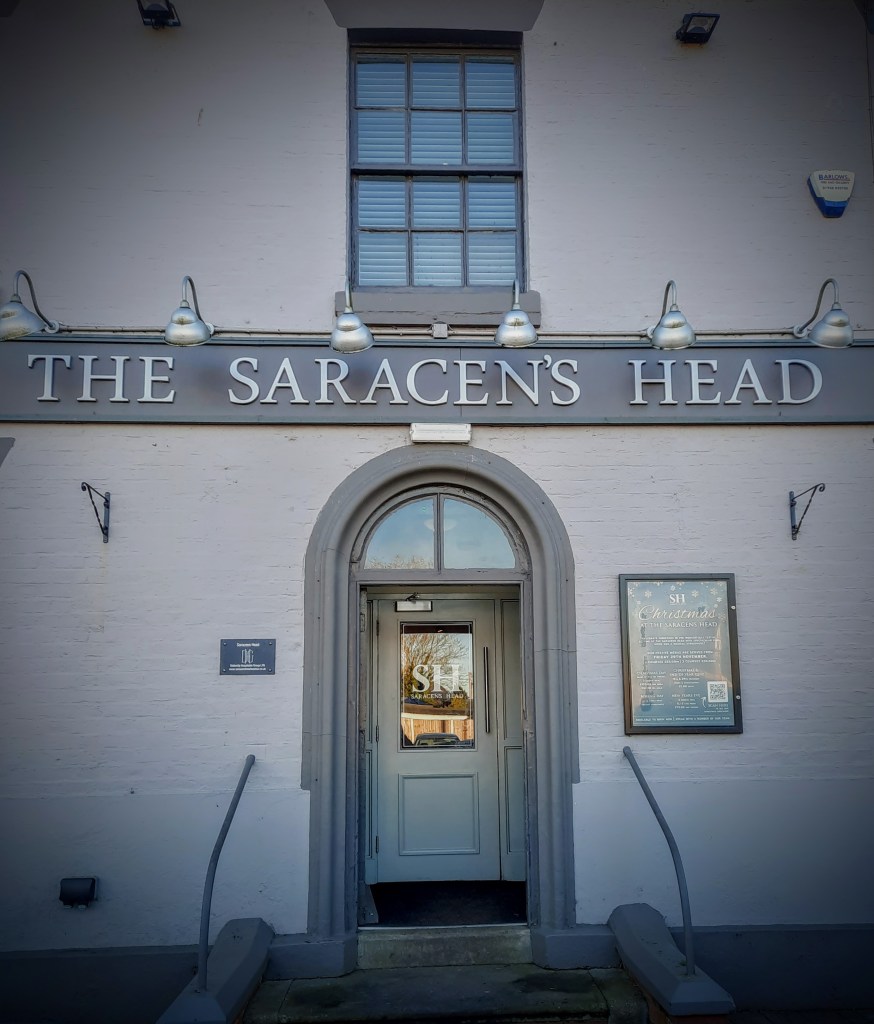
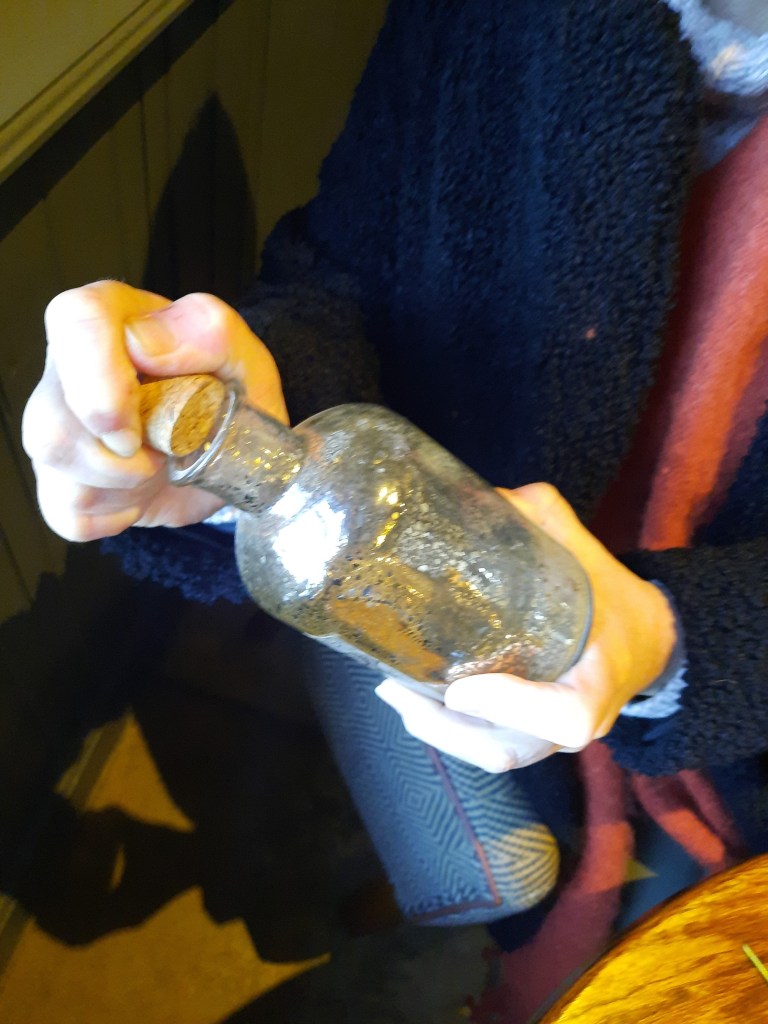
The story as it stands is strange enough but reader, there is a twist in this tale of a dead man walking. An article in the Staffordshire Advertiser in 1901 claims that Preston Moore was not the first of his family to ‘come again’ after his death. There was a legend in the local area that his father’s shade had roamed up and down the road between Stowe and Weston, until locals decided it had had enough exercise and it was time to exorcise this restless spirit. It was laid in a bottle and bricked up in the cellar of the Saracen’s Head Inn to remain there, ‘whilst holly and ivy are green’. It seems that during his life Mr Moore senior may have been the landlord at the inn making the real horror here the idea of being trapped in your workplace for eternity.

She wouldn’t let it lie!

Obviously my good friend Jacky and I went to investigate, by which I mean we popped into the pub for a coffee and pretended we’d found the bottle containing the spirit of Mr Moore on a shelf nearby where we sitting. I am convinced there’s more to be found out about the mysterious Moore family which may explain why the family seem to have been at the centre of village superstition. In the meantime, if you work at the pub, would you pop into the cellar and see if you can find where the old landlord lies? We should have asked but we didn’t have the bottle…

Sources

Staffordshire Folk and the Lore, Charlotte Sophia Burne

Phantasms of the Living, Edmund Gurney, FWH Myers and Frank Podmore

Staffordshire Advertiser 2nd March 1901

Staffordshire Advertiser 2nd March 1901

A Pub with Two Tails

There are many reasons one might visit a pub. To sample the fare, to enjoy an ale, to meet with companions. I went to the Dog and Doublet because it’s named after a murder. Or a dog wearing a jacket. Either way, I headed to the village of Sandon in Staffordshire, in my mystery machine (which looks a lot like a Toyota Avensis) to do a bit of investigating.

The first possible explanation for the pub’s name is that a former landlord was murdered by robbers and his faithful hound found the corpse. In what sounds like a gothic horror version of Lassie, he took his master’s blood-stained doublet back to the inn and then led a search party back to the body. The second less gory story says that a travelling fair came to Sandon and its star act was a performing pooch in a little jacket. The villagers thought he was such a good boy they decided to name their pub after him. A dog in a doublet was clearly a novelty back then. Nowadays I see some canines out walking in Leomansley Woods who have better wardrobes than I do.

The current building dates to 1906, and is described as having been erected by the Earl of Harrowby on a site adjoining that of the original. The tithe map seems to show that there was an inn there back in 1838, but it was known as the Packhorse. It’s all a bit confusing, even before you’ve had a drink, but I think I understand what happened with these hostelries. There was definitely a Dog and Doublet in the village dating back to at least the mid-18th century as I’ve found a reference for it in Aris’s Birmingham Gazettee. It seems to have stood on the other side of the road, at a place now known as Sandon Lodge and/or Erdeswicke House. When Sandon Hall burned down in the summer of 1848, the Earl of Harrowby made it his temporary family home, and had the pub sign moved to the Packhorse which presumably was also renamed at this point. He didn’t relocate the resident ghost though, as a man described as wearing brown clothes and a small wig and believed to be a former landlord, was still reported to be haunting his old hostelry in the 1950s.

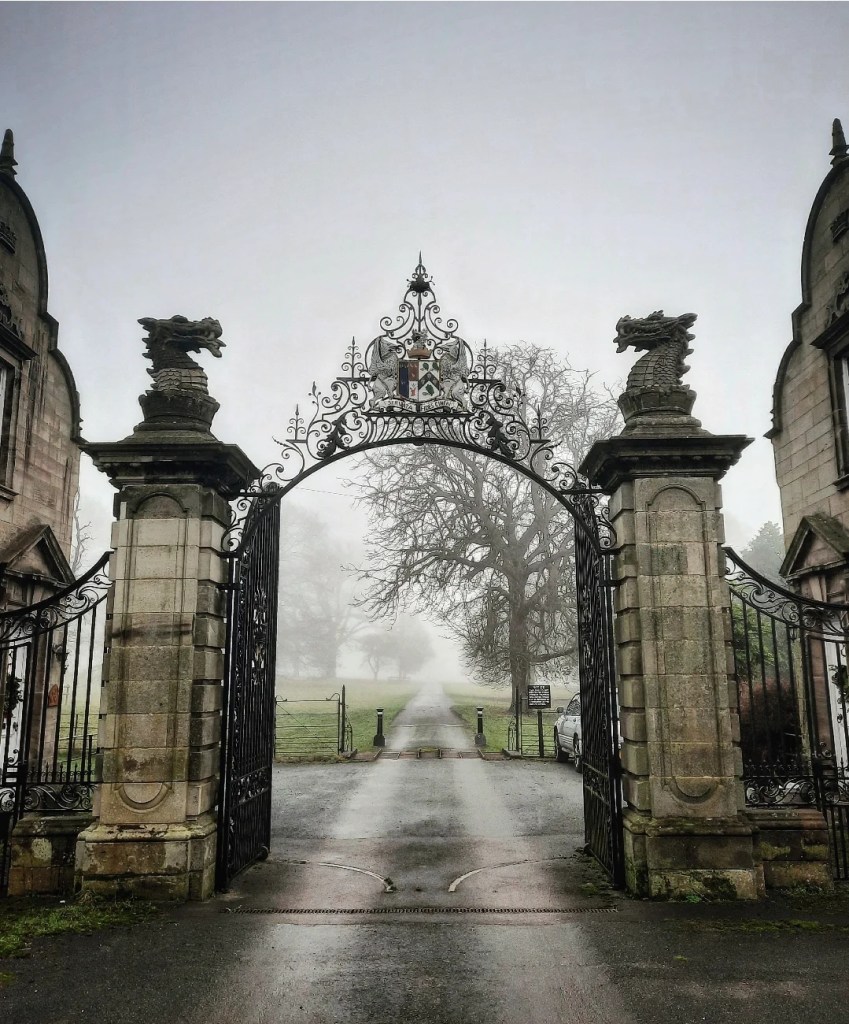
The gates to Sandon Hall

This information comes from Sam Berrisford, a former chairman of the Parish Council, who lived in part of Sandon Lodge. He also mentions an overgrown circular bowling green in the grounds of the old inn, which he suggested was Elizabethan. According to the listed building description, the oldest parts are 17th century and so certainly old enough that tales of parliamentarian troops draining quart pots and plunging their heads into vats of beer in the inn’s cellar prior to the Battle of Hopton Heath could be true. If so, it’s no wonder the Royalists defeated them eh? (put down your swords Roundheads, I’m just jesting. I know the outcome of the only Civil War battle to take place on Staffordshire soil isn’t that straightforward).

During its 18th century coaching inn days the hospitality of the hostelry was renowned and, in the absence of Trip Advisor, a satisfied customer is said to have scratched this verse onto one of the smoke-room windows of the old pub.

‘Most travellers to whom these roads are known
Would rather stay at Sandon than Stone
Good chaises, horses, treatment and good wines,
They always meet with at James Ballantine’s’.

Not everyone met with such a cordial welcome from Mr Ballantine however. There’s a story his daughter eloped with a young man and that when the boy broke into the inn to collect some of her belongings, Ballatine was there waiting for him. He handed his estranged son-in-law over to the law and the lad was hanged for theft. It’s said that on the night of the execution, a crowd of villagers surrounded the inn, chanting the 69th psalm and cursing James Ballantine. Possibly related to this family drama is a second verse that the Staffordshire Advertiser says was scratched into another of the inn’s windows which read, ‘Let the man that hates peace, and endeavours to trouble it, Be hung up by the neck, like this dog in the doublet’.

Whitehall, Beacon St. Once the Coach & Horses inn

Whether the story of Sandon’s star cross’d lovers is true I don’t yet know but I have found out that James Ballantine and his wife Catherine had six daughters in total. One of them was called Ann and in November 1779 she married Alderman John Fern, an eminent Wine and Brandy Merchant from Lichfield. So far, so respectable but then you learn the groom was sixty-two years old and Ann only twenty-one. I believe they’d have lived at Whitehall on Beacon Street in, another former inn with an intriguing past. Fern died in Lichfield on 16th February 1801 and his short obituary in the Whitehall Evening Post, refers to him as the ‘Father of the Corporation of that city’. Although surely he was old enough to be its Grandad…

Back to the Dog though and by December 1802, the landlord there was Mr Tomlinson who was paid a visit by a swindler, who may have been enticed by the Trip Advisor review for good horses in the window. He had, ‘very much the appearance of a gentleman aged about forty years, five feet eight or nine, dark curled hair, smooth face, smiling countenance and had on a dark mixture cloth coat, with one of his boots patched across the toe’. He arrived in a post-chaise from Cheadle and claimed to have left his horse at Leek due to the bad weather, asking for a horse for the following morning to take him to the banking house of Messrs Stevenson and Co. Inevitably, that was the last Mr Tomlinson saw of his horse and when enquiries were made at the bank in Stafford, it probably didn’t come as a shock that no such person had been there. A five guinea reward was offered by Tomlinson, along with ten pounds from ye olde neighbourhood watch scheme, the Sandon Association for Prosecuting Felons.

To the church. Let’s not split up eh gang?

And so it turns out there there are far more than two tales at the Dog and Doublet even if some of them are just shaggy dog stories. I’m not quite ready to fire up the Toyota Avensis and leave Sandon just yet though. There’s a mystery up at the church that needs solving…

Sources:

Birmingham Weekly Post 20th October 1950

Stone – The History of a Market Town, Norman A Cope

Staffordshire Advertiser 4th December 1802

Staffordshire Sentinel 18th February 1905

Staffordshire Advertiser 21st May 1864

Staffordshire Advertiser 16th November 1946

Oxford Journal 20th November 1779

Staffordshire Advertiser 10th May 1806

The Wraiths of Weston Hall

Afternoon tea at Weston Hall is my annual festive treat and though we didn’t spot any ghosts of governments past in the form of the MP from Stone eating scones again this year, plenty of other spectres are still present here.

Scones and spooks is my idea of heaven

The Jacobean hall is said to be so haunted that when it was used by the ATS in World War Two, there’s a story that the women stationed there opted to sleep outside in tents rather than risk meeting the legendary Grey Lady. It seems a less effective strategy when you learn that the wraiths of Weston Hall are not confined within its walls. A Green Lady walks up the stones steps to the entrance, a White Lady rushes across the nearby road and disappears into a hedge during a full moon and the sounds of a ghostly carriage and horses can be heard pulling up outside on the gravel, despite the driveway having been long paved over.

Stairway to heaven

Given there are so many ghosts, the house must surely have had a colourful history but details of its original owners are a little sketchy. In Henry Edward Chetwyn-Stapylton’s book on the Chetwynds of Ingestre, he suggests Weston was built by Lady Dorothy Devereux, youngest daughter of the former favourite of Elizabeth I, and William Stafford of Batherwyke, her second husband. He notes that Robert Plot says she was living there at the time he wrote his History of Staffordshire in 1686 but as she died in 1636 he must have been mistaken. Unless she’s the Grey Lady and it’s her ghost he saw…

Seems a bit scary on the outside but lovely on the inside. Just like me 😉

A later owner, Francis Lycett died there on the evening of 6th May 1792 from a fractured skull, a few days after falling down the stairs at The Falcon Inn at Stone. One of his spurs had caught on his great coat. I have read elsewhere on the internet that Francis is an ancestor of fellow Brummie (but not fellow comedian) Joe Lycett but haven’t yet been able to substantiate this.

By 1818, the hall was described as a farmhouse in a rather neglected state in the Staffordshire General and Commercial Directory. In the early twentieth century, the property was used as a pauper asylum by Staffordshire County Council to relieve overcrowding at Stafford. There were 45 female patients in August 1908 but again information is scarce. Afterwards it was allegedly sold to pay gambling debts and converted into flats. An application to convert the property to a nursing home in 1991 was abandoned and the hall stood derelict until Paul Reynolds rescued and restored the building a few years later.

The Falcon at Stone, where Francis Lycett had a fateful trip

For me it’s not so much generic stories of women in white (or grey, or green) that float my ghost ship, but something with more substance. An event in the past which may help to explains why there may be a perception of paranormal activity. When the hall was reopened as a hotel in the 1990s, staff reported tables being cleared, glasses being collected and ashtrays being emptied by an unknown entity. I can’t help but wonder if there’s a link here to the tragic events of March 1945 when a twenty five year old mess orderly in the canteen was accidentally killed when she was shot through the chest by an eighteen year old private in charge of a detachment of German POWs working at Weston Hall.

I’ll be haunting somewhere around here

Whoever it is that haunts Weston Hall, there are far worse places to spend your afterlife. In fact I love it so much that in years to come there may be reports of another female phantom who turns up at Christmas and sits by the fire stuffing herself with scones.

Sources

Paranormal Staffordhire, Anthony Poulton-Smith

Staffordshire Newsletter 4th October 1996

Stafford Post 21st March 1996

Staffordshire Sentinel 23rd July 1985

Staffordshire Newsletter 19th November 1976

Staffordshire Sentinel 6th July 1945

The Gentlemans Magazine and Historical Chronicle 1792

The Queen’s Shoes

I’m not organised enough to do an ‘On this day in history…’ type post and so I’ve just missed the 565th anniversary of the Battle of Blore Heath. However, as I know a couple of good stories about it, here’s an ‘on this Monday just gone in history’ post instead.

The tales take place away from the blood and gore of the battlefield, a mile up the road at Mucklestone, the most westerly parish in Staffordshire. Its name may derive from the OE ‘micel’ meaning large and ‘stan’ meaning stone and it seems likely this is linked to the presence of two monoliths known as the Devil’s Ring and Finger. Satan’s stones are believed to have originally been part of a chambered tomb and the ‘ring’ stone has a porthole, apparently large enough for a person to climb through, or be passed through. Some say to do so increases fertility. Having been erroneously told that several gaps on a traumatic caving expedition were big enough to get these child-bearing hips through, I’ll stick to two kids and a small amount of dignity thank you. Talking of children, there was also a belief that passing them through the circle several times would cure them of any ailments, which seems like a strangely wholesome thing for the devil to do. Much more in keeping with the name is the local legend that the stones mysteriously appeared at the spot after a girl was murdered here.

geograph-227107-by-Mr-M-Evison (1) (1)

Queen Margaret of Anjou is said to have watched the Battle of Blore Heath from the church tower at Mucklestone. On seeing the standard of her Lancastrian commander Lord Audley fall (a cross marks the spot where he was slain), the queen knew defeat by the Yorkist army was imminent. In a fit of rage and frustration, she is said to have stamped her feet so hard that her footprints remained on the stone floor of the tower long after she fled to safety. This sounds preposterous I know but I do have a theory about this. The outline of shoes are often found carved into church roofs (I’ve yet to find a satisfactory explanation as to why) and if there was such graffiti on the church roof at St Mary’s in Mucklestone, someone may have decided that it fitted into the story very nicely. Obviously, if I’d got in touch with someone at the church to ask them if such graffiti existed to back up my theory that would have bee useful, but yeah, that thing about being organised…

Mucklestone church tower

The most well known element of the legend is that Margaret’s escape was aided by local blacksmith William Skelhorn who was ordered to reverse the shoes of the queen’s horse in an attempt to fool those who attempted to follow.  His reward was to be beheaded on his own anvil, which can be found in the churchyard opposite the site of the smithy. Whether the execution was carried out on the orders of the queen to ensure Skelhorn’s silence, or by her enemies, as punishment for assisting her, depends on who is telling the story.

skelhorn mucklestone anvil
A 19th century forgery by the parish clerk?

It’s not the only instance of the old horseshoes-on-backwards-to-disguise-your-tracks ruse to be found. Amongst others, Robert the Bruce supposedly did it to escape from London after being betrayed there (with tracks going in the opposite direction to Scotland, presumably). Logically and practically it seems an unlikely tactic for Queen Margaret or anyone else to use, and is crying out for someone to do a myth-busting style experiment. I’ll volunteer to dress up as the queen and get on a horse if necessary. I’d look great in a crown and I’ve been pony trekking. Twice.

The thing about myths and legends is that it’s relatively easy to bust them if you try. Once this happens, there are several different ways to go. Either ignore the evidence and keep telling it anyway because why ruin a good story with facts. Dismiss it as a lot of nonsense and as having no value whatsoever. Or sit yourself comfortably somewhere between the two positions, enjoying it as a story in its own right but also exploring where it came from and why, who told it and if any nuggets of truth are actually contained within.  The same themes and events turn up in our folklore time after time.

As with the horseshoe part of the myth, echoes of other aspects of the Mucklestone story can also be heard elsewhere. Over at Stoke Golding, in Leicestershire, local tradition has it that the villagers climbed onto the battlements of the church of St Margaret to watch the Battle of Bosworth on 22 August 1485, and later watched the Tudor King’s coronation at Crown Hill.  Did someone draw on these stories and create one to put Mucklestone on the map? Could someone like William Skelhorn, directly descended from and carrying on the same trade as his 15th century ancestor and a parish clerk in the mid-19th century have forged his family into history? Not too far-rier fetched is it?

Sources:

http://www.bloreheath.org/mucklestone.php

Fleming, G. (1896) Horse-shoes and Horse-shoeing

http://www.search.staffspasttrack.org.uk

Staffordshire Sentinel 17th August 1908

Staffordshire Advertiser 8th November 1865

Anchors Away

It’s the first day of Autumn today, meaning yesterday was the last day of Summer and it definitely went out with a bang. The storm seems to have subsided a little but the pounding rain continues its bleak fall and so I’m virtually visiting Streethay this afternoon. The village sits on the Roman Ryknild Street, just beyond the boundary of Lichfield City and, most appropriately given the weather, it’s a place with some watery links that I want to explore.

The Anchor Inn, had already been boarded up for two years when I took this photo in February 2017.

The new housing estates springing up around the outskirts of Lichfield are certainly controversial but one positive development at Streethay, is the arrival of Bod. I’m a big fan of the Titanic brewery bar and I do wonder whether this new influx of people would have kept Streethay’s previous pub ‘The Anchor’ afloat, if it had happened sooner. It was not to be however, and it closed in January 2015.

At Bod, I found a tiny mermaid swimming in a glass of porter….(with apologies to Eliza Carthy) Created by Louise from Under a Pewter Sky.

The building still survives and is now occupied by an Osteopathy Clinic and apartments but let’s go back in time to those days when it still served as an inn. It was clearly in existence by November 1848 when an inquest was held there on the body of Henry Crutchley, a fourteen year old lad who died after climbing onto an engine and slipping beneath the wheels of the wagons it was pulling, but was rebuilt around 1906, when the Lichfield Brewery Company was granted permission on the basis that ‘the house was in a most dilapidated condition and it was impossible to repair it’. I’ve yet to find a photo of its former form but I have found a reference in 1779 to a public house ‘known by the sign of the Queen’s Head’ which stood on the turnpike from Lichfield to Burton at Streethay and I’m wondering if this might be an earlier name. There are also mentions of a inn known as The Dog, around the same time and I’d like to sniff out where exactly that was.

The Anchor, when it was still afloat in 2009
Photo © David Rogers (cc-by-sa/2.0)

In the Lichfield Mercury in 1972 an advert for the Anchor appeared with a curious reference to the ‘Klondyke Bar’, inviting you to enjoy your drink, ‘in the pleasant atmosphere of the Gold Rush’. One of the new apartments built in the grounds of the Anchor has been named after this, with the estate agents’ details explaining it was named after the ‘large wooden drinking hut’. Now I was given many nicknames by my brother when we were growing up, and one of them was ‘Klondyke Kate’. Whilst I’d like to think it was based on American vaudeville actress who provided inspiration for Scrooge McDuck’s girlfriend, I suspect it was more likely a reference to the British female wrestler. The Anchor’s Klondyke however is clearly a reference to the gold in them thar Canadian hills in the 1890s and was decorated with old photos and posters and, erm, pheasants, in a bid to recreate a prospectors’ bar. Much more of a mystery is why a bar on the outskirts of Lichfield chose it as a theme. In May 1979, the new licensees Norma and George Wolley presumably asked themselves the same question and relaunched the annexe bar as ‘The Mainbrace’. The hut itself had originally been a first world war army hut and this brings us nicely to a really interesting period in the pub’s history.

During the Second World War, the pub was frequented by personnel from RAF Lichfield. Jean Smith, in an interview with Adam Purcell, described how she and fellow WAAFs would stop off for a half a pint there on the way back home to their quarters on the opposite side of the road. On winter nights, when it was announced that flights had been cancelled due to fog and rain, the women would get their gladrags on and head out to the inn. Soon, the sound of bikes being propped against the wall of the pub would be heard as the lads from the aerodrome arrived at The Anchor, and the grounded pilots would soon be filling the air with cigarette smoke and tunes from the piano. The full interview with Jean can be found here and it’s a fascinating read, which really captures what the atmosphere was like for those young people living their lives in Lichfield, surrounded by the ever present threat of death.

This post was actually intended to be a deep dive into the village as a whole but I’ve got a bit overboard with the history of the Anchor Pub and so we’ll have to return to Streethay and its moated manor and plunge pool, the brewery and the canal wharf, and the lost hamlet of Morughale another day because we’ve only just dipped our toe in…

Brewery Row, once home to workers from the Trent Valley Brewery

Sources

Birmingham Journal 25th November 1848

Lichfield Mercury 16th March 1906

https://www.onthemarket.com/details/8779282/

Lichfield Mercury 25th May 1979

Lichfield Mercury 7th April 1972

Adam Purcell, “Interview with Jean Smith,” IBCC Digital Archive, accessed September 22, 2024, https://ibccdigitalarchive.lincoln.ac.uk/omeka/collections/document/3488.

http://raf-lichfield.co.uk/Anchor%20Pub.htm

https://www.british-history.ac.uk/vch/staffs/vol14/pp273-282

Battle Plans

Armed with a bag of Werther’s Originals and a vague plan about finding the site of Boudica’s final battle against the Romans, my friend (and countrywoman) and I headed down the A5 towards Atherstone.

By Boadicea by Colin Smith, CC BY-SA 2.0, https://commons.wikimedia.org/w/index.php?curid=107819273

Boudica’s burial place is one of Britain’s great mysteries. I thought for years that the warrior queen rested beneath a platform of Kings Cross Station but clearly I was on the wrong track. There is no trace of her there, or anywhere else for that matter, although plenty of places have been mooted as a possibility. Ever since Richard III was found under that car park, perhaps people are more comfortable putting forward their own research into such things. Even somewhere they flog burgers in Birmingham is apparently a contender for the final resting place of the scourge of the Roman Empire. If she genuinely is here, they really ought to consider changing the name to ‘Queen’s Norton’. Let’s be honest, it wouldn’t be the first time a significant piece of history has been linked to the foundations of a local fast food restaurant in the West Midlands. There are two Mummies beneath what was once another MaccyDs in Tamworth.

Despite several sites laying claim to being the scene of Boudica’s last battle, no archaeological evidence has turned up at any of them either. Claims have instead been based on descriptions of the battle ground from two Roman historians, Tacitus and Cassius Dio. It’s described as somewhere within a defile (a steep sided narrow gorge) with a wood behind it and open countryside in front of it, chosen to prevent ambushes from Boudica’s warriors. In 2004, archaeologist Jim Gould wrote an article in which he says the description of the site given by Tacitus is much too vague for positive identification. He believed it would never be identified on the ground, in the absence of an archaeological discovery.

One of the chief contenders is Mancetter, on the outskirts of Atherstone, or Manduessedum as it was known in Boudica’s time. If it is ever proved, then they ought to consider changing the name to ‘Womancetter’ but I think we are going to have to defile that thought away for now.

What we do have archaeological evidence of at Mancetter is a Roman fort, now occupied by the site of the church and manor house. As we stood nosing in at the gate of the latter, the gardener appeared and told us it dated back to the fourteenth century and had a priest hide and a secret tunnel leading to the church. Despite my enthusiasm for stories of this kind, experience tells me these architectural features often turn out to be a cupboard or a cellar. In this case however, it seems he may not have been leading us up the garden path. Well not entirely. According to the Atherstone News and Herald in June 1956, in what’s now known as the ‘Martyr’s Bedroom’, an escape route led to the roof via a sliding panel in, ahem, a cupboard

The manor was the home of the Protestant Glover brothers John, William and Robert. In 1555, the Bishop of Lichfield issued a warrant for their arrest but by the time the Mayor of Coventry arrived with men to carry out the orders two of the trio had escaped. Robert had been unable to flee as he was ill and was taken from his sick bed to Coventry and then to Lichfield where he dined at the Swan before being removed to a cell alongside a dungeon. I suspect this would have been the ‘church prison’, as described by Thomas Harwood which seems to have been underneath what’s now Number One, The Close, rather than the gaol at the Guildhall.

Robert Glover was burned at the stake in Coventry on 19th September 1555. His brother John eluded capture but died of an ague after living in the woods for some months. The Biishop’s Chancellor, Anthony Draycot was not about to let the whole business of him being a protestant lie though, informing the vicar that his body should be dug up and thrown over the churchyard wall. When the vicar pointed out that after six weeks the body stank and finding men willing to undertake the task would be tricky, Draycot instead ordered him to wait for 12 months and then throw the skeleton over the wall into the public highway. The third brother William also suffered post-death disgrace being refused a Christian burial in the town of Wem in Shropshire, his corpse instead being dragged by horses to a nearby field and buried there in unhallowed ground. Just in case a priest hole and secret tunnel haven’t given you your fill of folklore, you should know that Robert Glover’s ghost haunts the room from which he was taken.

Next door to the Glovers lived another Mancetter martyr, Joyce Lewis, who was burned at the stake in Lichfield on 18th December 1557. Despite a plaque in the Market Square recording this dark chapter of the city’s history I knew very little of her story until now. It seems Joyce fought to the death to defend her beliefs, asking the friends who visited her in prison how she might behave so, ‘her death might be more glorious to the name of God, comfortable to his people, and also most discomfortable unto the enemies of God’. The night before her execution she refused the offer of two priests to hear her confession and after fainting on route to the Market Square and being given a cup of water, she used it to drink to ‘the abolishment of papistry’. According to Foxe’s Book of Martyrs, ‘a great number, specially the women of that town, did drink with her; which afterward were put to open penance in the church by the cruel papists, for drinking with her’. I believe open penance would have been some sort of public punishment.

I may not have found the site of Boudica’s battleground on my journey up the A5 but it did lead me to the story of Joyce Lewis’s last stand much closer to home and how her final moments were spent surrounded by the solidarity of the women of Lichfield.

Sources:

https://ancientmonuments.uk/103961-roman-camp-mancetter

http://atherstonecivicsociety.co.uk/projectrm

https://www.archaeology.org/issues/95-1307/features/1090-boudicca-celtic-roman-empire-kings-cross

https://www.english-heritage.org.uk/visit/places/wall-roman-site/history/

https://www.patrickcomerford.com/2020_05_16_archive.html

Martyrologia, John Sundins Stamp

London Archaeologist Spring 2004, Boudica – yet again, Jim Gould