Murder Ballad

It seems apt that on St Andrew’s Day, I have a story for you which features both a Robert Burns poem and the one time president of the Walsall Burns Club. These events took place one hundred and fifty years ago this week and I will warn you in advance that it’s a bleak early winter’s tale, with no festive cheer to be found.

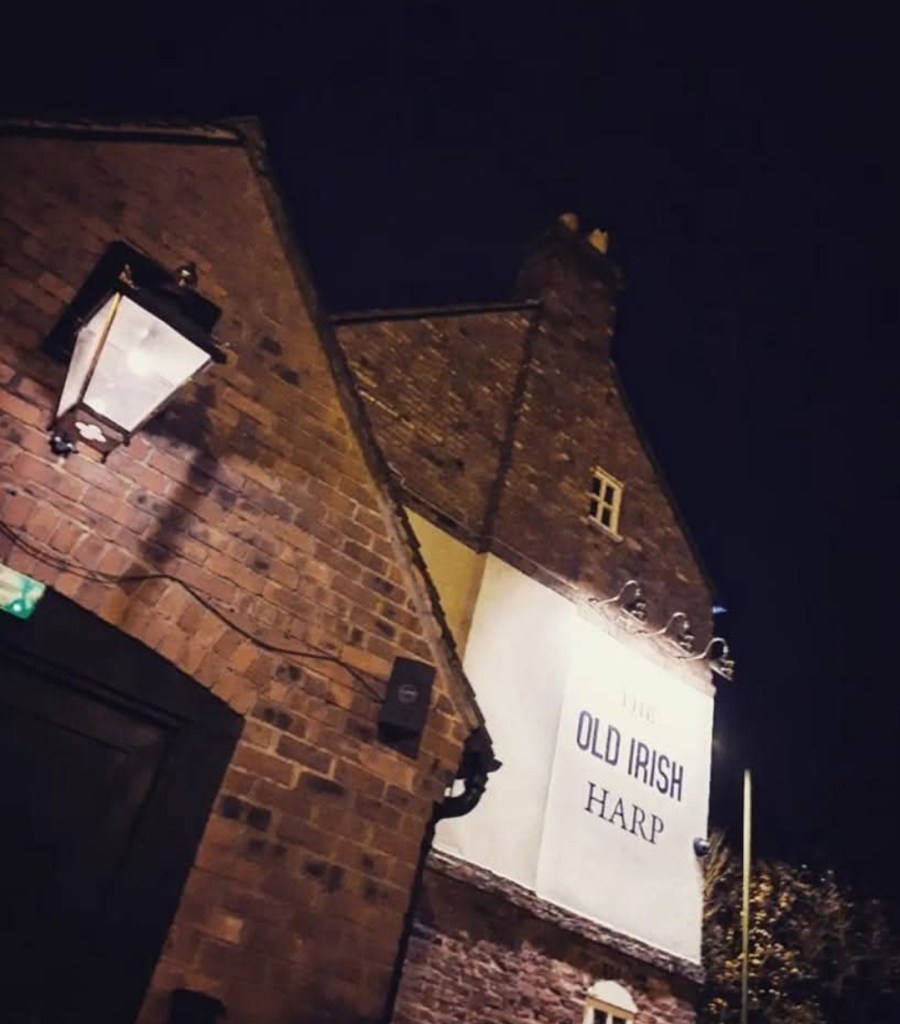
On 24th November 1874, a young Billy Meikle1 arrived in Alrewas on the first train of the day from Walsall. Snow had fallen overnight and the wintery dawn was just breaking as he passed the Paul Pry Inn2 with its sign hanging from a tree opposite. There were groans coming from the inside the old village lock-up and a howling hound outside was awaiting his master’s release. Billy then continued via the George and Dragon and the Navigation Inn (now the Delhi Divan restaurant) as he headed towards Yoxall via the Kings Bromley Road to collect the accounts of customers for the drapers business he worked for.

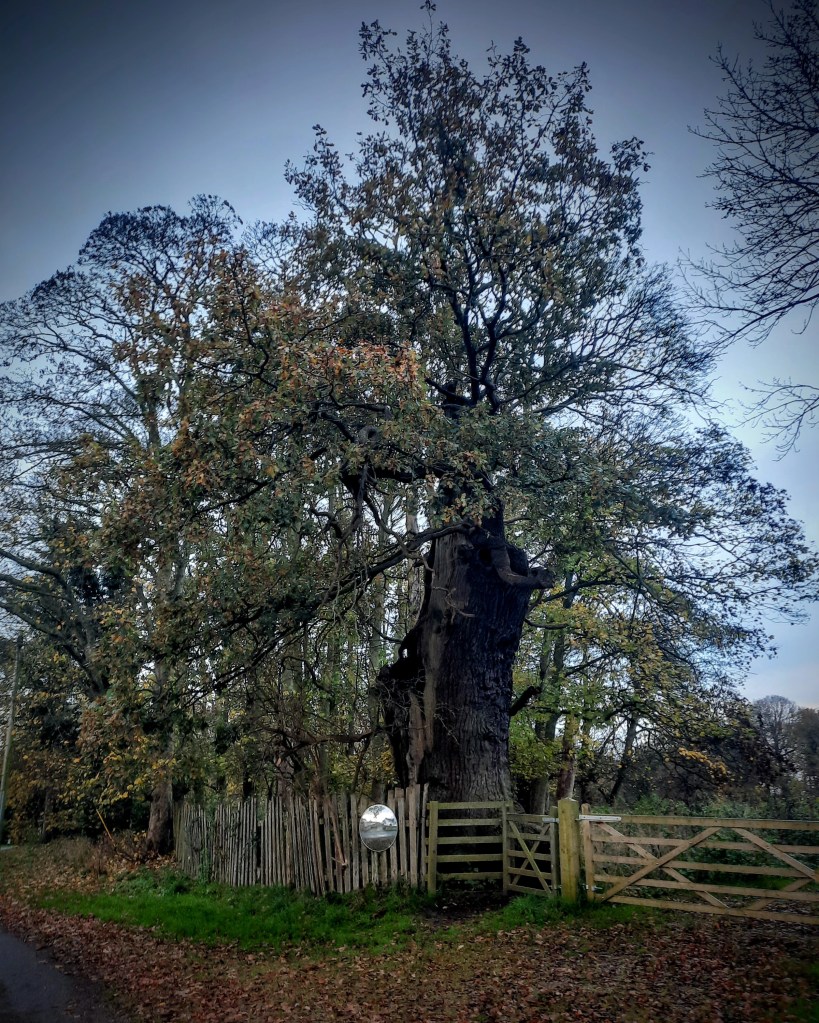
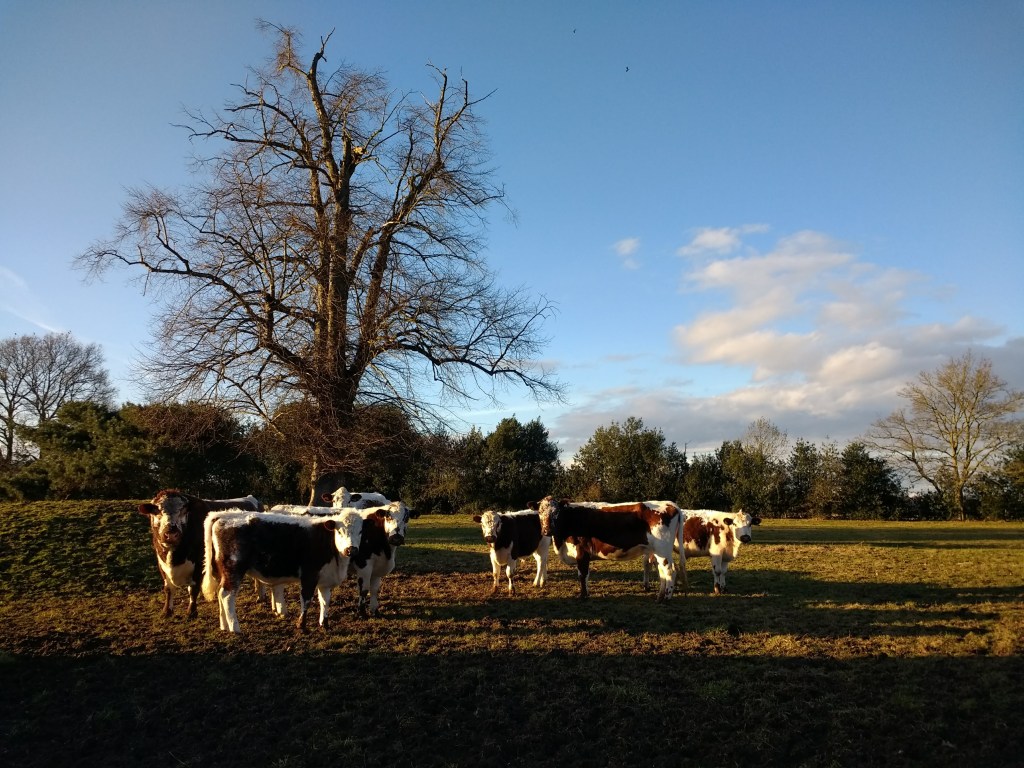
I believe this may be the tree near to where those terrible events took place 150 years ago

When he arrived at Yoxall he found the village in a state of frenzied excitement, following the news that murder had taken place the previous day. At every house he called at he heard the story of how Mrs Kidd had been killed by a vagrant at nearby Hoar Cross because the man had demanded 3d and she had only 2d to give him. Meikle was told the murder had taken place at a large tree, the location easily identifiable as the locals had scraped away the snow to see the pool of blood beneath it. As night fell, he set out in the moonlight to find the sinister spot for himself, but as he approached the tree where the tragedy took place, he lost his nerve and ran back to Yoxall.

The Golden Cup, Yoxall where the drinks still flow although I suspect step dancing on the ceiling is a thing of the past

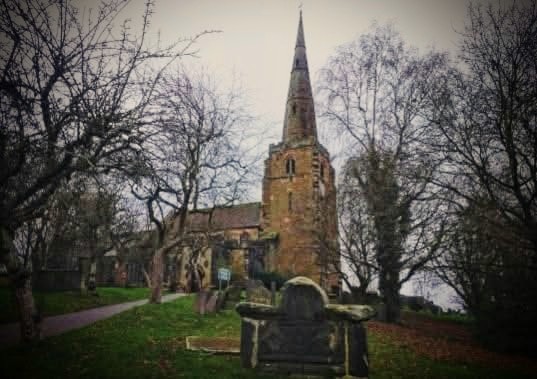
Unfortunately, the Golden Cup Inn where he was supposed to be staying was perhaps not the sanctuary he was hoping for. Mrs Badkins, who kept the local stationers shop, told him that the landlord had been drinking since his his wife had left him and had borrowed a gun, suggesting that staying at the Crown may be a safer option. Meikle did not heed her advice and took his chances at the Cup. On the day of the inquest on Mrs Kidds’ body, the tap room was flowing with talk of murder, both the very recent and historic. According to Meikle, things took a turn for the better when a man named Ned Dukes stood on his head on a table and sang a song about the world being upside down whilst he did a step dance on the ceiling. Personally, I’d have rather carried on talking about murders. At 10 pm time was called and the customers went home, ‘full of drink and murder’. Meikle was left alone with the landlord and his daughter and together they ate soup, bread and cheese. At several points during the supper, the landlord got up to investigate invisible things in the dark corners of the room. Eventually, bed was suggested and Billy was shown to his room which had been partitioned off from the club room. Despite thoughts of the landlord and his gun, Meikle drifted off to sleep. At 2am he heard the clock at St Peter’s chime but fell back to sleep. Soon after however, he was woken again by a terrible crash and peered from beneath his bedclothes to see the landlord stood in the room, candle in one hand, gun in the other.

Both men had thought the crash had been caused by the other firing shots but Billy assured the landlord he had no gun. The men then realised the crash they’d heard resulted from the partition between rooms falling down and both of them returned to their beds.

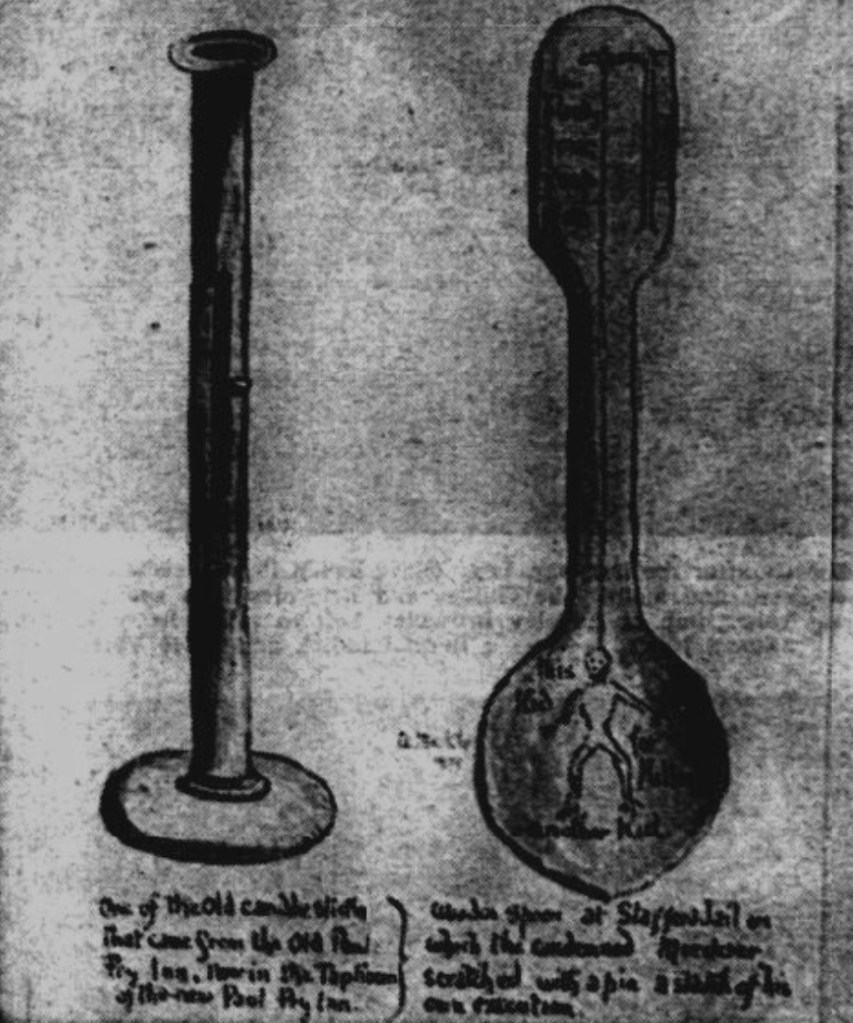
Billy Meikle’s sketches of a candlestick from the old Paul Pry Inn and the sinister spoon Taylor carved in Stafford Gaol

Meikle says the murderer of Mrs Kidd was arrested several weeks later. He was caught in a trap laid by the police who knew he was unable to resist singing a love song called The Thorn, based on a poem by Robert Burns. Pianists were planted in every pub in the East Staffordshire area, with instructions that they should play the song at regular intervals. The snare was a success and the murderer was arrested mid-song and later sentenced to death. Meikle says he scratched a figure of a man being hanged onto the wooden spoon he ate his final meal with along with the words ‘A bloody long drop for this kid for killing another ‘Kidd’.

It’s an incredible story but I suspect Billy Meikle’s account of events may not be altogether accurate. What is without doubt is that at the Stafford Assizes in December 1874, Robert Taylor, a 21 year old miner from Wigan was found guilty of the wilful murder of Mary Kidd on 23rd November in the parish of Yoxall. The main witness was her neighbour Sarah Ann Hollis, an eight year old girl who had gone with her. Sarah said that as they approached the wood, they saw Taylor and had a brief conversation with him. He followed them and asked for half a crown, and Mrs Kidd replied she did not have that amount but gave him 2d. Taylor then grabbed her and cut her throat with his pen knife. The sound of approaching cart wheels scared him away and may well have saved Sarah’s life.

Was Taylor trapped by a tune though? It seems the murderer was caught in a much more orthodox manner. Newspaper reports say that after visiting the murder scene, near to the new church at Hoar Cross and on the main road from Yoxall to Sudbury, Superintendent Bowen searched for the murder all night. Eventually he overtook him on the road to Burton, followed him into a shop and, recognising him from Sarah’s description, arrested him. Taylor’s clothes were examined and his shirt sleeves, trousers and coat were found to be saturated with blood. Traces of blood and bloody hand prints matching his were also found on the gate he escaped across towards Yoxall Lodge.

When the charges were read, Taylor replied with a smile, ‘I plead guilty to all that’. It was remarked that from the time Taylor was arrested until the time he stepped onto the scaffold, Taylor appeared to treat the whole thing as a joke, displaying no remorse. He commented to someone that he had no family or friends and didn’t care what happened to him. At Stafford Gaol, he attended services in the chapel on Sundays and on Christmas Day, sitting in the same pew where William Palmer had once sat. During the service the chaplain asked the congregation to pray for Robert Taylor, now lying under the sentence of death. His final weeks were spent in a cell with a straw mattress and his only visitor was a woman from his native Wigan who suspected Taylor to be her long-missing but still loved husband. The chaplain allowed her into the cell but after taking a good look at Taylor she declared that this was not her husband and headed back up north, no doubt much relieved. Robert Taylor really was alone in this world.

Taylor was executed within the walls of Stafford Gaol on the last day of 1874, just after the clock had struck eight o’clock. The morning is reported as being clear and bitterly cold. A couple of hundred people had congregated in the road near the gaol, drawn no doubt from the same morbid curiosity which drove me to write this post. Taylor’s final words to the executioner were ‘Snap me off quick’. He did.

Notes:

1 – Billy Meikle was a fascinating character with many interests including local history, photography and sketching scenes from the world around him. As mentioned above, he was also involved in the Walsall Burns Club. You can read more about him here.

2 – The Paul Pry Hotel in Alrewas stood on what is now the A38 and was demolished when the road was widened c.1960. I have read that a former landlord used to show punters a brace of pistols which had once been the property of a highway man said to frequent the inn.

Sources:

Rugeley Times 28th December 1968

Edinburgh Evening News 11th December 1874

County Advertiser & Herald for Staffordshire and Worcestershire

Burton Chronicle 26th November 1874

Abra-cadaver

It’s Sunday and it’s Spooky Season (or October as we used to call it) and so hey presto, I’ve written a post about unorthodox burials in this old city where magic may have been involved. I think you’ll like this. Not a lot, but you’ll like it (kids, ask your parents).

As a point of reference and, just to show I don’t just completely conjure things up, there’s a great paper by Roberta Gilchrist, which deals with the archaeology of magic in medieval burials. It outlines the norm for Christian interments at that time as being a body wrapped in a shroud and lacking a coffin, personal items and grave goods and also explains that around two percent of excavated burials are exceptional to this. Excitingly but perhaps unsurprisingly, it turns out that some of these intriguing inhumations have turned up in the Field of the Dead (or Lichfield as the authorities insist on calling it).

Amongst the fourteen burials found beneath what’s now the beer garden of the Brewhouse and Kitchen on Bird Street were the remains of three females, including a woman who lived in the mid-fourteenth century, described by archaeologist Mark Neal as being quite elderly and in poor health. The discovery of so many skeletons here suggests it was the location of the cemetery for Lichfield’s Fransican Friary and the presence of women raises some interesting questions about who was allowed to be buried here and what their role may have been. Most puzzling of all however was the discovery of a body found with a 2mm thick layer of charcoal beneath it. Research shows that such burials are mostly associated with people of note in the early medieval period and predate the founding of the Friary in 1230. Was this the site of a high status Saxon buried before the Franscicans arrived? It is of course possible that this funerary ritual was continued beyond the Saxon period here in Lichfield but could we be looking at a site with a history stretching back further than we thought? The history of the Grey Friars site suddenly seems very grey indeed…

The other burning question is of course, what was the significance of the charcoal? There are some intriguing possibilities ranging from the practical, where the charcoal layer was a way of absorbing bodily fluids during putrefaction, to some sort of post-humous purification ritual designed to save the soul after a life of sin and to stop the dead from returning to haunt the living. I don’t think I’ll ever look at a barbecue in quite the same way again.

Lichfield Cathedral. Pure magic.

Five further charcoal burials were found during excavations at Lichfield Cathedral, one of them inside a stone structure believed to have been part of the original Saxon church. One of those burials was that of a priest buried with something variously described as a hazel wand, rod or staff, as well as a cross of twigs, a chalice and patten and a eucharistic wafer. Yes the symbolism is strong with this one. Several theories exist regarding the presence of the wooden wand, including it being provided for protection as the priest made his final journey through the valley of the shadow of death. Perhaps the most peculiar burial here is that of a priest in an 11th century stone coffin which had an opening directly over where the mouth would be positioned. It’s been interpreted as a libation tube, where the living could make offerings of food and drink to their dead relative. It’s a pagan practice mostly associated with the Romans, and as yet, no-one has come up with a satisfying explanation for it being present in a place of Christian worship.

There are also an incredible 49 burials recorded at the Cathedral where white quartz stones have been found inside graves, and even clutched in the hands of the occupants. Again, the exact symbolism of these is unknown, but archaeologist Warwick Rodwell suggested the answer may lie in Revelation 2:17. This is a passage of the New Testament where a white stone with a new name written on it is given by Christ to his followers as symbol of forgiveness and an invitation to the afterlife. I think. It seems to make sense until you realise that people were incorporating these white pebbles into their funerary rituals long before Christianity existed. As we are on the subject of magic, can we also take a moment to appreciate that John who presents the video I’ve linked to looks like he might be an actual wizard.

St Michael’s on Greenhill is a place of many mysteries

A seemingly more recent, but no less bemusing burial was unearthed at St Michaels on Greenhill in 1852. Two gravediggers dug up the rotten fragments of an elm coffin and found that buried with the bones inside it was a bottle filled with a liquid believed to be urine. It has the feel of folk magic to me, particularly as in 2021, a similar discovery was made at the Trinity Burial Ground in Hull. We know that witch bottles were used to protect people from harm and that examples have been found buried in the foundations of buildings. Was this something similar, designed to protect the grave from robbers perhaps, or other less earthly threats? Or was it just a final drink for the coffin’s inhabitant to enjoy on their way to wherever they were headed to next?

I make no apologies for asking so many questions and being unable to answer any of them in this post. Time and time again, through writing this blog and being part of the Lichfield Discovered team, I realise that there is still so much to be uncovered and understood about the incredible history of this city. And for me? Well, that’s magic.

Sources:
Lichfield Mercury 5th January 1990

1 Bird Street, Lichfield Report on a watching brief, Marches Archaeology Series 103, November 103

Stone, R. (1999). 1 Bird Street, Lichfield: archaeological watching brief. Cirencester: Cotswold Archaeology.

Charcoal Burial in Early Medieval England, James Holloway (2009)

Gilchrist, R. ORCID: https://orcid.org/0000-0002-1967-2558
(2008) Magic for the dead? The archaeology of magic in later
medieval burials. Medieval Archaeology, 52. pp. 119-159

Jonsson, Kristina. “Burial Rods and Charcoal Graves: New Light on Old Burial Practices.” Viking and Medieval Scandinavia 3 (2007): 43–73. Web.

Community and Belief: the Development of Anglo-Saxon Christian Burial Practice,
AD 700-1066, Alexandra Aversa Sheldon (2018)

The Queen’s Shoes

I’m not organised enough to do an ‘On this day in history…’ type post and so I’ve just missed the 565th anniversary of the Battle of Blore Heath. However, as I know a couple of good stories about it, here’s an ‘on this Monday just gone in history’ post instead.

The tales take place away from the blood and gore of the battlefield, a mile up the road at Mucklestone, the most westerly parish in Staffordshire. Its name may derive from the OE ‘micel’ meaning large and ‘stan’ meaning stone and it seems likely this is linked to the presence of two monoliths known as the Devil’s Ring and Finger. Satan’s stones are believed to have originally been part of a chambered tomb and the ‘ring’ stone has a porthole, apparently large enough for a person to climb through, or be passed through. Some say to do so increases fertility. Having been erroneously told that several gaps on a traumatic caving expedition were big enough to get these child-bearing hips through, I’ll stick to two kids and a small amount of dignity thank you. Talking of children, there was also a belief that passing them through the circle several times would cure them of any ailments, which seems like a strangely wholesome thing for the devil to do. Much more in keeping with the name is the local legend that the stones mysteriously appeared at the spot after a girl was murdered here.

geograph-227107-by-Mr-M-Evison (1) (1)

Queen Margaret of Anjou is said to have watched the Battle of Blore Heath from the church tower at Mucklestone. On seeing the standard of her Lancastrian commander Lord Audley fall (a cross marks the spot where he was slain), the queen knew defeat by the Yorkist army was imminent. In a fit of rage and frustration, she is said to have stamped her feet so hard that her footprints remained on the stone floor of the tower long after she fled to safety. This sounds preposterous I know but I do have a theory about this. The outline of shoes are often found carved into church roofs (I’ve yet to find a satisfactory explanation as to why) and if there was such graffiti on the church roof at St Mary’s in Mucklestone, someone may have decided that it fitted into the story very nicely. Obviously, if I’d got in touch with someone at the church to ask them if such graffiti existed to back up my theory that would have bee useful, but yeah, that thing about being organised…

Mucklestone church tower

The most well known element of the legend is that Margaret’s escape was aided by local blacksmith William Skelhorn who was ordered to reverse the shoes of the queen’s horse in an attempt to fool those who attempted to follow.  His reward was to be beheaded on his own anvil, which can be found in the churchyard opposite the site of the smithy. Whether the execution was carried out on the orders of the queen to ensure Skelhorn’s silence, or by her enemies, as punishment for assisting her, depends on who is telling the story.

skelhorn mucklestone anvil
A 19th century forgery by the parish clerk?

It’s not the only instance of the old horseshoes-on-backwards-to-disguise-your-tracks ruse to be found. Amongst others, Robert the Bruce supposedly did it to escape from London after being betrayed there (with tracks going in the opposite direction to Scotland, presumably). Logically and practically it seems an unlikely tactic for Queen Margaret or anyone else to use, and is crying out for someone to do a myth-busting style experiment. I’ll volunteer to dress up as the queen and get on a horse if necessary. I’d look great in a crown and I’ve been pony trekking. Twice.

The thing about myths and legends is that it’s relatively easy to bust them if you try. Once this happens, there are several different ways to go. Either ignore the evidence and keep telling it anyway because why ruin a good story with facts. Dismiss it as a lot of nonsense and as having no value whatsoever. Or sit yourself comfortably somewhere between the two positions, enjoying it as a story in its own right but also exploring where it came from and why, who told it and if any nuggets of truth are actually contained within.  The same themes and events turn up in our folklore time after time.

As with the horseshoe part of the myth, echoes of other aspects of the Mucklestone story can also be heard elsewhere. Over at Stoke Golding, in Leicestershire, local tradition has it that the villagers climbed onto the battlements of the church of St Margaret to watch the Battle of Bosworth on 22 August 1485, and later watched the Tudor King’s coronation at Crown Hill.  Did someone draw on these stories and create one to put Mucklestone on the map? Could someone like William Skelhorn, directly descended from and carrying on the same trade as his 15th century ancestor and a parish clerk in the mid-19th century have forged his family into history? Not too far-rier fetched is it?

Sources:

http://www.bloreheath.org/mucklestone.php

Fleming, G. (1896) Horse-shoes and Horse-shoeing

http://www.search.staffspasttrack.org.uk

Staffordshire Sentinel 17th August 1908

Staffordshire Advertiser 8th November 1865

Anchors Away

It’s the first day of Autumn today, meaning yesterday was the last day of Summer and it definitely went out with a bang. The storm seems to have subsided a little but the pounding rain continues its bleak fall and so I’m virtually visiting Streethay this afternoon. The village sits on the Roman Ryknild Street, just beyond the boundary of Lichfield City and, most appropriately given the weather, it’s a place with some watery links that I want to explore.

The Anchor Inn, had already been boarded up for two years when I took this photo in February 2017.

The new housing estates springing up around the outskirts of Lichfield are certainly controversial but one positive development at Streethay, is the arrival of Bod. I’m a big fan of the Titanic brewery bar and I do wonder whether this new influx of people would have kept Streethay’s previous pub ‘The Anchor’ afloat, if it had happened sooner. It was not to be however, and it closed in January 2015.

At Bod, I found a tiny mermaid swimming in a glass of porter….(with apologies to Eliza Carthy) Created by Louise from Under a Pewter Sky.

The building still survives and is now occupied by an Osteopathy Clinic and apartments but let’s go back in time to those days when it still served as an inn. It was clearly in existence by November 1848 when an inquest was held there on the body of Henry Crutchley, a fourteen year old lad who died after climbing onto an engine and slipping beneath the wheels of the wagons it was pulling, but was rebuilt around 1906, when the Lichfield Brewery Company was granted permission on the basis that ‘the house was in a most dilapidated condition and it was impossible to repair it’. I’ve yet to find a photo of its former form but I have found a reference in 1779 to a public house ‘known by the sign of the Queen’s Head’ which stood on the turnpike from Lichfield to Burton at Streethay and I’m wondering if this might be an earlier name. There are also mentions of a inn known as The Dog, around the same time and I’d like to sniff out where exactly that was.

The Anchor, when it was still afloat in 2009
Photo © David Rogers (cc-by-sa/2.0)

In the Lichfield Mercury in 1972 an advert for the Anchor appeared with a curious reference to the ‘Klondyke Bar’, inviting you to enjoy your drink, ‘in the pleasant atmosphere of the Gold Rush’. One of the new apartments built in the grounds of the Anchor has been named after this, with the estate agents’ details explaining it was named after the ‘large wooden drinking hut’. Now I was given many nicknames by my brother when we were growing up, and one of them was ‘Klondyke Kate’. Whilst I’d like to think it was based on American vaudeville actress who provided inspiration for Scrooge McDuck’s girlfriend, I suspect it was more likely a reference to the British female wrestler. The Anchor’s Klondyke however is clearly a reference to the gold in them thar Canadian hills in the 1890s and was decorated with old photos and posters and, erm, pheasants, in a bid to recreate a prospectors’ bar. Much more of a mystery is why a bar on the outskirts of Lichfield chose it as a theme. In May 1979, the new licensees Norma and George Wolley presumably asked themselves the same question and relaunched the annexe bar as ‘The Mainbrace’. The hut itself had originally been a first world war army hut and this brings us nicely to a really interesting period in the pub’s history.

During the Second World War, the pub was frequented by personnel from RAF Lichfield. Jean Smith, in an interview with Adam Purcell, described how she and fellow WAAFs would stop off for a half a pint there on the way back home to their quarters on the opposite side of the road. On winter nights, when it was announced that flights had been cancelled due to fog and rain, the women would get their gladrags on and head out to the inn. Soon, the sound of bikes being propped against the wall of the pub would be heard as the lads from the aerodrome arrived at The Anchor, and the grounded pilots would soon be filling the air with cigarette smoke and tunes from the piano. The full interview with Jean can be found here and it’s a fascinating read, which really captures what the atmosphere was like for those young people living their lives in Lichfield, surrounded by the ever present threat of death.

This post was actually intended to be a deep dive into the village as a whole but I’ve got a bit overboard with the history of the Anchor Pub and so we’ll have to return to Streethay and its moated manor and plunge pool, the brewery and the canal wharf, and the lost hamlet of Morughale another day because we’ve only just dipped our toe in…

Brewery Row, once home to workers from the Trent Valley Brewery

Sources

Birmingham Journal 25th November 1848

Lichfield Mercury 16th March 1906

https://www.onthemarket.com/details/8779282/

Lichfield Mercury 25th May 1979

Lichfield Mercury 7th April 1972

Adam Purcell, “Interview with Jean Smith,” IBCC Digital Archive, accessed September 22, 2024, https://ibccdigitalarchive.lincoln.ac.uk/omeka/collections/document/3488.

http://raf-lichfield.co.uk/Anchor%20Pub.htm

https://www.british-history.ac.uk/vch/staffs/vol14/pp273-282

Battle Plans

Armed with a bag of Werther’s Originals and a vague plan about finding the site of Boudica’s final battle against the Romans, my friend (and countrywoman) and I headed down the A5 towards Atherstone.

By Boadicea by Colin Smith, CC BY-SA 2.0, https://commons.wikimedia.org/w/index.php?curid=107819273

Boudica’s burial place is one of Britain’s great mysteries. I thought for years that the warrior queen rested beneath a platform of Kings Cross Station but clearly I was on the wrong track. There is no trace of her there, or anywhere else for that matter, although plenty of places have been mooted as a possibility. Ever since Richard III was found under that car park, perhaps people are more comfortable putting forward their own research into such things. Even somewhere they flog burgers in Birmingham is apparently a contender for the final resting place of the scourge of the Roman Empire. If she genuinely is here, they really ought to consider changing the name to ‘Queen’s Norton’. Let’s be honest, it wouldn’t be the first time a significant piece of history has been linked to the foundations of a local fast food restaurant in the West Midlands. There are two Mummies beneath what was once another MaccyDs in Tamworth.

Despite several sites laying claim to being the scene of Boudica’s last battle, no archaeological evidence has turned up at any of them either. Claims have instead been based on descriptions of the battle ground from two Roman historians, Tacitus and Cassius Dio. It’s described as somewhere within a defile (a steep sided narrow gorge) with a wood behind it and open countryside in front of it, chosen to prevent ambushes from Boudica’s warriors. In 2004, archaeologist Jim Gould wrote an article in which he says the description of the site given by Tacitus is much too vague for positive identification. He believed it would never be identified on the ground, in the absence of an archaeological discovery.

One of the chief contenders is Mancetter, on the outskirts of Atherstone, or Manduessedum as it was known in Boudica’s time. If it is ever proved, then they ought to consider changing the name to ‘Womancetter’ but I think we are going to have to defile that thought away for now.

What we do have archaeological evidence of at Mancetter is a Roman fort, now occupied by the site of the church and manor house. As we stood nosing in at the gate of the latter, the gardener appeared and told us it dated back to the fourteenth century and had a priest hide and a secret tunnel leading to the church. Despite my enthusiasm for stories of this kind, experience tells me these architectural features often turn out to be a cupboard or a cellar. In this case however, it seems he may not have been leading us up the garden path. Well not entirely. According to the Atherstone News and Herald in June 1956, in what’s now known as the ‘Martyr’s Bedroom’, an escape route led to the roof via a sliding panel in, ahem, a cupboard

The manor was the home of the Protestant Glover brothers John, William and Robert. In 1555, the Bishop of Lichfield issued a warrant for their arrest but by the time the Mayor of Coventry arrived with men to carry out the orders two of the trio had escaped. Robert had been unable to flee as he was ill and was taken from his sick bed to Coventry and then to Lichfield where he dined at the Swan before being removed to a cell alongside a dungeon. I suspect this would have been the ‘church prison’, as described by Thomas Harwood which seems to have been underneath what’s now Number One, The Close, rather than the gaol at the Guildhall.

Robert Glover was burned at the stake in Coventry on 19th September 1555. His brother John eluded capture but died of an ague after living in the woods for some months. The Biishop’s Chancellor, Anthony Draycot was not about to let the whole business of him being a protestant lie though, informing the vicar that his body should be dug up and thrown over the churchyard wall. When the vicar pointed out that after six weeks the body stank and finding men willing to undertake the task would be tricky, Draycot instead ordered him to wait for 12 months and then throw the skeleton over the wall into the public highway. The third brother William also suffered post-death disgrace being refused a Christian burial in the town of Wem in Shropshire, his corpse instead being dragged by horses to a nearby field and buried there in unhallowed ground. Just in case a priest hole and secret tunnel haven’t given you your fill of folklore, you should know that Robert Glover’s ghost haunts the room from which he was taken.

Next door to the Glovers lived another Mancetter martyr, Joyce Lewis, who was burned at the stake in Lichfield on 18th December 1557. Despite a plaque in the Market Square recording this dark chapter of the city’s history I knew very little of her story until now. It seems Joyce fought to the death to defend her beliefs, asking the friends who visited her in prison how she might behave so, ‘her death might be more glorious to the name of God, comfortable to his people, and also most discomfortable unto the enemies of God’. The night before her execution she refused the offer of two priests to hear her confession and after fainting on route to the Market Square and being given a cup of water, she used it to drink to ‘the abolishment of papistry’. According to Foxe’s Book of Martyrs, ‘a great number, specially the women of that town, did drink with her; which afterward were put to open penance in the church by the cruel papists, for drinking with her’. I believe open penance would have been some sort of public punishment.

I may not have found the site of Boudica’s battleground on my journey up the A5 but it did lead me to the story of Joyce Lewis’s last stand much closer to home and how her final moments were spent surrounded by the solidarity of the women of Lichfield.

Sources:

https://ancientmonuments.uk/103961-roman-camp-mancetter

http://atherstonecivicsociety.co.uk/projectrm

https://www.archaeology.org/issues/95-1307/features/1090-boudicca-celtic-roman-empire-kings-cross

https://www.english-heritage.org.uk/visit/places/wall-roman-site/history/

https://www.patrickcomerford.com/2020_05_16_archive.html

Martyrologia, John Sundins Stamp

London Archaeologist Spring 2004, Boudica – yet again, Jim Gould

The Wizard and the Widow’s Curse

In certain magic circles, the story of the Wizard of Bromley Hurst is well-known. In the mid-nineteenth century, Thomas Charlesworth, a young dairy farmer living near Abbots Bromley, argued with his widowed mother over his choice of wife, who also happened to be his cousin. Old Mrs Charlesworth, who was probably younger than me at the time, apparently left the farm muttering he would never do any good and his cheeses would all tumble to pieces. In the months that followed, Thomas did indeed have trouble making cheese from the milk his herd produced, ‘a process which had up to that time been successfully performed’. The fact this coincided with the departure of his mother was surely not coincidence and Thomas leapt to the obvious conclusion. That his mum had been better than him at making cheese? Absolutely not. Young Farmer Charlesworth decided that his cheese-kettle and all of his cows had been cursed.

Cused cows? Pull the udder one

Local toll-gate keeper Sammons recommended he seek the help of a man named Tunnicliff who ran ‘The Royal Oak’ beerhouse four miles away at the somewhat appropriately named ‘Buttermilk Hill’. Many men and women who ran such establishments also had a side-hustle. Indeed, my own great-great grandfather ran a pub in Cirencester alongside a blacksmiths shop. Tunnicliff’s supplementary business though was black magic. The wizard agreed that the woes Thomas had recently incurred were due to the ‘Widow’s Curse’ and that he could take the spell a-whey. All he needed was a piece of Thomas’s wife’s dress and the names of all his cows. Oh and £7. His magic act is reported to have been making crosses over the doors with witch hazel twigs and waving his hands over the horses. It seems no-one at that point thought to ask exactly how bewitched horses affected the cheese-making process and Tunnicliff left the house, no doubt rubbing those same hands together at the thought of how easily he’d make his money that afternoon. So easily it seems that Tunnicliff decided to put in a nightshift.

The Charlesworths had an ‘awful night’. Outside in the yard came the sounds of loud yelling, groans and noises of various kinds. Thomas bravely asked someone else to look out to check if there were any animals under the windows but there was nothing to be seen. The following day, he went back to see a tired-looking Tunnicliff and told him about the sleepless night they’d experienced over a beer. Tunnicliff agreed to call in to see what he could do but back home at Bromley Hurst, Thomas experienced shooting pains in his chest, numbness of his limbs and shivering. Whilst these symptoms subsided around dinnertime, he decided to stay in bed an extra hour the following day. Tunnicliff turned up before he woke and took Thomas up a breakfast of ham, bread and coffee. Within half an hour, he was stricken with symptoms similar to those he’d suffered the previous day. Tunnicliff announced he was appointing himself the couple’s defender against the dark arts and would be sleeping in their room. Now comfortably settled in the Charlesworth’s home, he really decided to go big.

To explain Thomas’ ongoing suffering, Tunnicliff ‘revealed’ he was engaged in a battle with ‘Old Bull’ aka the wizard of Yeaverly place, and claimed that ‘a fresh secret has been communicated to me by the power which I possess, and I now tell you that everything you possess is bewitched. You will have to give me further sums of money to remove this betwitchment’. As well as carrying out his wizarding work, Tunnicliff was also taken on as a servant. Shortly after Elizabeth, their baby girl and her nursemaid all began experiencing the same symptoms as Thomas and tragically, it’s reported that the infant died of convulsions in the Autumn of 1856.

Things came to a climax on 11th February the following year, a night during which servants witnessed the family dog run through the house chased by a phantom hound, seemingly made of fire and Thomas Charlesworth was so seriously ill he lost conciousness and was believed to be close to death. Whether it was the terrified servants’ ultimatum that if Tunnicliff stayed they’d leave, or Elizabeth Charlesworth’s discovery that his all expenses paid trip to Derby to battle yet another wizard was entirely fictitious, the penny finally seemed to drop that Tunnicliff was more of a conman than a conjurer and was milking them dry. He was dismissed on the 17th February 1857 and when Thomas was miraculously cured of his supposedly supernatural symptoms shortly afterwards, he reported Tunnicliff to the authorities.

In a trial at Stafford, Tunnicliff’s defence was that Charlesworth was a drunk, as was his father before him. The case for the prosecution however was that the Charlesworths had been poisoned with white bryony root, also known as ‘the Devil’s Turnip’, found at Tunnicliff’s house. In the end, the judge ruled that the Wicked Wizard of the East (Staffordshire) was guilty of obtaining money on false pretences and he was sentenced to 12 months imprisonment with hard labour. Reading over the details of the case, I find it hard to believe he was found guilty only of deception and not of the murder of baby Elizabeth and attempted murder of her parents.

The Coach and Horses, Abbots Bromley

As if this story isn’t already strange enough there is just one more thing to throw into the mix of this heady potion. During the trial, Thomas told how Tunnicliff had been to Rake End to see his uncle/father-in-law William Charlesworth, to caution him to be careful or else come to harm. On 23rd May 1857, William Charlesworth’s body was found on the turnpike road to Lichfield. An inquest was held at the Coach and Horses, the last place he’d been seen alive, leading to the arrest of two men for his murder. Charles Brown was transported to Western Australia but George Jackson was hanged at Stafford. Dreadful is the mysterious power of fate.

Sources

Uttoxeter New Era 13 October 1875

https://trove.nla.gov.au/newspaper/article/273146076

Derbyshire Advertiser and Journal 7.11.1857

Staffordshire Advertiser 7th March 1857

Staffordshire Advertiser 15 August 1857

The Banshee at Weeford Rectory

In June 1863, Alice and Emmeline, daughters of the Rev Robert Cowpland were woken from their sleep at Weeford Rectory by an unearthly wailing. The only other member of the household to have been stirred by the sound was the family bulldog, who was found trembling with terror in a pile of wood. By the end of the month, their mother Jane was dead at the age of 57.

Many years passed, and then at around midnight on a still and calm August night in 1879, the sisters were again woken by, ‘ a terrible sound of shrieking or wailing, unlike anything which we have ever heard, except on the other occasion here mentioned, but louder’. The noise seemed to come from the passage leading past the door to their father’s bedroom, and so the sisters leapt from bed, lit candles and rushed from the room without even pausing to put on dressing gowns. Outside on the landing, they met their brother, the groom, the cook and the housemaid, all who had been woken by the supernatural sounds. Even the dogs in the house were said to be bristling with fear at the nocturnal noise which was later described by Alice Cowpland as being seemingly borne by a wind inside the house and amongst the rafters, an awful howling which seemed to rush past her, accompanied by a strong wind, although everything outdoors was perfectly still. As whatever it was left via a window, silence returned to the house save for the sobs of the cook. She knew what had just been amongst them and that it was a warning that her master’s days were now numbered.

Only the Rev Cowpland remained asleep throughout the banshee’s visit and confirmed at breakfast the following morning that he’d not heard a thing. As the cook had feared however, the wailing had been a warning and a fortnight later, on 9th September 1879, he died at the age of 75. It is somewhat ironic given the events of that evening, that the Lichfield Mercury describes him as having quietly passed away.

The church at Weeford where the Rev Cowpland is buried

By the middle of May 1885, Alice was married and living at The Firs in Bromyard. Her sister Emmeline was staying with her, and her brother Francis was at Upper House, Bishop’s Frome, around five miles away. Once again the two sisters, along with a woman called Emily Corbett and other servants, heard the wailing one night, though not as loud as it had been at Weeford and by the end of the month, Francis was dead.

At the end of August that year, the banshee returned again to The Firs. This time around, Alice not only heard the harbinger of death but she also saw one. On 1st September, she noticed a black dress in her bedroom, which rose up and took the form of a figure. It looked straight at her for a few seconds and she saw it was her sister Annie, her face pale and with a look of anguish. She was wearing a bonnet and a veil and the vision was so clear, she could see the freckles on her sister’s nose. The figure did not disappear instantly, but seemed to fade away. The same evening, a niece staying at the house also saw an apparition of Annie Cowpland. In her written account of those strange events, she says she was taking a bath when something compelled her to look towards a couch near the bed, where she noticed a figure dressed in black crepe. She immediately recognised it as her aunt and asked how it was that she was there. The figure then faded again. The following night at dinner, a message arrived at the house to say Annie Cowpland was dangerously ill. She died of diptheria two days later.

According to Alice, her mother Jane had sometimes experienced supernatural visits from those who were about to pass. In 1857, she saw her brother-in-law, the Rev William Cowpland, rector of Acton Beauchamp in Worcestershire, in her bedroom. She asked when he had arrived but received no response and the following day, a telegram arrived to say he had been found dead in his bed at the age of 55. Three years later, Jane heard footsteps in the hall of the Rectory at Weeford and saw William Dunn, a gardener at the house of a relative. It later transpired that he had died around the same time as his apparition had been seen, and shortly before his passing had expressed a wish to see Mrs Cowpland. In a way the strangest apparition of all occurred in 1862, when Mrs Cowpland saw an acquaintance of hers, known as Mrs F, at the foot of her bed. Again the appearance coincided with the time of death but as the two women weren’t close, Jane Cowpland always wondered why she had been the recipient of the woman’s final visit.

Alice passed away in 1915 and it would be fascinating to know if anything was heard from the banshee on the occasion of her death and indeed why it appears to have attached itself to them in the first place. It’s a subject that fascinates me given that I have my own family chronicles of deaths foretold, albeit in more hushed tones than the wails of the Cowplands’ banshee.

Sources

Proceedings of the Society for Psychic Research

Bringing up the Bodies

Our city churchyards are full of those Lichfeldians who have left us. There are gaol keepers and executed prisoners, civil war soldiers and WW2 airmen, paupers and presumably, somewhere, plague victims (although that’s a whole other line of enquiry). Yet there are also others, denied the right to a Christian burial, laid to rest in unhallowed ground.

I’ve written before about Bessy Banks and the tragic tale of Lichfield’s ‘love-desperate maid’. The story seems to have been well known in the 17th and 18th centuries, being written about by both Anna Seward and David Garrick, and the place name ‘Bessy Banks’ Grave’ survived until the start of the 20th century, when the supposedly haunted spot was built on as the area around Dimbles Lane, once a ‘sunken road leading north from Lichfield’, was developed. Ironically, given that Bessy appears to have been denied a Christian burial and instead interred at a crossroads for taking her own life, her grave now seems to lie within the grounds of a Catholic church. Unfortunately, there are no records of any remains being uncovered on the site when St Peter and St Paul was built which may have answered at least some questions about Bessy and her story.

1815 Map of Lichfield showing Bessy Banks Grave

At other Lichfield locations, we have the opposite problem – skeletons without a story. In 1862, workmen digging the foundations of a building at the warehouse of the Griffiths Brewery on St John Street, adjoining the South Staffordshire Railway, found the bones of ‘a full-grown person’, which ‘had been there for many years’, about four feet from the surface. As the newspaper reports that only the head and arms were removed, I can only conclude that the remainder of the remains remain there.

A burial place at the old brewery

Then, in February 1967, a skeleton believed to be around four hundred years old, turned up four feet down from the existing ground level during excavations at the new shopping precinct at Castle Dyke. Most of the bones were crumbled but the teeth were in a good condition. So good in fact that the site foreman said, ‘I would have been pleased to own them’. What became of the body and its nice set of gnashers is unknown.

Could either body belong to a man named Gratrex, found hanging in Lichfield on Wednesday 7th September 1763 and buried in the highway after the Coroner’s Inquest issued a verdict of ‘felo de se’? If not, it seems there maybe another skeleton lying somewhere beneath the streets of Lichfield still to be unearthed.

Sources

Lichfield Mercury 2/2/1967

Burton Chronicle 18/9/1862

Aris’s Birmingham Gazette 12/9/1763

Queen of the Stone Age

One of the highlights of this weekend’s coronation, appearances from Floella Benjamin and the Grim Reaper through the arched door aside, was The Coronation Chair. It is possibly the most famous piece of furniture in existence, rivalled only by Lichfield’s Victoria Hospital Chair now in the Samuel Johnson Minor Injuries Unit. Royalist or not, there is something rather thrilling about a graffiti and bomb scarred throne on which the behinds of thirty eight kings and queens, and the rump of Oliver Cromwell, have sat.

A big chair for the NHS. Hip hip hooray!

Even more ancient than the chair is is the ‘Stone of Destiny’ it was built to incorporate. The sandstone block, used for centuries as the crowning seat of Scottish kings, was stolen by Edward I in 1296 and only officially returned to the people of Scotland seven hundred years later. Many myths, legends and rumours surround the stone’s origin and its authenticity but today there’s another mysterious coronation seat somewhere in Staffordshire that I want to investigate.

Are you sitting comfortably? Then we’ll begin.

In September 1959, the Western Mail carried a story about a seat-shaped stone, located in the grounds of Blithfield Hall, Staffordshire. Visitors to the hall were told it was the ‘Welsh Coronation Stone’, which caused a great deal of confusion in Cardiff as nobody knew whether a Welsh Coronation Stone was actually a thing or not. An official at the Welsh Folk Museum was also non-committal given, ‘It is one thing to have a Stone and another thing to have a stone around which a story or tradition may have arisen’. It seems there was also reticence to discuss such monumental matters here in Staffordshire for fear of the stone being returned to its rightful home. All that could be established was that the family heirloom/national treasure had arrived at Blithfield in the 1920s.

Dancing kings aka the Abbots Bromley Horn Dancers on the lawn on Blithfield Hall

Ten years on, around the time of Charles’ investiture as Prince of Wales in the Summer of 69, another reference to the stone appeared in the Rugeley Times. The then headmaster of Hill Ridware School is pictured in the hall’s inner courtyard looking at what the newspaper describes as ‘the Welsh equivalent of the Scottish Stone of Scone’ and ‘the seat on which early Welsh kings were crowned’. It says it came from the Bagot’s estate near Ruthin called ‘Pool Park’ and a virtual visit there via the Ruthin Local History Society reveals that a ceremonial ‘coronation stone’ dating to the 5th or 6th century is mentioned in the estate’s 1928 sales catalogue, which fits in with the date of the Blithfield stone’s arrival in Staffordshire. The society give the Welsh name of the stone as ‘Cadair y Frenhines’ (The Queen’s Throne) and says it was brought down from ‘Llys y Frenhines’ (The Queen’s Court) in the early 19th century, along with another ancient monument with Ogham and Latin inscriptions (1). The latter was moved to the museum in Cardiff in 1936 and replaced by a replica at its unoriginal location at Pool Park but according to the history society, the whereabouts of the Queen’s Throne is now ‘unknown’.

Claim of thrones

I’m certain that this missing stone is the one described as being at Blithfield but so many questions remain. Fifty plus years later, is the monument even still at the hall? Was it ever really used to crown queens, or indeed kings, or did it gain this reputation through Georgian whimsy and the fact it looks a bit like a chair? Hopefully if the royal chair is still to be found in the courtyard at Blithfield, the true backside story of The Queen’s Throne might finally be revealed.

Sources
https://www.scone-palace.co.uk/stone-of-scone

https://www.historicenvironment.scot/archives-and-research/archives-and-collections/properties-in-care-collections/object/the-stone-of-destiny-13th-century-medieval-edinburgh-castle-6132

https://www.megalithic.co.uk/article.php?sid=49523

https://www.ruthinhistoryhanesrhuthun.org/pool-park

An Inventory of the Ancient Monuments in Wales and Monmouthshire Volume 4

https://www.mythslegendsodditiesnorth-east-wales.co.uk/pool-park-ogham-stone

(1) In defence of Bagot, the chair was rescued from one of his tenants who had been using it as a horse block. Sadly, its said that the tenant simply went and fetched another ‘old stone’ in its place.

Grave Digging

I recently visited the Staffordshire village of Colwich. It’s a lovely place but as is my wont, the outcome of the outing is a tale of murder and mystery.

We start our story in May 1977, when a member of the congregation of St Michael’s and All Angels took a walk through the churchyard and almost disappeared into an unmarked vault. The vicar at the time was the daring David Woodhouse who decided to descend into the dark depths to discover what, or who, was down there. Inside the vault, he found two skeletons and whilst there is nothing unusual about bones beneath a graveyard per se, there was something not quite rite about these burials. Skeleton One lay in a coffin and Rev Woodhouse mentions two odd things about it. Firstly, a small hole in the skull and secondly, the finger bones were disarticulated suggesting that this may have been a victim of both murder and grave robbery. The strangeness doesn’t stop there though as the remains of Skeleton Two are described as surrounding the coffin containing the first. One of the keywords for me here is ‘remains’, suggesting to me that this corpse may not have been complete when it was interred here.

The vicar’s theory was the vault was built for a wealthy family who fell on hard times and were then unable to afford a memorial to the two individuals resting in peace (or more aptly in one case, pieces) within it. Everyone seemed satisfied with this explanation, the hole was bricked up and, as far as I am aware, no-one has ever thought anymore about it until I read about the mysterious vault and started doing a bit of digging that is…

Back now to 18th July 1773 and a woodland just outside of Stone, Staffordshire where John Challenor and his son, also John, are working together. The two men have just eaten lunch when an argument flares up and John Jnr throws the iron cooking pot at John Snr’s head. It’s thrown with such force that once of the metal legs pierces the older man’s skull. He dies three days later and his son is sent to gaol for parricide. On 23rd August 1773 John Challenor Jnr is executed and his body taken down and hanged in chains at a spot near to the scene of his crime.

I don’t think you need to be DCI Barnaby to work out the links between this high-summer murder and the skeletons below ground at Colwich. The hole in the skull of Skeleton One clearly corresponds with the fatal injury sustained by John Challenor Snr. What’s more, the lack of a coffin together with the seemingly jumbled and incomplete nature of Skeleton Two is in keeping with a body that’s been gibbeted and later cut down and hastily buried, although not seemingly not quickly enough to prevent time, the weather or macabre souvenir hunters from starting to take their their toll. Perhaps it was the Challenors, who not only had a very literal reminder of the skeletons in their family closet displayed for all to see at a spot near Stone, but who may also have been concerned that without a Christian burial of sorts, their relative would not be resurrected to heaven but condemned to eternal damnation. Was it enough to save John Challenor’s soul though?

Thanks to information provided by Fulford Parish Council I believe I have located the place where his body was hung in chains. On their website they say ‘On the left of Hilderstone Road when travelling towards the ‘Wheatsheaf’, and just a short distance from Spot Acre cross roads, is a stand of Beech trees known locally as ‘The Rookery’. According to local lore the gibbets used to stand here, hence the overgrown lane which runs down past Idlerocks to Moddershall being called Gibbets Lane’.

Now, as regular readers of the blog will know, I love ghost stories but if you Scooby Don’t, then stop reading now as the next part of this story requires a little belief in such matters. You see, Stone lore also tells of a boggart which haunts these parts. And what on earth is a boggart I hear the non-northerners amongst you ask? Well, you know us Lichfield people love a dictionary and so I’ve looked it up in the OED and found the following definition: “A spectre, goblin, or bogy; in dialectal use, esp. a local goblin or sprite supposed to ‘haunt’ a particular gloomy spot, or scene of violence”.

Could the the boggart be the unquiet spirit of John Challenor? I mean it doesn’t get much more gloomy than having your corpse displayed on a gibbet does it? If the naysayers are still with us at this point I’m sure they’re saying, well, nay way but I’m tempted to head over there to see if I can find any more answers. In 1933, a Mr P C Dutton of Stone told members of the North Staffordshire Field Club that the boggart took the form of a dog or a calf and so this may involve me quizzing the local cows and canines to see if they’re the spectral incarnation of an 18th century murderer. More Doctor Doolally than Doolittle I know.

On a slightly more serious note, I am increasingly keen to not only share the stories which give us a sense of place but to bring something along to the party as well. I hope my version of events has given people some food for thought but as we know from the iconic Marmite, when it comes to a Staffordshire legend there is always a risk that some people might hate it 🙂

Sources:

Aris’s Birmingham Gazette – Monday 23 August 1773

Rugeley Times 21st May 1977

Staffordshire Sentinel – Friday 19 May 1933

http://www.fulfordvillage.com/resources/History/Fulford%20Parish%20-%20Spot%20Acre.pdf

https://www.exclassics.com/newgate/ng947.htm