Last week, together with other members of the Lichfield Discovered group, I enjoyed a Gruesome and Ghostly tour around the city lead by one of Lichfield’s Green Badge Guides. Some tales were familiar (although it’s always fascinating to hear someone else’s version of a story you know), others were complete revelations. I was particularly intrigued by the story of an ancient adult male skeleton, apparently discovered with the remains of a tiny baby in his arms when an access road was being built behind Bakers Lane. (1) Obviously when listening to stories in these circumstances, you’re never quite sure where truth ends and anecdote, myth and legend creep in, and I was interested to know whether there was any substance to this story. As of yet I haven’t been able to find anything on this particularly, but as you might expect, searching for skeletons in Lichfield turns up all sorts of intriguing information….

In 1925, the Tamworth Herald got very excited when it heard that workers digging a trench in the grounds of St John’s Hospital in Lichfield had discovered human remains, announcing that the skeletons discovered were ‘probably over 700 years old’ and that they may be ‘priors and their bretheren’. The Rev John Ernest Auden, chaplain at the hospital, wrote to the Lichfield Mercury to set the record straight – yes, ten bodies had been discovered but it was unlikely that they were seven hundred years old, or even half that. It was also unlikely that they were priors as such burials were usually discovered alongside an article of their service, often a chalice and patten, as had been discovered in 1917 at the former leper’s hospital at Freeford (2). It was much more likely that they were old residents of the hospital. Archaeological evidence in the form of tiles and pottery found alongside the bodies suggested that they had been there for around two hundred years. Rev Auden also recalled how, when he was curate of St Mary’s in 1886 to 1889, he could remember funerals taking place at St Johns and several older people he had known, including former resident of the hospital Henry Cartmale and City Coroner Charles Simpson, could recollect burials taking place in the grounds. Rev Auden also pointed out that there were three fairly modern gravestones under the Yew Tree supporting this.
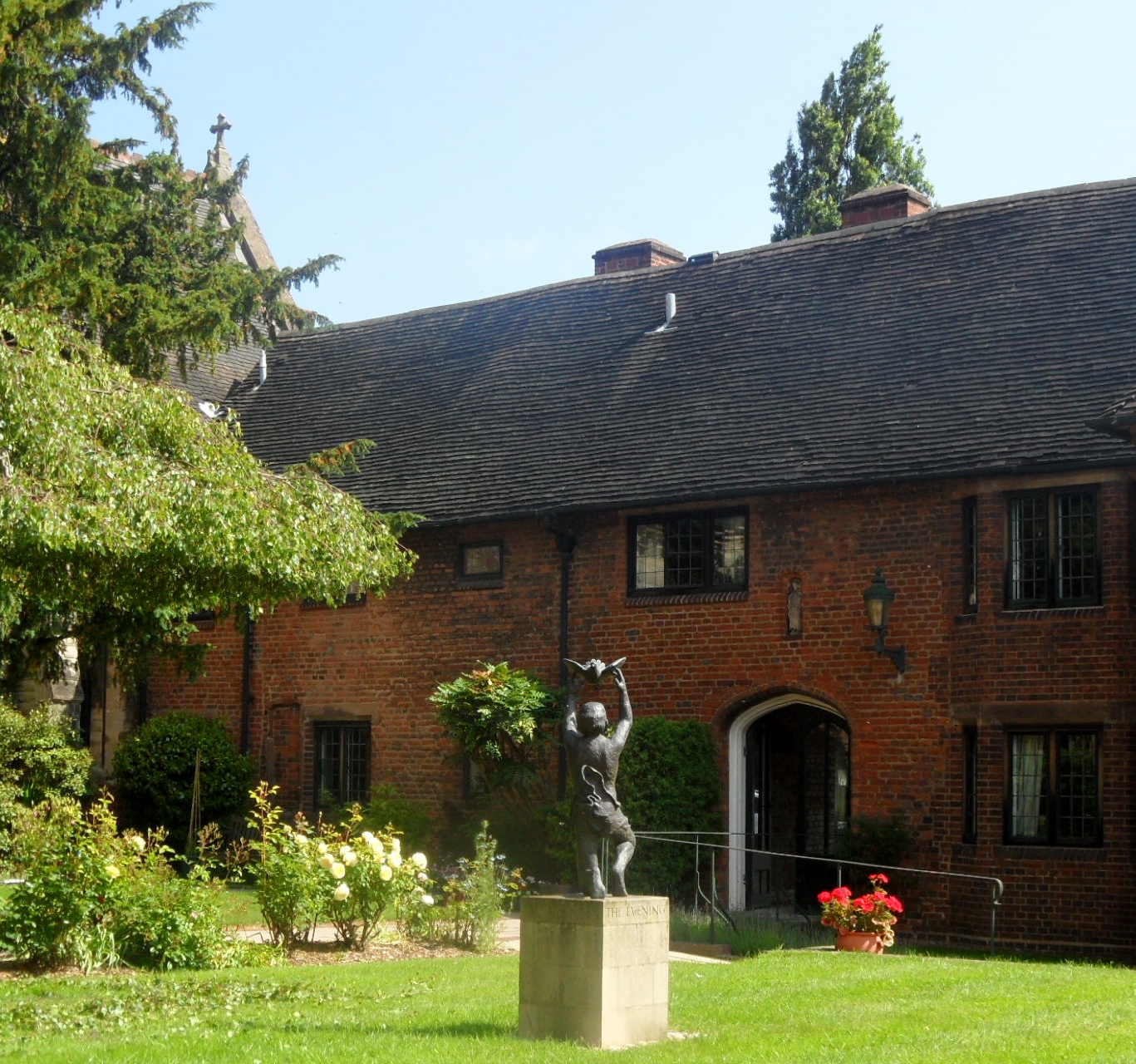
Part of the courtyard at St John’s Hospital
Apparently one woman had protested at ‘the hideous sacrilege and desecration in using ground solemnly consecrated and dedicated as God’s acre for ever, for a bed for sewers’, and so Rev Auden took the opportunity to reassure her, and anyone else that was concerned about the work that was being carried out, that the bones had been collected and reburied together and that the Hospital Quadrangle would soon resume its peaceful aspect, plus the manholes.
Although they did make assumptions in this particular instance, to be fair to the Tamworth Herald, evidence for much older burials, in and around the hospital, was discovered in 1967, when according to the County History, a medieval burial was found during alterations to the almshouses. In June last year, Annette Rubery and local newspapers reported that further remains were found just one metre below the pavement outside the hospital, when workers were repairing a gas pipe, although I don’t think the date of this burial was ever confirmed?
In another post, I’ll look at ‘Councillor Moseley’s Graveyard’, the nickname given to the site of the Friary after Thomas Moseley secured permission to excavate the site in the 1930s, uncovering several skeletons and other archaeological remains, and also the area in and around Lichfield’s Cathedral Close, where amongst other discoveries, a very unusual burial was reportedly found within the walls of one of the buildings in the early eighteenth century. They don’t call this the Field of the Dead for nothing you know (4).
Notes:
(1) One of the reasons I find this particularly interesting is that it seems unusual that it’s a male skeleton with a young child. Over in St Michael’s churchyard, the remains of an adult with a child were discovered, but this was thought to be a mother who had died in childbirth (and was of course in consecrated ground). For more information on that see here. Also, it makes you think about past uses of land and what discoveries like this can tell us. Edit: I’ve just re-read the report and the actual wording is ‘an adult and tiny baby found buried together…it is possible they represent a mother and child who died at childbirth’, so I should make it clear.
(2) For more information on the human remains discovered at Freeford, and thought to be related to the fomer lepers hospital there, see here
(3) Mr Charles Simpson b. April 9th 1800. Solicitor, Town Clerk and Coroner for the City of Lichfield, and Clerk of the Peace for Staffordshire 1825. d. April 22nd 1890Details from the Shrewsbury School Register 1734 – 1908, edited by….Rev J E Auden!
(4) As I’m sure everyone knows by now, Lichfield doesn’t really mean Field of the Dead, it’s just an old myth that’s most likely stuck because it’s more evocative than the real meaning of the the name which is thought to be something like ‘common pasture in or beside the grey wood’. For more on the place name and yet more Lichfield bones see here
Sources:
:Lichfield Mercury Archive
Tamworth Herald Archive
www.annetterubery.co.uk
Hospitals: Lichfield, St John the Baptist’, A History of the County of Stafford: Volume 3(1970), pp. 279-289
Shrewsbury School Register 1734 – 1908, edited by Rev J E Auden


 Lichfield Lore