Christ Church Open Day

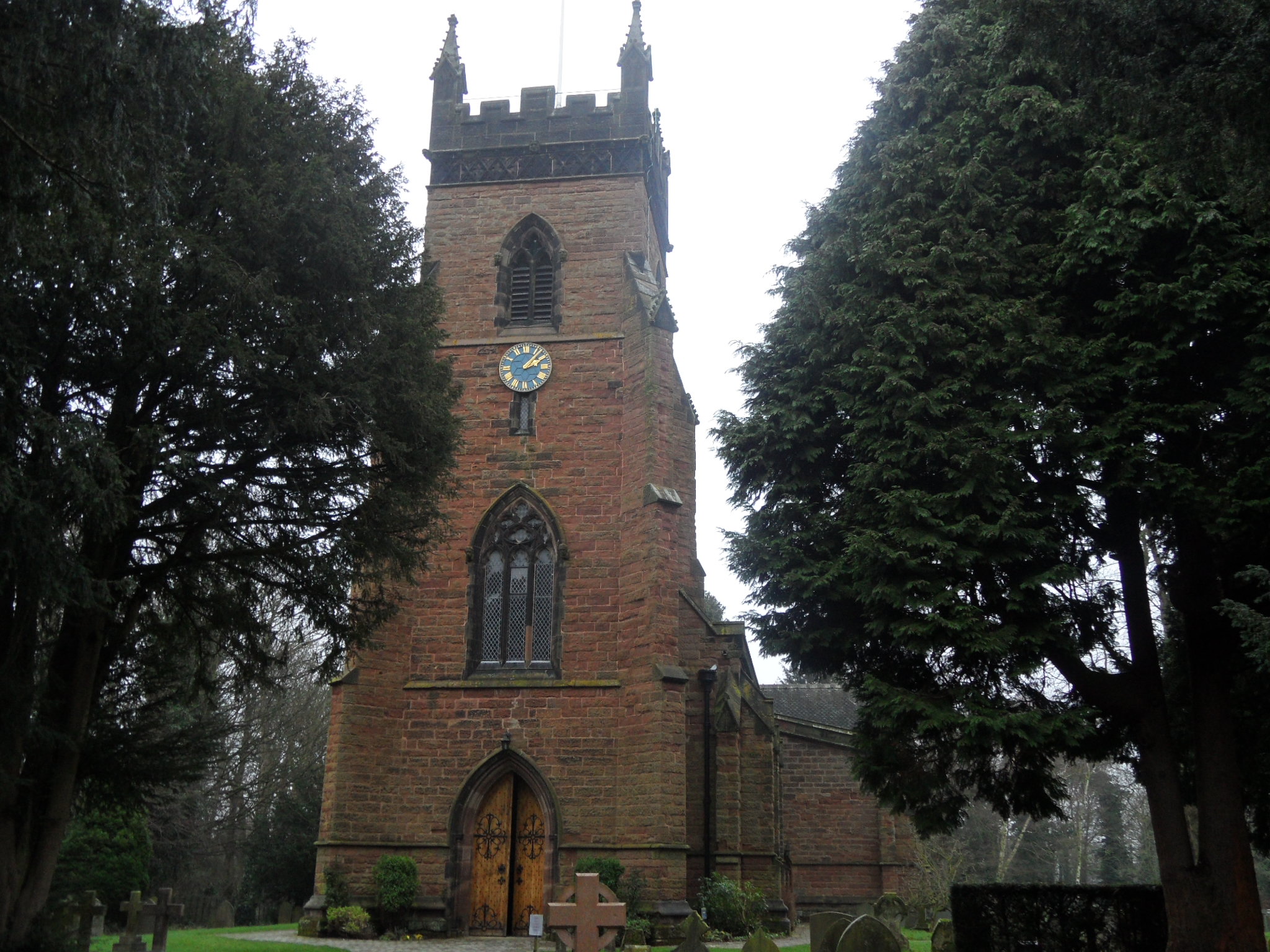
I’m delighted to see that Christ Church, Lichfield is having an open day. On Saturday 9th March, between 10am and 4pm, visitors will be able to explore this wonderful Victorian building and its architectural features, including the lovely chancel ceiling, original Minton tiles and stained glass, with the help of local history enthusiasts.

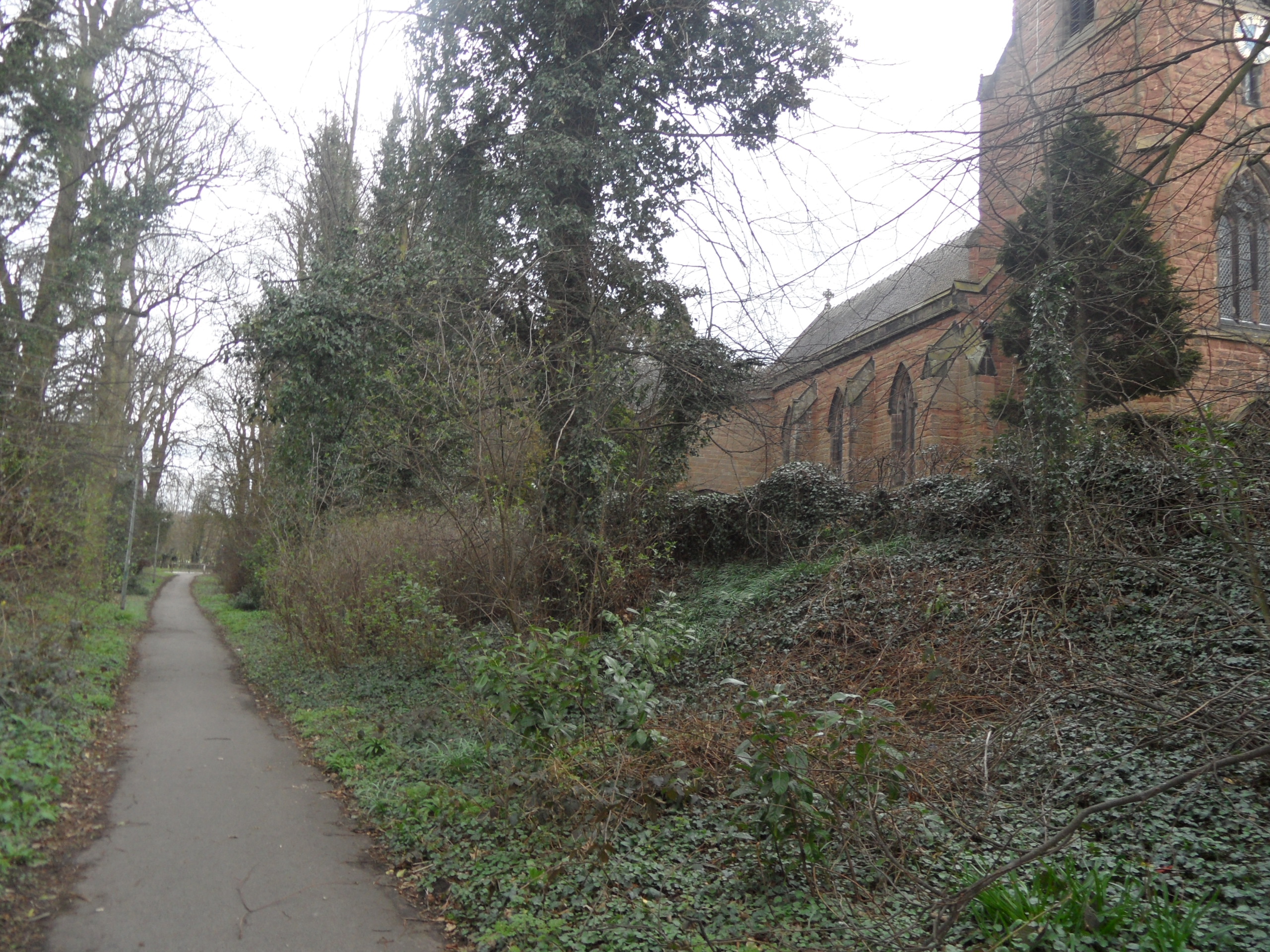
The grounds are lovely at this time of year, and a quick check of my photographs from last March tells me that the wild garlic and daffodils should be coming through in the lane alongside the church, so don’t forget to have a look outside as well as in.  There are also the intriguing stone heads around the inside and outside the building, that I wrote about back in January and am still none the wiser about (although I did see some very similar ones at St Michael’s –  a church that Thomas Johnson the architect was involved in restoring a few years before her started work here at Christ Church)!

The open day is being run by the new Friends of Christ Church, a group whose aim is to support the preservation, conservation and enhancement of the church and its grounds. I understand that anyone who becomes a member will receive an annual newsletter with details of upcoming events and projects to get involved in, and also a copy of the excellent book “Christchurch: A History”, which tells the story of the church, and the associated buildings in the area such as Christ Church School, The Old Vicarage, the cottage in the churchyard and Beacon Place (gone but not without a trace….).

More information can be found at www.christchurch-lichfield.org.uk/events or by email friendsofccl@btinternet.com.


The Faces of Christ Church

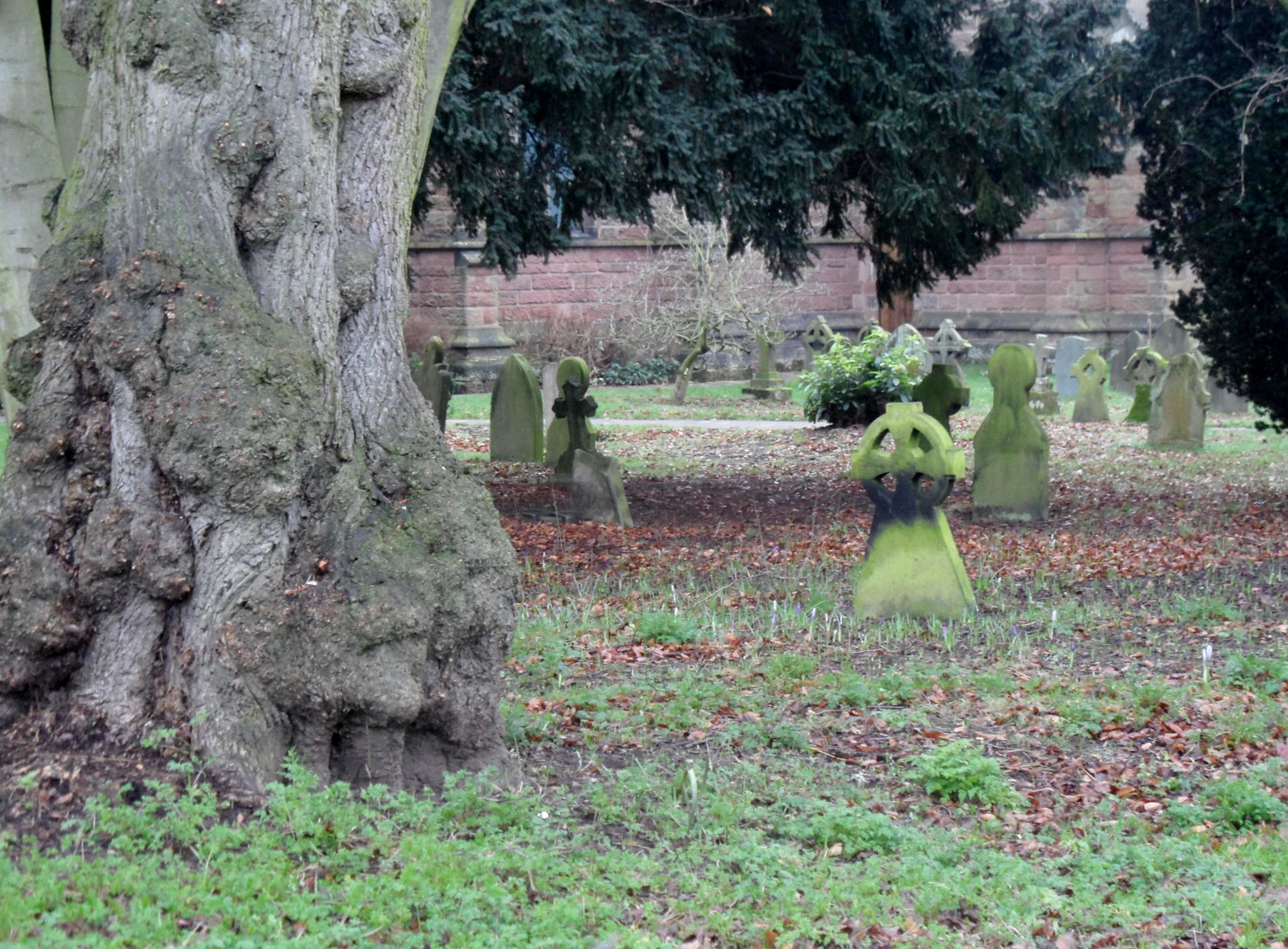
I visited Christ Church on a numbingly cold and drab January afternoon, and I welcomed the sight of the first crocuses and snowdrops beginning to appear amongst the stones erected as memorials to those who once lived here in the parish.
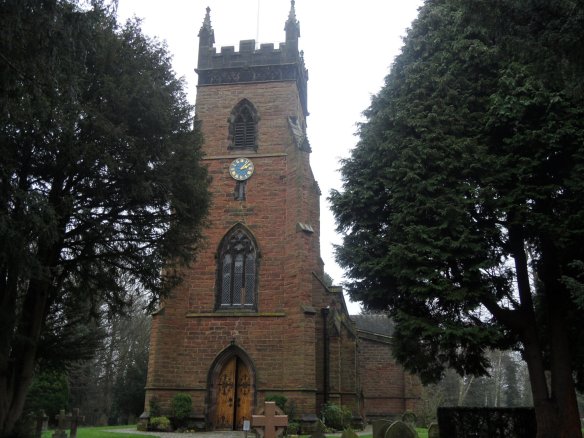
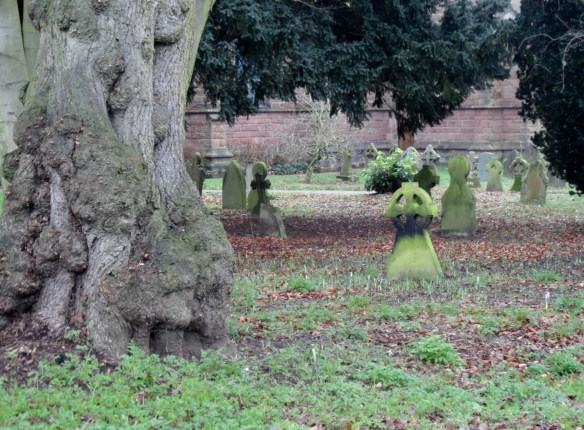
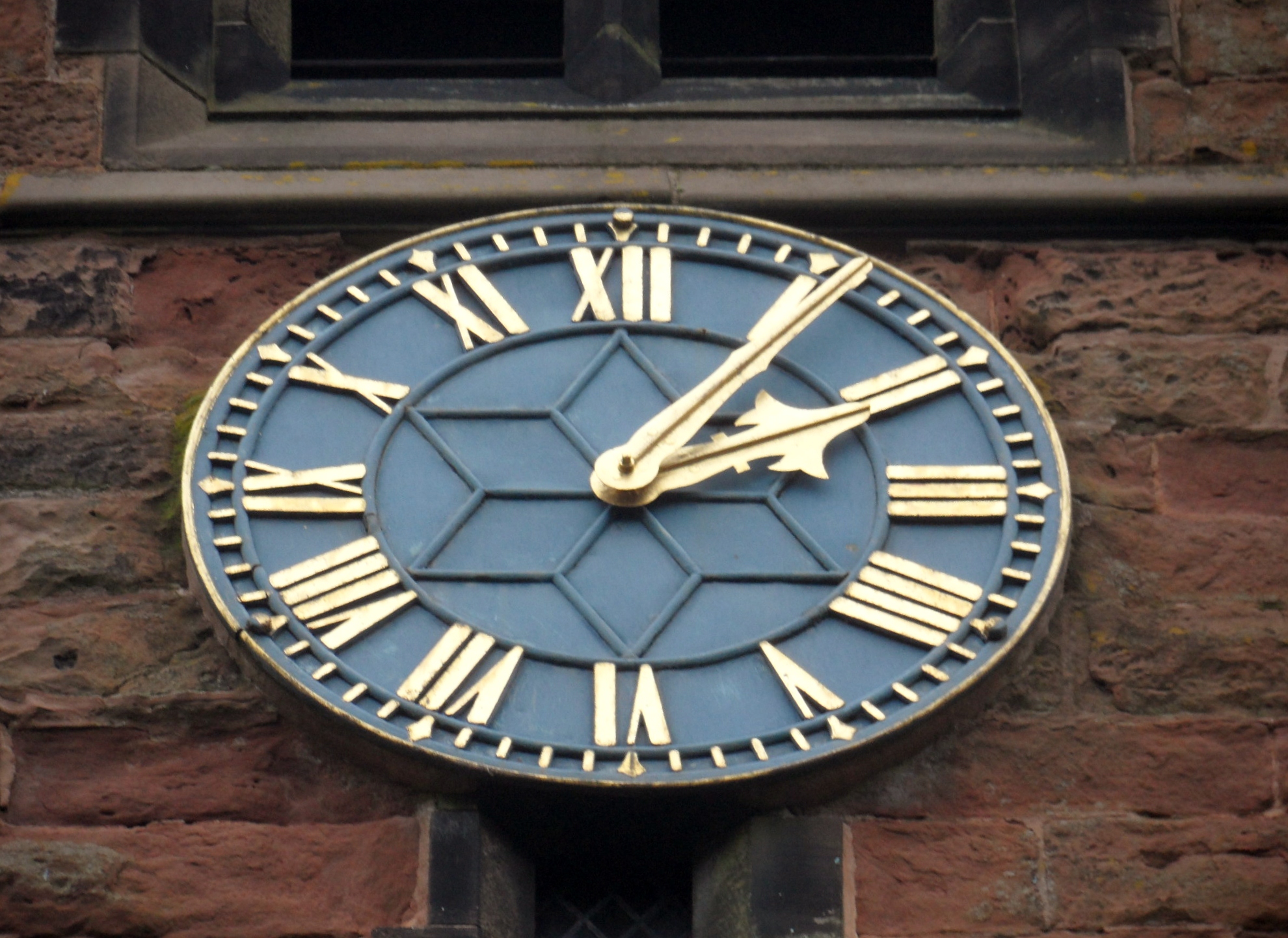
Of course, memorials can take different forms and the blue clock on the tower is dedicated to the memory of Sarah Worthington, of Maple Hayes, presented by her husband Albert Octavius of the Burton brewing company. (1)
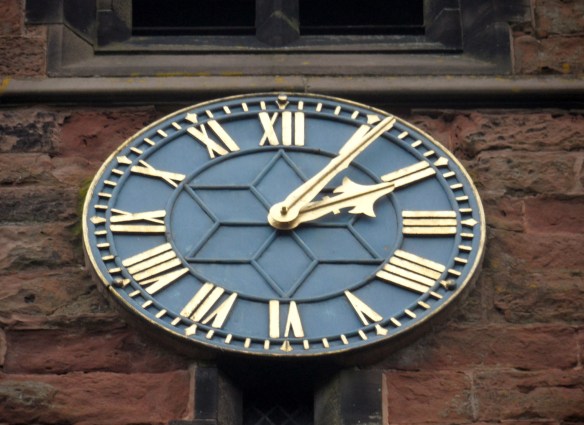
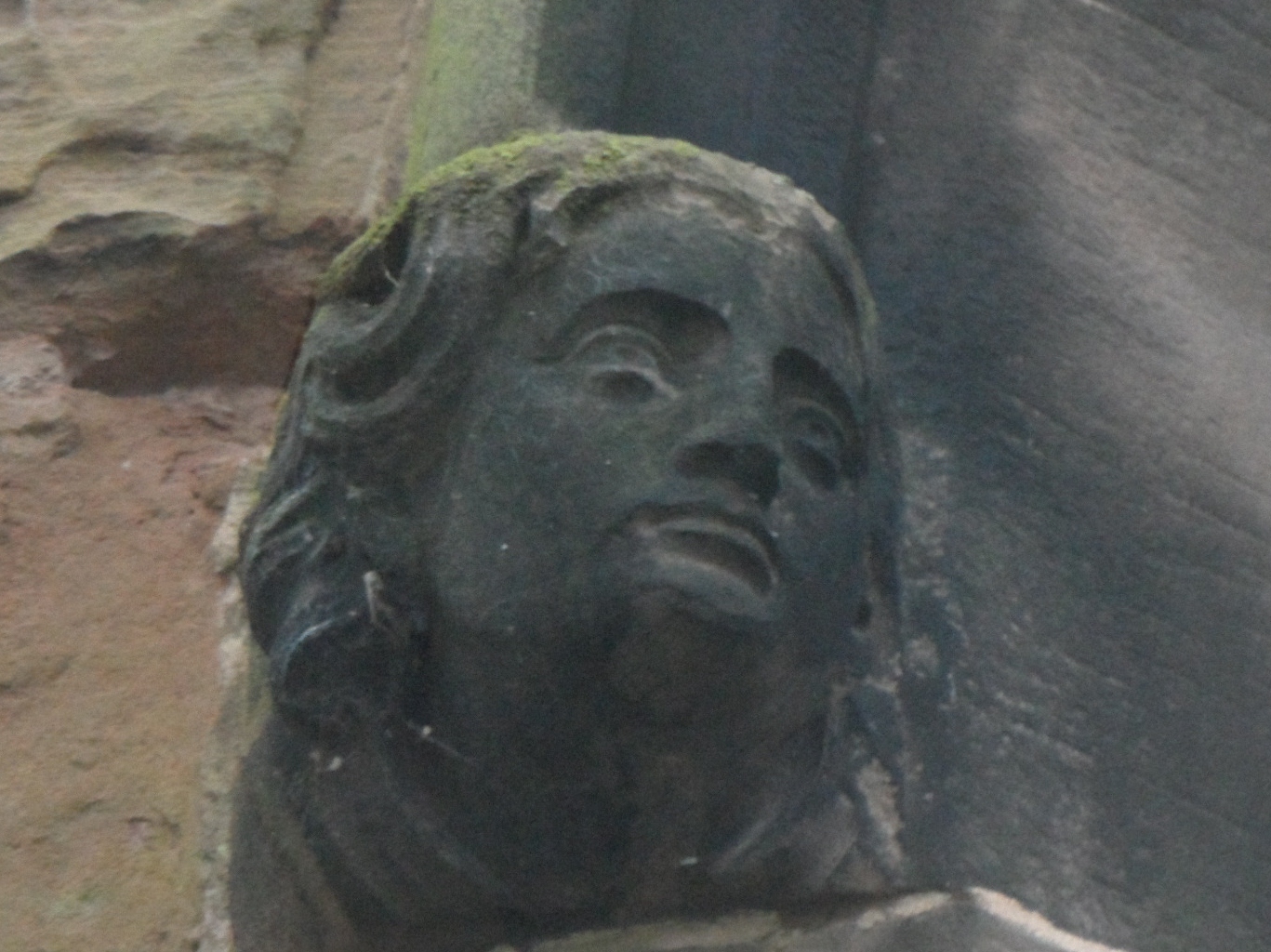
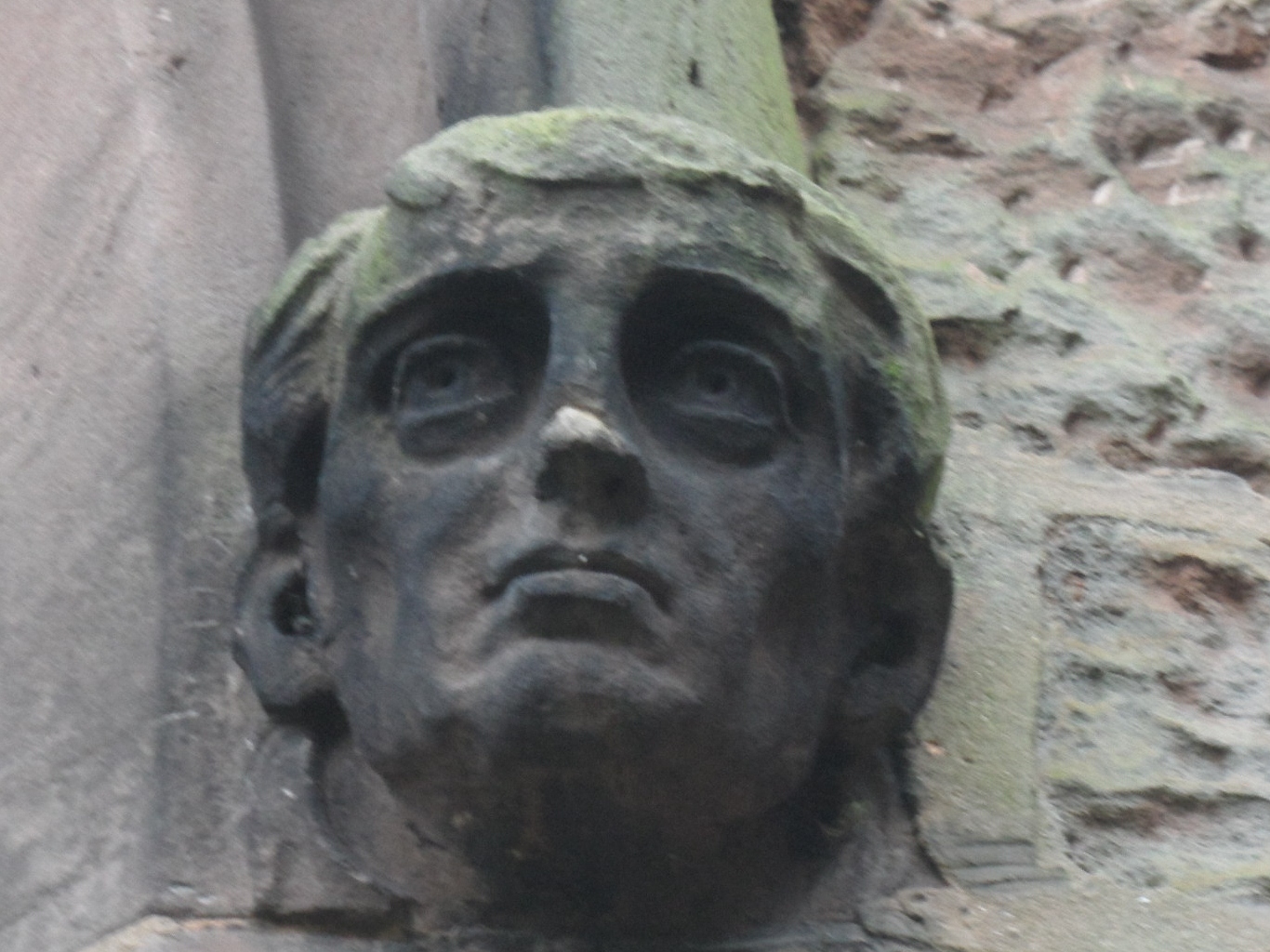
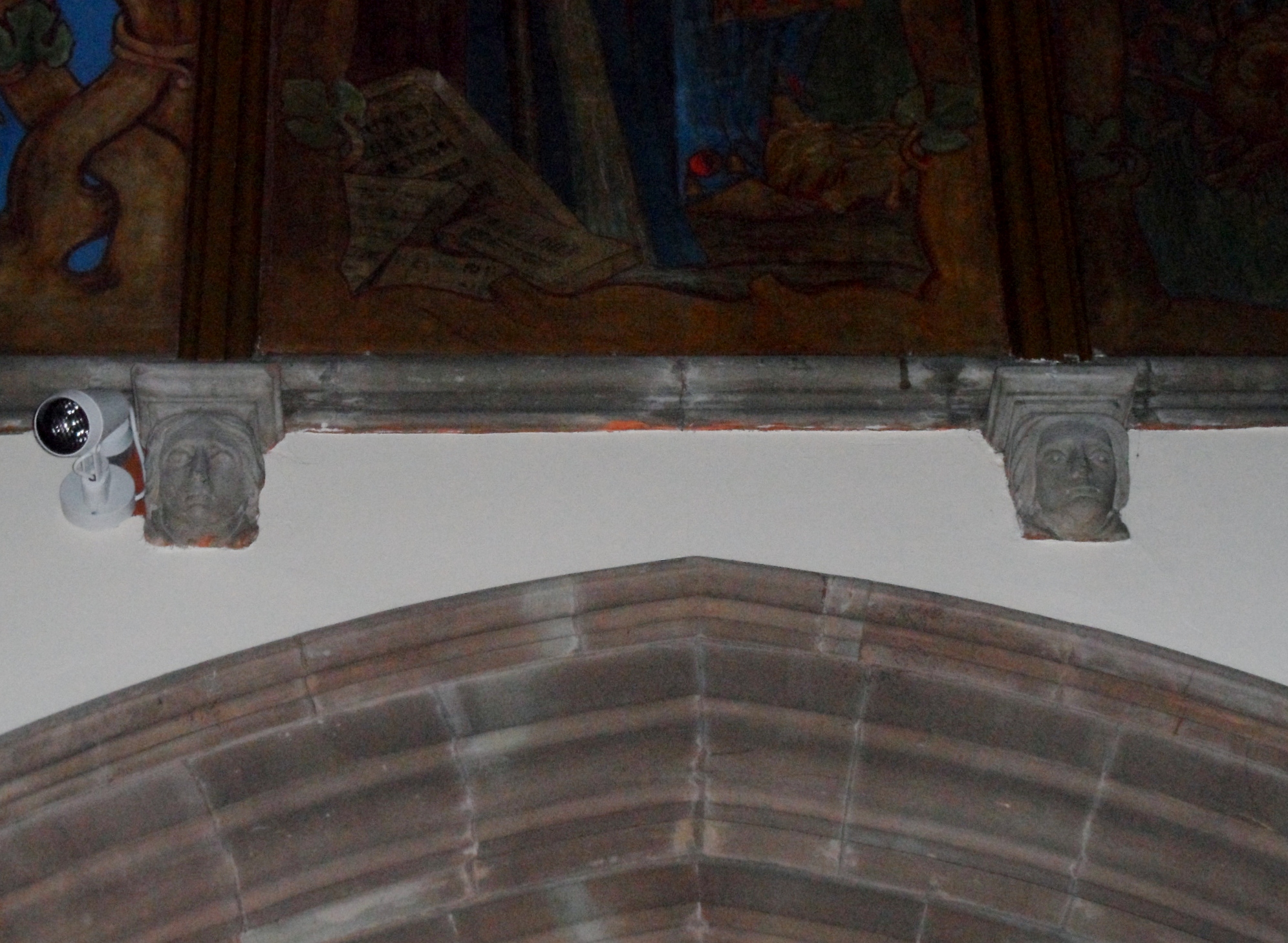
As you look at the clock face, on either side of the window below you notice faces of a different kind. On closer inspection, more of these faces can be found all around the church and I’ve included a few examples below.
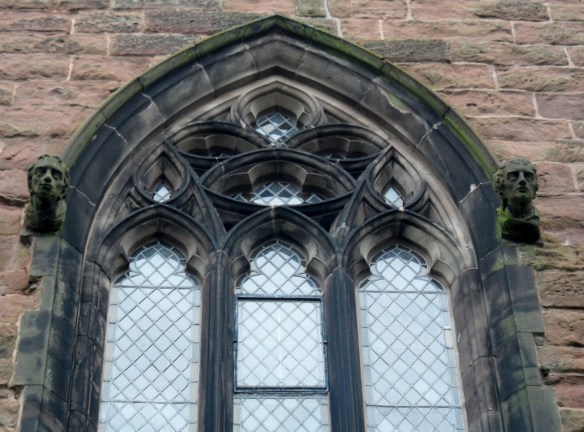
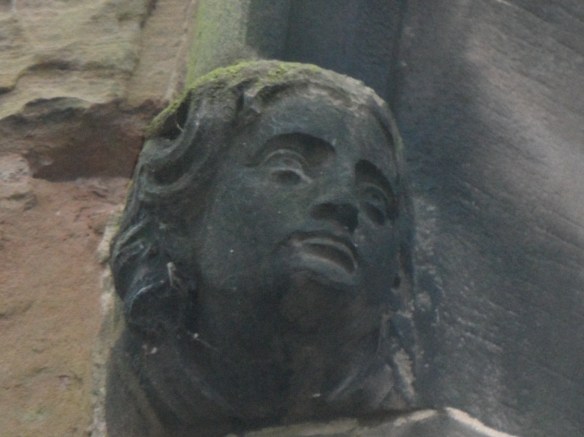
The church was built in 1847, in the Gothic Revival style, and so I imagine the architect Thomas Johnson (of Davidson House, St John St) included them to emulate the corbel heads found in medieval churches (a good example and explanation can be seen on the V&A website here). This might explain what they are, and why they are here, but not necessarily who they are! (3)

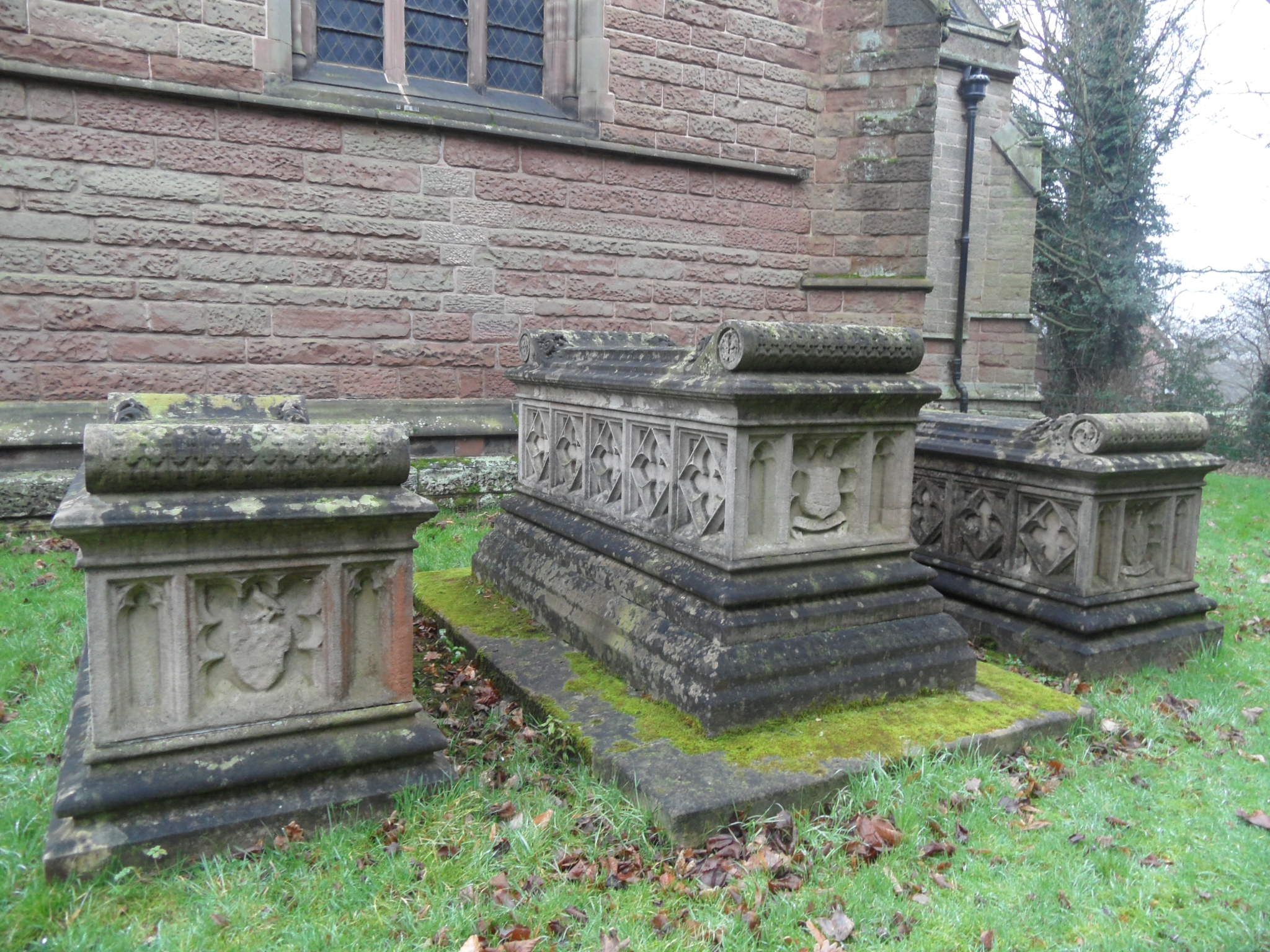
As I stood thinking about the faces, someone arrived to unlock the church door. I explained that I’d been looking at the stone heads and was told that there are more inside and was invited in. Apparently, despite being the subject of much debate, no-one quite knows the story behind them. One suggestion that has been put forward is that they are benefactors of the church. Two of the chest tombs behind the church belong to Ellen Jane Hinckley, the founder of the church and her husband Richard Hinckley, who gave land in the corner of their Beacon Place estate on which to build the church. (2) Are they also here at their church in stone form? Is the portrait of Thomas Johnson the architect or the church’s first curate Thomas Alfred Bangham to be found here? Do they depict people who used to live in the parish or are these heads in fact creations from inside the head of the stonemason?!

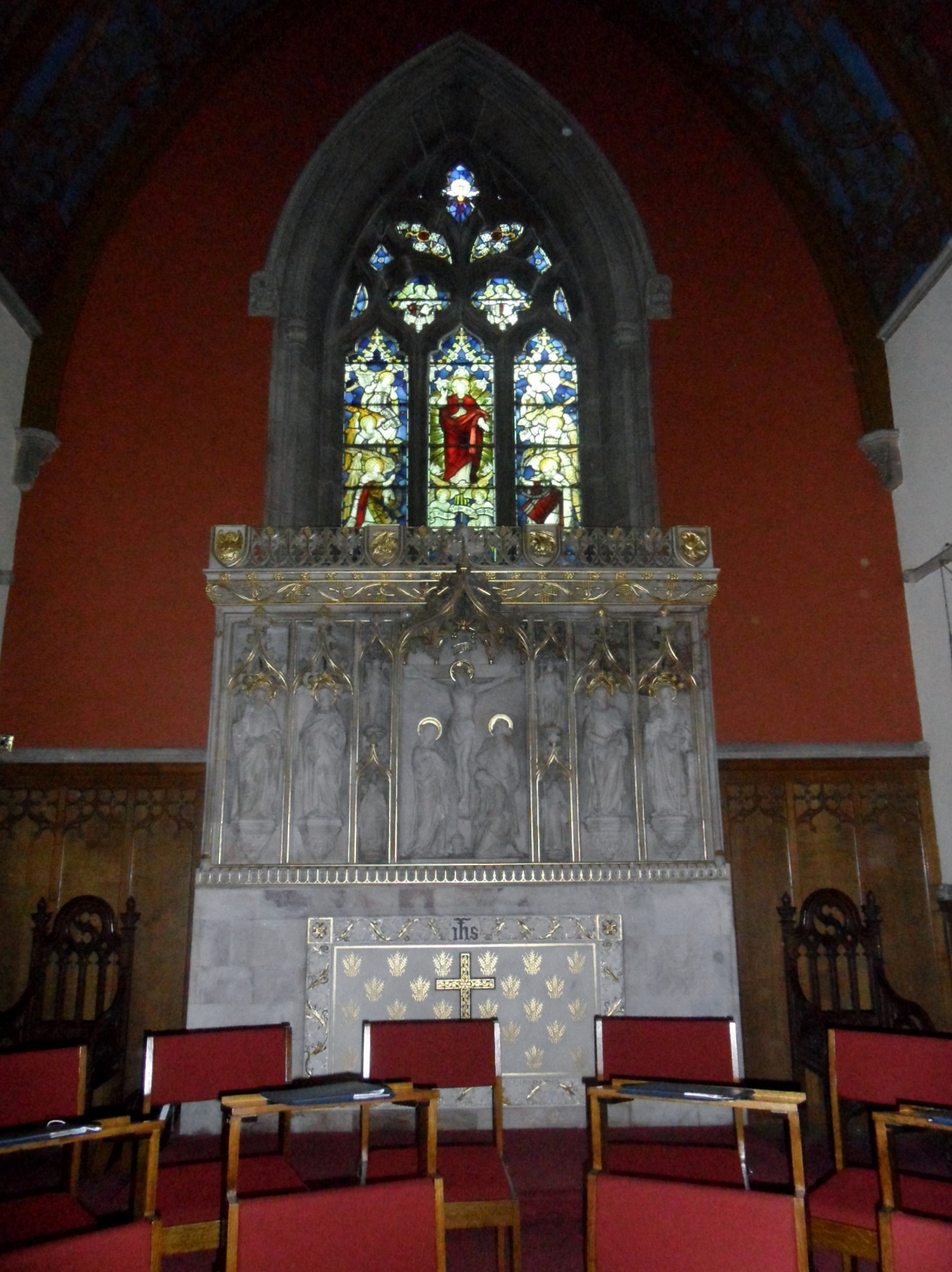
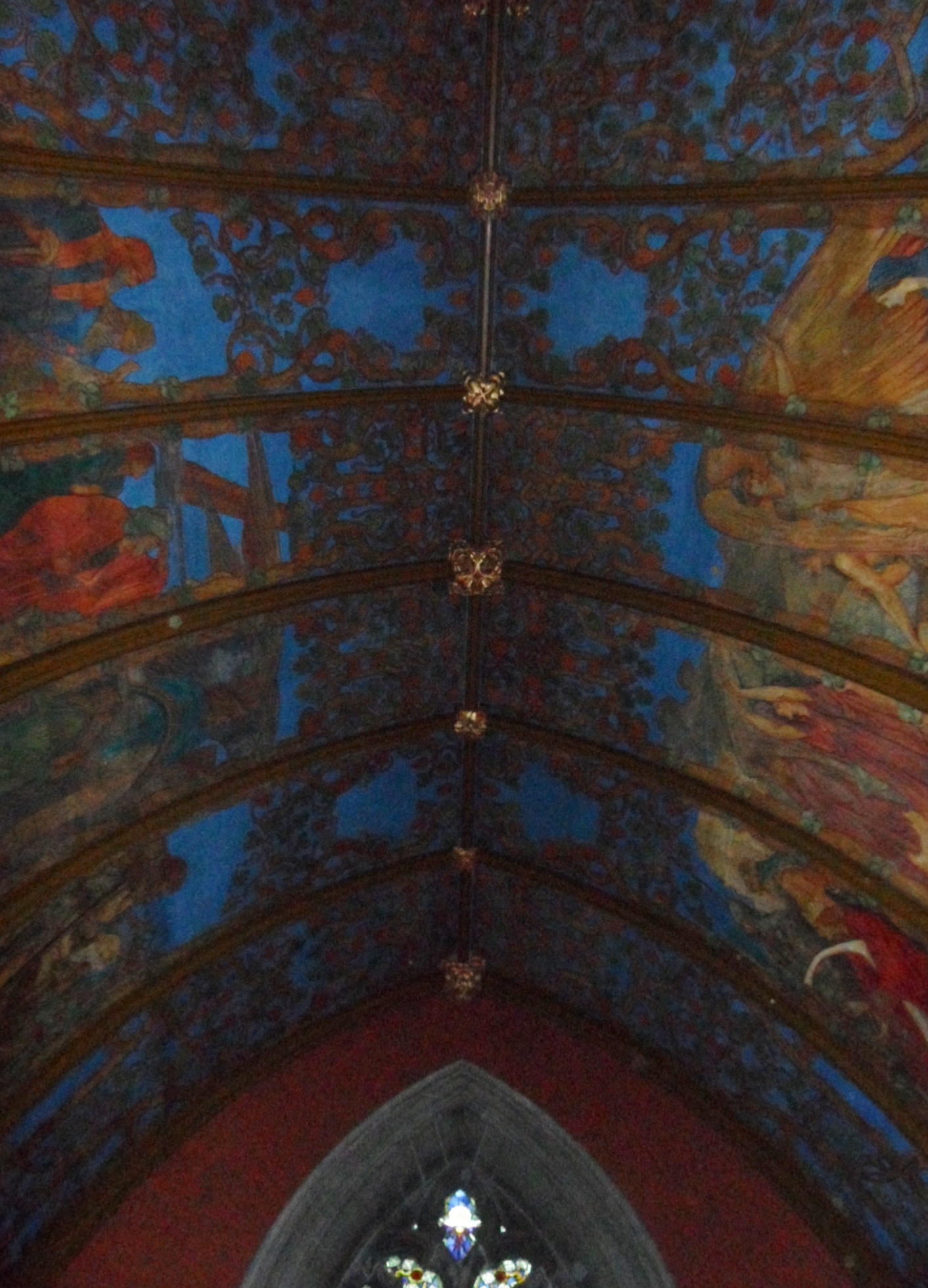
Inside, the majority of corbel heads are in and around the chancel, which has the most stunning ceiling. Although this is not my first time inside the church, it is the first time I’ve been in and concentrated solely on the building, rather than what is going on within it.  It hardly needs pointing out that my photos do it no justice whatsoever, but they do at least give some idea of the beautiful murals painted for the church’s Golden Jubilee by Pre-Raphaelite artist John Dixon Batten in 1897,  and the reredos, designed by GF Bodley and carved by the sculptors Bridgemans of Lichfield (a discovery of both a new word and a new example of Bridgemans’ work for me!). (4)

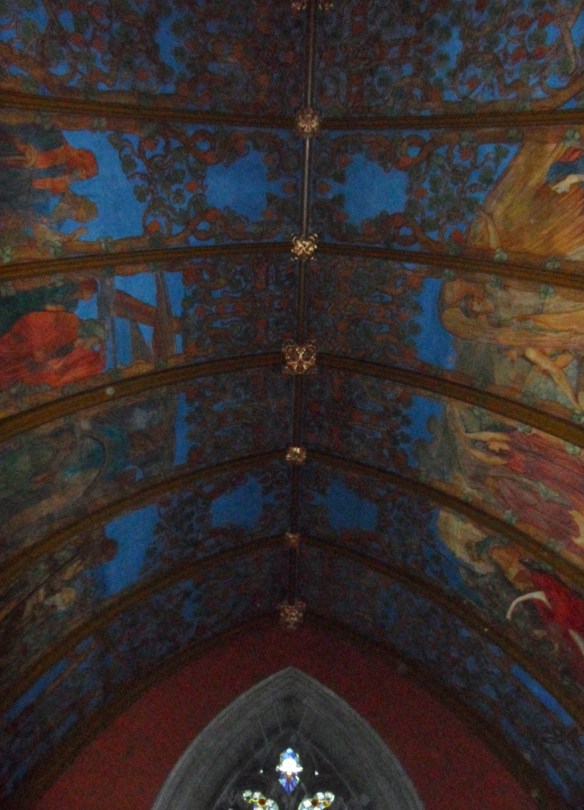
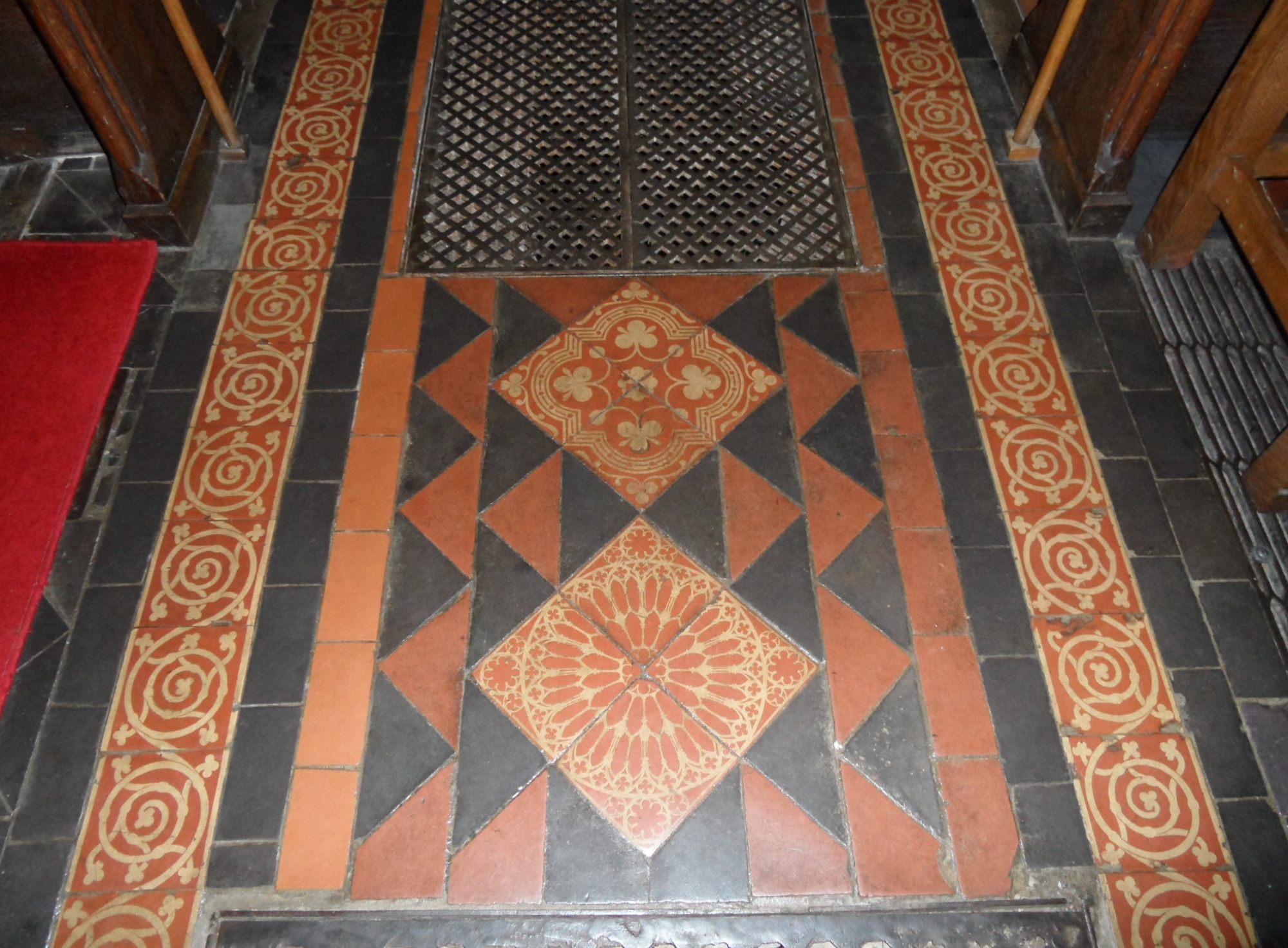
I made my way back outside down the aisle, laid with original Minton tiles (5).

The day should have seemed even greyer after the rich, warm colours of the church but with a copy of the newly purchased and brilliantly researched ‘History of Christ Church’ in my bag and the knowledge that such treasures were to be found on my doorstep, it actually felt considerably brighter.

Edit 10/02/2013 Good news! There’s a sign outside Christ Church saying that there is an open day on 9th March – a great opportunity to go and visit this lovely church for yourself. By then, there may even be some spring flowers and wild garlic in the lane alongside which is a nice thought, when you’re sat typing with snow drifting down outside the window. More details here

Notes

(1) The clock was made by John Smith and Sons of Derby a business founded in 1856. Whilst the firm is still going strong, the original headquarters were at risk as these photos and a news story from February 2011 (read here) show. I’d be interested to know what the current state of the building is? Also, it’s not only the clock we have the county of Derbyshire to thank for! The church’s Millenium Gates were created by David Tucker, a master Blacksmith from Derbyshire, that I wrote about here

(2) The third of the Hinckley Tombs belongs to Mrs Hinckley’s son from her second marriage to Hugh Dyke Acland. Mrs Hinckley’s daughters from her first marriage, are the girls depicted in Francis Chantrey’s sculpture known as ‘The Sleeping Children’ as Lichfield Cathedral

Hinckley Tombs, Christ Church

(3) In a 1950s edition of Life magazine, I came across an interesting article about Southwell Minster in Nottinghamshire. Their old carved heads had eroded badly, and so a stonemason was enlisted to restore them. However, rather than recreate the old images, he carved new images of people associated with the church at that time including a bell ringer, the clock winder, a dog whipper (actually in charge of the grounds) and the youngest member of the church choir (who would now be in his 60s). You can read the article and see the photos here 

(4) I believe that Bodley and Bridgemans also collaborated on the South African war monument in Duncombe Place, York, which is where the sailor on the wall of Lichfield Registry Office was originally destined for but was apparently rejected  for being too warlike.

(5) Between 1844 and 1858, Herbert Minton donated tiles to 46 Staffordshire churches & parsonages. More information can be found in the report ‘Minton Tiles in the Churches of Staffordshire’, carried out by Lynn Pearson for the Tiles and Architectural Ceramics Society. At the time of the report in the year 2000, amongst others, there were also examples at St Mary’s, Aldridge, possibly St James’ Church, Brownhills (though covered) and St Peter’s, Elford. An online version of the report with photographs can be found here 

Sources:

Christ Church Lichfield – A History by Ursula Frances Turner, later revisions Robert Hazel, Julia Baker and Larry Ridout

Public Sculpture of Staffordshire and the Black Country – George Thomas Noszlopy and Fiona Waterhouse
ExpLore – Lanes Around Leomansley

Walking is such a pleasure. I get seriously itchy feet if deprived for more than a day or so, and my spirits are always lifted after a good old trudge around. Exploring somewhere for the first time is fantastic, but I also love to walk around the places I know. It somehow gives me feel warm and comfortable feeling, like a favourite old cardigan. And of course, sometimes there can be surprises up even the most familiar sleeve…

I’ve decided I’d like to try and put some walks here so that people can get out and explore for themselves.  One of my best loved walks is of course around Leomansley, so here’s a walk around the lanes that I hope you’ll enjoy doing for yourself. Naturally,  I always encourage straying from the path to investigate something that looks interesting. Getting lost is part of the fun!

Lanes Around Leomansley

The map below gives a rough idea of the route, which is about 2km (depending on how many diversions you take!). I’ve marked some of the points that I think are of interest but of course there may be other things…….Below the map is a PDF with a written version of the route, giving information about each of the points. Hope you enjoy it, I’d like to hear how you get on!

Lanes Around Leomansley walk


An Inconstant Stream

According to place name expert Margaret Gelling, Leomansley Brook has a pre-English name. It’s thought the name could contain the Celtic word lēmo, meaning ‘elm’ (1) or lēme meaning ‘limetree’ (2).

1- Conduit Heads; 2 – Start of Leomansley Brook?; 3 Site of Leomansley Mill/House/Manor; 4 – Former Beacon Place fishponds, now Beacon Park boating lake

The brook rises near to the conduit heads at Pipe Hall Farm, Burntwood (at a place I’ve just noticed was also known as The Dimbles, just as the area near to the Circuit Brook is/was!), and crosses the Lichfield/Burntwood boundary, to fill a series of pools on the edge of Leomansley/Sloppy Wood before meandering through Pipe Green.

As mentioned in my previous post, Leamonsley Mill was built on the brook at the edge of Pipe Green in the 1790s. There are a few traces of the industry that was once here – ‘Leomansley Mill Cottage’ is a little further back down the track towards Christ Church Lane and there are also some possibly related brick structures. The second photo shows the place where the brook re-emerges to flow through Pipe Green, and is shown on some maps from the late 19th and early 20th century as a ‘Spout’.

Taken June 2011. On old maps, this is marked as sluice. This part of the watercourse was filled with water once again this weekend

Taken December 2010. Shows as spout on old maps.

I found a recollection by someone who spent the summer of 1984 at the old mill cottages then known as Leomansley House (which they have included a photo of!) producing the first and only issue of what they describe as a ‘local anarcho-DIY philosophy magazine’. In their description of the old house, they describe how Leomansley Brook ran past the front door.

The other stories I’ve found about the pool relate to changes brought about by nature. In February 1902, the frozen pool was used for ice skating.  The Lichfield Mercury reported that on the Friday after the freeze, the pool was quiet, but by Saturday a group of ‘horrid hockey people’ (as one unnamed woman described them) had discovered it and monopolised the best part of the pool.

Another Mercury story, from April 1976 when the artist Eilidh Armour Brown lived at Leomansley House, tells of a water shortage at the pool

Lichfield District Council Staff had been prepared to move fish from Leomansley Pool, after the water levels dropped to a dangerous level for the fish. The fish were to be transferred to Minster Pool until the water level at Leomansley had risen. Luckily a storm that weekend brought the much needed rain and it was no longer necessary.

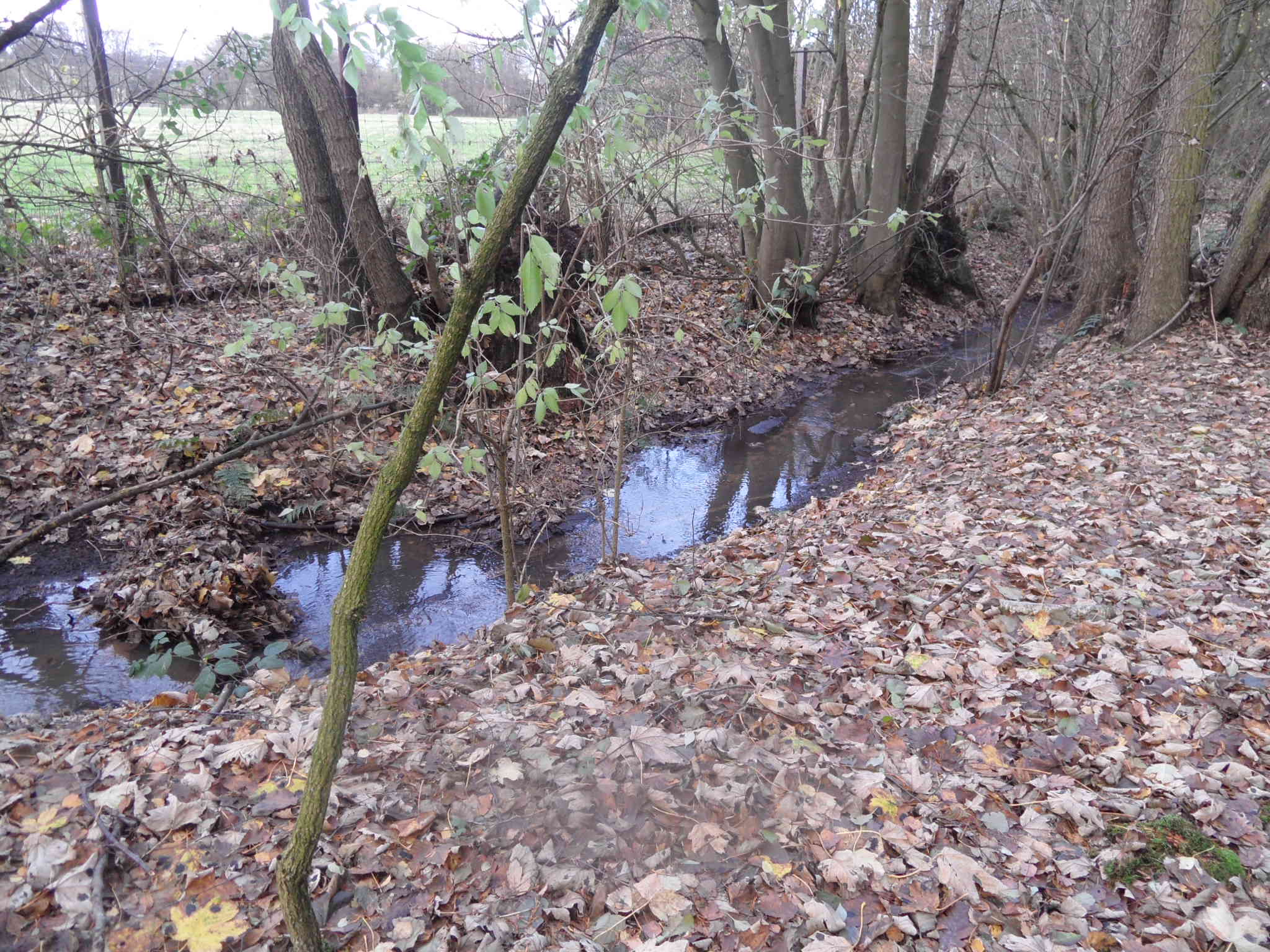
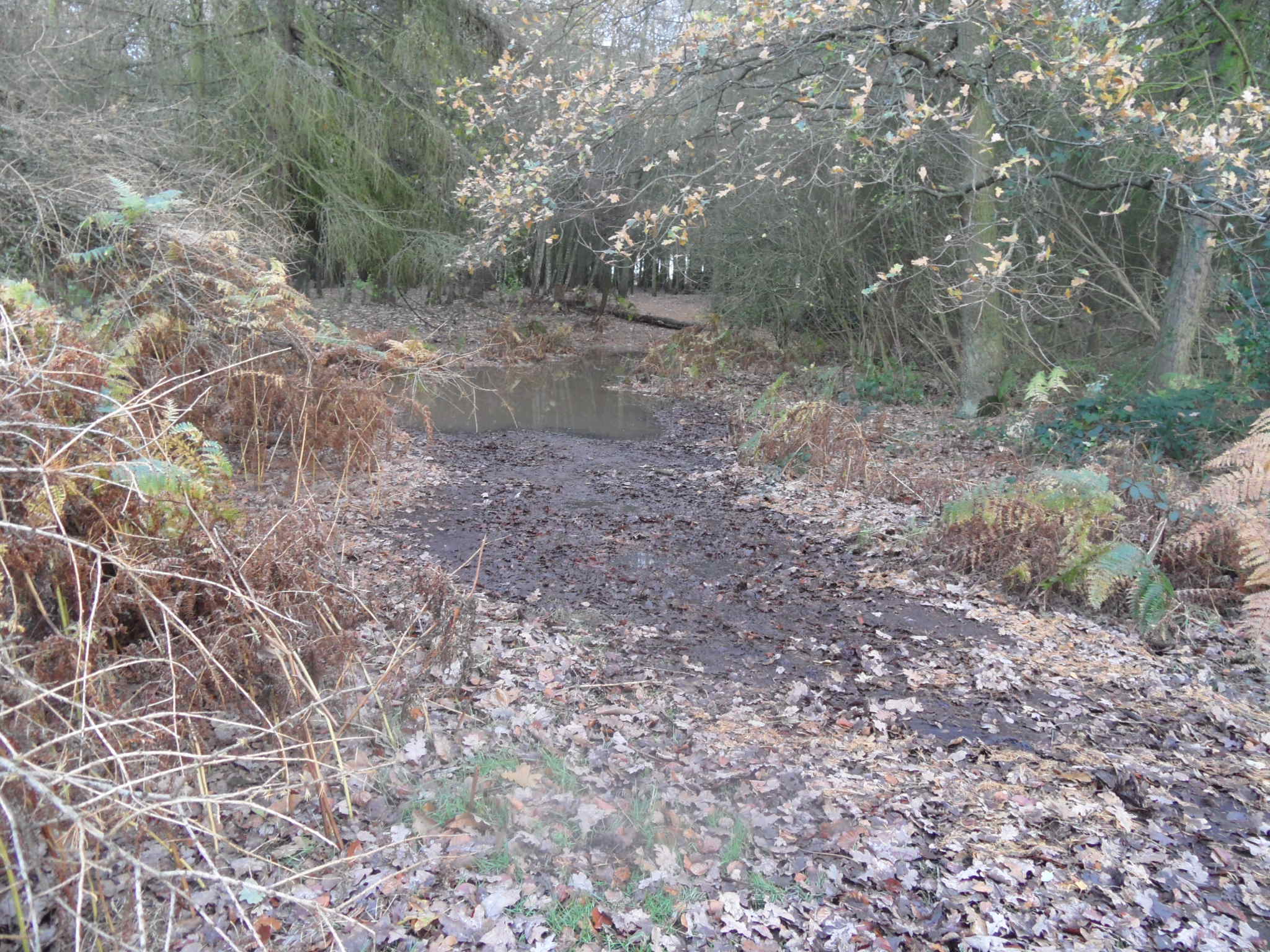
Things couldn’t have been more different this weekend. The normally dry part of the course along the edge of the woods was full, and levels in the pools were high, as you’d expect.

Taken November 2012. This part of the brook is normally dry.

Taken November 2012. I was told there used to be a bridge somewhere near here for farm carts to cross into the adjacent field.

Taken November 2012

As you can see in the above photo, not only was the brook refilled,  but the water was also claiming parts of the path. I imagine that’s how the name Sloppy Wood came about!

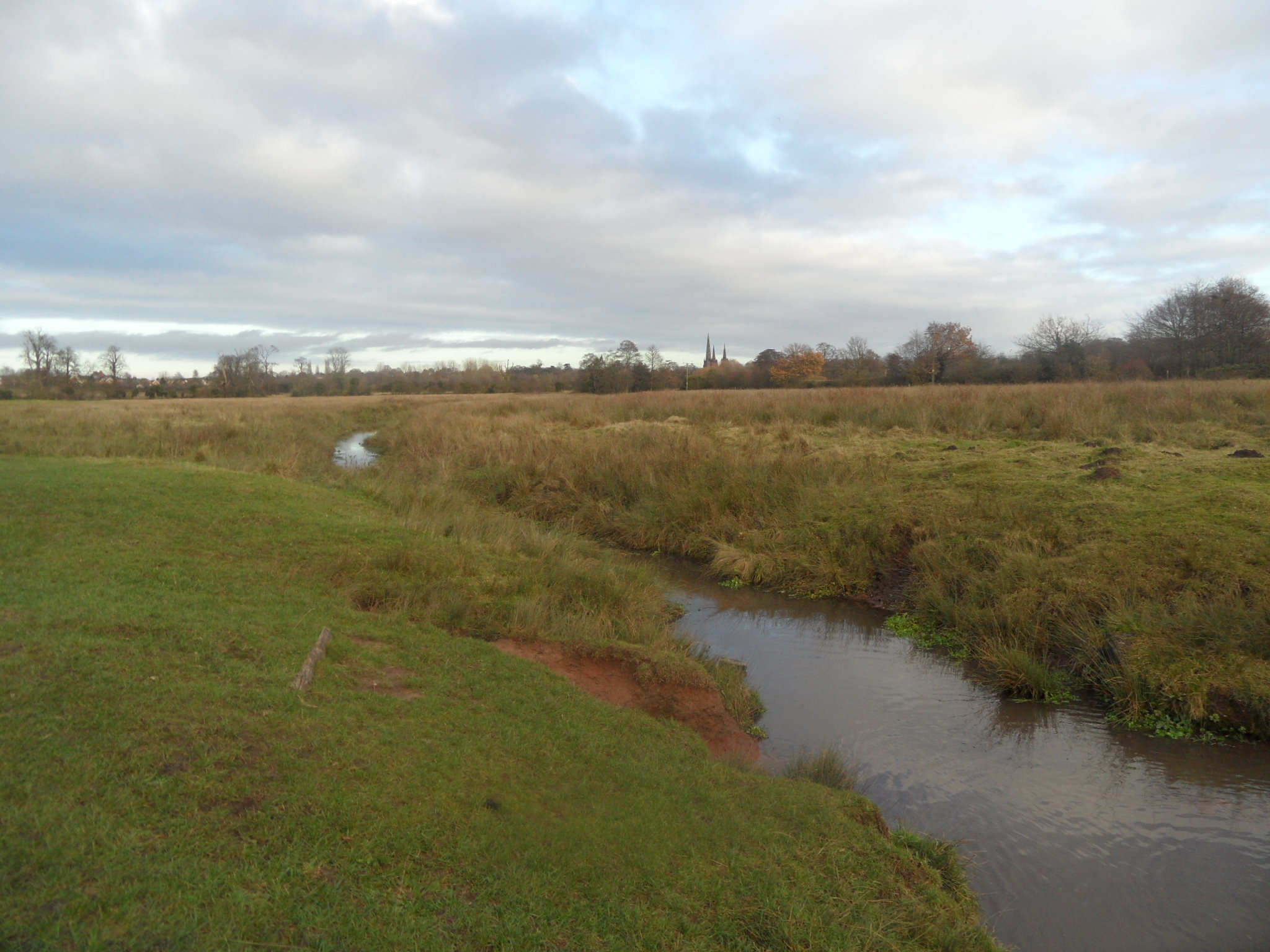
From Pipe Green, the brook is culverted under the A51, and then flows through Beacon Park, filling what used to be the fishponds for Beacon Place (now the boating lake in the park), before finally ending up at Minster Pool.

November 2012 – Through Pipe Green


November 2012 – Looking back towards Leomansley House/Mill/Manor!

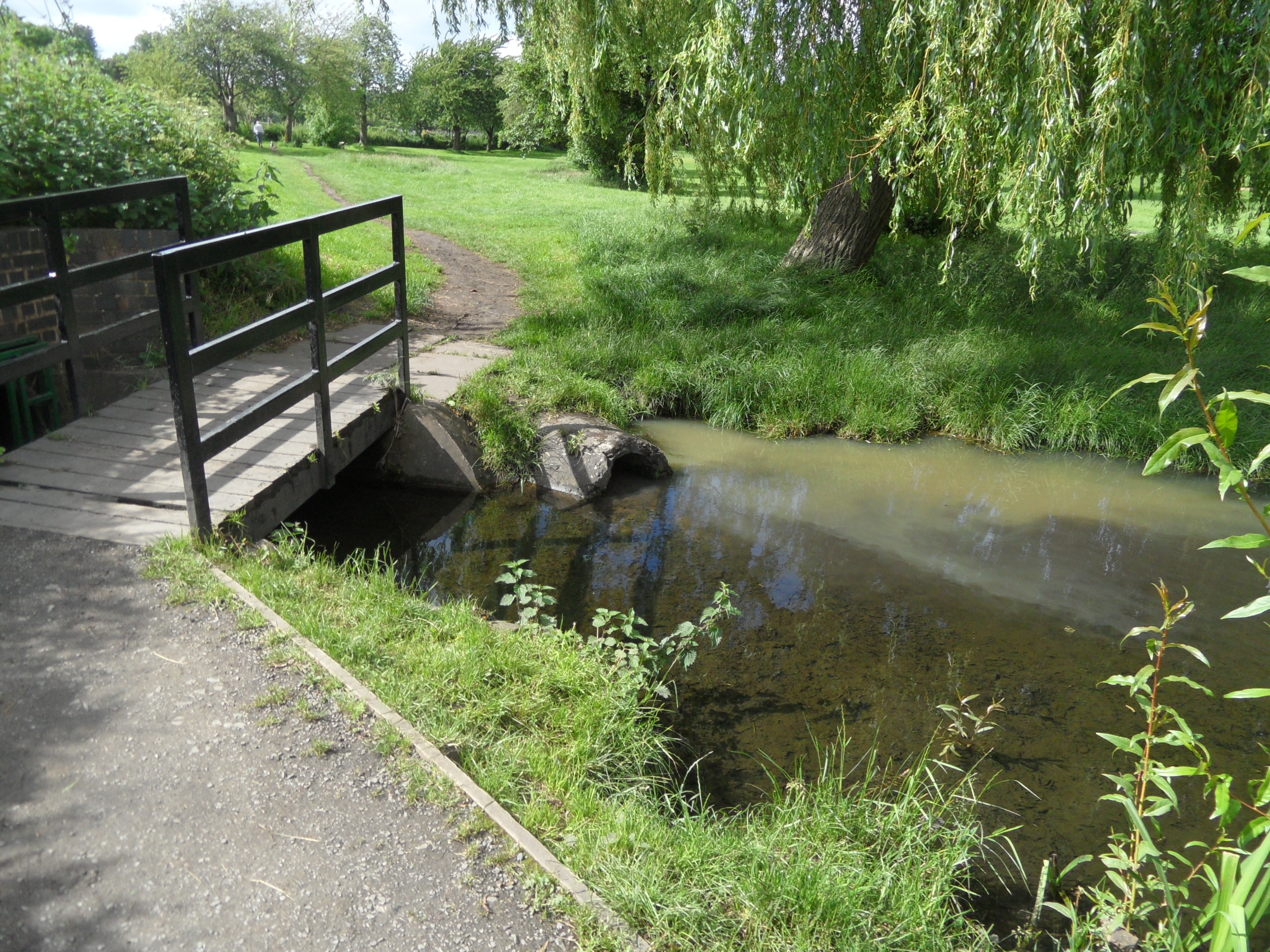
June 2012 – Leomansley Brook enters Beacon Park via a culvert under the A51. The reason the water looks murky by the pipe is that a little dog was paddling just before I took the photo!

June 2012 – Passing the play area in Beacon Park. This used to be a fish pond for the mansion Beacon Place (demolished 1964).

I don’t know anywhere near as much about streams and brooks as I’d like to but am really interested in them and their importance in the development of our landscape, e.g., the formation of natural boundaries and giving names to places that grew up along them. I’m also fascinated by our relationship with watercourses like these and our attempts to manage them, for better or for worse.

Sources

(1) ‘Lichfield: The place and street names, population and boundaries ‘, A History of the County of Stafford: Volume 14: Lichfield (1990), pp. 37-42.

(2) http://finds.org.uk/staffshoardsymposium/papers/mattiasjacobsson

The Mill's Tale

When I first moved to Lichfield, the building at the end of the track leading through Leomansley Woods was a derelict shell.  Intrigued, I looked into the history of the area and found out that it was probably related to a fulling mill that had been built there in 1791 by John Hartwell, on the edge of the Pipe Green trust land  (you can read more about this beautiful part of Lichfield on the Trust’s website here).

The OS map from 1815 shows a ‘Cotton Mill’ in that area.  Later maps refer to it as Leamonsley Mill. (In fact, the spelling of the name of the mill, and the area has changed several times. Variations include Lemmonsly, Leamonsley, Lemonsley, Lemondsley and in recent years, the name seems to have settled at Leomansley!).

This is the only image of Leomansley Mill I know of. It’s a trade token showing Leomansley Mill at the time of John Henrickson. Although the token isn’t dated, we can work out roughly that it must date to between 1809 and 1815 – the county history tells us that Mary Hartwell, widow of John Hartwell, let Leamonsley Mill together with a warehouse and weaving shop on Lombard St in 1809, and the following notice in the London Gazette tells us that Mr Henrickson, who is named on the token, went bankrupt in 1815.

To be sold by auction, by order of the major part of the Commissioners named and authorised in and by a Commission of Bankrupt against John Henrickson, of the City of Lichfield, Cotton-Spinner, at the Three Crowns Inn, in Lichfield aforesaid, on Monday the 18th day of March instant, between the hours of Three and Six o’Clock in the Afternoon, either together or in lots, as may be agreed upon at the time of sale;
All the machinery, mills, spindles, bobbins, winding frames, warping-mills, looms, shuttles, and other apparatus, suitable for carrying on an extensive trade in the Cotton Spinning and Calico-Weaving business, now standing in Lemmonsley-Mill and Lombard-Street-Factory, in the said City of Lichfield, late the effects of the said Bankrupt. The machinery and implements are all nearly new, and in excellent condition, and may be viewed by applying to Mr. Palmer, of Mr. Rutter, of Lichfield aforesaid, the Assignees of the said Bankrupt;and further particulars may be had at the Office of Mr. Foster, Solicitor, Rugeley, Staffordshire.

Reproduced from Lichfield District Council flickr stream

Recently, I found a newspaper notice of the sale by auction at The George Hotel on 24th May 1833, giving another detailed description of the mill.

‘A valuable watermill called Leamonsley Mill with a large Head of Water and Appurtenance, situated at Leamonsley near the city of Lichfield, formerly erected as a Fulling Mill, but lately re-built four stories high, and now in work and used for spinning hosiery and knitting yarn for the Leicester and other markets. Power to any extent may be added by erecting steam, being on the road from the Brownhill Colliery. Also. a right of four inches of top water from the pool of John Atkinson of Maple Hayes, covering about six acres of ground; with a good dwelling house, garden. land, combing shop and premises occupied therewith, late in lease to Thomas Leach.

It seems that the new owner, did decide to add steam power, as an 1860 newspaper carries an advert for,

Leamonsley Mill, within one mile of the City of Lichfield. Woollen Machinery, Water Wheel, Steam Engines. Messrs C and H Gillard are instructed to sell by auction on Monday 30th July 1860, on the premises,
The Machinery and Plant of the above Mill, for spinning floss or fleecy wool, comprising spinning frames, roving and doubling machines, a very  capital overshot or breast water wheel, constructed of iron. An excellent noncondensing or high pressure steam-engine, 2 feet stroke, of about 8 horse power, with beam, fly wheel, and governor and steam boiler, together with the shafting, as recently in use. Also, a capital brass lift and force pump, with lever on plank, quantity lead pipe.
This whole lot to be sold in several lots, as appear in catalogues, in consequence of the building being required for other purposes

And yes, I am trying to locate a ‘Glossary of Mill terminology’ to work out what half of those things are!  I wonder if the sale was related to the bankruptcy of James Johnson of Lemonsley Mill in January 1858, as notified in the London and Edinburgh Gazettes? The fact the building was ‘being required for other purposes’ is an interesting one…by 1884, ‘Leamonsley Cottages’ are shown in the place where the mill once was. I believe that by this time, it had become part of the Maple Hayes estate, and the cottages were used to house some of its workers. I’d like to know more about the state of this industry to discover why more than one bankruptcy featured in the history of the mill, and also why in 1860, a working mill was abandoned in preference of using the building as accommodation for servants?

I find it hard to imagine Leomansley as a place of industry, but it’s why the area developed in the early 19th century.  A while back I did a post about how the 1841 census showed that many residents seemed to have been employed by the mill.

Of course, whilst the area of Leomansley grew up around the mill, the mill presumably was there as a result of Leomansley Brook. And Leomansley Brook deserves a post of its very own….

Sources:

Lichfield: Economic history’, A History of the County of Stafford: Volume 14: Lichfield(1990), pp. 109-131

Sheriffs Ride…I walk!

I understand that for about 330 years, Lichfield was not just a city, it was a county, one of 18 towns and cities in England which gained county corporate  status at one time or another, for a variety of reasons e.g. Poole became a county separate to Dorset for reasons involving piracy! Lichfield’s status was granted by Mary I, apparently as a reward to the city for support during the Duke of Northumberland‘s rebellion.

A perambulation of the border of the city had been taking place since 1548, when Lichfield was made a city in Edward VI’s charter. However, that was carried out in view of the Sheriff of Staffordshire. Queen Mary’s charter, gave Lichfield the privilege of having its own Sheriff, who took over the perambulating duties and began the tradition of the Sheriff’s Ride which still takes place every September, on the Saturday nearest to the Nativity of the Blessed Mary. This year, it’s this Saturday (8th September).

According to the county history, the earliest records of Lichfield’s boundaries date back to the late 1700s (although older records of surrounding places indicate that changes in the borders have occurred over the years, particularly in the north and west). For those wondering, Lichfield is no longer a county, it reverted back to being part of Staffordshire in 1888.

Sheriff’s Ride, 1908. Taken from Lichfield DC flickr stream.

Thomas Harwood wrote in 1806,

The boundaries of the city of Lichfield according to ancient writings are a circuit of about sixteen miles.

Unfortunately, he doesn’t say where they are from, or just how ancient these writings are. However, it’s still interesting to read these ‘ancient writings’, not least because of the place names, familiar and not so that crop up along the route. (Some of the spellings are pretty interesting too!)

It begins at a place called the Cross and Hand near the end of a street there called Bacon street and from thence goeth northward along the lane leading to Longdon Church unto a little lane * at the further side of Oakenfields and so along that little cross lands unto another lane that leadeth from Lichfield to King’s Bromley and then along that lane towards Lichfield unto a little lane lying between the Grange Ground and Collin’s Hill Field commonly called the Circuit lane unto the further end of it betwixt two fields the one called Hic-filius and the other Piper’s Croft and so over across a lane that leadeth from Lichfield to Elmhurst and then into another little lane between Stichbrooke Ground and Gifforde’s Crofte and so along that little lane to a green lane at the further side of the Lady being the land of Zachary Babington Esquire and down that lane to a called Pone’s Brook and so over that brook into another lane called Stepping Stones lane and so along that lane taking in the land of Richard Dyott Esq Pone’s Fields unto a lane leading from Lichfield to Curborough Somerville so along that lane towards Lichfield until you come to the upper end of the grounds called Scott’s Orchard and then leaving that lane turn into a field of Lichfield called Whisich at a stilt going into the fields called Browne’s Fields and so taking in the field clled Whisich then go by the closes called Browne’s Fields Hedge unto the grounds called God’s Croft Hedge and so along that hedge taking in the field called Whisich lane called Goslinge’s lane and along Goslinge’s Lane unto a lane called Matthew Coal Lane and so over across that lane into a field called Cross field at or near an elm tree and so along a head land about the middle of Cressfield unto the nearer end of Gorsty Bank into the lane leading from Lichfield to a cross way called Burton turnings and from thence along Ikenield street taking in Spear Hill and Boley unto a cross way leading from Lichfield to Whittington and so along that lane towards Whittington unto the south end of Austin’s Coat Grounds then turning upon the left hand at that brook to a gate going into Fulfin Grounds unto the moors called Dernford Moors and so along by the hedge of those moors unto the nether side of Dernford Mill stream and so going by the mill door to the pool dam and going along by the pool and the brook taking in Horslade and a meadow belonging to Freeford House unto a bridge called Freeford Bridge in a lane leading from Lichfield to Tamworth and so from that bridge up the sandy lane to Freeford House and along that lane to the corner of the meadow and then turning into Bispells at the corner of the meadow and so going by the meadow hedge until you come to the brook that runneth to Freeford Bridge and so going up a little pool taking in all Bispells unto a ford called Baltrex ford and then entering into Old field turn up the left hand to the brook that runs from Freeford Pool and so along that brook to Freeford Pool and along by the pool and the brook that comes from Swynfen Mill until you come into the lane that leads from Swynfen unto the mill and so along that lane to a gate that leads from Lichfield unto Swynfen called Old Field Gate and then not coming in at that gate but going to the corner of the hedge adjoining to Cley Lands come in at a gap and taking in all Old field come by the demesnes of Swynfen unto a place called Long bridge and so entering into a little lane between Long furlong and Long bridge grounds leading to Well crofts and so taking in all Well crofts along by the Knowlc Leasowes being the Hospital Land unto Ikeneld street and so along Ikeneld street unto the further side of a close called Gorsty Leasowe and leaving the hedge on the left hand taking in that close going along by that hedge leading to Hare house Ground and so along that hedge unto the top of Dean’s Slade taking in all Hare house Ground northward enter into Park field leaving the hedge on the right hand and so following that hedge unto a little lane at Aldershawe that comes down that lane to the gate and through the gate then turn upon the left hand by Aldershawe Hedge taking in the barn and so go into the Wheat Close leaving the hedge on the left hand unto the road called the Fosse way up to the top of Mickle hill then crossing over Pipe green along an old decayed cart way into a lane end that leads to Pipe grange lane to the further side of Padwell’s and so taking in Padwell’s leaving the hedge on the left hand to a little lane that leadeth into Ashfield leaving the hedge on the left hand into the grounds called Lammas Grounds and leaving the hedge on the left hand and so into Lemondsley then following the brook to Pipe green gate and so along the brook in Pipe green into a little lane that butteth upon the lane that leadeth from Lichfield to Pipe and crossing that lane into Smithfield at the corner of Abnell Hedge and so taking in all Smithfield leaving Abnell Ground on the left hand unto the Cross and Hand where it began
*now Featherbed Lane

The ride now begins at the Guildhall, rather than Cross in Hand Lane but I’ve always thought it would be great to do the journey described above, looking out for the place names and landscape features mentioned (and potentially getting very lost, as some of them used in the directions may no longer exist!). As I don’t have a horse (my equine experience  consists only of  a few pony trekking expeditions, one of which ended in me being bitten by one in Cumbria), it’s a journey to make on foot, and probably in stages.  I have recently made a start but rather pathetically only got as far as Featherbed Lane. Only another 15 1/2 or so miles to go then. Just as well I’m not the Sheriff of Lichfield.

Cross in Hand Lane

Sources:

http://www.lichfield.gov.uk/events.ihtml

Lichfield: The place and street names, population and boundaries ‘, A History of the County of Stafford: Volume 14: Lichfield (1990), pp. 37-42. URL: http://www.british-history.ac.uk/report.aspx?compid=42340

The History & Antiquities of the Church & City of Lichfield, Thomas Harwood 1806

Tree following: Midsummer

Even though it feels as if it’s barely begun, it’s already Midsummer and the lane next to the church is now green and leafy. Lovely as it is, this is probably the least interesting time for the lane.

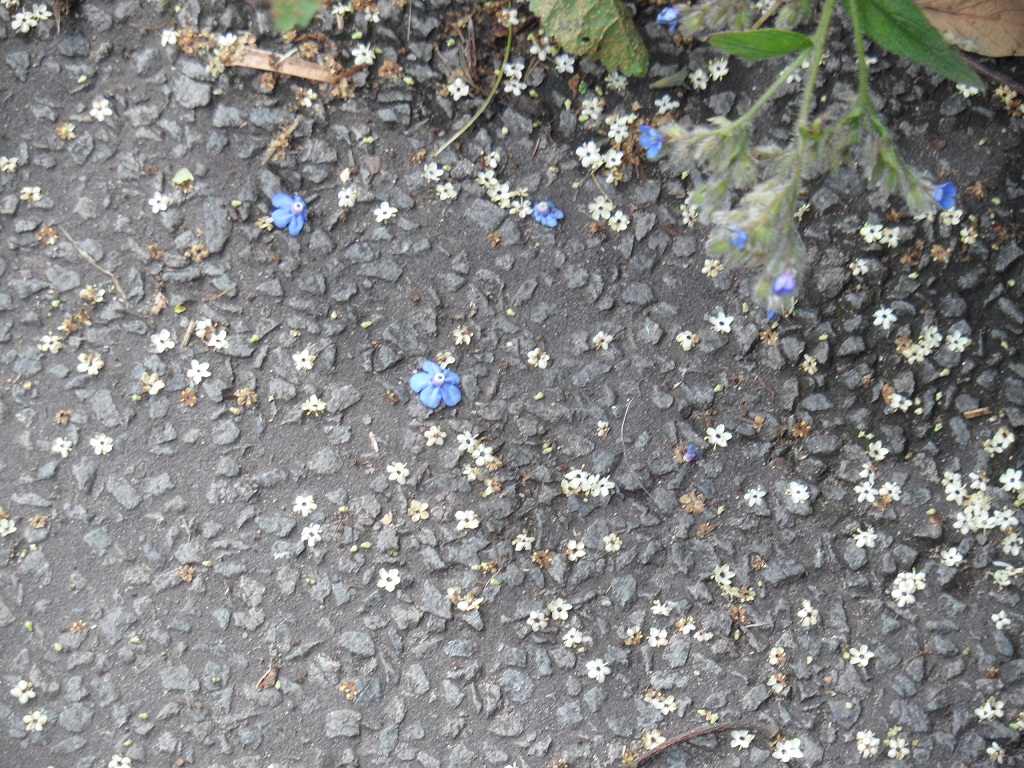
Fallen elderflowers and other petals lie scattered like confetti from nearby Christ Church.

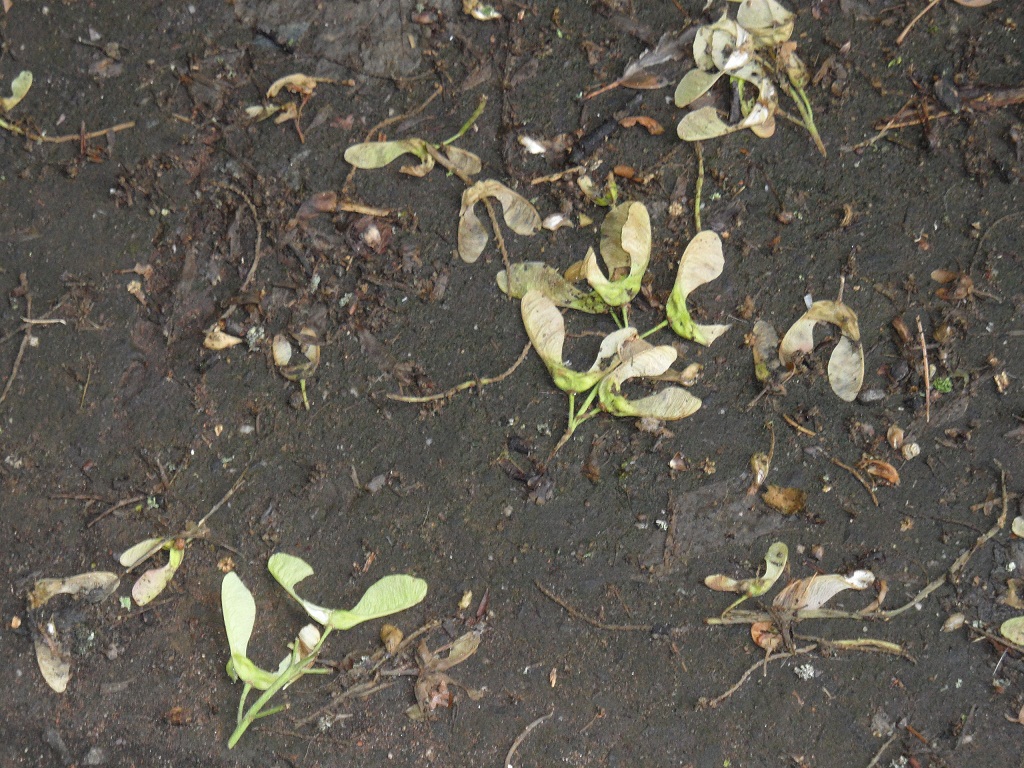
Alongside them are Midsummer reminders of Autumn.

The holes in the tree still hold a fascination for me. I put my hand in and took some more photos of the inside, with irrational thoughts of the Boca della Verita at the back of my mind.


Lost in the Woods

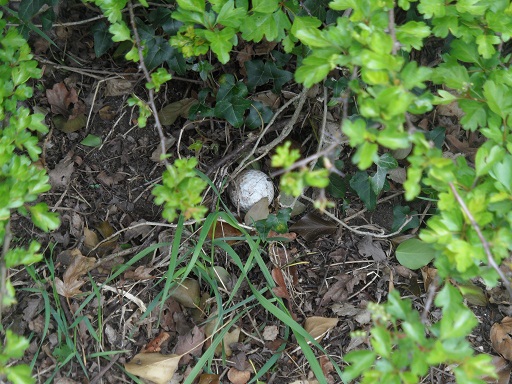
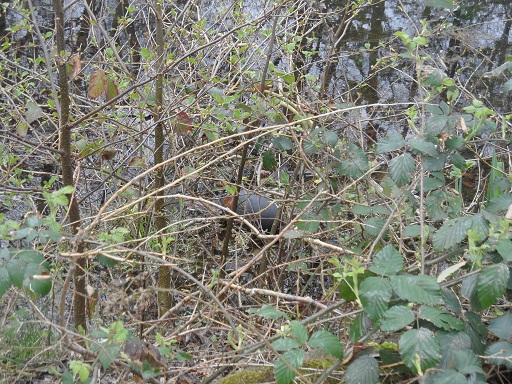
Whenever I see an object out of place it intrigues me.  I’m not talking litter here, I mean the things that are dropped by accident, things that are left behind. Lost property. Things that might (or might not!) interest future archaeologists if they were to discover them in a couple of centuries time.  I want to know the story behind them, who they belonged to & how they ended up lost, but I realise that I might be on my own with this one! 

I’ve put together a gallery of things found on the path past Leomansley Wood to Pipe Green and on the Green itself.

Lost by a horse, found by a friend. Brownhills Bob told me that it's not that old. Still lucky though!


Dropped by someone in need of a lucky horseshoe? Or on the way home from the fair?

Lost whilst blackberrying?


Dropped after an impromptu paddle in the brook?


See above!


In the rough. Not sure Leomansley Wood makes a great fairway.

Or a great rugby pitch either.

I guess the robber escaped from the cop.


The remnants of an overenthusiastic dog's toy?

I would ask people to send me photographs of things they’ve found, but I appreciate that I might be the only person in Lichfield who goes around taking photographs of old socks!


Tree following: White Heat

“No, I can’t come out with you, I’m supposed to be working”. “You know you want to… I’m only going to be around for the next few days and then I don’t know when I’ll be back in Lichfield again”. “Oh, go on then…..”

Yes, my old friend summer is back in town, and so I went to see how my tree that I follow on the path from Leomansley Wood to Pipe Green is getting on. To be honest I’m now following pretty much the whole path, so the tree doesn’t get that much of a look in these days. I’m sure it’ll come in to its own as the seasons progress though!

It was a delight for most of the senses.  Birdsong and drumming woodpeckers, butterflies and an abundance of mostly white flowers along the floor and hedgerows, the warmth of the sun, the cool of the breeze and the shade of the trees and of course the scent of early summer in the air. Taste is the only one that eluded me on my walk (although I’m sure there were probably some wild goodies I could have tried if I was both more knowledgeable and brave about these things). I think my tea & cake when I got home might just about count though.

Tree following: Mayday

It took a bit of effort to drag myself out into the murky, wet evening. Glad I made the effort though. Before I’d even got to the woods, I had a treat when a heron swooped down onto a roof and remained there for a few moments before flying off in the direction of Waitrose. I’ve spotted a heron a couple of times near the old mill pool over there. On twitter, Brownhills Bob & someone from the Pipe Green Trust thought he may have been heading to a heronry at Aldershawe.

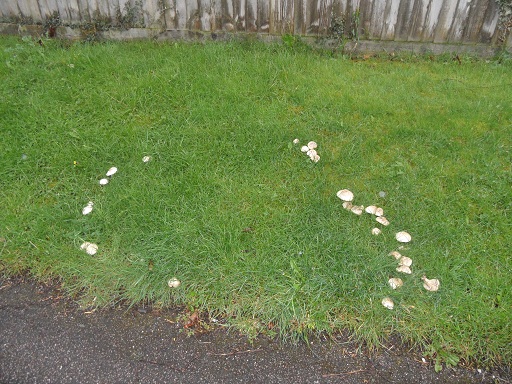
Another few steps and I found myself passing a slightly wonky fairyring of mushrooms. I didn’t get too near. I’ve read what happens to mortals who do…..

Once in the woods, the trees, plants and hedgerows glistened, but with drops of recent rainfall, rather than may dew.

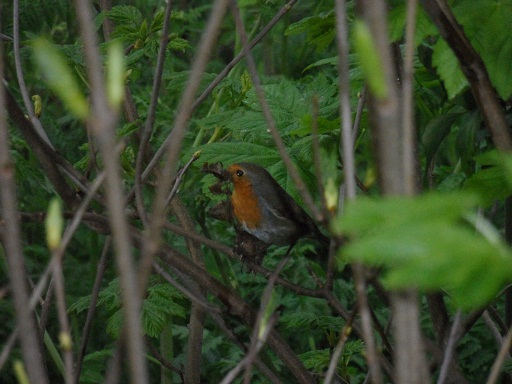
I wanted to measure my tree, to get an idea of how old it was. It soon became apparent that this was no task to undertake alone. The people in the flats overlooking the lane, and this robin that turned up to watch, probably wondered what on earth I was doing.

Happily, I managed to enlist someone’s help and we discovered that the trunk measured about 3.2m which could mean that it is anything from around 210 years old to around 130 years old. According to the Royal Forestry Society, a tree could grow between 1.5cm & 2.5cm per year, depending on things like location, soil quality.  So I’m going to read up on Mitchell’s Rule and then maybe I’ll have another go at estimating the age!

Tree measuring task completed, I headed back down the lane and met a couple out for a walk. They didn’t seem to mind the weather, in fact they thought it was lovely…….