I’m reading the memoirs of a man named William Purcell Witcutt. Like me he had connections to both Birmingham and Staffordshire, and was fascinated by folklore. Unlike me, he was an protestant vicar who converted to Catholicism before being exiled to the furthest outpost of the Diocese for the crime of commenting on the corrupt nature of many medieval priests. Yes, they sent him to Leek.
In his book, ‘Return to Reality’ there is a chapter called ‘The Valley of Phantoms’, in which he describes how, ‘Leek lay hidden in mist and woods in the middle distance, and one of the older boys tried to convince me that it was invisible from the air. Leek will never be bombed said he, and quoted with assurance the prophecy that there would come a time when, ‘there will be no safety in the land save ‘twixt Mow Cop and Morridge’.
No I can definitely see it
Witcutt was soon to find plenty more superstition in this Staffordshire Moorland town. It seemed to him that the valley and moors around it swarmed with ghosts and bogies, which people still believed in. There was the Headless Horseman, or in Leek dialect, ‘a man on an ‘oss without yed on, an awful gory sight’, and nearby was a Black Dog who guarded the graves of those who died a violent death. According to Witcutt, the Queen of the Leek demons was the Mermaid of Black Mere, who I wrote about many years ago here. A new story to me was that of ‘Ball Haye Jack’, a little grey man whose appearance in front of one of the mills was believed to bring bad luck. One curious custom Witcutt noted was that on seeing his collar, the girls and women who worked in the mills would touch the factory railings, a somewhat unsettling reaction given it seems to be linked to the superstition that touching iron would protect against the power of a sorcerer.
One of the strangest spots Witcutt writes about is the Coombes Valley, When he visited in May 1940 he found a farmer planting potatoes and as the man sowed his spuds, he shared stories of the valley. At a place nearby, the spectre of a murdered man was said to ride up and down the ridge. Once seven priests came to lay him but all but one of the gathered fathers fled. The final man standing held up a stone in the brook, dismissing the pleas of the phantom for mercy, and laid him beneath the rock. The process appears to have been unsuccessful however and so the dead man rode out once more. This next time he was laid beneath a hawthorn tree at a place known very appropriately as Spirit Hole. Even that was only sort of successful though as he still haunts the valley, although now in far less malevolent form of a bird heard singing as the night falls at the Spirit Hole. The stone which had failed to keep the ghost grounded was still there when Witcutt visited (and I believe it still is), and according to the farmer it had once been a stone of sacrifice.
No wonder the valley is full of phantoms.
Source: WITCUTT, W.P. Return to reality, Macmillan, 1955.
Three men, three deaths all seemingly linked. Somewhere in the story there must be a clue to tell us whether it was coincidence or if something creepier was at play here.
As the harvest of 1853 was gathered from the fields at Rownall in Staffordshire, Colonel Thomas Powys sat beneath the shade of a small oak tree, overseeing the work of the new labourers he had hired. Hours passed and day turned to dusk, but still Powys remained sat under the tree until Jack Shaw, one of the seasoned workers wandered over and found him in a state of insensibility, muttering the same phrases over and over. ‘And then another’, ‘Yet another’ and then, ‘The grass’.
Shaw shouted to the other men to stop their work in the meadow and together they carried the near comatose Captain back to his home Westwood Hall. The doctor was called for and when he arrived Powys was still saying those strange words. ‘And then another…then another…the grass’, although his voice was now not much more than a whisper. Soon afterwards, he was dead.
When Jack Shaw returned to the tree where the Captain had sat he noticed the grass where the man’s feet had rested had withered. Shaw’s son, telling the story to the Newcastle Under Lyme Times in October 1940, said he had witnessed it himself and that no grass would grow on the spots for some years after. Another odd detail about the death of Captain Powys is that when Mr Leese the coffin-maker was called to measure him for his coffin, he noticed that the corpse hadn’t stiffened and still hadn’t done so by the time it was placed in it.
The story would be strange enough as it stands but several years later another man died in the very same spot beneath the oak tree. Mr Yates, the tenant of the farm had felt faint and gone to sit in the shade. Just like the Captain before him, he had to be helped home and never recovered from what ever malady struck him that day. And just like the Captain, his corpse never stiffened.
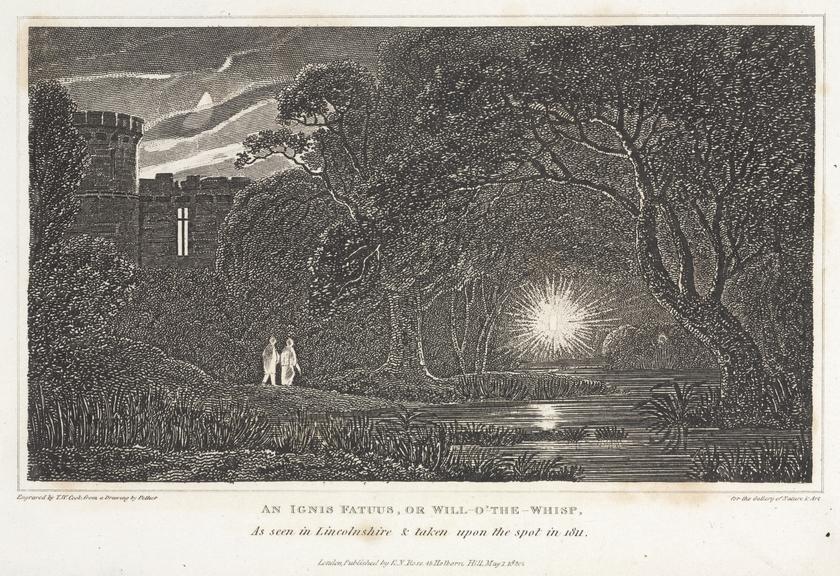
A man named Heath became a tenant of the farm and, one day whilst cutting rushes in the same meadow where the other men had been stricken, he too was taken ill and died shortly afterwards. Shaw Jnr could not confirm whether or not he had sat in the same spot as Powys and Yates prior to his demise but he does recall that Heath’s body remained flexible even as he was placed in his coffin. He adds that after each of the three men died, so one of the tree’s branches. Of course, there were theories from the locals. One was that all three had entered into some sort of trance and that they were still under it when they died. If true, it would make a strange story truly sinister as it suggests they may have been buried alive. Shaw Jnr’s own explanation was that all three contracted some sort of illness from the marshy ground at the end of the field. He had seen the will o’ th’ wisp there on several occasions and as the explanation for these eerie lights is that they are caused by the spontaneous combustion of gases, perhaps he was on to something?
I am a storyteller, not a scientist, and so I am asking any readers of this post to share their theories regarding the mystery of these three strange deaths in the Staffordshire Moorlands.
There’s folklore and there’s legendary
Sources
Newcastle-under-Lyme Times – Friday 04 October 1940
Charlotte Sophia Burne, the first woman to become president of the Folklore Society, once said of Staffordshire, ‘It is comparatively an ordinary occurrence for this or that lately deceased person to ‘come again’ after death’.
I can’t help but wonder if she’d heard of the post-mortem wanderings of Preston Moore and his father in the village of Weston, near Stafford. A book called ‘Phantasms of the Living’, contains the following account from a Mrs J Bennett written in 1882 about the eerie events of 13th April 1860.
“My daughter Annie and I had been drinking tea with the late Mrs Smith and Miss Moore, and talking about their brother Preston being very ill and not expected to recover, and were returning home in the evening when between the little wicket which opens out of the Vicarage field and Mrs Newbould’s house, we met the identical man in face, form and figure, dressed as he was always wont; slouched hat, old frock coat, open in front, knee-breeches and gaiters, with a long stick. He passed so near us that we shrank aside to make way for him. As soon as we got to Mrs Newbould’s she exclaimed, ‘So Preston Moore is dead!’, when we both exclaimed, ‘Oh no, we have just seen him!’. We found, in fact, that he had died about half an hour before he appeared to us’.
Something wicked this way comes
Mrs Bennett was adamant that it could not have been a case of mistaken identity. According to her, ‘We cannot call to mind anyone at all resembling the individual in question; his appearance, dress and gait were utterly unlike anyone else residing in or about the neighbourhood’. More intriguing details emerged during psychical researcher Eleanor Sidgwick’s interview with Mrs Bennett. There was apparently something forbidding about Preston Moore and his sister Miss Moore was also considered odd. Preston may also have had a thing for Mrs Bennett. He once bought her pansies pinched from a neighbouring gentleman’s garden and another time, cauliflowers, also illegitimately acquired. Perhaps I should have saved this story for Valentines Day? ‘Roses are red, violets are blue, here are some vegetables, I’ve stolen for you. Violets are blue, roses are red, I’ll still be around, even after I’m dead’.
A lovely pub. We will definitely come again.
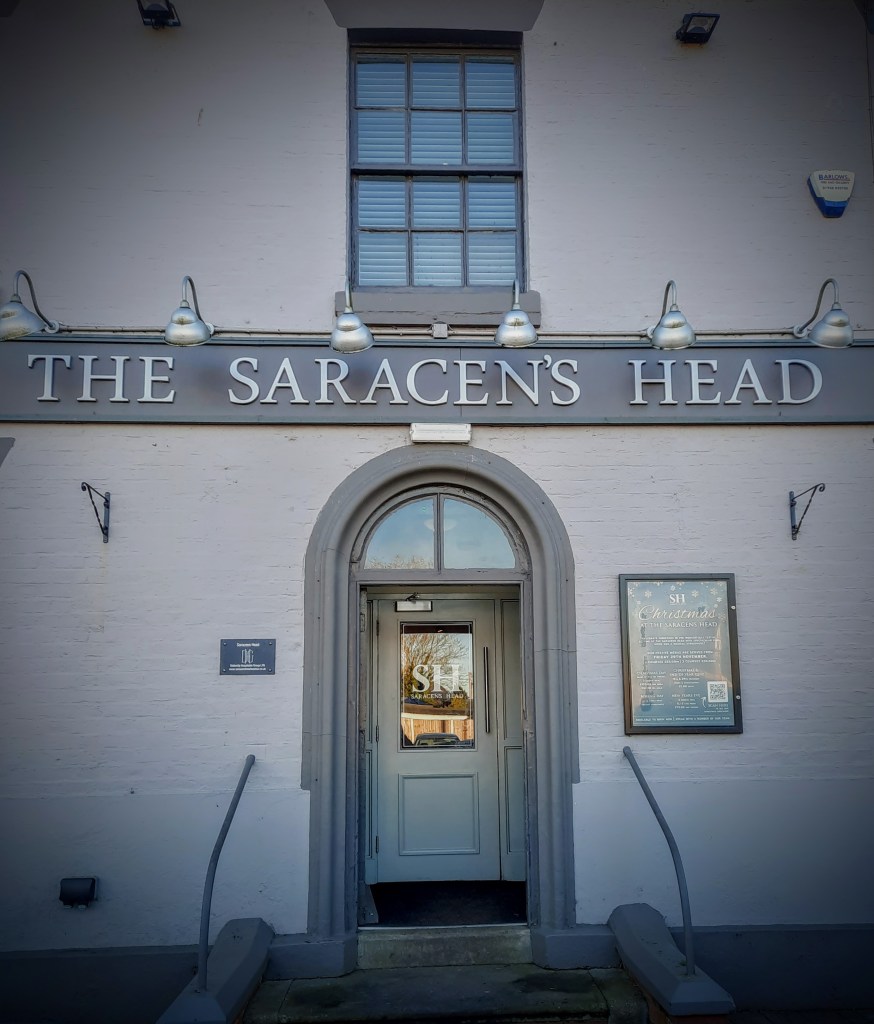
The story as it stands is strange enough but reader, there is a twist in this tale of a dead man walking. An article in the Staffordshire Advertiser in 1901 claims that Preston Moore was not the first of his family to ‘come again’ after his death. There was a legend in the local area that his father’s shade had roamed up and down the road between Stowe and Weston, until locals decided it had had enough exercise and it was time to exorcise this restless spirit. It was laid in a bottle and bricked up in the cellar of the Saracen’s Head Inn to remain there, ‘whilst holly and ivy are green’. It seems that during his life Mr Moore senior may have been the landlord at the inn making the real horror here the idea of being trapped in your workplace for eternity.
She wouldn’t let it lie!
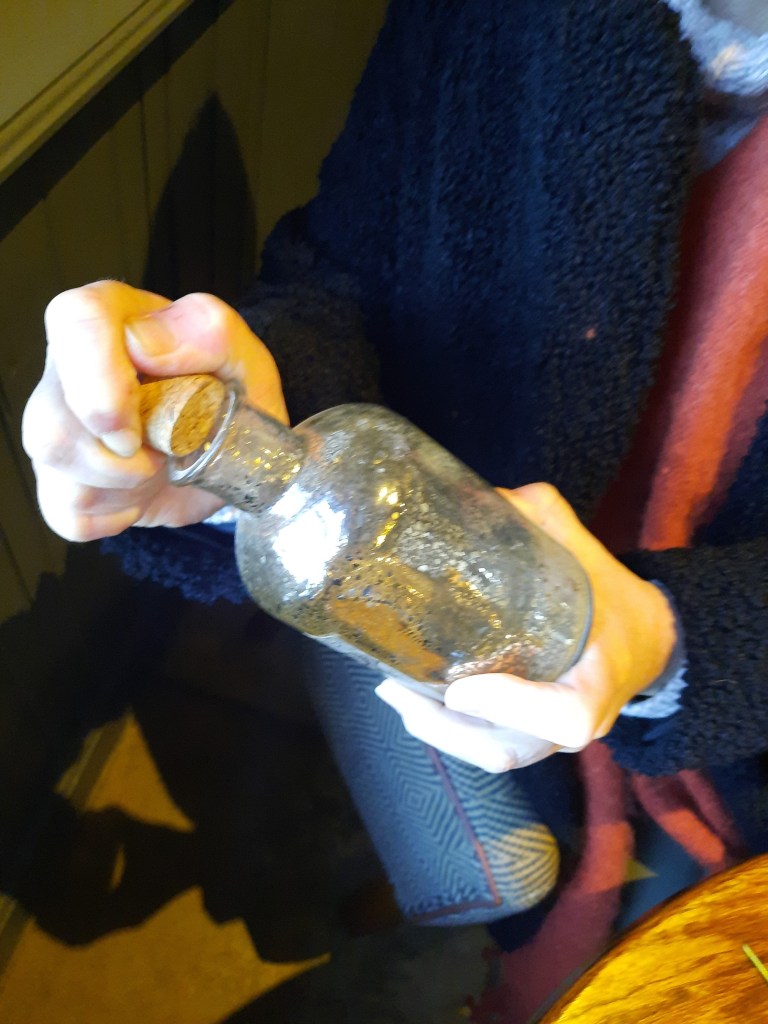
Obviously my good friend Jacky and I went to investigate, by which I mean we popped into the pub for a coffee and pretended we’d found the bottle containing the spirit of Mr Moore on a shelf nearby where we sitting. I am convinced there’s more to be found out about the mysterious Moore family which may explain why the family seem to have been at the centre of village superstition. In the meantime, if you work at the pub, would you pop into the cellar and see if you can find where the old landlord lies? We should have asked but we didn’t have the bottle…
Sources
Staffordshire Folk and the Lore, Charlotte Sophia Burne
Phantasms of the Living, Edmund Gurney, FWH Myers and Frank Podmore
There are many reasons one might visit a pub. To sample the fare, to enjoy an ale, to meet with companions. I went to the Dog and Doublet because it’s named after a murder. Or a dog wearing a jacket. Either way, I headed to the village of Sandon in Staffordshire, in my mystery machine (which looks a lot like a Toyota Avensis) to do a bit of investigating.
The first possible explanation for the pub’s name is that a former landlord was murdered by robbers and his faithful hound found the corpse. In what sounds like a gothic horror version of Lassie, he took his master’s blood-stained doublet back to the inn and then led a search party back to the body. The second less gory story says that a travelling fair came to Sandon and its star act was a performing pooch in a little jacket. The villagers thought he was such a good boy they decided to name their pub after him. A dog in a doublet was clearly a novelty back then. Nowadays I see some canines out walking in Leomansley Woods who have better wardrobes than I do.
The current building dates to 1906, and is described as having been erected by the Earl of Harrowby on a site adjoining that of the original. The tithe map seems to show that there was an inn there back in 1838, but it was known as the Packhorse. It’s all a bit confusing, even before you’ve had a drink, but I think I understand what happened with these hostelries. There was definitely a Dog and Doublet in the village dating back to at least the mid-18th century as I’ve found a reference for it in Aris’s Birmingham Gazettee. It seems to have stood on the other side of the road, at a place now known as Sandon Lodge and/or Erdeswicke House. When Sandon Hall burned down in the summer of 1848, the Earl of Harrowby made it his temporary family home, and had the pub sign moved to the Packhorse which presumably was also renamed at this point. He didn’t relocate the resident ghost though, as a man described as wearing brown clothes and a small wig and believed to be a former landlord, was still reported to be haunting his old hostelry in the 1950s.
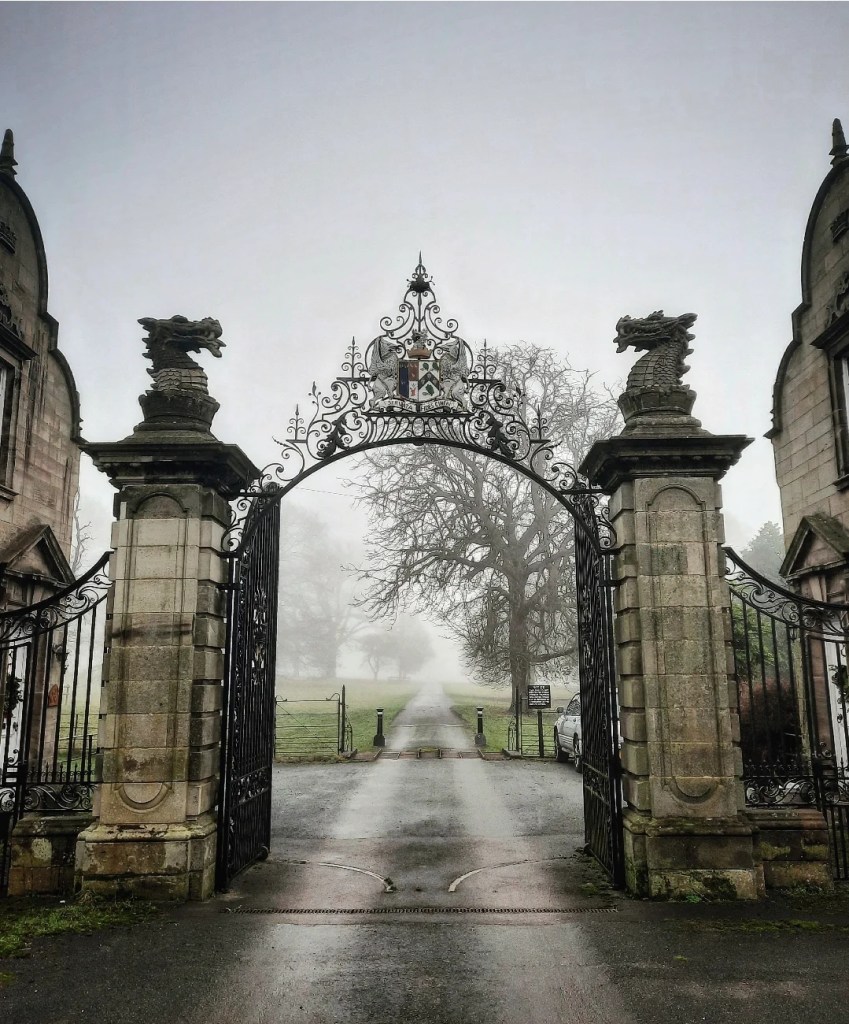
The gates to Sandon Hall
This information comes from Sam Berrisford, a former chairman of the Parish Council, who lived in part of Sandon Lodge. He also mentions an overgrown circular bowling green in the grounds of the old inn, which he suggested was Elizabethan. According to the listed building description, the oldest parts are 17th century and so certainly old enough that tales of parliamentarian troops draining quart pots and plunging their heads into vats of beer in the inn’s cellar prior to the Battle of Hopton Heath could be true. If so, it’s no wonder the Royalists defeated them eh? (put down your swords Roundheads, I’m just jesting. I know the outcome of the only Civil War battle to take place on Staffordshire soil isn’t that straightforward).
During its 18th century coaching inn days the hospitality of the hostelry was renowned and, in the absence of Trip Advisor, a satisfied customer is said to have scratched this verse onto one of the smoke-room windows of the old pub.
‘Most travellers to whom these roads are known Would rather stay at Sandon than Stone Good chaises, horses, treatment and good wines, They always meet with at James Ballantine’s’.
Not everyone met with such a cordial welcome from Mr Ballantine however. There’s a story his daughter eloped with a young man and that when the boy broke into the inn to collect some of her belongings, Ballatine was there waiting for him. He handed his estranged son-in-law over to the law and the lad was hanged for theft. It’s said that on the night of the execution, a crowd of villagers surrounded the inn, chanting the 69th psalm and cursing James Ballantine. Possibly related to this family drama is a second verse that the Staffordshire Advertiser says was scratched into another of the inn’s windows which read, ‘Let the man that hates peace, and endeavours to trouble it, Be hung up by the neck, like this dog in the doublet’.
Whitehall, Beacon St. Once the Coach & Horses inn
Whether the story of Sandon’s star cross’d lovers is true I don’t yet know but I have found out that James Ballantine and his wife Catherine had six daughters in total. One of them was called Ann and in November 1779 she married Alderman John Fern, an eminent Wine and Brandy Merchant from Lichfield. So far, so respectable but then you learn the groom was sixty-two years old and Ann only twenty-one. I believe they’d have lived at Whitehall on Beacon Street in, another former inn with an intriguing past. Fern died in Lichfield on 16th February 1801 and his short obituary in the Whitehall Evening Post, refers to him as the ‘Father of the Corporation of that city’. Although surely he was old enough to be its Grandad…
Back to the Dog though and by December 1802, the landlord there was Mr Tomlinson who was paid a visit by a swindler, who may have been enticed by the Trip Advisor review for good horses in the window. He had, ‘very much the appearance of a gentleman aged about forty years, five feet eight or nine, dark curled hair, smooth face, smiling countenance and had on a dark mixture cloth coat, with one of his boots patched across the toe’. He arrived in a post-chaise from Cheadle and claimed to have left his horse at Leek due to the bad weather, asking for a horse for the following morning to take him to the banking house of Messrs Stevenson and Co. Inevitably, that was the last Mr Tomlinson saw of his horse and when enquiries were made at the bank in Stafford, it probably didn’t come as a shock that no such person had been there. A five guinea reward was offered by Tomlinson, along with ten pounds from ye olde neighbourhood watch scheme, the Sandon Association for Prosecuting Felons.
To the church. Let’s not split up eh gang?
And so it turns out there there are far more than two tales at the Dog and Doublet even if some of them are just shaggy dog stories. I’m not quite ready to fire up the Toyota Avensis and leave Sandon just yet though. There’s a mystery up at the church that needs solving…
Sources:
Birmingham Weekly Post 20th October 1950
Stone – The History of a Market Town, Norman A Cope
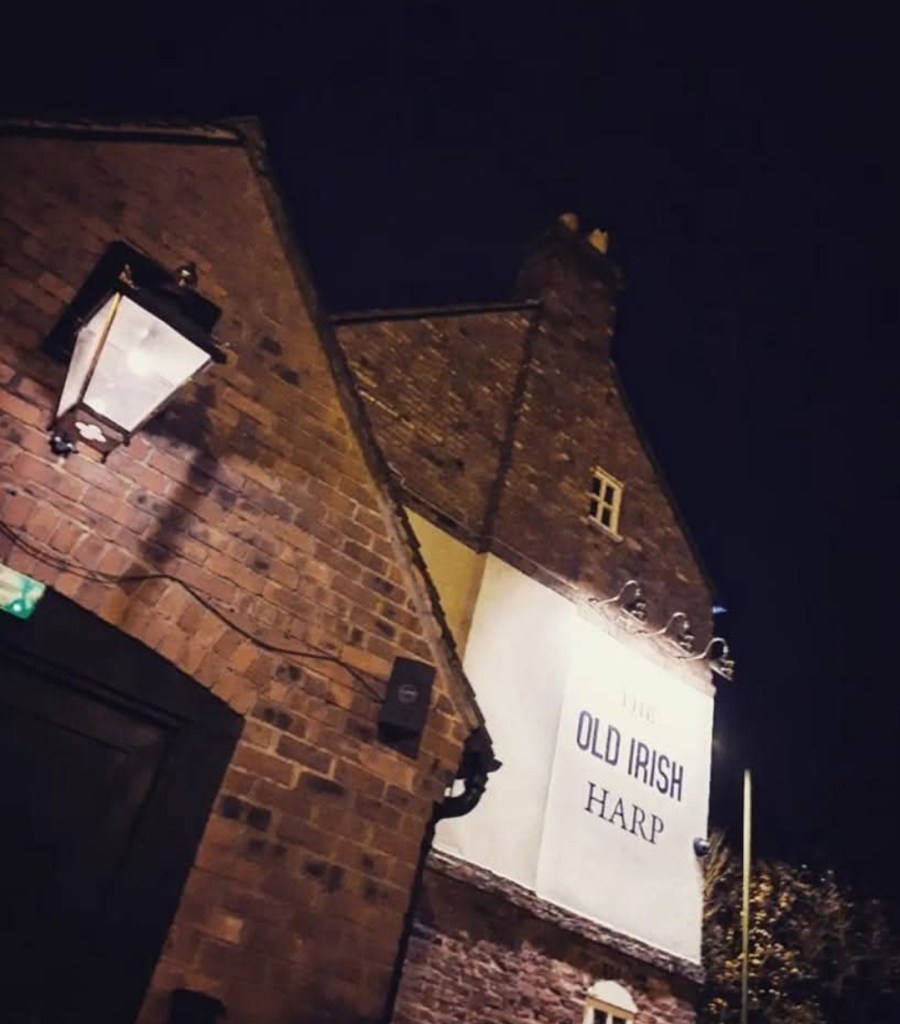
I feared from the looks on my family’s faces that my interest in the macabre may have gone too far when I happened to mention during a meal at the Old Irish Harp that an inquest on the body of a genteelly dressed woman found ‘wilfully murdered’ in a wood near Sutton Coldfield had taken place not far from where we were sat, albeit 250 years prior. I thought perhaps it was time to find a different hobby. Embroidery perhaps? A pleasant pastime for sure, but turns out that for me it’s no substitute for finding and sharing a ripping yarn. And now that we’ve established that I am beyond all redemption, I want to regale you with a post about crime and punishment on the mean streets of Staffordshire.
Back when the inquest took place it was just known as the ‘Irish Harp’.
On the evening of 26th October 1764, a little after 8 o’clock in the evening, Mr Thomas Hurdman of Alrewas was stopped by a footpad opposite St Michael’s churchyard. The Aris’s Birmingham Gazette cryptically reported the rogue was suspected to be a W_____ C_____ of Greenhill. I’m not sure why such nominal secrecy though, when they also published a description of him in the same report (not yet 20, about 5 feet 5 inches high, wide mouthed and wearing his own hair, if not altered, which was brown and short cut’). Despite being caught by one of the city’s constables, WC managed to quite literally give him the slip by sliding out of his coat, and legging it out of Lichfield in a linen frock. His freedom (and any semblance of anonymity) was short-lived however. In March the following year, newspaper reports reveal that the ID of WC was William Cobb and that he’d been sentenced by the High Steward of Lichfield, Fettiplace Nott, to be transported for his assault on Thomas Hurdman and making many violent threats of murder.
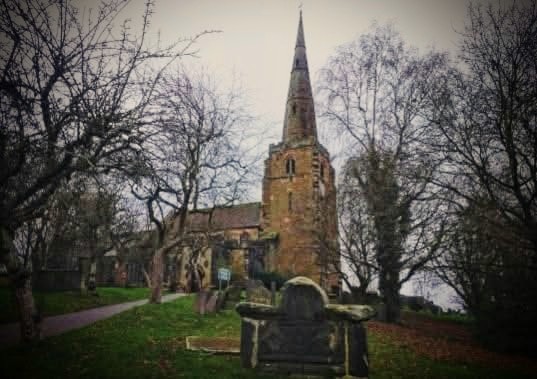
St Michael’s Lichfield is the graveyard for some who went to the gallows
Ashmoor Brook, up Cross in Hand Lane, was the scene of another robbery which went awry. In Lichfield March 1833, a notorious local character known as Crib Meacham, a name apparently derived from his success in various pugilistic encounters, was charged with robbing a Mr Lees of Stoneywell. According to Lees, Meacham was one of a gang of four who attacked him and his wife. The pair were in possession of a large sum of money but it was Mrs Lees who was holding the purse strings at the time and the thieves had allowed her to run away. She soon returned with assistance and it was the robbers turn to run, leaving a gagged Mr Lees unharmed but relieved of his relatively empty purse and hat. Meacham was arrested later that evening but as of yet, I cannot tell you anymore about him, neither the fights which earned him his nickname in the past nor the fate he earned from his part in the robbery.
Cross in Hand Lane is only just outside Lichfield but must have felt like the back of beyond travelling through here after dark
I can tell, however, tell you much more about Robert Lander aka Bradbury a cordwainer of Milford near Stafford who robbed Solomon Barnett, a wax chandler of Liverpool in March 1798. The newspaper reports at the time give not only a physical description (Lander was a stout built man, 5ft 5 inches, 25 years of age wearing a blue coat, a striped fancy coloured waistcoat, and thickest breeches, torn upon the left thigh and patched upon both the knees). It also gives his villain origin story, starting at his childhood home of Haywood near Stafford. When his Dad died, he inherited a few hundred pounds. At the age of 21 he got turned down for a job at the Board of Excise and so went to work for a gentleman in the wine and spirit trade instead. This, it seems, may have been the start of his downfall. During his employment he is said to have remained in a permanent state of intoxication, eventually absconding and taking with him a watch belonging to his master. He sold it at Stafford where he enlisted into a Regiment of Foot but ended up, somewhat ironically, in the shoe making business. This didn’t last long either and neither did his subsequent enlistment into four other regiments. His career in crime also came to an abrupt end when he was found guilty of the robbery of Solomon Barnett and sentenced to death at the Stafford Assize. When the judge prayed that the Lord would have mercy on his soul, it was reported Lander replied, ‘G__d d___n you and the gallows too. I care for neither’. I assume he said it in full but that his blasphemy was censored by the Chester Chronicle. He was executed in August 1798 and the parish register of St Mary’s Stafford records that, along with Edward Kidson, Robert Lander alias Bradbury was executed _ _ _ _ _ _ _.
These are all true crime stories, but it would’t be Lichfield Lore without a bit of folklore would it folks? You’ll be relieved to know I’m not going to go down the Turpin turnpike road but I am going to give a dishonorable mention to Tom ‘Artful’ Arnott, a highwayman who was supposedly executed, gibbeted and, eventually, buried at this crossroads in Cannock.
Although Arnott’s grave is marked on old maps there are no records of anyone of that name ever being executed. Intriguingly though, there is a record of a Thomas Arnott being buried on 1st September 1777 at St Luke’s in Cannock. Clearly a man can’t be buried in two places at once but it’s the right kind of era and area. Then there’s a Thomas Arnott mentioned in Aris’s Birmingham Gazette in October 1792 for absconding from his master’s service in Birmingham. Intriguingly, after given a description of him (35 years old, five feet five inches, marked with the Small Pox, dark lank hair, and lightly made, wearing a blue coat), it mentions that prior to his work as a stamp, press, lathe and die maker, he had been employed as a forger. Do they mean the criminal variety and if so, does this strengthen the case for him being our Tom? Just to add an extra layer of intrigue, there was yet another absconding Thomas Arnott, who was apprenticed to a Whitesmith in Worcester but ran away on 5th April 1803. He’s described as 5 feet two inches, black curled hair, wearing a blue coat with yellow buttons, a green striped cashmere waistcoat with yellow buttons and dark velveteen breeches. In that outfit, if he did become a highwayman, he’d have been a very dandy one indeed. Could any of these be the legendary Arnott? Did he even exist in the first place? All I do know is that this story is one T__B__C__________.
Arnott’s Grave. Unless it turns out to be at St Luke’s Cannock.
Sources Aris’s Birmingham Gazette 5th November 1764
I’m not organised enough to do an ‘On this day in history…’ type post and so I’ve just missed the 565th anniversary of the Battle of Blore Heath. However, as I know a couple of good stories about it, here’s an ‘on this Monday just gone in history’ post instead.
The tales take place away from the blood and gore of the battlefield, a mile up the road at Mucklestone, the most westerly parish in Staffordshire. Its name may derive from the OE ‘micel’ meaning large and ‘stan’ meaning stone and it seems likely this is linked to the presence of two monoliths known as the Devil’s Ring and Finger. Satan’s stones are believed to have originally been part of a chambered tomb and the ‘ring’ stone has a porthole, apparently large enough for a person to climb through, or be passed through. Some say to do so increases fertility. Having been erroneously told that several gaps on a traumatic caving expedition were big enough to get these child-bearing hips through, I’ll stick to two kids and a small amount of dignity thank you. Talking of children, there was also a belief that passing them through the circle several times would cure them of any ailments, which seems like a strangely wholesome thing for the devil to do. Much more in keeping with the name is the local legend that the stones mysteriously appeared at the spot after a girl was murdered here.
Queen Margaret of Anjou is said to have watched the Battle of Blore Heath from the church tower at Mucklestone. On seeing the standard of her Lancastrian commander Lord Audley fall (a cross marks the spot where he was slain), the queen knew defeat by the Yorkist army was imminent. In a fit of rage and frustration, she is said to have stamped her feet so hard that her footprints remained on the stone floor of the tower long after she fled to safety. This sounds preposterous I know but I do have a theory about this. The outline of shoes are often found carved into church roofs (I’ve yet to find a satisfactory explanation as to why) and if there was such graffiti on the church roof at St Mary’s in Mucklestone, someone may have decided that it fitted into the story very nicely. Obviously, if I’d got in touch with someone at the church to ask them if such graffiti existed to back up my theory that would have bee useful, but yeah, that thing about being organised…
Mucklestone church tower
The most well known element of the legend is that Margaret’s escape was aided by local blacksmith William Skelhorn who was ordered to reverse the shoes of the queen’s horse in an attempt to fool those who attempted to follow. His reward was to be beheaded on his own anvil, which can be found in the churchyard opposite the site of the smithy. Whether the execution was carried out on the orders of the queen to ensure Skelhorn’s silence, or by her enemies, as punishment for assisting her, depends on who is telling the story.
A 19th century forgery by the parish clerk?
It’s not the only instance of the old horseshoes-on-backwards-to-disguise-your-tracks ruse to be found. Amongst others, Robert the Bruce supposedly did it to escape from London after being betrayed there (with tracks going in the opposite direction to Scotland, presumably). Logically and practically it seems an unlikely tactic for Queen Margaret or anyone else to use, and is crying out for someone to do a myth-busting style experiment. I’ll volunteer to dress up as the queen and get on a horse if necessary. I’d look great in a crown and I’ve been pony trekking. Twice.
The thing about myths and legends is that it’s relatively easy to bust them if you try. Once this happens, there are several different ways to go. Either ignore the evidence and keep telling it anyway because why ruin a good story with facts. Dismiss it as a lot of nonsense and as having no value whatsoever. Or sit yourself comfortably somewhere between the two positions, enjoying it as a story in its own right but also exploring where it came from and why, who told it and if any nuggets of truth are actually contained within. The same themes and events turn up in our folklore time after time.
As with the horseshoe part of the myth, echoes of other aspects of the Mucklestone story can also be heard elsewhere. Over at Stoke Golding, in Leicestershire, local tradition has it that the villagers climbed onto the battlements of the church of St Margaret to watch the Battle of Bosworth on 22 August 1485, and later watched the Tudor King’s coronation at Crown Hill. Did someone draw on these stories and create one to put Mucklestone on the map? Could someone like William Skelhorn, directly descended from and carrying on the same trade as his 15th century ancestor and a parish clerk in the mid-19th century have forged his family into history? Not too far-rier fetched is it?
Armed with a bag of Werther’s Originals and a vague plan about finding the site of Boudica’s final battle against the Romans, my friend (and countrywoman) and I headed down the A5 towards Atherstone.
Boudica’s burial place is one of Britain’s great mysteries. I thought for years that the warrior queen rested beneath a platform of Kings Cross Station but clearly I was on the wrong track. There is no trace of her there, or anywhere else for that matter, although plenty of places have been mooted as a possibility. Ever since Richard III was found under that car park, perhaps people are more comfortable putting forward their own research into such things. Even somewhere they flog burgers in Birmingham is apparently a contender for the final resting place of the scourge of the Roman Empire. If she genuinely is here, they really ought to consider changing the name to ‘Queen’s Norton’. Let’s be honest, it wouldn’t be the first time a significant piece of history has been linked to the foundations of a local fast food restaurant in the West Midlands. There are two Mummies beneath what was once another MaccyDs in Tamworth.
Despite several sites laying claim to being the scene of Boudica’s last battle, no archaeological evidence has turned up at any of them either. Claims have instead been based on descriptions of the battle ground from two Roman historians, Tacitus and Cassius Dio. It’s described as somewhere within a defile (a steep sided narrow gorge) with a wood behind it and open countryside in front of it, chosen to prevent ambushes from Boudica’s warriors. In 2004, archaeologist Jim Gould wrote an article in which he says the description of the site given by Tacitus is much too vague for positive identification. He believed it would never be identified on the ground, in the absence of an archaeological discovery.
One of the chief contenders is Mancetter, on the outskirts of Atherstone, or Manduessedum as it was known in Boudica’s time. If it is ever proved, then they ought to consider changing the name to ‘Womancetter’ but I think we are going to have to defile that thought away for now.
What we do have archaeological evidence of at Mancetter is a Roman fort, now occupied by the site of the church and manor house. As we stood nosing in at the gate of the latter, the gardener appeared and told us it dated back to the fourteenth century and had a priest hide and a secret tunnel leading to the church. Despite my enthusiasm for stories of this kind, experience tells me these architectural features often turn out to be a cupboard or a cellar. In this case however, it seems he may not have been leading us up the garden path. Well not entirely. According to the Atherstone News and Herald in June 1956, in what’s now known as the ‘Martyr’s Bedroom’, an escape route led to the roof via a sliding panel in, ahem, a cupboard
The manor was the home of the Protestant Glover brothers John, William and Robert. In 1555, the Bishop of Lichfield issued a warrant for their arrest but by the time the Mayor of Coventry arrived with men to carry out the orders two of the trio had escaped. Robert had been unable to flee as he was ill and was taken from his sick bed to Coventry and then to Lichfield where he dined at the Swan before being removed to a cell alongside a dungeon. I suspect this would have been the ‘church prison’, as described by Thomas Harwood which seems to have been underneath what’s now Number One, The Close, rather than the gaol at the Guildhall.
Robert Glover was burned at the stake in Coventry on 19th September 1555. His brother John eluded capture but died of an ague after living in the woods for some months. The Biishop’s Chancellor, Anthony Draycot was not about to let the whole business of him being a protestant lie though, informing the vicar that his body should be dug up and thrown over the churchyard wall. When the vicar pointed out that after six weeks the body stank and finding men willing to undertake the task would be tricky, Draycot instead ordered him to wait for 12 months and then throw the skeleton over the wall into the public highway. The third brother William also suffered post-death disgrace being refused a Christian burial in the town of Wem in Shropshire, his corpse instead being dragged by horses to a nearby field and buried there in unhallowed ground. Just in case a priest hole and secret tunnel haven’t given you your fill of folklore, you should know that Robert Glover’s ghost haunts the room from which he was taken.
Next door to the Glovers lived another Mancetter martyr, Joyce Lewis, who was burned at the stake in Lichfield on 18th December 1557. Despite a plaque in the Market Square recording this dark chapter of the city’s history I knew very little of her story until now. It seems Joyce fought to the death to defend her beliefs, asking the friends who visited her in prison how she might behave so, ‘her death might be more glorious to the name of God, comfortable to his people, and also most discomfortable unto the enemies of God’. The night before her execution she refused the offer of two priests to hear her confession and after fainting on route to the Market Square and being given a cup of water, she used it to drink to ‘the abolishment of papistry’. According to Foxe’s Book of Martyrs, ‘a great number, specially the women of that town, did drink with her; which afterward were put to open penance in the church by the cruel papists, for drinking with her’. I believe open penance would have been some sort of public punishment.
I may not have found the site of Boudica’s battleground on my journey up the A5 but it did lead me to the story of Joyce Lewis’s last stand much closer to home and how her final moments were spent surrounded by the solidarity of the women of Lichfield.
In certain magic circles, the story of the Wizard of Bromley Hurst is well-known. In the mid-nineteenth century, Thomas Charlesworth, a young dairy farmer living near Abbots Bromley, argued with his widowed mother over his choice of wife, who also happened to be his cousin. Old Mrs Charlesworth, who was probably younger than me at the time, apparently left the farm muttering he would never do any good and his cheeses would all tumble to pieces. In the months that followed, Thomas did indeed have trouble making cheese from the milk his herd produced, ‘a process which had up to that time been successfully performed’. The fact this coincided with the departure of his mother was surely not coincidence and Thomas leapt to the obvious conclusion. That his mum had been better than him at making cheese? Absolutely not. Young Farmer Charlesworth decided that his cheese-kettle and all of his cows had been cursed.
Cused cows? Pull the udder one
Local toll-gate keeper Sammons recommended he seek the help of a man named Tunnicliff who ran ‘The Royal Oak’ beerhouse four miles away at the somewhat appropriately named ‘Buttermilk Hill’. Many men and women who ran such establishments also had a side-hustle. Indeed, my own great-great grandfather ran a pub in Cirencester alongside a blacksmiths shop. Tunnicliff’s supplementary business though was black magic. The wizard agreed that the woes Thomas had recently incurred were due to the ‘Widow’s Curse’ and that he could take the spell a-whey. All he needed was a piece of Thomas’s wife’s dress and the names of all his cows. Oh and £7. His magic act is reported to have been making crosses over the doors with witch hazel twigs and waving his hands over the horses. It seems no-one at that point thought to ask exactly how bewitched horses affected the cheese-making process and Tunnicliff left the house, no doubt rubbing those same hands together at the thought of how easily he’d make his money that afternoon. So easily it seems that Tunnicliff decided to put in a nightshift.
The Charlesworths had an ‘awful night’. Outside in the yard came the sounds of loud yelling, groans and noises of various kinds. Thomas bravely asked someone else to look out to check if there were any animals under the windows but there was nothing to be seen. The following day, he went back to see a tired-looking Tunnicliff and told him about the sleepless night they’d experienced over a beer. Tunnicliff agreed to call in to see what he could do but back home at Bromley Hurst, Thomas experienced shooting pains in his chest, numbness of his limbs and shivering. Whilst these symptoms subsided around dinnertime, he decided to stay in bed an extra hour the following day. Tunnicliff turned up before he woke and took Thomas up a breakfast of ham, bread and coffee. Within half an hour, he was stricken with symptoms similar to those he’d suffered the previous day. Tunnicliff announced he was appointing himself the couple’s defender against the dark arts and would be sleeping in their room. Now comfortably settled in the Charlesworth’s home, he really decided to go big.
To explain Thomas’ ongoing suffering, Tunnicliff ‘revealed’ he was engaged in a battle with ‘Old Bull’ aka the wizard of Yeaverly place, and claimed that ‘a fresh secret has been communicated to me by the power which I possess, and I now tell you that everything you possess is bewitched. You will have to give me further sums of money to remove this betwitchment’. As well as carrying out his wizarding work, Tunnicliff was also taken on as a servant. Shortly after Elizabeth, their baby girl and her nursemaid all began experiencing the same symptoms as Thomas and tragically, it’s reported that the infant died of convulsions in the Autumn of 1856.
Things came to a climax on 11th February the following year, a night during which servants witnessed the family dog run through the house chased by a phantom hound, seemingly made of fire and Thomas Charlesworth was so seriously ill he lost conciousness and was believed to be close to death. Whether it was the terrified servants’ ultimatum that if Tunnicliff stayed they’d leave, or Elizabeth Charlesworth’s discovery that his all expenses paid trip to Derby to battle yet another wizard was entirely fictitious, the penny finally seemed to drop that Tunnicliff was more of a conman than a conjurer and was milking them dry. He was dismissed on the 17th February 1857 and when Thomas was miraculously cured of his supposedly supernatural symptoms shortly afterwards, he reported Tunnicliff to the authorities.
In a trial at Stafford, Tunnicliff’s defence was that Charlesworth was a drunk, as was his father before him. The case for the prosecution however was that the Charlesworths had been poisoned with white bryony root, also known as ‘the Devil’s Turnip’, found at Tunnicliff’s house. In the end, the judge ruled that the Wicked Wizard of the East (Staffordshire) was guilty of obtaining money on false pretences and he was sentenced to 12 months imprisonment with hard labour. Reading over the details of the case, I find it hard to believe he was found guilty only of deception and not of the murder of baby Elizabeth and attempted murder of her parents.
The Coach and Horses, Abbots Bromley
As if this story isn’t already strange enough there is just one more thing to throw into the mix of this heady potion. During the trial, Thomas told how Tunnicliff had been to Rake End to see his uncle/father-in-law William Charlesworth, to caution him to be careful or else come to harm. On 23rd May 1857, William Charlesworth’s body was found on the turnpike road to Lichfield. An inquest was held at the Coach and Horses, the last place he’d been seen alive, leading to the arrest of two men for his murder. Charles Brown was transported to Western Australia but George Jackson was hanged at Stafford. Dreadful is the mysterious power of fate.
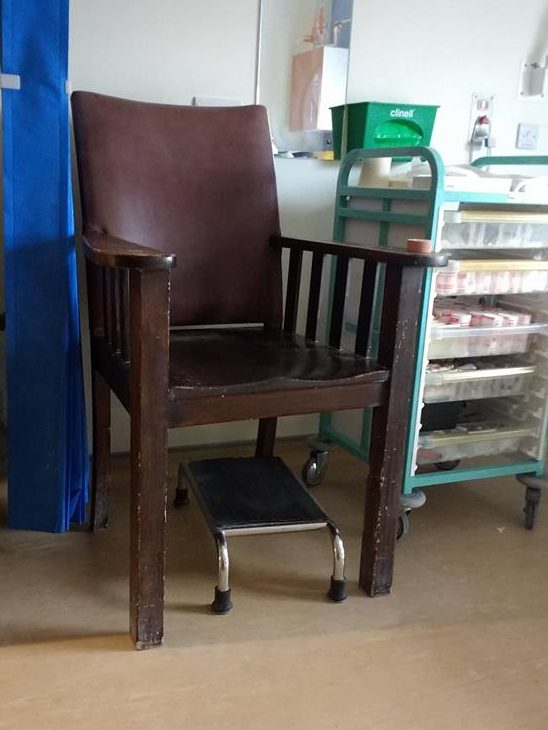
One of the highlights of this weekend’s coronation, appearances from Floella Benjamin and the Grim Reaper through the arched door aside, was The Coronation Chair. It is possibly the most famous piece of furniture in existence, rivalled only by Lichfield’s Victoria Hospital Chair now in the Samuel Johnson Minor Injuries Unit. Royalist or not, there is something rather thrilling about a graffiti and bomb scarred throne on which the behinds of thirty eight kings and queens, and the rump of Oliver Cromwell, have sat.
A big chair for the NHS. Hip hip hooray!
Even more ancient than the chair is is the ‘Stone of Destiny’ it was built to incorporate. The sandstone block, used for centuries as the crowning seat of Scottish kings, was stolen by Edward I in 1296 and only officially returned to the people of Scotland seven hundred years later. Many myths, legends and rumours surround the stone’s origin and its authenticity but today there’s another mysterious coronation seat somewhere in Staffordshire that I want to investigate.
Are you sitting comfortably? Then we’ll begin.
In September 1959, the Western Mail carried a story about a seat-shaped stone, located in the grounds of Blithfield Hall, Staffordshire. Visitors to the hall were told it was the ‘Welsh Coronation Stone’, which caused a great deal of confusion in Cardiff as nobody knew whether a Welsh Coronation Stone was actually a thing or not. An official at the Welsh Folk Museum was also non-committal given, ‘It is one thing to have a Stone and another thing to have a stone around which a story or tradition may have arisen’. It seems there was also reticence to discuss such monumental matters here in Staffordshire for fear of the stone being returned to its rightful home. All that could be established was that the family heirloom/national treasure had arrived at Blithfield in the 1920s.
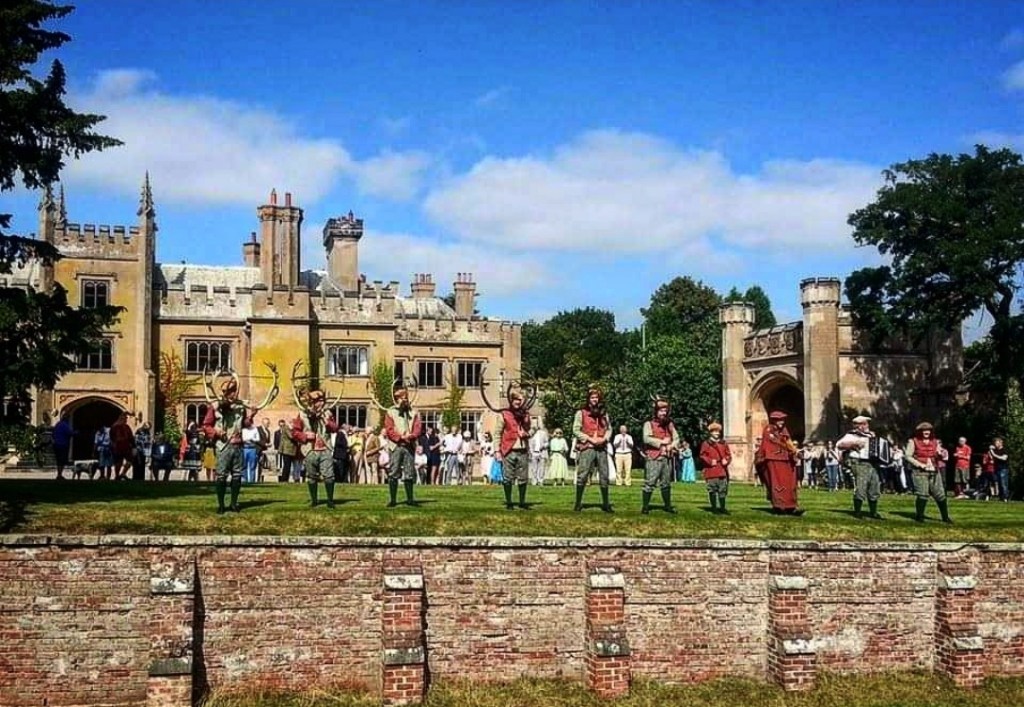
Dancing kings aka the Abbots Bromley Horn Dancers on the lawn on Blithfield Hall
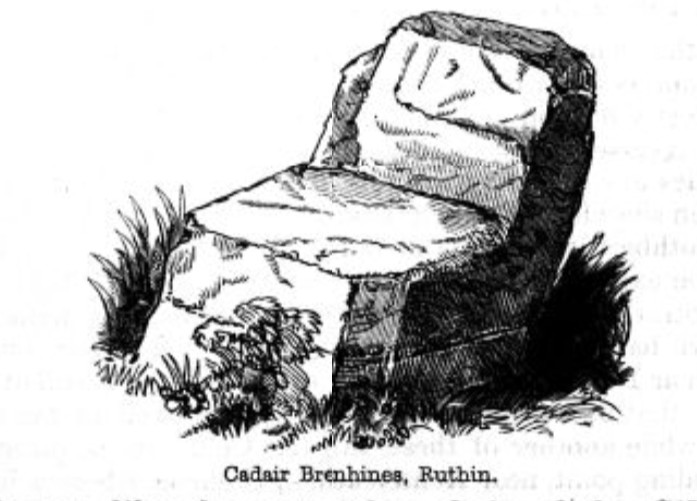
Ten years on, around the time of Charles’ investiture as Prince of Wales in the Summer of 69, another reference to the stone appeared in the Rugeley Times. The then headmaster of Hill Ridware School is pictured in the hall’s inner courtyard looking at what the newspaper describes as ‘the Welsh equivalent of the Scottish Stone of Scone’ and ‘the seat on which early Welsh kings were crowned’. It says it came from the Bagot’s estate near Ruthin called ‘Pool Park’ and a virtual visit there via the Ruthin Local History Society reveals that a ceremonial ‘coronation stone’ dating to the 5th or 6th century is mentioned in the estate’s 1928 sales catalogue, which fits in with the date of the Blithfield stone’s arrival in Staffordshire. The society give the Welsh name of the stone as ‘Cadair y Frenhines’ (The Queen’s Throne) and says it was brought down from ‘Llys y Frenhines’ (The Queen’s Court) in the early 19th century, along with another ancient monument with Ogham and Latin inscriptions (1). The latter was moved to the museum in Cardiff in 1936 and replaced by a replica at its unoriginal location at Pool Park but according to the history society, the whereabouts of the Queen’s Throne is now ‘unknown’.
Claim of thrones
I’m certain that this missing stone is the one described as being at Blithfield but so many questions remain. Fifty plus years later, is the monument even still at the hall? Was it ever really used to crown queens, or indeed kings, or did it gain this reputation through Georgian whimsy and the fact it looks a bit like a chair? Hopefully if the royal chair is still to be found in the courtyard at Blithfield, the true backside story of The Queen’s Throne might finally be revealed.
(1) In defence of Bagot, the chair was rescued from one of his tenants who had been using it as a horse block. Sadly, its said that the tenant simply went and fetched another ‘old stone’ in its place.
I recently visited the Staffordshire village of Colwich. It’s a lovely place but as is my wont, the outcome of the outing is a tale of murder and mystery.
We start our story in May 1977, when a member of the congregation of St Michael’s and All Angels took a walk through the churchyard and almost disappeared into an unmarked vault. The vicar at the time was the daring David Woodhouse who decided to descend into the dark depths to discover what, or who, was down there. Inside the vault, he found two skeletons and whilst there is nothing unusual about bones beneath a graveyard per se, there was something not quite rite about these burials. Skeleton One lay in a coffin and Rev Woodhouse mentions two odd things about it. Firstly, a small hole in the skull and secondly, the finger bones were disarticulated suggesting that this may have been a victim of both murder and grave robbery. The strangeness doesn’t stop there though as the remains of Skeleton Two are described as surrounding the coffin containing the first. One of the keywords for me here is ‘remains’, suggesting to me that this corpse may not have been complete when it was interred here.
The vicar’s theory was the vault was built for a wealthy family who fell on hard times and were then unable to afford a memorial to the two individuals resting in peace (or more aptly in one case, pieces) within it. Everyone seemed satisfied with this explanation, the hole was bricked up and, as far as I am aware, no-one has ever thought anymore about it until I read about the mysterious vault and started doing a bit of digging that is…
Back now to 18th July 1773 and a woodland just outside of Stone, Staffordshire where John Challenor and his son, also John, are working together. The two men have just eaten lunch when an argument flares up and John Jnr throws the iron cooking pot at John Snr’s head. It’s thrown with such force that once of the metal legs pierces the older man’s skull. He dies three days later and his son is sent to gaol for parricide. On 23rd August 1773 John Challenor Jnr is executed and his body taken down and hanged in chains at a spot near to the scene of his crime.
I don’t think you need to be DCI Barnaby to work out the links between this high-summer murder and the skeletons below ground at Colwich. The hole in the skull of Skeleton One clearly corresponds with the fatal injury sustained by John Challenor Snr. What’s more, the lack of a coffin together with the seemingly jumbled and incomplete nature of Skeleton Two is in keeping with a body that’s been gibbeted and later cut down and hastily buried, although not seemingly not quickly enough to prevent time, the weather or macabre souvenir hunters from starting to take their their toll. Perhaps it was the Challenors, who not only had a very literal reminder of the skeletons in their family closet displayed for all to see at a spot near Stone, but who may also have been concerned that without a Christian burial of sorts, their relative would not be resurrected to heaven but condemned to eternal damnation. Was it enough to save John Challenor’s soul though?
Thanks to information provided by Fulford Parish Council I believe I have located the place where his body was hung in chains. On their website they say ‘On the left of Hilderstone Road when travelling towards the ‘Wheatsheaf’, and just a short distance from Spot Acre cross roads, is a stand of Beech trees known locally as ‘The Rookery’. According to local lore the gibbets used to stand here, hence the overgrown lane which runs down past Idlerocks to Moddershall being called Gibbets Lane’.
Now, as regular readers of the blog will know, I love ghost stories but if you Scooby Don’t, then stop reading now as the next part of this story requires a little belief in such matters. You see, Stone lore also tells of a boggart which haunts these parts. And what on earth is a boggart I hear the non-northerners amongst you ask? Well, you know us Lichfield people love a dictionary and so I’ve looked it up in the OED and found the following definition: “A spectre, goblin, or bogy; in dialectal use, esp. a local goblin or sprite supposed to ‘haunt’ a particular gloomy spot, or scene of violence”.
Could the the boggart be the unquiet spirit of John Challenor? I mean it doesn’t get much more gloomy than having your corpse displayed on a gibbet does it? If the naysayers are still with us at this point I’m sure they’re saying, well, nay way but I’m tempted to head over there to see if I can find any more answers. In 1933, a Mr P C Dutton of Stone told members of the North Staffordshire Field Club that the boggart took the form of a dog or a calf and so this may involve me quizzing the local cows and canines to see if they’re the spectral incarnation of an 18th century murderer. More Doctor Doolally than Doolittle I know.
On a slightly more serious note, I am increasingly keen to not only share the stories which give us a sense of place but to bring something along to the party as well. I hope my version of events has given people some food for thought but as we know from the iconic Marmite, when it comes to a Staffordshire legend there is always a risk that some people might hate it 🙂








 Lichfield Lore