Wall Street Journal

Sunny days should be spent out and about under blue skies, not shopping for bathroom suites in Cannock. However, needs must and afterwards we made up for it by continuing the bath theme in much more pleasant surroundings, spending the afternoon at the Roman bath house at Wall. Although it’s only about three miles away from Leomansley, it’s a while since I’ve been to the ruins of the Roman settlement of Letocetum. My last visit  was in 2011,during an open day organised by the Friends of Letocetum for the National Archaeology Festival. Another visitor on that day, who sadly I didn’t meet, was the late Mick Aston (wearing a stripy jumper of course!), who had one of his first experiences of archaeology at the site as a young man under the guidance of Jim Gould FSA.

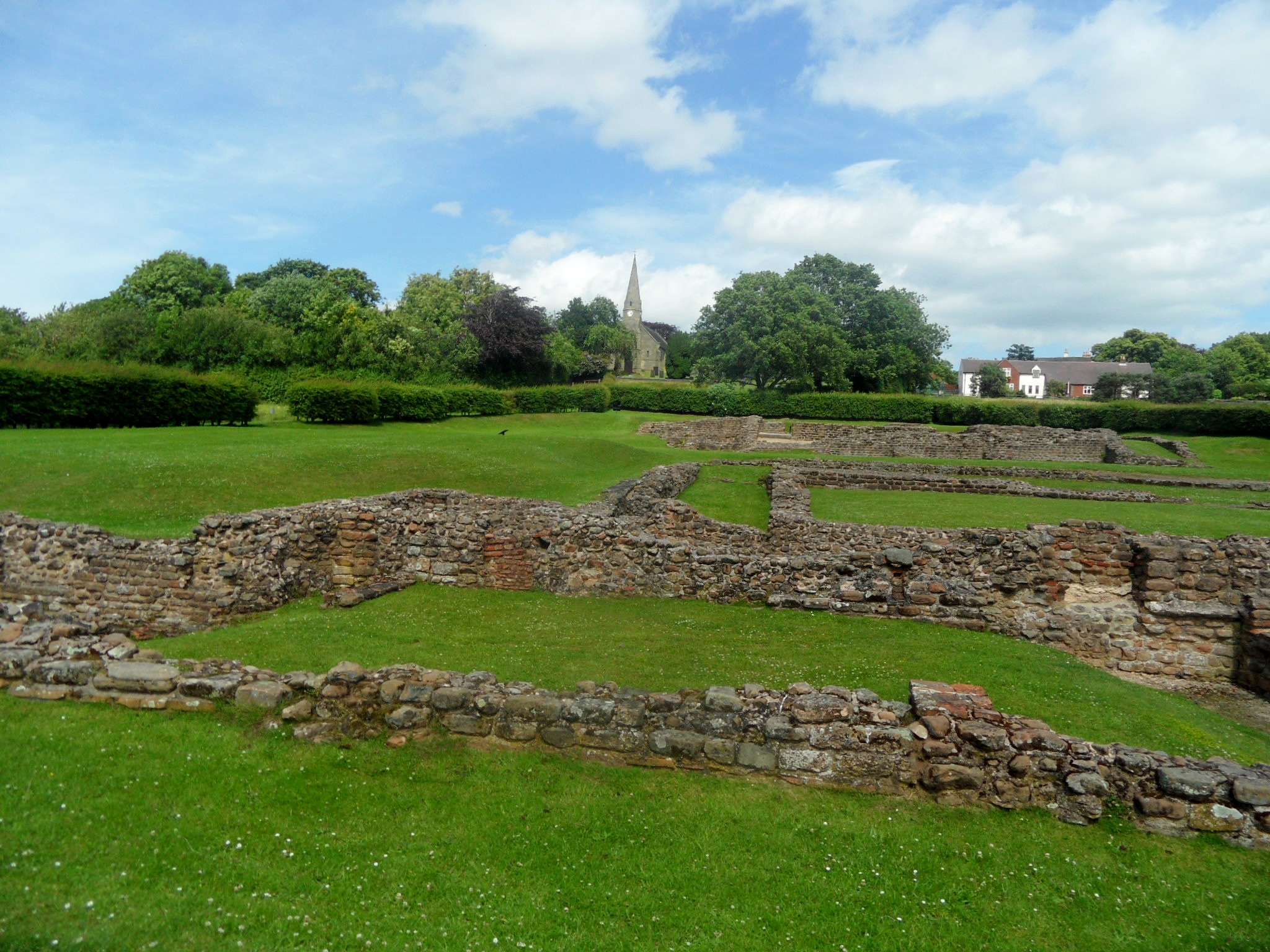
Remains of the guest house and bath house at the Roman settlement of Letocetum

Roman occupation at the site is thought to have begun with the establishment of a military site to protect this important route, later developing into a staging post where those travelling along Watling St could rest and recuperate at the guest house and bath house, (it is the remains of these buildings which are still visible) and eventually a small town.  You can see another Roman road, running between the remains of the two buildings on the site, with some of the original cobbles still intact.

Not quite on Watling Street scale, but a Roman road nonetheless.

After looking around the ruins, we followed the Wall Heritage Walk (available from the museum) which took us along more ancient routes – the greenways and sunken lanes that surround the village, thought to be old drovers’ roads.

I’m including this, not because I fancy myself as a wildlife photographer, but because I am grateful to the subject for being the only butterfly ever to have stayed still long enough for me to take a photo!

As well as enjoying the views and the wildlife of the hedgerows, I also couldn’t help looking out for buildings in the area that had used stone from the ready made quarry nearby!

Are these Roman stones I wonder?

One of the lanes runs past St John’s church. Built in the late 1830s, in comparison to the ruins it overlooks, it’s a young whippersnapper of a building. The architects were George Gilbert Scott and William Bonython Moffat, who it seems were also working on Lichfield’s new workhouse at St Michael’s around the same time.

One of the questions that seems to be subject to much discussion here is, could earlier places of worship once have existed on the site? There has been speculation that there was once a shrine to Minerva here, based on an account of a man who worked draining the lands around Wall. Asked if he had ever found anything in the course of his work, he told how as well as finding lots of old coins, he once found an earthenware figure that he described as being as big as a man, but not a man due to having a bust, and also not a woman as it had a queer dress and a man’s cap like a soldier’s helmet. And what did he do with this amazing find? Prepare to weep – he used it to mend a drain.

However, before getting too upset we can perhaps take some comfort in the fact that Jim Gould (who as well as working extensively at Wall explored and wrote about the archaeology of many of the other sites around here) was not convinced that the statue ever existed, the story being “from an unknown source, of the finding of an impossible statue, by an un-named man, at an unknown spot and date (1). A good lesson that no matter how appealing some stories may seem, they should be taken cum grano salis. 

Entry is free but the museum is only open on certain weekends so check first!

Thanks to archaeologists like Mr Gould and others, a great deal of the history and significance of the site has already been discovered, although it seems there are still plenty of crop marks and questions out there (including the relationship between Letocetum and what was to become Lichfield) to keep future generations of archaeologists busy. However, just as sunny days ideally shouldn’t be spent shopping on retail parks, places such as Wall ideally shouldn’t be explored through words and photographs along, but physically instead. The museum even has a collection of objects you can touch! Instead of using this post to further summarise the history of the site (especially as others will have done a far superior job elsewhere!),  I’d rather encourage you to go and have a look for yourself.  In case you need any further convincing, entrance to the ruins and the museum is free and the heritage leaflet I picked up there was worth every one of the 20 pennies I paid for it.

Slightly gratuitous photo of Roman army re-enactors, English Heritage Festival of History 2011

Sources:

(1) http://www.sahs.uk.net/Volume%20XXXIII.pdf

Wall Heritage Walk

Pastscape Record for Letocetum

Trading Places

In June 1945, local historican Mr Jackson contributed an article to the Lichfield Mercury in which he shared his memories of the shops and businesses that surrounded him as a young boy growing up in the city during the 1870s. I’ve summarised the article below so settle yourself down with a bottle of herb beer and a bag of toffee nobs and have a read!

In Breadmarket St, Mr Bartlam had a tinsmith business and Mr Marshall ran a dairy in the premises next to the old watchmakers and jewellers owned by Mr Corfield. Mr Corfield’s shop burnt down in 1872 – a tragedy that resulted in the entire Corfield family losing their lives (1). In 1872 there were three breweries – Griffith’s, the Lichfield Brewery Co. and Smith’s on Beacon St (the City Brewery and the Trent Valley Brewery came later). Mounsden and Sons was a wine and spirit business, according to Mr Jackson, one of the oldest in the city. There was Mr Nicholls, a photographer who also had a fancy goods shop on the site of what was to become the Regal Cinema (but has since been the Kwik Save and a nightclub, with plans to turn it back into the Regal Cinema again!).

Regal Cinema Lichfield. Late 1960s? Taken from Gareth Thomas’s Pinterest site http://pinterest.com/FieldOfTheDead/old-photos-lichfield/

A little shop in Tamworth St was kept by the Misses Wilcox who sold fancy goods and toys. Mr Jackson remembers that the shop was well below the pavement (why would this be?) and stocked everything from pins to rocking horses! He recalls buying yards of elastic for making catapults, along with marbles, tops and hoops.

Mr Young, a whitesmith, lived in the old Frog Lane School House and his workshop was in the same street. There were several ironmongers including Mr Crosskey on Market St, Sheriff of Lichfield in 1863 and Mayor in 1868. Next to the old Victoria Nursing Home at 15 Sandford St was Mr Tricklebank’s tin-ware business.

On Market St, was Mr Caldwell’s hardware business (Frisby’s Boot and Shoe store in 1945).  Over on Church St, Mr Platt made rope, twine and string (Mr Jackson believes he was the only one in the district at the time) and C W Bailey had an agricultural implement depot.  Blacksmiths were in demand – Gallimore on Lombard St, Mr Salt on Sandford St, Mr Sandland on Beacon St (later taken over by Mr Goodwin who, as you may remember from a previous post featuring Mr Jackson’s memories of Beacon St, was said to have shod a dancing bear).  Apparently, the smithy on Beacon St was the oldest in the city, dating back to the mid 1800s.

I believe that this building on Lombard St was once a blacksmith’s forge.

Wheel wrights producing traps, carts and wagons and well as the wheels to put on them could be found on Church St (Mr Davis) and Beacon Hill (Mr Horton).

This advert for John Simms shows that at some point the business moved to Church St. Image taken from Gareth Thomas’s http://pinterest.com/FieldOfTheDead/

John Simms had his mineral water works on Stowe St opposite St Chad’s School, and Mr Jackson remembers that when he was a pupil at this school in 1869, nearly every other cottage in Stowe St sold bottles of home made herb beer during the summer (was this actual proper beer or more like the ginger beer of Enid Blyton books?). Perhaps of even more interest for the little ones were the sweet shops – ‘Suckey’ Blakeman and ‘Suckey’ Perry in Market St and Mr Giles on Gresley Row with his ‘super’ toffee nobs.  When Mr Jackson moved up to the Minors School on the corner of St John St and Bore St, he recalls taking it in turns with his fellow students to fetch not just mere ‘super’ but ‘luxury’ toffee nobs from Miss Hicken’s (and later Miss Hobby’s) shop in St John St opposite the back entrance to the school.

Cities are constantly changing places. Even though my Lichfield memories only stretch back as far as the beginning of the 21st century (with the exception of one family day trip to Beacon Park in the 1980s) a lot has changed even in that short space of time with shops and businesses coming and, as is all too often the case these days, going. Just last week the Greenhill Chippy shut. A couple of years ago my friend and I were heading to the Duke of York when we got talking to a man who was passing through Lichfield on a long journey he was undertaking on foot. He didn’t explain why, and for some reason it didn’t seem right to ask him. He hadn’t any money and didn’t ask for any, but did accept a portion of chips from the Greenhill fish shop. I often think of him, and what his story may have been when passing by there. Anyway, my point is that places have memories attached to them and I think it’s important to record them, just as Mr Jackson did. There’s some great stuff being shared on the Lichfield Facebook group and some wonderful old photos on Gareth Thomas’s blog. For a much more in depth look at the shops and businesses of Lichfield, I know that there is a great book “Trades of a City: Lichfield Shops and Residents from 1850” by JP Gallagher, (although having only borrowed copies, if anyone can point me in the direction of where to purchase my own, I’d be grateful!). I think it would be brilliant to do some walks where instead of being led by a guide, people have a stroll around the streets together sharing memories and stories with each other. Until then, if anyone can identify any of the locations in Mr Jackson’s reminisces please let me know!

(1) This is a sad but interesting story in itself and I will cover it in a separate post.

Source: Lichfield Mercury 8th June 1945

Dog Days

At the weekend, I received an email from Lorna Bushell, asking if I’d ever come across Purchaser’s grave. Purchaser and his fellow canine, Vendor, are buried in the grounds of a building that was home to a firm of solicitors for many, many years – hence the unusual pet names! Although I found the headstone marking Purchaser’s grave easily, the memorial to Vendor wasn’t as obvious and may even be missing altogether.

I can only make out some of the writing on the stone, which I think testifies to the dog’s ‘personable disposition’, endearing him to all who knew him. If anyone has better eyes than me and can transcribe the full epitaph, please do!

I’ve seen memorials to animals at several former country houses I’ve visited in the past including these headstones at Trentham Gardens last summer, and up at Brocton on Cannock Chase, there is a headstone to Freda, the mascot dog of the New Zealand Rifle Brigade during the First World War. Brownhills Bob visited the memorial a while back and wrote a lovely article on it here.

One of the inscriptions at Trentham Gardens reads ‘Dolly – The Duke Cromartie’s Shooting Pony Died March 1923 Aged 12 (?) years.

I’m being deliberately vague about the location of Purchaser’s Grave, as on leaving I was stopped by someone and quizzed about what I was doing in their car park. I’m assuming that they may not take kindly to more people traipsing around their property searching for a dog’s lost grave.  Fair enough, I suppose, although it always seems a shame to me when parts of our history, no matter how big or small, are tucked away in unseen corners or hidden behind locked doors and gates, at risk of being forgotten about or lost for good. Down in London, there is a pet cemetery in Hyde Park – a fascinating piece of social history that few know about and even fewer get to see.

Back to Lichfield and if anyone does know any more about those solicitors’ best friends, Purchaser and Vendor, I’d love to hear about it.

 With thanks to Lorna Bushell for the information

Multi Story Huts

A while ago I wrote about the old scout hut in Leomansley, triggered by the chance discovery of an old girl guides badge in Moggs Lane (does anyone call it by that name these days I wonder? I’m going to try and resurrect it – it’s much better than calling it ‘the lane that runs past Martin Heath hall towards the football pitches’). The hut is believed to have originally been a cadet hut, from one of the first world war training camps on Cannock Chase.  There is a fantastic section on the Staffordshire Pasttrack website regarding the training camps, including a description of the huts themselves. After the war, many were sold off to towns and villages for use as village halls, workshops, and here in Lichfield, a youth club.

Colin Halfpenny sent me two photographs featuring his father, Frank Halfpenny, and other civic dignitaries welcoming the Duke of Gloucester to the hut in Leomansley in 1939. At the time it was being used at the headquarters of the Christ Church Boys Club on the Walsall Rd but was eventually taken over by the 6th Lichfield Scout Group. The hut was replaced by a new building in 2009.

Cllr Frank Halfpenny (the Sheriff of Lichfield), Alderman Tayler (the Mayor) and the Chairman of the Youth Club Committee stand on the steps of the hut with the Duke of Gloucester in 1939.

The Mayor, the Duke of Gloucester, Mrs Ballard, Mr A.N.Ballard (the Town Clerk), the Sheriff (Mr Halfpenny), the Sheriff`s Lady (Mrs Mary Halfpenny)  and the Mayoress

I have also started to read about Brindley Heath, where the abandoned huts of the military hospital were taken over by the West Cannock Colliery Company, providing homes for miners and their families until the 1950s.

Imagine the stories held within the walls of these simple wooden buildings – those of thousands of men, who called them home (possibly for some their last) as they trained for life, and in far too many cases death, in the trenches abroad.  Once peace was restored, there were new chapters in the stories of the huts themselves, with each one put to a new use amongst a different community.  As the centenary of the first world war approaches, I wonder if any of them are still around in our towns and villages, or have they all now been replaced?

With thanks to Colin Halfpenny for the photographs.

Edit: One of the huts may have been used at Snibston in Leicestershire, as a temporary residence for the Vicar whilst he waited for his new vicarage to be built. Also it appears that the memorial hall and men’s club at Glascote, Tamworth was also a former army hut.


Forge and Ford

As the afternoon’s weather in Longdon was not quite warm enough for basking in the beer garden of the Swan with Two Necks, I took myself off for a little wander. The pub has a late 19th century map mounted on the wall, and it shows that the building next door was once a smithy. I’ve always had a soft spot for these simple buildings, softened even further by the discovery that one of my ancestors was an innkeeper with a sideline in blacksmithing. One of these days I’ll stop romanticising about it and actually get around to visiting Cirencester to see whether the forge is still there.  For now though, back to Longdon, where in May 1918, the then blacksmith, a Mr T Broadhurst had decided to give up the business and was selling the tools of his trade. On offer was a grindstone on a iron frame, two circular double blast bellows (nearly new), a treadle drilling machine, two black staple vices and other useful tools. The building remained a forge until 1938 and now is home to the WI.

Something else that appears on the pub’s map is a ford, which as the name suggests, is at the end of this lane. I had a walk down and within minutes found myself alongside the Shropshire Brook. I stood for a while on the little footbridge watching tiny yellow birds flit between the trees and the water’s edge. Interestingly, on earlier maps this seems to be called the How Brook.

Fords “shine in the memory” according to the writers of England in Particular

I don’t know much about fords, other than they are a way of crossing streams and rivers, presumably at their shallowest points. Whilst reading up on them at home, I came across a surprising account of an event that seems to have taken place here or very nearby (1).

Sir William Wolseley … lost his life about the beginning of the last century* in a very singular manner. He went to Lichfield one morning about nine miles from his house in his coach and four and on his way passed a little brook which runs across the road at Longdon and which is so shallow that a foot passenger can easily step over it the water being kept up by a mill dam at some distance from the road. When Sir William Wolseley reached this brook on his return home in the evening the mill dam just at that instant suddenly gave way the water rushed across the road overturned the carriage and drowned Sir William with his horses. The coachman was thrown off the box into a tree and escaped.

*July 8th 1728 according to the inscription on the monument to Sir William in Colwich church

Could this these gently flowing waters really have caused such devastation? It’s hard to imagine. A reminder, I suppose, that whether it’s the fire of the blacksmith, or the water turning the mill wheel, we can manipulate the elements of nature, but we are never fully in control.

Sources

(1) – A topographical and historical description of the Parish of Tixall in the County of Stafford, Sir Thomas Clifford and Arthur Clifford Esq, 1817.


Fareground Attraction

In the last couple of weeks, I’ve done a fair bit of walking in the lanes (and on one misjudged occasion, a potato field) around the Lichfield/Burntwood area. On one walk I was accompanied by my husband, on another I was alone. Well, I say alone, but actually you bump into others – cyclists, horseriders and of course other walkers, who generally smile and say hello, and exchange pleasantries. I like that a lot. On the walk I did alone, I made the mistake of trying to take a shortcut. It was a way marked path through fields and the views were great but it felt too lonely. I retraced my steps back through the potatoes and back to the lanes. I’ve realised that I’m not much of a fan of walking through fields. I prefer to be somewhere where others have been, and others are.

Anyway, in case anyone wants to do a similar walk themselves, here’s a suggested route. I think it’s about 5 and a half miles.  As you can see it’s pretty straight forward, and in fact you could do it either way around, but I’d been reading the book ‘Holloway‘ and liked the idea of walking from Farewell towards the Cathedral down Cross in Hand Lane, as pilgrims did in the past, and indeed still do.

On walks these days, I am torn between the joy of discovering the unknown, and the disappointment on getting home and finding that you were just minutes away from a Tudor gatehouse/CAMRA pub of the year/ancient burial site etc. I hope that including a couple of photos with suggestions of things to look out for won’t make it too prescriptive, but will give you a flavour of the walk.

In parts, Abnalls Lane cuts through sandstone, and tree roots grow above your head.

According to the Staffordshire Heritage Environment Record, there are a series of these holloways on the Lichfield/Burntwood border.

Walking through the potatoes, it felt like there was nothing else but fields.

I was glad to get back on the lanes and see signs of human life, like these old cottages at Spade Green, on Abnalls Lane before turning up The Roche.

Found lots of water around Cresswell  (except for the well itself!). This is part of an old mill race, seemingly all that’s left of Little Pipe corn mill.

The Nelson Inn shows up on the 1815 map, and the pub’s website says that there may have been a pub onsite since the 1500s (presumably with a different name?). The low building to the left (which I’ve practically cut off the photo!) was a smithy. In 1909, Clifford Daft advertised himself as a general shoeing smith, willing to undertake all kinds of jobbing and repairs to farm implements.

Looking at a series of old maps, there’s not just the one well around here but several. However, I didn’t find any of them, so I had to settle for a different form of refreshment. And a very nice pint of Theakston’s Lightfoot  it was.

We found the old Farewell and Chorley schoolhouse, but I haven’t been able to find out much more about Elizabeth Annie Page as yet.

An old farm at Chorley

The Malt Shovel at Chorley. Great pub.

A lovely babbling brook running alongside the path. Was tempted to have a paddle as it was hot and my feet were rubbing, but thought I’d never put my not entirely appropriate shoes back on again if I did.

In between walks, some of the wildflowers on the roadside verges had been chopped down which was a shame, but there were still pockets of them in places, including these incredibly late bluebells.

Farewell church, a church of two halves. Once the site of a Benedictine Priory and where some mysterious jars were found in the wall, during renovations….

…and somewhere beneath the greenery is the ‘pure spring’ that gives the place its name. You can’t see much, but you can sometimes hear it gurgling away if the water table is high enough (thank you Brownhills Bob for explaining away this mystery)

Down Cross in Hand land, past Farewell Mill. There’s been a mill here since the 12th century. It was apparently in operation until the 1940s (source: Staffordshire Past Track).

Past the sheep taking a dip in the sparkling water that flows along the lane.

Cross in Hand Lane, I understand, was once the old road to Stafford. As you reach these lovely white cottages set back into the sandstone, you are nearly back at the A51, which is of course the new road to Stafford…

Of course, if you don’t want to say farewell (ho,ho) to the walk just yet, somewhere around these cottages is an old track called Lyncroft Lane, which leads to Lyncroft House aka The Hedgehog!

Pillars of the Community

Back in April, I found what I thought were moss covered stone pillars in the undergrowth at Beacon Park, and asked if anyone knew what they were, or where they had come from. Well now, thanks to members of Lichfield District Council and the Beacon Street Area Residents Association, we have not one possible solution but three!

Could they be:

a) a section of balustrading from the Bird St/Beacon St side of the park, removed in the 1980s to create a corner entrance to the park over by the new Chandlers kiosk and the public toilets?

b) part of a structure used by a dairyman to shelter in during bad weather? There was once a farm in the vicinity of the Bunkers Hill Car Park, and a dog walker remembers that before the war, dairy cows were kept on the land that is now the football pitches and woodland.

Beacon Park map. Source: Gareth Thomas and his excellent blog – http://allaboutlichfield.blogspot.co.uk/

c) part of a “tower” that was originally at Stowe pool?  Apparently, after it became unsafe, the tower was dismantled and some of the stonework was put in the woodland.

d) None of the above?!

It’s great how by trying to uncover the story behind the stones, it’s also uncovered other things – the memories of cows on what’s now the football pitch and the possibility of a tower at Stowe Pool for starters! It’s also a good reminder that the version of a story we’ve been told, or the one we remember, might not be altogether correct. That’s not to say that such stories don’t have value, it’s just we need to be careful about accepting things at face value.

By the way,  if I was betting woman I’d go for option a….

A Fleeting Present

A while back I wrote about Mr J W Jackson, the ghost hunting city librarian who wrote a local history column for the Lichfield Mercury in the 1930s and 40s. Last night I found an article about ‘dear old Beacon Street’, written by Mr Jackson in November 1943, in response to a letter from one of his old school friends who emigrated to Canada in 1870, at the age of twelve. Of course, in describing the changes that have taken place in seventy years, Mr Jackson gives us a glimpse of Beacon St in both his past and his present, which is actually now our past. Before things get too wibbley wobbley timey wimey, let’s move on to a summary of the changes Mr Jackson noted in Beacon Street over the seventy years leading up to 1943.

Mr Jackson says the old pinfold still remained but was hardly, if ever, used for its original purpose – in the past it frequently containing horses, cattle or sheep caught straying on the road and penned by official pinner, Watty Bevin.  Fifty yards away from the pinfold as you walked back towards the city there used to be an old iron pump where the children used to fill up the vinegar bottles they were taking home from Hagues in Beacon St, after enjoying a couple of sips.  The Anchor Inn kept by Billy Godwin had been cleared away and the field between the Inn and Smith’s Brewery was now the residential school. The brewery itself where the children took cans to be filled with barm had been converted into a foundry.

The Fountain Inn still remained  but visitors from the Black Country no longer came to play bowls on its lawns. The Lemon Tree Inn, kept by Sam Boston was now a house, as was the old butchers shop (kept by Mr Yeomans) and the Pheasant Inn previously kept by Mr Stone is also a house.  The wall shutting off Beacon Hall had been partly taken down and was now a garage and a residence. The old fashioned grocery shop at corner of Shaw Lane, owned by Mr Hall had been sold and replaced by a much larger shop, eventually becoming an antiques shop. Whitehall and Milley’s Hospital remained as they were in 1870 but the Free Library & Museum had been built near to the site of Griffith’s Brewery. (Note: Think this was probably earlier – Free Library & Museum built 1859?)

Green house was formerly the Lemon Tree Inn

The Angel Croft was described by Mr Jackson as ‘now a hostel’. The Old Beehive Inn had also been converted into a residence as had the Wheel Inn at the corner of Wheel Lane. The windmill where Mr Jackson played as a child was no longer in use but converted to a picturesque residence. Apparently the miller came in a considerable fortune and disappeared leaving everything as it stood and nothing was heard of him again.

Beacon Gardens built 1925

Council houses known as Beacon Gardens had been built on the fields in front of the Fountain Inn. The old blacksmiths, where legend has it that a French man once took his dancing bear to be shod was still going strong.  The Feathers Inn was still licensed and the row of cottages adjoining was much the same. The Old St Chad’s Rectory garden and field had been built over, the new road known as Nether Beacon. By 1943, the wheelwrights shop on brow of Beacon Hill had long since disappeared but the Little George Inn still stood as did the George & Dragon.

Of course, we can also now compare Beacon St seventy years on from when Mr Jackson did his comparison. I took most of the photos on Sunday (before I found the article weirdly!). The old pinfold still remains, but I doubt anyone now even remembers it being used to lock up straying animals.

Beacon Street School Sanatorium

The residential school has now been converted into apartments and the site of the Foundry is now Morrison’s Supermarket. Funnily enough you can probably get barm, or something similar there once again, as I think it’s a type of yeast (as in the northern ‘Barm Cake’). The Fountain Inn is still open, and Milley’s Hospital and Whitehall are still there. The Free Library and Museum building is of course now used as the Registry Office. As we are all too aware the Angel Croft is still there, but for how much longer in its desperate state?

The blacksmiths has gone but is not altogether forgotten with road names ‘Forge Lane’ and ‘Smithy Lane’ to remind us. The Feathers Inn is still licensed but has now expanded into the row of cottages adjoining (for the record, I had a very nice jacket potato in the beer garden there on Bower Day this year). The George and Dragon, thankfully, still stands but the Little George is now a private, rather than public house. According to John Shaw’s Old Pubs of Lichfield, after WW2, the licence of the pub was transferred to the new pub on Wheel Lane, known as the Windmill. This ‘new’ pub which, wasn’t around in Mr Jackson’s time will probably not be around for much longer, as it is has been closed for some time and the site earmarked for development.

Mr Jackson’s article reminds me of the need for recording the everyday and the seemingly ordinary, as one day the present will be the past and what was once commonplace may no longer be.  I’m a big believer in using place names that reflect the history of a place, but on its own, a street sign for ‘Smithy Lane’ only tells you part of the story. Had Mr Jackson not added the story of the dancing bear’s shoes and the missing miller and his money to his reminiscences, they may well have been forgotten. “So what?” some may say, dismissing them as mere trivialities, but I disagree. I think stories matter.

Perhaps in seventy years time someone will look back at how Beacon St was in 2013. I wonder what will have changed and if we’ll have left them with any good stories?

Sources:
Lichfield Mercury archive
The Old Pubs of Lichfield, John Shaw

Refusing to Bough Down

I didn’t spend as long as I normally do at the Bower yesterday, but I did wander around the busy streets, catching the end of the procession on Dam St, and I was glad to hear that the day had been a success. Something that I’ve always been interested in is the traditions associated with the event and today I found an interesting story from the 1950s about one of those customs.

At dawn on Bower Day in 1952, some of the male residents of Lower Sandford St were gathering elm branches near to Beacon Farm, on the edge of what is now Beacon Park. Apparently every year, for as long as anyone could remember, the boughs had been cut from the trees and used to decorate the houses in ‘Old San’ as the street was known. However, as the men gathered the boughs, a police officer arrived and instructed them to stop, on the orders of the Town Clerk and the Estates Committee of the City Council, as it had been reported that in previous years the trees had been damaged.

The residents of ‘Old San’ were angry that their ancient privilege was being threatened and sent a message back to the Town Clerk and the Mayor, Cllr. C Bridgeman, that if no further boughs were allowed to be cut, then those that had already been collected would be used to barricade Sandford St and prevent the Bower Procession from entering. As tensions rose, the Town Clerk and the Mayor arrived at the scene and gave their permission for residents to continue collecting boughs, providing that no trees were damaged in the process. The boughs were then used to decorate the houses of old Sandford St along with bunting, balloons and slogans, with prizes awarded for the best decorated properties.  One lady, born in Sandford Street in the late nineteenth century, told the reporter that when she was younger the boughs had been taken from the old brook near the Bowling Green Inn. In her opinion,  “When ‘Old San’ finishes, so has the Bower”.

What’s also interesting is that the incident seemed to awaken a fighting spirit within Sandford St. At the start of June, a committee was formed following a outdoor meeting held on some waste ground in the street. With Mr Frank Halfpenny, the former City and County Councillor, as chair, the committee asked Lichfield City Council to address not only the issues that had arisen during Bower Day, but also other matters affecting them. The wanted Sandford Street to be regularly swept and cleaned, the sites owned by the council on the street, described as being in a ‘neglected and disgraceful condition’ to be ‘cleaned up, fenced in and, at the earliest possible opportunity, built on’ and recreation facilities, such as a playground to be provided in the park. The committee also planned to organise the street’s coronation celebrations for the following year, and to send parcels to local men serving in the forces.

I usually watch the Bower procession from outside the Police Mutual on Queen St, not far from Sandford St. As far as I know, the houses are no longer decorated and I’d be interested to know more about this tradition and the Sandford Street community, who clearly had their own strong identity within the city.

Source:

Lichfield Mercury Archive

A Change of Scenery

Since visiting the new Christian Fields local nature reserve last year, I’d been waiting for an opportunity to return and follow the ancient route which runs from the reserve to the village of Elmhurst.

I was eager to see was whether the dry pool/well we thought we’d found last time had filled with water. Turns out it had, but not necessarily in the way I was expecting… When I went in September it looked like this:

Now (assuming I have got the right place!) it looks like this:

The reason for the change is that site is being developed with £100,000 of funding to attract wildlife (and members of the public!) to the site. As well as the new pond and dipping platform, there will also be picnic areas, wild flower meadows and information boards.  There were lots of tadpoles swimming about in the new pool, so it looks as though efforts to improve the site’s biodiversity may be starting to pay off. You can read more information on the project here.

After watching the tadpoles, we passed two women out dog walking.One was trying to disentangle herself from a bramble that had taken a liking to her, but it seemed the feeling wasn’t mutual. “Bloody nature!”, we heard her shout as we walked past.

We continued along the wooded path leading to Fox Lane, Elmhurst.  Interestingly, up until the middle of the last century, it seems that both the path and Fox Lane were actually a continuation of Dimbles Lane.  After brushing past wild flowers and negotiating tree roots on the narrow, winding path we emerged from the green corridor into the village. I would love to know how often this path was trod by past generations, but surely none of them have ever tried to take a motor vehicle up there. Have they?

I believe that ‘new’ name for the lane relates to a retired business man, George Fox, who bought Elmhurst Hall in 1875. Fox died in London from a chill in 1894 after moving from Elmhurst to enable the Duke of Sutherland to use the house to host the Prince of Wales on his visit Lichfield for the centenary of the Staffordshire Yeomanry.

The original Elmhurst Hall was built by the Biddulph family in the late seventeenth century and replaced by an Elizabethan style house in 1804, with building materials from the original house being offered for sale. I wonder where these parts of Elmhurst Hall ended up?

Source: Wikimedia commons

Source: Wikimedia commons

The second Elmhurst Hall was demolished in 1921. Its last owner was the brewer Henry Mitchell (as in Mitchells & Butlers). There are still remains of the estate in evidence including a walled garden which dates back to at least 1740 and a lodge built in the 1870s, in the same style as the main hall, known as High Field Lodge. There was also another earlier lodge on Tewnals Lane but I haven’t been to have a look and see if that still exists.

High Field Lodge

Walled Garden

Whilst at Elmhurst Hall, Mr Fox established a mission room linked to St Chad’s Church, Lichfield to compensate for a lack of a place of worship in the village. I understand that services were taken by students from Lichfield Theological College and  Mr Fox himself.

Wild garlic & a rusty barrow outside the Mission Room

As I was walking, I couldn’t help but think of Alfred Cleveley, a butler a Elmhurst Hall in 1914 and later a recipient of the Military Medal, killed in action in May 1917, who I wrote about here. I later found that Private Joseph Hall, aged 20 and a member of the Mission Room choir also lost his life during the war. Born in Elmhurst in 1897, on the 1911 census Joseph was an errand boy. It’s a sad thought that the names of Joseph and so many like him would not appear on another census but instead on war memorials and rolls of honour. However, there did seem to be some controversy regarding where names should be included.  Whilst reading through the newspaper archive on Elmhurst, I found a letter from someone using the pseudonym ‘A Mother’, wanting to know why her son, born at Elmhurst, who died making ‘the great sacrifice’ on the battlefield aged just eighteen years old, should not be eligible to have his name enrolled on the Lichfield memorial. Apparently, she was told after making a voluntary subscription that the lad did not belong to Lichfield. ‘Then where did he belong to I should like to know?’ ends her letter.

I imagine that both Joseph Hall and the unnamed soldier went to Elmhurst School, opened in 1883 on land given by George Fox who also sat on the board as chairman. A proposal to close the school on account of low numbers was rejected by parents in the 1930s, and the school remained open until 1980 when the building was taken over by the Elmhurst and Curborough Community Association and pupils were transferred to other Lichfield primary schools, including Christ Church.

The Lichfield side of Dimbles Lane now has a very different feel to the rest of the route which shares its name, although the former landscape is reflected in the names of some of the new closes and crescents built by the local authorities after the First World War and throughout the twentieth century – Bloomfield, Greencroft, Willowtree.  The building program meant that the population of Lichfield increased significantly, and it’s a good reminder that housing estates are just as much a part of our history as the old country estates such as Elmhurst Hall. This is something that is being recognised more and more these days with some great work on our recent past going on in other places. For now, I will try and put something together so that others can follow this walk for themselves.

Start of Dimbles Lane at the Lichfield city end

Dimbles Lane as it crosses Eastern Avenue and enters Christian Fields Nature Reserve

Edit: Oh look! There’s a story here on Lichfield Live about volunteering at Christian Fields LNR on June 3rd. If you go, say hi to the tadpoles for me!

Sources:

Townships: Curborough and Elmshurst’, A History of the County of Stafford: Volume 14: Lichfield (1990), pp. 229-237

Lichfield Mercury Archive