Shiver Me Timbers

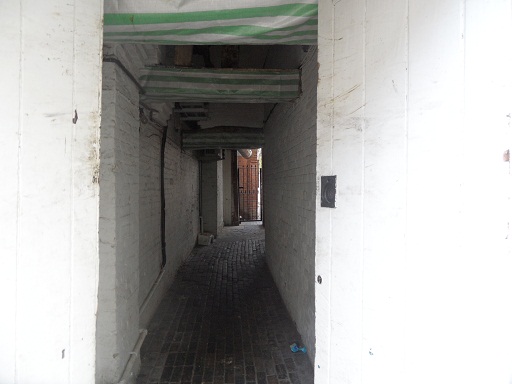
Where there’s an old wooden beam, there’s often a rumour that it originated on an old ship. It’s a bit of folklore that I keep encountering time and time again, even here in landlocked Lichfield and Staffordshire. Back in 2011, I visited St John’s Hospital during the Lichfield Heritage Weekend and heard that the Master’s House, which was originally the canons’ and pilgrims’ hall and enlarged by Bishop Smythe in the late fifteenth century, was built using beams from galleons. On the ghost tour earlier this month, we were told that that wooden beams in an entry running alongside the Walter Smith butcher shop on Market Street came from old ships and when researching the Four Crosses Inn in Cannock for a piece in the Chase Gazette, I once again came across claims that the oldest part the building, dating to 1636, made use of timber from ships.

Alongside butcher shop on Market St. Beams are covered in stripy plastic on this photo unfortunately, but every now and again the alley is open for you to go and take a look...

Alongside butcher shop on Market St. Beams are covered in stripy plastic on this photo unfortunately, but every now and again the alley is open for you to go and take a look…

Last night, a discussion on Twitter about those other two old inn regulars – ghosts and Dick Turpin – moved onto the subject on the use of old ships’ beams and a quick google search revealed yet more old Midlands buildings making the claim including the Ye Olde Gate Inn in the Derbyshire village of Brassington and the appropriately named Old Ship Inn in Worksop, Nottinghamshire. Could there be any truth in any of these claims? As someone unfamiliar with the world of carpentry, I was interested to read a discussion between some experts on the matter which you can read here. Just as I was sure that this myth was pretty much busted I clicked on the link in the penultimate comment, which took me here – a website telling the story of the lost Brig Elizabeth Jane, launched in Nova Scotia in 1817 and abandoned off the Yorkshire coast in 1854. Incredibly, the name board and the port of registration board were discovered in a ceiling in Robin Hood’s Bay in 2003 leaving no doubt that this was one case where the rumours were true.

A one off perhaps? It seems not as shortly aftewards I came across the website of the Chesapeake Mill in Hampshire, where the beams, joists and floors are all said to have been constructed from the United States frigate ‘The Chesapeake’. On a slightly gory note, an extract from ‘The Navy and Army Illustrated’ in 1898, included on the  mill’s website, describes the joists as ‘covered with the blood of the men who were killed and wounded in action, and many bullets are embedded in them; in fact a good many of the timbers seem quite soaked with blood’.  You should read the full story on their website here it’s a fascinating place!

Closer to home, I found an article on Graiseley Old Hall in Wolverhampton which says that some of the purlins (now there’s a word I didn’t know existed until today!) in the roof came from old ships. What’s also interesting about this article is that it acknowledges that similar claims are made about many buildings, but that hard evidence to support it only exists in a few and then gives us a possible explanation for this, suggesting that often it could be a reference to the quality of the timber rather than where it came from.

I’d really like to hear of any more examples that people know of where old ships timbers are said to have been used, proved or otherwise.  When it comes to myths and folklore, we shouldn’t always believe everything we hear, but we should definitely listen in the first place. You never know where a story will lead.


Review of the Year…1884

Around this time, we seem to get the urge to look back and reflect on the events of the dying year. However, as I’m sure memories of 2013 are still fresh in your mind, let’s imagine instead that it’s the year 1884 that is drawing to a close and take a tour of the ‘Chronological List of the Principal Local Events’ of that year, courtesy of the Lichfield Mercury.
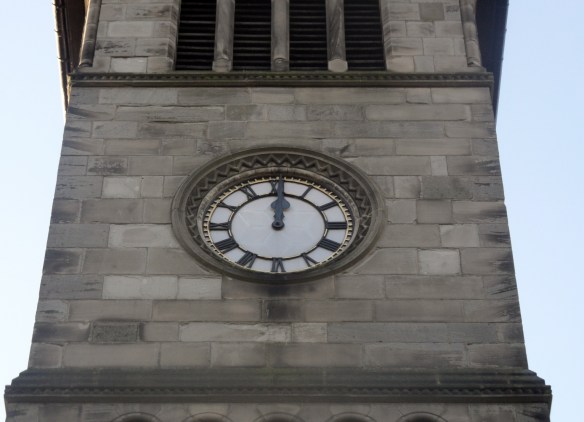
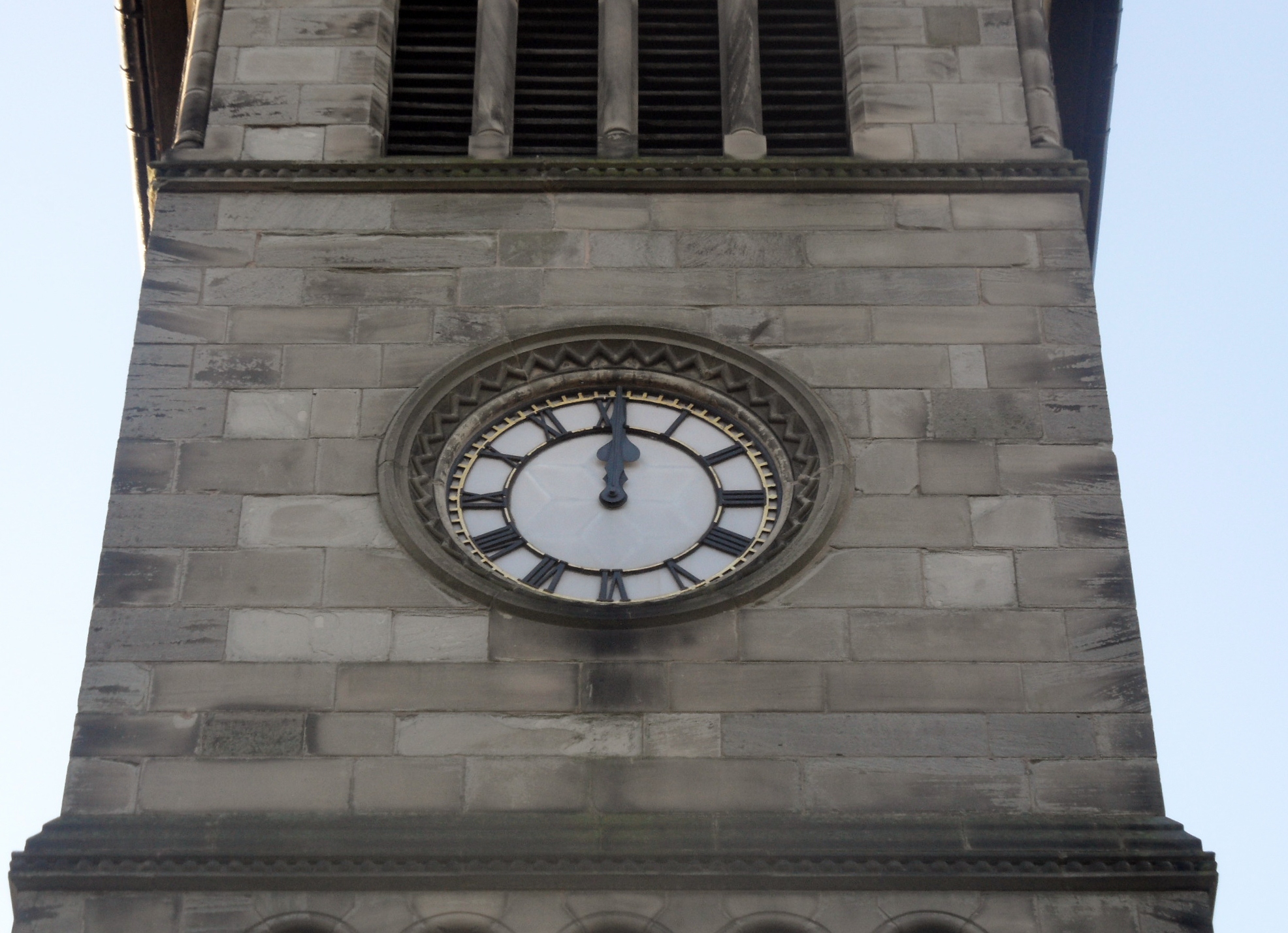
I never did get around to arranging that New Year's Eve party at the Friary Clock Tower...

I never did get around to arranging that New Year’s Eve party at the Friary Clock Tower…

In January, we have the adoption of fish dinners in the Lichfield Union Workhouse and a local government board enquiry into the affairs of Walsall Workhouse.  Whatever those affairs may have been, the next entry informs us they were concluded and moves on to the conviction of Thomas Skelton, a Lichfield Jockey and Trainer, fined £5 for assaulting a commercial traveller at Nottingham. The Trent Valley Brewery Company were in trouble too, alleged to have illegally seized the goods of a Southwell brewer. There was yet more excitement towards the end of the month with a ‘daring till robbery’ at Mr R Cleaver’s shop on Tamworth St.

Sports news in February when Lichfield Cricket Club decided to rent the ground previously known as the County Ground, to raise funds for a pavilion and to obtain the services of a professional cricketer. Over at Hednesford, the Poultry and Pigeon show took place over two days. Mrs Scott’s annual sale of work in Lichfield (who Mrs Scott was and what she was selling is tbc). More seriously, there was an inquiry into the sanitary conditions at the Birmingham Road Barracks in Lichfield, and a railway accident at Sutton Coldfield left an engine and guard’s van wrecked. As the month progressed,  the Brethren of St John’s Masonic Lodge decide to present a statue of Queen Victoria to fill in one of the niche’s on the Cathedral’s Western Front and the Lichfield Board of Guardians decided not to extend the workhouse. The month ended on a high with the Lichfield Old Fair.

March began with trouble on the railways –  a ‘slight accident’ at Lichfield and the commitment for trial of a Cannock Chase miner for attempting to wreck trains near Lichfield, both of which events warrant further exploration. Sir Arthur Scott at Great Barr passed away, as did Lichfield Workhouse Master, Mr Winkely, replaced almost immediately by Mr and Mrs Williams.

At the beginning of April, there was a meeting at Rugeley to condemn the ‘Deceased Wife’s Sister Bill’, and the sad discovery of a soldier found dead in an entry of Rotten Row in Lichfield. The inquest, unable to determine a cause of death, simply returned a verdict of ‘Found Dead’. In the middle of the month, the Lichfield Spring Races took place and the Sister Dora Memorial Convalescent Hospital at Milford was opened. On the 22nd, the Bishop of Lichfield said goodbye to the Derbyshire Clergy, as the county left the Diocese. and over at Brownhills, William Henry Wombwell was convicted of non-delivery of voting papers in the Local Board of Brownhills elections.

May 1884 was a grim month.  Two miners were committed for trial for shooting a man at Gentleshaw and the trial of the seventeen year old miner who attempted to wreck at train on the Trent Valley Line concluded with him being convicted and sentenced to seven years penal service. There was more trouble at Walsall Workhouse when the Master, William Pritchard, was accused of embezzlement and there was a tragic accident on the Walsall Rd, when a young man shot himself. One positive thing that took place this month was the rededication of the restored Western Front of Lichfield Cathedral.

Festivities in the month of June included the Court of Array and the Greenhill Bower, and the decoration of Dr Johnson’s Statue by the Staffordshire Yeomanry who were assembled in Lichfield for a week’s training under the command of Colonel Bromley-Davenport. Yet within days, things had taken a sour turn with a disturbance between the Yeomanry and Lichfield civilians and then the sudden death of Colonel Bromley-Davenport in St John St. In the days that followed, an inquest into the Colonel’s death, returning a verdict of ‘death by natural causes’, was held, as was a Military Court of Inquiry at Yeomanry House on St John St into the disturbances which had taken place.

July brought with it the closing of Fair Oak Colliery, a ‘Great Temperance Fete’ at Hagley Park, Rugeley and a guilty verdict for Mr Pritchard, the Walsall Workhouse Master, who was sentenced to fifteen months imprisonment for fraud.

August was a quiet month. The cornerstone of a new mission church was laid at Chase Terrace and there were a lot of sheep sales – the Beaudesert Flock and the Freeford Flock amongst them.

September was more eventful with the opening of the Lichfield and Sutton Coldfield Railway for goods traffic and of course, the annual Sheriff’s Ride. There was a fire at Mr Williams’ chemist on Bird St and Mr Peattie, of the Old Crown Hotel died from injuries sustained after being thrown from a trap near Whittington Barracks.  There was an Autumn race meeting at Lichfield, as well as the fifth annual Working Men’s Association Produce and Poultry Show.

In October, the Mercury reported on riots and destruction of property at a Conservative rally in Aston, Birmingham and the presumably much more sober affair that was the ‘Annual Festival of the Lichfield Diocesan Church of England Temperance Society’ rounded the month off.

November saw the opening of the new Lichfield City Station, an event seemingly marked with tragedy when, ten days later, a railway porter was killed there. Councillor J H Hodson was elected Mayor and there was a dinner at the Swan Hotel for the outgoing Mayor, T H Hunt. The Lichfield Board of Guardians were back to discussing the extension of the Workhouse again.

As the year drew to a close, there was another railway tragedy when a guard was killed on a siding at Shenstone, on the same day that the new Lichfield and Sutton Coldfield Railway was opened. The year ended with Lichfield Cricket Club deciding to purchase their pavilion for £150, a performance of Handel’s Messiah at St James’s Hall, a bazaar at Elmhurst Hall to raise funds for St Chad’s Church tower and finally, on 30th December 1883, a Great City Tea.

As well as the obvious interest of following up on some of these stories, something I find fascinating about something like this is how it’s so locally orientated, but then every now and then, you get glimpses of what was going on in the big wide world outside of Lichfield, and our corner of Staffordshire. I’m also tempted to look back over copies of the Lichfield Mercury for 1884 to see if I agree that these were the ‘Principal Local Events’ of that year or just something that the writer threw together in a hurry.

Of course, as well as looking back, it’s also a time to look forward. I may not be reviewing 2013 here but do just want to mention that I am looking forward to 2014, and especially the upcoming walks, talks and workshops that we’ve got planned for our group Lichfield Discovered. More to come on that shortly.  This history lark is always more fun when you do it with others and on that note, I’d just like to say thanks for reading the blog, especially to those who contributed in some way, whether by providing information or support and encouragement along the way. A very Happy New Year to you all!
Something Old, Something Neo

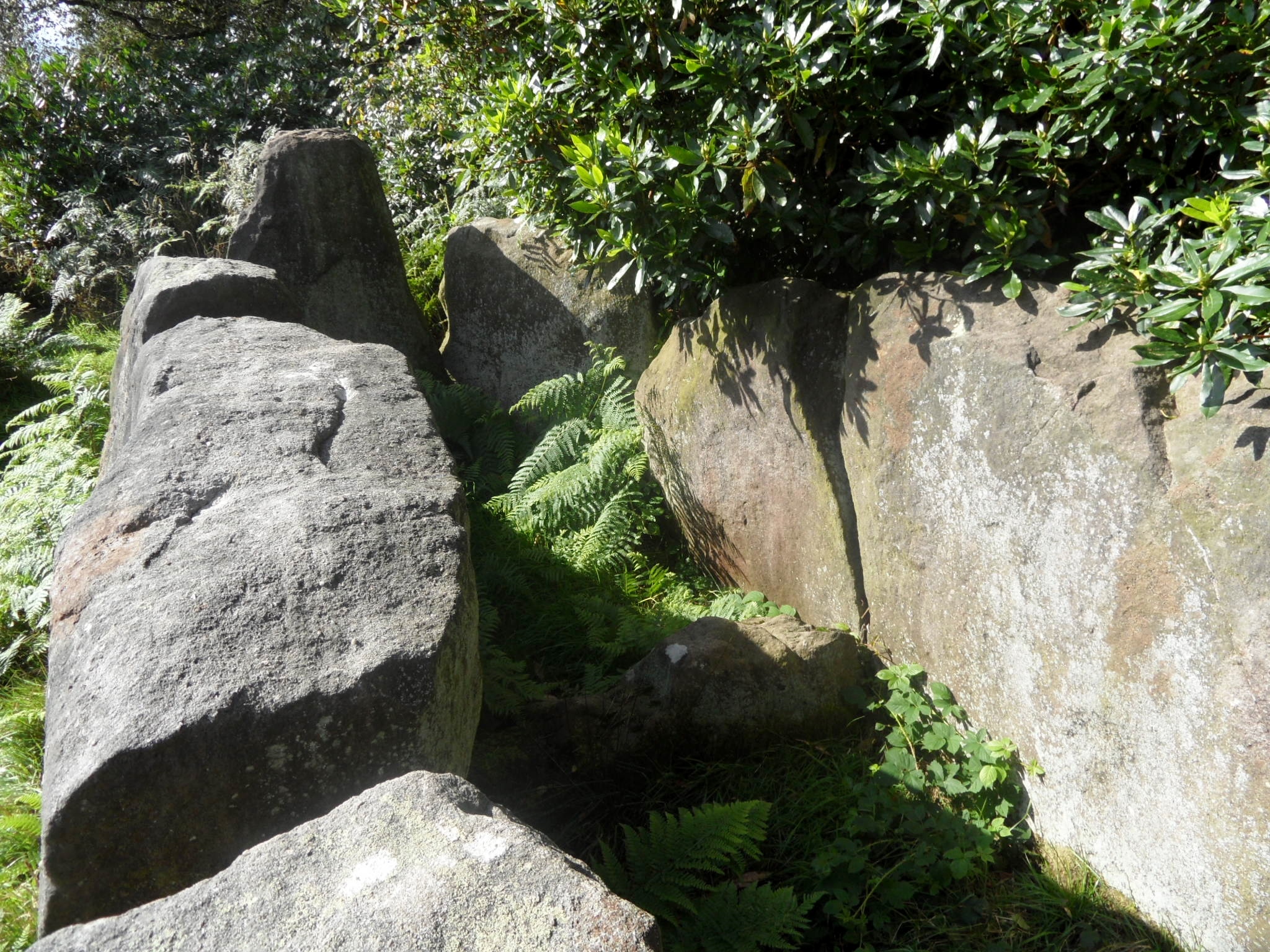
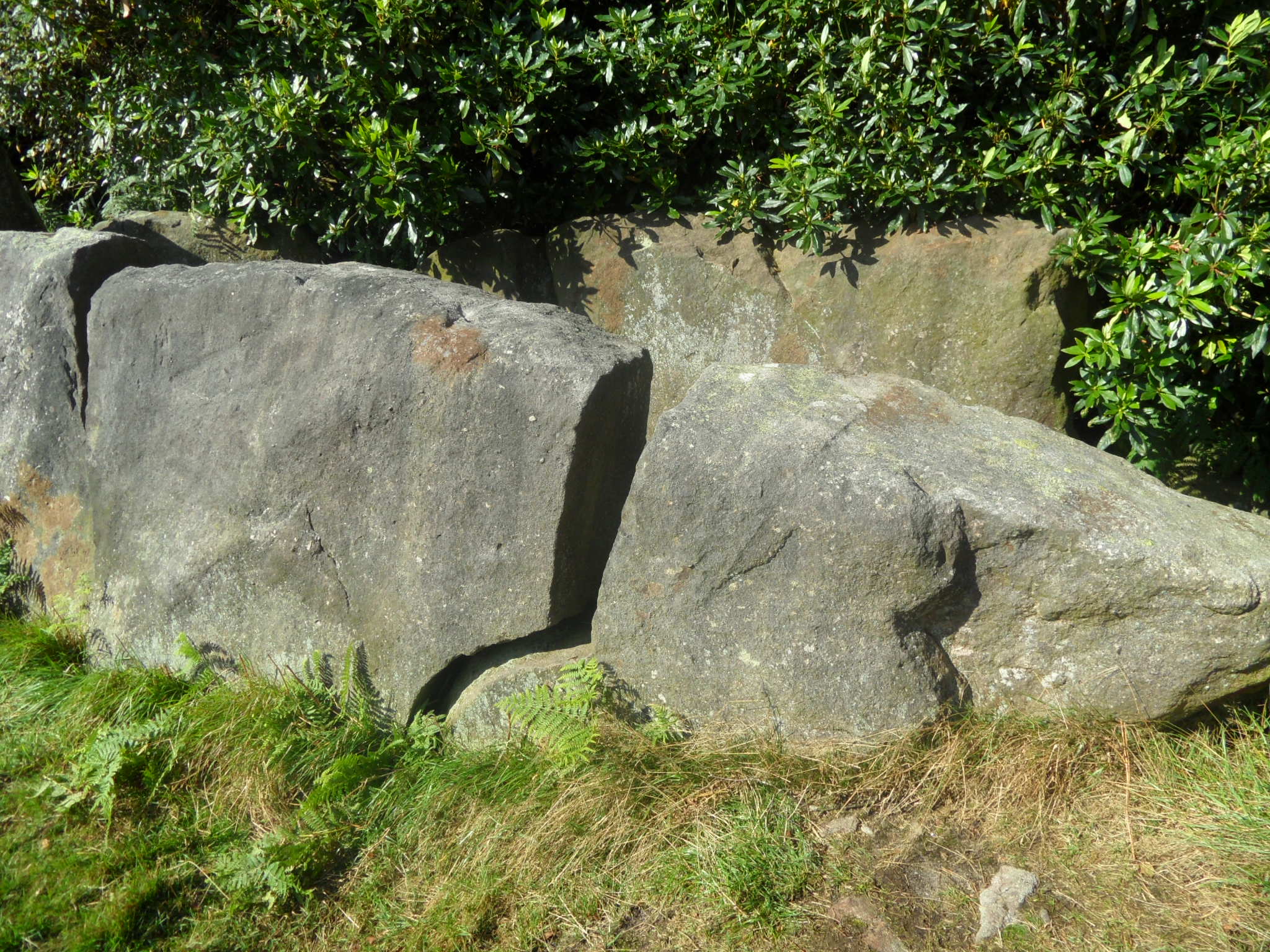
At the end of the summer I went with friends to visit the Bridestones. Admittedly, this Neolithic burial chamber is a fair few miles from Lichfield and technically is not even in Staffordshire but definitely worth an excursion both in real life and also, I hope, via the blog.

The Bridestones are thought to be somewhere between six thousand and four thousand years old. When you think that the estimate for the monument’s age alone covers a range of around two thousand years, you realise just how little we can be certain of and how vast the time scales are when it comes to ‘prehistory’. It’s an absolute wonder that these stones are still standing, and all the more remarkable when you read of their treatment in the past. Back in the eighteenth century, the site was regarded as a convenient quarry and was plundered for its stone, some of which was used to build local houses and some of which was taken to build the nearby toll road, as described in Henry Rowlands’ 1766 Mona Antiqua Restaurata

There was a large heap of stones that covered the whole an hundred and twenty yards long, and twelve yards broad These stones have been taken away from time to time by masons and other people for various purposes. And in the year 1764 several hundred loads were carried away for making a turnpike road about sixty yards from this place which laid it open for examination.


There are also rumours that some of the stone can be found in the ornamental gardens at Tunstall Park, which was opened to the public in June 1908. I’m a little sceptical about this but it does once again raise that interesting idea of recycling materials from older structures. The stones are said to have sustained yet more damage in the nineteenth century, both accidentally, when a fire lit at the site caused the stones to crack, and deliberately, when an engineer working on the Manchester Ship Canal supposedly demonstrated how detonation worked on one of the larger stones.

When trying to understand sites like the Bridestones, we look to archaeology to provide us with answers. The Stoke on Trent Museum Archaeological Society have a fascinating report on their website which contains drawings of what the Bridestones may have looked like back in the eighteenth century together with details of the archaeological investigations which have since taken place and what they can tell us about this ancient structure. You can read it here. However, as well as evidence provided by science, I also enjoy the folklore and myths that grow up around sites like the Bridestones. There are stories that they mark the resting place of a murdered pair of newly weds, a Saxon woman and her Viking groom. Others say weddings once took place here. Was the name ‘Bridestones’ given to the site to reflect these stories, or were they invented to explain an already existing name? I think it’s worth considering that stories were (and still are) ways of sharing and passing on information and that perhaps sometimes this information might yet be contained within such stories, however naive and implausible they seem upon first listen.

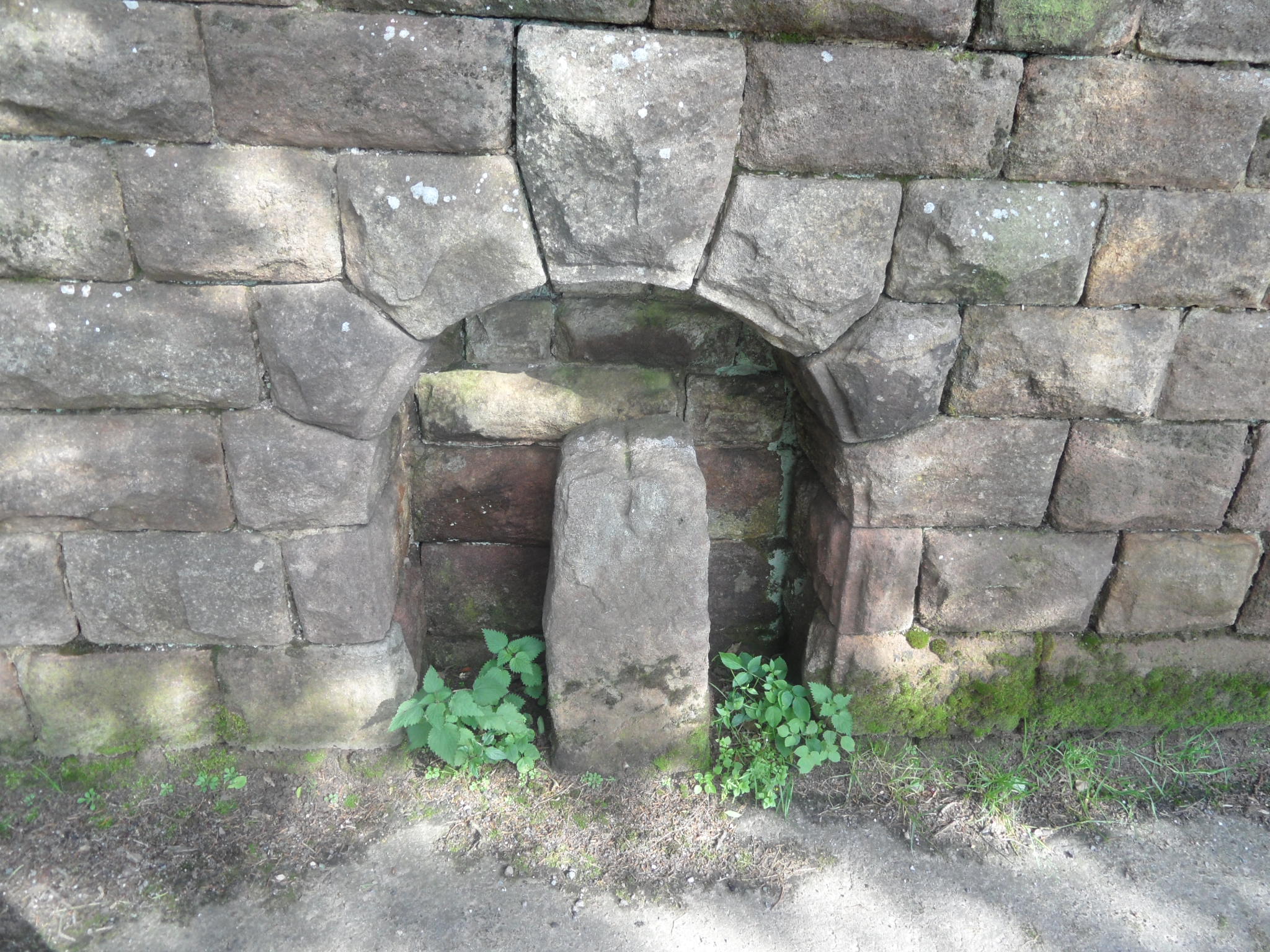
As I mentioned at the start, the Bridestones sit on the Staffordshire/Cheshire border, just inside the latter county. There’s a boundary stone very close by on the drive leading to the site and surely it was due to the presence of the Bridestones themselves that the border was established here in the first place, acting as a memorable boundary landmark. Why did our ancestors chose to erect their monument at this particular spot in the first place though?

Despite being ransacked and not looked after properly over the years, this is still an incredible place and you should definitely take the time to hop over the border and pay this old Cheshire couple a visit.

Bones of Contention

Last week, together with other members of the Lichfield Discovered group, I enjoyed a Gruesome and Ghostly tour around the city lead by one of Lichfield’s Green Badge Guides. Some tales were familiar (although it’s always fascinating to hear someone else’s version of a story you know), others were complete revelations. I was particularly intrigued by the story of an ancient adult male skeleton, apparently discovered with the remains of a tiny baby in his arms when an access road was being built behind Bakers Lane. (1) Obviously when listening to stories in these circumstances, you’re never quite sure where truth ends and anecdote, myth and legend creep in, and I was interested to know whether there was any substance to this story. As of yet I haven’t been able to find anything on this particularly, but as you might expect, searching for skeletons in Lichfield turns up all sorts of intriguing information….

In 1925, the Tamworth Herald got very excited when it heard that workers digging a trench in the grounds of St John’s Hospital in Lichfield had discovered human remains, announcing that the skeletons discovered were ‘probably over 700 years old’ and that they may be ‘priors and their bretheren’. The Rev John Ernest Auden, chaplain at the hospital, wrote to the Lichfield Mercury to set the record straight – yes, ten bodies had been discovered but it was unlikely that they were seven hundred years old, or even half that. It was also unlikely that they were priors as such burials were usually discovered alongside an article of their service, often a chalice and patten, as had been discovered in 1917 at the former leper’s hospital at Freeford (2).  It was much more likely that they were old residents of the hospital. Archaeological evidence in the form of tiles and pottery found alongside the bodies suggested that they had been there for around two hundred years. Rev Auden also recalled how, when he was curate of St Mary’s in 1886 to 1889, he could remember funerals taking place at St Johns and several older people he had known, including former resident of the hospital Henry Cartmale and City Coroner Charles Simpson, could recollect burials taking place in the grounds. Rev Auden also pointed out that there were three fairly modern gravestones under the Yew Tree supporting this.

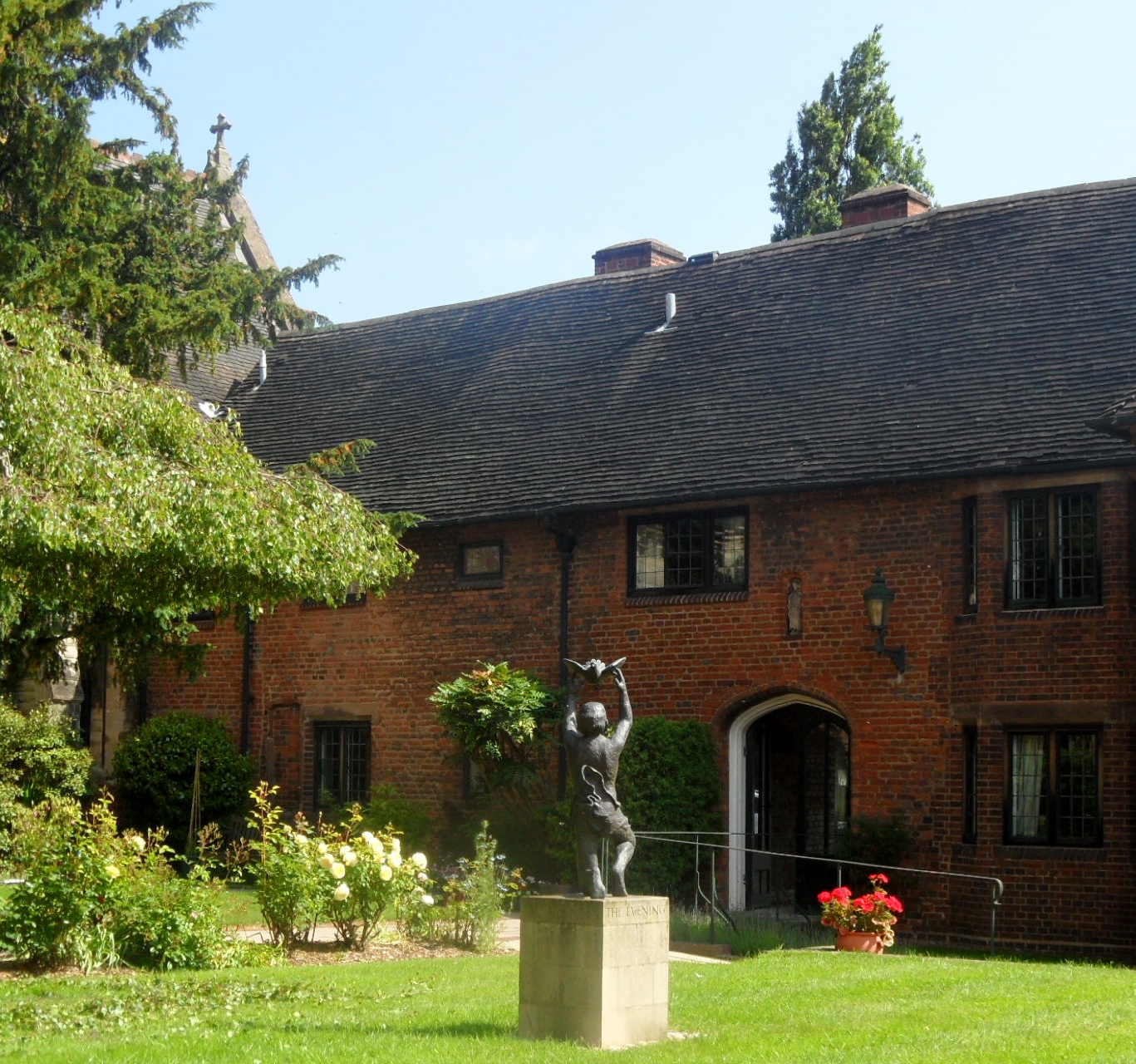
Part of the courtyard at St John’s Hospital

Apparently one woman had protested at ‘the hideous sacrilege and desecration in using ground solemnly consecrated and dedicated as God’s acre for ever, for a bed for sewers’, and so Rev Auden took the opportunity to reassure her, and anyone else that was concerned about the work that was being carried out, that the bones had been collected and reburied together and that the Hospital Quadrangle would soon resume its peaceful aspect, plus the manholes.

Although they did make assumptions in this particular instance, to be fair to the Tamworth Herald, evidence for much older burials, in and around the hospital, was discovered in 1967, when according to the County History, a medieval burial was found during alterations to the almshouses. In June last year, Annette Rubery and local newspapers reported that further remains were found just one metre below the pavement outside the hospital, when workers were repairing a gas pipe, although I don’t think the date of this burial was ever confirmed?

In another post, I’ll look at ‘Councillor Moseley’s Graveyard’, the nickname given to the site of the Friary after Thomas Moseley secured permission to excavate the site in the 1930s, uncovering several skeletons and other archaeological remains, and also the area in and around Lichfield’s Cathedral Close, where amongst other discoveries, a very unusual burial was reportedly found within the walls of one of the buildings in the early eighteenth century. They don’t call this the Field of the Dead for nothing you know (4).

Notes:

(1) One of the reasons I find this particularly interesting is that it seems unusual that it’s a male skeleton with a young child. Over in St Michael’s churchyard, the remains of an adult with a child were discovered, but this was thought to be a mother who had died in childbirth (and was of course in consecrated ground). For more information on that see here. Also, it makes you think about past uses of land and what discoveries like this can tell us. Edit: I’ve just re-read the report and the actual wording is ‘an adult and tiny baby found buried together…it is possible they represent a mother and child who died at childbirth’, so I should make it clear.

(2) For more information on the human remains discovered at Freeford, and thought to be related to the fomer lepers hospital there, see here

(3) Mr Charles Simpson b. April 9th 1800. Solicitor, Town Clerk and Coroner for the City of Lichfield, and Clerk of the Peace for Staffordshire 1825.  d. April 22nd 1890Details from the Shrewsbury School Register 1734 – 1908, edited by….Rev J E Auden!

(4) As I’m sure everyone knows by now, Lichfield doesn’t really mean Field of the Dead, it’s just an old myth that’s most likely stuck because it’s more evocative than the real meaning of the the name which is thought to be something like ‘common pasture in or beside the grey wood’. For more on the place name and yet more Lichfield bones see here 

Sources:

:Lichfield Mercury Archive

Tamworth Herald Archive

www.annetterubery.co.uk

Hospitals: Lichfield, St John the Baptist’, A History of the County of Stafford: Volume 3(1970), pp. 279-289

Shrewsbury School Register 1734 – 1908, edited by Rev J E Auden

Sweet Bells

One Saturday morning, as I sat reading in Lichfield Library, I heard a clip clopping in the street outside. Standing up to look out of the window, I saw a horse and carriage making its way up Bird St. It occurred to me that this was a sound and a sight that people would not have batted an eyelid nor an eardrum at in previous centuries, yet to my twenty first century ears, it was something so out of the normal it warranted me putting down a good book to have a shufty.

More often than not, when we explore the way our towns and cities have changed, it’s the visual changes that we concentrate on – old photographs, old maps, landscape features etc. Yet the sounds of places change too e.g. the pools at Leomansley are quiet and still now that the waterwheel of the mill no longer turns, the sounds of animals at the Smithfield have been replaced by those of cars and shoppers and Beacon Street hasn’t heard a blacksmith hammering metal in a long time. However, amidst the changes, there is also consistency in the sounds that surround us.

The tower at St Chad’s church houses four bells. Three of them were cast in the seventeenth century and the oldest of these three dates to 1625 with the inscription ‘DOMINO CANTICUM CANTATE NOVUM’. The second is from 1664 and declares ‘GOD SAVE THIS CHURCH AND REALM THE KING IN WAR, I.C.1664. Even the youngest of the three, featuring the names Ralph Low and Richard Grimley, is from 1670 meaning that the people of the parish and those who are passing by have heard these bells ring out for well over three hundred years. The fourth bell is even older still, although no one can agree on just how old. An article in the Lichfield Mercury in August 1936 described it as ‘England’s Oldest Bell’, and gives it a date of 1033. As it stands, the country’s oldest inscribed bell is believed to be the Gargate Bell at Caversfield Church, Oxfordshire, dating to c.1215AD and the country’s oldest dated bell (1245AD) is at Lisset Church in Easy Yorkshire. Therefore if this date of 1033AD were true, we would probably have a another Lichfield Entry in the Guiness Book of Records (to go alongside the largest curry ever, cooked by Abdul Salam of Eastern Eye on Bird St). Yet, the St Chad’s website itself casts doubt on this claim as there wasn’t a tower to put a bell in at the church at this time! Another date suggested for the bell is 1255 but the County History also disputes this and says that it was probably cast at Nottingham c.1500AD. There is an inscription on the bell +O BEATE MARIAA.A.R. and some numerals that no-one can read, hence the enigma. I’d love to see it. Not that I would be any help at all in solving the mystery but you know I’d just like to have a look at it. See I’m not satisfied with simply hearing it – there’s that visual dominance of history taking over again.

I have actually been at the other end of the bell rope. After I stumbled upon a practice session on another Saturday morning, I took up a kind offer to have a go at ringing one of the St Chad’s bells myself. Whilst at the time I was too terrified of having a campanology related mishap to fully appreciate the moment, afterwards I thought of all the people that had rung those bells in the past, and all those who had heard them and the message they were conveying. Next time, you’re passing, stop for a moment and listen too.

Sources:

Lichfield: Churches’, A History of the County of Stafford: Volume 14: Lichfield (1990), pp. 134-155

http://saintchads.weebly.com/the-bells.html