Scratching the Surface

I had an hour to spend in Abbots Bromley and so I grabbed my camera and went for a walk.

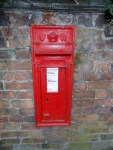
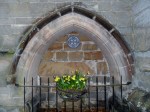
The theme seemed to be ‘things found on buildings’, be it wooden and painted signs, carved heads and crosses on the church, horns outside a restaurant alluding to the village’s famous tradition (the Abbots Bromley Horn Dance), or an old post box.  Until I got home and did a bit of reading, I had no idea that a very famous visitor had also left her mark on one of the village’s buildings. Mary, Queen of Scots is believed to have stayed overnight at Abbots Bromley’s Manor House during what was to be her last journey. A pane of glass with the inscription ‘Maria Regina Scotiae quondam transibat istam villam 21 Septembris 1585 usque Burton’, said have been scratched by Mary with a diamond ring, was taken from the house and is now in the William Salt Library.

I’m back in Abbots Bromley for another hour next week! In the meantime, maybe I’ll look a bit deeper…

A Life of Service

Inside St Chad’s Church is a memorial dedicated to the men of the parish who lost their lives in the First World War. One of those commemorated on the memorial is also remembered on a separate plaque alongside the memorial, featuring a statue of St George and the following inscription:

To the honoured memory of Alfred Cleveley Sergeant South Staffordshire Regiment. He was in service at Elmhurst Hall and enlisted in August 1914 and fought in Gallipoli and in France where he gained the military medal and fell in action on May 12th 1917 aged 32.

The memorial was given by Alfred’s former employer, Mrs Hamer, who was renting the now demolished Elmhurst Hall at the time. Before coming to Elmhurst Alfred, who was originally from Powick in Worcester, had been employed as a ‘house and garden boy’ at The Rectory in Shobdon in Herefordshire in 1901 and as a butler at Aldersey Hall in Cheshire in 1911, possibly the position he left to come to Elmhurst Hall.

Elmhurst Hall Source: Wikimedia Commons

I’ve found Alfred’s medal card at the National Archives (as well as the Military Medal, Alfred also received the British War Medal, the Victory Medal and the 1914/15 Star), and the Commonwealth War Graves Commission record that tells us that his name is inscribed on the Arras Memorial. However, one thing I can’t find is his name on the main War Memorial in the Garden of Remembrance near to Minster Pool.

I was wondering whether this had something to do with Alfred not being ‘a local’ as such, and then I found the speech that was read at the memorial’s dedication ceremony on October 20th 1920.  Major Longstaff, the Chairman of the Memorial Committee explained

‘This being a City Memorial, it was decided to limit the names to be inscribed to those born in the City, or whose house or permanent address at the time of joining the Imperial Forces was within the City and who lost their lives in the war…Further, the great sacrifice made by those whose names are here recorded was an equal one, and we decided that the names only, without rank or unit, should be recorded in alphabetical order’.

Presumably then, living and working at Elmhurst Hall wasn’t classed as having a permanent address in Lichfield? I wonder if this was a standard approach for those in service? I also wonder how common it was for employers to commemorate their domestic staff? Actually, I did notice for the first time that not all of the names are in alphabetical order which suggests that some may have been added at a later date?

I’m very grateful to Steve Lightfoot who has been making some enquiries regarding the time that Sergeant Alfred Cleveley spent in the 1st Battalion of the South Staffs regiment, and the regiment’s role in the Battle of Arras where it seems he lost his life.  I’m looking forward to hopefully hearing more of Alfred’s story but one final question for the time being – where are Alfred’s medals now?

Gathering Moss

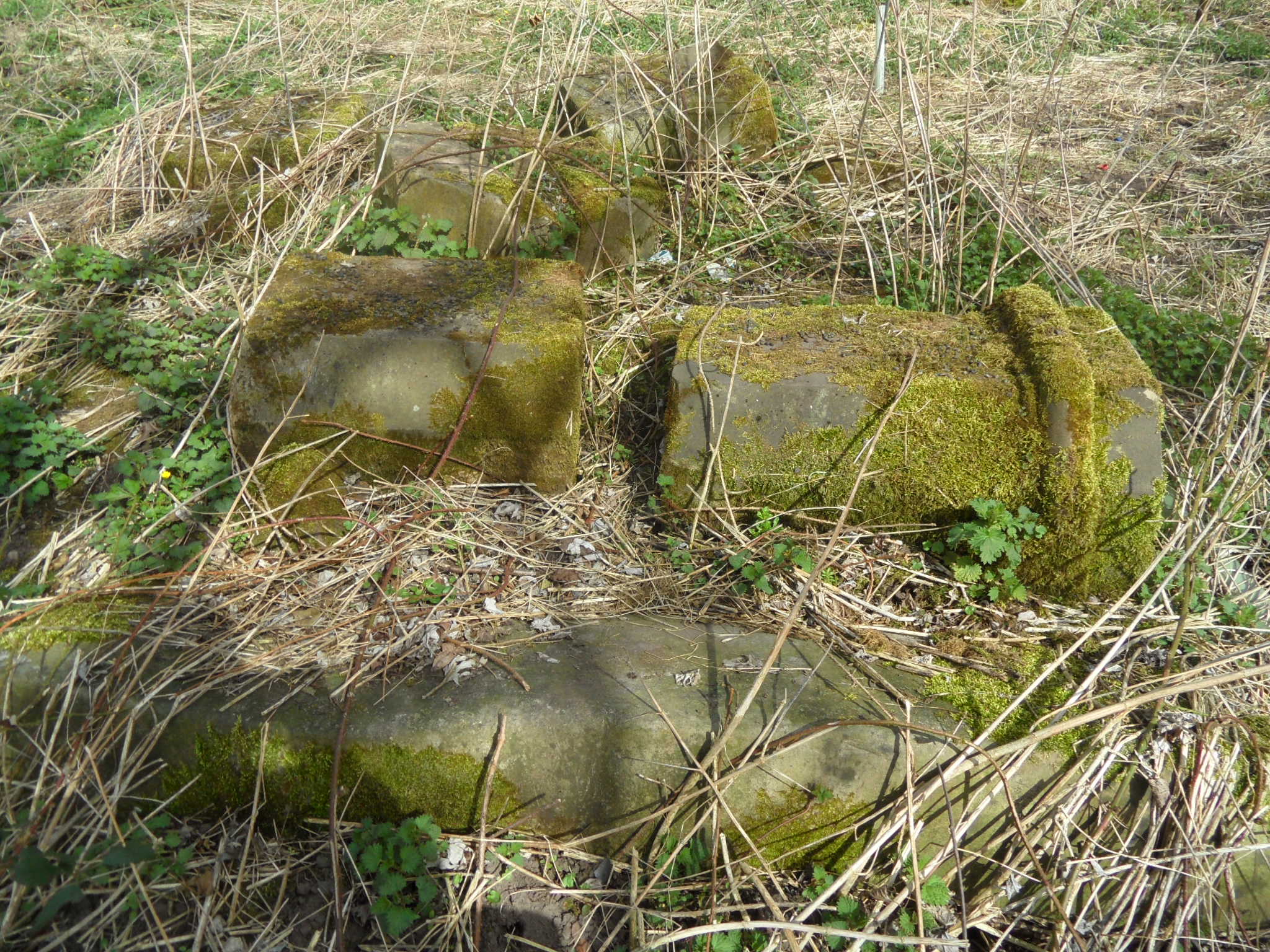
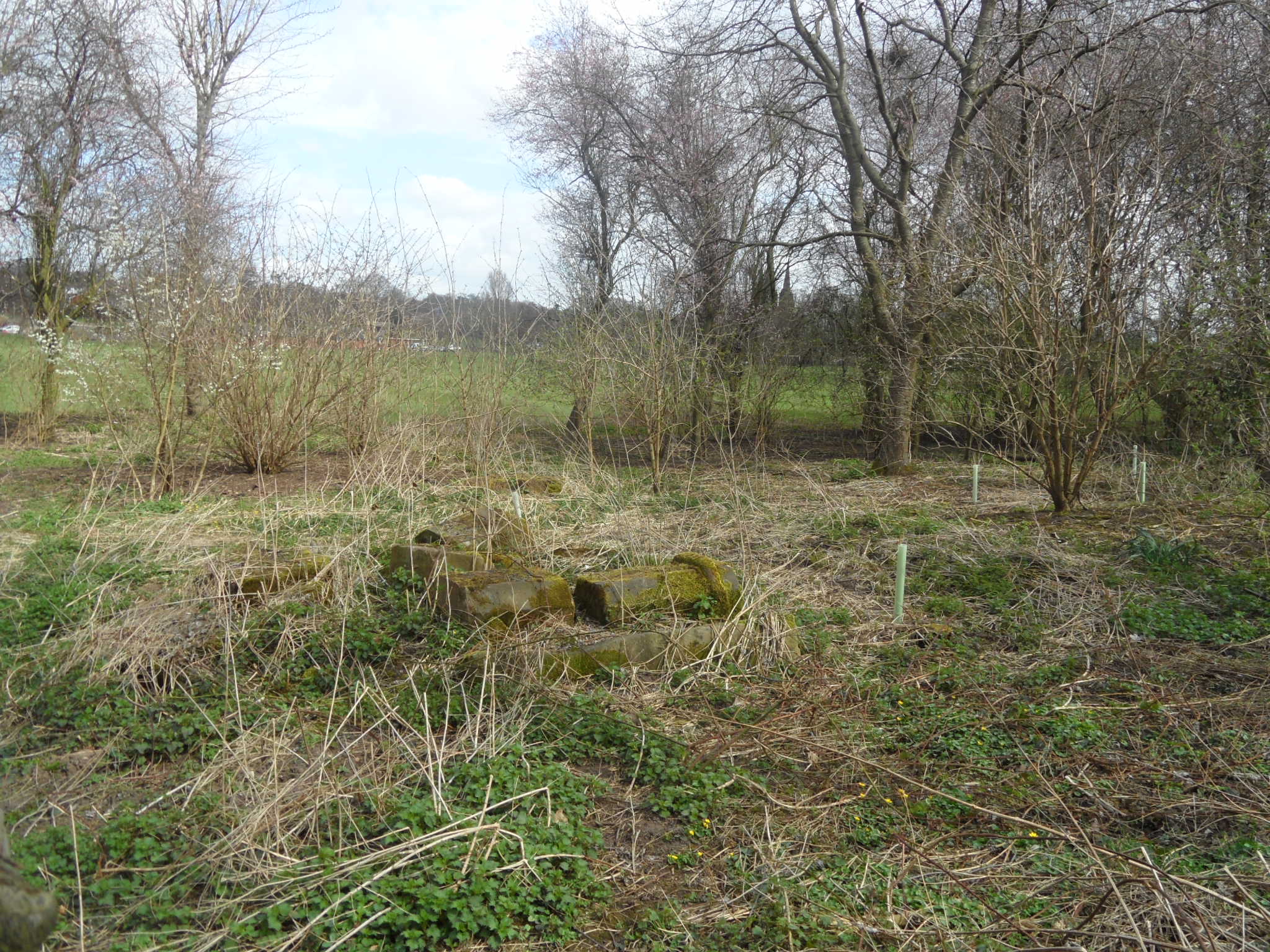
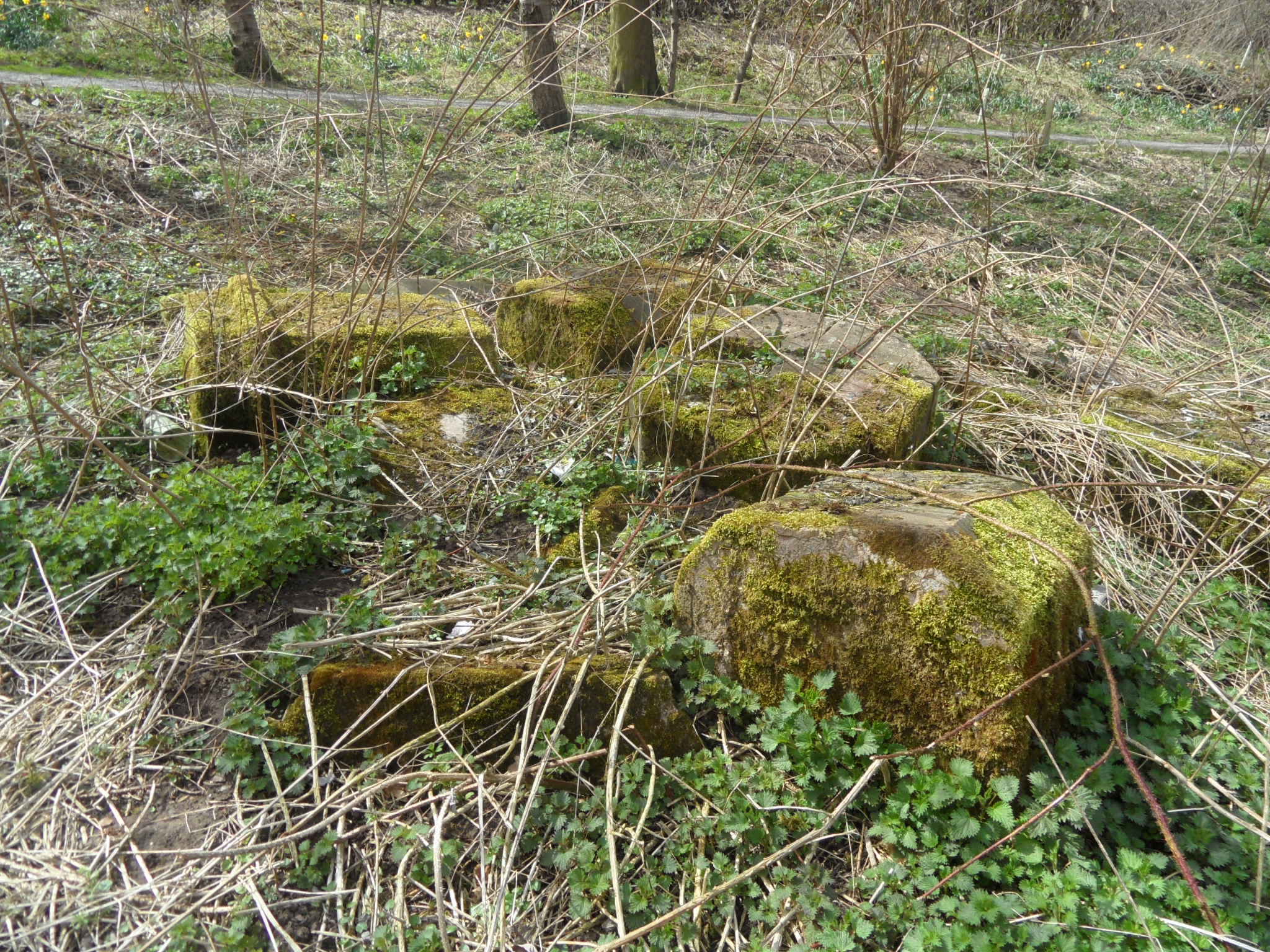
Walking around the edge of Beacon Park, I noticed a pile of moss covered stones in the undergrowth that I’d never seen before.  To me, they look like part of an old building, possibly pillars? It’s a long shot I know, but does anyone recognise them or have any idea as to where these pillars (if that’s what they are!) may have come from?

Whilst on the subject of ‘parts of old buildings found in unexpected places’, I have to mention my old favourite Fisherwick Hall. Back in January, I wrote an article for the Lichfield Gazette which mentioned that the hall had been demolished, but that parts of it had been reused elsewhere. After lying around for some years covered in moss, the pillars from Fisherwick went to the George Hotel in Walsall – you can read the great post written about the hotel by Stuart Williams of Walsall Local History Centre here. However,  I had no idea what had happened to the pillars, following the demolition of the hotel in the 1930s. Therefore, I was delighted when Paul (the editor of the Lichfield Gazette) told me that someone had contacted him, saying that some years ago he had seen them lying on a patch of ground near to the cricket ground in the Highgate area of Walsall. The gentleman described them as lying in pieces and covered with moss and lichen. Sounds familiar! Coincidentally, the site the gentleman described is a stone’s throw from where some of my relatives live, and so the next time I visited I went to take a look, but I had no luck in finding them. So near, yet so far….

Back to our Beacon Park stones, and someone from the Beacon Street Area Residents’ Association has very kindly said that he will ask the people in the know i.e. the Parks team and the Civic Society if they can shed any light on the matter. In the meantime, he’s left me pondering the fact that parts of the old bandstand and cycle track are also apparently also still around in the park somewhere…

Beacon Park bandstand c.1905
Source: Wikimedia Commons

Family Trees

Standing in a small area of woodland on the edge of a field in Leomansley is a stone with the inscription ‘Greville’s Belt W.W.W 1923‘. It isn’t a gravestone, although you can see why some have mistaken it for one, but a marker erected by the then owner of the Maple Hayes estate, William Worthington Worthington, to commemorate the planting of this small belt of trees, named after his eldest son (William) Greville Worthington.(1)

In 1918, William Worthington had inherited Maple Hayes from his father Albert Octavius Worthington, a partner in the Burton brewery that carried his family name, who had originally purchased the estate in 1884. However, Greville Worthington would not inherit the estate from his father. In the early hours of 17th March 1942, whilst serving as a Lieutenant in the Royal Navy Volunteer Reserve at Dover, Greville drove through a restricted area. Although the sentry on duty ordered him to ‘Halt!’ twice, he failed to stop.The sentry opened fire and Greville was fatally wounded, dying in hospital ten days later. A verdict of accidental death was recorded. In the October of the following year, there was another family tragedy.  Lady Diana Worthington, Greville’s former wife, went missing from her home Weston Manor in Olney. A scarf and a coat were found on the banks of the River Ouse and after a week of searching, Diana’s body was recovered from the water.

Greville and Diana had four children together – Caroline, Anna, Charles and Benjamin. I have not yet been unable to find out much about what happened to the children following the deaths of their parents. However, we do know that when William Worthington died in 1949, nineteen year old Charles was his heir. (2)  William’s death brought the Worthington era at Maple Hayes to an end and in 1950, the estate was sold. The house and around twenty three acres were acquired by Staffordshire County Council for educational purposes. Since 1981, the site has been occupied by the Maple Hayes Dyslexia School. The remainder of the estate, some 1,500 acres including farms, cottages and agricultural land, was sold to a trust.(3)

As well as Greville’s Belt,  other areas of woodland were named after Worthington family members. Lady Muriel’s Belt, Herbert’s Spinney and Fitzherbert Firs still appear on maps of the area, as mentioned in BrownhillsBob’s recent post on Leomansley. Are there more stone markers to be found in these places?  I also noticed a house on the site of the old playground of Christ Church School, near to the church, which has a plaque saying ‘W.W.W 1920‘. Surely another reference to William Worthington Worthington, although exactly what the connection is I don’t know as yet.  The Worthington family may no longer reside at Maple Hayes but their names still echo in the landscape that surrounds their former home.

Notes

(1) I have seen similar stones marking ‘Parker’s Plantation’ and ‘The Roundabouts’ at the Pipe Hall Farm, owned by The Woodland Trust.

(2) W.G.W had a younger brother Albert Ronald Worthington, born 1904 and died in 1951. but according to the County History, it was grandson Charles, eldest son of W.G.W that was W.W.W’s heir.

(3) Until last year, around 360 acres of the former Maple Hayes estate was still owned by the trust. However, in April 2012 it was sold to new owners The Crown Estate for just under three million pounds.

Sources

Burntwood: Manors, local government and public services’, A History of the County of Stafford: Volume 14: Lichfield (1990), pp. 205-220.

The Lichfield Mercury archives

Nottingham Evening Post archive
 

A Dark Chapter

I vaguely knew the story of Thomas Day and his attempt to mould a perfect wife from one of two orphan girls, that he ‘acquired’. However, until I read ‘How to create the perfect wife’, by Wendy Moore, I hadn’t appreciated just how much of an ordeal Day subjected the two young girls to.

After taking them from the orphanage, Day took the girls, Sabrina and Lucretia, to France, where they lived a life of drudgery and servitude.  On their return to England, Day decided to focus his efforts on Sabrina, and packed Lucretia off to be a milliner’s apprentice. Sabrina was brought to Lichfield, where they became part of the social circle that included Anna Seward, Erasmus Darwin and members of the Lunar Society. Sabrina and Day lived at Stowe House, and it was here that some of his worst treatment of the girl took place. As well as making Sabrina carry out all of the household tasks in the four storey house looking over Stowe Pool, Day subjected her to sadistic ‘training’ designed to develop stamina, strength and courage. Apparently, despite knowing that she was unable to swim,  Day even forced the poor child into the waters of the pool itself on one occasion. Once soaked through, Day made her lie in one of the nearby fields until she dried out.

Although many in Lichfield knew of Day’s experiment, Wendy Moore believes that a combination of Day’s money and background, and the fact that many of his Lichfield ‘friends’ had their own scandals to deal with, meant that a blind eye was turned to his treatment of the girl.

Day eventually decided Sabrina wasn’t suitable and so she too was sent away, whilst Day turned his attentions elsewhere. Whilst the book explores Day’s continuing quest for the perfect wife, it was the story of what happened to Sabrina that I was really interested in. Thankfully,  Wendy Moore does not abandon Sabrina as Day did and follows her life up until the end, thereby allowing us to know the full story of Sabrina as a person in her own right, and not just as part of a bizarre experiment carried out by a cruel and irresponsible man.

Stowe House, overlooking St Chad’s and Stowe Pool

‘How to create the perfect wife’ by Wendy Moore is published by Orion. Details here.


Sole Trader

Whilst having a browse in Lichfield Record Office,  I came across an account of more archaeological finds discovered at Minster Pool.  During the construction of a storm water sewer in the 1970s, surplus soil was taken from the pool to a council rubbish tip. One day Mr Miller, from the city’s Engineering and Surveyoring department, happened to notice fragments of Cistercian ware amongst the peaty earth and alerted local experts. On examining the tip more closely, they discovered that the soil from Minster Pool also contained lots of fragments of leather.

Mr Miller and the others had discovered the remains of medieval leather shoes from a cobbler’s workshop that had been operating near to Minster Pool between the years 1400 and 1550. It’s thought that after being repaired several times, the shoes were in such bad condition that they were discarded by the cobbler (only for them to resurface on another rubbish heap some five hundred years later!). The account I read said that after their discovery, the shoes had been taken to Lichfield Museum. On returning home I was delighted to see that some kind soul had photographed some of them and added them to the Lichfield District Council flickr stream. However, in two and a half years they’ve only had sixteen views (and I think three of those were me!) so now you know the story behind how they were found, please pop and over and take a look at them here! It’s a shame that we’ll probably never know the story of the people the shoes belonged to, or the story of the cobblers who patched them up time and time again….

Three examples of 500 year old leather shoes found in soil from Minster Pool on the council rubbish dump! Image taken from Lichfield District Council flickr stream.

Sources:

South Staffordshire Archaeological and Historical Society (SAHS) Transactions XIV – XVI, 1972 – 1975