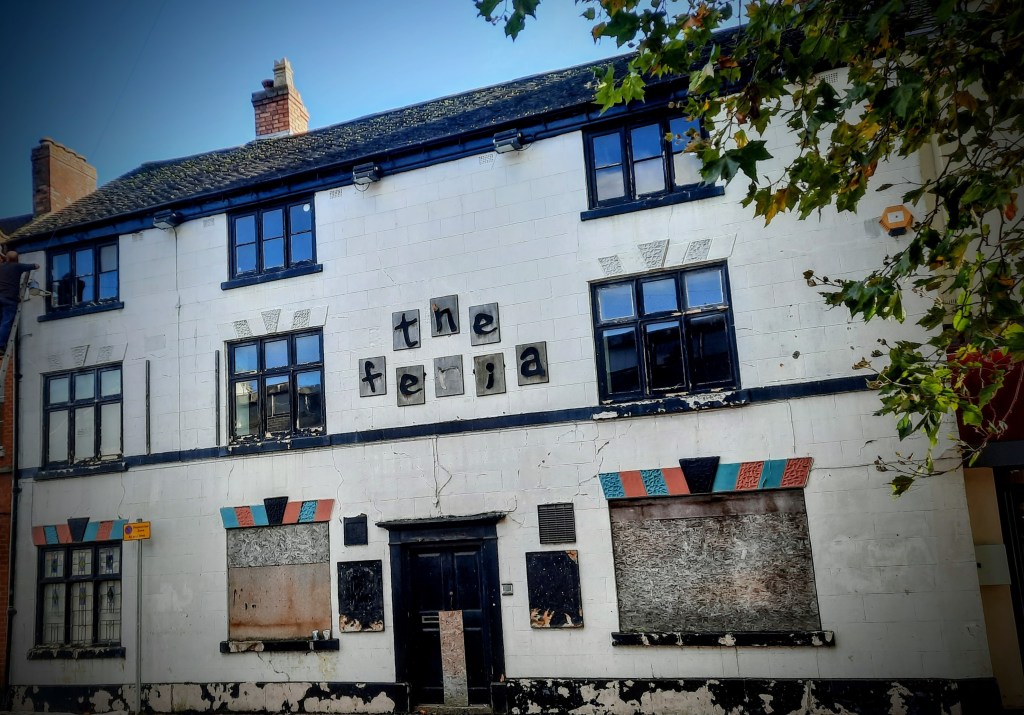
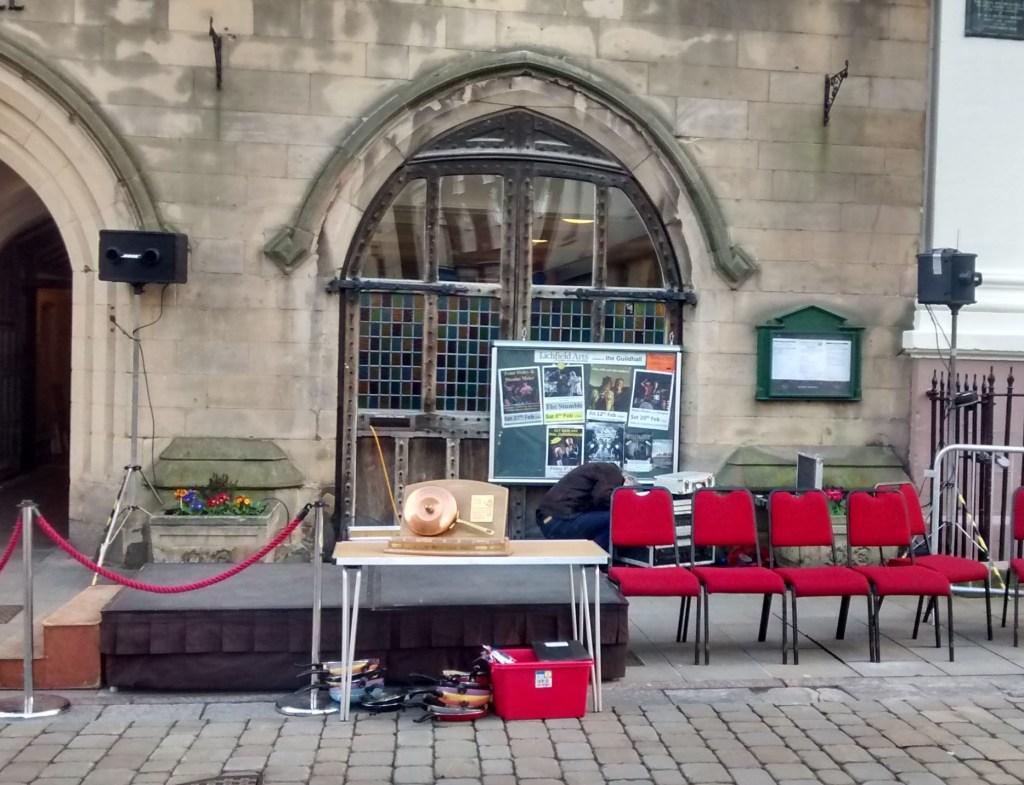
Here in Lichfield, Shrove Tuesday is celebrated with people dressed up as princesses, pirates or, um, slices of pizza racing along Bore Street as they flip pancakes. Visitors to the city tomorrow may see the old Price of Wales/Chameleon Bar/Feria and think its been boarded up as a precautionary measure in case the shrovetide shenanigans get out of hand but it’s actually just been left derelict for about twenty years.
A flipping disgrace
Somewhere they really do have to take such steps to protect their premises is up the A5 at Atherstone, where instead of pancake racing they play a truly hardcore game of football and have been doing so since 1199. Apparently, once the giant leather ball has been tossed into the crowds onto Long Street there are only two rules. One is that the ball must stay on Long Street. The other is that you can’t kill anyone. I told you it was hardcore (by comparison, the rules of the Lichfield Shrovetide Festivities include mandatory non-slip footwear and that at some point during the festivities the Mayor of Lichfield must be photographed in a spinning teacup on the Market Square).
Pandemonium (Lichfield style)
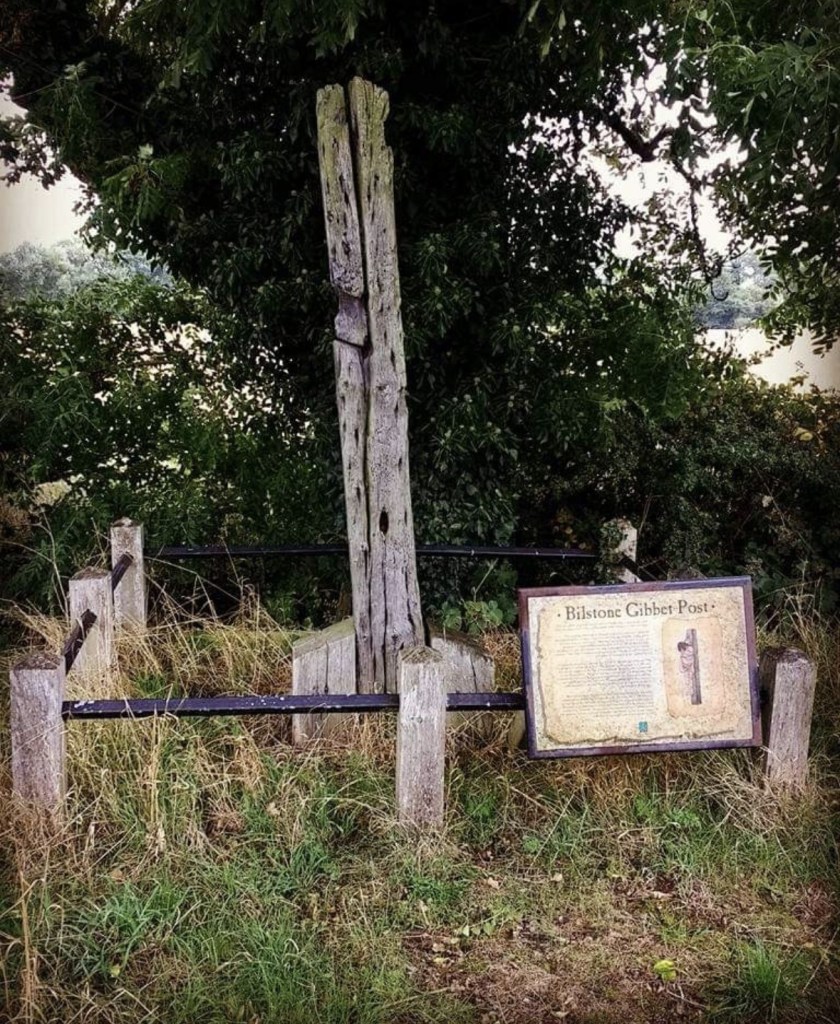
With this in mind, I am inclined to believe the following anecdote about the good folks of Atherstone. In February 1800, John Massey was executed for murder and his body was gibbeted at Bilstone, near the site where he committed his heinous crime. Eighteen years later, his rotting remains remained on display, and became quite the local tourist attraction for Atherstonians who would pop there for a picnic. Once they’d finished their food, they’d partake in that quaint old pastime of throwing stones at the murderer’s skeleton. Eventually, a grocer called Mr Peach knocked the skull from its boney shoulders and so the group of day-trippers took it back home to Atherstone with them. It seems Peach then presented this sinister souvenir as a gift to his local pub.
My grocer went Bilstone and all I got was this skull of a lousy murderer
I’ve read the skull was lined with silver and turned into a punchbowl. Other versions claim the cranium became a candle holder. Some say it was eventually stolen, others say it’s still kept in a secret safe in one of Atherstone’s ancient inns. If you know anything more, please give me a heads up. Finally, please do accept my apologies if I’ve put you off your pancakes.
It seems apt that on St Andrew’s Day, I have a story for you which features both a Robert Burns poem and the one time president of the Walsall Burns Club. These events took place one hundred and fifty years ago this week and I will warn you in advance that it’s a bleak early winter’s tale, with no festive cheer to be found.
On 24th November 1874, a young Billy Meikle1 arrived in Alrewas on the first train of the day from Walsall. Snow had fallen overnight and the wintery dawn was just breaking as he passed the Paul Pry Inn2 with its sign hanging from a tree opposite. There were groans coming from the inside the old village lock-up and a howling hound outside was awaiting his master’s release. Billy then continued via the George and Dragon and the Navigation Inn (now the Delhi Divan restaurant) as he headed towards Yoxall via the Kings Bromley Road to collect the accounts of customers for the drapers business he worked for.
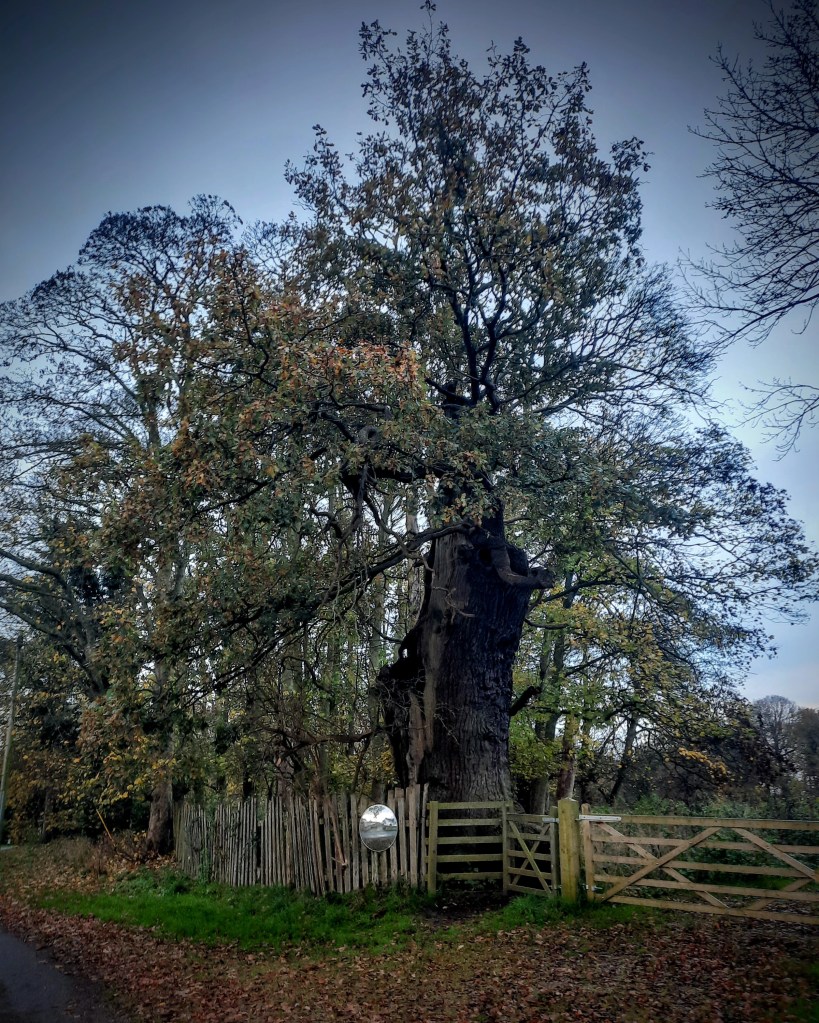
I believe this may be the tree near to where those terrible events took place 150 years ago
When he arrived at Yoxall he found the village in a state of frenzied excitement, following the news that murder had taken place the previous day. At every house he called at he heard the story of how Mrs Kidd had been killed by a vagrant at nearby Hoar Cross because the man had demanded 3d and she had only 2d to give him. Meikle was told the murder had taken place at a large tree, the location easily identifiable as the locals had scraped away the snow to see the pool of blood beneath it. As night fell, he set out in the moonlight to find the sinister spot for himself, but as he approached the tree where the tragedy took place, he lost his nerve and ran back to Yoxall.
The Golden Cup, Yoxall where the drinks still flow although I suspect step dancing on the ceiling is a thing of the past
Unfortunately, the Golden Cup Inn where he was supposed to be staying was perhaps not the sanctuary he was hoping for. Mrs Badkins, who kept the local stationers shop, told him that the landlord had been drinking since his his wife had left him and had borrowed a gun, suggesting that staying at the Crown may be a safer option. Meikle did not heed her advice and took his chances at the Cup. On the day of the inquest on Mrs Kidds’ body, the tap room was flowing with talk of murder, both the very recent and historic. According to Meikle, things took a turn for the better when a man named Ned Dukes stood on his head on a table and sang a song about the world being upside down whilst he did a step dance on the ceiling. Personally, I’d have rather carried on talking about murders. At 10 pm time was called and the customers went home, ‘full of drink and murder’. Meikle was left alone with the landlord and his daughter and together they ate soup, bread and cheese. At several points during the supper, the landlord got up to investigate invisible things in the dark corners of the room. Eventually, bed was suggested and Billy was shown to his room which had been partitioned off from the club room. Despite thoughts of the landlord and his gun, Meikle drifted off to sleep. At 2am he heard the clock at St Peter’s chime but fell back to sleep. Soon after however, he was woken again by a terrible crash and peered from beneath his bedclothes to see the landlord stood in the room, candle in one hand, gun in the other.
Both men had thought the crash had been caused by the other firing shots but Billy assured the landlord he had no gun. The men then realised the crash they’d heard resulted from the partition between rooms falling down and both of them returned to their beds.
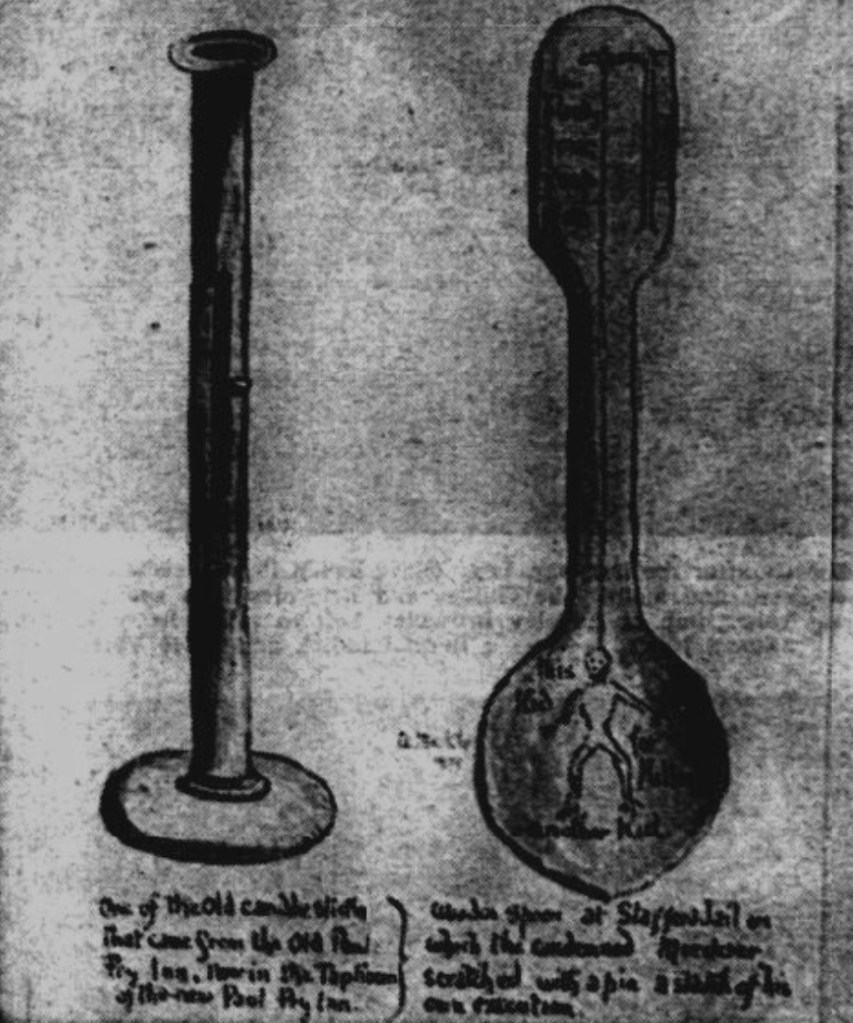
Billy Meikle’s sketches of a candlestick from the old Paul Pry Inn and the sinister spoon Taylor carved in Stafford Gaol
Meikle says the murderer of Mrs Kidd was arrested several weeks later. He was caught in a trap laid by the police who knew he was unable to resist singing a love song called The Thorn, based on a poem by Robert Burns. Pianists were planted in every pub in the East Staffordshire area, with instructions that they should play the song at regular intervals. The snare was a success and the murderer was arrested mid-song and later sentenced to death. Meikle says he scratched a figure of a man being hanged onto the wooden spoon he ate his final meal with along with the words ‘A bloody long drop for this kid for killing another ‘Kidd’.
It’s an incredible story but I suspect Billy Meikle’s account of events may not be altogether accurate. What is without doubt is that at the Stafford Assizes in December 1874, Robert Taylor, a 21 year old miner from Wigan was found guilty of the wilful murder of Mary Kidd on 23rd November in the parish of Yoxall. The main witness was her neighbour Sarah Ann Hollis, an eight year old girl who had gone with her. Sarah said that as they approached the wood, they saw Taylor and had a brief conversation with him. He followed them and asked for half a crown, and Mrs Kidd replied she did not have that amount but gave him 2d. Taylor then grabbed her and cut her throat with his pen knife. The sound of approaching cart wheels scared him away and may well have saved Sarah’s life.
Was Taylor trapped by a tune though? It seems the murderer was caught in a much more orthodox manner. Newspaper reports say that after visiting the murder scene, near to the new church at Hoar Cross and on the main road from Yoxall to Sudbury, Superintendent Bowen searched for the murder all night. Eventually he overtook him on the road to Burton, followed him into a shop and, recognising him from Sarah’s description, arrested him. Taylor’s clothes were examined and his shirt sleeves, trousers and coat were found to be saturated with blood. Traces of blood and bloody hand prints matching his were also found on the gate he escaped across towards Yoxall Lodge.
When the charges were read, Taylor replied with a smile, ‘I plead guilty to all that’. It was remarked that from the time Taylor was arrested until the time he stepped onto the scaffold, Taylor appeared to treat the whole thing as a joke, displaying no remorse. He commented to someone that he had no family or friends and didn’t care what happened to him. At Stafford Gaol, he attended services in the chapel on Sundays and on Christmas Day, sitting in the same pew where William Palmer had once sat. During the service the chaplain asked the congregation to pray for Robert Taylor, now lying under the sentence of death. His final weeks were spent in a cell with a straw mattress and his only visitor was a woman from his native Wigan who suspected Taylor to be her long-missing but still loved husband. The chaplain allowed her into the cell but after taking a good look at Taylor she declared that this was not her husband and headed back up north, no doubt much relieved. Robert Taylor really was alone in this world.
Taylor was executed within the walls of Stafford Gaol on the last day of 1874, just after the clock had struck eight o’clock. The morning is reported as being clear and bitterly cold. A couple of hundred people had congregated in the road near the gaol, drawn no doubt from the same morbid curiosity which drove me to write this post. Taylor’s final words to the executioner were ‘Snap me off quick’. He did.
Notes:
1 – Billy Meikle was a fascinating character with many interests including local history, photography and sketching scenes from the world around him. As mentioned above, he was also involved in the Walsall Burns Club. You can read more about him here.
2 – The Paul Pry Hotel in Alrewas stood on what is now the A38 and was demolished when the road was widened c.1960. I have read that a former landlord used to show punters a brace of pistols which had once been the property of a highway man said to frequent the inn.
Sources:
Rugeley Times 28th December 1968
Edinburgh Evening News 11th December 1874
County Advertiser & Herald for Staffordshire and Worcestershire
In certain magic circles, the story of the Wizard of Bromley Hurst is well-known. In the mid-nineteenth century, Thomas Charlesworth, a young dairy farmer living near Abbots Bromley, argued with his widowed mother over his choice of wife, who also happened to be his cousin. Old Mrs Charlesworth, who was probably younger than me at the time, apparently left the farm muttering he would never do any good and his cheeses would all tumble to pieces. In the months that followed, Thomas did indeed have trouble making cheese from the milk his herd produced, ‘a process which had up to that time been successfully performed’. The fact this coincided with the departure of his mother was surely not coincidence and Thomas leapt to the obvious conclusion. That his mum had been better than him at making cheese? Absolutely not. Young Farmer Charlesworth decided that his cheese-kettle and all of his cows had been cursed.
Cused cows? Pull the udder one
Local toll-gate keeper Sammons recommended he seek the help of a man named Tunnicliff who ran ‘The Royal Oak’ beerhouse four miles away at the somewhat appropriately named ‘Buttermilk Hill’. Many men and women who ran such establishments also had a side-hustle. Indeed, my own great-great grandfather ran a pub in Cirencester alongside a blacksmiths shop. Tunnicliff’s supplementary business though was black magic. The wizard agreed that the woes Thomas had recently incurred were due to the ‘Widow’s Curse’ and that he could take the spell a-whey. All he needed was a piece of Thomas’s wife’s dress and the names of all his cows. Oh and £7. His magic act is reported to have been making crosses over the doors with witch hazel twigs and waving his hands over the horses. It seems no-one at that point thought to ask exactly how bewitched horses affected the cheese-making process and Tunnicliff left the house, no doubt rubbing those same hands together at the thought of how easily he’d make his money that afternoon. So easily it seems that Tunnicliff decided to put in a nightshift.
The Charlesworths had an ‘awful night’. Outside in the yard came the sounds of loud yelling, groans and noises of various kinds. Thomas bravely asked someone else to look out to check if there were any animals under the windows but there was nothing to be seen. The following day, he went back to see a tired-looking Tunnicliff and told him about the sleepless night they’d experienced over a beer. Tunnicliff agreed to call in to see what he could do but back home at Bromley Hurst, Thomas experienced shooting pains in his chest, numbness of his limbs and shivering. Whilst these symptoms subsided around dinnertime, he decided to stay in bed an extra hour the following day. Tunnicliff turned up before he woke and took Thomas up a breakfast of ham, bread and coffee. Within half an hour, he was stricken with symptoms similar to those he’d suffered the previous day. Tunnicliff announced he was appointing himself the couple’s defender against the dark arts and would be sleeping in their room. Now comfortably settled in the Charlesworth’s home, he really decided to go big.
To explain Thomas’ ongoing suffering, Tunnicliff ‘revealed’ he was engaged in a battle with ‘Old Bull’ aka the wizard of Yeaverly place, and claimed that ‘a fresh secret has been communicated to me by the power which I possess, and I now tell you that everything you possess is bewitched. You will have to give me further sums of money to remove this betwitchment’. As well as carrying out his wizarding work, Tunnicliff was also taken on as a servant. Shortly after Elizabeth, their baby girl and her nursemaid all began experiencing the same symptoms as Thomas and tragically, it’s reported that the infant died of convulsions in the Autumn of 1856.
Things came to a climax on 11th February the following year, a night during which servants witnessed the family dog run through the house chased by a phantom hound, seemingly made of fire and Thomas Charlesworth was so seriously ill he lost conciousness and was believed to be close to death. Whether it was the terrified servants’ ultimatum that if Tunnicliff stayed they’d leave, or Elizabeth Charlesworth’s discovery that his all expenses paid trip to Derby to battle yet another wizard was entirely fictitious, the penny finally seemed to drop that Tunnicliff was more of a conman than a conjurer and was milking them dry. He was dismissed on the 17th February 1857 and when Thomas was miraculously cured of his supposedly supernatural symptoms shortly afterwards, he reported Tunnicliff to the authorities.
In a trial at Stafford, Tunnicliff’s defence was that Charlesworth was a drunk, as was his father before him. The case for the prosecution however was that the Charlesworths had been poisoned with white bryony root, also known as ‘the Devil’s Turnip’, found at Tunnicliff’s house. In the end, the judge ruled that the Wicked Wizard of the East (Staffordshire) was guilty of obtaining money on false pretences and he was sentenced to 12 months imprisonment with hard labour. Reading over the details of the case, I find it hard to believe he was found guilty only of deception and not of the murder of baby Elizabeth and attempted murder of her parents.
The Coach and Horses, Abbots Bromley
As if this story isn’t already strange enough there is just one more thing to throw into the mix of this heady potion. During the trial, Thomas told how Tunnicliff had been to Rake End to see his uncle/father-in-law William Charlesworth, to caution him to be careful or else come to harm. On 23rd May 1857, William Charlesworth’s body was found on the turnpike road to Lichfield. An inquest was held at the Coach and Horses, the last place he’d been seen alive, leading to the arrest of two men for his murder. Charles Brown was transported to Western Australia but George Jackson was hanged at Stafford. Dreadful is the mysterious power of fate.
I recently visited the Staffordshire village of Colwich. It’s a lovely place but as is my wont, the outcome of the outing is a tale of murder and mystery.
We start our story in May 1977, when a member of the congregation of St Michael’s and All Angels took a walk through the churchyard and almost disappeared into an unmarked vault. The vicar at the time was the daring David Woodhouse who decided to descend into the dark depths to discover what, or who, was down there. Inside the vault, he found two skeletons and whilst there is nothing unusual about bones beneath a graveyard per se, there was something not quite rite about these burials. Skeleton One lay in a coffin and Rev Woodhouse mentions two odd things about it. Firstly, a small hole in the skull and secondly, the finger bones were disarticulated suggesting that this may have been a victim of both murder and grave robbery. The strangeness doesn’t stop there though as the remains of Skeleton Two are described as surrounding the coffin containing the first. One of the keywords for me here is ‘remains’, suggesting to me that this corpse may not have been complete when it was interred here.
The vicar’s theory was the vault was built for a wealthy family who fell on hard times and were then unable to afford a memorial to the two individuals resting in peace (or more aptly in one case, pieces) within it. Everyone seemed satisfied with this explanation, the hole was bricked up and, as far as I am aware, no-one has ever thought anymore about it until I read about the mysterious vault and started doing a bit of digging that is…
Back now to 18th July 1773 and a woodland just outside of Stone, Staffordshire where John Challenor and his son, also John, are working together. The two men have just eaten lunch when an argument flares up and John Jnr throws the iron cooking pot at John Snr’s head. It’s thrown with such force that once of the metal legs pierces the older man’s skull. He dies three days later and his son is sent to gaol for parricide. On 23rd August 1773 John Challenor Jnr is executed and his body taken down and hanged in chains at a spot near to the scene of his crime.
I don’t think you need to be DCI Barnaby to work out the links between this high-summer murder and the skeletons below ground at Colwich. The hole in the skull of Skeleton One clearly corresponds with the fatal injury sustained by John Challenor Snr. What’s more, the lack of a coffin together with the seemingly jumbled and incomplete nature of Skeleton Two is in keeping with a body that’s been gibbeted and later cut down and hastily buried, although not seemingly not quickly enough to prevent time, the weather or macabre souvenir hunters from starting to take their their toll. Perhaps it was the Challenors, who not only had a very literal reminder of the skeletons in their family closet displayed for all to see at a spot near Stone, but who may also have been concerned that without a Christian burial of sorts, their relative would not be resurrected to heaven but condemned to eternal damnation. Was it enough to save John Challenor’s soul though?
Thanks to information provided by Fulford Parish Council I believe I have located the place where his body was hung in chains. On their website they say ‘On the left of Hilderstone Road when travelling towards the ‘Wheatsheaf’, and just a short distance from Spot Acre cross roads, is a stand of Beech trees known locally as ‘The Rookery’. According to local lore the gibbets used to stand here, hence the overgrown lane which runs down past Idlerocks to Moddershall being called Gibbets Lane’.
Now, as regular readers of the blog will know, I love ghost stories but if you Scooby Don’t, then stop reading now as the next part of this story requires a little belief in such matters. You see, Stone lore also tells of a boggart which haunts these parts. And what on earth is a boggart I hear the non-northerners amongst you ask? Well, you know us Lichfield people love a dictionary and so I’ve looked it up in the OED and found the following definition: “A spectre, goblin, or bogy; in dialectal use, esp. a local goblin or sprite supposed to ‘haunt’ a particular gloomy spot, or scene of violence”.
Could the the boggart be the unquiet spirit of John Challenor? I mean it doesn’t get much more gloomy than having your corpse displayed on a gibbet does it? If the naysayers are still with us at this point I’m sure they’re saying, well, nay way but I’m tempted to head over there to see if I can find any more answers. In 1933, a Mr P C Dutton of Stone told members of the North Staffordshire Field Club that the boggart took the form of a dog or a calf and so this may involve me quizzing the local cows and canines to see if they’re the spectral incarnation of an 18th century murderer. More Doctor Doolally than Doolittle I know.
On a slightly more serious note, I am increasingly keen to not only share the stories which give us a sense of place but to bring something along to the party as well. I hope my version of events has given people some food for thought but as we know from the iconic Marmite, when it comes to a Staffordshire legend there is always a risk that some people might hate it 🙂
The run up to Halloween feels like the right time to resurrect the blog and, in keeping with the spirit of my favourite season, it’s my intention to share some of the more sinister stories that I know about Staffordshire and the surrounding area over the course of the coming week. However, 2020 hasn’t quite gone to plan and it’s entirely possible that I could fall victim to an attack of the mutant crayfish clones by Friday and so whether my bad intentions will materialise or fall by the wayside remains to be seen.
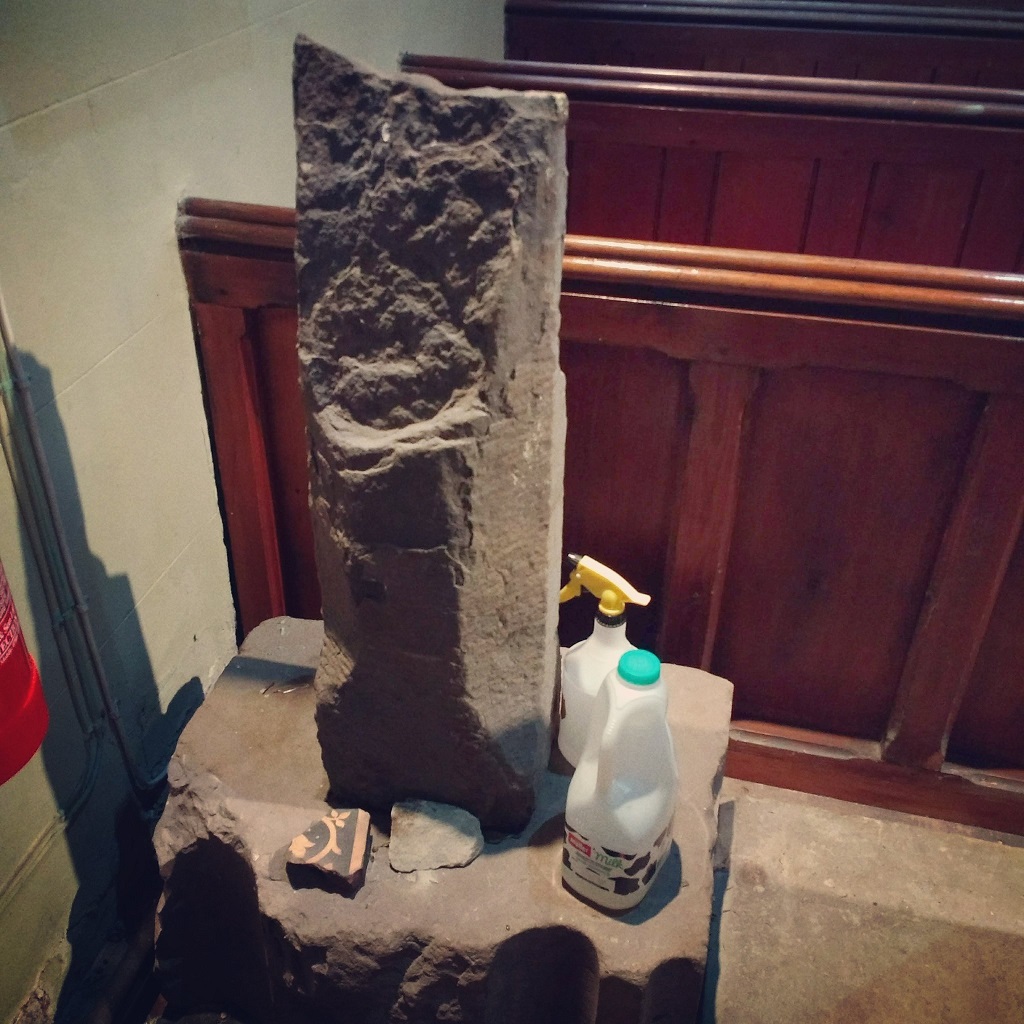
I suspect Pevsner would not approve but I think it gives churches a nice lived-in feel and exudes an eccentric sort of charm and therefore, I make no apologies for failing to remove the carton of milk and bottle of spray from my photograph of the remains of this stone cross in Tixall Church.
The cross stood on Kings Lowe, a Bronze Age Bowl Barrow on Tixall Heath before what remained of it was removed to the church for safe keeping. Its exact provenance is a mystery but in 1818 Sir Thomas Clifford of Tixall described it as having been placed there in around 1803, it being, ‘a very antique stone cross, which once stood before the gate of a ruined mansion in South Wales…It is of very hard moor-stone; the shaft, which has eight unequal sides, supports a tablet of an hexagonal form, adorned with very rude carvings; on one side, a crucifix, on the other, the virgin with the child in her lap. On the edge of the tablet is also a figure thought by some experienced antiqueries (sic) to be St. John the Evangelist’. The cross was said to mark the spot where Sir William Chetwynd of nearby Ingestre Hall was assassinated in 1494, although you might think that after 309 years the moment for a monument to a murder had passed. Who erected it and why they did so after all that time is not recorded.
In 1825, Alexander Wilson wrote a travelogue called ‘Alice Allan, The Country Town etc’ and appears to have had some sort of down the rabbit hole experience, proclaiming that, “When I entered Staffordshire, my straight-forward, regular travelling was at an end”. After insinuating that the residents of God’s own county used to get up to some Summerisle-esque unpleasantness involving wicker, Wilson relays the story told to him by an old countryman whilst driving across the heath. Sir William Chetwynd of Ingestre and Sir Humphrey Stanley of Pipe Ridware were both vying for the favour of King Henry VII, and so Sir Humphrey decided to rid-ware himself of his rival. A letter purporting to be from the Sheriff of Staffordshire was sent to Sir William requesting his attendance in Stafford at 5am the following morning. As he crossed Tixall Heath at dawn, accompanied by his son and two servants, he was ambushed by twenty men, several of whom were members of the Stanley family.
Despite a petition by the widowed Lady Chetwynd, Stanley literally got away with murder. Or did he? According to the story told to Alexander Wilson, some years after he’d killed Bill, Sir Humphrey was thrown from his horse at the same spot on Tixall Heath, breaking his neck. Official records show he died in 1505 and is buried amongst the great and also probably not very good at Westminster Abbey. As of yet, I can’t find a record of where or how he died and so perhaps that old countryman was right and karma did catch up with him in the end. Interestingly, it seems with the Stanleys, the rotten apple did not fall from the tree. An effigy in Lichfield Cathedral immortalises the disgrace of Sir Humphrey’s son, John, a man who committed a misdemeanor so grave that he was excommunicated and had to agree to spending the rest of his death being depicted as paying penance in order to be granted a Christian burial inside the Cathedral. There is no record of his specific wrongdoing but in 1867, the Very Rev Canon Rock suggested that Stanley’s offence may have been that he had spilled blood inside that sacred space. A 17th century drawing of the effigy by William Dugdale shows the stone Stanley bareheaded and bare chested, flanked by two bucks’ horns, wearing a skirt decorated with heraldic arms and armour on his legs. It’s a strong look to carry off for eternity although during the Civil War, the Roundheads did make some alterations in their own unique style… The much mutilated monument can still be found in the Cathedral so do go and see what’s left of him. I bet you there will be a stack of plastic chairs somewhere nearby too…
I’ll sing you a song about two lovers, Who from Lichfield town they came, The young man’s name was William Taylor, The lady’s name was Sarah Gray
So begins one version of the ballad ‘Bold William Taylor’ in which William leaves Lichfield to go and fight a war. Sarah doesn’t get on well with her parents and so decides she too will become a soldier in order to be reunited with her true love. She disguises herself as a sailor but after suffering a wardrobe malfunction aboard the ship she is working on, it becomes apparent to the captain of the ship that she is in fact a woman. Understandably curious, the Captain wants to know what she’s doing on board his ship and Sarah explains that she’s there looking for her lover. The Captain gives her the devastating news that William Taylor has gone off and married a rich young lady but tells her that if she rises before the break of day she’ll find him out walking with his new wife. Sarah does just that and, on spying the happy couple together, calls for a sword and pistol and shoots William dead. In this version, the Captain is so impressed he puts Sarah in command of the ship and all his men. All’s fair in love and war? There’s a great performance of the song by Jim Moray here on YouTube.
As I’m quickly discovering, establishing the origins of folk songs and ballads is nigh on impossible. It seems this may have originated in Lincolnshire but why Lichfield was chosen as the home town of the unhappy couple is a mystery and to confuse matters further, in some versions, Lichfield isn’t mentioned at all. Of course, I wanted to know if there were any more songs or ballads that mentioned Lichfield. I found that the Bodleian Library has a huge, searchable archive of over 30,000 broadside ballads. According to them, ‘Broadside ballads were popular songs, sold for a penny or half-penny in the streets of towns and villages around Britain between the sixteenth and early twentieth centuries. These songs were performed in taverns, homes, or fairs — wherever a group of people gathered to discuss the day’s events or to tell tales of heroes and villains’. I was really pleased to find that the collection includes several political ballads relating to Lichfield elections in the eighteenth and nineteenth century.
Apparently, these broadside ballads didn’t have their own music, but came with a suggestion of a well known tune that they could be sung to. I’m reading them with an image in my head of people stood around in the Ye Olde City’s pubs and taverns rowdily joining in with lines like,
With the help of Dick Dyott We’ll keep ’em all quiet And soon cool their Courage, and Fire: If I give up this place May I ne’er show my face Till I’m hang’d by my Toes on the Spire
The above lines come from a sheet dated 1799 (it has the year handwritten on it). However, this can’t be right as on the same page is the story of Sarah Westwood, a Lichfield woman was executed for murdering her husband, a nailer from Burntwood, in January 1844. If you want to read the full story of the case it’s well documented elsewhere, especially as Sarah was the last woman to be executed at Stafford Gaol. The inclusion of scandals and sensations such as this, along with the songs have led to many describing them as the tabloids of their day. You can search the Broadside Ballad archive yourself here.
As I’ve said before, we often focus on the visual changes of places, but the sounds change as well. I’m thinking that with its mixture of traditional songs, contemporary folk songs, drinking songs, ballads, humour, monologues and poems, the Folk Singaround at the King’s Head looks like a great way to get an idea of what our pubs may once have sounded like and hope to get down there for one of the sessions soon.





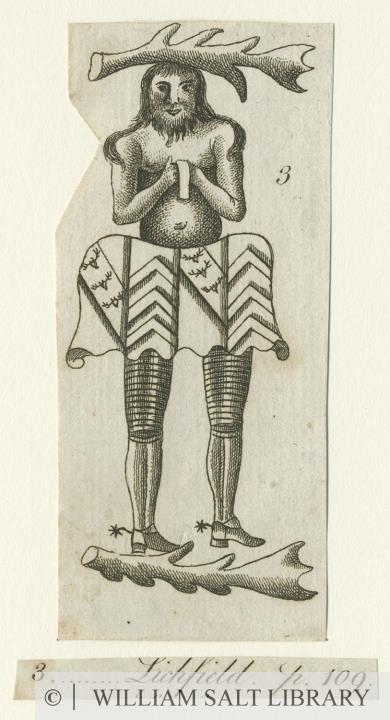 Lichfield Cathedral - Effigy of Captain Stanley: engravingShowing a print of the Stanley effigy. Anonymous.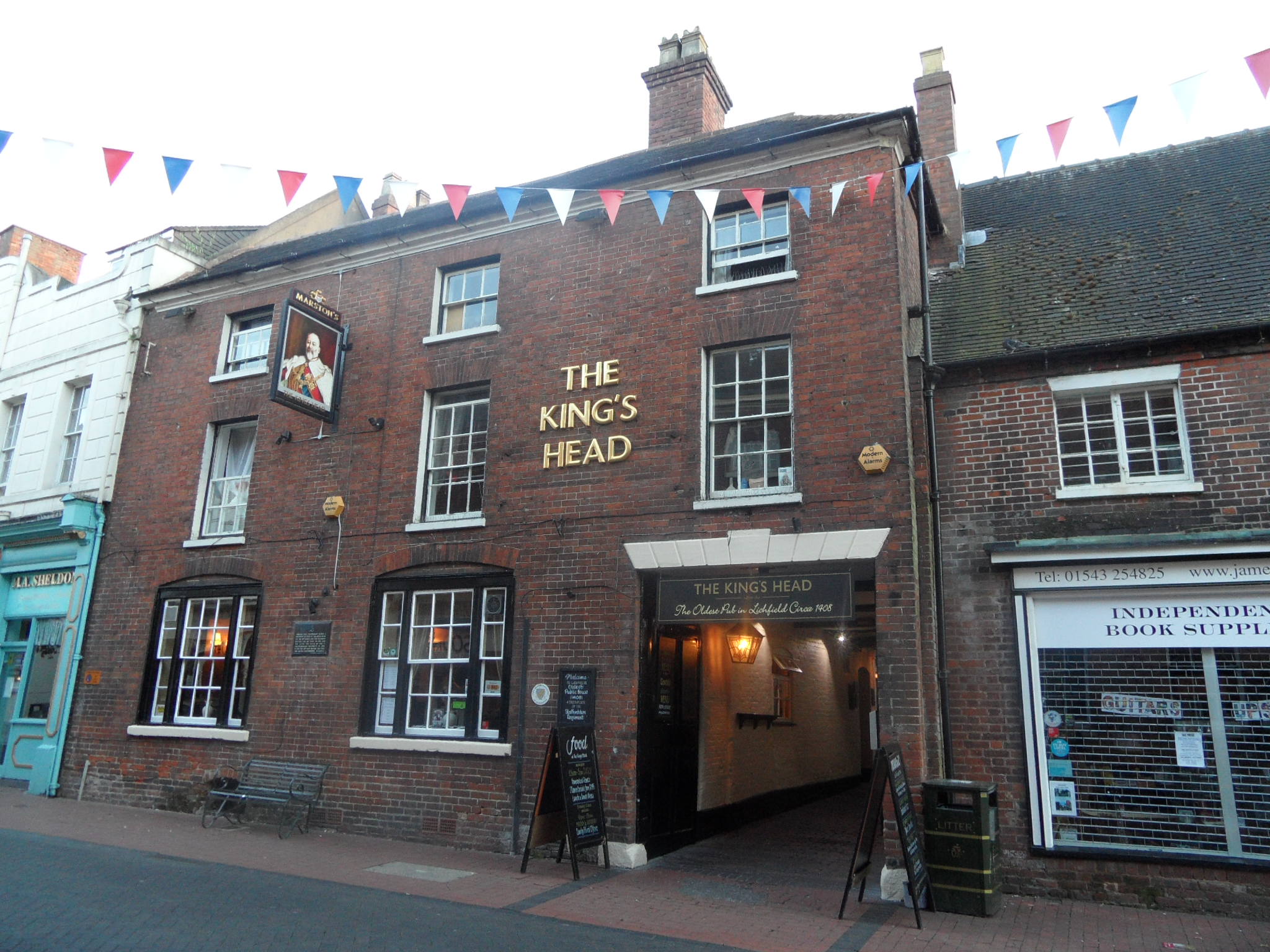
 Lichfield Lore