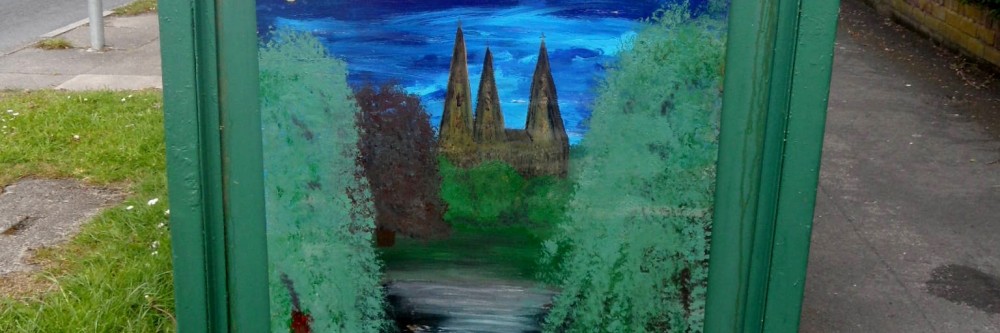
The Valley of Phantoms

I’m reading the memoirs of a man named William Purcell Witcutt. Like me he had connections to both Birmingham and Staffordshire, and was fascinated by folklore. Unlike me, he was an protestant vicar who converted to Catholicism before being exiled to the furthest outpost of the Diocese for the crime of commenting on the corrupt nature of many medieval priests. Yes, they sent him to Leek.

In his book, ‘Return to Reality’ there is a chapter called ‘The Valley of Phantoms’, in which he describes how, ‘Leek lay hidden in mist and woods in the middle distance, and one of the older boys tried to convince me that it was invisible from the air. Leek will never be bombed said he, and quoted with assurance the prophecy that there would come a time when, ‘there will be no safety in the land save ‘twixt Mow Cop and Morridge’.
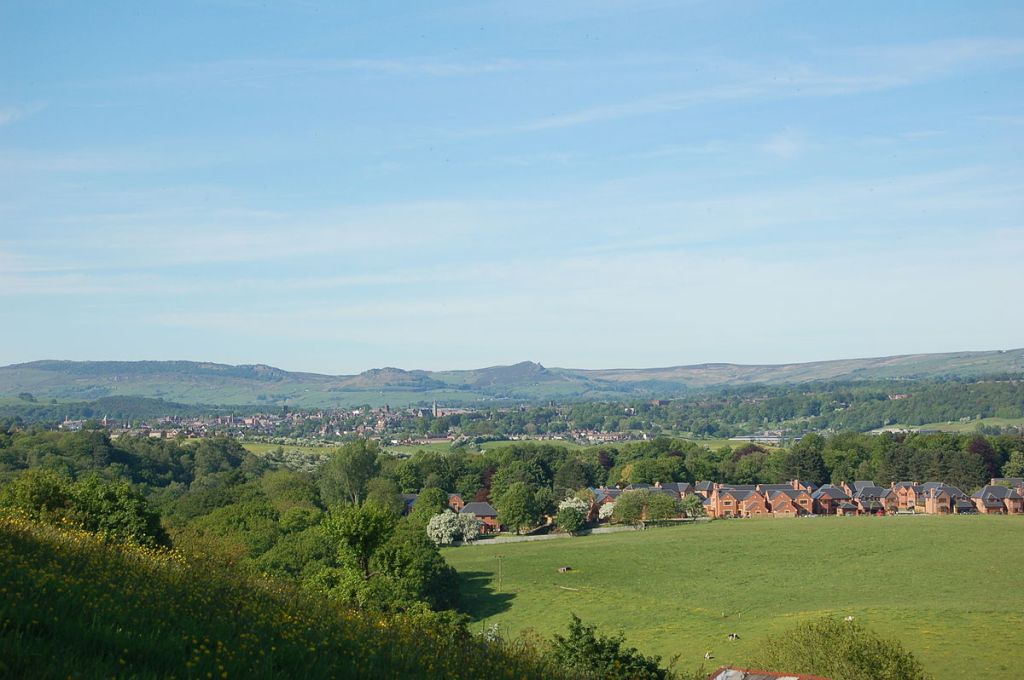
No I can definitely see it

Witcutt was soon to find plenty more superstition in this Staffordshire Moorland town. It seemed to him that the valley and moors around it swarmed with ghosts and bogies, which people still believed in. There was the Headless Horseman, or in Leek dialect, ‘a man on an ‘oss without yed on, an awful gory sight’, and nearby was a Black Dog who guarded the graves of those who died a violent death. According to Witcutt, the Queen of the Leek demons was the Mermaid of Black Mere, who I wrote about many years ago here. A new story to me was that of ‘Ball Haye Jack’, a little grey man whose appearance in front of one of the mills was believed to bring bad luck. One curious custom Witcutt noted was that on seeing his collar, the girls and women who worked in the mills would touch the factory railings, a somewhat unsettling reaction given it seems to be linked to the superstition that touching iron would protect against the power of a sorcerer.

One of the strangest spots Witcutt writes about is the Coombes Valley, When he visited in May 1940 he found a farmer planting potatoes and as the man sowed his spuds, he shared stories of the valley. At a place nearby, the spectre of a murdered man was said to ride up and down the ridge. Once seven priests came to lay him but all but one of the gathered fathers fled. The final man standing held up a stone in the brook, dismissing the pleas of the phantom for mercy, and laid him beneath the rock. The process appears to have been unsuccessful however and so the dead man rode out once more. This next time he was laid beneath a hawthorn tree at a place known very appropriately as Spirit Hole. Even that was only sort of successful though as he still haunts the valley, although now in far less malevolent form of a bird heard singing as the night falls at the Spirit Hole. The stone which had failed to keep the ghost grounded was still there when Witcutt visited (and I believe it still is), and according to the farmer it had once been a stone of sacrifice.

No wonder the valley is full of phantoms.

Source: WITCUTT, W.P. Return to reality, Macmillan, 1955.

The Banshee at Weeford Rectory

In June 1863, Alice and Emmeline, daughters of the Rev Robert Cowpland were woken from their sleep at Weeford Rectory by an unearthly wailing. The only other member of the household to have been stirred by the sound was the family bulldog, who was found trembling with terror in a pile of wood. By the end of the month, their mother Jane was dead at the age of 57.

Many years passed, and then at around midnight on a still and calm August night in 1879, the sisters were again woken by, ‘ a terrible sound of shrieking or wailing, unlike anything which we have ever heard, except on the other occasion here mentioned, but louder’. The noise seemed to come from the passage leading past the door to their father’s bedroom, and so the sisters leapt from bed, lit candles and rushed from the room without even pausing to put on dressing gowns. Outside on the landing, they met their brother, the groom, the cook and the housemaid, all who had been woken by the supernatural sounds. Even the dogs in the house were said to be bristling with fear at the nocturnal noise which was later described by Alice Cowpland as being seemingly borne by a wind inside the house and amongst the rafters, an awful howling which seemed to rush past her, accompanied by a strong wind, although everything outdoors was perfectly still. As whatever it was left via a window, silence returned to the house save for the sobs of the cook. She knew what had just been amongst them and that it was a warning that her master’s days were now numbered.

Only the Rev Cowpland remained asleep throughout the banshee’s visit and confirmed at breakfast the following morning that he’d not heard a thing. As the cook had feared however, the wailing had been a warning and a fortnight later, on 9th September 1879, he died at the age of 75. It is somewhat ironic given the events of that evening, that the Lichfield Mercury describes him as having quietly passed away.

The church at Weeford where the Rev Cowpland is buried

By the middle of May 1885, Alice was married and living at The Firs in Bromyard. Her sister Emmeline was staying with her, and her brother Francis was at Upper House, Bishop’s Frome, around five miles away. Once again the two sisters, along with a woman called Emily Corbett and other servants, heard the wailing one night, though not as loud as it had been at Weeford and by the end of the month, Francis was dead.

At the end of August that year, the banshee returned again to The Firs. This time around, Alice not only heard the harbinger of death but she also saw one. On 1st September, she noticed a black dress in her bedroom, which rose up and took the form of a figure. It looked straight at her for a few seconds and she saw it was her sister Annie, her face pale and with a look of anguish. She was wearing a bonnet and a veil and the vision was so clear, she could see the freckles on her sister’s nose. The figure did not disappear instantly, but seemed to fade away. The same evening, a niece staying at the house also saw an apparition of Annie Cowpland. In her written account of those strange events, she says she was taking a bath when something compelled her to look towards a couch near the bed, where she noticed a figure dressed in black crepe. She immediately recognised it as her aunt and asked how it was that she was there. The figure then faded again. The following night at dinner, a message arrived at the house to say Annie Cowpland was dangerously ill. She died of diptheria two days later.

According to Alice, her mother Jane had sometimes experienced supernatural visits from those who were about to pass. In 1857, she saw her brother-in-law, the Rev William Cowpland, rector of Acton Beauchamp in Worcestershire, in her bedroom. She asked when he had arrived but received no response and the following day, a telegram arrived to say he had been found dead in his bed at the age of 55. Three years later, Jane heard footsteps in the hall of the Rectory at Weeford and saw William Dunn, a gardener at the house of a relative. It later transpired that he had died around the same time as his apparition had been seen, and shortly before his passing had expressed a wish to see Mrs Cowpland. In a way the strangest apparition of all occurred in 1862, when Mrs Cowpland saw an acquaintance of hers, known as Mrs F, at the foot of her bed. Again the appearance coincided with the time of death but as the two women weren’t close, Jane Cowpland always wondered why she had been the recipient of the woman’s final visit.

Alice passed away in 1915 and it would be fascinating to know if anything was heard from the banshee on the occasion of her death and indeed why it appears to have attached itself to them in the first place. It’s a subject that fascinates me given that I have my own family chronicles of deaths foretold, albeit in more hushed tones than the wails of the Cowplands’ banshee.

Sources

Proceedings of the Society for Psychic Research