There are many reasons one might visit a pub. To sample the fare, to enjoy an ale, to meet with companions. I went to the Dog and Doublet because it’s named after a murder. Or a dog wearing a jacket. Either way, I headed to the village of Sandon in Staffordshire, in my mystery machine (which looks a lot like a Toyota Avensis) to do a bit of investigating.

The first possible explanation for the pub’s name is that a former landlord was murdered by robbers and his faithful hound found the corpse. In what sounds like a gothic horror version of Lassie, he took his master’s blood-stained doublet back to the inn and then led a search party back to the body. The second less gory story says that a travelling fair came to Sandon and its star act was a performing pooch in a little jacket. The villagers thought he was such a good boy they decided to name their pub after him. A dog in a doublet was clearly a novelty back then. Nowadays I see some canines out walking in Leomansley Woods who have better wardrobes than I do.

The current building dates to 1906, and is described as having been erected by the Earl of Harrowby on a site adjoining that of the original. The tithe map seems to show that there was an inn there back in 1838, but it was known as the Packhorse. It’s all a bit confusing, even before you’ve had a drink, but I think I understand what happened with these hostelries. There was definitely a Dog and Doublet in the village dating back to at least the mid-18th century as I’ve found a reference for it in Aris’s Birmingham Gazettee. It seems to have stood on the other side of the road, at a place now known as Sandon Lodge and/or Erdeswicke House. When Sandon Hall burned down in the summer of 1848, the Earl of Harrowby made it his temporary family home, and had the pub sign moved to the Packhorse which presumably was also renamed at this point. He didn’t relocate the resident ghost though, as a man described as wearing brown clothes and a small wig and believed to be a former landlord, was still reported to be haunting his old hostelry in the 1950s.
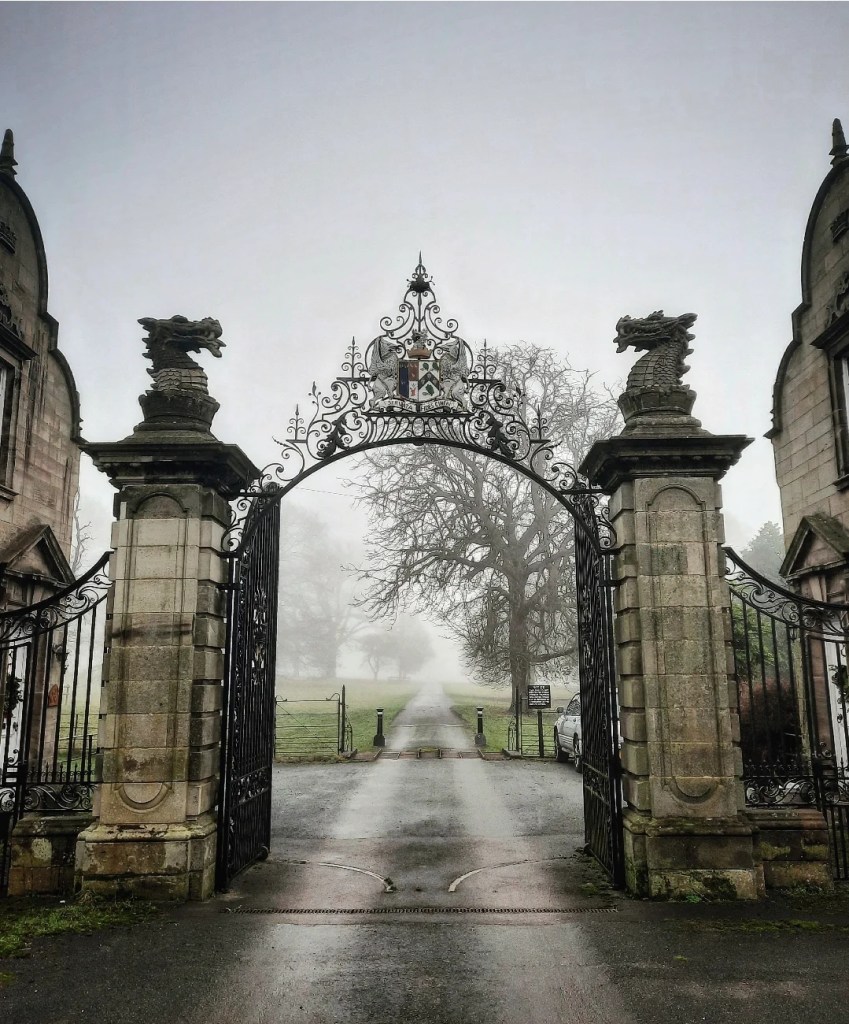
This information comes from Sam Berrisford, a former chairman of the Parish Council, who lived in part of Sandon Lodge. He also mentions an overgrown circular bowling green in the grounds of the old inn, which he suggested was Elizabethan. According to the listed building description, the oldest parts are 17th century and so certainly old enough that tales of parliamentarian troops draining quart pots and plunging their heads into vats of beer in the inn’s cellar prior to the Battle of Hopton Heath could be true. If so, it’s no wonder the Royalists defeated them eh? (put down your swords Roundheads, I’m just jesting. I know the outcome of the only Civil War battle to take place on Staffordshire soil isn’t that straightforward).

During its 18th century coaching inn days the hospitality of the hostelry was renowned and, in the absence of Trip Advisor, a satisfied customer is said to have scratched this verse onto one of the smoke-room windows of the old pub.
‘Most travellers to whom these roads are known
Would rather stay at Sandon than Stone
Good chaises, horses, treatment and good wines,
They always meet with at James Ballantine’s’.
Not everyone met with such a cordial welcome from Mr Ballantine however. There’s a story his daughter eloped with a young man and that when the boy broke into the inn to collect some of her belongings, Ballatine was there waiting for him. He handed his estranged son-in-law over to the law and the lad was hanged for theft. It’s said that on the night of the execution, a crowd of villagers surrounded the inn, chanting the 69th psalm and cursing James Ballantine. Possibly related to this family drama is a second verse that the Staffordshire Advertiser says was scratched into another of the inn’s windows which read, ‘Let the man that hates peace, and endeavours to trouble it, Be hung up by the neck, like this dog in the doublet’.

Whether the story of Sandon’s star cross’d lovers is true I don’t yet know but I have found out that James Ballantine and his wife Catherine had six daughters in total. One of them was called Ann and in November 1779 she married Alderman John Fern, an eminent Wine and Brandy Merchant from Lichfield. So far, so respectable but then you learn the groom was sixty-two years old and Ann only twenty-one. I believe they’d have lived at Whitehall on Beacon Street in, another former inn with an intriguing past. Fern died in Lichfield on 16th February 1801 and his short obituary in the Whitehall Evening Post, refers to him as the ‘Father of the Corporation of that city’. Although surely he was old enough to be its Grandad…
Back to the Dog though and by December 1802, the landlord there was Mr Tomlinson who was paid a visit by a swindler, who may have been enticed by the Trip Advisor review for good horses in the window. He had, ‘very much the appearance of a gentleman aged about forty years, five feet eight or nine, dark curled hair, smooth face, smiling countenance and had on a dark mixture cloth coat, with one of his boots patched across the toe’. He arrived in a post-chaise from Cheadle and claimed to have left his horse at Leek due to the bad weather, asking for a horse for the following morning to take him to the banking house of Messrs Stevenson and Co. Inevitably, that was the last Mr Tomlinson saw of his horse and when enquiries were made at the bank in Stafford, it probably didn’t come as a shock that no such person had been there. A five guinea reward was offered by Tomlinson, along with ten pounds from ye olde neighbourhood watch scheme, the Sandon Association for Prosecuting Felons.

And so it turns out there there are far more than two tales at the Dog and Doublet even if some of them are just shaggy dog stories. I’m not quite ready to fire up the Toyota Avensis and leave Sandon just yet though. There’s a mystery up at the church that needs solving…
Sources:
Birmingham Weekly Post 20th October 1950
Stone – The History of a Market Town, Norman A Cope
Staffordshire Advertiser 4th December 1802
Staffordshire Sentinel 18th February 1905
Staffordshire Advertiser 21st May 1864
Staffordshire Advertiser 16th November 1946
Oxford Journal 20th November 1779
Staffordshire Advertiser 10th May 1806


 Lichfield Lore