Parks and Wreck Creation

This is the final part of my car park trilogy and I know you’ve all been desperate to find out where this multi-story ends. Will it be Bunkers Hill, with its supposed civil war connections or the Friary Inner or Outer which always makes me think of bellybuttons? I felt it only right to end at the home of civic car parking in Lichfield. Buckle up, we are going to the Council House Car Park (Saturdays and Sundays only).

Back in 2008, there was an article in the Birmingham Mail about how archaeologists investigating the car park had discovered part of the ditch which ran around the city from around 1130AD. The section they found here contained broken medieval pottery, leather and animal bones, including a medieval dog’s skull, confirming anecdotal accounts that it had doubled up as a public tip. Rather than being a defensive structure, the ditch is believed to have been dug to stop traders entering the city without paying a toll at one of the five gates – Bachunneswich (Beacon St), Sandford St, Stowe, Tamworth St and Culstubbe (St John’s St). It’s ironic that that the excavations which uncovered the section of the ditch which has been used as the town dump, were undertaken as part of the preparation for Friarsgate, which was of course intended to bring traders into the city but ended up being a load of rubbish.

The Old Grammar School was once a highly regarded establishment which prided itself on wisdom and knowledge. It is now home to Lichfield District Council

This section of the structure was known as the Castle Ditch. Back in the early 1800s, when digging the foundations for long disappeared cottages in Gresley Row, another section of it was discovered filled with the horns, skulls and bones of large quantities of cattle. Local lore has it that these are the remains of the two thousand oxen supposedly enjoyed by Richard II and guests during his Christmas food festival at Lichfield Castle in 1197. I’m guessing the bones are still there? We may not have kings under our car parks but we might have the remains of their dinner under the local branch of Argos.

In their ‘Short Account of the City and Close of Lichfield’, Lomax and Newling noted land adjoining this newly erected street was known as Oxenbury field, which may or may not be a coincidence. I’ve been trying to find out more about Oxenbury, including where exactly it was. Well, still is but we just don’t know it by that name any more. There are a few clues to be found. One account by J W Jackson in the Mercury in December 1945 describes it as being to the south of St John Street and stretching as far as Aldershawe and on John Speed’s 1610 map, he has drawn two giant Oxen on what I think must be the site of Oxenbury Field, which may or may not be a coincidence.

John Speed 1610 map of Lichfield

According to the Staffordshire HER there is documentary evidence of a cross of Bishop Walter (Langton?) in the area to the south of St John’s Hospital which I think might be the same one referred to in Harwood’s History and Antiquities as, ‘a cross in the hand at the end of Aldershaw or St John’s Lane, anciently Schoolhouse Lane’. The same HER entry also says there is documentary evidence of a duelling ground in the same area and so it seems that Oxenbury, or at least part of it, may have been used as a tournament field in medieval times. According to an article on Lichfield place names in the Mercury in September 1972, an area of land near to Chesterfield Rd was known as Soldiers’ Field and a John Jackson article from June 1944 says Oxenbury was used for military exercises and was also where archery was practised. I’m fighting to resist making too much of all this until I’ve managed to put a bit more flesh on the bones of it all but it’s certainly worth a bit more digging.

By the mid-16th century, Oxenbury Field became known as Castle (Ditch) Field. We know this because Leyland visited Lichfield and said something like, ‘There hath been a castle of ancient time but no part of it standeth. The place of the ditch is seen and it is yet called Castle field’. In an advertisement in the Mercury in June 1888, building land known as ‘Castle Ditch Ground’ or ‘Cherry Orchard’ was to be sold at auction at the Smithfield Hotel or as it became known a hundred years later, the Sozzled Sausage. Sadly I never got around to visiting to sample the boozy bangers before it was closed. The building has now been demolished but stood near to where the entrance to Tesco car park (two car parks for the price of one you lucky things!) and, as you may have guessed from the name, it was connected to a livestock market. Wonder if they sold oxen?

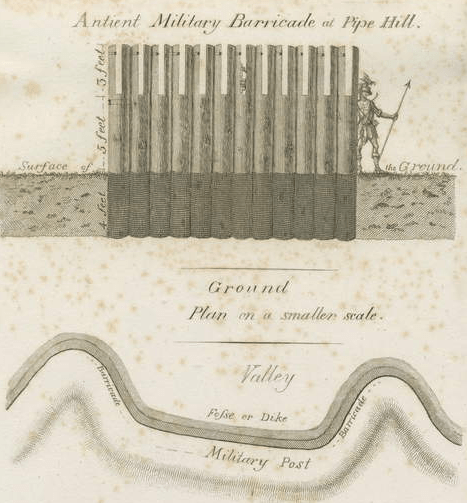
Understandably, place names such as Castle Ditch and Castle Field have given rise to speculation over the centuries that Lichfield did have some sort of castle on the south of the city in addition to the Cathedral Close, fortified by Bishop Clinton in the 12th century. A little further afield, we have Castle Croft near Chesterfield and the Roman settlement at Wall and I’m starting to suspect that the legendary Lichfield Castle may in fact be Letocetum.

D Horovitz suggests that ‘Ancient names with castle often mark what was, or was thought to be a castle in the conventional sense (e.g. Castle Church referring to Stafford Castle and Castle Croft near Chesterfield, named from substantial walls of Roman date), but often a prehistoric or later earthwork, from OE and OF castel, but sometimes from OE ceastel, ‘heap of stones’, often with archaeological interest. Hang on, a heap of stones with archaeological interest? That brings us nicely back to the car park and the Friarsgate, sorry, Birmingham Road site.

If you enjoyed the trip please do join me next time when inspired by Christopher Biggins and some old charity records (the archives kind, not the “Is this the way to Amarillo?’ by Tony ‘I was Waitrose’s most famous customer called Tony until someone saw that bloke from Spandau Ballet in there’ Christie & Peter Kay kind), we will be going on safari.

Sources: ‘Lichfield: The 19th century’, in A History of the County of Stafford: Volume 14, Lichfield, ed. M W Greenslade (London, 1990) Lichfield Mercury Archive https://www.birminghammail.co.uk/news/local-news/archaeologists-find-historic-ditch-in-lichfield-60115 The History and Antiquities of the Church and City of Lichfield, Rev T Harwood A Short Account of the City and Close of Lichfield, Lomaz and Newling Staffordshire HER Records A Survey and Analysis of the Place-Names of Staffordshire’ by David Horovitz, LL. B https://www.thecaterer.com/archive/not-such-silly-sausages

Parking Mad

This is the second blog post in my car park trilogy. My Attack of the Cones, my Three Colours: White (Lines), my Yawn of the Dead. In this thrilling instalment, the action moves to Bird Street car park, or as we’ve already established everyone over the age of 35 still calls it, the back of Woolies.

Back in October 1988, the Dean of Lichfield urged Lichfield District Council to redevelop Bird St car park and create ‘one of the most beautifully placed theatres in England’ along with a whole host of other attractions to boost tourism in the city. This included the restoration of the medieval ferry which carried pilgrims across Minster Pool to visit the shrine of St Chad, so that modern day visitors could follow the same route. ‘Ooooh we’d love to’, cooed the council, ‘but without a wealthy benefactor there are a couple of million reasons we can’t’. And lo, the Dean’s ideas did not come to pass and so unto this day, Lichfield has one of the most beautifully placed car parks in England.

Less well received were plans by Tamworth artist David Perks to create a sculpture that recreated Bird St car park on the surface of Minster Pool by floating 30 car roofs in a herring bone pattern using polystyrene blocks and nylon cord as part of the Lichfield Fringe Festival in the summer of 1990. Members of the District Council’s Leisure and Recreation committee derided the proposed art work as ‘tasteless’, claiming it would ‘make Lichfield a laughing stock’. Hold that thought for when we head over to the Council House car park for the final part of the trilogy.

You can still follow in the footsteps of pilgrims along part of the route they took on their spiritual and sacred journey to the Cathedral by walking up Cock Alley and taking a left at the pay and display machine. Doesn’t have quite the same ring as Cross in Hand Lane does it? Despite claims from some local historians that the name derives from a connection with the unholy ‘sport’ of cock-fighting, a document from 1335 says Canon Nicholas Teyturrell made a grant of a plot in Wroo Lane, Lychefeld to John Slorcoke, a carpenter, which wood work as an etymological explanation. The earlier name of Wroo Lane derives from an old word meaning a corner or angle and needs no further explanation when you see the course of the lane. On a plan of the City of Lichfield from 1815 showing the proposed improvements of the streets and supply of water, the name has been changed to Wet Lane, which I can only assume in the absence of any other evidence refers to the fact it led to Minster Pool. I’m wondering too if it was also another example of the gentrification of street names that seems to have taken place in Lichfield the early nineteenth century? Pease Porridge Lane became Bakers Lane, Womens’ Cheaping became Breadmarket Street and most famously, Bacon Street became Beacon Street.

Whilst researching the route the pilgrims took, I came across a reference that J W Jackson makes in his local history column in the Lichfield Mercury to the Gate House (not the old Wetherspoons on the corner of Bird St). He describes it as a pretentious black and white residence standing out on pillars from the other buildings in Market Street on the site of what was later the Maypole Dairy Co and Mr Playfers Shoe and Boot Shop. He suggested that it had originally been owned by the Vicars Choral and was the entrance where pilgrims from the south had access to the ferry at Minster Pool. Where exactly was this and if (and in the absence of any real evidence to back this up, it is an if) this is correct, how does this slot in to the documented access via Cock Alley?

Market St, Lichfield July 2019

Finally, I know I’m going off at a bit of a Wroo but whilst exploring our Cock Lane, I also found that our Dr Samuel Johnson had been involved in a bizarre series of events involving another Cock Lane whilst down in that London. Plenty has been written on the subject including, ‘When Lexicographer Samuel Johnson Became a Ghostbuster’ or ‘Murder, sex and haunting in Dr Johnson’s London’ and so you can see why my curiosity was aroused. The Cock Lane Ghost was supposedly the spirit of a young woman called Frances Lyle, who returned from the dead to let people know that she hadn’t died of smallpox as had been claimed but that she had been murdered by her lover who was her dead sister’s husband. Events came to a head on 1st February 1762, when Dr Johnson led a small party to the vaults of St John’s Clerkenwell where ‘Scratching Fanny’, as the spirit became known, was asked to reveal herself. I won’t give away anymore spoilers as the story of the entity is worth seeking out and reading in its entirety but don’t blame me if it gives you the woolies.

Credit: Complete contemp. history of Cock Lane Ghost. Credit: Wellcome Collection. CC BY

Car Parkaeology

Amongst the slightly more leftfield Lichfield Discovered ideas me and a comrade have had, is lurking at various places where there is a wondrous story to be told, and regaling unsuspecting passers-by with it. However, we thought people might think we were a bit creepy if we did that and so we put the brakes on that idea. Instead you’ll have to hear about how fascinating one of Lichfield’s car parks is from the safety of your own home, rather than have me leap out at you from a pay and display machine whilst you are trying to remember your registration number.

Cross Keys. Ye oldest evidence for ye olde city?

So, if I haven’t driven you away yet, then let’s head over to Cross Keys car park. Or is it Lombard Street? To be honest, we probably all still call it Carol’s anyway because ‘the superstore with a whole lot more’ was only demolished about two years ago, and I still hear Bird St car park being called Woolies when it’s been gone for at least ten. Anyway, evidence of Lichfield’s oldest building was uncovered here and I call that momentous. The time between the last days of Letocetum, abandoned in the 5th century and the arrival of St Chad in Lichfield in the 7th century and the relationship between the two sites has always intrigued me. The ‘stone-built post-Roman structure’ discovered at Cross Keys during excavations in 2007/8 incorporated masonry from a ‘substantial Roman building’ and this along with a construction date of 5th to 7th century, seems to provide a link between the two times and places. The Cross Keys building is believed to have been continuously occupied from AD 400 to AD 950, with the post Roman structure later being replaced by a sunken feature building known as a Grubenhaus when it burned down.

It’s also important because it’s evidence of an early settlement of some sort at Lichfield and it has been suggested that St Chad came to Lichfield as there was already a church or religious community here. We know that there was Christianity in the area based on the discovery of a 4th century bronze bowl with a Chi-Rho symbol in a grave at Wall. There is something else too, something that I’ve been avoiding for years because, frankly I thought it was as bonkers as my idea to recreate all of the statues in Lichfield using plasticine but it turns out it isn’t. There is a seventh century poem called ‘The Death Song of Cynddylan’ which recalls three battles fought by Prince Cynddylan of Powys. One of these was at a place called ‘Caer Luitcoed’, which translates to ‘the fortified grey wood’ or, as everyone, including proper historians, who has translated the poem calls it- Lichfield. Here’s the relevant extract:

My heart burns like a firebrand.
I enjoyed the wealth of their men and women.
They could not repay me enough.
I used to have brothers. It was better when they were
the young whelps of great Arthur, the mighty defender.
Before Lichfield they caused gore beneath the ravens and fierce attack
Lime-white shields were shattered before the sons of Cynddylan.
I shall lament until I would be in the land of my resting place for the slaying of Cynddylan, famed among chieftains.
Grandeur in battle, extensive spoils
Moriel bore off before Lichfield
1500 cattle from the front of battle,
80 stallions and equal harness.
The chief bishop wretched in his four-cornered house
The book clutching monks did not protect
those who fell in the battle before the splendid warrior.

So, if the poem is to be believed, Cynddylan’s mate Moriel plundered Lichfield, taking 1,500 cattle and 80 horses. The bookish monks were no match for the Welshmen (sometimes the pen just isn’t mightier than the sword unfortunately) and I think we can deduce from ‘gore beneath the ravens’ that this was a bloody affair. There is some debate around who the battle was actually between given that Cynddylan was a Mercian ally but that’s probably one for discussion in front of a fire over a goblet of mead. For now, let’s just focus on the fact that there appears to have been a battle at or near Lichfield in which religious men were slaughtered. Am I clutching at straws (eco friendly paper ones obvs) or does this not sound a bit like it might be where the Field of the Dead legend may have originated? You, know the one where early converts to Christianity were massacred by pagans and their bodies ‘left unburied, a prey to the birds and beasts of the forest’, an image that it doesn’t take too much imagination to get to from ‘gore beneath the ravens’. And what about those finds over at Toads Hole Piece (a meadow adjoining Christian Fields, near Pones Mill) in the early 19th century which included ‘a considerable quantity of human bone’ and ‘various piece of earthenware, some of which are Roman’? Yet I keep reading that there is no evidence that a massacre ever took place and it’s just a legend. It seems to me that this might just be a bit too dismissive and actually, maybe Robert Plot wasn’t just making it up after all but the story had become confused, as they often do. Or maybe I’ve just become confused as now I’m not quite sure how I got from Cross Keys to Christian Fields. Please do tell me if I’m losing the plot…

The Martyrs Plaque in Beacon Park is one of several places you can see an interpretation of the city shield which features the legend of the massacred martyrs

In the meantime, I’m off to the Fuse festival. Don’t worry, I won’t jump out on you and try to tell you the history of Bunker’s Hill cark park whilst you are waiting in the queue for the beer tent. Promise.

Sources:

https://finds.org.uk/staffshoardsymposium/papers/alexjones
Lichfield EUS Report Final

Some Place-Names in the Immediate Area of the Staffordshire Hoard Mattias Jacobsson (Jönköping University)

A Load of Old Bull

I have beer in my my blood. Literally, because I’m drinking a bottle of Backyard Blonde whilst writing this and metaphorically, as an ancestor of mine called Organ, ran an ale house in Cirencester called the Three Cocks. Stop sniggering at the back.

Perhaps this is why I love a bit of pub history, particularly when it is overflowing with stories and legends. If you want to know where the best beer is you’ll need the CAMRA guide, if you want to know where some of the best stories are, here’s an extract from the Cardigan guide, where a well kept past is as important as a well kept pint.

The Bull’s Head in Shenstone dates to the mid eighteenth century and was originally a house. It later became an inn and was also used for petty court sessions and, in the 1970s, then landlord George Waite told the Lichfield Mercury that he’d heard that one of the cellars had been used as a cell. Mr Waite said he’d seen curious niches, chains and shackles in a sealed underground vault which he believed supported the story. An example of the kind of cases dealt with at the petty sessions is that of Thomas Flanagan and Mary Walsh, who were brought before J S Manley Esq and the Rev TOB Floyer, after they were accused by a Hammerwich farmer of stealing turnips. Flanagan, who had ironically been appointed to watch that the turnips weren’t stolen, was sentenced to 14 days hard labour and Mary was sent to gaol for three days. There is also the shocking tale of the besom maker’s brush with the law. He or she was fined for cutting birch saplings in Weeford Park as a caution to others, as this kind of theft and trespass by travelling besom makers had become prevalent. Whilst reported sightings of a grey lady at the inn may be suspect, there have been definite sightings of the Chocolate Soldier. In 1969, the landlord of the pub was approached by someone who wanted to use the stables at the back for a pony and despite Chocolate Soldier being teetotal, he often trotted into the bar on a Sunday lunchtime.

The Pig on Tamworth St in Lichfield was originally the Acorn, its name apparently being taken from an oak tree growing outside the original pub which was knocked down and rebuilt. I know that this took place in around 1909, as in November that year, the Lichfield Mercury reported that Frederick Cope from George Lane fell into a hole caused by the work and fractured his ankle. In the 1970s, the Acorn was threatened with demolition as Allied Breweries wanted to build shops on the site. Shortly after these plans were announced, tales of paranormal activity at the pub emerged. Theresa Bird, who worked behind the bar, revealed that she’d had strange dreams of a man dressed in black who then turned up at the pub but disappeared as she went to serve him. Landlord Les Hine informed her that it was Fred and his presence in the pub had been witnessed by himself, other members of staff and customers on many occasions, reading the paper and sometimes throwing things around (which to be fair to Fred is sometimes what I feel like doing after reading the paper). Whether due to supernatural or market forces, The Acorn was not felled although in 1988, it was renamed as The Pig and Truffle due to the presence of Percy (a two foot pottery pig) and chocolate truffles, which you got if you ordered a coffee. Percy the pig, who was described as normally being dressed in a waistcoat, flatcap and glasses (although that wording implies he may have had other outfits) later disappeared and I’d like to think it was Fred’s way of protesting against the nonsensical name change. In the meantime, two derelict buildings next door had been converted into a Wetherspoons, and John Shaw, author of the Old Pubs of Lichfield book, successfully campaigned for it to acquire the name of The Acorn, as a tribute to its neighbour’s former identity. Recently, the popularity of the once packed Pig and Truffle had dwindled but earlier this year it gained a brilliant new owner. The Pig is now run by the Derby Brewing Company, and it’s fantastic to see the place rammed.

The Whittington Arms on the Tamworth Rd was once the clubhouse for the Whittington Barracks Golf Club, and prior to that a house for high ranking officers from Whittington Barracks. Between 1959 and 1998, it was home to the Lochranza kennels which bred cocker spaniels. It’s the cats I’m most interested in though. In the 1970s, workmen found the remains of four of them in the foundations of the building and passed them on to a car salesman at the garage next door. In his opinion, they had been placed in there already dead but were they accidentally trapped or a ritual offering? Those of you thinking the latter is too far fetched need to brush up on your Greek and do a bit of research into apotropaic magic. Removing your defences against the dark arts is always foolhardy move, leaving your premises vulnerable to all sorts of malevolent forces, as the landlord of the pub discovered in 1993 when a 12 foot inflatable castle was stolen from outside the pub. This may or may not have been modelled on the present Whittington Heath Golf Course which was built as the grandstand for the racecourse which moved here from Fradley Common in 1702. The last race meeting was held on 14th March 1895 and the racecourse is now the golf course although I’ve read the finishing post is still in situ. Oh and I’ll just mention that in the 18th century there was a riot at the racecourse during the course of which a dancing master whipped a Duke. Round of crazy golf anyone?

Ye Olde Windmill in Gentleshaw is believed to be four hundred years old and takes its name from an olde windmill in the beer garden. Less obviously, there is a well with a giant eel in it somewhere in the grounds. Actually, the Eel in the Well would be a great name for a pub. Better than the Pig and Truffle anyway. In the 1970s, a tradition developed where regulars would bring the landlord Len Banks models of mills for him to display in the bar. In ‘The Friendship of Cannock Chase’, written in 1935 by Cllr Mac Wright who wrote under the name ‘Pitman’, he describes how a Mr Bonehill, keeper of the Windmill Tavern refused to acknowledge the local lordship of the Pagets of Beaudesert and tells the story of when the old Marquis of Anglesey (suspect this may have been the 13th Lord Paget) heard about this and visited Bonehill to ask if the rumours were true. Hopefully, Bonehill’s curt response, “They speak the truth my Lord. Good morning”, took the wind right out of the aristocrat’s sails.

The Nelson Inn at Cresswell Green, Burntwood was refurbished in 1972, and there were rumours that the builders had discovered that some of the beams had originated from a 15th century shipwreck. It’s a story that washes up over and over again in relation to old buildings, but there is no watertight evidence anywhere to suggest that timber from ships was ever used in the construction of any building, including the Nelson. Reuse of timber from other buildings was common however, and so perhaps the builders found evidence of this but were in a maritime frame of mind due to the pub’s name? Some bonaparte fide nautical curios were added to the fixtures and fittings however, including a cannon from Portsmouth Dockyards which was fired on special occasions until it was stolen in 1985, and to celebrate the refurbishment and reopening, a telegram of congratulations was received from HMS Victory and its captain LCdr Hardy.

If I may, I’d like end with some advice for all you good, good people during these turbulent times? Go to the Bull’s Head/The Pig/The Whittington Arms/The Wiindmill/The Nelson/any of the other fine hostelries and inns we have in and around Lichfield and wait for all of this to blow over. And to all you bad people? Don’t steal things from pubs. Or turnips.

Sources:

Townships: Wall with Pipehill’, A History of the County of Stafford: Volume 14: Lichfield (1990)

Shrouded in Mystery

Waking up to a blanket of thick fog this morning put me in the mood to share an update on the lost chapel of Longdon Green and, in particular, the mysterious gravestone which seemed to appear out of thin air.

You may recall that the chapel had been built in the late 17th century and was demolished in the 1960s to make way for the A51 flyover. You may also recall that in Summer 2018, my attempt to see if anything was left of it was thwarted by vegetation (and if you don’t, the original post is here). Whilst waiting for it to die off, I read that three years after the chapel had been torn down, a lone gravestone had inexplicably turned up at the site. A week after reading that, my mate ‘Betsy’ and I inevitably turned up at the site to see if it is still there. It is.

Investigations by the Birmingham Daily Post in June 1969 failed to discover who had erected the stone and why. The Vicar of Longdon said he only knew that it had appeared by the A51. Staffordshire County Council thought it might have been something to do with the construction company who had damaged a tombstone whilst carrying out the demolition of the chapel but a spokesman for them said, “I don’t know anything about it”.

Investigations by me in February 2019 have failed to uncover any further details about the life of William Edwards, and the story of why someone chose to quietly erect this monument to him two hundred years after his death and three years after the demolition of the chapel where he had served as a clerk remains shrouded in mystery. The explanation may lie buried somewhere in the archives somewhere but fifty years on, I suspect that it has most likely been lost in the mists of time.

Unless you know any different….

Death Wish

One of the best known landmarks on Cannock Chase is the the 318ft high telecommunications tower at Pye Green, one of 14 built across the country as part of the Cold War ‘Backbone’ network. However, recent discussions based on my previous post revealed that another lesser known landscape feature lay somewhere nearby.

Pye Green Communications Tower cc-by-sa/2.0 – © John M – geograph.org.uk/p/2899217

Like its more famous but less whimsical neighbour the Glacial Boulder, the Wishing Stone appears to be an erratic.  However, unlike its more famous neighbour, nobody has thought to put it on a plinth or named a car park after it making it a lot harder to find. The only clues I had to its location was an old postcard someone posted for me on Facebook, a description on Staffordshire Past Track, describing it as being sited on, ‘an old packhorse route known as Blake Street Road and near the possibly medieval St. Chad’s Ditch’ and a reference in the modern classic that is the ‘Adopted Development Brief for Land to the West of Pye Green Road, Hednesford’.

Wishing Stone, Pye Green

Image via link to Staffs Past Track website

Ok, I’m going to cut to the chase. I went to have a look and didn’t find it. I know it’s still there however, as I’ve just seen a photo of someone stood on it on Facebook. Let me tell you though, this is probably the worst time of year for doing a search in a Facebook group for the word ‘Wishing’. A Happy New Year to all you good folks too.

Once I get out of my Christmas onesie I will go for another look. What I have found in the meantime though is an intriguing reference to the grave of a local highway man called John Deacon. The local legend is expanded upon in the Cannock Chase Guide from 1957, which Brownhills Bob very kindly scanned and uploaded to his blog with a little help from his friends a couple of years ago. It says that Blake Street was frequented by a notorious highwayman known as John th’ Deacon who evaded capture for many years by dressing as a cleric, hence the name. The story paints him as a do-gooding baddie – he may have robbed from the rich but he looked after the poor and needy of the countryside. Bless him. Eventually, th’ Deacon met his maker when he met with a coach-load of Bow Street Runners and he was buried on the spot where he was killed. That spot was somewhere near to the Wishing Stone which frankly, I feel he could have made better use of in this situation. Perhaps he couldn’t find it either.

Blake Street, Pye Green

Understandably, there is lots of scepticism around the tale, with suggestions that the place name of Deacon’s (or Deakin’s as it has sometimes been recorded) Grave is actually a corruption of the word ‘grove’. Whilst it’s tempting to write the story off as nothing more then a folk etymology, I have good reason to think there is more to it than that. An 1817 Ordnance Survey plan of the Penkridge area shows that there was a place called ‘Deadmans Grave’ in the vicinity and in May 1951, the Lichfield Mercury published the recollections of a Brocton resident called Mrs Holmes who had spent her life living on the Chase. One thing she remembered was a mound of earth, which local people referred to as ‘Dead Man’s Grave’.

Part of Ordnance Survey plan 1817. Taken from British Library collection http://www.bl.uk/onlinegallery/onlineex/ordsurvdraw/p/002osd000000010u00170000.html

In Mrs Holme’s version of the legend, the deadman in question was not our Blake Street bandit Deacon, but one or more Mercian monarchs who hunted on the Chase. On the day an excavator came to clear the mound away in preparation for the construction of sewage beds for the military camp, some of the locals skived off work to watch. Although nothing of interest was discovered on that occasion, a much more fruitful exploration of the mound was described by two chaps called Cherry at the start of the 20th century. In their book, they described how ‘the opening of this ‘bury’ afforded a remarkable instance of the confirmation of oral tradition by modern research. Such tradition had from time immemorial described the Milford bury as the as the grave of three Kings slain in a great battle fought on the spot. At the base of the mound were found three separate and distinct layers of human bones, all showing the action of fire and surrounded by a few coarse fragments of ancient British pottery. As confirmatory of the tradition, it is of course noteworthy that no other remains were found and that apparently no previous disturbance of the tumulus had taken place’. Getting into their poetic stride, Cherry & Cherry suggest that the three warriors had found ‘the sleep that lies among the lonely hills’, lying undisturbed as the centuries rolled by whilst an old wives tale kept their memory green’. Indeed it did. Thank you Mrs Holmes.

I would probably bet my money and my life that a highwayman dressed as a man of the cloth did not come riding-riding-riding up and down Blake Street but I’m also confused that the area marked as ‘Deadman’s Grave’ on the 1817 map appears to be a good five miles away from Milford and the mound which was known by this name.  I’ve heard so much about Saxon warriors recently, I’m starting to feel like I’m living in a Bernard Cornwell novel. Were three of them really killed and buried on the Chase or is this just pye in the sky? I wish I knew….

Sources

Historical Studies Relating Chiefly to Staffordshire by JL Cherry and Karl Cherry (1908)

Lichfield Mercury Archive

A Portrait of Cannock Chase published by The Association of Friends of Cannock Chase (1957)

Rock and Roll

My friend thinks glacial boulders are rubbish and that this one on Cannock Chase is Staffordshire’s answer to Craggy Island’s stone of Clonrichert. She isn’t alone.  Some years ago, the Express and Star included it in a list of top ten terrible attractions describing it as ‘just a medium sized rock on a plinth’.

A medium sized rock on a plinth

Surely, though a landmark as well known as the Chase’s Glacial Boulder must have a story or two to tell? There’s often a lot of mythology connected to lithology. The Gilbert Stone in Birmingham was taken there by a giant to mark his territory and the Webb stone in Bradley was nicked from the church by Old Nick who wanted to use it to rebuild hell and women who take it a (rock) cake on Halloween get to see their future spouse.

A medium sized rock not on a plinth (aka The Gilbert Stone)

Well I have found this….The boulder was found in a pit in Brocton around 1950 and was originally placed at the top of the wonderfully named Pudding Hill at Milford by the Association of the Friends of Cannock Chase. In September 1954, it was pushed off the hill by a gang of wrong ‘uns and so the friends group decided to cement it to the top of Spring Hill, which at 450ft above sea level was a fair bit higher than Pudding Hill. This did not prevent the boulder from going roly-poly again though. In May 1958, it was found at the bottom of Spring Hill having been chipped from its concrete base. Five men from the area were later arrested and fined £13 9s 2d each. The Birmingham Post and Gazette reported that they had, perhaps unsurprisingly, come up with the idea in the pub. “We only did it because it was a challenge and they said it could not be moved”. Apparently it took them four hours.  It’s now located in a car park not on a hill which makes it easy to visit but do try not to get as excited as the couple spotted getting erotic on top of the erratic one boxing day.

I don’t think I’ve quite succeeded yet in my own challenge to convince my friend that Cannock Chase’s rolling stone is a rock star, but I’ll keep chipping away.

Witchfield Gore

I have always been fascinated by folklore, superstition, ghost stories and all that kind of hocus-pocus. Growing up on a new housing estate in suburban Birmingham is perhaps not the most obvious place to have become acquainted with the old ways but they made their presence known from time to time. My Dad would never allow new shoes to be put on the table and a bird in the house was very bad news indeed.  Whilst working in a fast food joint in Sparkhill one Saturday afternoon, a woman ordered some southern fried chicken and read my palm. My brother’s rogue of a mate swore he saw an elderly neighbour doing the gardening a couple of weeks after she’d died and apparently there was a horse buried under a small hillock in our local park. I must google that one actually.

I’m well aware that such matters are a bit Marmite (and it just so happens that I know of an urban myth about that particular food stuff and Dartmoor Prison) but as Halloween is fast approaching, indulge me briefly to mention a few local stories that I’m fascinated by.

First up, a few tales of fangtastic beasts and where to find them (although given that seeing them is said to bring misfortune, I’d advise you not to go looking). The Black Dog of Brereton roams the lanes of, well, Brereton, terrifying all those who encounter it before vanishing into thin air. Demon doggos have also been witnessed locally by young Ivan Vinnel on Woodhouses Road in Burntwood in the 1930s and, more recently, by a number of motorists on the M6 toll road who reported a wolf-like creature bounding around Junction 10A. The Black Dogs of Brereton and Burntwood and the M6 Toll road. 666/10 would not pet.

Another ghost dog in Brereton. The 18thc Talbot Inn, now closed.

A google ghost hunt has thrown up Lichfield district’s very own phantom flan flinger. In January 1979, ATV Today visited The Burntwood Patisserie to interview the bakery director Steve Davies and employee Dawn Evans after paranormal activity in the building put the night shift on hold. Sadly, the video clip is not yet available on line through the MACE archive.  Elsewhere in the ATV archive is footage from May 1965, when a camera crew visited Dam Street’s ‘Little Gallery’, an antique shop run by Jack Whitney, to try and capture evidence of a monk said to haunt the 500 year old building. What are these two buildings now?

Dam St, Lichfield

It’s a mystery at one of my own previous haunts that’s really intrigued me however. Back in the summer, I wrote about the lost chapel at Longdon . It had been built in the late 17th century and was demolished in the 1960s to make way for the A51 flyover. In June 1969, the Birmingham Post reported that a gravestone with the inscription ‘William Edwards. Died 6 August 1775 aged 67. Clerk to this chapel for 19 years’ had appeared alongside the site where the congregational chapel once stood, three years after it had been torn down. Everyone involved from the clergy to the constructors to the council denied any knowledge of where it came from, who put it there and why. Looking back at JW Jackson’s description of the site when he explored it in 1876, there was a small graveyard. So why was this the only memorial from it to have been replaced at the site? And another fifty years on, is it still there?

Sources:

Real Monsters, Gruesome Critters, and Beasts from the Darkside by Brad Steiger

The Weiser Field Guide to Cryptozoology by Deena West Budd

http://www.macearchive.org/films/atv-today-03011979-burntwood-patisserie-near-lichfield

Birmingham Post Archive

Dead End Streets

I have been dead certain for sometime that there would once have been corpse roads leading to Lichfield, bringing bodies from the surrounding hamlets and villages to be buried in the consecrated ground of their mother church.

My Scooby sense about their existence eventually translated into something a little more tangible when I found the following reference in the 1819 book,  ‘A Short Account of the City and Close of Lichfield’ by Thomas George Lomax, William Newling:


‘By the side of the chapel is Dove house lane once the burial road from the village of Wall now disused’.

Further evidence can be found in the rolls of St George’s Court held on 28th April 1656, which record how Michael Salt was fined 6D for “not making a stile into Dovehouse Field from the Clay Pitts, this being a church way”.

Dovehouse Fields sign

Given that Wall was part of St Michael’s parish, this surely must have been the mother church and the final destination. As to the exact course the corpse road took, I suspect the answers lie buried in old place names. Look out for references to anything church, burial, coffin or corpse related on old maps and documents.

Claypit Lane sign

Whilst you’re at it, give some thought to Shenstone too, where in October 1817 the Staffordshire Advertiser carried the following description:

…a certain road, heretofore used as a burial road, beginning at the north-westward end of a Road called the Walk, belonging to Edward Grove Esq, and extending in a north-westwardly direction over an ancient inclosure called Lower Park Field, belonging to Ann Adams, over an ancient Inclosure called New Piece, belonging to said Edward Grove, over an ancient inclosure called Over Park Field, over an ancient inclosure called Upper Park Field, and over an ancient inclosure called Near Park Field, belonging to Ann Adams, to the Birmingham and Lichfield turnpike road, then crossing the said road in a south-westwardly direction to an ancient inclosure called Bull’s Head Piece, then turning in a westwardly direction over the said Bull’s Head Piece and another another ancient inclosure called Church Piece, belonging to Henry Case, Esq.

Elsewhere in the country, numerous stories and superstitions have materialised around these paths where the dead were toted. The general flavour of the folklore associated with these roads involves rituals designed to ensure the spirit of the dead could not escape en-route nor return home. The corpse would be carried feet first and often over water as apparently ghosts can’t cross running water (although I have heard of a spectral passenger hitching a lift in a taxi as it drove over the causeway at Blithbury Reservoir). Despite these rites of passage, there are stories of the supernatural associated with burial routes –  phantom funeral processions, corpse candles and headless black dogs are just some of the shady characters to be wary of when travelling the same way as the dead did. If only we knew exactly which way that was….

wall green lane

Wall is surrounded by these ancient green ways. Could one of them have been part of the old burial road?


Little Green Chapel

Following on from the last post about the Minors School, it seems that its founder was no stranger to controversy either. Here’s the original extract from the Victoria County History someone sent to me which unexpectedly ignited my interest in Presbyterian places of worship with mention of a meeting house in the city being burned down during riots in 1715 and a chapel at Longdon Green.

The Presbyterians remained powerful in the city after the Restoration. Bishop Hacket complained that ‘the Presbyterians of the city do what they list, come not to the holy communion, baptize in hugger-mugger, are presented for their faults but no order taken with them’, and Dean Wood allotted prominent seats in the cathedral to Thomas Minors and his brother-in-law William Jesson. Presbyterian influence extended in 1667 to the election as M.P. of Richard Dyott, who Hacket believed was completely under their control.  In July 1669 Minors and Jesson were summoned before the Privy Council for holding a conventicle in Minors’s house. They moved the meeting to a farmhouse at Elmhurst, where a conventicle later the same month lasted most of the day. According to Hacket it was attended by some 80 people, of whom the ringleader was a Lichfield carrier named James Rixam (or Rixom), a man ‘no way fit for that trust, being a transcendent schismatic’. Minors and Jesson subsequently appeared before the Council but were discharged.


Five houses in Lichfield were licensed for Presbyterian worship in 1672; they included Minors’s house and that of John Barker, another mercer who was later one of the trustees of the English school in Bore Street established under Minors’s will. By 1695 a Presbyterian minister, Robert Travers, was working in the area, with a chapel at Longdon Green. He baptized at Lichfield in 1700, and there was a meeting house in the city by 1707.  It was burnt down during riots in 1715 but had been rebuilt by 1718.  In 1720 Travers was living in the house of Elizabeth Jesson, possibly in Saddler Street. In 1738 his own house in Lichfield was licensed for worship. He may still have been active in 1747, but by April 1748 the congregation was served by Samuel Stubbs.  The Lichfield chapel was closed in 1753,  but the congregation continued to meet at Longdon Green.

I’ve wandered around Longdon a fair few times, and news of a 17th century chapel was new to me . Local historian J W Jackson went for a wander around there in the glorious summer of 1876 and described in his Lichfield Mercury column how he stumbled upon the chapel:

‘On this occasion, we decided on following the Stafford Road, via Lyncroft and taking the lower road to Longdon Green, then turning to the right by Lysways Hall….As we stood feasting our eyes on the beauty around us, our attention was attracted to a solitary building in front of us. At first, we took it to be a cottage but as we got nearer we saw that the windows were much like those of a church, deep and arched, and as we had to pass near it on our way we decided to examine it closer. As we came near it we heard voices singing a hymn and at once concluded it was a small chapel. Crossing over a tiny stream we entered the small graveyard and walked quietly to the open door, when the hymn had ended, we quietly entered and took our seats on the nearest vacant bench and a grey-haired old caretaker handed us books. The singing had not been led by a trained choir and organ but the small congregation sang as if from the heart, and fairly well in tune…At the time we little thought we were in the first Lichfield Congregational Church which like a great wide spreading tree had sent its branches over the district’.

In the glorious summer of 2018, local nosey parker K L Gomez decided on following the road from the Red Lion pub down Lysways Lane, looking for the site of the small chapel. I knew it had been demolished from the description on Pastscape but, as ever, I was curious to see if some trace remained.

It says Chapel House. Please beleaf me.

The name of the nearby house on the opposite side of a tiny stream (the Bilson Brook) confirmed that I was more or less in the right place. The sweet singing of the choir has been replaced by the noise from the road which the chapel was demolished to make way for in 1966 and the holly and the ivy (and hawthorn bushes and nettles) are both so full grown that the public path running alongside is inaccessible. Further exploration to try and find traces of the lost chapel and its graveyard will need to wait until winter when some of the Longdon greenery has died off a bit.

In the meantime, I want to know more about those incendiary events of 1715. Where was the meeting house which was burned down and is its replacement still standing?

Sources

Lichfield Mercury Archive
Lichfield: Roman Catholicism and Protestant nonconformity’, in A History of the County of Stafford: Volume 14, Lichfield, ed. M W Greenslade (London, 1990), pp. 155-159. British History Online http://www.british-history.ac.uk/vch/staffs/vol14/pp155-159