Captivated

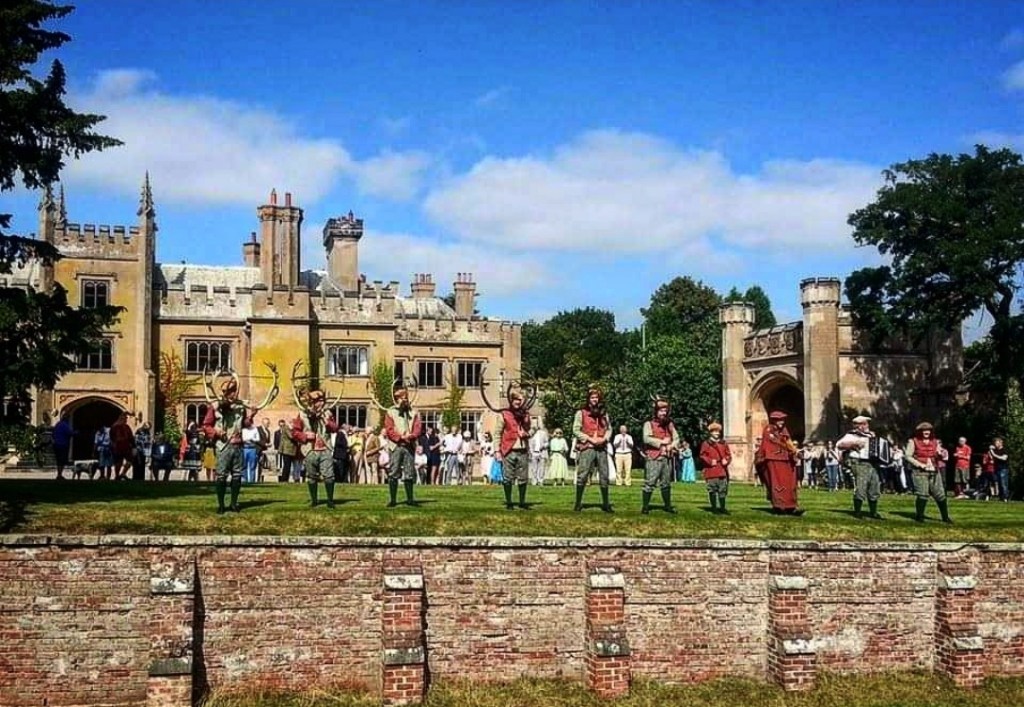
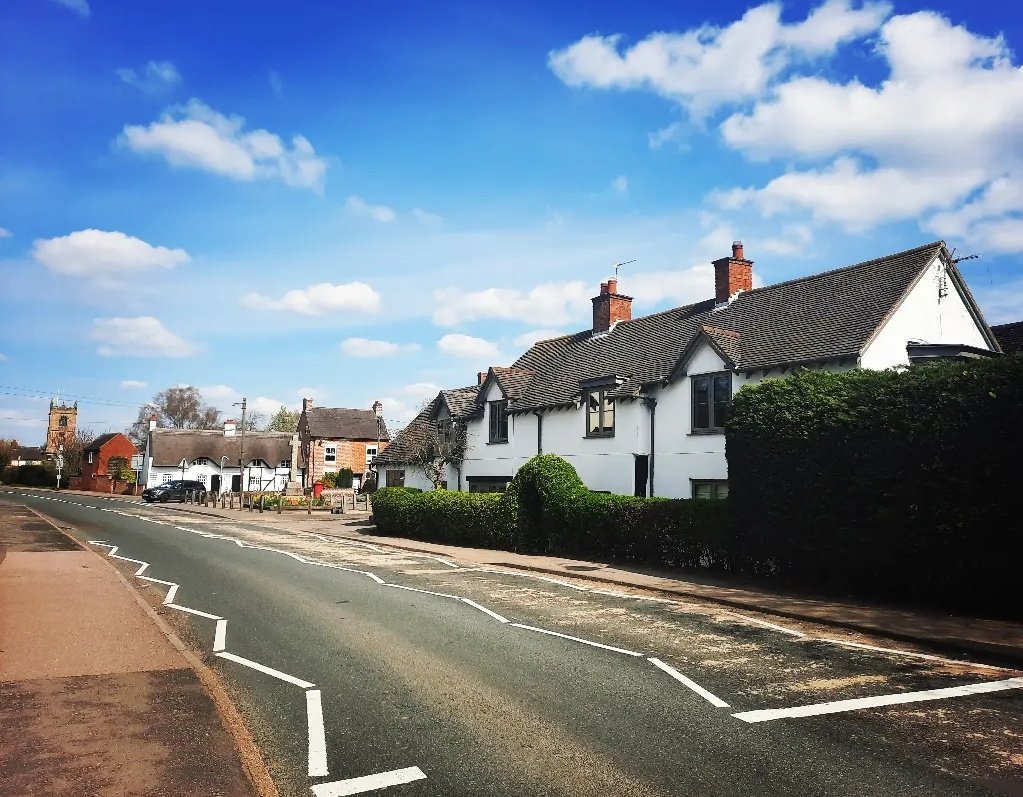
Abbots Bromley is of course famous for its horn dance which bring hoards of historians, pagans and morris dancers hey nonny nonnying into the village on the Monday following the first Sunday after 4th September. However, as I came to Staffordshire’s folk horror capital in search of Other Things, my latest visit took place on the first Monday after I broke up for my Easter holidays.

Hello again my deer

I’ve long been intrigued by the fact that though Mary, Queen of Scots spent many of her years of captivity in the county, the story of her time under lock and key in Staffordshire is surprisingly low key. I used to be a bit sniffy about popular history but nowadays I’m all for using it as a hook to get people interested in places. Hence why I went in search of the House on Hall Hill.  

Mary Stuart woz ere

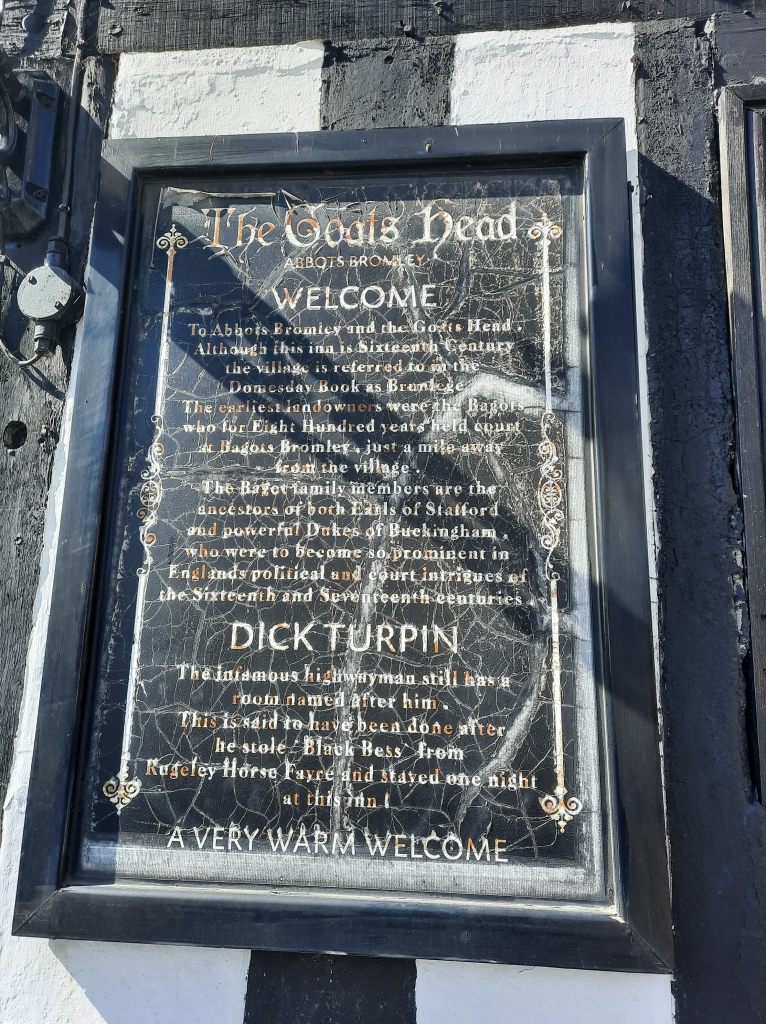
The tourism potential of having hosted one of history’s most famous prisoners in the village, however fleetingly, was clearly capitalised on lback in the early 20th century. Visitors were shown the room the Scottish Queen stayed in which was particularly impressive given that the current house on the site only dates back to the 18th century. This tourism tactic is also used at the Goat’s Head pub which has gone a step further and named a room in ‘honour’ of Dick Turpin staying there. It’s highwayman unlikely that he did but does it really matter if he didn’t? Are people looking for history or just a story? Pubs and other local businesses are struggling so much for survival right now, if Dick and Mary, a secret tunnel or a haunting help to keep them alive then I’m happy to perpetuate a few myths.  Besides, don’t we all deserve a little enchantment and escapism these days?

I got a warm welcome when I got told off by a man mowing his lawn who said it was too hot to be wearing my big coat. Reader, it was 9 degrees centigrade.

A word of warning however. Ghosts aren’t always good for business. In the 1950s, the landlady of the 18th century Royal Oak inn complained punters had been avoiding the place after rumours of a bearded ghost in a nightdress who played a musical box up the chimney spread like wildfire. It’s now an Indian infused restaurant which I’ve been told does fabulous food. I understand the signature dish is a Chicken Vinda-boo.

Is the ghost still up the chimney?

Back to Mary’s visit, as it seems actual evidence of the event may exist. A pane of glass taken from the Manor House and reportedly now in the William Salt Library in Stafford is inscribed with the words ‘‘Maria Regina Scotiae quondam transibat istam villam 21 Septembris 1585 usque Burton’. Local legend says Mary scratched it into the glass herself using a diamond ring. An article in the Staffordshire Sentinel from April 1900 sort of corroborates this by saying,

’ The villagers tell with a faint suspicion of envy how the present proprietor of the farm sold a stained-glass window for £300, upon which had been scratched the autograph of Queen Elizabeth (sic) and, in their estimation made a very good bargain with the old tapestry from the Manor’.

I don’t want to shatter any romantic notions about this souvenir glassware but I have got a faint suspicion that the present proprietor might have been weaving a yarn here. Although I’m taking its provenance with a pinch of William Salt I’d still love to see the glass at the library and when their catalogue is up and running again I’ll be having a look through it to see if the pane is still part of their collection.  

One thing I can say with certainty is that Kate Lichfieldiae hic erat 3 Aprilis 2023 and was as captivated as ever by this beautiful Staffordshire village and its stories.

This guide is great (and I am not just saying it so I don’t end up being sacrificed Wicker Man style on the next horn dance day)

Sources:

Staffordshire Past Track

A Historical Guide to Abbots Bromley – Abbots Bromley Parish Council

Staffordshire Sentinel 7 April 1900

Rugeley Times 11 Deceber 1954

Birmingham Daily Gazette 13 December 1954

Lichfield Law

I know the Winter Solstice has passed and the nights are drawing out but I’m still, ok always, in the mood for a dark tale. Here’s a short, but definitely not sweet story about Doctor Darwin and the Dissection of the Deserter.

On 23rd October 1762, a notice appeared in Aris’s Birmingham Gazette advertising that,

The Body of the Malefactor, who is order’d to be executed at Lichfield on Monday the 25th Instant will be afterwards convey’d to the House Of Dr DARWIN, who will begin a COURSE of ANATOMICAL LECTURES at Four o’Clock on Tuesday evening, and continue them every Day as long as the Body can be preserved; and shall be glad to be favour’d with the Company of any who profess Medicine or Surgery, or whom the Love of Science may induce.

This public announcement has been discussed in many accounts of Darwin’s life but, as far as I can see, none of them ever named the Malefactor in question. His identity was easy enough to deduce as there is an article in the same newspaper a month prior describing how, Thomas Williams, a Soldier in the King’s Regiment of Volunteers quartered at Lichfield, who ‘had deserted from thence was seized in that City by two men belonging to the Regiment but he ran into the Fields and the Men pursuing him, he turned and stabbed the Foremost one, William Sly, with a Knife so that he died soon after. He then made off but has since been taken and committed to Lichfield Gaol’. The Coroner’s Inquest brought in a verdict of Wilful Murder.

Public hangings were few and far between in Lichfield but drew a bigger crowd than a new batch of Prime arriving at Aldi when they did take place. In the twenty three years Darwin lived in the city, Thomas Williams was the only murder to be hanged at Gallows Wharf. This suggests to me that this course of anatomical lectures may have been a one-off, unless Darwin had a supply of criminal corpses from elsewhere? Somewhere like Birmingham, for example? Disclaimer: as a Brummie I am allowed to get away with saying this. Actually, there was only ever one public execution in the second city, and it’s an intriguing tale indeed. One for another time though.

In December 1978, the Derby Daily Telegraph reported how the ‘Lichfield Quarter Sessions Order Book, 1727 – 58’, had recently been acquired from a sale at Christie’s by the Lichfield Record Office. It was the earliest volume in a series covering the period up until 1923, the rest of which were already held in the archives. It’s likely that it too had once been part of the collection but seems to have somehow strayed into private hands at some point. Criminal eh?

Amongst the many misdemeanors reported amidst its pages is the case of Henry Murral, who was hanged at Lichfield on 12th May 1738 for murdering Edward Cheney with a pitchfork. Just under ten years later, on 9th April 1747, William Hiccock, a soldier belonging to the Regiment of Old Buffs met the same fate for the murder of Mr Pealing, a Labourer from Lichfield.

Although there are examples of murderers being buried beneath the gallows they’d hanged from, I suspect that the bodies of Murral and Hiccock now lie in St Michael’s churchyard as their crimes were committed prior to the Murder Act of 1751, which stipulated that, ‘in no case whatsoever shall the body of any murderer be suffered to be buried’ and should instead by publicly dissected or hanged in chains, their burial in consecrated ground would still have been permissible. In addition, parish registers from the 16th century record the burials of a number of criminals taking place here. Amongst them is an entry for February 17th October 1592, when William Key of Bliffield and Nicholas Hatherton of Lichfield, two prisoners, ‘condemnd according to the laws of the land and executed here at this Cittie were both buryed in one grave’. What they were condemnd for is not recorded. We also of course know that the men executed for forgery in the early 19th century were interred here. I am curious as to what happened to the body of Thomas Williams once it was past the point of preservation. Does he rest in pieces at St Michaels?

Clearly, Doctor Darwin obtained his offender officially. However, there were of course those who did not. There was supposedly an infamous body snatcher called Bannister who lived in the Lichfield area in the first part of the nineteenth century. In July 1851, a group of men were drinking brandy and water at The Angel Inn including fishmonger Abraham Phillips, Henry Cato, landlord of the nearby Three Crowns, a draper’s assistant called Thomas Smith and Mr Orgill, the landlord of the Angel. It was an ill-tempered affair with insults and accusations flying about. At one point, Cato turned to Phillips and told him he’d never had much opinion of him since he’d been in partnership with old Bannister before asking him how many years it had been since his cart broke down from the weight of carrying the dead body of a solicitor named Robinson out of Ridware churchyard. Another man, Mr Emery joined in to say he thought it a bit fishy to suggest Phillip’s cart ever had the body in it, as Phillips had weighed twenty-two stone. Cato, however was adamant. “I can swear it and will prove it”, he declared although given that he ended up in court paying a farthing to Phillips for slander it seems he probably didn’t.

Can we prove it though? Was there any truth to this bodysnatching banter and is there hard evidence to suggest that bodies were taken from graveyards in the Lichfield area? Time to do some more digging…

Update:

In January 1829, two men stood before a judge and jury at the Lichfield quarter sessions accused of body snatching. The previous month, witnesses had seen them carrying a hamper from St Michael’s churchyard to the Swan Inn.

When John Coxon, church warden at St Michael’s and John Charles, a police officer, arrived at The Swan they opened the hamper and found it contained the body of a man who had been interred the previous Tuesday. The hamper was addressed to a man called Johnson of Tooley Street, Southwark, London, the men intending for their corporeal cargo to be delivered to him via coach.

Two pairs of muddy trousers were found at one of the men’s lodgings opposite the churchyard on Greenhill, where evidence of three more disturbed graves was discovered. Two had been broken open but the bodies left behind as their advanced state of decomposition meant they were not fit subjects for surgical operations. There were also rumours in the city that a child body had been stolen from St Chad’s the week before.

William Simpson and James King were both sentenced to 9 months in prison. Whether Mr Johnson of London was punished for his part in these ghastly goings on I do not know. It seems unlikely as he covered his tracks well. The address in Southwark appears to have been an old inn known as the Kings Head, where no doubt anonymous collection would have been arranged for a small fee, no questions asked.

Sources:

Aris’s Birmingham Gazette 27th September 1762

http://www.capitalpunishmentuk.org/lichfield.html

Rev Thomas Harwood (1806), The History and Antiquities of the Church and City of Lichfield

Wolverhampton Chronicle and Staffordshire Advertiser 19th March 1851

Staffordshire Advertiser 15th March 1851

Birmingham Journal 29th November 1828

Memento Mori

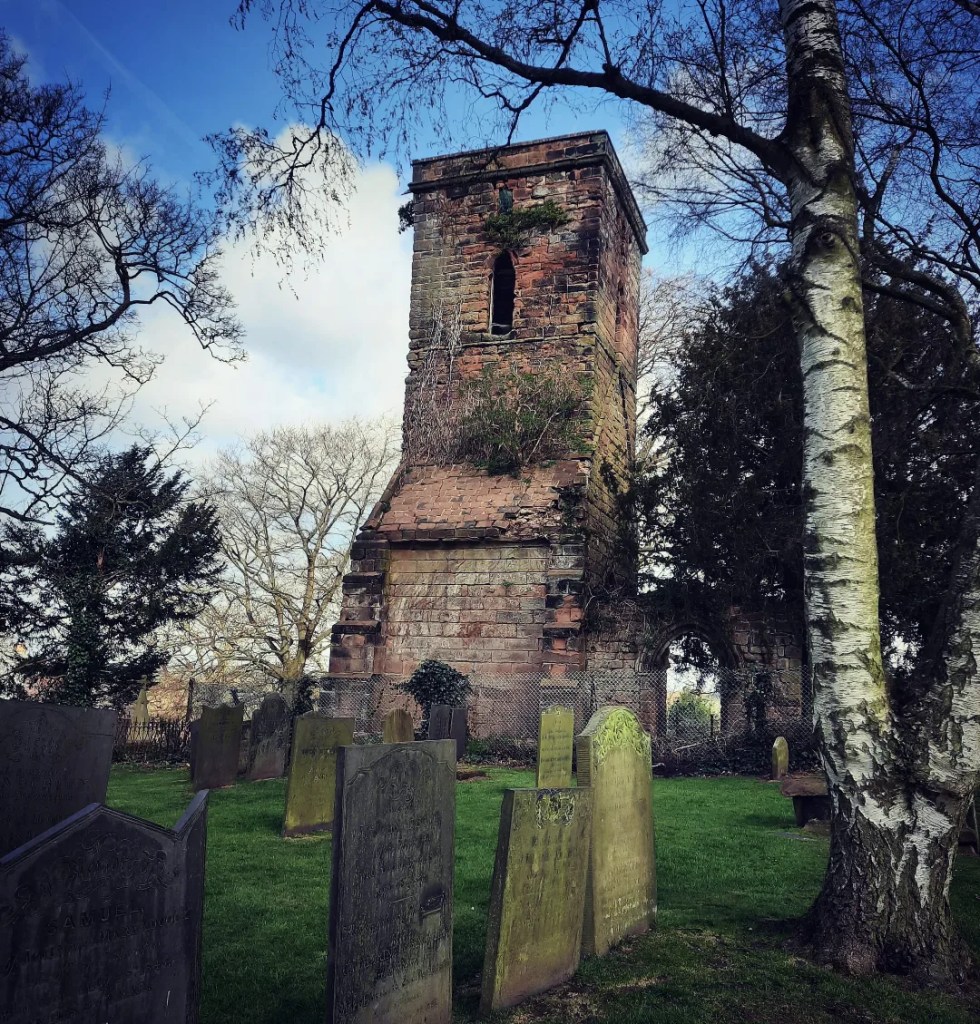
Many people are familiar with the story of John Neve, William Weightman and James Jackson, the last men to be hanged in Lichfield on 1 June 1810, for the crime of forgery. Their shared headstone can be seen tucked away under the tower at St Michael’s, although they are buried elsewhere in the churchyard in a now unmarked a communal grave. One particularly poignant postscript to these events is that after his execution, the friends of John Neve commissioned three mourning rings to be made, each with an inscription to his memory and containing a lock of his hair. I wonder whether it was these same friends who erected a headstone as to my knowledge there are no memorials to any of the other executed criminals buried here?

Amongst them is another tragic trio, Thomas Nailor, Ralph Greenfield and William Chetland who met the same end for the same crime at the same place on 13th April 1801. Prior to their execution, two of the men had attempted to escape from Lichfield gaol by filing through their irons and putting them back together with shoe maker’s wax. Their cunning plan had been to knock down the gaoler when he came to lock them up for the night and they would have gotten away with it had it not been for pesky Joseph Vaughton, a private in the 38th regiment of foot, to whom Nailor had given a pattern of the wrench he wanted making and a Bailiff called Mr Scott who discovered the file they had been using. Headstone they may not have but incredibly a tangible link to this execution does apparently exist. In 1947, the Town Clerk of Lichfield received a letter from a Mr Clayton W McCall of Canada to say a morbid memento had turned up in an antique shop in Vancouver in the form of a silver salver, ‘Presented by the Corporation of the City of Lichfield to Revd. Bapt. Jno. Proby, Vicar of St Mary’s, for his pious attention to three unhappy convicts who were executed in that City April 13th 1801’. However, as with the rings, its current location is unknown.

One very unhappy convict sentenced to be hanged at the gallows on 6th September 1782 was 62 year old William Davis who had been convicted of horse theft. The Derby Mercury, reported that in his final moments, David’s behaviour was bold, paying little attention to anything that was said to him. Then, just as the executioner was about to send him eternity, Davis threw himself from the cart with such force, that the rope snapped. After much confusion and delay, the rope was replaced and Davis’s last earthly words are recorded as having been, ‘This is murder indeed!’.

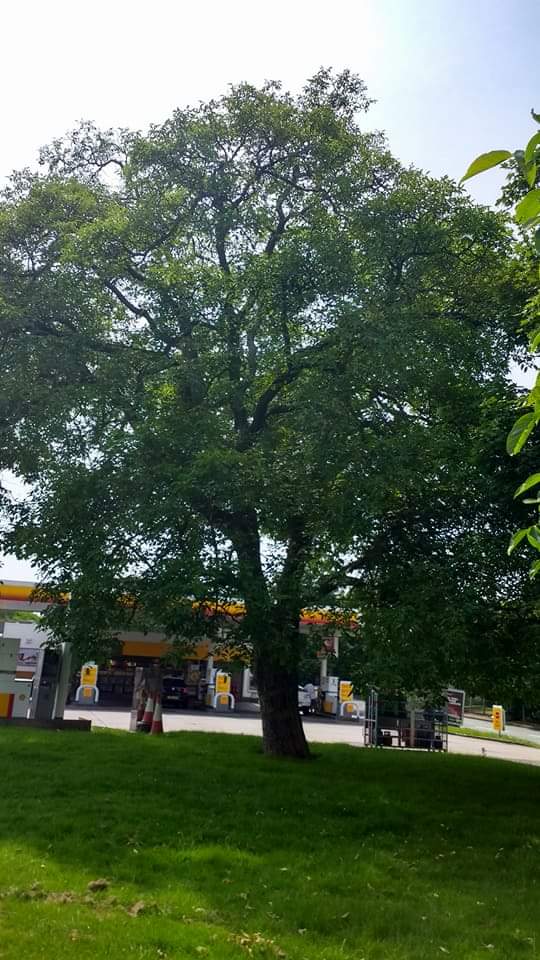
In 1935, the site of the old gallows was described as being ‘preserved and indicated to passers-by with an inscription recording its ghastly use in bygone days’. The area has developed significantly since then, but I was told by Janice Greaves, former Mayor and current Sheriff of Lichfield, that the exact spot where the gallows stood is now marked by a walnut tree growing on the patch of grass alongside the garage. There has been some discussion about what form the gallows actually took, but there is evidence to suggest that there was a permanent structure to which the cart carrying the condemned convicts would be brought. In Aris’s Birmingham Gazette it describes how ‘On Friday Night last, Richard Dyott Esq, who lives near Lichfield was going home from thence, he was stopp’d near the Gallows by two Footpads, who robb’d him of five Guineas, and in the Scuffle he lost his hat’.

My plea to you this Halloween is to keep your eyes on Ebay for Neve’s mourning rings and the silver salver. If however you decide to take a wander over to Gallows Wharf in search of Richard Dyott’s hat, please be warned that an ex-executioner from centuries past appears to have been sentenced to linger at the spot and you may well feel a push from behind as he attempts to dispatch you to your doom.  

Sources

Evening Dispatch 31st March 1935

Aris’s Birmingham Gazette 3rd February 1752

Strange Things

At the turn of the century, the infamous Montague Summers attended Lichfield Theological College. He went on to publish the first English translation of the 15th century witch-hunting manual, the Malleus Maleficarum (“The Hammer of Witches”) along with books on vampires and werewolves. There was a rumour that he had actually seen the devil (we can only assume this was not in Lichfield) and when asked if Old Nick had a goat’s head, horns and a forked tail, he supposedly replied, ‘No tail, my dear’. On his gravestone is the epitaph ‘Tell me strange things’. Ok then Monty, you’re on…

I know I can hardly claim to be compiling a Halloween special given that I am always writing about weird things, but I am hoping to share a small selection of strange things from Staffordshire in the run up to Goth Christmas. And where better to begin our journey across the veil here than here in the bloody city of Lichfield?

Langton House

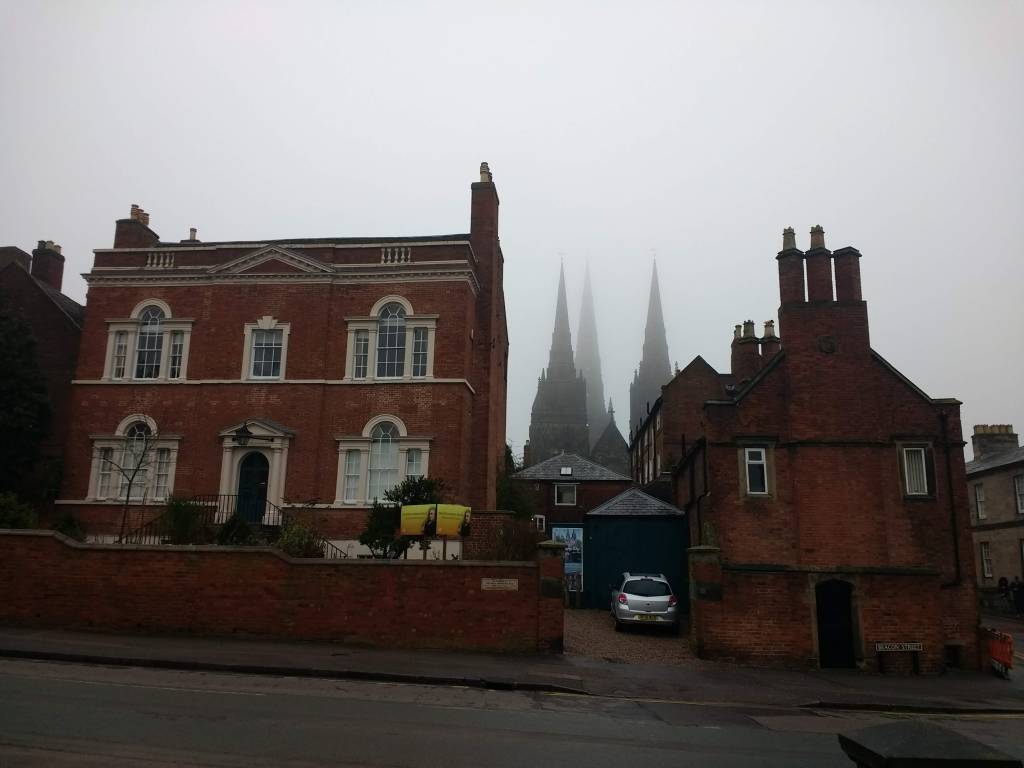
In the 1960s, a group of students from Lichfield Theological College found themselves experiencing a Nightmare on Bird Street when staying in Langton House. The Georgian property was named after a 14th century Bishop of Lichfield, but it was the 20th century Bishop of Stafford who performed a service of exorcism there in August 1964 in an attempt to silence the disembodied screams which had been heard inside the hostel since the trainee vicars had taken up residence two years prior.

The Lichfield Mercury reported that in a bid to bring peace to the premises, the Bishop had gathered the residents of the house and performed a service lasting half an hour, in which the Lords Prayer, and others, were said with holy water sprinkled over every room, door and window. From that day on, the only screams to be heard at Langton House have come from outside the building as the younglings make their way home after a night out in ye olde city. Prior to it being purchased by the Theological College, Langton House had been the home of Colonel Boscawen Savage, founder of the Staffordshire Regiment Museum, until his tragic death on 11th June 1958. The house was sold in November 1972 after the closure of the college and has been used as offices ever since.

The Theological College itself occupied the site of the ‘New College’ in The Close, which confusingly was actually very old having been built in the early 13th century. It was originally the residence of the chantry priests of the cathedral but in the 17th century it was divided into private residences. In Lomax’s history of Lichfield, he writes, “The houses in the adjoining court, called the New College, were given by Bishop Burghilll for the residence of the chantry Priests who officiated in the cathedral, previous to which they appear to have formed part of a regular religious foundation. Many human bones have been dug up and about 1728, the skeleton of a female which was placed upright in a stone wall…upon the skull was a silver bodkin, round which the hair had been twisted, and on recently removing other old foundations adjoining, one was found in a similar position, amongst numbers of bones scattered in all directions’.

Only the Theological College’s Victorian chapel, now known as College Hall, remains today although archaeological digs on the site in 1976/77 revealed the medieval vaults of its predecessor survive below ground. Other finds included pottery and tools dating back to Neolithic times, as well as evidence for a timber framed building on the banks of Minster Pool in the 13th century which the HER suggests may have been the college’s lavatorium. The discovery of three Christian burials dating to the late Saxon period suggest to me that the majority of the bones unearthed in the 17th century may also have been the remains of those who worshipped at the wooden church housing the remains of Saint Chad, before the Norman invasion brought with it a new cathedral of stone.

However, despite my own digging, I have as yet been unable to come up with a satisfactory explanation for how or why the remains of two women came to be bricked-up in a medieval wall . A strange thing indeed…

Sources

Miller, D (2014), Witches and Witchcraft

The Archaeological Journal, Vol 2

Lichfield Mercury Friday 5th August 1977

Heritage Gateway – Results

Stone Dead

I think this is the first time I’ve written a blog post whilst drinking a beer of the same name. We’ll know how successful this is as writing technique by the final paragraph. Anyway, now my Mum and Dad no longer live in Stone, it’s the church and brewery that are my two favourite things about the place.

20220726_131849

St Michael and St Wulfad’s church was rebuilt in 1758 on the site of a twelfth century priory church which had pretty much collapsed into a pile of stones after the funeral of Elizabeth Unitt, bringing it full circle as legend has it that the church here started out as a pile of stones. The story of Queen Ermenilda erecting cairns over the bodies of her sons, slain by their pagan father Wulfhere after they rebelled Saxon style and converted to Christianity, also gave the town its name.  A church was later built over the graves, replaced in 1135AD by the aforementioned Augustinian Priory. 

IMG_20220725_191115_618

The church registers reveal that the arch and pillars fell on at 12.45am on 31st December 1749, leaving the steeple unsafe. It was removed and the bells taken into storage, except for one which was hung in a tree, causing a ‘witty’ traveller to comment, ‘Poor Stone, paltry people; Got a church without a steeple; The further I travel the more wonders I see; There’s a church with no steeple, it’s a bell in a tree!’. 

The new church wasn’t rebuilt on the exact footprint of the former building and I’ve always felt a bit sorry for this couple, left outside to the mercy of the Staffordshire elements after having previously been safely ensconced in the chancel of the medieval church. Interestingly, the dad of the weather-worn William Compton, who lies here with his wife Jane Aston, was the person who purchased the priory at the Reformation. Prior to this there had been a petition sent to the Lord Protector complaining that a William Compton, ‘hath lately attempted to pluck down the said church and hath uncovered a large part thereof and conveyed away the lead for his own purposes’. I can’t help but feel that his stone-cold son and his wife are now paying for the price for his father’s greed. Vengeance is mine, and all that. 

20220725_143622

Elsewhere in the churchyard is the Jervis family mausoleum. When Ludovic Kennedy arrived here as part of his research into Admiral John Jervis aka Earl St Vincent, he was disappointed to discover that he was unable to gain access. The church has a press clipping of Ludo stood at the door, not quite an angry person in a local newspaper but certainly a disappointed one. It was nothing personal. No-one had entered the vault since the internment of Mary Ann Jervis, by then known as Lady Forster, took place in March 1893 and the locks had rusted and jammed.  It wasn’t until several years later that a brave soul volunteered to climb in through the small round window at the back and opened the door from the inside. In the Staffordshire Advertiser’s report into the funeral of Lady Forster it describes how the, ‘the interior of the mausoleum was adorned with white blossoms upon a dark background of evergreens’. The person who climbed through the window reported that these floral tributes were still in place but crumbled to dust as the fresh air entered the vault for the first time in decades. 

Screenshot_20220725-144623_Instagram

Unlike Ludo, my good friend Jacky and I have been able to access the mausoleum. Twice. Also unlike Ludo, I had no particular interest in this famous son of Stone who ran away to sea from the family home at Meaford Hall and went on to be a key figure in the British navy. I just happened to be standing there when someone said, ‘Does anyone want to look inside the mausoleum?’. Twice.  I think I’m right in saying that Kennedy’s research into Jervis was for his 1975 book ‘Nelson and his Captains‘, but I confess that naval history is not really something which floats my boat.

I am much more drawn to the local legends surrounding the mausoleum and its macabre contents. Hence why my blog is called ‘Lichfield Lore’ and not ‘Lichfield Naval History’.  There are rumours that one of the servants from Meaford Hall was buried beneath the threshold of the vault, possibly to continue to serve the Jervises in the afterlife or perhaps to help guard the treasure said to have been stashed in one of the coffins inside. I was hoping that this mythical hoard of riches may have included the silver-gilt coronet presented to Mary Anne Jervis by the Iron Duke in 1838. Wellington’s nickname for her was the ‘Syren’, which is rather fitting for a beautiful young woman from a famous sea-faring family who he had a deep friendship with. However, in 2018 it turned up at Sotheby’s, albeit mysteriously caked in dirt.

mary-ann-jervis

Mary Ann Jervis. My, my.

Despite the rumours surrounding them, Wellington turned out not to be Mary Anne’s Waterloo and she instead married David Ochterlony Dyce Sombre, MP for Sudbury between July 1841 and April 1842, when he was removed for bribery. A short tenure indeed, but still longer than any Chancellor of the Exchequer has lasted in 2022.  To say the marriage was troubled is an understatement and it ended with Dyce Sombre accusing Mary Anne of infidelity with several men, her own father included, before being certified insane and, showing he could escape if he wanted to, fleeing to France. He spent the rest of his life trying to prove his sanity and reclaim the fortune that his estranged wife had taken control of, before returning to Britain and dying of a septic foot in 1851. The whereabouts of his body is unknown but I think we can safely say it is not inside the Jervis Family Mausoleum. His lost fortune however…


Sources:

Uttoxeter Newsletter 4th October 1991

Belle Tower

Around a year ago, restoration of the old church tower at Shenstone started, thanks to the fundraising efforts of a friends group founded in 2019. I recently visited for the first time since the work commenced and what a glow up there’s been.

It’s a 10 but it needs some TLC…
The old tower in April 2021
Ding dong!
The old tower August 2022

One of the highpoints of the project, literally, is the installation of a staircase which will enable visitors to climb to the top of the tower and enjoy the scenery of Staffordshire and other less illustrious counties. Joking apart, it will be interesting to see just how far can be seen from the rooftop. On my visit I was lucky enough to have a sneak peek inside to see the new staircase. I say new, there was never actually an old staircase, instead the brave bell-ringers had to climb the rungs of a ladder to access the bell ropes. An alternative albeit accidental way to ascend the tower was via one of said bell ropes. The Derby Mercury reported on some high-jinks which occurred in July 1790 when Mr Brown, a Lichfield miller was amusing himself with the ringers at Shenstone Church and, ‘was overpowered by the great bell and carried up with great velocity by the rope to the ceiling of the Belfry, from whence he fell down on the floor upwards of thirty feet. He was taken up very much bruised and quite insensible, put into a bed and carried home in a cart but fortunately having the immediate aid of a surgeon there is a prospect he may recover, although it cannot at present be discovered whether or not he has any broken limb’. On another bell related note, I heard from a resident of Shenstone that raising money for the restoration work included selling off pieces of the old wooden bell frame from the tower. I love the idea but if I find out that they didn’t refer to it as a fundraising ap-peal then I’m going to be disappointed.

Stairway to heaven

It’s referred to as ‘the Old Church Tower’ but just how old is it exactly? Evidence from excavations in the 1970s showed that the 13th century tower of the church of St John the Baptist had been built on Saxon foundations but, as I’ve said before, I suspect this site may have been sacred long before St Chad introduced Christianity to Mercia. A short distance from the church is a holy well, also dedicated to St John. Hope’s Legendary Lore of the Holy Wells of England tells us, ‘At Shenstone, near Lichfield, a little distance from the church, was a well called ” St. John’s Well,” after the saint in whose honour the parish church is dedicated. It was looked upon as sacred from the miracles or cures wrought by its waters on St. John the Baptist’s day, June 24. For this reason was a sanctity placed upon it by the faithful, who brought alms and offerings, and made their vows at it.’

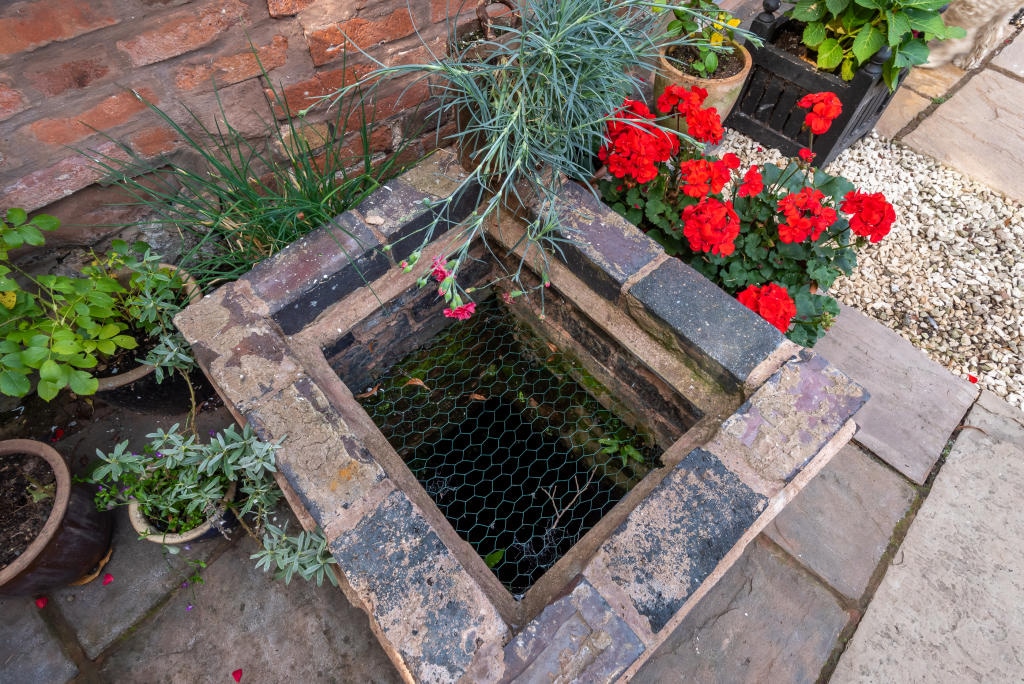
We know there was some continuity between pagan sites and Christian ones and that a well thought to have healing powers would have been spiritually significant for followers of the old gods and the new one but I’m not going to dive into that subject anymore deeply here. Whatever the origins of the well, it’s wonderful to see it still survives in the garden of Ivy House, a 17th century property on the village’s Main Street. And I do literally mean see! The house is up for sale and there’s a photo of it included in the particulars.

(c) Knight Frank

Within the estate agent’s description, there is also a reference to a priest’s hole, which is even included on the floorplan and perhaps more tenuously, an underground tunnel. Obviously there is no photo of that but intriguingly I have come across an article in the Rugeley Times from 1939 which paints an interesting picture in relation to this subterranean selling point. It describes how three years prior, workmen repairing the pathway by the old tower ruins came across the entrance to what they believed to be a tunnel leading under the steep slope towards the old tower. There had been a tradition locally that there was a ready made shelter for Shenstonians beneath the church hill should the village ever require it and the workmen’s discovery did nothing to dampen these rumours. It’s also referenced in, ‘The Annals of Shenstone’, by the Rev Essington, vicar between 1848 and 1895, who said, ‘It was said there had been an underground passage between the house (the vicarage) and the tower, and the ex-vicar regrets he never tried to trace it’. Obviously, as it seems is so often the case, the vicar at the time the apparent tunnel was discovered instructed it to be filled in. Wait, there have been rumours circulating for centuries about some kind of mysterious underground feature in your churchyard and you have the opportunity to bring the truth to light but instead choose to keep it buried? Seems to me there’s something about this story that does not ring true…

Sources:

Derby Mercury, 29th July 1790

Lichfield Mercury, 31st October 1947

The Legendary Lore of the Holy Wells of England, R C Hope (1893)

Rugeley Times, 4th March 1939

Grave Digging

I recently visited the Staffordshire village of Colwich. It’s a lovely place but as is my wont, the outcome of the outing is a tale of murder and mystery.

We start our story in May 1977, when a member of the congregation of St Michael’s and All Angels took a walk through the churchyard and almost disappeared into an unmarked vault. The vicar at the time was the daring David Woodhouse who decided to descend into the dark depths to discover what, or who, was down there. Inside the vault, he found two skeletons and whilst there is nothing unusual about bones beneath a graveyard per se, there was something not quite rite about these burials. Skeleton One lay in a coffin and Rev Woodhouse mentions two odd things about it. Firstly, a small hole in the skull and secondly, the finger bones were disarticulated suggesting that this may have been a victim of both murder and grave robbery. The strangeness doesn’t stop there though as the remains of Skeleton Two are described as surrounding the coffin containing the first. One of the keywords for me here is ‘remains’, suggesting to me that this corpse may not have been complete when it was interred here.

The vicar’s theory was the vault was built for a wealthy family who fell on hard times and were then unable to afford a memorial to the two individuals resting in peace (or more aptly in one case, pieces) within it. Everyone seemed satisfied with this explanation, the hole was bricked up and, as far as I am aware, no-one has ever thought anymore about it until I read about the mysterious vault and started doing a bit of digging that is…

Back now to 18th July 1773 and a woodland just outside of Stone, Staffordshire where John Challenor and his son, also John, are working together. The two men have just eaten lunch when an argument flares up and John Jnr throws the iron cooking pot at John Snr’s head. It’s thrown with such force that once of the metal legs pierces the older man’s skull. He dies three days later and his son is sent to gaol for parricide. On 23rd August 1773 John Challenor Jnr is executed and his body taken down and hanged in chains at a spot near to the scene of his crime.

I don’t think you need to be DCI Barnaby to work out the links between this high-summer murder and the skeletons below ground at Colwich. The hole in the skull of Skeleton One clearly corresponds with the fatal injury sustained by John Challenor Snr. What’s more, the lack of a coffin together with the seemingly jumbled and incomplete nature of Skeleton Two is in keeping with a body that’s been gibbeted and later cut down and hastily buried, although not seemingly not quickly enough to prevent time, the weather or macabre souvenir hunters from starting to take their their toll. Perhaps it was the Challenors, who not only had a very literal reminder of the skeletons in their family closet displayed for all to see at a spot near Stone, but who may also have been concerned that without a Christian burial of sorts, their relative would not be resurrected to heaven but condemned to eternal damnation. Was it enough to save John Challenor’s soul though?

Thanks to information provided by Fulford Parish Council I believe I have located the place where his body was hung in chains. On their website they say ‘On the left of Hilderstone Road when travelling towards the ‘Wheatsheaf’, and just a short distance from Spot Acre cross roads, is a stand of Beech trees known locally as ‘The Rookery’. According to local lore the gibbets used to stand here, hence the overgrown lane which runs down past Idlerocks to Moddershall being called Gibbets Lane’.

Now, as regular readers of the blog will know, I love ghost stories but if you Scooby Don’t, then stop reading now as the next part of this story requires a little belief in such matters. You see, Stone lore also tells of a boggart which haunts these parts. And what on earth is a boggart I hear the non-northerners amongst you ask? Well, you know us Lichfield people love a dictionary and so I’ve looked it up in the OED and found the following definition: “A spectre, goblin, or bogy; in dialectal use, esp. a local goblin or sprite supposed to ‘haunt’ a particular gloomy spot, or scene of violence”.

Could the the boggart be the unquiet spirit of John Challenor? I mean it doesn’t get much more gloomy than having your corpse displayed on a gibbet does it? If the naysayers are still with us at this point I’m sure they’re saying, well, nay way but I’m tempted to head over there to see if I can find any more answers. In 1933, a Mr P C Dutton of Stone told members of the North Staffordshire Field Club that the boggart took the form of a dog or a calf and so this may involve me quizzing the local cows and canines to see if they’re the spectral incarnation of an 18th century murderer. More Doctor Doolally than Doolittle I know.

On a slightly more serious note, I am increasingly keen to not only share the stories which give us a sense of place but to bring something along to the party as well. I hope my version of events has given people some food for thought but as we know from the iconic Marmite, when it comes to a Staffordshire legend there is always a risk that some people might hate it 🙂

Sources:

Aris’s Birmingham Gazette – Monday 23 August 1773

Rugeley Times 21st May 1977

Staffordshire Sentinel – Friday 19 May 1933

http://www.fulfordvillage.com/resources/History/Fulford%20Parish%20-%20Spot%20Acre.pdf

https://www.exclassics.com/newgate/ng947.htm

The Pub with Two Names

An intriguing message about a strange experience at the Wolseley Arms inn received late one night inevitably led to me doing some research into the place. According to the Rugeley Times, the pub has fifteenth century origins and originated as a hunting lodge on the Wolseley estate before being transformed into a coaching inn as passing trade on the Liverpool to London Road demanded. Much to Sir Charles Wolseley’s disgust, this trade included the ‘Convict Van’ which stopped at the inn in June 1834 to change horses. It was the governor’s decision to give the 18 men on board their dinner which particularly incensed the local lord and resulted in a heated letter penned to ‘Mr Corbett, the Member for Oldham’ being published in the Staffordshire Advertiser. Clearly this was the way for local politicians to embarrass themselves and their constituents prior to Twitter being invented.

Turn right at the Roebuck

According to Wolseley’s correspondence, the coachload of convicts each received, ‘an enormous piece of the WHITEST bread, as large a lump of COLD BOILED BEEF’ as he ever saw. He then continues, ‘Well! but this was not all – for there was handed to each of THE GENTLEMEN half a pint of Mr Moxon’s best ALE!. While these CONVICT GENTLEMEN are REGALED with COLD BOILED BEEF and STAFFORDSHIRE ALE, the POOR or IRELAND are absolutely STARVING!’. By the way, the capitalisation and exclamation marks are all Sir Wolseley’s! Except that one. That’s mine.

By 1952, the Wolseley Arms was still lit by paraffin lamps and, according to the article in the Staffordshire Advertiser on 28th March of that year, it was probably one of the last in the country to be so. The article also explains how the inn was originally known as the Wolseley Arms, then changed to The Roebuck Inn and then changed back again around 1945. Confusingly, the original Roebuck Inn was what is now Wolseley Bridge Farm. In 1963, the Rugeley Times described the Wolseley Arms/Roebuck Inn as one of the few pubs in the country to be known by two names, with two signs to reflect this. However by 1973, only the Wolseley Arms sign remained, no doubt creating confusion for travellers who had been given instructions such as ‘Turn right at the ‘Buck’ by rapscallions from Rugeley.

Apparently, the original name change to The Roebuck came about as the inn became known as a place of ill repute and Sir Edward, the baronet at the time, didn’t want the family name besmirched. Ironically, the family had themselves been at the centre of an eighteenth century Staffordshire scandal when claims were made about the validity of the marriage between Sir William Wolseley and Ann ‘The Widow of the Wood’ Whitby, who may or may not have also been married to the MP for Stafford at the time. Full details of the ‘intimacy and alleged marriage’ between Whitby and Wolseley can be found in a 1755 book, which survived the Wolseley family’s best efforts to buy and burn as many copies as they could. I wonder if it’s available in our new Waterstones? Feels like there needs to be a Netflix series called ‘Wolseley Bridgerton’.

Colwich Church where the alleged marriage took place, allegedly at midnight on 23rd September 1752
The bridge and the inn are supposedly haunted by a ‘Quaker looking man’. A pub seems an odd place for a Puritan to hang out in for eternity but who am to question how someone spends their afterlife?

Supposedly the Wolseley estate had been given to the family by King Edgar as a reward for ridding the area of wolves. To celebrate, the Wolseleys adopted a family motto, ‘Homo Homini Lupus’ or ‘Man is a wolf towards his fellow man’, as the Royalist Sir Robert found out when said estate was confiscated after the Civil War. Ah, how the family fortunes of our local nobility ebb and flow like a spring time river. On the subject of rivers, the Wolseley Arms sits on one of the banks of the mighty Trent. Tradition describes it as a greedy river claiming three lives a year but whether this is a warning or a demand I do not know. Perhaps this is why in medieval time a wayfarers’ chapel was built on the crossing but it seems it was no match for the old water gods, and it was eventually swept away with the rest of the structure in 1795. Traces of the former bridge were discovered in July 1962 when engineers lowered the level of the river by 18 inches as part of a realignment project. Old blocks of sandstone were discovered along with the bases of the piers the lost bridge’s arches were built upon. The largest of these was found beneath the central arch giving rise to the theory that this is where the chapel would have stood. You can see photos of the discoveries here.

The Wolseley Arms was enlarged in April 1973 and given a new ye olde makeover with a medieval theme including swords, spears, balls and chains, suits of armour and other military ironmongery, plus a portcullis. Frankly I’m suprised they didn’t go all in and rename the pub (again) as The Drawbridge. It was renovated again in July 1982 when it was officially opened by Patrick Anson, the 5th Earl of Lichfield. The Queen’s cousin is not the only famous punter to have a pint here. NHS hero Nye Bevan popped in for a drink, as did Winifred Atwell the Trinidadian pianist who was the first black person to have a number one hit in the UK singles chart. I sincerely hope they didn’t have to buy their own STAFFORDSHIRE ALE.

References:
Staffordshire Advertiser 28 March 1952

Rugeley Times 16 August 1958

Rugeley Times 28th April 1973

Staffordshire Newsletter 16 July 1982

Rugeley Times 7 August 1954

Rugeley Times Saturday 20 April 1963

Rugeley Times 7 July 1962

The Hanging Tree


Outside Hanch Hall is an ancient chestnut tree on a godcake. That’s what our Warwickshire neigbours call a grassy triangle at a road junction because of its resemblance to a sweet pastry filled with some sort of preserve. Gives a whole new meaning to the phrase traffic jam. Anyroads, this tree has intrigued me for years, it clearly of being of some age and significance. Records and maps reveal that the tree marks the parish boundary between Kings Bromley and Longdon.

In 1887, the Walsall historian Duignan estimated its age as three hundred years old and in 1894, the tradition of beating the bounds of the former was resurrected. After lunch underneath the spreading chestnut tree, where I’d like to think Staffordshire oatcakes were eaten on the godcake, a number of small boys in the party were instructed to climb up and were passed between its boughs. I’ve found an even earlier record of the tradition in the Staffordshire Advertiser in May 1838, detailing a perambulation of the boundaries of the manor of Longdon, which began at the Chestnut Tree and I’m sure it dates back centuries further still.

Local folklore tells the tale of a Victorian postman called Mr Lyons who had to pass the tree on his way to deliver mail to the village of King Bromley. On several occasions he reported seeing the ghost of a dog, pacing around the trunk. Faced with disbelief, he invited sceptics to go and see the pawprints of the giant hound for themselves. Local historian J W Jackson, who always claimed he didn’t believe in ghosts but was always ready to fire up his mystery machine regardless, went to investigate and found freshly trodden tracks around the trunk, although inconclusively concluded that, ‘What had made it, we couldn’t say’. I am sure that there is no connection between these events and the notice of a one pound reward in the Staffordshire Advertiser in October 1837 for anyone giving information to the shepherd at Hanch Hall leading to the recovery of a ‘rough, grizzled sheep dog (Bob)’.

Since posting the story about the mailman and his encounter with the demon dog on the godcake, several people have contacted me to say they’ve heard that the chestnut was a ‘Hanging Tree’, used to execute criminals. One even claimed that bones had been found in an adjacent field. Perhaps that’s what Bob the non-ghost dog had sniffed out?

Clearly a belief in this tree being a place of execution has grown from somewhere, but as yet I’ve not discovered anything to corroborate this. I do however know for that it’s not the only big, old tree at a junction to be labelled a ‘hanging tree’. Outside the now demolished Baswich House at Weeping Cross on the outskirts of Stafford, a tree also known by that grim epithet was believed to have been planted in 1832 to replace a gallows which once stood on the spot. When it was struck by lightning in 1975, the borough council decided to sell off chunks of its trunk for a quid a piece. Who says money doesn’t grow on trees?

Sources

Lichfield Mercury 25 November 1938

Burton Chronicle 18 October 1894

Walsall Observer, and South Staffordshire Chronicle – Saturday 30 July 1887

Staffordshire Newsletter August 8 1975

Bad Habits

It is time to say hello once again to Farewell. A little recap for those of you who did not binge read my blog during lockdown because there was, frankly, not much else to do. Farewell is named after a spring, which still flows near to the church. This ‘fair well’, if you will, would clearly have been the reason why the site was originally established as a hermitage by Bishop Roger de Clinton in the twelfth century. By 1140 it had been transferred to a community of nuns, and became a Benedictine Priory.

Women of God they may have been but there are suggestions they may not have been quite so pure as the spring water which gave the place its name. Two canonical visitations in the 14th century found that nuns would sometimes take a leisurely stroll down to Lichfield without the permission of the Prioress. Less nuns on the run, more nuns on the way to do a bit of shopping. Yes, I am showing my age with that reference. In fact, so bad were the nuns’ habits that the back door of the nunnery had to be kept locked as a result of ‘several scandals’ which I wouldn’t even like to speculate about. If you would like to, then you don’t have to Google too far afield to find similar stories. However, while we may laugh about naughty nuns and get all Carry on Convent about it, it is fascinating to think of this community of land-owning sisters doing it for themselves on the outskirts of Lichfield in the Middle Ages. I’m not claiming it was paradise but arguably there were worse options for medieval women than getting thee to an nunnery?

Of course, the Priory did not survive horrible Henry’s reformation and in 1527 the remaining nuns said farewell to Farewell and their lands were given to Lichfield Cathedral. We know the last prioress, Elizabeth Kylshaw, was transferred to the aptly named Nuneaton but her presence may still be in evidence here with a possible carving of her initials on an oak seat in the sanctuary. It seems that the church was then largely abandoned until the 17th century by when the Priory buildings had most likely been pilfered by locals for its stone, some of which you can see reused in local walls and houses in the lanes between Lichfield and Burntwood. The Church of St Mary was rebuilt in the 18th century and re-dedicated to St Bartholomew. During the restoration, a number of earthenware vessels were discovered built into the church’s south wall. Each lay on their side, their openings facing the church and covered with a thin layer of plaster. Their exact purpose is unknown but they may have been ‘acoustic jars’, used to improve the building’s resonance. I have heard of them being found elsewhere but, to the best of my knowledge, they are the only examples of this practice in Staffordshire.

All that survives of the Priory today, visibly at least, is the stone chancel of the chapel. In 1993, when installing a new toilet at the church, the remains of the other priory buildings were discovered. Unfortunately, the article in the Sandwell Evening Mail does not specify where but does include a brilliant quote from one of the archaeologists who said the discovery did not mean an end to hopes for a new toilet. Priory priorities eh? As such, I’m still trying to flush out exactly where the buildings would have been. I had read they were in the vicinity of where Farewell Hall now stands but that seems a long way to walk if you are caught short during a service. In August 1931, the North Staffordshire Field Club visited the hall and were shown the alleged blocked up entrance to a tunnel in the basement which led to the church but but believe me, since starting this blog, I’ve stood in enough cellars with supposed secret passages to think the majority of these stories are just pulling our chain.

Both the church and hall are now approached by a drive, but until relatively recent times, the only approach was via a farmer’s field. Local historian JW Jackson was once the organist at St Bartholomew’s in 1887 and writing in the Lichfield Mercury, described how to protect the right of way, the farmer would meet an approaching funeral to collect a few pence from the undertaker for bringing the hearse over his land. In another of his history columns, self-confessed supernatural sceptic Mr Jackson described how he was once playing the organ in a local church late at night when, ‘something impelled me to look around, and there in the dark part of the western end I distinctly saw what appeared to be the figure of a beautiful lady in a shining light’. Joining the dots here, it seems that this mysterious apparition may have materialised at St Bartholomew’s. It wouldn’t be the only uncanny encounter in these parts. Recently, I was told a story about someone picking up a distressed woman from Cross in Hand Lane, the old pilgrimage route running between Farewell and Lichfield. He dropped her off at a pub in Burntwood and then decided to go inside and check if she was ok. He was informed by those inside that no-one else had entered the pub for some time. Perhaps it was one of those nuns and she’d been hoping to hitch a lift to go shopping in Lichfield like in the old days instead?

Sources:
Staffordshire Past Track

http://www.patrickcomerford.com/2021/08/blog-post.htm

https://www.british-history.ac.uk/vch/staffs/vol3/pp222-225

Sandwell Evening Mail 16 July 1993

Staffordshire Sentinel 21 August 1931

Lichfield Mercury 29 January 1943