You say Leamonsley, I say Leomansley

I still don’t think anyone is quite sure how this area of Lichfield is actually spelled. It’s not suprising, I’ve come across at least five different versions over the last five years! I remember there was an issue with signposts some years ago too. I’m going with Leomansley for consistency as this seems to be the current spelling that most would recognise.

Accoring to a transaction on pre-conquest Lichfield from the Staffordshire Archaeological & Historical Society, the name Leomansley contains elements indicating there may have been a Welsh settlement here around the 6th century.

Lemansyche

In ‘Lichfield: The cathedral close’, A History of the County of Stafford: Volume 14: Lichfield (1990), pp. 57-67, it tells us that

“in the 13th century the cathedral was described as being between Lemansyche and Way Clife. Gaia Lane may have been called Lemansyche as Shaw Lane, the extension of Gaia Lane on the west side of Beacon Street, is in the direction of Leamonsley”.

Edit 2/2/2012 : The origins of placenames is a fascinating but tricky subject. I did read a few days ago that ‘sike’ or ‘sitch’ could be a regional names for a small streams (especially one flowing through flat or marshy ground). Apparently the word was used especially when describing boundaries. It comes from the OE ‘sic’ and in the Midlands became ‘sich’ by the 1500s (2).

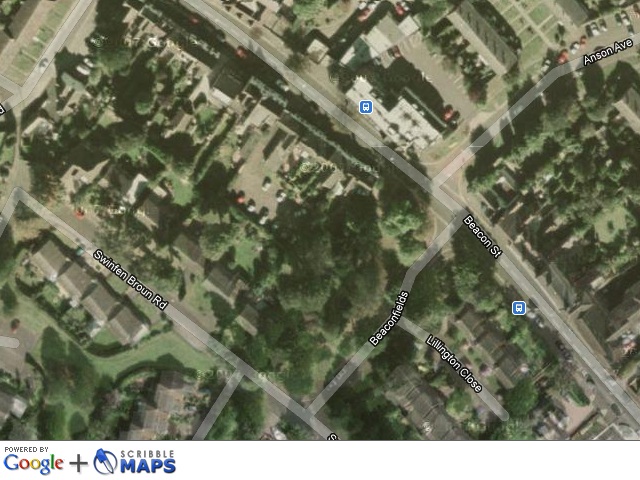
So could I be right in thinking that the Lemansyche referred to might be Leomansley Brook, which runs across Beacon Park? This would be in keeping with the boundary idea and also with the stream over marshy ground. As this excerpt from wikipedia says ‘The land on which Beacon Park now stands was originally low lying, poorly drained pasture alongside the Leamonsley Brook. The Museum Gardens and Recreation Grounds were the site of Bishops Fish Pool or Upper Pool. The pool was created when a causeway was built on Beacon Street in the 14th century separating it from Minster Pool. The area around Bishops Fish Pool in all directions was waterlogged marshland, this area south of Bird Street became known as the moggs from the 15th century and later Swan moggs’.

Is this feasible? As I said, a tricky subject, even for experts, and especially for dabblers like me!

Leamonsley

We are told by the County History that that the hamlet* of Leamonsley grew up around the fulling mill on Leamonsley brook in the early 1790s. In 1841 census there were 13 households, including that of the tenant of the mill; with the number rising to 27 households in 1851.

* a term often used to describe a village without a church

Lemondsley

In 1806, the Rev Thomas Harwood referred to “four closes of land, pasture and meadow, lying next together near the said city (Lichfield), called Lemondsley for which the rent of 10s per annum is now paid”.

Lemmonsly

In the book “Trade Tokens” by J.R.S.Whiting, and on http://www.windmillworld.com, there is a reference to a twopenny token of Lemmonsly Worsted Mill, Lichfield (John Henrickson). Henrickson is a “calico, cotton and shirting manufacturer” . The token shows a mill with trees at sides, and river. On the reverse is the arms of Lichfield between oak branches, and text “One pound note for 120 tokens”. A picture can be seen on Flickr following this link.

www.flickr.com/photos/30084068@N08/3305680975/in/photostream

There is no date on the token but John Henrickson let and ran the mill from around 1810 until he went bankrupt in 1815.

Leomansley Mill, now that sounds like an interesting place………..

Sources

‘Lichfield: The 19th century’, A History of the County of Stafford: Volume 14: Lichfield (1990), pp. 24-32. URL: http://www.british-history.ac.uk/report.aspx?compid=42338 .

(2) Edit 2/2/2012 http://voices.yahoo.com/shallow-shoal-shoot-sike-sitch-origins-forms-histories-5293647.html

Eilidh Armour-Brown

Leomansley House was once the home of the artist Eilidh Armour-Brown. She was chairman, treasurer and vice president of Lichfield Society of Artists and a founder member of Lichfield Arts Centre. Fans of ‘Who Do You Think You Are?’ will be interested to know that she was the great niece of Dr Thomas Barnardo. Eilidh and her husband Peter bought the house in the 1950s when it was three old mill cottages. Eilidh died in 1994 and there is a stone seat in the corner of Pipe Green Meadow, which reads ‘Peter Eilidh who loved this place’. I like to sit there and try and spot the deer at Maple Hayes through the fence. I love it too.


Some of Eilidh’s work can be found at http://www.search.staffspasttrack.org.uk

An interesting tidbit of info is that whilst renovations were taking place in 1956 an 11th century spear head was discovered by Master Derek Fearn.

Sources:
Lichfield in Old Photographs by Howard Clayton & Kathleen Simmons

Lichfield Record Office

Hollow Ways with Cross in Hand

Abnalls Lane

I first came across a description of Hollow Ways in the excellent book “England in Particular: A Celebration of the Commonplace, the Local, the Vernacular and the Distinctive”  by Sue Clifford and Angela King.

They describe Hollow Ways as “…those curious rural tracks that have been gradually ground out from hillsides by generations of pedestrians”.

As ever whilst looking for somthing else, I found out that there are several hollow ways nearby – leading East from Farewell, on the Parish boundary between Farewell and Chorley and Burntwood, Cross in Hand Lane and in the Maple Hayes area (Abnalls Lane) amongst others.

It seems from this description in ‘Lichfield: Domestic buildings and communications’, A History of the County of Stafford: Volume 14: Lichfield (1990) that Cross in Hand Lane was the road to Stafford until 1770.

“In the north of the city the road followed Beacon Street, described as the road to Stafford in the later 13th century, and Cross in Hand Lane. It branched off to follow the lane running along the north-west boundary which was still known as Old London Road in 1835. The cross with the hand which stood at the fork by the 15th century was probably a direction post. In 1770 the course of the road was straightened to avoid the hollow way in Cross in Hand Lane by means of a new line to the east, the present Stafford Road.”

There are records of a medieval cross between Beacon Street and Cross in Hand Lane, but no trace of this cross has been seen. I have seen two theories for the name Cross in Hand. Firstly, according to ‘Townships: Burntwood’, A History of the County of Stafford: Volume 14: Lichfield (1990), the area “..took its name from ‘the cross with the hand’ mentioned in the later 15th and early 16th century, evidently a direction post”. The Staffs Past Track website suggests this “The lane from Lichfield to Farewell, known as ‘Cross in Hand Lane’, is thought to be so-called because travellers wanting sanctuary at the Benedictine priory would use that route, carrying a cross in their hand”.

I have found a description of the Cross in Hand Hollow Way in ‘The Olio’ 1829.

“But the chief interest of the yew tree, in my eyes, is the mutual connection between it and some of the most stirring recollections of the past, and the most endearing circumstances of the present. How can I forget those twin Titans,superb in the blackness of their vivid foliage, that towered and waved over the red holloway near Lichfield! It was a little hamlet that, lying midway between the city and the old Benedictine Convent of Fairwell, was called Cross-in-hand, doubtless from the frequent monastic processions between the Nunnery and the Minster, or from some rustic image enshrined by the roadside.

The houses, nested under high banks, scarce revealed themselves by the smokewreathes among their orchards ; and the orchards themselves just raised their coloured raiment of blossom or fruit to a level with the smooth green uplands, which the holloway so deeply bisected. But the two yews, justly entitled Gog and Magog, upheaved their funereal forms and surgy branches into the free sky,— for miles the cynosure of this little caverned village”

I wonder if these two yews still exist. I’ll just add it to my ever growing list of things to go and have a look for!

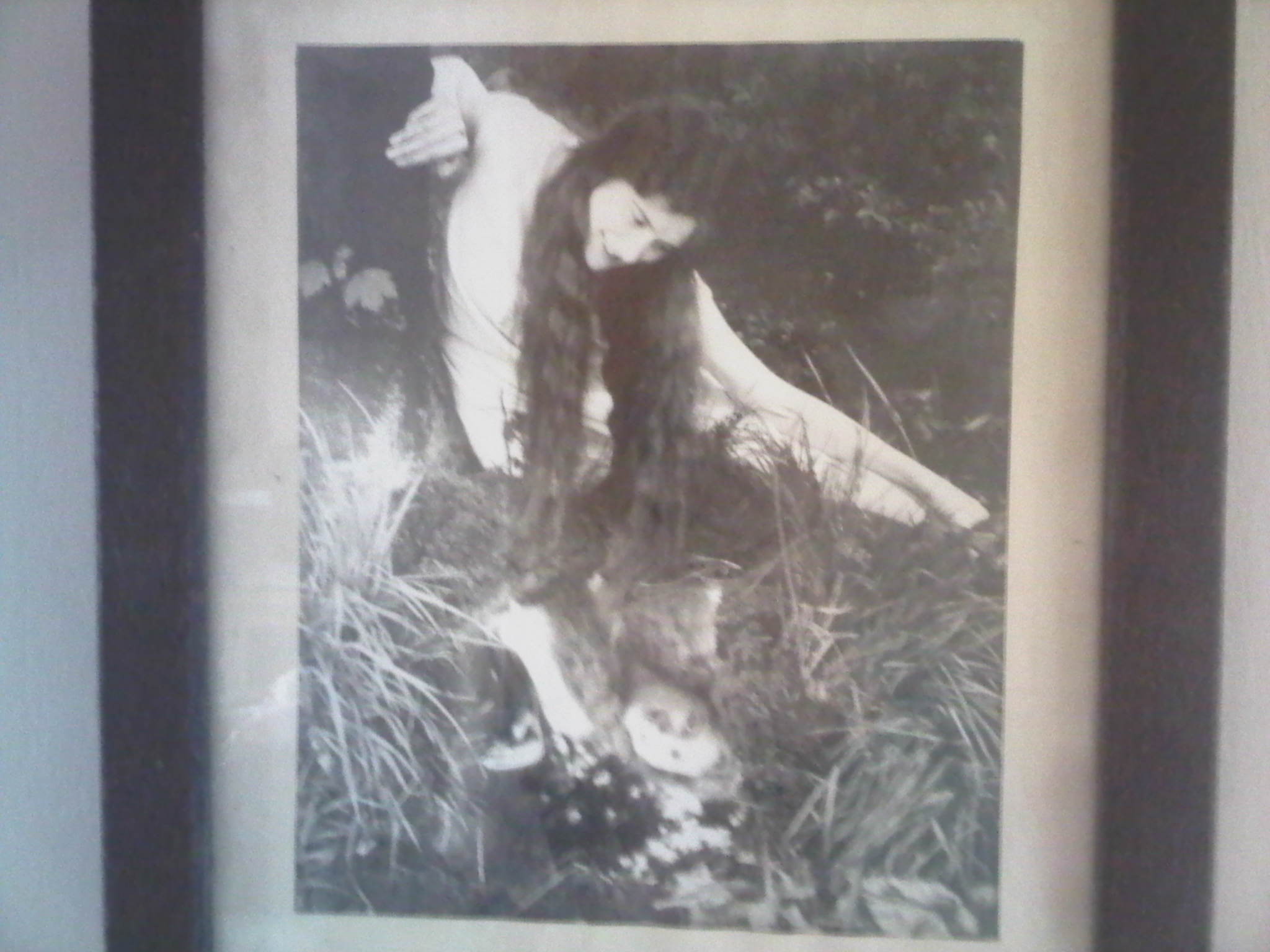
The Grave of Poor Bessy Banks

I spotted a place labelled Bessy Banks’ Grave on the 1815 Ordnance Survey drawing of Lichfield by Robert Dawson 1815.

Immediately, I thought of the story of Kitty Jay on Dartmoor. A little investigation has revealed a few details. In ‘History of the City and Cathedral of Lichfield’ by John Jackson (1805), I found the following;

“…of Betsy Banks grave* once the famous rendezvous of lovers….now no more is remembered than that poor Betsy is said to have fallen victim to hapless love.

*there is a spot in a field in Lichfield still distinguished by that name”

Anna Seward wrote to her friend Honora Sneyd about the place in a letter dated May 1772, that she described as ‘Written in a summer evening from the grave of a suicide’. I’ve only included the first part as its quite long.

“It suits the temper of my soul to pour
Fond, fruitless plaints beneath the lonely bower,
Here, in this silent glade, that childhood fears,
Where the love-desperate maid, of vanish’d years,
Slung her dire cord between the sister trees,
That slowly bend their branches to the breeze,
And shade the bank that screens her mouldering form,
From the swart Dog-Star, and the wintry storm….”

Another reference can be found in one of David Garrick’s letters.  He wrote that “the name Dimble is given to a sunken road leading north from Lichfield past a spot, supposedly haunted called Betty Honks Grave. Two sister trees form an elegant arch over a stream”.

By 1791, it was found that the sister trees had been recently cut down.

So who was Bessy Banks, did she really exist? If so, is her grave still there, now unmarked and unremembered?
Edit 5/9/2011

I recently had the St Chad’s tithe map (1849) out in Lichfield Record Office, looking for something else. A whole plot of land is listed as ‘Bessy Banks’. Born a Lichfeldian has kindly worked out where the stream in this area would have been. Taking into account this and the tithe map it seems that ‘Bessy Banks’ was somewhere in the region between Dimbles Lane and Greencroft.
John Jackson’s description suggects that in 1805 the story is already an old one. It does seem a fairly well-known tale, to have actual places on maps marked after it, as well as being mentioned by Garrick (albeit with the name Betty Honks!) & Seward.  Was it just a made-up story, or did it arise from actual events? I wonder when (and why?) the people of Lichfield stopped telling the story? Or could there even still be people who could tell us the tragedy of Lichfield’s ‘love-desperate maid?’

Edit: 15/4/2012

A notice in the Lichfield Mercury 20th February 1914 lists a lot for sale as garden land, known as Bessy Banks, adjoining a plot of arable land let by T Chapman and located next to Gaiafields House and Gaia Fields Cottage.

Long Live the King's Head!

 A neighbour of the King’s Head has been complaining about the noise. Perhaps when they moved to the area they didn’t realise that there was a pub nearby – after all it has only been there since 1495. Anyway, for anyone who is interested in one of Lichfield’s oldest and most historic inns, here is a bit of history and legend.
According to the County History, The King’s Head in Bird Street was known as such by 1694 but in existence as the Antelope by 1495 and later called the Bush.


 On 25th March 1705 Colonel Luke Lillingston raised a regiment initially named ‘Lillingston’s Regiment’, then the ’38th of Foot’, and finally ‘The South Staffordshire Regiment’.  The 80th Regiment of Foot was raised in 1793 by Henry William Paget for the Revolutionary War with France and the original headquarters and place for enlistment was The King’s Head.

It is of course listed and the description given is ‘A coaching inn, now public house. Mid to late C18 with early C19 alterations. A good example of one of the coaching inns which served the London to Holyhead and Carlisle road’.

From the 1828-29 Pigotts Directory (as seen on the Burntwood Family History Group Website).

Coaches
TO LONDON the Herald (from Manchester) calls at the King’s Head every morning (Mondays excepted) at half past-two; goes thro’ Tamworth, Atherstone, Coventry, Daventry, Towcester, Stoney Stratford, Dunstable, St Albans Ec
TO MANCHESTER the Herald, (from London) calls at the King’s Head, every morning (Mondays excepted) at nine; goes thro’ Stone, Newcastle, Congleton Ec.
CARRIERS (i.e. freight)
TO BIRMINGHAM, Mrs. Bates, from the King’s Head,
TO BIRMINGHAM, UTTOXETER Ec.. Thomas Butler, from the King’s Head
The pub features on the Lichfield Ghost Walk. A maid is supposed to have died in a fire and a ghostly light is seen flickering in the upstairs windows. A mortally wounded laughing (!) cavalier wanders the pavement outside. According to the Staffordshire Encyclopedia there is also a ghost called George. On a personal note, I was sitting at a table with my family near the bar several years ago and I felt a sharp pain in my neck, as if someone had flicked it really hard and my necklace fell off. My neck had a big red mark on it and I’m still not quite sure what caused it!

Well, well, well! Merlich, Jacob & Mary


Most of us Lichfeldians know about St Chad’s well. However, I have come across a few other wells in Lichfield which seem to have disappeared.

Merliches Well – According to the William Salt Archaeological Society’s ‘Collection for a History of Staffordshire’, Merliches Well was on Merliches Lane, a short lane at right angles to Pipe Lane. Pipe Lane was the old name for Abnalls Lane and was on the east side of Beacon Street, or Bacone Street as it was known then.

From A Short Account of the Ancient and Modern State of the City and Close of Lichfield, ‘on the North Side of Shaw Lane leading to Merliche’s or Maudlin’s Well was a large house called Whitehall, and on the south side the Archdeacon of Chester had a house’. ( I think the Archdeacons house was on the corner of Beacon St and Shaw Lane).

John Jackson’s History of the City and Cathedral of Lichfield says that tradition suggests that Maudlins Well was so called due to a drunkard tumbling in one evening after one too many. However Jackson believes that the name instead referes to Magdalen.

Jacob’s Well – near Friar’s Alley, a few yards from the brook near this place was a spring formerly in repute for curing weak eyes and sores.

Marywell – In Breadmarket St, was a house called Priest’s Hall (now St Mary’s Chambers) and near here was a well called Marywell. According to the County History, St. Mary’s Well, in Breadmarket Street opposite the west end of St. Mary’s church, existed in the late Middle Ages

The Lichfield Gallows

A while ago someone told me that the Lichfield Gallows were situated near the Shell Garage on the London Road/Tamworth Road junction. A woman had told him she was walking past one evening and was pushed by unseen hands. Spooky!

I’ve always meant to check if this was correct and it appears that it is (the location that is, not the spooky story)!

Here’s a link to one of the oldest maps I know of – John Ogilby 1675 Lichfield to Chester  It’s fascinating in its own right, but for today’s purposes look at the bottom left corner and you’ll see Gallows marked, just outside of Lichfield.

‘The History of the County of Stafford: Volume 14’ tells us that ‘A gallows was built, or possibly repaired, at the bishop’s expense in 1532–3. In 1650 there was a gallows on the west side of the London road near its junction with Shortbutts Lane. The gallows there fell down c. 1700, its foundations undermined by people digging for sand, but it was re-erected’

In ‘Staffordshire Customs, Supersitions and Folklore (1924)’, Frederick Hackwood writes that at Gallows Wharf ‘half a centry ago a decayed oak stump stood two feet out of the ground….and was said to be the remains of the ancient gallows-tree’.

Given the description from the County History above, it seems unlikely that this is correct. However, it wouldn’t be the only one in the area – in Brereton (Brewerton?), near Rugeley, Mr Ogilby has marked ‘a hangmans oake on ye road’. A quick look at the archives does show a Hangman’s Croft in Brereton in the 1800s but at the moment I can’t find any other references.

JW Jackson, a City Librarian of Lichfield, contributed a local history column to the Lichfield Mercury in the 1930s. He carried out some research into crime and punishment in Lichfield and found that in 1711 the Sheriff of Lichfield was instructed to carry out two executions. One of these was a man condemned for murder. The other a woman who was sentenced to death for stealing a pair of shoes, a straw hat with brimming, a sixpenny loafe and a cheese. Presumably this poor woman fell foul of the 1699 Shoplifting Act which made it a capital offence to steal goods worth more than 5 shillings!

It seems public executions in Lichfield weren’t a common occurence. According to the website Capitalpunishmentuk, six executions were carried out in the City between 1735 and 1782.  Three men were hanged for uttering (which I understand is the crime of putting something forged into circulation) in April 1801 and the gallows was used for the last time on 1 June 1810 when three forgers were hanged. On the 1884 Ordnance Survey Map, the area is called Gallow’s Wharf, but by the 1920s it was known as St John’s Wharf.

Knaves Castle

One of the great thing about doing this blog is that whilst looking for one thing, you find ten other things! It’s amazing how many fascinating things are on your doorstep, or just down the A5 in this case. Until recently, I had never heard of Knaves Castle, but now that I have, I’m intrigued as to what this was. It seems that this question has puzzled people over the centuries.

Back in 1794, in ‘The History and Antiquities of Shenstone’, Rev Henry Sanders wrote that Dr Plot believed that Knaves Castle was a place to watch travellers safely cross ‘this heath, formerly all wood and much infested with robberies’…'(for) which the passengers allowed some small gratuity’.  In complete contrast, he reported that another of Dr Plot’s theories was that ‘the robbers themselves harboured in this place’ and hence the name Knaves Castle.  Rev Sanders’ own opinion is that ‘though there remain no signs of a fort, it seems very likely to have been one to guard strangers passing over so wild and dreary a country as Cannoc Wood is at present; much more was it such formerly, when full of woods and thickets’. I’m assuming that he is referring to Dr Robert Plot who wrote a ‘Natural History of Staffordshire’ in 1686 which included a map showing Knaves Castle (this can be seen on the Staffordshire Past Track website.

In 1870-72, John Marius Wilson’s Imperial Gazetteer of England and Wales, saysTraces of a Roman camp, called Knave’s Castle, are to the N of the village’ (the village referred to is Ogley Hay).

According to ‘Notes on Staffordshire Place Names’ by WH Duignan of Walsall, earthworks and tumuli are often called castles.  The book states that the tumulus is now almost obliterated and enclosed in a garden, but that sixty years ago was very plain (the book was written in 1902, so ’60 years ago’ would have been the 1840s).

Knave’s Castle is a kilometre west of the Staffordshire Hoard findsite, but Della Hooke from the University of Birmingham, in her paper ‘The Landscape of the Staffordshire Hoard’, casts doubt on the description of Knave’s Castle as a tumulus and believes that it is no more than a raised natural hillock.

The English Heritage description of the site can be at found at the Pastscape website.

Unfortunately, no there are no physical remains of  Knaves Castle.  Was it really a Roman earthwork, a hideout for robbers or just a hill?

Update: Since originally doing this post earlier this year, I have since come across an excellent and much more in depth post on Knaves Castle on The Gatehouse website.  The post concludes that Knaves Castle was an artificial earthwork, albeit one that may have developed from a natural feature.

The Carpenters Arms – a Lichfield Beer House

The Carpenters Arms was a pub on Christ Church Lane, sadly demolished before I moved to Lichfield.

1841 Census

Back in 1841, the premises wasn’t listed as a pub. The census entry just names James Page, Carpenter, his wife Maria and their family. Twenty years later, in 1861, Maria is the head of the household and a beerhouse keeper. The premises is known as the Carpenters Arms, Leomansley.

1861 census

I understand that premises like the Carpenters Arms existed all over Britain, thanks to the Beer House Act in 1830. In order to promote beer drinking, seen as a healthy alternative to gin and of course untreated water, the duty on beer was removed. In addition, for a small fee of two guineas, anyone could brew and sell beer. According to John Shaw, this is where we get the term ‘Public House’ from, along with terminology such as lounge (for upmarket customers) and bar (which stopped customers going into the private part of the house).1 The law did tighten up again in 1869, with the introduction of the Wine and Beer House Act, which meant a license for the premises had to be acquired from the local magistrate, who would of course refuse to renew a license for a beer house that was disorderly or unsuitable.

It seems the Carpenters Arms remained a beer house until February 1949, when a full license was applied for. Supporting the application, one customer said there were a lot of elderly people in the district who liked a short drink for medicinal purposes. Also, he explained that when a person took his wife, they liked a short drink, and you could not offer ladies a glass of beer!

Another customer reported how for whisky or other shorts, you had to go into Lichfield and if you weren’t a regular, it wasn’t often you got one.2

The application for the Carpenters Arms was granted and so, the Leomansley old folk didn’t have to go without their medicinal whisky and the ladies of Leomansley were able to drink in a ladylike fashion.

However, as previously mentioned, the pub closed in around 2002. The Rise apartments now occupy the site and unless I’m mistaken, I don’t think that there is an acknowledgment of the site’s history, which is a shame. It also seems a shame that, given the huge increase in population in Leomansley in recent years, the Carpenter’s Arms may have had a new lease of life had it managed to survive another few years. We’ll never know.

I’d be interested to know if any other Lichfield pubs started off as beerhouses….

Edit: This morning I remembered that there was some information about another Lichfield Beer House on the excellent BrownhillsBob’s Brownhills Blog. Sadly now also demolished, the Royal Oak started life at Sandyway Farm, Walsall Rd, now in the process of being redeveloped into residential properties. There had been an application to turn it back into a pub a couple of years ago, but I think it was rejected.

The pub moved up the road to the top of Pipehill in around 1868, but closed in the 1960s. Have a look at Bob’s post The Lost Pub of Pipehill for more information, plus photos and a really interesting discussion.

Sources:
1. The Old Pubs of Lichfield – John Shaw
2.The Lichfield Mercury archives accessed at Lichfield Records Office

Lichfield Brewery & The Bridge Tavern

The Lichfield Brewery Co was formed in 1869, a merger of two local breweries, owned by the Griffith Brothers Co and The Lichfield Malting Co.1 The name is fading, but just about legible on this building behind Lichfield City railway station. Observant readers will notice that the date on the building of 1858 predates the company by 11 years  – it’s thought the building originally belonged to the Griffith Brothers. Perhaps Lichfield Brewery Co was added at the time of the merger.

In Howard Clayton’s Victorian Lichfield, there is reproduction of a Lichfield Brewery Co advert. On offer are Pale Ales, Light Pale Ale ‘AK’ (intriguingly recommended for family use!), Strong Ale, Mild Ales, Stout and Porter along with Harvest Burgundy (Red or White) and Tintara wines.

The company was taken over by Samuel Allsopp and Co in 1930 and production at the Lichfield Brewery ceased soon afterwards. In 1931, The Lichfield Aerated Water Co set up at the site, but were taken over by a Derby company, Burrows & Sturgess (who produced soft drinks and who claimed to have produced the first Iron Bru.2 I always thought it was made in Scotland, from girders!). A new company called the Birmingham Chemical Co was established from this takeover. Apparently, the site became known as the ‘Wiltell Works’, after this company’s slogan ‘Quality Will Tell’, and there’s a Wiltell Rd nearby too!3

The majority of the buildings were demolished in 1969.  However, still standing are the Brewery Offices with their roll of honour, still actively used to pay tribute to the 13 employees killed in the First World War.  Their names are also included on the memorial in the Remembrance Garden.

On the opposite side of Upper St John St is a building that was once the Bridge Tavern4. Staffordshire Pasttrack has two photographs taken outside the pub around 1910. The first depicts the publican, stood outside by a horse & cart. The second, shows the pub decorated with greenery, and a huge crowd of people gathered for a celebration, possibly the Bower.

You can still see where the pub sign used to be, and a little further down, the place where a board proudly announced:

‘William Whatkiss Licensed Retailer Ale, Beer, & Foreign and British Wines and Spirits. Dealer in Tobacco’

In my previous post, I said I’d like to find out about current local breweries. It’s been a lot easier to find out about the old Lichfield Brewery than it has about the new Lichfield Brewery!  I’m sure I had one of their beers at the Lichfield Medieval Market a couple of years back, called Festival Ale.  I’ve been trying to find out if the brewery is still going.  You can buy pump clips on ebay for their beers such as Steeple Jack and MT Pocket, but I can’t find much more at the moment.

Sources:
1. ‘Lichfield: Public services’, A History of the County of Stafford: Volume 14: Lichfield (1990)
2. http://www.bygonederbyshire.co.uk/
3 & 4 The Old Pubs of Lichfield – John Shaw*

*I had a copy of this ages ago and lent it out.  Chatting on Twitter with @brownhillsbob a while ago he reminded me about what a great book it is and I treated myself to another copy.   Loads of info & some great photos too. If you’re interested in Lichfield History (and if you’re here, I’m assuming you are ;0), you should invest in a copy. Go on, go on, go on….