Scheduled Visit

Sitting in the car park of a closed museum*, we pondered our next move. I remembered there was a sign for ‘Castle Ring’ a little way down the road, an Iron Age Hill Fort I’d always meant to visit, but hadn’t. Perfect. A short while later we pulled up in a much fuller car park that the one we had left.

Plan B
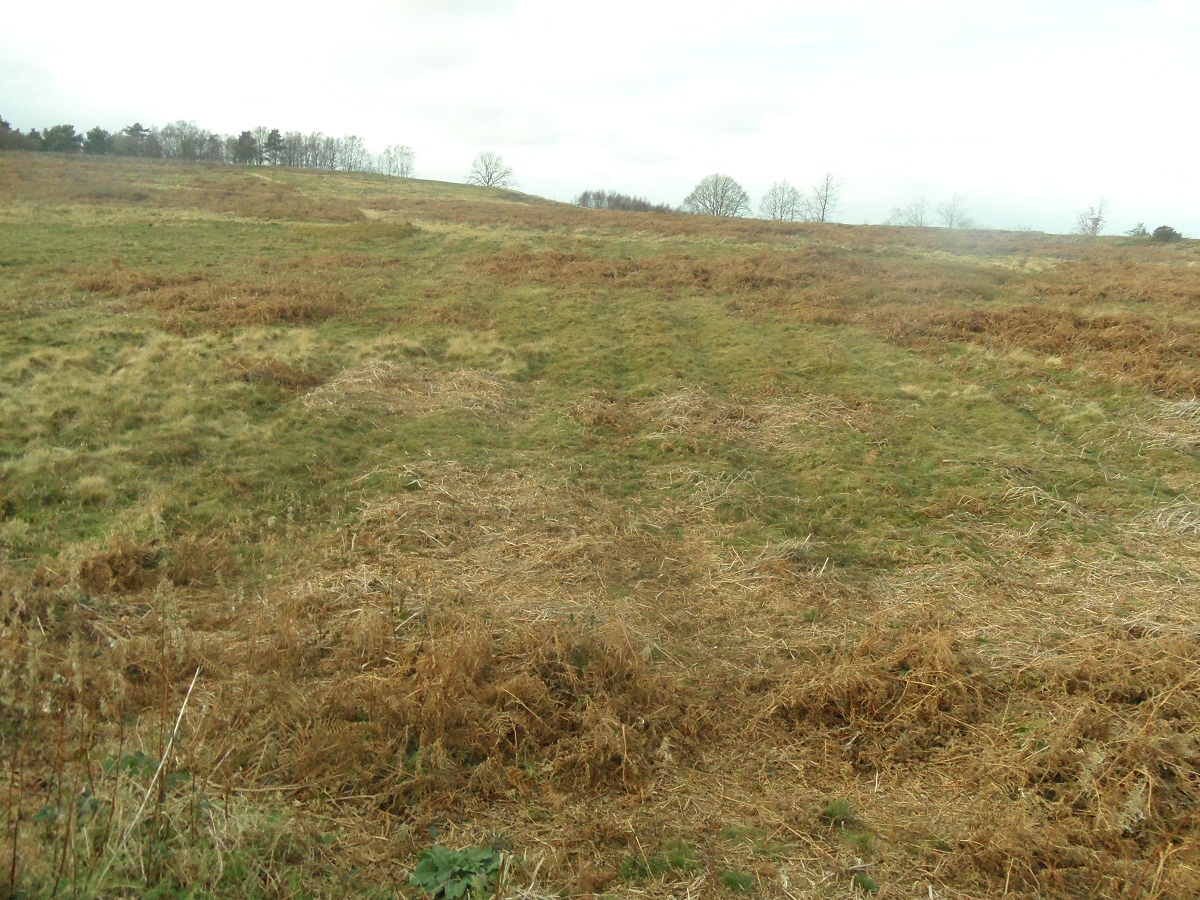
Ridge & Furrow I think. See edit below.

As Castle Ring is only about 6 miles away from Lichfield, this post is a nudge to get you to go and have a look for yourself if you possibly can, as descriptions and photos (especially the kind I take!) are no substitute for visiting the highest point of Cannock Chase (235m in fact), which also happens to be a site thought to have been occupied 2,500 years ago. For more information & directions, you can download the leaflet from here and read a much more detailed description on the Pastscape record.

On the subject of photos though, it is worth having a look at a photo of the site from above.

Now that I’ve been once, I shall definitely have to go back. There are the remains of a 12th century medieval hunting lodge I missed and as well as being a Scheduled Ancient Monument, it’s also been classified as a Site of Biological Importance. Adders and common lizards, damselflies and dragonflies are found in the grass and bogland habitats there.

Obviously, I am no expert, but it’s interesting to read the Management Plan  produced by Cannock Chase District Council (according to the plan, they purchased the site for £200 in 1933 at a sale at the Swan Hotel in Lichfield. It had previously belonged to the 6th Marquis of Anglesey). It must be a hard task to maintain a balance between public access to somewhere like this and protecting the site’s ecology and archaeology. 

I’ve mentioned the Scheduled Ancient Monument we have here in Lichfield before. Other than this listing, is there anything in place to protect, manage or inform about this site, as there is at Castle Ring? Should there be?

*My fault entirely. Considering I spend so much time on the internet, you’d think I’d use it for useful things like checking opening times!

Edit 25/1/2012. Doubt has crept in about when that ridge & furrow dates to. I originally said it dated back to early 20th century, based on something I’d read but ‘Born a Lichfeldian’s’ comment has made me rethink this. So if any knows any better (and I’m sure there are plenty that do!) please don’t hesitate to put me straight!

Wood Work

This week started with a brand new orchard and ended with an ancient woodland.

Last weekend, I helped to plant cider trees at Woodhouse Community Farm in Fisherwick. It wasn’t just the potential liquid reward that got me out of bed on a cold and frosty Sunday morning, there were a couple of other reasons!

It's got a lot of potential....


Orchards are becoming a rare habitat – according to Natural England, it’s estimated that the overall orchard area in England has declined by 63% since 1950. A traditional orchard can support around 1,800 species of wildlife. Although it will clearly take a while for the new cider orchard to reach this stage, I’m hoping that it will help to redress the balance a little bit! The People’s Trust for Endangered Species recently created an inventory of the traditional orchards in England, and you can read the summary of their findings for Staffordshire here.

Being involved with the orchard will also give me an opportunity to learn something about some disappearing traditional skills and knowhow. Growing fruit trees is a fascinating business, although I clearly have much to learn as I was the only person whose tree had to be dug up and replanted. Hopefully I’ll be better at the cider making bit, but if not, there’s always the cider drinking part which I’m fairly confident about.

In contrast to this budding orchard, on Friday I found myself amongst much older trees. Merrion’s Wood is a lovely nature reserve, just outside Walsall town centre and looked after by Walsall Countryside Services. Bluebells are already starting to shoot up all over there and countryside ranger Morgan told me that these plants were an indicator of ancient woodland, along with several other species.

Ancient Woodland in Leomansley

Leomansley Wood is full of bluebells in springtime. An interactive map of habitats from DEFRA confirms it as ‘ancient replanted woodland’. This means that although the site has been continuously wooded since 1600 (at least), the trees are more recent. It’s interesting that the place name is thought to include the celtic element ‘lemo’, meaning an elm (1) or possibly ‘leme’, lime tree.  The ‘-ley’ suffix is thought to come from the Anglo Saxon ‘leah’ meaning ‘clearing’ (2).

I think that to find a nearby semi natural ancient woodland, you need to visit Hopwas Woods near Whittington Barracks.  I should probably do this myself at some point! It’s worth pointing out that only 1.2% of the UK is made up of this kind of habitat and that it is irreplaceable. (3)

The DEFRA map also shows a traditional orchard between Maple Hayes and Jubilee Wood (where the conduits are!) with several others around Burntwood and Chorley. Perhaps even more interestingly, it seems there are two patches of traditional orchard in a built up residential area of Lichfield. I don’t know if I should say where, it might encourage scrumping!

I’ve also noticed several apple trees growing alongside the A51. How did these get here – discarded apple cores from car windows or remnants of something else? Perhaps more importantly, can I use these to make cider? 😉

Footnotes:

Don’t just take my work for how brilliant Woodhouse Community Farm is! There is a snowdrop walk on Sunday 5th February at 10.30am, where you can also see some of the things they have planned for the future.

The Woodland Trust point out that although many ancient woodlands have been recorded on inventories, there may also be unidentified fragments out there. Although bluebells don’t always indicate ancient woodland, if you do spot any growing this spring it might be worth having a closer look to see what else is around! The Woodland Trust have a really interesting guide to ancient woodland that you can read by clicking here.

Sources:

1) ‘Lichfield: The place and street names, population and boundaries ‘, A History of the County of Stafford: Volume 14: Lichfield (1990), pp. 37-42.
 2) http://finds.org.uk/staffshoardsymposium/papers/mattiasjacobsson

(3)http://jncc.defra.gov.uk/page-1437

Fruit & Nut

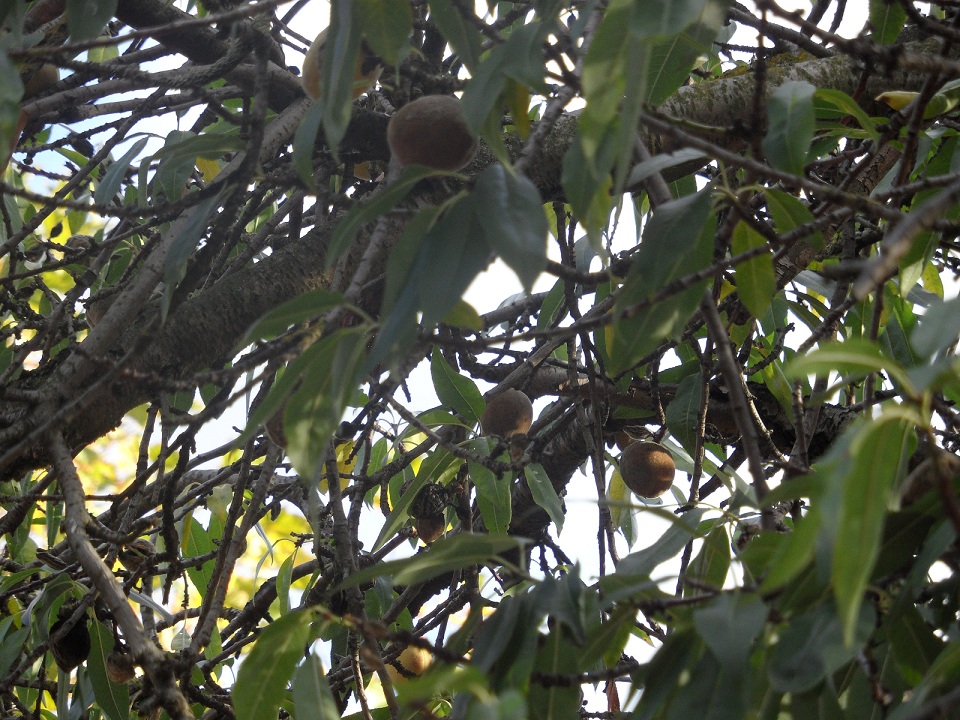
Following on from the apple tree & walnut tree post, Pat (someone who makes a fantastic contribution to this blog via his comments & in other ways), got in touch to say that he knew of an almond tree in Lichfield.

I admit that I don’t know much about thses things, but to me that seems unusual. I associate almonds with warmer climates and so I didn’t expect one to be growing near to the Friary car park. However, there it was, boughs laden. With a lemon tree also growing nearby, perhaps this part of Lichfield has a mediterranean micro-climate?!

Something that I didn’t know until today was that almonds, are not true nuts, but are part of the ‘prunus’ family, together with apricots, cherries & peaches. The edible part of almonds is the seed, but only for the sweet variety. As Pat pointed out these almonds are likely to be wild, bitter almonds and therefore contain cyanide!   So, don’t get picking them to grind up into your Bakewell Tart …

Many thanks to Pat, for sharing this information.

Meripilus Giganteus & Wealhhnutu

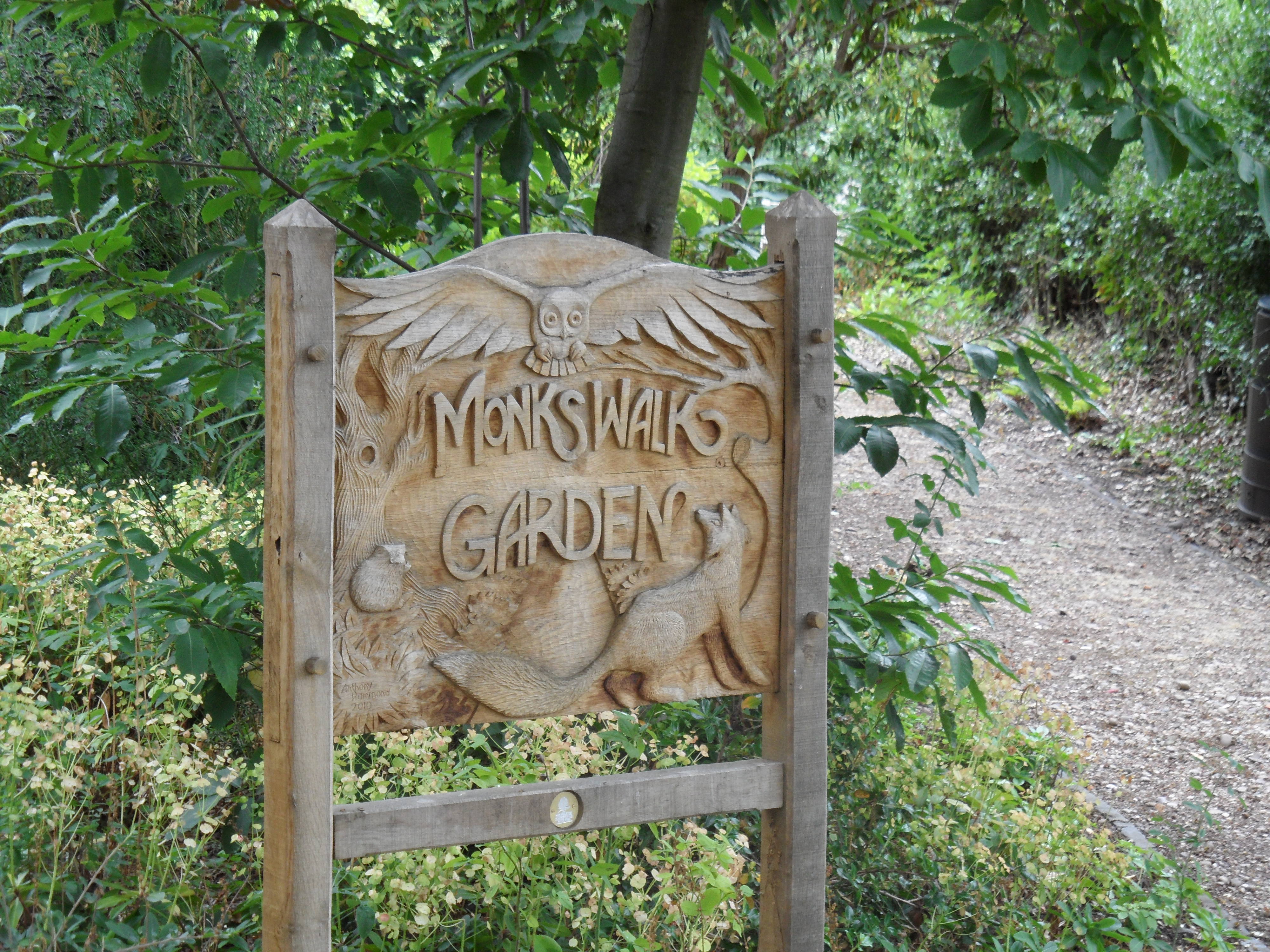
Lorna from the Monks Walk Group has been in touch to say that unfortunately the beech tree in the gardens has been lost due to the Meripilus Giganteus fungus. The good news is that Staffordshire County Council is providing a walnut tree as a replacement.


I don’t know much about fungi or walnuts, so I did a quick bit of research. Apparently, Meripilus Gigantus also known as Giant Polypore is a common cause of death for mature beech trees. It seems we can’t even get our revenge on this fungus by eating it as, although not poisonous, it doesn’t taste particularly good.  However, it is sometimes eaten by mistake as it looks like the Hen of the Woods, which is a tasty, edible fungus (and very good in risotto according to Morgan from Walsall Wildlife!).

In one of my all time favourite books, ‘England in Particular’, the entry for walnuts tells us that the trees were originally brought to Britain by the Romans (the Old English was wealhhnutu which means ‘foreign nut’)and amongst other places were planted in monastery gardens, so it seems that Staffordshire County Council have made an appropriate choice!

A huge walnut wood was planted to the north-east of Ashby de la Zouch around 10 years ago. Jaguar Lount wood is the largest plantation of walnut trees in Britain and as you might guess from the name, the project was sponsored by Jaguar Cars and it includes an area where they are researching the the growth of different varieties for timber and for their nuts. You can see the Forestry Commission leaflet here.

Of course, it probably goes without saying that perhaps most importantly of all, walnuts are a crucial ingredient in Walnut Whips. Much tastier than Meripilus Gigantus.

Sources:
England in Particular – Sue Clifford & Angela King