Cross County

Looking for ancient crosses in Lichfield, has so far lead only to hints of their existence – a one line reference in an old book here, a placename there. Nothing concrete (or should I say stone?).  So imagine how happy I was when I visited Ilam Park yesterday and found that were two thought to date back to the 10thc standing in the churchyard with a third shaft incorporated into the church wall…..
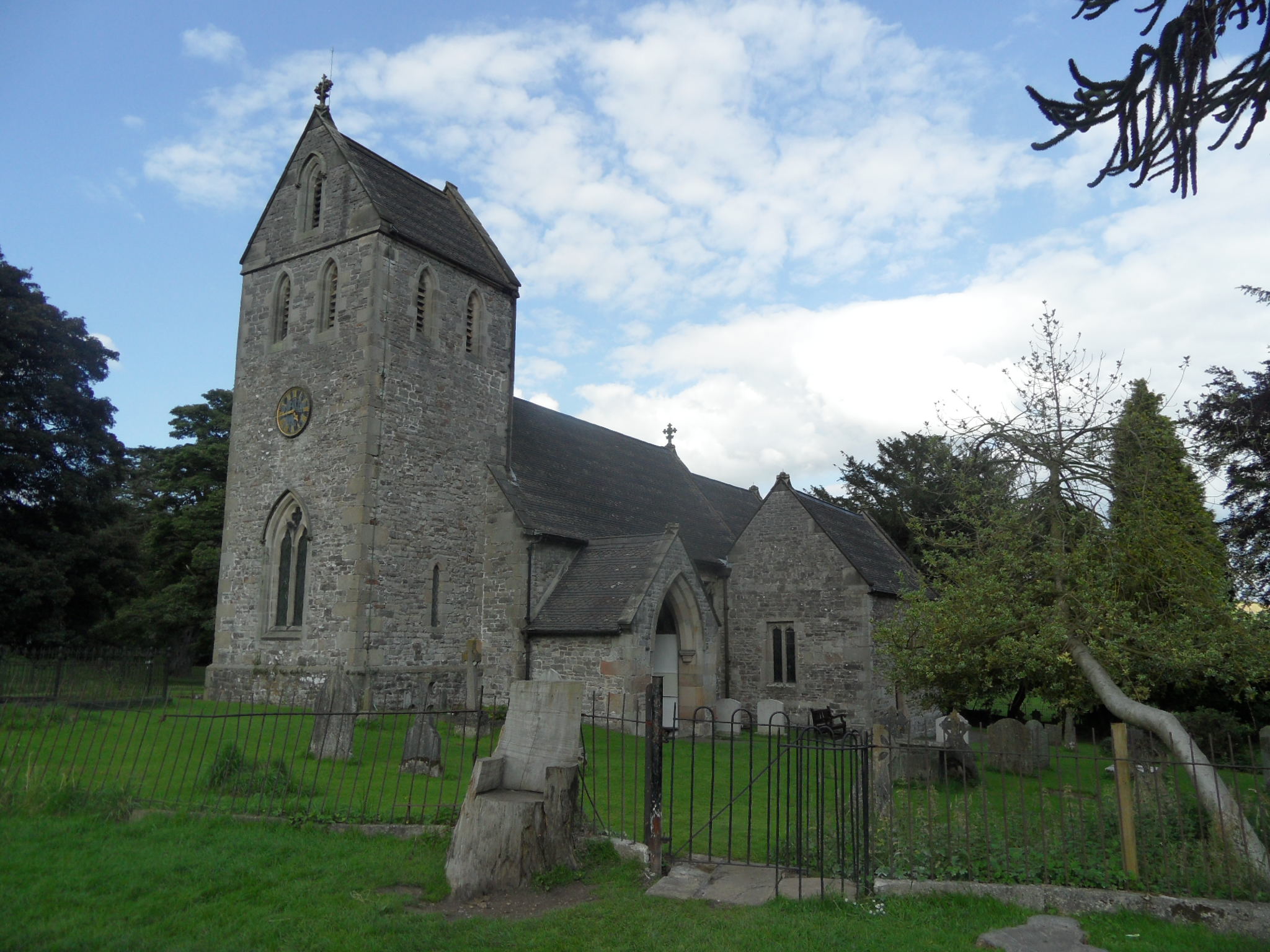
Church of the Holy Cross, Ilam, Staffs
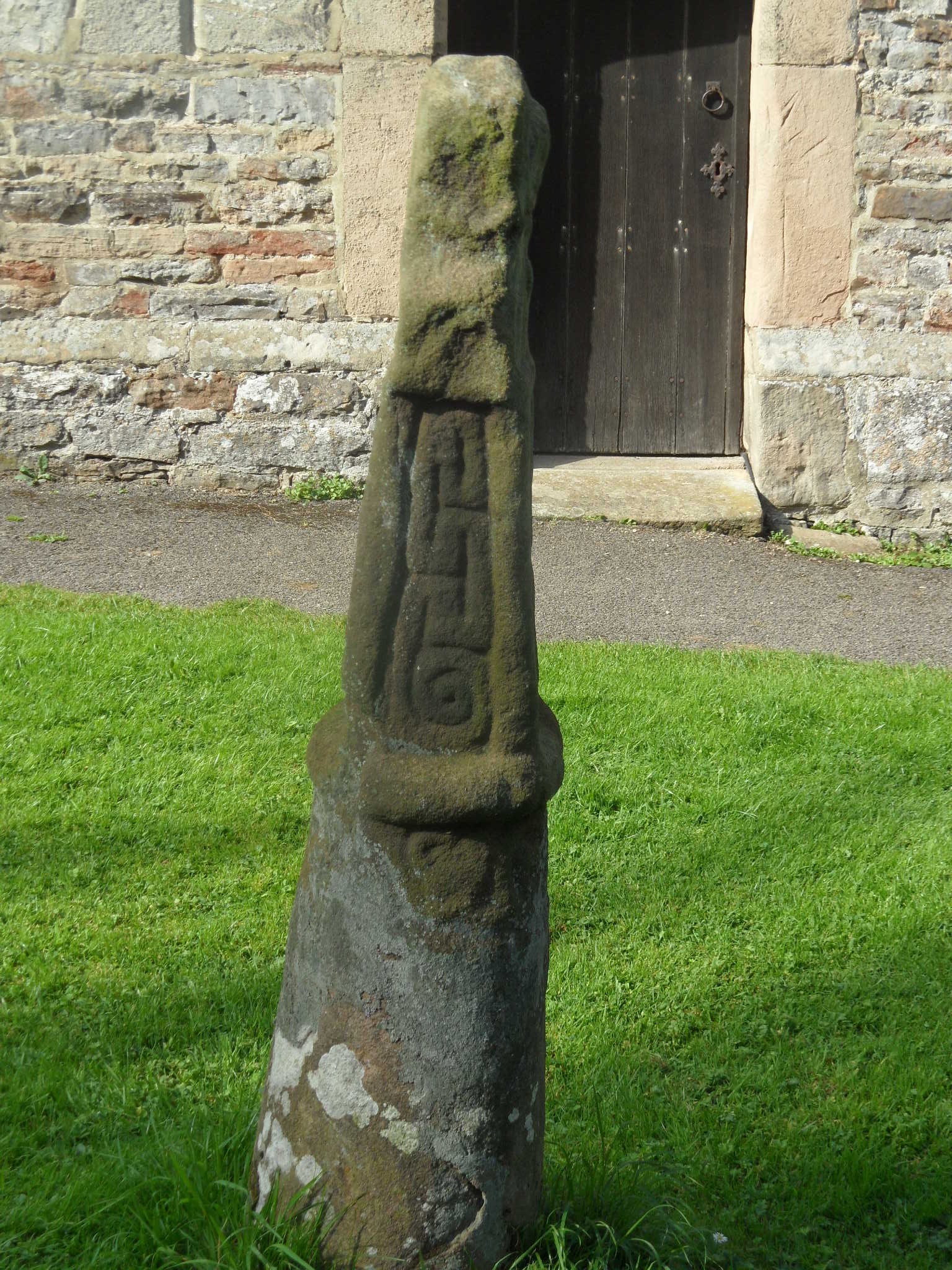
 

…..and imagine how much I kicked myself when I got home and found out there was yet another stone, known as ‘The Battle Stone’, located in the grounds of Ilam Hall that I had missed!

However, as a consolation, I learnt at home that this spring near to the church is thought by some to be St Bertram’s Well (although others place this on a hillside near to the village).
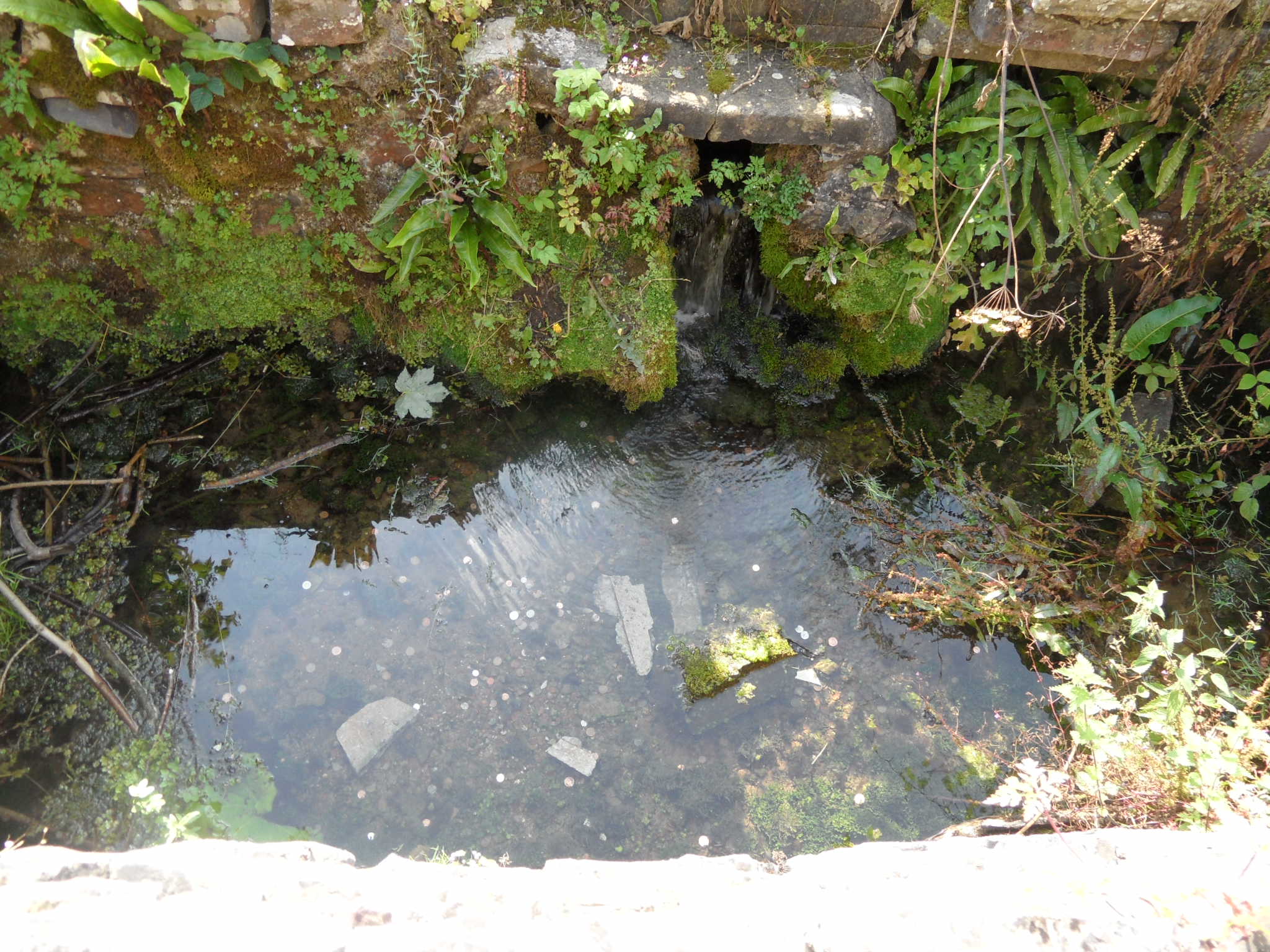
St Bertram’s Well?

The Shrine of St Bertram (also known as St Bertelin or maybe Beorhthelm of Stafford) is inside the church. As you might expect, there is more than one account of St Bertram’s life. The most well known version seems to be the tragic story that he was a Mercian Prince whose wife gave birth to a child in a forest. The wife and baby were killed by wolves and St Bertram became a hermit near to Ilam, It’s thought this story might be represented on the churches font, which dates back to around the 12thc.
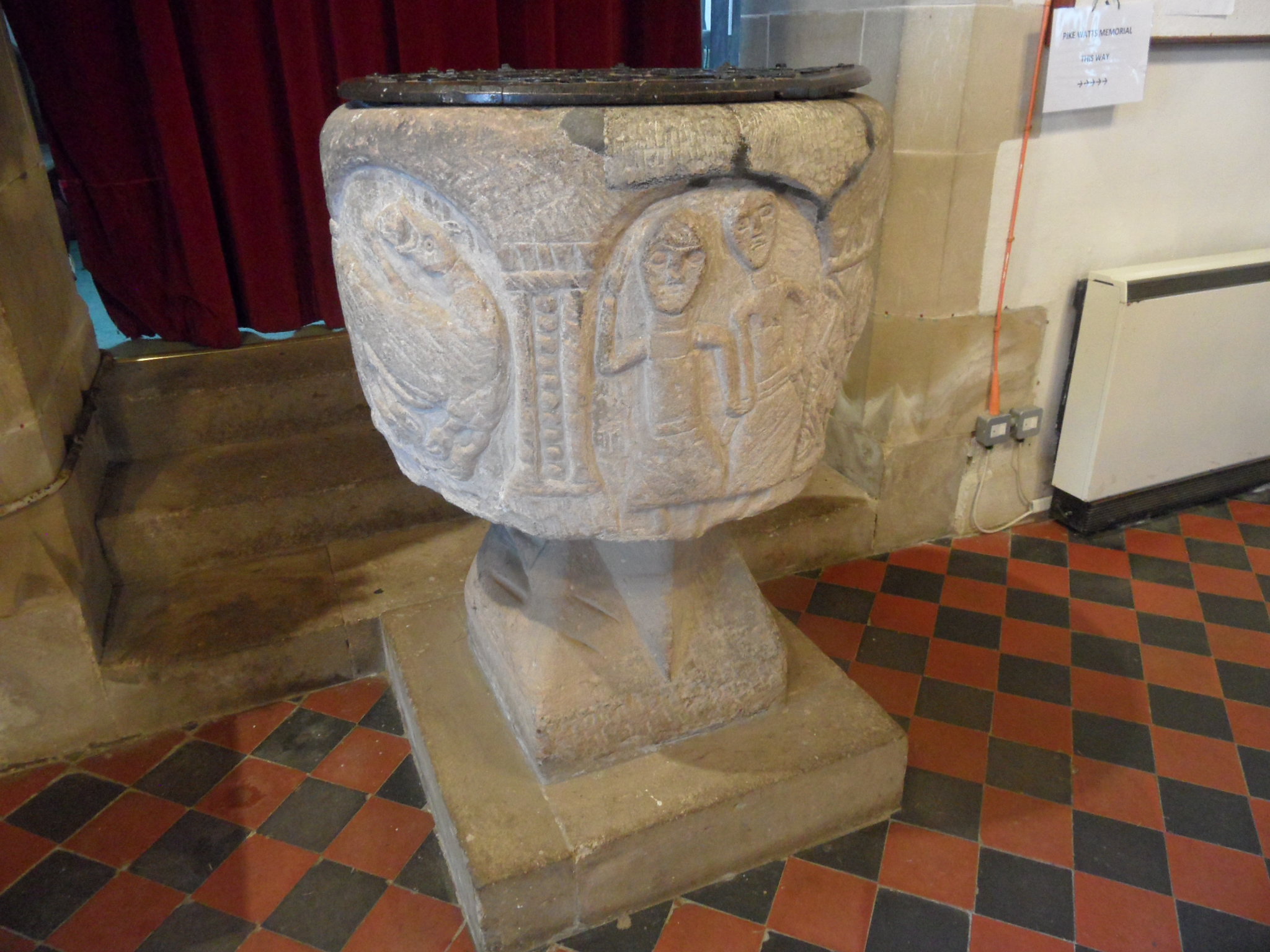
You can decide for yourself, if you look at this website on Romanesque sculpture, which gives a detailed description of the font, together with photos.

However, Stafford Borough Council have this version on their website, which doesn’t feature the tragic part of the legend.

The legend of St Bertelin derives from the 14th century account of him by Capgrave in his ‘Nova Legenda Anglie’, retold by Dr Robert Plot in his ‘Natural History of Staffordshire’ (1686). He is reputed to have been the son of the Mercian prince, the friend and disciple of St Guthlac who, after St Guthlac’s death c 700, continued his holy vocation on the islet of Betheney now Stafford. Here, he remained until forced to retreat from the ill-will of jealous detractors, when he repaired to Ilam, in Dovedale, Derbyshire where ultimately he died. His burial place in Ilam church was once a place of pilgrimage.

His burial place still seems to be a place where people come, not just seeking out history like me, but for spiritual reasons. As you can see from the photo of the shrine, prayers (I didn’t read them) and candles are still left there.

I have found a copy of the ‘Nova Legenda Anglie’, but as my Latin only stretched to ‘Caecilius est pater’, I need a bit of time alone with google translate.  So, I’ll leave the legend of St Bertram/Bertelin there for now other than to say that it’s believed that the remains of St Bertelin’s chapel in Stafford were excavated in the 1950s and they discovered part of a 1,000 year old cross. And this one is made of wood!

Ilam, Stafford and I’ve seen references to existing crosses in Wolverhampton, Leek, Chebsey (between Eccleshall & Stafford), amongst other places. With the discovery of the ‘Battlestone’ in Ilam (the one that I missed!) in the foundations of a cottage, during a restoration in 1840, I’m still clinging to the hope that at least a fragment of one survives somewhere in Lichfield!

Sources:

http://www.heritagegateway.org.uk/gateway/

http://list.english-heritage.org.uk/ (Entry numbers 1038113, 1012654, 1012653,

Corpus of Romanesque Sculpture in Britain & Island http://www.crsbi.ac.uk/index.html

http://www.geograph.org.uk/photo/705619

http://www.megalithic.co.uk/ (St Bertram’s Well http://www.megalithic.co.uk/article.php?sid=14731)
http://www.staffordbc.gov.uk/in-touch-with-the-past

Back to the Future

In the March 15th 1907 edition of the Lichfield Mercury, there’s an article written by Clifford Mackay entitled ‘Lichfield in 2007 – A Dream of the Future’. Old Ben Wallace, a Lichfield cobbler, takes a trip through the city streets and discovers how things have changed over one hundred years.

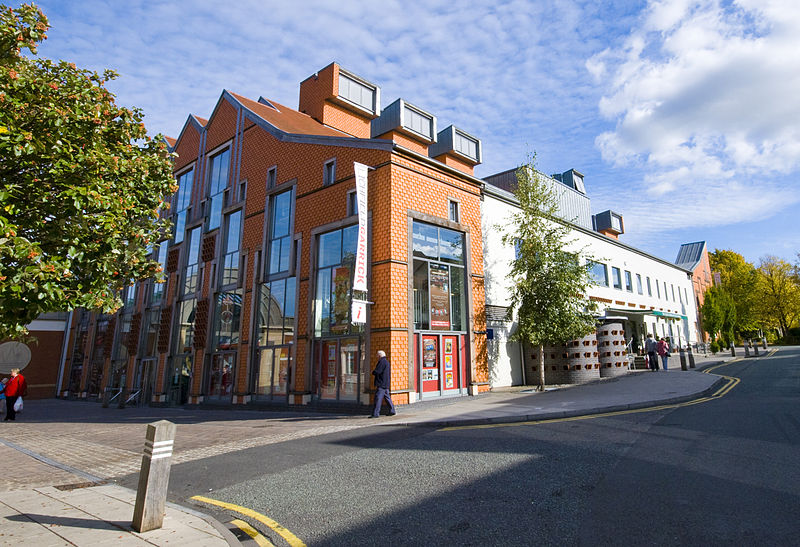
Here’s a heavily abridged version, so that you can see for yourself where Mr Mackay got it right (a new theatre called ‘The Garrick’, new houses, mixed schools), got it wrong (a tube station at the Friary, a model Venetian village hiring out gondolas) and sometimes got it very wrong indeed (meeting visitors from Mars on the way to Minster pool).

New houses, a large new theatre of varieties, and an entire renovation of the Market, now Dr Johnson’s Square, are amongst other things which come before his astonished eyes, besides a tremendous building called the ‘Royal Garrick’ Theatre, many shops bearing familiar names but entirely rebuilt, and all the streets reconstructed on an absolutely novel, yet excellent plan.

Garrick Theatre by Bs0u10e01 (image taken from Wikipedia)

….the old man noticed the date of the year – 2007- for the first time he also sees one of the airships from London come in. A tube station now stands at the Friary corner, and a large new hotel – the Savoy- has been erected. Sandford St is now a magnificent thoroughfare, and the ‘George’ and ‘Swan’ hotels have also been rebuilt. They encounter some of the visitors from Mars, and arrive at Minster pool, which has undergone great changes. The two pools, Minster and Stowe have been purchased by the council and now form magnificent pleasure lakes. The former is now illuminated every night, while a band plays from the wonderful new stand erected in the middle

They visit Elysia – the large new pleasure gardens formed out of the late Museum Gardens and Recreation Grounds, and take a trip round in a gondola hired from the model Venetian village

Museum Gardens early 20thc

Inevitably, old Ben finds himself at the Cathedral and it’s here where you begin to wonder if there is more of a point to this article than just a bit of fun. I don’t know enough about the protestant religion to comment but amongst other things, Ben the cobbler is told that,

 The church had grown very worldly – it was neither one thing nor the other – so it had to be purged. It was disestablished and set to rule itself, with the result that many parsons came to believe that after all they were not the demi-gods and worldly magnates that some of them imagined themselves to be. These people here took the lead and set the example to the rest of England – and it was quickly followed everywhere. They gave up their large houses and went to live in smallest ones(the bishop giving his up to be a hospital for the poor and needy)

…..the people are religious as anything – it is a reality to us and not a sham. The Cathedral is packed every Sunday, at all services too, it’s hard to get a seat.

Soon though whatever point is being made, has been made and Ben finds himself

…close to the new marvel, which stood in the field before the Stowe Pool….raised in five lofty square iron towers, nearly sixty feet in height, one being at each corner, and one in the middle was a gigantic platform…..Inside each of ther four corner towers the old man could distinguish lifts ascending from, and descending to the ground floor. Tethered to one of the sides her engines still throbbing, and having an indication with the word Aberdeen printed on it, affixed to its side, lay a huge aeroplane.

Away from the Cathedral Ben is surprised to learn  about the changes in another religion –  Lichfield City FC are doing well having won the English Cup seven times, fielding four international players and getting an an average gate of gate of 12 to 14,000 per match. Of course,the Lichfield manager does it for the love of the game and the reputation of the City rather than as a money making concern.

Ben also learns that the grammar school has been moved from its position near Borrowcop Hill due to drainage issues and that,

…all the schools are mixed in England now. Girls and boys all work together…its a splendid system

At the end of the walk it all goes a bit ‘Life on Mars‘ as old Ben is knocked down by a car on Wade St. But of course, as with all the best stories, it turns out to be just a dream, and he wakes back in his workshop back in 1907.

I know that a prediction of the year 2007, made a hundred years previous is a bit of an  easy target.  I’m sure if I were to make predictions here and now about the year 2112, it would be mostly ridiculous. Could we predict the next 50 or even the next 10 years? In looking to the future of Lichfield, would it reveal anything about our present? Maybe we should give it go. It’d give future generations a good laugh if nothing else. Any volunteers?


What's the Story?

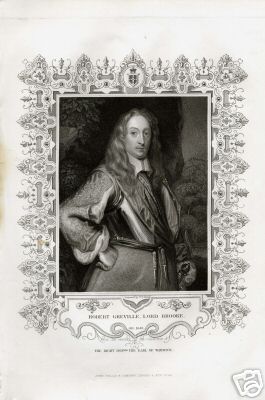
On a building called Brooke House in Dam St is a plaque.  The name and the plaque’s inscription relate to the man killed there during the civil war. According to the Public Monument & Sculpture Association records1, Richard Greene (he of Lichfield’s Museum of Curiosities) commissioned the plaque in the 1700s, and it reads as follows:

‘MARCH 2ND 1643 LORD BROOKE A GENERAL
OF THE PARLIAMENT FORCES, PREPARING TO
BESIEGE THE CLOSE OF LICHFIELD, THEN GARRISONED
FOR KING CHARLES THE FIRST, RECEIVED HIS DEATH WOUND
ON THE SPOT BENEATH THIS INSCRIPTION BY A SHOT IN THE
FOREHEAD, FROM MR DYOTT. A GENTLEMAN WHO HAD
PLACED HIMSELF ON THE BATTLEMENTS OF THE
GREAT STEEPLE TO ANNOY THE BESIEGERS’

A couple of weeks ago, I’d have said without hesitation that I knew this story. Lord Brooke was shot through the eye and it was John Dyott (or Dumb Dyott as he was known) with a musket from the central spire of the Cathedral.  It’s possible that this is the correct version, but as I know now, it’s certainly not the only version.

Lord Brooke (source: Wikipedia)

 According to a letter from Richard Greene2 the version he based the inscription on was from Sir William Dugdale’s 1681 book ‘The Late Troubles in England’. Greene believed this gave the most ‘circumstantial account of the affair’. Over in the comments section of the Shopping Daze post, Pat & Ian have been discussing the affair, following a comment left by ‘Born a Lichfeldian’. In arguing their case, Pat & Ian have both done some research – Ian has found these different accounts on the Learning with Archives in Staffordshire & Stoke on Trent website and Pat has found a programme that includes a section about John Dyott. 


The fact that Brooke was killed on 2nd March doesn’t seem to be in dispute but inevitably, with this date being St Chad’s day the significance attributed to this does differ. Some, like Archbishop Laud suggested that St Chad had a hand in events…..

So, let’s imagine there was a way to prove exactly what happened on 2nd March 1643 (yes, I’m still thinking about my reconstruction idea!). What would we gain and what would we lose by doing so?

I can’t add any new photos so I can’t provide one of Brooke House. How about walking a few of those mince pies off with a stroll up Dam St to have a look for yourself?

Big thanks to Pat & Ian for all their contributions to this post and those in the pipeline 😉

 Sources:
1.http://pmsa.cch.kcl.ac.uk/BM/STliLIlb010.htm
2. Vol 55 of The Gentleman’s Magazine,