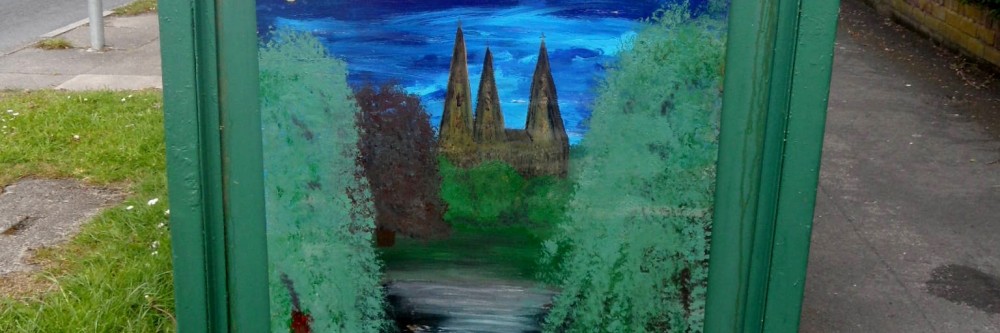
The Valley of Phantoms

I’m reading the memoirs of a man named William Purcell Witcutt. Like me he had connections to both Birmingham and Staffordshire, and was fascinated by folklore. Unlike me, he was an protestant vicar who converted to Catholicism before being exiled to the furthest outpost of the Diocese for the crime of commenting on the corrupt nature of many medieval priests. Yes, they sent him to Leek.

In his book, ‘Return to Reality’ there is a chapter called ‘The Valley of Phantoms’, in which he describes how, ‘Leek lay hidden in mist and woods in the middle distance, and one of the older boys tried to convince me that it was invisible from the air. Leek will never be bombed said he, and quoted with assurance the prophecy that there would come a time when, ‘there will be no safety in the land save ‘twixt Mow Cop and Morridge’.
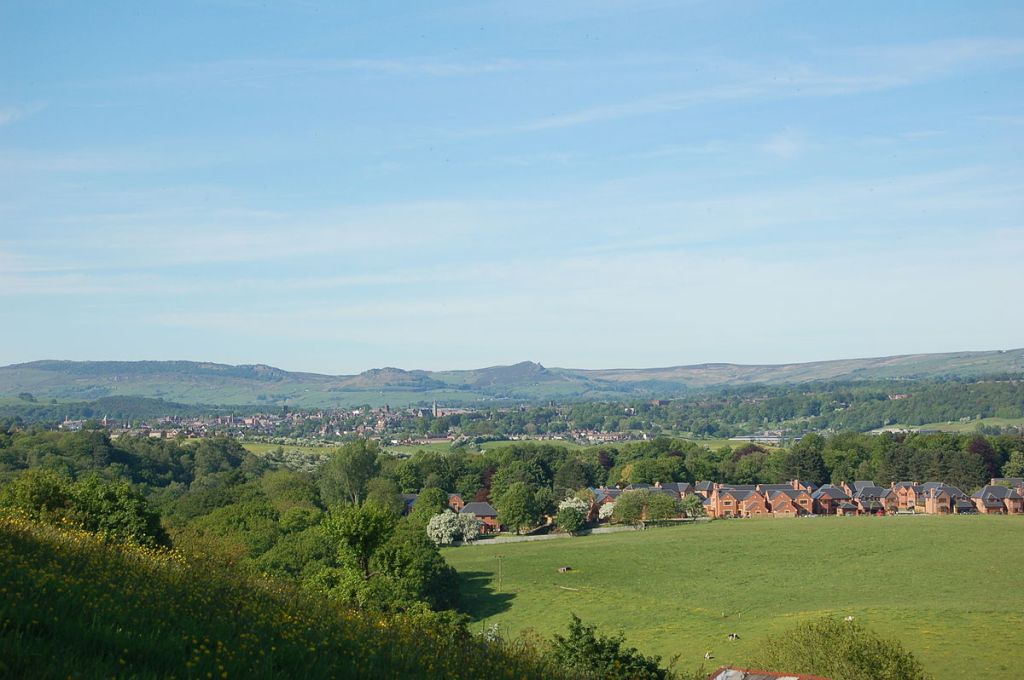
No I can definitely see it

Witcutt was soon to find plenty more superstition in this Staffordshire Moorland town. It seemed to him that the valley and moors around it swarmed with ghosts and bogies, which people still believed in. There was the Headless Horseman, or in Leek dialect, ‘a man on an ‘oss without yed on, an awful gory sight’, and nearby was a Black Dog who guarded the graves of those who died a violent death. According to Witcutt, the Queen of the Leek demons was the Mermaid of Black Mere, who I wrote about many years ago here. A new story to me was that of ‘Ball Haye Jack’, a little grey man whose appearance in front of one of the mills was believed to bring bad luck. One curious custom Witcutt noted was that on seeing his collar, the girls and women who worked in the mills would touch the factory railings, a somewhat unsettling reaction given it seems to be linked to the superstition that touching iron would protect against the power of a sorcerer.

One of the strangest spots Witcutt writes about is the Coombes Valley, When he visited in May 1940 he found a farmer planting potatoes and as the man sowed his spuds, he shared stories of the valley. At a place nearby, the spectre of a murdered man was said to ride up and down the ridge. Once seven priests came to lay him but all but one of the gathered fathers fled. The final man standing held up a stone in the brook, dismissing the pleas of the phantom for mercy, and laid him beneath the rock. The process appears to have been unsuccessful however and so the dead man rode out once more. This next time he was laid beneath a hawthorn tree at a place known very appropriately as Spirit Hole. Even that was only sort of successful though as he still haunts the valley, although now in far less malevolent form of a bird heard singing as the night falls at the Spirit Hole. The stone which had failed to keep the ghost grounded was still there when Witcutt visited (and I believe it still is), and according to the farmer it had once been a stone of sacrifice.

No wonder the valley is full of phantoms.

Source: WITCUTT, W.P. Return to reality, Macmillan, 1955.

My Bloody Valentine

For those of you who aren’t feeling the love for Valentines Day, here’s some black magic. And I’m not talking chocolates. In his Lichfield Mercury column ‘Historical Gleanings – Lichfield Over a Century Ago’, JW Jackson recalled the following article in a local paper from 1836,

“On Saturday, the sexton of a certain church observing an elegantly dressed female walking mysteriously up and down the churchyard, watched her secretly, when he saw her rake up the earth with her foot and, after depositing something in the ground, cover it up. Induced by curiosity he opened up the place and found a hare’s heart in which 365 pins were stuck buried there. It was an old superstition in this county that if a person who had been foresaken by one professing love for her shall bury a hare’s heart full of pins near a newly made grave in the churchyard, as the heart decays, so the health of the faithless swain will decline, and that he will die when it has mouldered to dust. The fair deceived one had been instigated by revenge to this act of folly and credulity.”


Getting revenge on a faithless swain. Sweeter than a whole box of Thorntons. Frederick William Hackwood also mentions a similar practice in his Mercury column on “Staffordshire Superstitions’ (1923), ‘Among the lingering superstitions are present-day memories of an old woman given to witchcraft sticking a bullock’s heart full of pins with the vicious intent of piercing the heart of some deadly enemy with whom she had quarrelled beyond all hopes of forgiveness or reconciliation”.

Luckily, a defence against these dark arts did exist.  In a book published by the Folklore Society in 1890, Alexander M McAldowie tells of two witch brooches which his brother Robert found in Staffordshire.   One was discussed in a section of the 1896 Journal of the British Archaeological Society called ‘Notes on North Staffordshire’ and is described as being heart-shaped with unequal sides, little more than an inch in height and made of silver with eighteen crystals. Apparently, these talismans were often bought alongside wedding rings and would keep the wearer safe from harm. In a post on witch brooches, the Spyders of Burslem blog includes the notes given to the North Staffordshire Field Club in 1891 by Robert McAldowie. What’s extra interesting for us here is that he mentions a witch brooch he got in Lichfield from a jeweller who had bought two of them from an old servant of a family once living near the city but had melted one down for silver.

I’ve not managed to track down the whereabouts of any the Staffordshire brooches yet, assuming they even still exist. There is a Victorian one for sale on a vintage site here if you want a belated present that looks pretty and has the added bonus of protecting your beloved from witches and evil in general.

Antique Victorian Witch Brooch. Image from rubylane.com

Antique Victorian Witch Brooch. Image from rubylane.com

However, if it’s a hare’s or bullock’s heart you’re after, I’m afraid I can’t help you. Try Waitrose.