Forge and Ford

As the afternoon’s weather in Longdon was not quite warm enough for basking in the beer garden of the Swan with Two Necks, I took myself off for a little wander. The pub has a late 19th century map mounted on the wall, and it shows that the building next door was once a smithy. I’ve always had a soft spot for these simple buildings, softened even further by the discovery that one of my ancestors was an innkeeper with a sideline in blacksmithing. One of these days I’ll stop romanticising about it and actually get around to visiting Cirencester to see whether the forge is still there.  For now though, back to Longdon, where in May 1918, the then blacksmith, a Mr T Broadhurst had decided to give up the business and was selling the tools of his trade. On offer was a grindstone on a iron frame, two circular double blast bellows (nearly new), a treadle drilling machine, two black staple vices and other useful tools. The building remained a forge until 1938 and now is home to the WI.

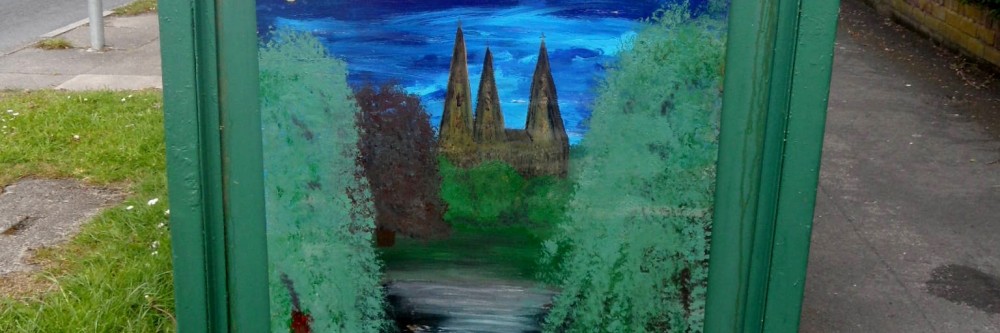
Something else that appears on the pub’s map is a ford, which as the name suggests, is at the end of this lane. I had a walk down and within minutes found myself alongside the Shropshire Brook. I stood for a while on the little footbridge watching tiny yellow birds flit between the trees and the water’s edge. Interestingly, on earlier maps this seems to be called the How Brook.

Fords “shine in the memory” according to the writers of England in Particular

I don’t know much about fords, other than they are a way of crossing streams and rivers, presumably at their shallowest points. Whilst reading up on them at home, I came across a surprising account of an event that seems to have taken place here or very nearby (1).

Sir William Wolseley … lost his life about the beginning of the last century* in a very singular manner. He went to Lichfield one morning about nine miles from his house in his coach and four and on his way passed a little brook which runs across the road at Longdon and which is so shallow that a foot passenger can easily step over it the water being kept up by a mill dam at some distance from the road. When Sir William Wolseley reached this brook on his return home in the evening the mill dam just at that instant suddenly gave way the water rushed across the road overturned the carriage and drowned Sir William with his horses. The coachman was thrown off the box into a tree and escaped.

*July 8th 1728 according to the inscription on the monument to Sir William in Colwich church

Could this these gently flowing waters really have caused such devastation? It’s hard to imagine. A reminder, I suppose, that whether it’s the fire of the blacksmith, or the water turning the mill wheel, we can manipulate the elements of nature, but we are never fully in control.

Sources

(1) – A topographical and historical description of the Parish of Tixall in the County of Stafford, Sir Thomas Clifford and Arthur Clifford Esq, 1817.



The Dunk Cow

Trying to find a bit more out about the old Dolphin pub in Bore St, I had a look through the newspaper archives. I did find one really nice snippet – at the grand opening of Lichfield’s Co-op in 1914, Councillor JR Deacon, who built the new Co-op on the site of the Dolphin, presented the chairman with a walking stick made from one of the old inn’s beams.

However, I confess that sometimes when trying to find information in old newspapers, I often find myself distracted. I am utterly incapable of passing by a story with an intriguing headline.  If you think you could stay focused after turning up ‘Antics of Mad Cow. Swam Stowe Pool Twice’ in a search, then I salute your willpower. I, however, needed to know more about these events immediately and thought I’d share the unusual story here.

Ducks but no cows. By the way, is this Johnson’s Willow (well its replacement anyway)?

In 1946, two young men were spending a quiet Monday afternoon fishing at Stowe Pool Suddenly, they noticed a cow swimming towards them. The heifer got out of the water, charged at them and then started swimming back towards Stowe St. However, something must have changed its mind, as the cow then decided to come back, charging at a policeman who had just arrived on the scene. By this time, the fishermen and the pool attendant, a Mr Boston, were hiding behind Johnson’s Willow. Deciding to make a run for it Mr Boston headed for the Boathouse and the two lads jumped over the hedge. Unfortunately, so did the cow. With PC King in hot pursuit, the poor beast ran up The Windings and into a field, where finally having calmed down, it stayed overnight, before ‘being removed’ the following morning (the Mercury reporter thought it had been destroyed). Where the cow came from, and what caused this odd behaviour is not known. For those involved, I’m sure that this was quite a frightening experience at the time, but I do wonder if, once the shock had subsided, it went on to become a favourite family story e.g. “Tell us about the time you got chased by a cow, Grandad…”?

By coincidence the story is actually linked to the previous post about the Dolphin in a way – the two young men were butchery assistants at the Co-op! From a dolphin in Bore St to a cow in Stowe Pool, I love how you just never know what story is going to turn up next!

Bit of a Bore

Last night in the Horse & Jockey on Sandford Street, the Holden’s Golden Glow and the football were in full flow. The former was definitely more satisfying than the latter. As Spain made their millionth pass around the forty minutes mark, my mind started to wander. It wandered back to Bore St, where I was still trying to work out which of the ward banners belonged to this Lichfield ward and why (some of the name plaques underneath the flags were obscured when I went back to check).

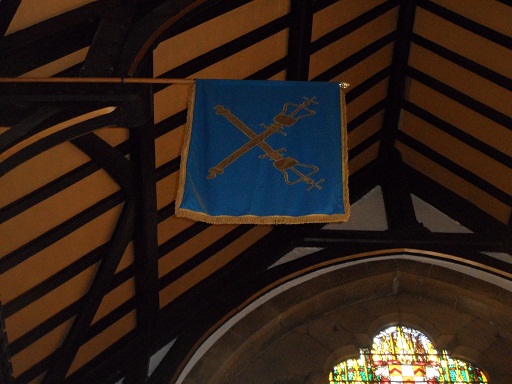
Bore St ward banner?


It dawned on me that this flag showed the city maces, which are used in civic processions and date from 1664 and 1690. The centre of civic events in Lichfield is of course the Guildhall on Bore St where of course the flag is hanging. So I should probably  have worked this one out a bit quicker!

The maces being carried in the 2012 Lichfield Bower procession


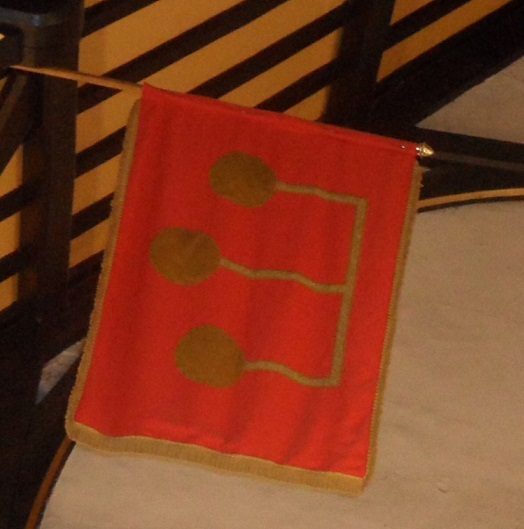
Whilst we’re on the subject of football, what about the golden balls of the Lombard St ward banner? I didn’t know until now but Lombard is another name for a pawn broker, and of course this type of business has long been identified by this symbol. Wikipedia explains that the concept originated in the Lombardy region of Italy.

Lombard St was once known as Stowe St infra barras (i.e. the part of Stowe St inside the barrs (or gate) of the city). Did the name change occur when this kind of business was set up in the street? Or is there another reason?

Lombard Ward banner