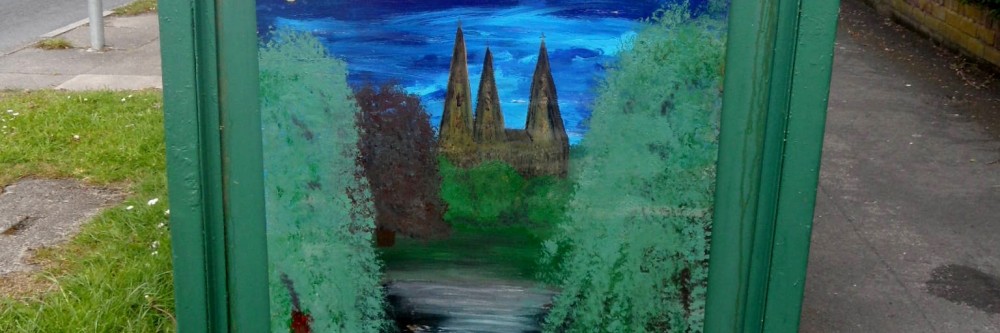
The Highwayman’s Grave

I love a tomb with a tale attached and the churchyard at Sandon delivered. An article in the Staffordshire Sentinel in December 1955, talks of, ‘a grave, said to be that of a highwayman who met his death at Sandon. Certainly the curious shape of a horse and rider on the gravestone would bear out this legend’. A misty winter’s morning, in the dead days of last December, provided the ideal conditions to seek it out and, as the fog swirled around our feet, we found it. Sadly, those curious shapes are now encrusted with lichen and much-weathered by the sixty-nine winters which have passed since the description in the Sentinel was published.
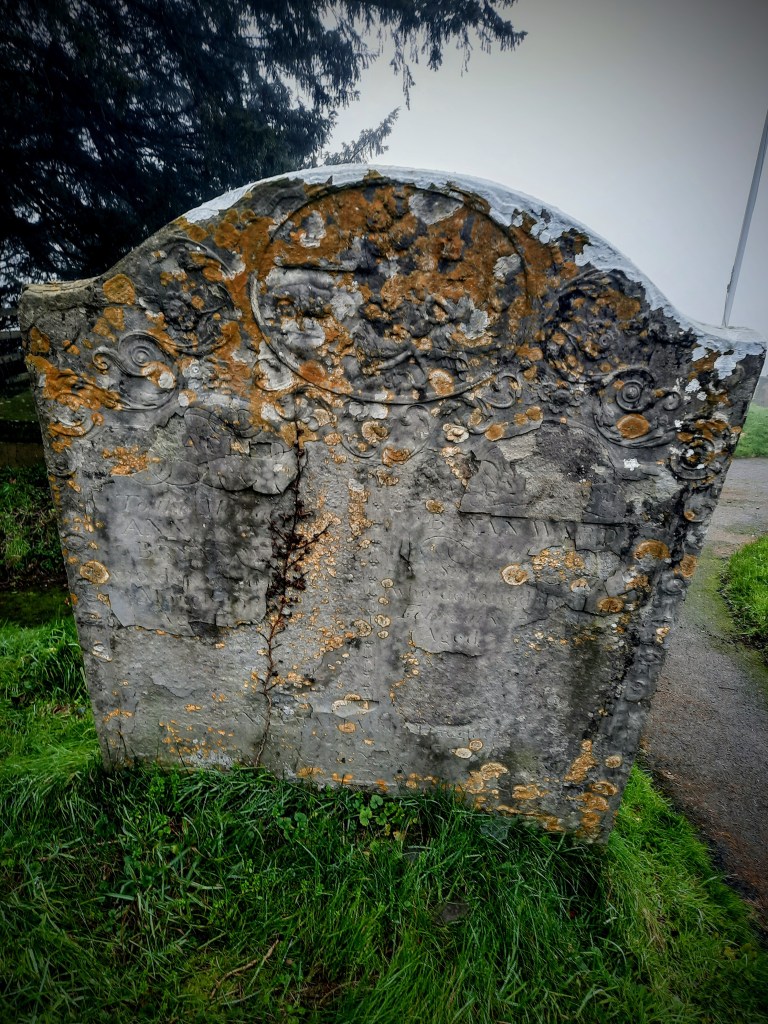
Six months on and I’m still trying to solve the mystery of the so-called highwayman’s headstone. A figure lays stricken on the floor, a man leaning over with his hand on their heart. Whether he’s trying to slay or save them isn’t obvious. To the right, two men stand look-out and at the back is a riderless horse. There’s a church in the carving but as it has a spire this can’t be Sandon, which does not. I’m describing it from a photo taken in 1965 ago which is in the Historic England collection. Unfortunately, their copyright rules don’t allow me to share it here for you to see yourself although I have contacted them to see if I can get permission.
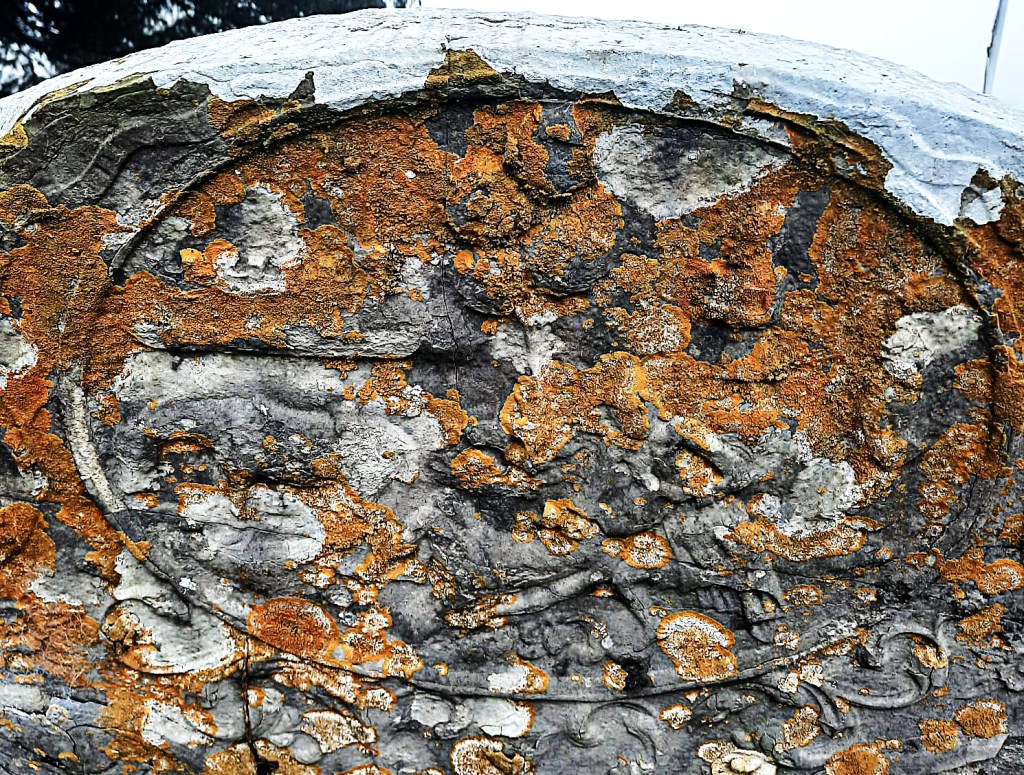
The inscriptions on the tomb are as follows:

To the Memory of
Ann the Wife of
BRYAN WARD
who departed this life
March 19th 1807
Aged 65 Years

BRYAN WARD
of Smallrice, Gent
who departed this life
February XX 1809
Aged 74

Anna Maria their daughter
died September 15th 1797

Something else is written below the inscriptions for both Ann and Bryan but was illegible even on the 1965 photo.

The All Saints parish register has the entries for Mr Brian Ward’s burial on 23rd February 1809 and five year old Anna Maria Ward’s burial on 15th September 1797. Neither has a note attached to suggest there was anything unusual or untoward about their deaths. I’m sure that had there been, the Vicar of Sandon would have included something as above the entry of Anna Maria’s is a record of the burial of Michael Tams supplemented to say he was drowned in the River Trent on the 25 Evening of December.
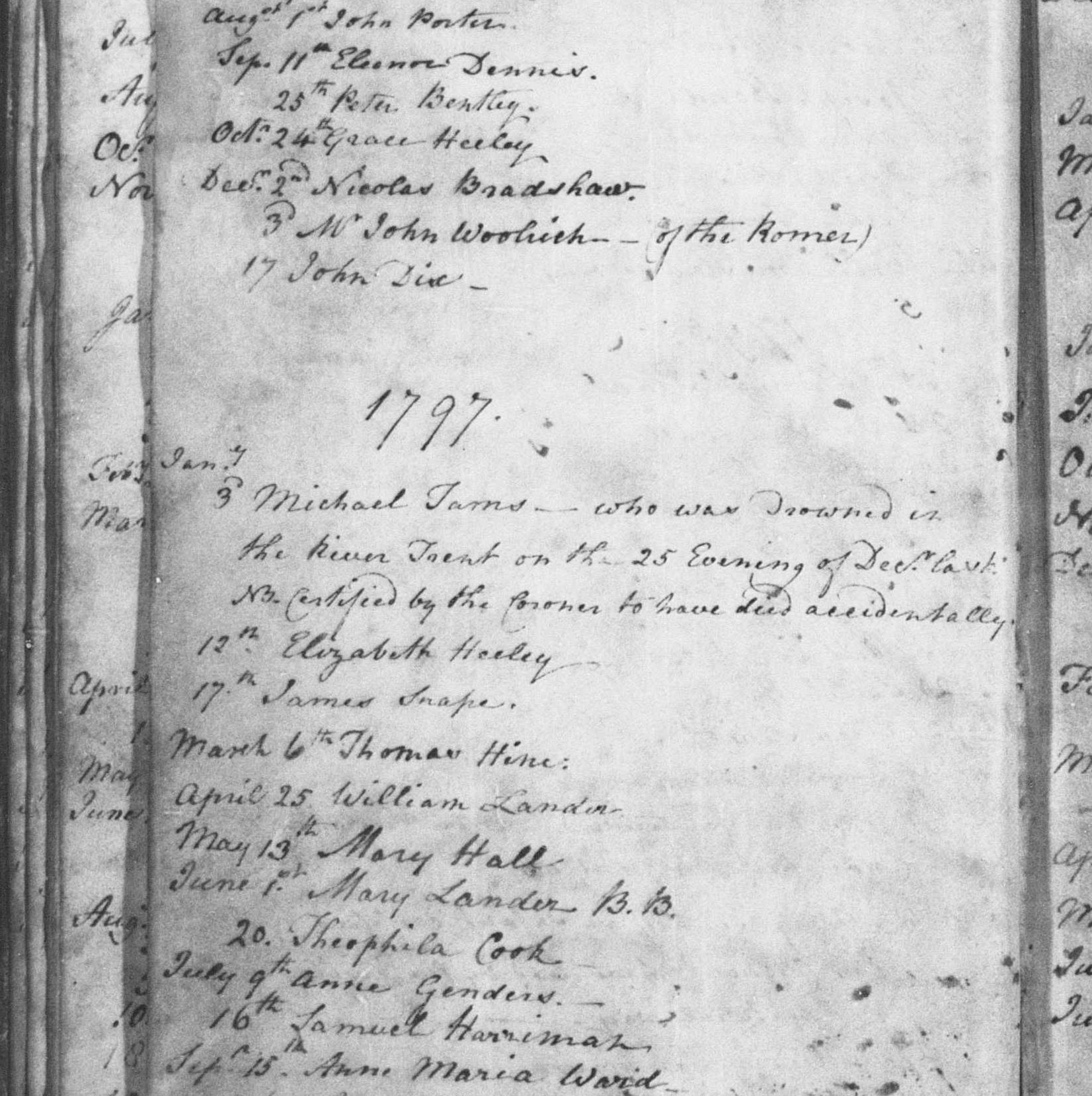
The burial record for Anne Maria Ward on 15th September 1797

What I can’t find in the Sandon register is a record of the burial of Ann Ward in 1807. In fact, I can’t find any record of her burial at all.
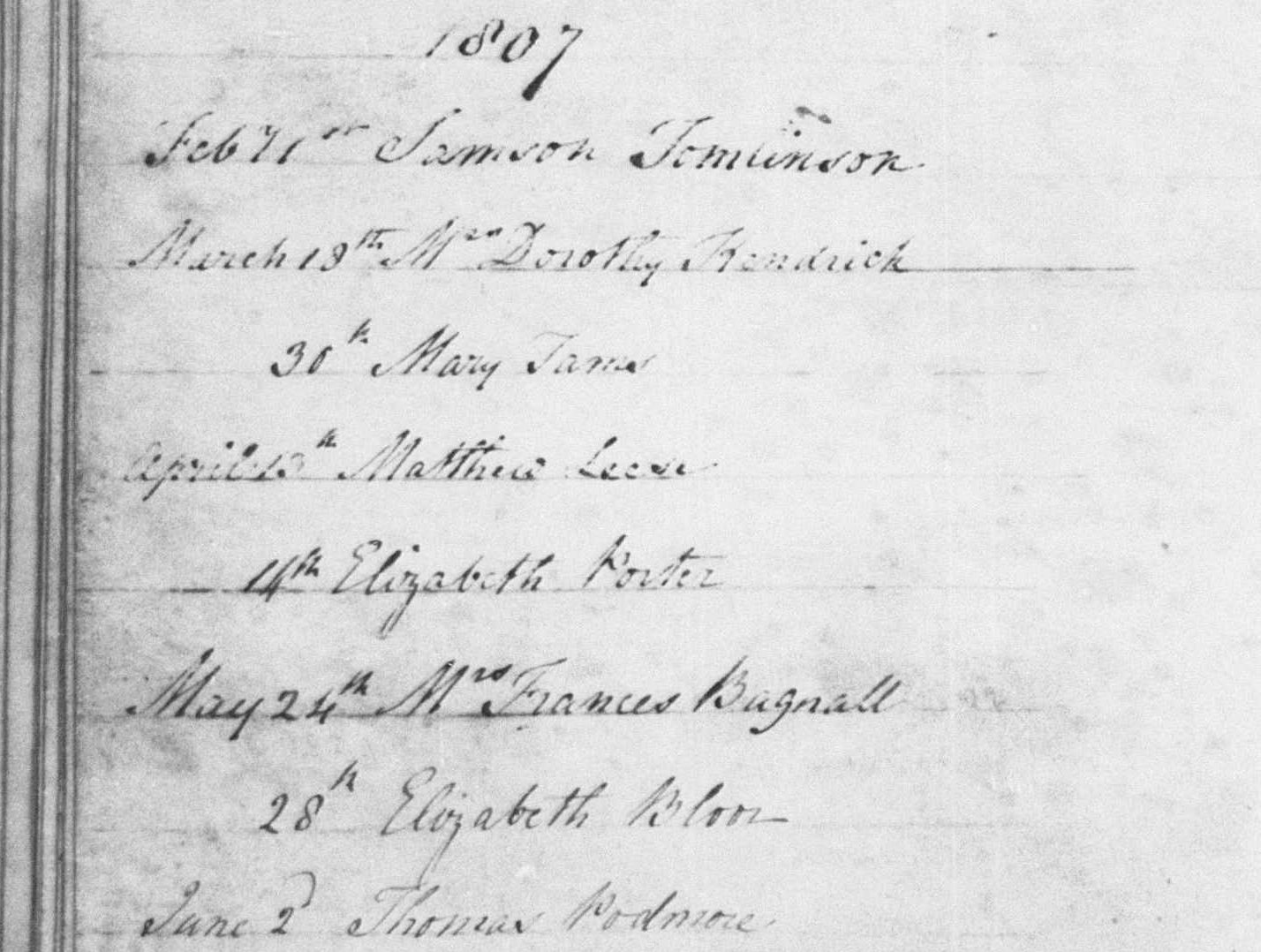
I’m starting to suspect that the curious carving at Sandon might depict the death of Ann Ward in someway but if she wasn’t buried beneath it here at All Saints, then where is she? Are we going to be able to solve the mystery and rewrite the local legend of The Highwayman’s Grave?

Sweet Bells

One Saturday morning, as I sat reading in Lichfield Library, I heard a clip clopping in the street outside. Standing up to look out of the window, I saw a horse and carriage making its way up Bird St. It occurred to me that this was a sound and a sight that people would not have batted an eyelid nor an eardrum at in previous centuries, yet to my twenty first century ears, it was something so out of the normal it warranted me putting down a good book to have a shufty.

More often than not, when we explore the way our towns and cities have changed, it’s the visual changes that we concentrate on – old photographs, old maps, landscape features etc. Yet the sounds of places change too e.g. the pools at Leomansley are quiet and still now that the waterwheel of the mill no longer turns, the sounds of animals at the Smithfield have been replaced by those of cars and shoppers and Beacon Street hasn’t heard a blacksmith hammering metal in a long time. However, amidst the changes, there is also consistency in the sounds that surround us.

The tower at St Chad’s church houses four bells. Three of them were cast in the seventeenth century and the oldest of these three dates to 1625 with the inscription ‘DOMINO CANTICUM CANTATE NOVUM’. The second is from 1664 and declares ‘GOD SAVE THIS CHURCH AND REALM THE KING IN WAR, I.C.1664. Even the youngest of the three, featuring the names Ralph Low and Richard Grimley, is from 1670 meaning that the people of the parish and those who are passing by have heard these bells ring out for well over three hundred years. The fourth bell is even older still, although no one can agree on just how old. An article in the Lichfield Mercury in August 1936 described it as ‘England’s Oldest Bell’, and gives it a date of 1033. As it stands, the country’s oldest inscribed bell is believed to be the Gargate Bell at Caversfield Church, Oxfordshire, dating to c.1215AD and the country’s oldest dated bell (1245AD) is at Lisset Church in Easy Yorkshire. Therefore if this date of 1033AD were true, we would probably have a another Lichfield Entry in the Guiness Book of Records (to go alongside the largest curry ever, cooked by Abdul Salam of Eastern Eye on Bird St). Yet, the St Chad’s website itself casts doubt on this claim as there wasn’t a tower to put a bell in at the church at this time! Another date suggested for the bell is 1255 but the County History also disputes this and says that it was probably cast at Nottingham c.1500AD. There is an inscription on the bell +O BEATE MARIAA.A.R. and some numerals that no-one can read, hence the enigma. I’d love to see it. Not that I would be any help at all in solving the mystery but you know I’d just like to have a look at it. See I’m not satisfied with simply hearing it – there’s that visual dominance of history taking over again.

I have actually been at the other end of the bell rope. After I stumbled upon a practice session on another Saturday morning, I took up a kind offer to have a go at ringing one of the St Chad’s bells myself. Whilst at the time I was too terrified of having a campanology related mishap to fully appreciate the moment, afterwards I thought of all the people that had rung those bells in the past, and all those who had heard them and the message they were conveying. Next time, you’re passing, stop for a moment and listen too.

Sources:

Lichfield: Churches’, A History of the County of Stafford: Volume 14: Lichfield (1990), pp. 134-155

http://saintchads.weebly.com/the-bells.html