Lichfield Cathedral and the Chimney Sweep

Most of the medieval figures on the Western Front of Lichfield Cathedral, damaged during the Civil War, were removed in 1744.  However, a few were removed a later date (possibly 1749) by a young chimney sweep at the request of the Dean who was afraid that one of them might fall on his head on his way into or out off the Cathedral!


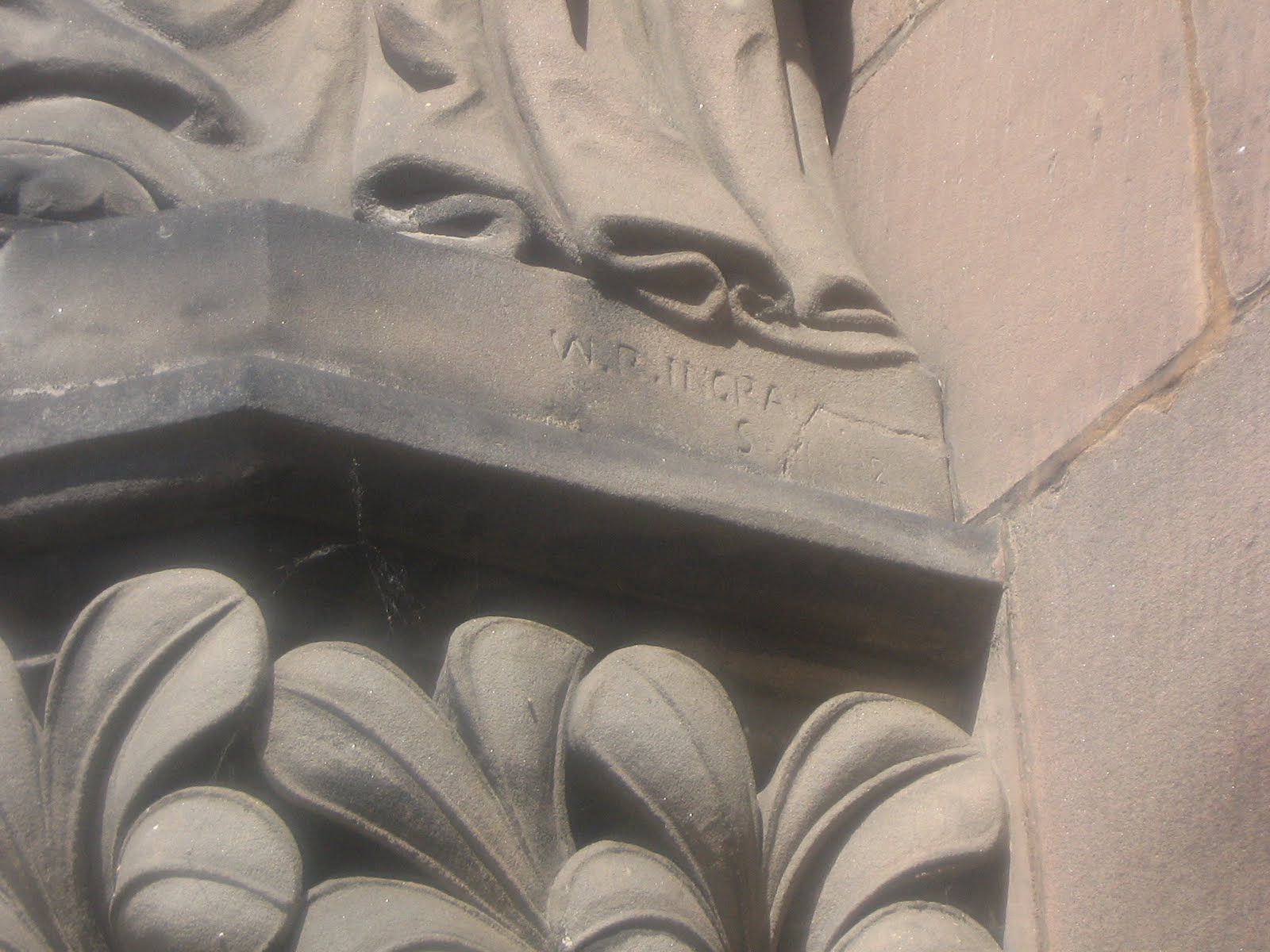
WR Ingram, on sculpture of St Stephen
Most of the figures seen today are Victorian replacements, sculpted by Robert Bridgeman & Sons, GWSeale, WR Ingram . HRH Princess Louise sculpted the statue of her mother, Queen Victoria.  There are five remaining original medieval sculptures on the north west tower.  Originally the medieval statues would have been painted and gilded.
Sources:

Public sculpture of Staffordshire and the Black Country by George Thomas Noszlopy, Fiona Waterhouse
TheCatherals of England MJ Taber

Lore on Tour! Drayton Manor – Police, Phantoms & Pirate Ships

This is a story of a place with two identities. There’s the Drayton Manor that was the home of Lettice Knollys (grand-niece of Ann Boleyn) and rebuilt in 1830 by Sir Robert Peel, founder of the Metropolitan Police Force and future British Prime Minister. Where Peel entertained Queen Victoria and Prince Albert in 1843 and from where his body was taken to be buried at the local parish church of Drayton Bassett following his death in 1850 from injuries sustained falling off his horse on Constitution Hill in London.
The Drayton Manor that passed to the next three Sir Robert Peels, only for them to fritter it away until all that remained was the ivy clad clock tower. Have a look here if you are interested in the story of how the estate came to ruin. 
History of the Peel Family 

 In 1950, the second Drayton Manor, the one most would associate with today was born, opening with one restaurant, a tea room, three hand operated rides, six rowing boats and some dodgems.  Some of my memories from the 1980s are of frisbee, football and picnics on the grassy car park, trying to stretch the day out, because Mum and Dad wouldn’t buy any more ride tickets; the horror of plastic animals jolting up out of the water and the dark tunnel of the Jungle Cruise *shudder*; finding out the hard way that sitting on the end of the Pirate Ship is not the same ride as sitting in the middle of the Pirate Ship, and perhaps most of all The Snake Train, which was toned down in 1986 and finally closed in 1993, saving future generations from bruises, whiplash and worse. For some pictures of Drayton Manor Park from the 1950s to the 1990s visit their website Drayton Manor 60th Anniversary 

Now, I can’t resist a ghost story, and Drayton Manor has a fair few.  Sir Robert Peel, whilst Prime Minister, was taking a walk in the grounds of Drayton Manor, when apparently his father (deceased) appeared to him and had a chat.

Sir Robert himself is believed to have been seen wandering the grounds or riding his horse up the drive to the caravan site (!). People have heard horses running towards them in one of the lanes at the back of Drayton Manor.  Opposite the nearby central stores, the black outline of a gentleman, said to be ‘Sir Bobby’, can be seen standing looking woefully into the distance. Perhaps he’s thinking about his spendthrift descendants and his squandered legacy.However, the naughty Peels still seem to be having a good time  – in the park’s Missanda Suite lights switch on and off on their own accord and even party-like noises have been heard coming from the suite late at night.  Also, beer occasionally dispenses itself at the Park Inn where the clock regularly comes off the wall for no apparent reason. At the clock tower, one of the few features of the original Drayton Manor building, ‘someone’ has been seen loitering around and even climbing the tower itself. 

One final interesting fact about Drayton Manor is that the Tamworth Breed Pig originated at the Estate.  Also, there are some pictures of the house and estate at the StaffsPastTrack website

Lichfield Lunatic Asylum

“The Lunatic Asylum, pleasantly situated at Sandfield, about 1 mile S. of Lichfield, is a well conducted institution, belonging to Dr. Rowley, of Freeford Cottage. It was commenced in 1818. Mr. Samuel Heighway is the superintendent”, was William Wright’s description in his 1834 History, Gazetteer & Directory of Staffordshire.  Figures for 1844 show the asylum housed 4 private and 32 pauper ‘lunatics’.
In 1851 “The Parliamentary gazetteer of England and Wales” was still describing it as a ‘well-conducted and useful institution’.
However, this was far from the true state of affairs – in 1847 the Lord Chancellor had submitted his report “Commissioners In Lunacy” to parliment, as follows:
“No particular mention of Sandfield Asylum in the County of Stafford, occurs in the Report of 1844, except that it is stated …”that a Patient thereto. had escaped from it, and had not since been heard of. The premises, however, are inconvenient, and the rooms and yards appropriated to the Paupers very confined. On visiting the Asylum in February and April, 1846, various defects were observed by the Commissioners, and commented on, with a view to their removal; similar remarks had been made by the Visiting Justices, but apparently without much effect. The outer dormitories, for the Paupers, especially were noted as being cold, damp, and uncomfortable. On again visiting the Asylum on the 17 th of December last, the Commissioners found the place in a very unsatisfactory state. After adverting, in their report, to the want of space in the yards (which are exceedingly small and unfit for the purposes of exercise, and are moreover surrounded by high buildings), they state, amongst other things, that they observed no tables in any of the Paupers’ sitting-rooms (where, however, they dine and take their meals): that the bed clothes were quite insufficient during that inclement season; that in the various beds which they uncovered they found only one rug and a blanket for the upper covering, many of the blankets being old and several consisting of fragments only: that a Patient in bed complained of being starved with cold: that the Patients of both classes, with scarcely an exception, were unemployed; and that they (the Commissioners) saw no book nor any means of amusement provided for them. Upon hearing this report read at the weekly board, we directed a letter to be addressed to the Proprietor of the Asylum, intimating that unless the defects noticed in the last report were forthwith remedied, we should think it our duty to recommend that his licence should not be renewed. This establishment is by no means well adapted to the accommodation of Insane Patients”.
A further horrfiying account was given by Robert Gardiner Hill* in his book ‘Lunacy: its past and present’, who described the asylum as “One of the most disgusting places I visited”.  He goes on to say “The house was in a state of filth, and the buildings generally unfit for occupation. The patients were barely clothed, fastened and manacled as was usual at that time”.
 According to A History of the County of Stafford: Volume 14, the asylum was finally closed in 1856 following recommendations from the comissioners that the licence be revoked.
A County Asylum opened in Burntwood in 1864.

 
*From wikipedia ‘Robert Gardiner Hill MD (1811-1878) was born in Louth, Lincoln, of parents engaged in trade. He is normally credited with being the first superintendent of a small asylum  (approximately 100 patients) to develop a mode of treatment where by the reliance on mechanical restraint and coercion could be made obsolete altogether, a situation he finally achieved in 1838′.

'Ofsted' Report 1869 – Lichfield Grammar School

So again, looking for something completely different I came across this little gem which I thought I’d share.   Mr Green’s report on Lichfield Grammar School is a lot more complimentary than his report on the school at the ‘large lifeless village’ of Abbots Bromley!  

Odd Grammar School, St John St

Lichfield Free Grammar School – Mr. Green’s Report (1869)
   

I have elsewhere spoken of the grammar school here as rather more select than most. The yearly payment of an ordinary day boy at it would come practically to 12l. a year; that of the six foundationers to 4/., against which has to be set 1/. 6s. 8d. paid yearly to each of the foundationers. Lichfield being a town in which there are a good many professional men, there is no difficulty in getting a fair number of boys at the terms mentioned. When I was there, 26 day boys (including foundationers) were in attendance, with 17 boarders. The terms for the latter, I was told, were not uniform. Meanwhile there are two commercial academies in the town. At one of them, from which I obtained some information, there were 24 day boys at 4/. each a year, and 12 boarders (mostly sons of farmers) at from 22/. to 25/. a year. I was not allowed to examine this school, but I think that little is learnt in it except the reading and writing of English, and arithmetic. In the other I understood that there were about 20 day boys. There is no doubt that the existence of these schools is chiefly clue to the expensiveness of the grammar school, and to the proportion which the attention given in it to Latin, Greek, and French, bears to the attention given to ‘English’ and arithmetic. Whether the presence in the grammar school of the sons of professional men, who now attend it, could be combined with that of the boys now sent to the private commercial schools, is a very doubtful question.
All the boys in the grammar school learn Latin, French, and drawing. All begin Greek in the second class (from the top) unless the parents object. One or two learn a little German. In the first class, when I was there, were five boys, aged respectively 15, 15, 16, 14, 15. Two of them (not the best) were boarders. Of three day boys one was the son of the station master, the other two were sons of professional men. They had been reading Virgil, Xenophon’s Anabasis, and the Hecuba. One of them, however, did not learn Greek. I heard them construe 100 lines of the 2nd TEneid, which they had got up for the second time the night before, and also some Xenophon. In both they construed readily and correctly, and were very intelligent about the grammar. They understood the formation of tenses in Greek, and the higher syntax. Two of them certainly would have been likely to do well at Rugby or Marlborough, if sent on there. In the second class were eight boys, of the average age of 14, of whom three were boarders, five (the highest) day scholars. They were doing Caesar and Greek grammar. They construed the Caesar very well, without the usual boggling over relatives. The third class I tried in English grammar and writing from dictation ; in both they did fairly. The arithmetic of the second and third classes was decent, but, considering that more than half the school was below the third, not so quick or correct as might have been desired. The Euclid, again, of the first class wasnot quite in proportion to their Latin and Greek. I gave the boys in it a few minutes to look over the last five propositions of the first book, which they had done some time before, and then set them to write out the 47th. Two did it well, but the rest failed. These boys could translate easy French into English, without dictionary, pretty well, but were puzzled by a difficult construction.On the whole I thought that quite as much had been made of the school as could be expected, but that the subjects of instruction were rather overcrowded. In particular it was to be regretted that arithmetic was taught only in half-hours, and those the least fresh half-hours of all, it having been the custom to assign the last half-hour of every morning to it. The behaviour of the boys was very pleasing.
The schoolroom was large and good, but had no class room. A gravelled playground of fair size, with a swing, adjoined. A field for cricket was hired elsewhere. The master kept some of his boarders in a rented house, the one belonging to the school not being large enough. When I was there, he employed two assistants, not graduates, whose united salaries were 1001 a year, with board and lodging. In addition to what I have said about charities and education at Lichfield in my general report, I have only to suggest the desirability of affiliating Minor’s school in some way to the grammar school.
Digest Op Information.
“The Municipal Trustees have a charity, called Terrick’s, for teaching poor children. It consists of consols, and a house and garden in Lichfield which stood under a building lease of 99 years at 5I. a year until June 1864. Out of the income was paid 5/. a year to the girls’ national school, and occasional accumulation sof the balance were divided amongst the three parish schools.
Head master’s house adapted for boarders. ENDOWED
Objects of Trust.—For a free grammar school at Lichfield for the instruction of poor boys (feoffment, 27 April 1587).
Subjects of Instruction.—School founded as a grammar school.
Government and Masters.—The trustees of the Lichfield municipal charities (appointed by Court of Chancery) appoint and dismiss the masters and fix the payments to be made by town boys.
Head master is not required to be a clergyman, or a graduate. The trustees do not object to his holding church preferment.
State of School in Second Half-year of 1864.

General Character.—Classical. In age of scholars, second grade.
Masters.—Head master and usher.
Day Scholars.—26 (in Jan. 1869) including six free scholars on Dean Walker’s foundation, and two free scholars on Terrick’s trust. Nonfoundationers pav 5l 8s. for general instruction. All pay 3/. 3s. for French and drawing, and 1/. is. for incidental expenses.
Boarders.—8 (in Jan. 1869), paying 52/. 10s. for board and instruction. French and drawing 41. 4s. extra. Four meals a day.
Instruction, Discipline. – At admission boys must be able to read and write.
School classified by Latin chiefly. School course modified to suit particular cases. Scripture lessons prepared on Sunday for Monday. Catechism taught.
School opened and closed daily with prayers from Prayer Book generally. Promotions according to master’s opinion of proficiency in Latin.

Examinations every year by examiners chosen by the master. Prizes to the first and second boys in each class, and for German, French, and drawing.
Punishments: extra lessons, detention in school, and caning in public; the latter by head master only.
Under masters may give extra lessons; monitors (first class) assist in maintaining discipline.
Playground, quarter of an acre, and field (quarter of a mile off) for cricket and football. No school bounds.
School time, 40 weeks per annum. Study, 32 hours per week for day boys, 38 for boarders. During last five years no boy gone to University.
List Of Trustees, &c.
Trustees (1865):
Rev. Trevor Owen Burnes Floyer, of Aldersham.
Rev. John Muckleslon,
Rev. T. G. Parr,
M. B. Morgan, Surgeon, }all of Lichfield.
H. W. Hewitt,
James Potter, Architect,
Steward and Treasurer: Charles Simpson.
Head Master (1867): Rev. J. M. Seaton, M.A.

Plague and Water

In 1840 Dr Rawson published ‘An Inquiry into the History and Influence of the Lichfield Waters: intended to show the Necessity of an Immediate and Final Drainage of the Pools’. The work was originally anonymous according to medical journal The Lancet.

According to the Lancet, Dr Rawson “contends that the stagnant pools around Lichfield are injurious to the health of the inhabitants, and urges several reasons for draining, and filling them up. This is objected to by certain lovers of the picturesque; and by another very opposite class of persons, who button up their breeches-pockets very closely, that the money may fructify there,when a call is made upon them for any public purpose”.

Part of Dr Rawson’s argument was that during the sixteenth and seventeenth centuries, Lichfield suffered five or six plagues. Although the whole of England had been affected, Dr Rawson argued that the effects in Lichfield were disproportionate for its size.

The doctor used statistics quoted in ‘ Harwood’s History,’ to produce the following table:

Statistics of the Plague in Lichfield, in 1645-6.

NORTH TOWN.

Beacon-street, Gaia-lane, Shaw-lane, Close, value £8.—Chiefly on ridge land, and all well ventilated, except the vicarage. The Close ditch was drained in 1643, and part of Beacon-street burned down, during the plague.

SOUTH TOWN.

Market-street, value £4 18s 4d; deaths 38; per cent. 18.—Defended by domestic comforts.

Dam-street, Butcher-row, Tamworthstreet, Boar-street, the Woman’s Chyping, value £4 14s 8d ; deaths 200; per cent. 16. —Exposed to external ventilation, except one side of Butcher-row; but partly adjoining the most infected districts, and containing a common channel, with stagnant water in it.

Stow-street, Lombard-street, Bird-street, Sandford-street, value £4 2s 7d; deaths 282; per cent. 41.—The extreme parts, small houses close to the pools. Bird-street, in the centre, being so narrow, that it has since been widened by act of Parliament.

Green-hill, George-lane, St. John-street, Frog-lane, Wade-street, value £3 13s 7d; deaths 321; per cent. 47.—Partly intersected by the Common Ditch and Common Muck-hill of the town, parallel to, but under the level of which were Frog-lane and Wade-street, while John-street was hemmed in between these and the Bishop’s Marsh.”

Statistics wise 51 per cent of Lichfield’s population died of plague in 1593-4, and 32 per cent, in 1645-6.

So, yet another miserable subject I’m sorry. I’ll try and find something a little more cheerful for next time……

Life in Lichfield Gaol 1839

I’ve found a report by the Inspector of Prisons for Lichfield Gaol, from 1839.  I think it is absolutely fascinating, so I’ll just be quiet and let you read on……

LICHFIELD.Borough Gaol And House OF Correction.

Construction.—There have been no alterations in the building since my former visit. It is in contemplation to buy the malthouse adjoining, in which case more yards, including a labour-yard, might be built.

There are here :—1 male debtors’ yard.
1 women’s ditto.
1 untried males’ ditto.
    1 convicted males’ ditto.
1 other.
Total, 5 yards.
There is no female debtors’ yard.
There are eight cells here, exclusive of debtors’ cells. In the year ending December 31, 1839, the highest number of prisoners here, exclusive of debtors, was nine.
Management.—This is a police-station house as well as a prison. The whole is clean and neat in proportion to the existing means.
There have been no alterations in the system since my last visit.
The keeper is still a constable, but he does not go out as such in general.
His salary is 60l. Five pounds per annum has been allowed to his wife, the matron, since November, 1839, when she received her appointment.
No wardsmen or wardswomen are employed.
No letters are admitted or taken out, except after being read by the keeper.
No visits to the prisoners are allowed without an order from a magistrate.
On the night preceding my visit, all the prisoners were sleeping in single cells, except one, who was put in the same bed with a debtor, who was melancholy and likely to commit suicide. Except the above, no prisoners were sleeping two in a bed.
The one female prisoner was sleeping in a cell by herself.
They are sometimes obliged to put two in a bed when the prison is crowded, but this might be obviated by placing more bedsteads in some of the cells.
Day-rooms are still in use. The labour is at present carried on in the day-room of the convicted prisoners.The number of prisoners usually confined here is small, and that the keeper does his best I fully believe; but the control over the prisoners is quite insufficient and nominal, because in his absence they are left entirely to their own humours and conversation. He affirms their behaviour to be usually orderly.
 

Escapes.—There have been none since my last visit.

Suicide.—There has been no case since my last visit.

Solitary Confinement by Sentence of Court.—In such cases the bed is taken out of an ordinary cell and the window closed with a shutter. Before the prisoner goes in, his breakfast is given him. He is taken out for an hour, daily, for exercise.

The diet is bread and water; and, on Sundays, potatoes and meat. The longest term of such confinement is a month; the average, a fortnight. Such persons go to chapel.

Refractory prisoners are locked up for one or two days in a darkened cell.

Religious and other Instruction.—About two years ago the curate of a parish in the town began to perform divine service once on Sundays, with a sermon. He comes occasionally at other times to inquire how the prisoners are getting on, but does not go into the wards. He has no salary, I believe.

The chapel is a small ordinary room, with no pulpit.

There is no ladies’ committee here.

The sacrament has not been delivered since my last visit.

The prisoners are attentive at chapel.

Books are well provided, but there is no instruction in reading.

The behaviour of the prisoners is moderately good. About five were punished for refractory conduct in 1839; but no one was put in irons.

The keeper, during the four years that he has been here, is acquainted with no case of reform after discharge.

Treatment of Sick, Disease, and Mortality.—There are no regular infirmary-rooms, but there are rooms with fire-places suitable for the purpose. The surgeon comes sometimes on passing by, to ask how the prisoners are, but only goes into the wards when sent for, or desired to do so, by the keeper. He sends in a bill, and has no salary. The health of this prison is good.

There has been no death since my last visit. I found no one ill, except a man with a venereal affection.

During the last four years, no woman has been confined to her bed, or has had a worse complaint than a cold. The only cases since my last visit have been colds, venereal affections, and itch. I found a bottle of dissolved salts in the day-room, which had been sent by the surgeon; the men took them when they thought proper. With respect to extra diet, one man now here has had half a pint of milk at night, and half a pint of porter at dinner.

Diet.—This is the same as at my last visit: 3/4 lb of meat in the week; 1lb 1/4lb of best bread daily; 1 lb. of potatoes daily; and 4 pints of gruel daily.

Labour.—It is in contemplation here to get a tread-wheel, or to introduce stone-breaking, if the ground of the adjoining malthouse be purchased. At present the prisoners grind beans and barley with a hand and a crank-mill; the latter will occupy five men at once, but no one is present during labour. If they get a tread-wheel, or break stones, it is then intended to have some officer present during the hours of labour. I found four men grinding beans and barley.

The profits of labour are very little.

The prisoners do not go outside the walls to work on any pretext.

Population.—This continues about the same.
The lowest number here at once in 1839 was, 2 (both felons).
The number of admissions from January 1 to December 31, 1839, was:

34 (including debtors).
32 (without debtors).
The above number does not include the night-charges.
The greatest number of women here at once in 1839 was, 2.
Greatest number of debtors at once in 1839, 2 (both men).
During the last four years there have been no female debtors.
At the date of my visit there were here:—
Men.
1 for trial.
4 convicted at sessions.
1 summary conviction.
1 debtor.
7 men, and 1 woman for non-payment of fine. Total, 8.
Of the 7 men, none had been here before.  

Stock.—The bedding consists of 10J prs. of sheets; 22 blankets; 10 mattresses for men; 10 bedsteads. Combs, towels, and soap are well supplied. The stock of clothing consists of 6 suits for men; 16 shirts (12 new); 8 pairs of clogs, and 12 of stockings; 2 shifts; 2 flannel petticoats; 1 black petticoat; 1 pair of shoes; 1 pair of stays; no cap; 2 gowns; 2 aprons.

Registration.—There is one register.
General Remarks.—No prisoner has ever been sent to the county gaol at Stafford during the four years that the keeper has been here. There has been no case of capital offence, or such would have been sent thither.
Relief on Discharge.—Such relief is not afforded without application to the magistrates, and never unless the prisoner has behaved well, and has a long way to go.

Suggestions towards Improvement.

1. Some separation should be made in the chapel between the male and female prisoners.
2. Separate locks and keys should be used on the female side, as directed by the late Prison Act.
3. The window of the untried prisoners’ day-room should be made to open.
4. A journal should be kept by the chaplain and surgeon.
5. More bedsteads and bedding should be procured in order to enable each prisoner to sleep in a separate bed.
6. In order to promote a better separation of the prisoners, three bedsteads should be put up in the room called the weighing-room, which is at present not used as a sleeping-room.
7. The room in which the wood is at present kept should be prepared and used as a dark cell for refractory prisoners.
8. The hard labour at present carried on here is little more than a mode of passing away tedious time, because there is no paid officer present to control the prisoners. It cannot be expected that the keeper can be constantly present. The appointment of a turnkey would be a great advantage in this respect, as well as generally for the better ordering of the prison.
9. This prison has not a sufficient number of wards or divisions to comply with the late Prison Act.

If anyone wants to read more, here is a link to the 1847 inspection.  The inspector’s not too impressed…..

The Bones of Lepers at Freeford

There may be a deserted medieval village at Freeford, (Fraiforde in the Domesday Book).  Evidence consists of surface finds of pottery ranging from 12th – 16th century together with some documentary references in 1334 and 1377 in the form of taxation records.

By the mid 13th century, there was a lepers hospital at Freeford on the site of the present day Freeford House (on the Tamworth Rd, before the junction with Ryknild St). Some of the exisiting masonry on the site is thought to part of the hospital chapel’s foundations. According to Thomas Harwood,  ‘A corner of the field, north-east of the present house yet bears the name ‘Chapel Yard’ and human bones are frequently cast up in this spot by the plough’.  The hospital was united with St John’s Hospital in Lichfield in 1496   Apparently institutions relating to lepers were often dedicated to either St John or St Leonard. 

English Heritage report that some 80 human skeletons were discovered near to the site during excavations for a road widening scheme in December 1917. These remains were buried around 3ft deep, all without coffins and on the whole, in a Christian orientation. A chalice and paten (small plate) were found in the the hands of one of the skeltons.  I understand that it was the custom to bury these items with a priest. The chalice and paten are thought to be from around the 12th or 13th centuries, if not earlier. More bones were discovered in 1969, during the construction of another road.

I wonder what happened to the skeletons – have they been reburied elsewhere?  Are there anymore under the fields of Freeford? 

Sources:
The Hisotry & Antiquities of the Church & City of Lichfield – Rev Thomas Harwood (1806)

English Heritage Pastscape Record 306532

Deserted Medieval Villages

The wikipedia definition of a deserted medieval village (DMV) is a former settlement which was abandoned during the Middle Ages (around 500AD to 1500AD), typically leaving no trace apart from earthworks or cropmarks.
Several potential DMVs are thought to be in Lichfield and the surrounding area (there are over 100 for Staffordshire as a whole).
Here is selection from the Staffordshire HER. 
Tamhorn Deserted Settlement, Fisherwick
Curborough
Littlebeech, Lichfield (Saxon, mentioned in Domesday)
Farewell
Horton, Fisherwick
Stychbrook
Elford
Swinfen
Freeford
Abbots Bromley
I hope to have a look at these in more detail and to post updates shortly!