Highway to Hell

I feared from the looks on my family’s faces that my interest in the macabre may have gone too far when I happened to mention during a meal at the Old Irish Harp that an inquest on the body of a genteelly dressed woman found ‘wilfully murdered’ in a wood near Sutton Coldfield had taken place not far from where we were sat, albeit 250 years prior. I thought perhaps it was time to find a different hobby. Embroidery perhaps? A pleasant pastime for sure, but turns out that for me it’s no substitute for finding and sharing a ripping yarn. And now that we’ve established that I am beyond all redemption, I want to regale you with a post about crime and punishment on the mean streets of Staffordshire.
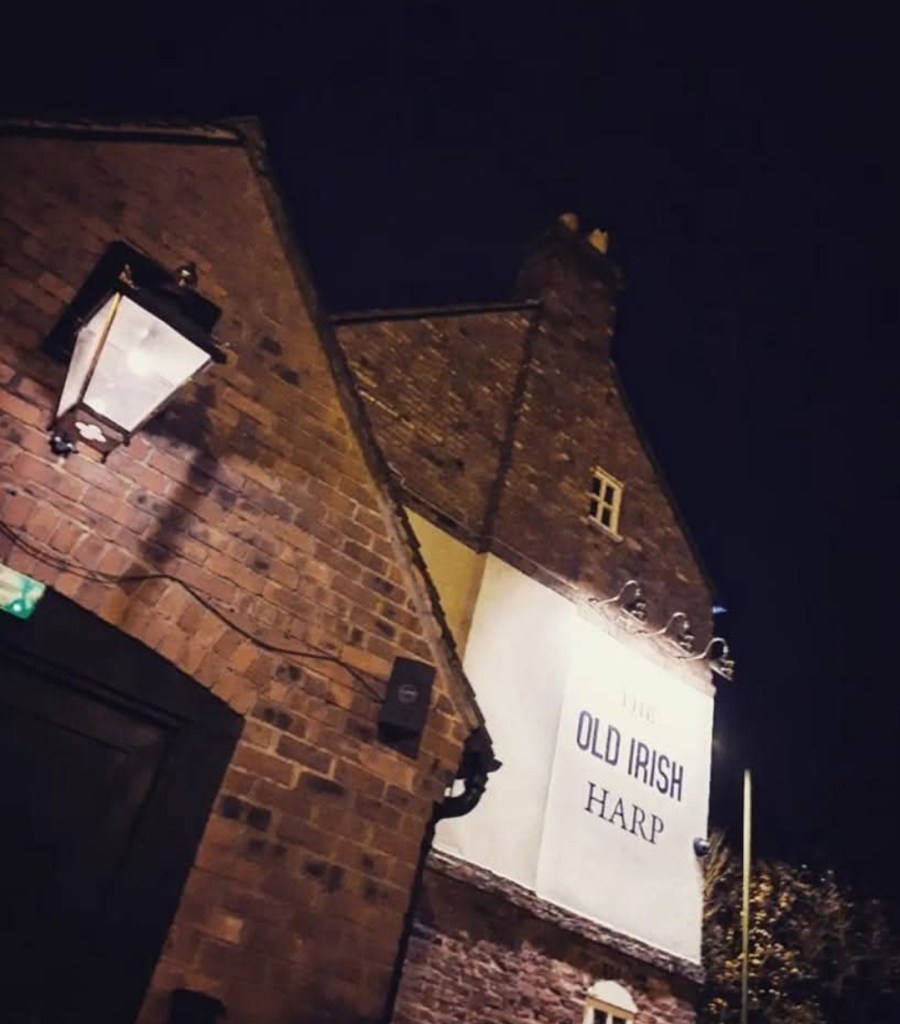
Back when the inquest took place it was just known as the ‘Irish Harp’.

On the evening of 26th October 1764, a little after 8 o’clock in the evening, Mr Thomas Hurdman of Alrewas was stopped by a footpad opposite St Michael’s churchyard. The Aris’s Birmingham Gazette cryptically reported the rogue was suspected to be a W_____ C_____ of Greenhill. I’m not sure why such nominal secrecy though, when they also published a description of him in the same report (not yet 20, about 5 feet 5 inches high, wide mouthed and wearing his own hair, if not altered, which was brown and short cut’). Despite being caught by one of the city’s constables, WC managed to quite literally give him the slip by sliding out of his coat, and legging it out of Lichfield in a linen frock. His freedom (and any semblance of anonymity) was short-lived however. In March the following year, newspaper reports reveal that the ID of WC was William Cobb and that he’d been sentenced by the High Steward of Lichfield, Fettiplace Nott, to be transported for his assault on Thomas Hurdman and making many violent threats of murder.
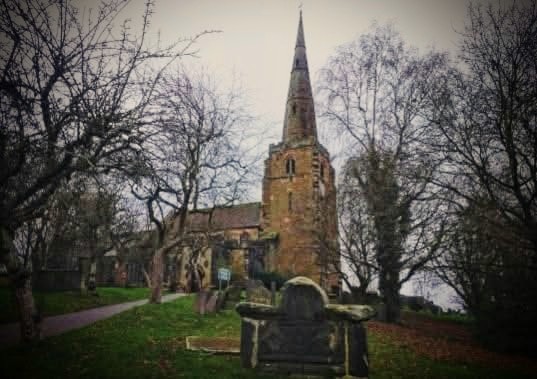
St Michael’s Lichfield is the graveyard for some who went to the gallows

Ashmoor Brook, up Cross in Hand Lane, was the scene of another robbery which went awry. In Lichfield March 1833, a notorious local character known as Crib Meacham, a name apparently derived from his success in various pugilistic encounters, was charged with robbing a Mr Lees of Stoneywell. According to Lees, Meacham was one of a gang of four who attacked him and his wife. The pair were in possession of a large sum of money but it was Mrs Lees who was holding the purse strings at the time and the thieves had allowed her to run away. She soon returned with assistance and it was the robbers turn to run, leaving a gagged Mr Lees unharmed but relieved of his relatively empty purse and hat. Meacham was arrested later that evening but as of yet, I cannot tell you anymore about him, neither the fights which earned him his nickname in the past nor the fate he earned from his part in the robbery.

Cross in Hand Lane is only just outside Lichfield but must have felt like the back of beyond travelling through here after dark

I can tell, however, tell you much more about Robert Lander aka Bradbury a cordwainer of Milford near Stafford who robbed Solomon Barnett, a wax chandler of Liverpool in March 1798. The newspaper reports at the time give not only a physical description (Lander was a stout built man, 5ft 5 inches, 25 years of age wearing a blue coat, a striped fancy coloured waistcoat, and thickest breeches, torn upon the left thigh and patched upon both the knees). It also gives his villain origin story, starting at his childhood home of Haywood near Stafford. When his Dad died, he inherited a few hundred pounds. At the age of 21 he got turned down for a job at the Board of Excise and so went to work for a gentleman in the wine and spirit trade instead. This, it seems, may have been the start of his downfall. During his employment he is said to have remained in a permanent state of intoxication, eventually absconding and taking with him a watch belonging to his master. He sold it at Stafford where he enlisted into a Regiment of Foot but ended up, somewhat ironically, in the shoe making business. This didn’t last long either and neither did his subsequent enlistment into four other regiments. His career in crime also came to an abrupt end when he was found guilty of the robbery of Solomon Barnett and sentenced to death at the Stafford Assize. When the judge prayed that the Lord would have mercy on his soul, it was reported Lander replied, ‘G__d d___n you and the gallows too. I care for neither’. I assume he said it in full but that his blasphemy was censored by the Chester Chronicle. He was executed in August 1798 and the parish register of St Mary’s Stafford records that, along with Edward Kidson, Robert Lander alias Bradbury was executed _ _ _ _ _ _ _.

These are all true crime stories, but it would’t be Lichfield Lore without a bit of folklore would it folks? You’ll be relieved to know I’m not going to go down the Turpin turnpike road but I am going to give a dishonorable mention to Tom ‘Artful’ Arnott, a highwayman who was supposedly executed, gibbeted and, eventually, buried at this crossroads in Cannock.

Although Arnott’s grave is marked on old maps there are no records of anyone of that name ever being executed. Intriguingly though, there is a record of a Thomas Arnott being buried on 1st September 1777 at St Luke’s in Cannock. Clearly a man can’t be buried in two places at once but it’s the right kind of era and area. Then there’s a Thomas Arnott mentioned in Aris’s Birmingham Gazette in October 1792 for absconding from his master’s service in Birmingham. Intriguingly, after given a description of him (35 years old, five feet five inches, marked with the Small Pox, dark lank hair, and lightly made, wearing a blue coat), it mentions that prior to his work as a stamp, press, lathe and die maker, he had been employed as a forger. Do they mean the criminal variety and if so, does this strengthen the case for him being our Tom? Just to add an extra layer of intrigue, there was yet another absconding Thomas Arnott, who was apprenticed to a Whitesmith in Worcester but ran away on 5th April 1803. He’s described as 5 feet two inches, black curled hair, wearing a blue coat with yellow buttons, a green striped cashmere waistcoat with yellow buttons and dark velveteen breeches. In that outfit, if he did become a highwayman, he’d have been a very dandy one indeed. Could any of these be the legendary Arnott? Did he even exist in the first place? All I do know is that this story is one T__B__C__________.

Arnott’s Grave. Unless it turns out to be at St Luke’s Cannock.

Sources
Aris’s Birmingham Gazette 5th November 1764

Aris’s Birmimgham Gazette 18th March 1765

Aris’s Birmingham Gazette 25th March 1833

Staffordshire Advertiser 24th March 1798

The Chronicle 7th September 1798

Chester Chronicle 17th August 1798

Aris’s Birmingham Gazette 8th October 1792

Aris’s Birmingham Gazette 2nd May 1803

Crime Scenery

I know. It’s been a while. You don’t know what I did this summer but I’d quite like to confess. There have been visits to gibbets, wells, shrines, mausoleums, derelict churches, ruined abbeys, tunnels and places with names which sound a bit rude. It’s less about serious history and more about a series of stories told by the landscape that surrounds us. Sometimes you have to listen very carefully to hear them (especially over the sound of my friend Jacky eating crisps), sometimes they shout in your face via an interpretation board funded by the parish council.  If you’re sitting comfortably*, then I’ll begin by sharing** evidence from some of the crime related activities we’ve been getting up to.

*unlike another friend Eddie the time we visited an old priory and had to stick him in the back of a van
**unlike Jacky with her crisps

Once upon a time, there was a little girl called Katie. When she grew up she wanted to be Mavis Cruet from Willo the Wisp. For a short while, she lived in Coleshill in North Warwickshire and almost everyday she’d walk past the town’s pillory. At the time she didn’t realise that it was a rare example combining three methods of corporal punishment i.e. stocks, a pillory AND a whipping post, and was last used in 1863, but she was curious all the same.

coleshill-pillory-michael-garlick

Coleshill Pillory by Michael Garlick from geography.org.uk http://creativecommons.org/licenses/by-sa/2.0/

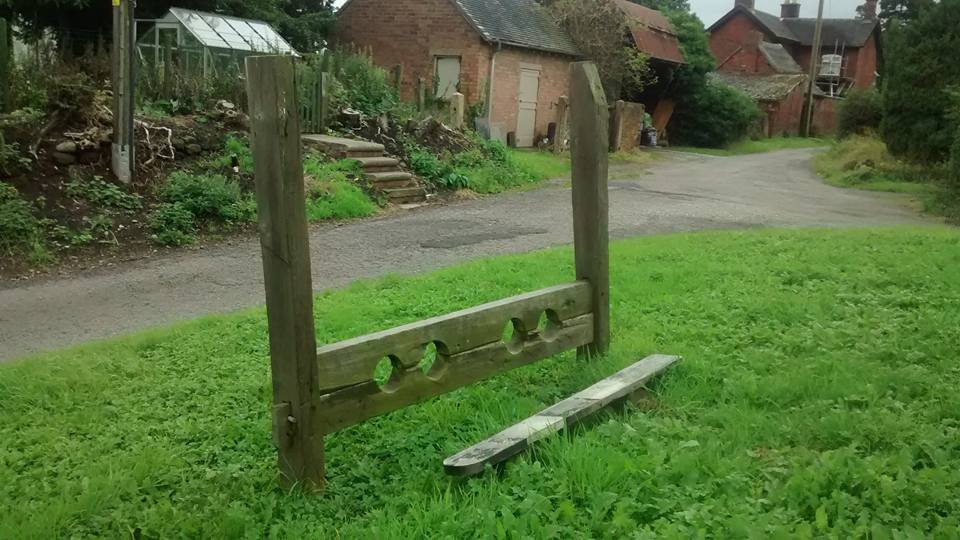
Many years passed and in August 2016,  Katie was visiting her parents in Stone in Staffordshire when she turned off too early towards Hilderstone. This was in no way down to her lack of navigational skills, there was a tree obscuring the ‘Hilder’ bit of the sign. Around the corner was a patch of grass with a set of stocks.

Stocks just after Hilderstone turning on A51 near Stone

Stocks just after Hilderstone turning on A51 near Stone

Despite extensive research (doing a google search), she couldn’t find any information on them. Katie hadn’t grown up to be Mavis Cruet, but she had continued to be curious. How many more sets of stocks were there around the country? Had anyone ever recorded them? Who had been publicly humiliated and punished here and what were the reasons? Our towns and cities are filled with monuments to the so-called great and good of society. Are these our monuments to those considered petty and bad who lived on its fringes? And so, after musing over these thoughts with friend Patti who already had a knowledge of and interest in this area, they decided to set up a discussion group called ‘Offending Histories’, with the aim of finding remaining physical evidence of crime and punishment across the Midlands and telling the sort of stories in which no one lives happily. Ever after or otherwise.

In just a month, we’ve already started to record a fascinating range of sites and objects. Here are some samples of the more local examples.

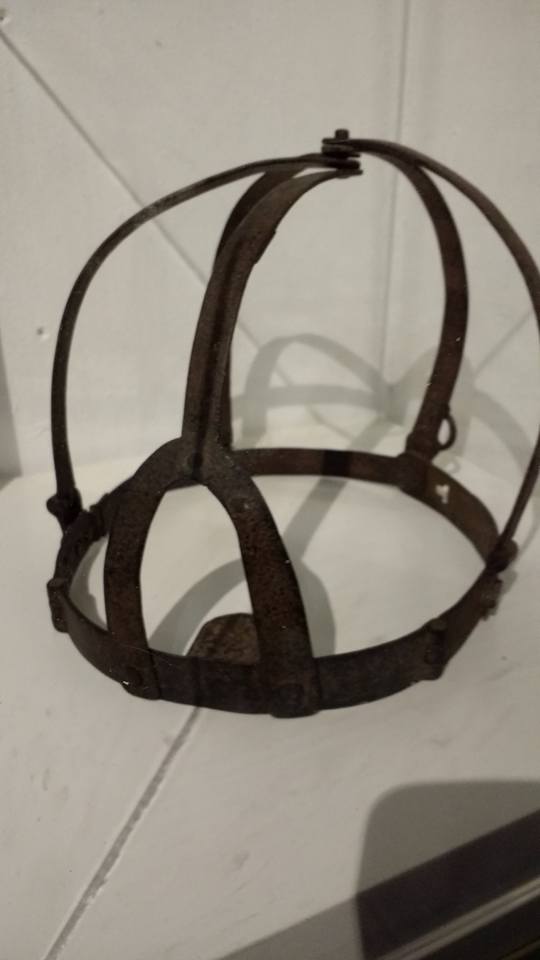
The old gaol cells in Lichfield have an example of a Scold's Bridle or brank on display. There's an excellent article from the Museum of Witchcraft and Magic exploring the history of these vile items here - http://museumofwitchcraftandmagic.co.uk/…/object-of-the-mo…/). Of particular interest is the following reference,

The old gaol cells in Lichfield have an example of a scold’s bridle or brank on display. There’s an excellent article from the Museum of Witchcraft and Magic exploring the history of these vile items here. Of particular interest is the following reference, “In 1789, the brank was used in Lichfield. A local farmer enclosed a woman’s head “to silence her clamorous Tongue” and led her round a field while boys and girls “hooted at her” “Nobody pitied her because she was very much disliked by her neighbours.”

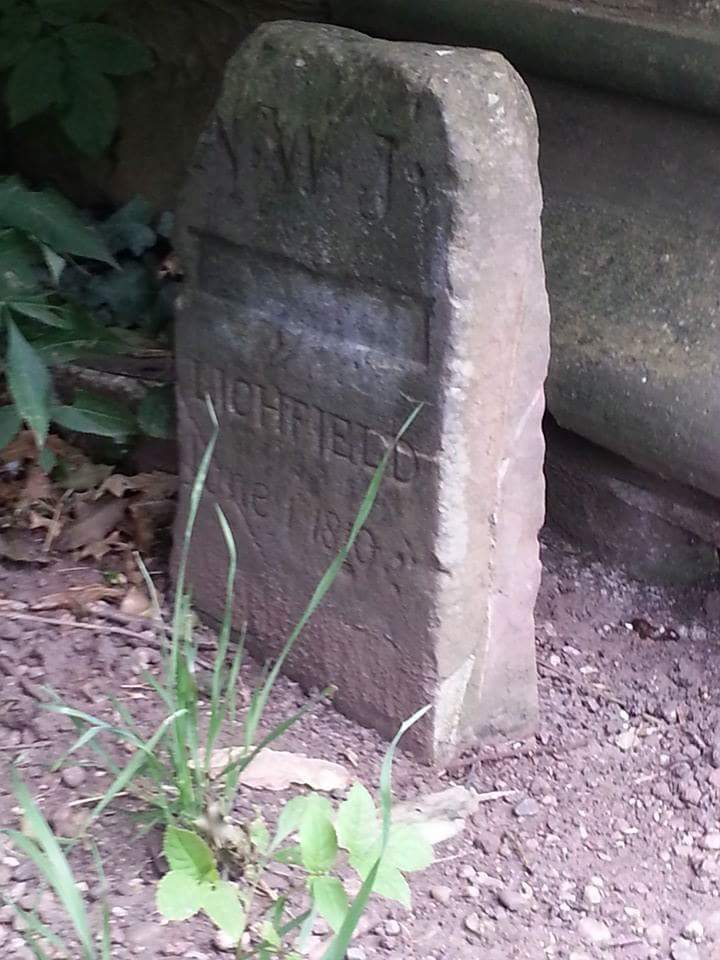
Outside St Michael's church is the relocated headstone of the last three men to be executed in the city. On 1st June 1810, Neve, Jackson & Weightman were taken by cart from the city gaol & publicly hanged for forgery at the city gallows (where Tamworth St, Upper St John St & the London Road cross). Interesting that at some point, the word 'hanged' appears to have been obliterated from the monument. Although this appears to be the only marker to executed criminals buried here, the church register records the names of others who were executed and buried e.g. John Wilson Sept 23rd 1583 and John Walle and Robert Hodgson described as prisoners executed and buried on 13 October 1587.

Outside St Michael’s church is the relocated headstone of the last three men to be executed in the city. On 1st June 1810, Neve, Jackson & Weightman were taken by cart from the city gaol & publicly hanged for forgery at the city gallows (where Tamworth St, Upper St John St & the London Road cross). Interesting that at some point, the word ‘hanged’ appears to have been obliterated from the monument. Although this appears to be the only marker to executed criminals buried here, the church register records the names of others e.g. John Wilson on Sept 23rd 1583 and, John Walle and Robert Hodgson described as prisoners executed and buried on 13 October 1587.

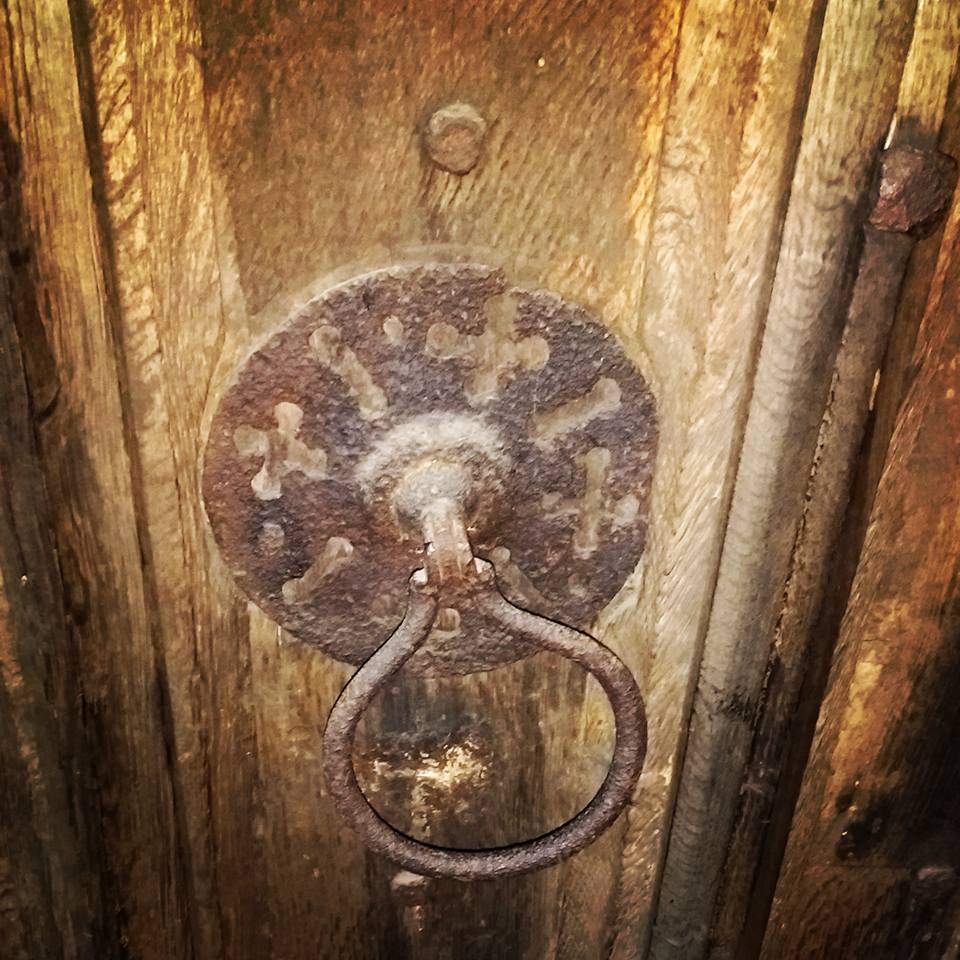
Patti pointed out this example of a sanctuary knocker on a door in Elford church, dating to circa 1450AD. By touchin the knocker, a fugitive from the law could be given sanctuary in the church for a period of time. If they made it that far. One example given by Karl Shoemaker in his book 'Sanctuary and Crime in the Middle Ages' tells of Elyas, a chaplain imprisoned in Staffordshire to await trial for murder, who 'killed the gaoler's attendant, escaped from the prison & fled towards the church'. The gaoler & others from Staffordshire pursued him and cut off his head before he could reach the church'. Another example comes from Colton History Society - in 1270 Nicholas son of William De Colton stabbed Adam, son of Hereward in a brawl; he fled to the church and took sanctuary. Claiming sanctuary was abolished 1623.

At St Peter’s in Elford, Patti pointed out this example of a sanctuary knocker on a door dating to circa 1450AD. By touching the knocker, a fugitive from the law could be given sanctuary in the church for a period of time (this seems to have been forty days which is a nice biblical number) . If they made it that far. One example given by Karl Shoemaker in his book ‘Sanctuary and Crime in the Middle Ages’ tells of Elyas, a chaplain imprisoned in Staffordshire to await trial for murder, who ‘killed the gaoler’s attendant, escaped from the prison & fled towards the church’. The gaoler & others from Staffordshire pursued him and cut off his head before he could reach the church’. Another example comes from Colton History Society – in 1270 Nicholas son of William De Colton stabbed Adam, son of Hereward in a brawl and fled to the church where he took sanctuary. Claiming sanctuary was officially abolished in 1623.

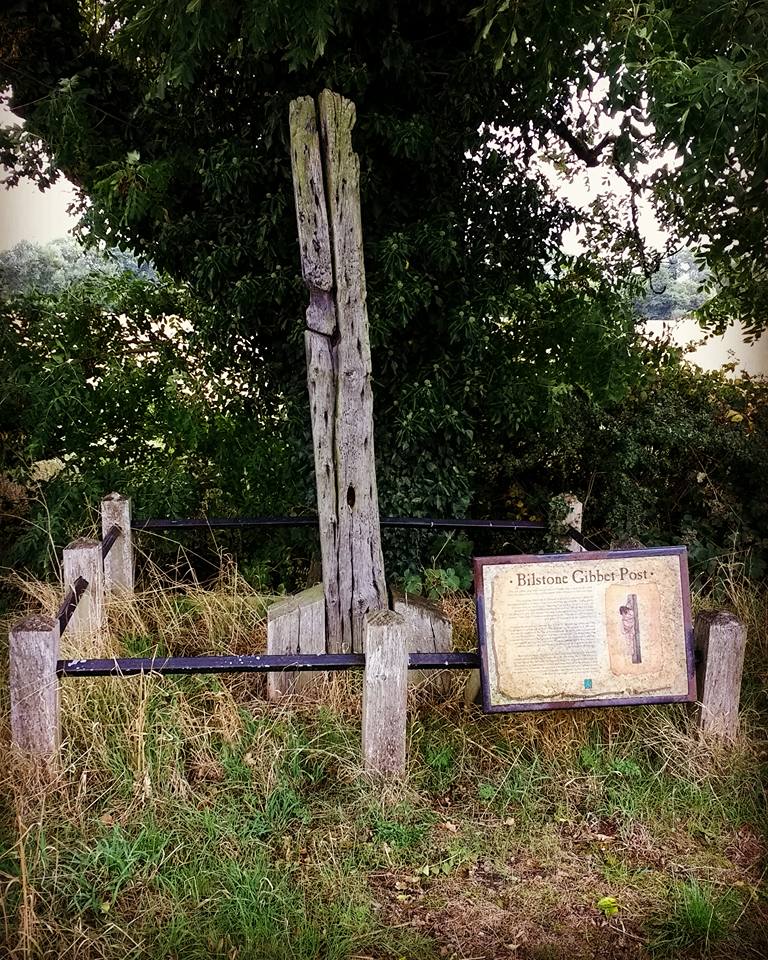
The Bilstone Gibbet Post, Leicestershire. Erected in March 1801 to display the body of local man John Massey, executed for murdering his wife Lydia and attemping to murder his step- daughter. Massey's headless skeleton, wrapped in chains, remained hanging from the post for seventeen years, his skull apparently being used as a candle holder in a pub in Atherstone. In the early twentieth century, the post was a venue for religious meetings but today, there are rumours of more unusual behaviour taking place here.

The Bilstone Gibbet Post, Leicestershire. Erected in March 1801 to display the body of local man John Massey, executed for murdering his wife Lydia and attempting to murder his step- daughter. Massey’s headless skeleton, wrapped in chains, remained hanging from the post for seventeen years, his skull apparently being used as a candle holder in a pub in Atherstone. In the early twentieth century, the post was a venue for religious meetings but today, there are rumours of more unusual behaviour taking place here.

Unable to find much on this pillor outside the Cock Inn at Stowe by Chartley, but it does appear to have been relocated here at some point.

Pillory outside the Cock Inn at Stowe by Chartley. Appears to have been relocated here at some point as not shown on early 19thc photographs of the pub

It is a dark subject at times but there are lighter moments too. Currently providing wry amusement is the question of how, and indeed why, was a seventeenth century cucking stool stolen from the church of St Edward at Leek? A meta-criminal mastermind at work? It’s very much an ongoing exploration and if you are interested or better yet, have something to contribute, and aren’t offended by an element of gallows humour, please do join our Offending History group here

Cell Mates

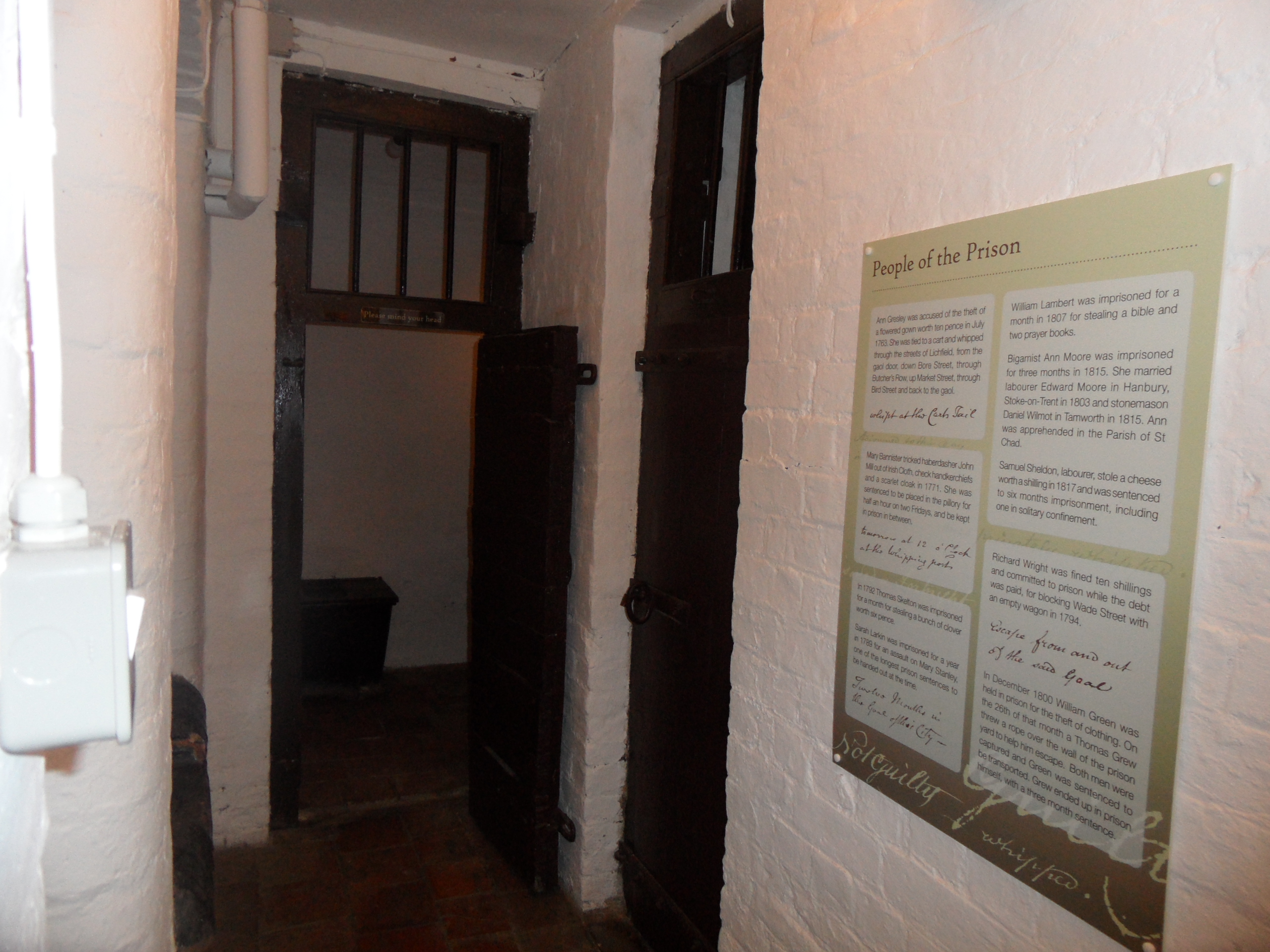
The Lichfield Discovered gang will be back at the old Gaol Cells at Lichfield Guildhall this coming Saturday (21st February 2015) between 2pm and 4pm, to resume our quest to record the graffiti left behind by prisoners. There’s plenty of it, but we’re up against the ravages of time and liberal applications of varnish. We did manage to pick up one definite name on our last visit. John Lafferty who, judging by the reports in the Lichfield Mercury, appears to have been a serial offender from Sandford St in the late nineteenth century, scratched his name into one of the cell doors along with the words ‘7 days’, presumably the length of his stay…on that occasion.

Gaol Graffiti 1

Lafferty graffiti

The cells officially reopen to the public in April, and will then be open every Saturday between 10am and 4pm until September.  Since 2012, over 7,000 people have visited and in order to continue to be able to give people access to this part of Lichfield’s history, Joanne Wilson, the city’s Museum and Heritage Officer, is recruiting a team of volunteers to welcome visitors to the cells, keep a record of visitor numbers, answer questions and provide information. You don’t need any previous experience just an interest in heritage, enthusiasm and the ability to smile when you hear, ‘You’re not going to lock us in, are you?’ for the twenty-seventh time that day. Each volunteer session usually lasts around three hours, but dates and times are flexible and you can do as much or as little as you are able to. It’s a great opportunity to get involved in the city’s history and to share it with all kinds of people – I volunteered a couple of years ago and welcomed local people, wedding guests, day trippers, and even someone who’d worked at the Guildhall for years without realising what was behind the red door at the end of the corridor.

Fifty shades of varnish

If you would like to know more about volunteering, please contact Joanne on 01543 264 972 or via email at sjmuseum@lichfield.gov.uk. Alternatively, pop into the Samuel Johnson Birthplace Museum on Breadmarket St. You are also very welcome to join us on Saturday. And yes, we promise not to lock you in.


Lichfield Law

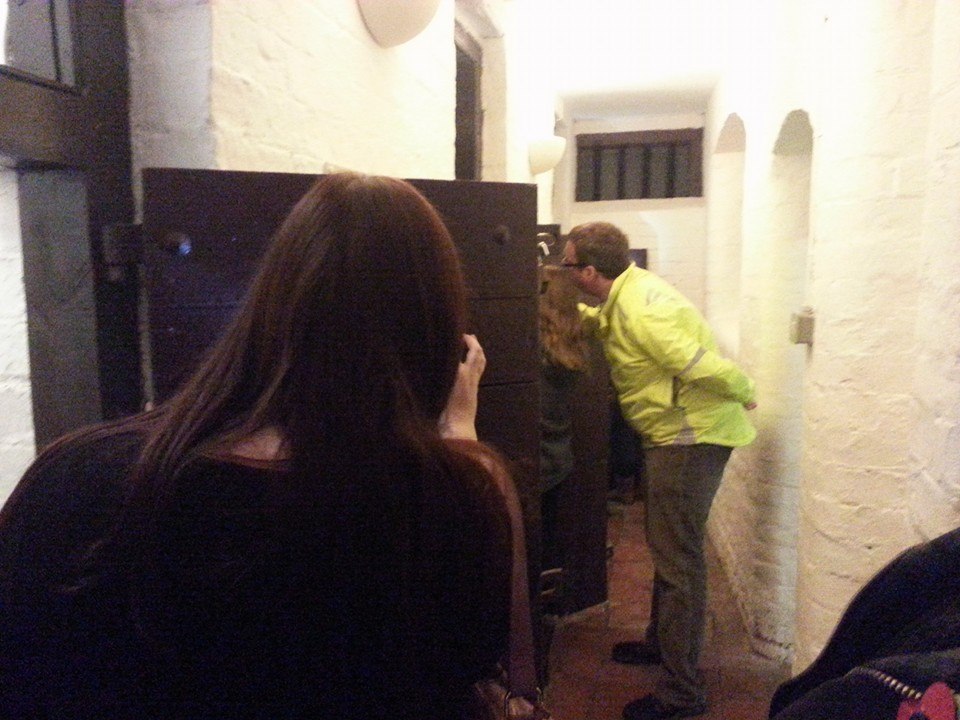
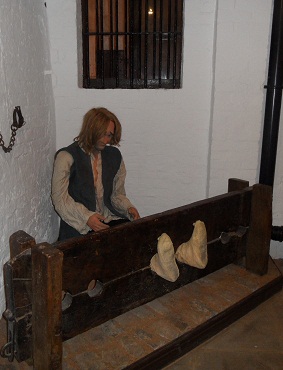
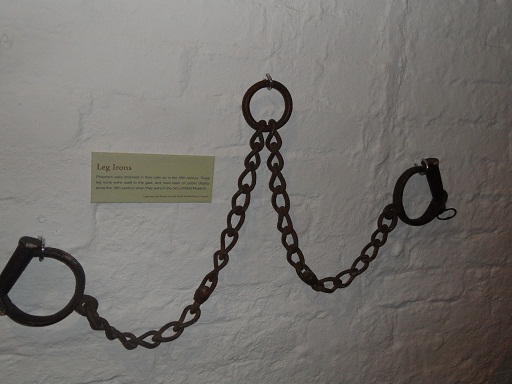
Lichfield’s old gaol is open to the public once more, allowing us to see how ‘justice’ was administered in the past, and read about some of those on the receiving end of it.

I took a few photos but to get a true feel of the place you really need to visit these ‘…cells, whose echoes only learn to groan’, as Erasmus Darwin put it. 

This is a thought provoking part of Lichfield, tucked away at the back of the Guildhall.

The cells open every Saturday until the end of September from 10am to 4pm. To find out more call 01543 264972 or email sjmuseum@lichfield.gov.uk.  There’s no admission charge (although you are likely to hear at least one person quipping about having to pay to get out).