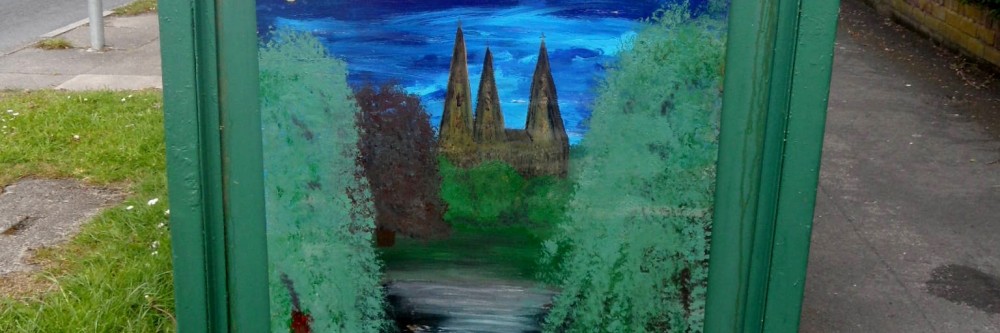
Lichfield Castle isn’t a spectacular ruin like Kenilworth nor a well-preserved motte and bailey like Tamworth. Our castle is a conundrum and the mystery of where it stood has intrigued people for centuries.
Almost 500 years ago John Leland wrote that there had been a castle of ancient time in the south end of the town, but that nothing remained. He noted that there was a place called Castle Field , where there were dykes, but concluded that it was more likely that the castle would have stood in the Close, with the ground being somewhat castle-like.
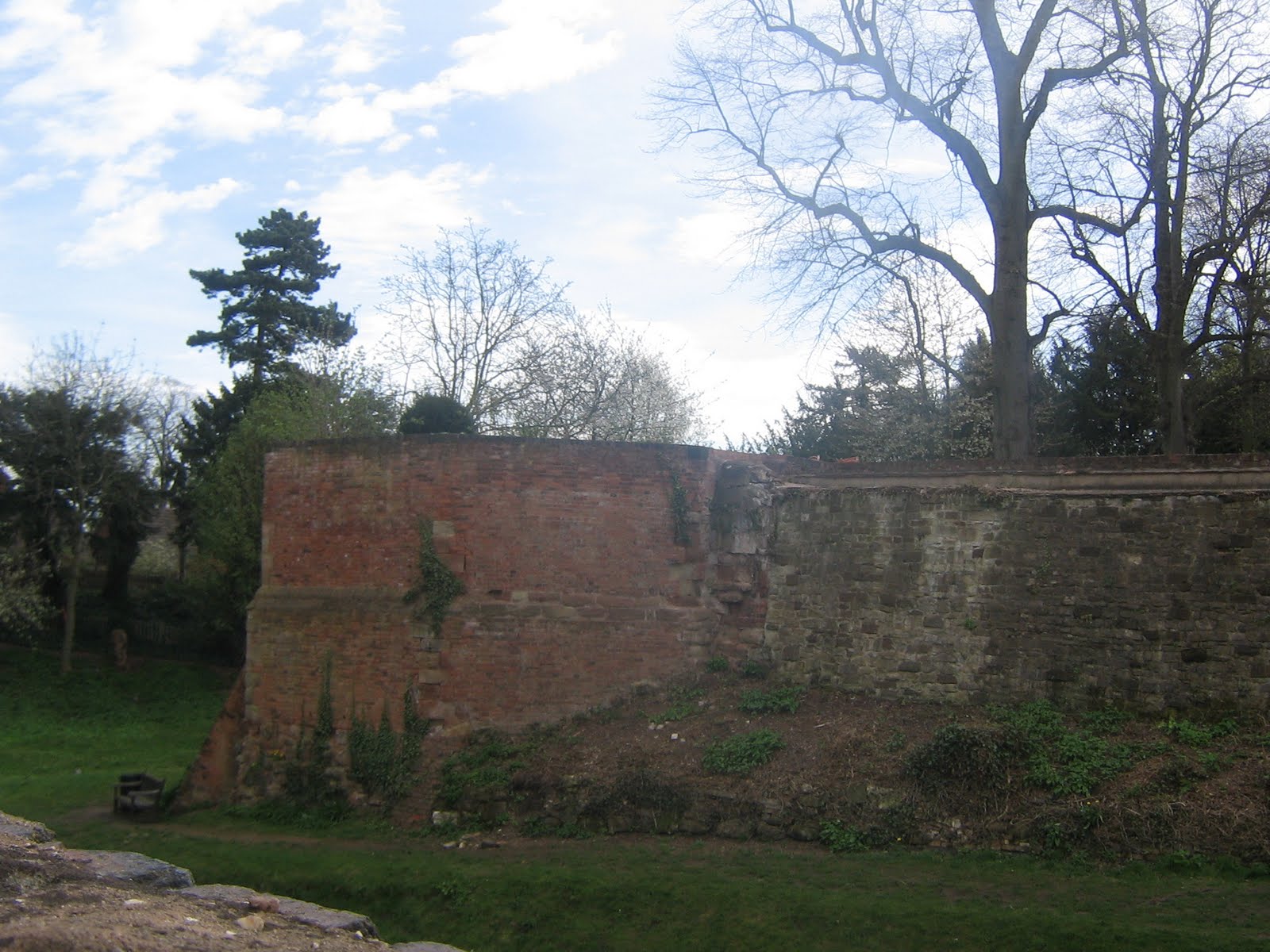 |
| Remains of North East Tower, as seen from Gaia Lane |
Richard II spent Christmas 1397, in Lichfield Castle, consuming 200 tuns of wine and 2000 oxen.Two years later, the King’s fortunes had changed and he was imprisoned in Lichfield on route from Chester to London.Some accounts just say he was incarcerated in Lichfield Castle, others specify a tower in the Close and the County History of Stafford, says that the Richard was held in the Archdeacon of Chester’s house in Beacon Street. J Gould’s report on Lichfield Archaeology & Development says that if King Richard was imprisoned in the fortified Close, it would most likely have been in the North East tower, the footings of which can be still be seen. The tower was said to have been 52 feet high, 20 foot above the rest of the buildings.In some versions of the story it is reported that an unsuccessful attempt was made to escape through a window!
To add to my confusion, Thomas Harwood wrote in his History of Lichfield, that King Richard spent Christmas in the Close and that later he was imprisoned in the magnificent tower in the Close, built by Bishop Clinton. However, in Sampson Erdeswick’s Survey of Staffordshire (which I understand was written in the late 16th Century, with a version edited by Thomas Harwood published in the 1844) both the castle and Bishop Clinton’s fortifications are listed, seemingly as two separate entities ‘The castle, in which Ric. II. kept his Christmas in 1397, and in which, two years afterwards, he was confined; the city walls; bishop Clinton’s costly fortifications ; with the beautiful western gate, are all levelled. The castle stood on an eminence on the south side of Tamworth-street, the site of which is now occupied by small houses and gardens”.
The case for the Tamworth Street site seems to consist of the place names in that area (Castle Dyke, Castle Field (historic)) and (rather tenuously) a large amount of ox bones dug up in the 1800s in nearby ‘Oxenbury Field’ that were said to be the remains of Richard’s Christmas feast. It seems traces of old stonework found in this area were locally considered proof of a castle here but a report by the South Staffordshire Archaeological & Historical Society (SSAHS) discounts these as merely the cellars of domestic buildings.
English Heritage’s description of Lichfield Castle on Pastscape also says that no evidence was found by field investigators in the Tamworth St area, in 1958 or 1974. One explanation given to the placenames found in the area, is that they relate to an Anglo-Saxon fort on Borrowcop Hill. The description also includes the opinion of a Phillip Davis* on the matter “There is some doubt as to whether a castle existed in Lichfield. However, the tradition of a castle in the town is a very strong one. My personal view is that there was a timber castle of some sort in the town in the early 12th century (probably started at the same time as Tamworth and Stafford, i.e. circa 1070) but that the work by Clinton was probably done on the Cathedral Close, and the castle was basically defunct at this time.”
So, it seems there could have been two castles, with references to each becoming confused and muddled over the years.It seems the castle relating to King Richard was the fortified Close and there may also have been an Anglo-Saxon castle.As ever, this raises more questions.Why did the original Lichfield Castle vanish, yet Tamworth’s and Stafford’s castles still stand strong today?Was it abandoned after the fortification of the Close or before? Did it stand on Borrowcop Hill?The mystery of Lichfield Castle continues….
*I’m assuming this is the same Phillip Davis from The Gatehouse Website
Sources:
Lichfield Close in the Middle Ages by William Beresford
The Reliquary and illustrated archaeologist vol 7
The Itinerary of John Leland in or about the years 1535-1543.
Lichfield: The cathedral close’, A History of the County of Stafford: Volume 14: Lichfield
SSAHS Transactions (1981-82)
Lichfield Archaeology & Development by Jim Gould FSA
History and Antiquity of the Church and City of Lichfield by Thomas Harwood
Erdeswick’s Survey of Staffordshire
http://www.pastscape.org.uk




 Lichfield Lore