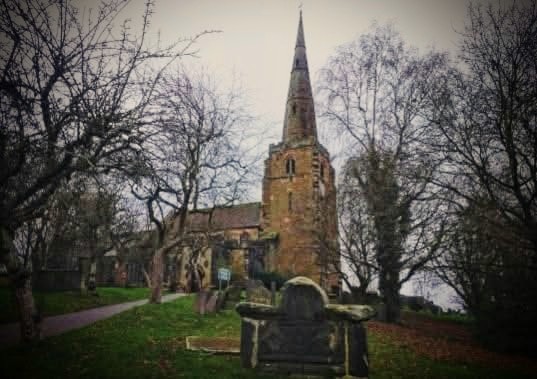
The Bible Thief

When John Duncalf was released from the House of Correction in Kingswinford in 1675, he swore he would never set his feet in the town again as long as he lived. It was a promise that was to become grimly prophetic.

On leaving Kingswinford, he embarked on a life of petty crime and sin. He would later confess to, ‘Idleness, Stealing, Cursing, Swearing, Drunkeness and Uncleanness with Women’, although he explained that he had not actually committed actual Fornication or Adultery with a woman except in the thoughts of his heart, and by lascivious words and gestures, whereby he had endeavoured to tempt them to lewdness in divers places. I think we can infer from this that his lack of lewd action was not for want of trying.

The chapter of crime he was to become truly infamous for was the theft of a bible. If he’d only read one of them, paying particular attention to the eight commandment, things could have turned out a lot differently. But, on 5th January 1677, Duncalf turned up on the doorstep of Grange Mill, masquerading as a beggar. It was the home of Margaret Babb and when she charitably invited him in for a drink to celebrate Twelfth Night, the bad man stole her good book.

Duncalf stealing the Bible from Margaret Babb as she fetched him a drink. I’m not quite sure exactly what Mr Babb is doing. (Woodcut from Divine Judgement and Mercy Exemplified In a Variety of Surprising Instances)

Duncalf sold Babb’s Bible on to a maid at Heath Forge at Wombourne but its provenance was discovered and suspicion fell on Duncalf. He swore it wasn’t him apparently, ‘wishing his hands might rot off, if that were true’. It would turn out to be the second prescient statement Duncalf would make. Soon afterwards, the flesh around his wrists began to turn black. His ungodly wish was about to be granted.

A few weeks later, Duncalf was working in Dudley with a joiner called Thomas Osborn when he felt weak and faint and feverish. It was Shrove Tuesday and he headed home towards Codsall but collapsed in a barn at Perton Hall in Tettenhall en-route. After two days and two nights, he was discovered unable to walk and so was carried back to his last place of settlement. And so it was that John Duncalf found himself back in the town of Kingswinford but, just as he had sworn, without actually set foot in the place. He was taken in by a man called John Bennett and at first he was lodged in a barn belonging to the Three Crowns Inn on the Wolverhampton to Kidderminster Road. After a fortnight, he was taken to Bennett’s house in Wall Heath where his blackened flesh began to rise in lumps at his hands and wrists before beginning to decay.
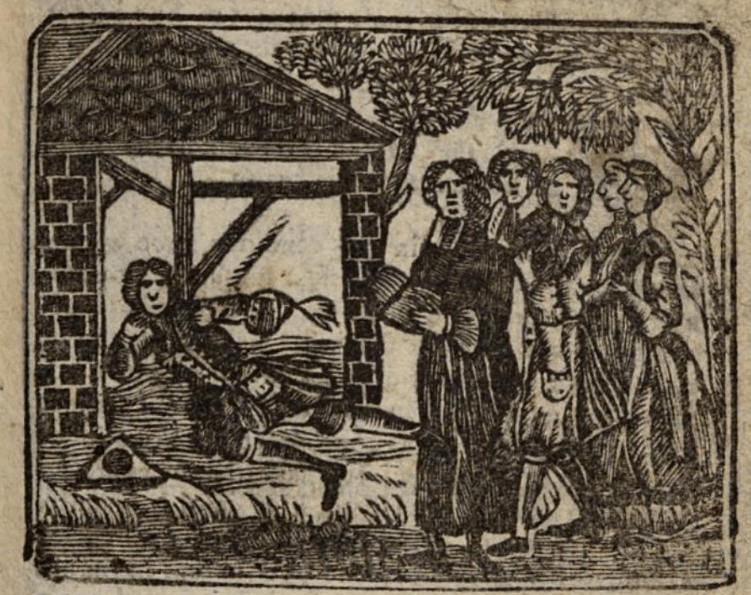
A vicar visits Duncalf just before he’s about to lose his left hand (Woodcut from Divine Judgement and Mercy Exemplified In a Variety of Surprizing Instances)

The account I’ve read comes from James Illingworth, one of the clergymen who visited him amidst the crowds. He says that by the end of April, ‘many little Worms came out of the rotten flesh, such as are usually seen in the dead Corpes (sic)’. Many visitors also appeared, posies pressed to their nostrils to block out the putrid smell, hoping to see the man who they believed was being literally and directly punished by God for his sins. Despite everything, Duncalf did not appear to have learned his lesson. Illingworth heard him tell his keeper John Bennet that he wished his visitors’ noses might drop off and asked why he did not dash out their teeth to stop them from grinning at him.

Eventually, Duncalf asked for Margaret Babb to visit, and she came with the maid he had sold the stolen book to. He confessed his crime to them and asked their forgiveness, which both of them granted. When his hands rotted off, there was hope that penance had now been paid and that God would punish him no more. Yet, the suffering continued. By 8th May, both of his lower legs had fallen off at the knee, although he didn’t realise it until Bennett held them up to show him.
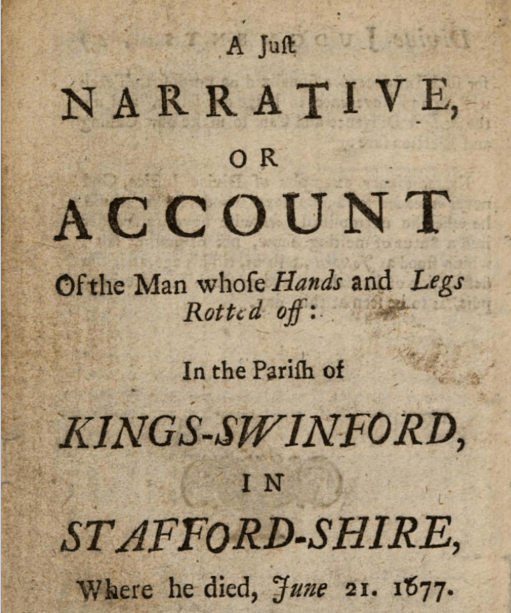
According to the Dudley Archives and Local History Service, the entry in the parish register at Kingswinford shows that John Duncalf was buried on 22nd June 1677, and is described as, ‘the man that did rott both hands & leggs’. The entry notes that he stole a bible, a charge, ‘he wickedly denyed with an imprecation, wishing that if he stole it his hands might rot of which afterwards they did in a miserable manner’. It adds that, ‘many people (I verily believe hundreds) saw him as hee lay with his hands & leggs rotting off, being a sad spectacle of God’s justice and anger’ and ends by saying it was registered as, ‘a certain trueth, to give warning to posterity to beware/ of false oathes’.

Clearly there is a certain trueth to this story which elevates the death of John Duncalf to more than mere folklore but what did cause his terrible demise if it wasn’t a punishment dished out via divine judgement?
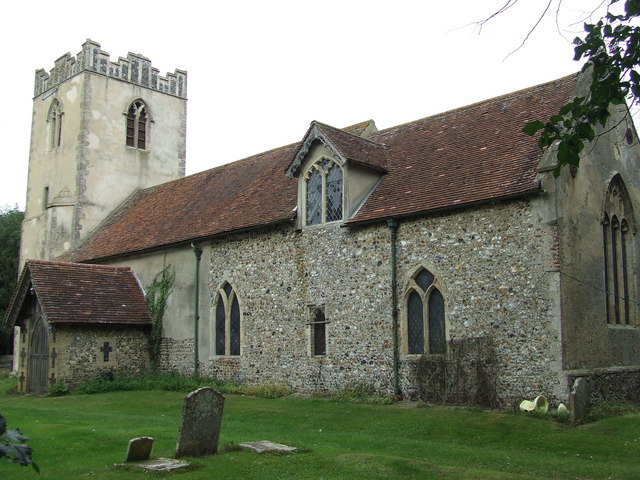
Keith Evans / St Nicholas Wattisham / CC BY-SA 2.0

A memorial in the tower (which you can see here around 13m20s in) and an entry in the parish register at the now disused church of St Nicholas at Wattisham in Suffolk describe the sad fate of the Downing family who all lost their feet in 1762, although four of them survived. I’ll spare you from the full gory details but belief amongst local people was that the poor family were victims of witchcraft. The local vicar Rev Bones (I kid you not) was not convinced and set out to ascertain the cause of their affliction sending several letters to the Royal Society who concluded the culprit was gangrenous ergotism caused by eating grains infected by the fungus Claviceps purpurea.

I’ve seen this ‘tragic ‘singular calamity’ as Rev Bones called it, described as the only recorded case of ergot poisoning in England. However, I strongly suspect that John Duncalf may have been another of its victims and possibly, had John Bennett and others sought medical attention for him rather than condemning him to be some sort of religious freak-show, he may even have survived.

I definitely wouldn’t swear on it though…

Sources

Ian Atherton (2022): ‘John Duncalf the Man that Did Rott Both Hands & Leggs’: Chronicle of a Staffordshire Death Retold in the Long Eighteenth Century, Midland History, DOI: 10.1080/0047729X.2022.2126237

Divine Judgements Exemplified

https://www.facebook.com/dudleyarchives

https://wellcomecollection.org/works/uh33ekuf

Hereford Times – Saturday 09 March 1867
Highway to Hell

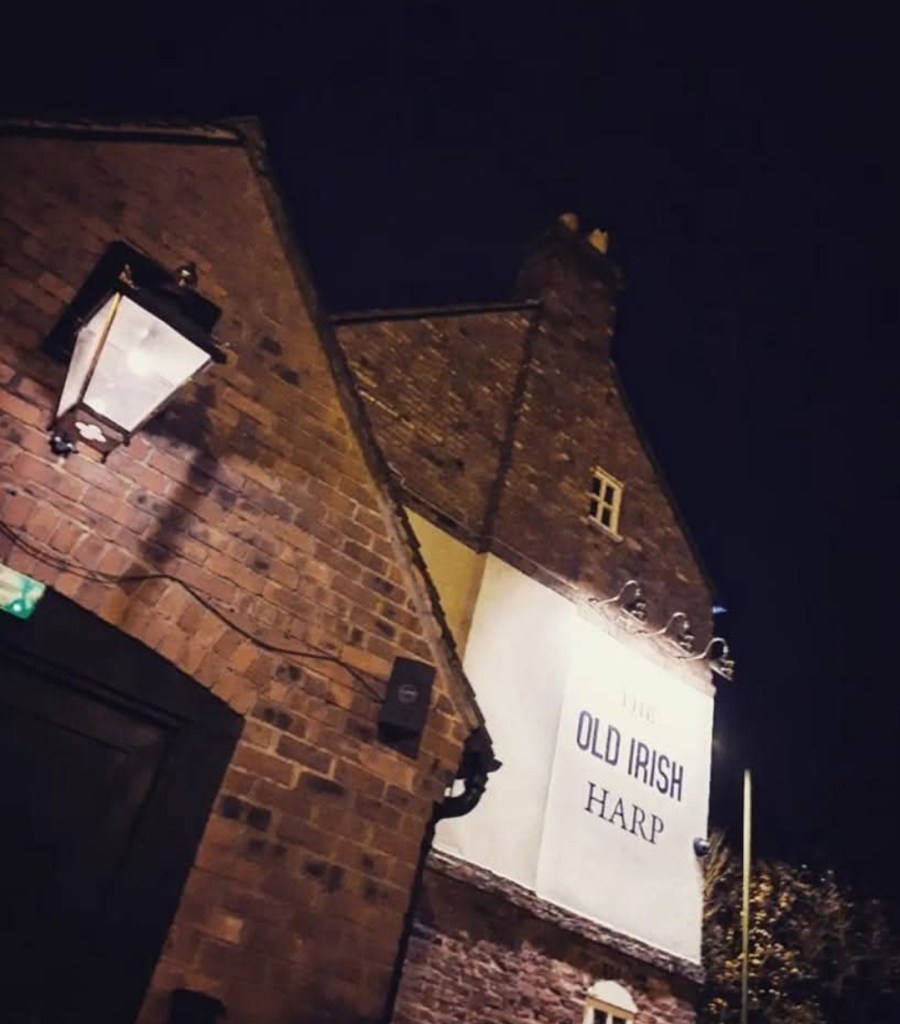
I feared from the looks on my family’s faces that my interest in the macabre may have gone too far when I happened to mention during a meal at the Old Irish Harp that an inquest on the body of a genteelly dressed woman found ‘wilfully murdered’ in a wood near Sutton Coldfield had taken place not far from where we were sat, albeit 250 years prior. I thought perhaps it was time to find a different hobby. Embroidery perhaps? A pleasant pastime for sure, but turns out that for me it’s no substitute for finding and sharing a ripping yarn. And now that we’ve established that I am beyond all redemption, I want to regale you with a post about crime and punishment on the mean streets of Staffordshire.

Back when the inquest took place it was just known as the ‘Irish Harp’.

On the evening of 26th October 1764, a little after 8 o’clock in the evening, Mr Thomas Hurdman of Alrewas was stopped by a footpad opposite St Michael’s churchyard. The Aris’s Birmingham Gazette cryptically reported the rogue was suspected to be a W_____ C_____ of Greenhill. I’m not sure why such nominal secrecy though, when they also published a description of him in the same report (not yet 20, about 5 feet 5 inches high, wide mouthed and wearing his own hair, if not altered, which was brown and short cut’). Despite being caught by one of the city’s constables, WC managed to quite literally give him the slip by sliding out of his coat, and legging it out of Lichfield in a linen frock. His freedom (and any semblance of anonymity) was short-lived however. In March the following year, newspaper reports reveal that the ID of WC was William Cobb and that he’d been sentenced by the High Steward of Lichfield, Fettiplace Nott, to be transported for his assault on Thomas Hurdman and making many violent threats of murder.

St Michael’s Lichfield is the graveyard for some who went to the gallows

Ashmoor Brook, up Cross in Hand Lane, was the scene of another robbery which went awry. In Lichfield March 1833, a notorious local character known as Crib Meacham, a name apparently derived from his success in various pugilistic encounters, was charged with robbing a Mr Lees of Stoneywell. According to Lees, Meacham was one of a gang of four who attacked him and his wife. The pair were in possession of a large sum of money but it was Mrs Lees who was holding the purse strings at the time and the thieves had allowed her to run away. She soon returned with assistance and it was the robbers turn to run, leaving a gagged Mr Lees unharmed but relieved of his relatively empty purse and hat. Meacham was arrested later that evening but as of yet, I cannot tell you anymore about him, neither the fights which earned him his nickname in the past nor the fate he earned from his part in the robbery.

Cross in Hand Lane is only just outside Lichfield but must have felt like the back of beyond travelling through here after dark

I can tell, however, tell you much more about Robert Lander aka Bradbury a cordwainer of Milford near Stafford who robbed Solomon Barnett, a wax chandler of Liverpool in March 1798. The newspaper reports at the time give not only a physical description (Lander was a stout built man, 5ft 5 inches, 25 years of age wearing a blue coat, a striped fancy coloured waistcoat, and thickest breeches, torn upon the left thigh and patched upon both the knees). It also gives his villain origin story, starting at his childhood home of Haywood near Stafford. When his Dad died, he inherited a few hundred pounds. At the age of 21 he got turned down for a job at the Board of Excise and so went to work for a gentleman in the wine and spirit trade instead. This, it seems, may have been the start of his downfall. During his employment he is said to have remained in a permanent state of intoxication, eventually absconding and taking with him a watch belonging to his master. He sold it at Stafford where he enlisted into a Regiment of Foot but ended up, somewhat ironically, in the shoe making business. This didn’t last long either and neither did his subsequent enlistment into four other regiments. His career in crime also came to an abrupt end when he was found guilty of the robbery of Solomon Barnett and sentenced to death at the Stafford Assize. When the judge prayed that the Lord would have mercy on his soul, it was reported Lander replied, ‘G__d d___n you and the gallows too. I care for neither’. I assume he said it in full but that his blasphemy was censored by the Chester Chronicle. He was executed in August 1798 and the parish register of St Mary’s Stafford records that, along with Edward Kidson, Robert Lander alias Bradbury was executed _ _ _ _ _ _ _.

These are all true crime stories, but it would’t be Lichfield Lore without a bit of folklore would it folks? You’ll be relieved to know I’m not going to go down the Turpin turnpike road but I am going to give a dishonorable mention to Tom ‘Artful’ Arnott, a highwayman who was supposedly executed, gibbeted and, eventually, buried at this crossroads in Cannock.

Although Arnott’s grave is marked on old maps there are no records of anyone of that name ever being executed. Intriguingly though, there is a record of a Thomas Arnott being buried on 1st September 1777 at St Luke’s in Cannock. Clearly a man can’t be buried in two places at once but it’s the right kind of era and area. Then there’s a Thomas Arnott mentioned in Aris’s Birmingham Gazette in October 1792 for absconding from his master’s service in Birmingham. Intriguingly, after given a description of him (35 years old, five feet five inches, marked with the Small Pox, dark lank hair, and lightly made, wearing a blue coat), it mentions that prior to his work as a stamp, press, lathe and die maker, he had been employed as a forger. Do they mean the criminal variety and if so, does this strengthen the case for him being our Tom? Just to add an extra layer of intrigue, there was yet another absconding Thomas Arnott, who was apprenticed to a Whitesmith in Worcester but ran away on 5th April 1803. He’s described as 5 feet two inches, black curled hair, wearing a blue coat with yellow buttons, a green striped cashmere waistcoat with yellow buttons and dark velveteen breeches. In that outfit, if he did become a highwayman, he’d have been a very dandy one indeed. Could any of these be the legendary Arnott? Did he even exist in the first place? All I do know is that this story is one T__B__C__________.

Arnott’s Grave. Unless it turns out to be at St Luke’s Cannock.

Sources
Aris’s Birmingham Gazette 5th November 1764

Aris’s Birmimgham Gazette 18th March 1765

Aris’s Birmingham Gazette 25th March 1833

Staffordshire Advertiser 24th March 1798

The Chronicle 7th September 1798

Chester Chronicle 17th August 1798

Aris’s Birmingham Gazette 8th October 1792

Aris’s Birmingham Gazette 2nd May 1803