It seems apt that on St Andrew’s Day, I have a story for you which features both a Robert Burns poem and the one time president of the Walsall Burns Club. These events took place one hundred and fifty years ago this week and I will warn you in advance that it’s a bleak early winter’s tale, with no festive cheer to be found.
On 24th November 1874, a young Billy Meikle1 arrived in Alrewas on the first train of the day from Walsall. Snow had fallen overnight and the wintery dawn was just breaking as he passed the Paul Pry Inn2 with its sign hanging from a tree opposite. There were groans coming from the inside the old village lock-up and a howling hound outside was awaiting his master’s release. Billy then continued via the George and Dragon and the Navigation Inn (now the Delhi Divan restaurant) as he headed towards Yoxall via the Kings Bromley Road to collect the accounts of customers for the drapers business he worked for.
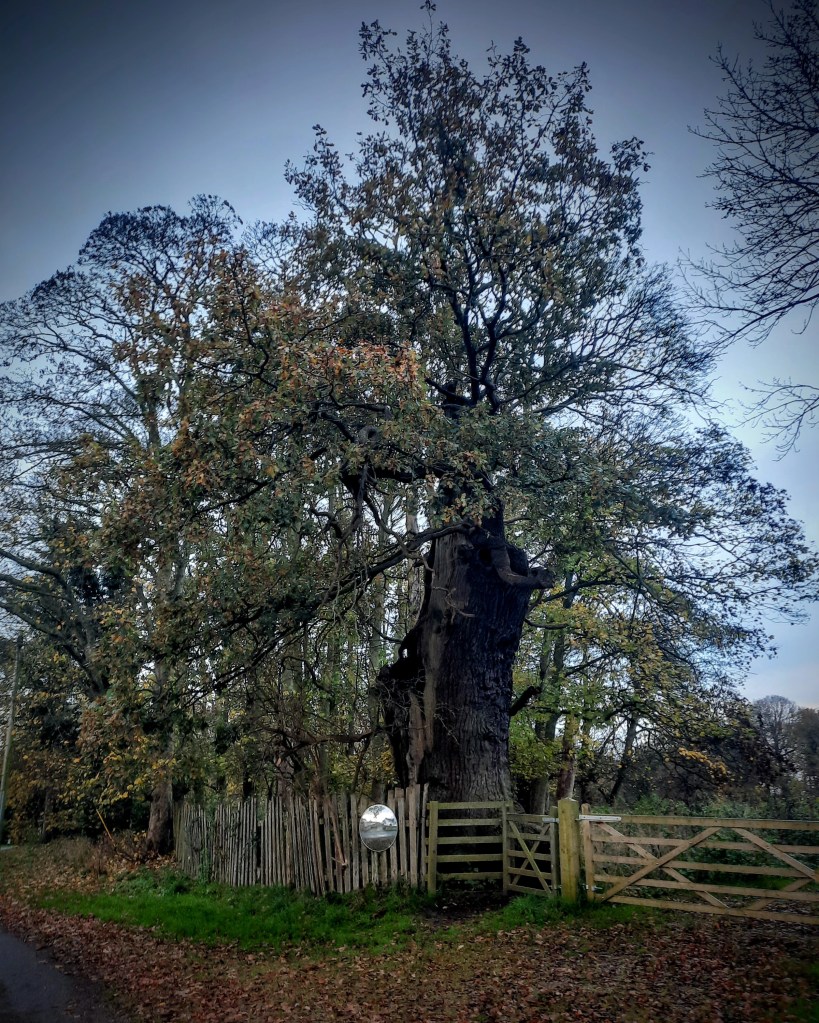
When he arrived at Yoxall he found the village in a state of frenzied excitement, following the news that murder had taken place the previous day. At every house he called at he heard the story of how Mrs Kidd had been killed by a vagrant at nearby Hoar Cross because the man had demanded 3d and she had only 2d to give him. Meikle was told the murder had taken place at a large tree, the location easily identifiable as the locals had scraped away the snow to see the pool of blood beneath it. As night fell, he set out in the moonlight to find the sinister spot for himself, but as he approached the tree where the tragedy took place, he lost his nerve and ran back to Yoxall.

Unfortunately, the Golden Cup Inn where he was supposed to be staying was perhaps not the sanctuary he was hoping for. Mrs Badkins, who kept the local stationers shop, told him that the landlord had been drinking since his his wife had left him and had borrowed a gun, suggesting that staying at the Crown may be a safer option. Meikle did not heed her advice and took his chances at the Cup. On the day of the inquest on Mrs Kidds’ body, the tap room was flowing with talk of murder, both the very recent and historic. According to Meikle, things took a turn for the better when a man named Ned Dukes stood on his head on a table and sang a song about the world being upside down whilst he did a step dance on the ceiling. Personally, I’d have rather carried on talking about murders. At 10 pm time was called and the customers went home, ‘full of drink and murder’. Meikle was left alone with the landlord and his daughter and together they ate soup, bread and cheese. At several points during the supper, the landlord got up to investigate invisible things in the dark corners of the room. Eventually, bed was suggested and Billy was shown to his room which had been partitioned off from the club room. Despite thoughts of the landlord and his gun, Meikle drifted off to sleep. At 2am he heard the clock at St Peter’s chime but fell back to sleep. Soon after however, he was woken again by a terrible crash and peered from beneath his bedclothes to see the landlord stood in the room, candle in one hand, gun in the other.
Both men had thought the crash had been caused by the other firing shots but Billy assured the landlord he had no gun. The men then realised the crash they’d heard resulted from the partition between rooms falling down and both of them returned to their beds.
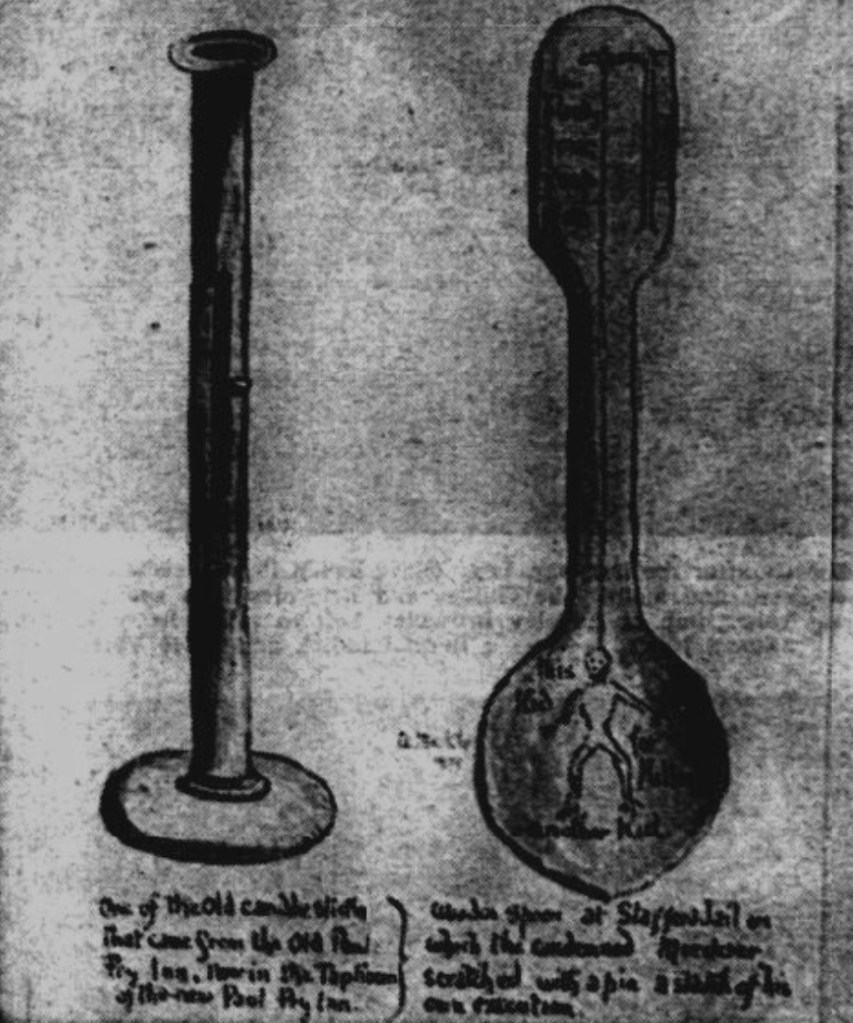
Meikle says the murderer of Mrs Kidd was arrested several weeks later. He was caught in a trap laid by the police who knew he was unable to resist singing a love song called The Thorn, based on a poem by Robert Burns. Pianists were planted in every pub in the East Staffordshire area, with instructions that they should play the song at regular intervals. The snare was a success and the murderer was arrested mid-song and later sentenced to death. Meikle says he scratched a figure of a man being hanged onto the wooden spoon he ate his final meal with along with the words ‘A bloody long drop for this kid for killing another ‘Kidd’.
It’s an incredible story but I suspect Billy Meikle’s account of events may not be altogether accurate. What is without doubt is that at the Stafford Assizes in December 1874, Robert Taylor, a 21 year old miner from Wigan was found guilty of the wilful murder of Mary Kidd on 23rd November in the parish of Yoxall. The main witness was her neighbour Sarah Ann Hollis, an eight year old girl who had gone with her. Sarah said that as they approached the wood, they saw Taylor and had a brief conversation with him. He followed them and asked for half a crown, and Mrs Kidd replied she did not have that amount but gave him 2d. Taylor then grabbed her and cut her throat with his pen knife. The sound of approaching cart wheels scared him away and may well have saved Sarah’s life.
Was Taylor trapped by a tune though? It seems the murderer was caught in a much more orthodox manner. Newspaper reports say that after visiting the murder scene, near to the new church at Hoar Cross and on the main road from Yoxall to Sudbury, Superintendent Bowen searched for the murder all night. Eventually he overtook him on the road to Burton, followed him into a shop and, recognising him from Sarah’s description, arrested him. Taylor’s clothes were examined and his shirt sleeves, trousers and coat were found to be saturated with blood. Traces of blood and bloody hand prints matching his were also found on the gate he escaped across towards Yoxall Lodge.

When the charges were read, Taylor replied with a smile, ‘I plead guilty to all that’. It was remarked that from the time Taylor was arrested until the time he stepped onto the scaffold, Taylor appeared to treat the whole thing as a joke, displaying no remorse. He commented to someone that he had no family or friends and didn’t care what happened to him. At Stafford Gaol, he attended services in the chapel on Sundays and on Christmas Day, sitting in the same pew where William Palmer had once sat. During the service the chaplain asked the congregation to pray for Robert Taylor, now lying under the sentence of death. His final weeks were spent in a cell with a straw mattress and his only visitor was a woman from his native Wigan who suspected Taylor to be her long-missing but still loved husband. The chaplain allowed her into the cell but after taking a good look at Taylor she declared that this was not her husband and headed back up north, no doubt much relieved. Robert Taylor really was alone in this world.
Taylor was executed within the walls of Stafford Gaol on the last day of 1874, just after the clock had struck eight o’clock. The morning is reported as being clear and bitterly cold. A couple of hundred people had congregated in the road near the gaol, drawn no doubt from the same morbid curiosity which drove me to write this post. Taylor’s final words to the executioner were ‘Snap me off quick’. He did.
Notes:
1 – Billy Meikle was a fascinating character with many interests including local history, photography and sketching scenes from the world around him. As mentioned above, he was also involved in the Walsall Burns Club. You can read more about him here.
2 – The Paul Pry Hotel in Alrewas stood on what is now the A38 and was demolished when the road was widened c.1960. I have read that a former landlord used to show punters a brace of pistols which had once been the property of a highway man said to frequent the inn.
Sources:
Rugeley Times 28th December 1968
Edinburgh Evening News 11th December 1874
County Advertiser & Herald for Staffordshire and Worcestershire
Burton Chronicle 26th November 1874
 Lichfield Lore