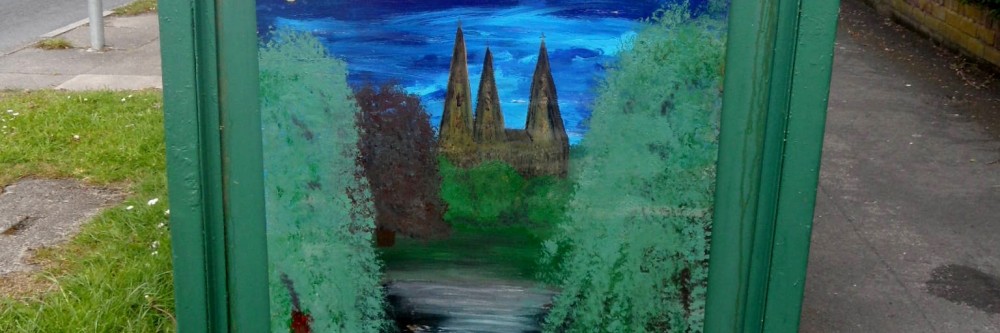
Abra-cadaver

It’s Sunday and it’s Spooky Season (or October as we used to call it) and so hey presto, I’ve written a post about unorthodox burials in this old city where magic may have been involved. I think you’ll like this. Not a lot, but you’ll like it (kids, ask your parents).

As a point of reference and, just to show I don’t just completely conjure things up, there’s a great paper by Roberta Gilchrist, which deals with the archaeology of magic in medieval burials. It outlines the norm for Christian interments at that time as being a body wrapped in a shroud and lacking a coffin, personal items and grave goods and also explains that around two percent of excavated burials are exceptional to this. Excitingly but perhaps unsurprisingly, it turns out that some of these intriguing inhumations have turned up in the Field of the Dead (or Lichfield as the authorities insist on calling it).

Amongst the fourteen burials found beneath what’s now the beer garden of the Brewhouse and Kitchen on Bird Street were the remains of three females, including a woman who lived in the mid-fourteenth century, described by archaeologist Mark Neal as being quite elderly and in poor health. The discovery of so many skeletons here suggests it was the location of the cemetery for Lichfield’s Fransican Friary and the presence of women raises some interesting questions about who was allowed to be buried here and what their role may have been. Most puzzling of all however was the discovery of a body found with a 2mm thick layer of charcoal beneath it. Research shows that such burials are mostly associated with people of note in the early medieval period and predate the founding of the Friary in 1230. Was this the site of a high status Saxon buried before the Franscicans arrived? It is of course possible that this funerary ritual was continued beyond the Saxon period here in Lichfield but could we be looking at a site with a history stretching back further than we thought? The history of the Grey Friars site suddenly seems very grey indeed…

The other burning question is of course, what was the significance of the charcoal? There are some intriguing possibilities ranging from the practical, where the charcoal layer was a way of absorbing bodily fluids during putrefaction, to some sort of post-humous purification ritual designed to save the soul after a life of sin and to stop the dead from returning to haunt the living. I don’t think I’ll ever look at a barbecue in quite the same way again.

Lichfield Cathedral. Pure magic.

Five further charcoal burials were found during excavations at Lichfield Cathedral, one of them inside a stone structure believed to have been part of the original Saxon church. One of those burials was that of a priest buried with something variously described as a hazel wand, rod or staff, as well as a cross of twigs, a chalice and patten and a eucharistic wafer. Yes the symbolism is strong with this one. Several theories exist regarding the presence of the wooden wand, including it being provided for protection as the priest made his final journey through the valley of the shadow of death. Perhaps the most peculiar burial here is that of a priest in an 11th century stone coffin which had an opening directly over where the mouth would be positioned. It’s been interpreted as a libation tube, where the living could make offerings of food and drink to their dead relative. It’s a pagan practice mostly associated with the Romans, and as yet, no-one has come up with a satisfying explanation for it being present in a place of Christian worship.

There are also an incredible 49 burials recorded at the Cathedral where white quartz stones have been found inside graves, and even clutched in the hands of the occupants. Again, the exact symbolism of these is unknown, but archaeologist Warwick Rodwell suggested the answer may lie in Revelation 2:17. This is a passage of the New Testament where a white stone with a new name written on it is given by Christ to his followers as symbol of forgiveness and an invitation to the afterlife. I think. It seems to make sense until you realise that people were incorporating these white pebbles into their funerary rituals long before Christianity existed. As we are on the subject of magic, can we also take a moment to appreciate that John who presents the video I’ve linked to looks like he might be an actual wizard.

St Michael’s on Greenhill is a place of many mysteries

A seemingly more recent, but no less bemusing burial was unearthed at St Michaels on Greenhill in 1852. Two gravediggers dug up the rotten fragments of an elm coffin and found that buried with the bones inside it was a bottle filled with a liquid believed to be urine. It has the feel of folk magic to me, particularly as in 2021, a similar discovery was made at the Trinity Burial Ground in Hull. We know that witch bottles were used to protect people from harm and that examples have been found buried in the foundations of buildings. Was this something similar, designed to protect the grave from robbers perhaps, or other less earthly threats? Or was it just a final drink for the coffin’s inhabitant to enjoy on their way to wherever they were headed to next?

I make no apologies for asking so many questions and being unable to answer any of them in this post. Time and time again, through writing this blog and being part of the Lichfield Discovered team, I realise that there is still so much to be uncovered and understood about the incredible history of this city. And for me? Well, that’s magic.

Sources:
Lichfield Mercury 5th January 1990

1 Bird Street, Lichfield Report on a watching brief, Marches Archaeology Series 103, November 103

Stone, R. (1999). 1 Bird Street, Lichfield: archaeological watching brief. Cirencester: Cotswold Archaeology.

Charcoal Burial in Early Medieval England, James Holloway (2009)

Gilchrist, R. ORCID: https://orcid.org/0000-0002-1967-2558
(2008) Magic for the dead? The archaeology of magic in later
medieval burials. Medieval Archaeology, 52. pp. 119-159

Jonsson, Kristina. “Burial Rods and Charcoal Graves: New Light on Old Burial Practices.” Viking and Medieval Scandinavia 3 (2007): 43–73. Web.

Community and Belief: the Development of Anglo-Saxon Christian Burial Practice,
AD 700-1066, Alexandra Aversa Sheldon (2018)
The Wizard and the Widow’s Curse

In certain magic circles, the story of the Wizard of Bromley Hurst is well-known. In the mid-nineteenth century, Thomas Charlesworth, a young dairy farmer living near Abbots Bromley, argued with his widowed mother over his choice of wife, who also happened to be his cousin. Old Mrs Charlesworth, who was probably younger than me at the time, apparently left the farm muttering he would never do any good and his cheeses would all tumble to pieces. In the months that followed, Thomas did indeed have trouble making cheese from the milk his herd produced, ‘a process which had up to that time been successfully performed’. The fact this coincided with the departure of his mother was surely not coincidence and Thomas leapt to the obvious conclusion. That his mum had been better than him at making cheese? Absolutely not. Young Farmer Charlesworth decided that his cheese-kettle and all of his cows had been cursed.

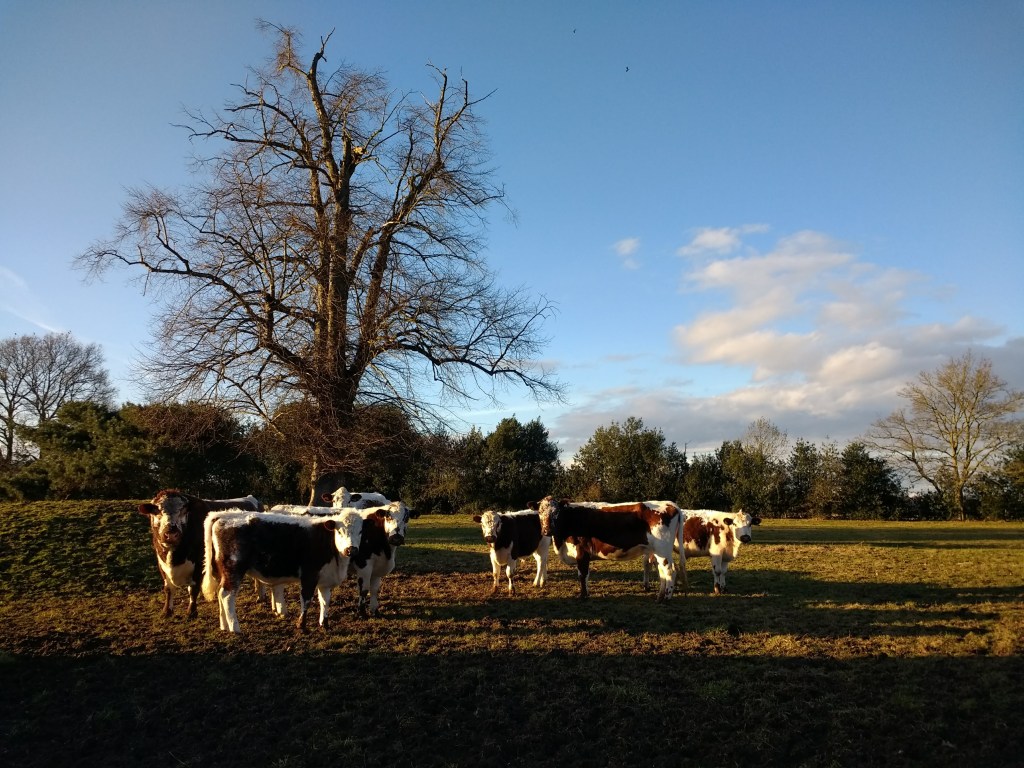
Cused cows? Pull the udder one

Local toll-gate keeper Sammons recommended he seek the help of a man named Tunnicliff who ran ‘The Royal Oak’ beerhouse four miles away at the somewhat appropriately named ‘Buttermilk Hill’. Many men and women who ran such establishments also had a side-hustle. Indeed, my own great-great grandfather ran a pub in Cirencester alongside a blacksmiths shop. Tunnicliff’s supplementary business though was black magic. The wizard agreed that the woes Thomas had recently incurred were due to the ‘Widow’s Curse’ and that he could take the spell a-whey. All he needed was a piece of Thomas’s wife’s dress and the names of all his cows. Oh and £7. His magic act is reported to have been making crosses over the doors with witch hazel twigs and waving his hands over the horses. It seems no-one at that point thought to ask exactly how bewitched horses affected the cheese-making process and Tunnicliff left the house, no doubt rubbing those same hands together at the thought of how easily he’d make his money that afternoon. So easily it seems that Tunnicliff decided to put in a nightshift.

The Charlesworths had an ‘awful night’. Outside in the yard came the sounds of loud yelling, groans and noises of various kinds. Thomas bravely asked someone else to look out to check if there were any animals under the windows but there was nothing to be seen. The following day, he went back to see a tired-looking Tunnicliff and told him about the sleepless night they’d experienced over a beer. Tunnicliff agreed to call in to see what he could do but back home at Bromley Hurst, Thomas experienced shooting pains in his chest, numbness of his limbs and shivering. Whilst these symptoms subsided around dinnertime, he decided to stay in bed an extra hour the following day. Tunnicliff turned up before he woke and took Thomas up a breakfast of ham, bread and coffee. Within half an hour, he was stricken with symptoms similar to those he’d suffered the previous day. Tunnicliff announced he was appointing himself the couple’s defender against the dark arts and would be sleeping in their room. Now comfortably settled in the Charlesworth’s home, he really decided to go big.

To explain Thomas’ ongoing suffering, Tunnicliff ‘revealed’ he was engaged in a battle with ‘Old Bull’ aka the wizard of Yeaverly place, and claimed that ‘a fresh secret has been communicated to me by the power which I possess, and I now tell you that everything you possess is bewitched. You will have to give me further sums of money to remove this betwitchment’. As well as carrying out his wizarding work, Tunnicliff was also taken on as a servant. Shortly after Elizabeth, their baby girl and her nursemaid all began experiencing the same symptoms as Thomas and tragically, it’s reported that the infant died of convulsions in the Autumn of 1856.

Things came to a climax on 11th February the following year, a night during which servants witnessed the family dog run through the house chased by a phantom hound, seemingly made of fire and Thomas Charlesworth was so seriously ill he lost conciousness and was believed to be close to death. Whether it was the terrified servants’ ultimatum that if Tunnicliff stayed they’d leave, or Elizabeth Charlesworth’s discovery that his all expenses paid trip to Derby to battle yet another wizard was entirely fictitious, the penny finally seemed to drop that Tunnicliff was more of a conman than a conjurer and was milking them dry. He was dismissed on the 17th February 1857 and when Thomas was miraculously cured of his supposedly supernatural symptoms shortly afterwards, he reported Tunnicliff to the authorities.

In a trial at Stafford, Tunnicliff’s defence was that Charlesworth was a drunk, as was his father before him. The case for the prosecution however was that the Charlesworths had been poisoned with white bryony root, also known as ‘the Devil’s Turnip’, found at Tunnicliff’s house. In the end, the judge ruled that the Wicked Wizard of the East (Staffordshire) was guilty of obtaining money on false pretences and he was sentenced to 12 months imprisonment with hard labour. Reading over the details of the case, I find it hard to believe he was found guilty only of deception and not of the murder of baby Elizabeth and attempted murder of her parents.

The Coach and Horses, Abbots Bromley

As if this story isn’t already strange enough there is just one more thing to throw into the mix of this heady potion. During the trial, Thomas told how Tunnicliff had been to Rake End to see his uncle/father-in-law William Charlesworth, to caution him to be careful or else come to harm. On 23rd May 1857, William Charlesworth’s body was found on the turnpike road to Lichfield. An inquest was held at the Coach and Horses, the last place he’d been seen alive, leading to the arrest of two men for his murder. Charles Brown was transported to Western Australia but George Jackson was hanged at Stafford. Dreadful is the mysterious power of fate.

Sources

Uttoxeter New Era 13 October 1875

https://trove.nla.gov.au/newspaper/article/273146076

Derbyshire Advertiser and Journal 7.11.1857

Staffordshire Advertiser 7th March 1857

Staffordshire Advertiser 15 August 1857

The Leomansley Witch Project

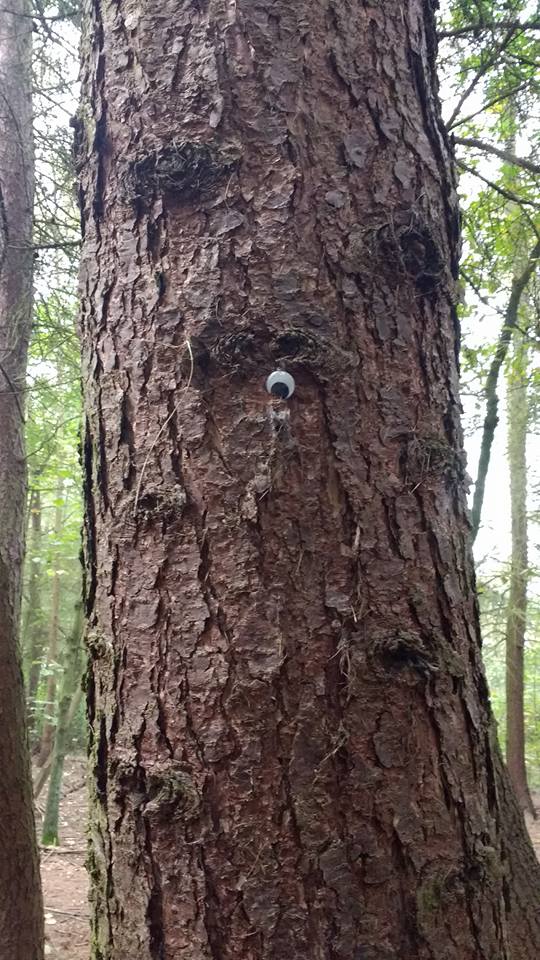
Imagine you’re watching a horror film. A woman heads into ancient woods which are shrouded in mist. And before long, she comes across a tree. With an eye stuck to it.

leomansley-mist

Chances are at this point in the film, you’d be shouting, ‘Don’t go in there. Run away!, whilst feeling smugly confident behind your cushion that you’d never be as stupid as to stay hanging around in mist shrouded woods where there are eyes stuck to trees. Well, I was in Leomansley Woods earlier this week. It was shrouded in mist and there was an eye on a tree. But did I leg it? No. And not just because I don’t do running under any circumstances.

woods-oct-16-2

If something wicked that way had come, I had Finn the swamp dog to protect me and my experience of fighting off a clown in Beacon Park earlier in the month to draw upon. Crucially though, I know and love these woods and consider the tokens and trinkets that have been appearing there since the summer more curious than creepy, possibly symbols of someone else’s affection for them.

finn-swamp-dog

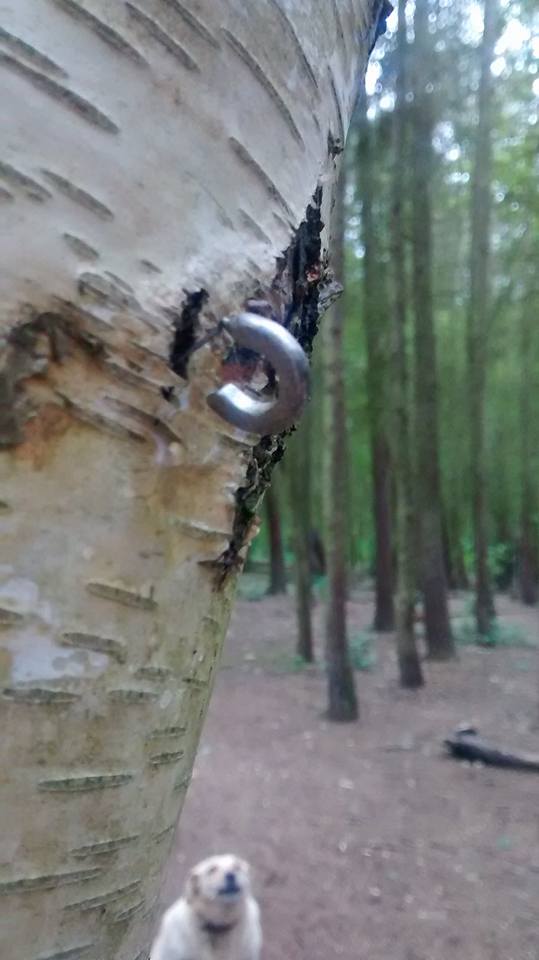
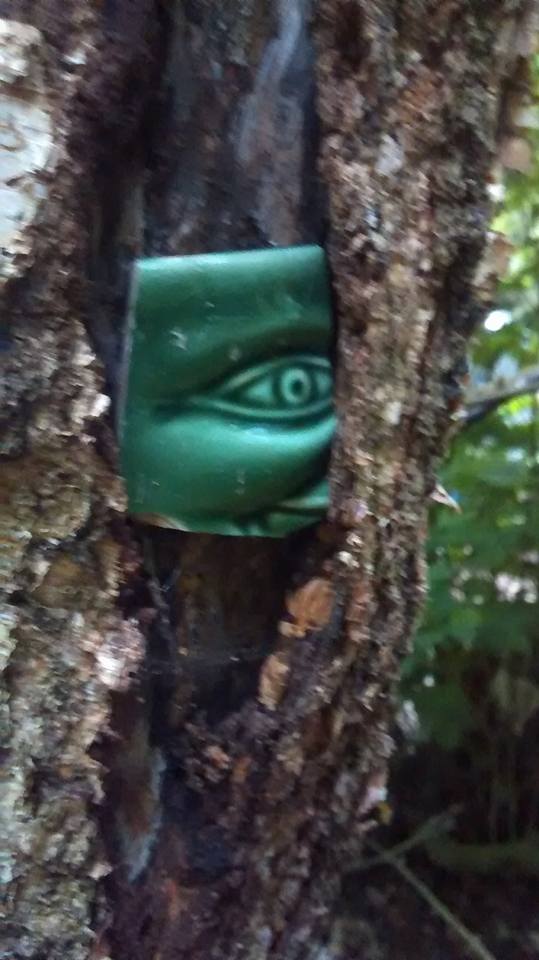
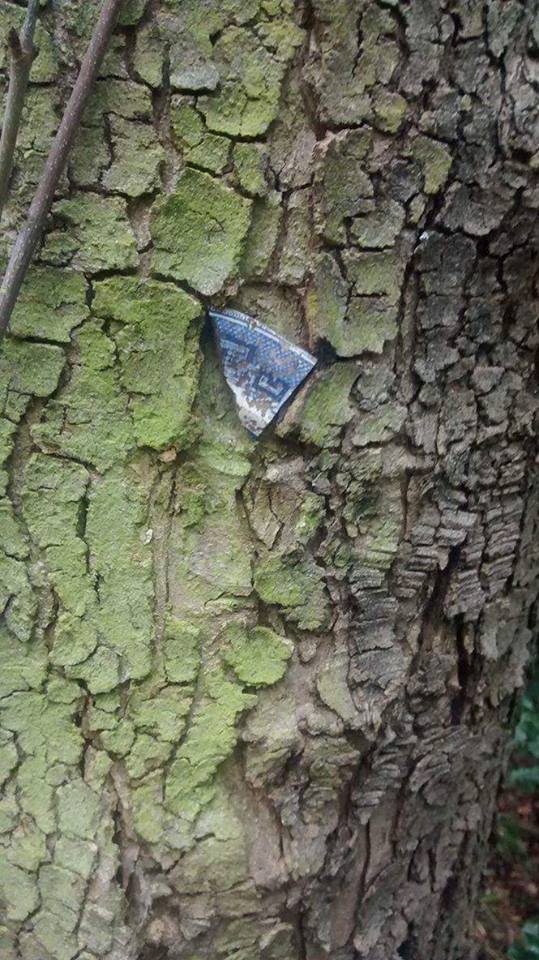
Back in 2004, when I was a newcomer to these parts, I remember getting a call from my sister telling me to go and take a look in the woods as somebody, or more likely somebodies, had created works of art in amongst the trees. There were mosaics created from leaves and petals, clay faces sculpted onto the trunks of trees and brightly coloured papers hanging from their branches. For reasons I can’t remember, I didn’t take any photographs but I can clearly recall the sense of mystery and magic someone had created in the woods that day. We never discovered who or why and there was no encore. The seasons turned and the years went by and then, early this summer, we began to notice things. At first it was subtle. A pebble placed here, a strip of silver birch bark there. It was the first piece of pottery appearing lodged in the knot of a tree that convinced us this was more than the handy work of squirrels and our overactive imaginations. Dog walks took on a new dimension as every day seemed to bring something new. I’m sure at its peak, others were joining in and making their own contributions. And this time I did bring my camera.

woods-june-2016-3

leomansley-woods-june-2016

woods-june-2016-6

woods-june-2016-4

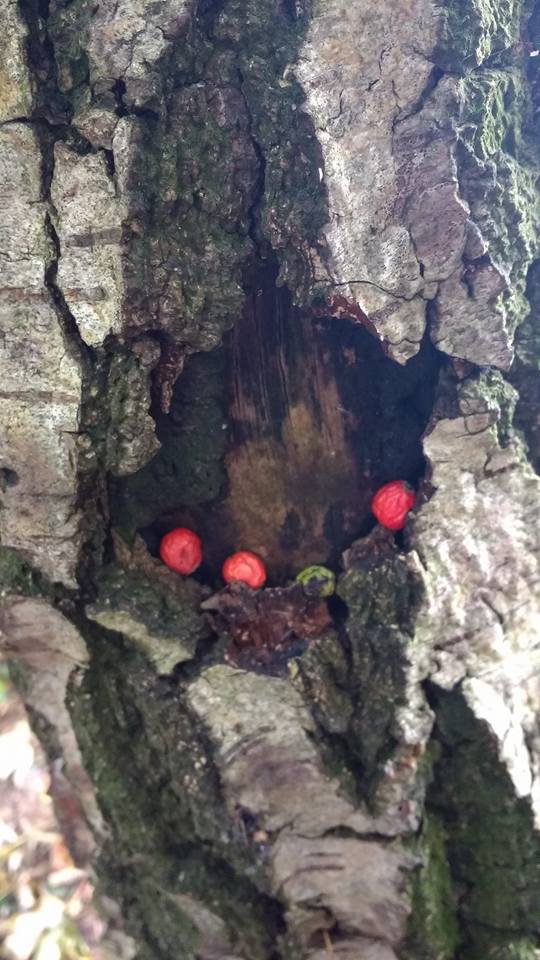
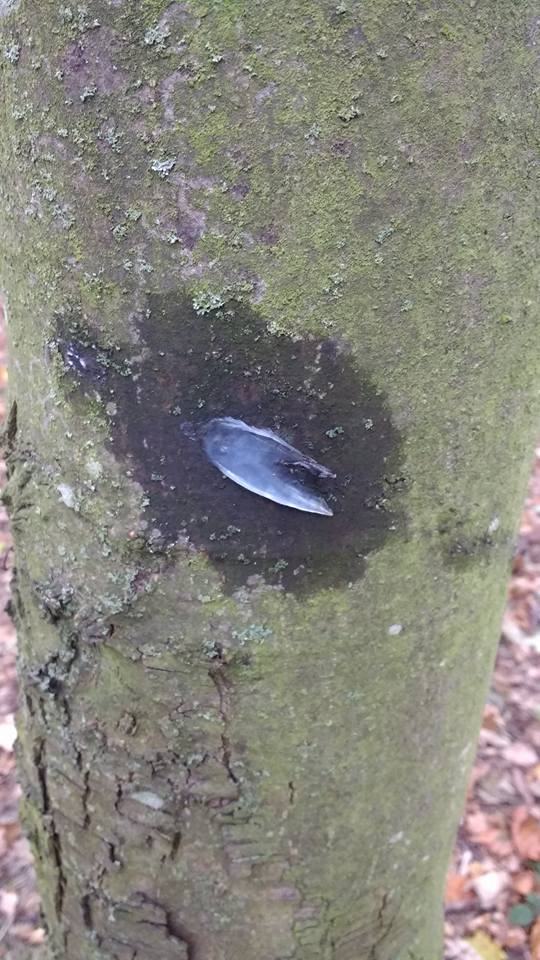
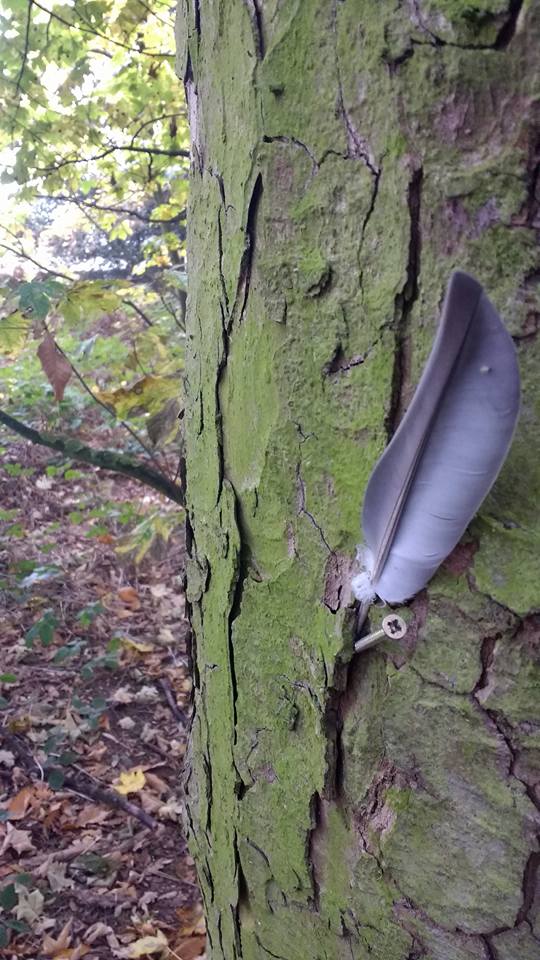
As the summer faded, the activity seemed to wane, and I’d assumed there would be no more. The other half took over the dog walks for a while but recently, for reasons involving a prolapsed disc, I took up the lead once again. Many of the original tree decorations had vanished but a handful of hawthorn berries, melted candle wax and a tickle of feathers (that’s genuinely and rather pleasingly the collective noun for them) had taken their place. Interestingly, others seem to be joining in once again, including the Leomansley contingent of the One Direction fan club.

leomansley-wood-berries

woods-oct-16-3

Woods Oct 2016.jpgwoods-oct-16

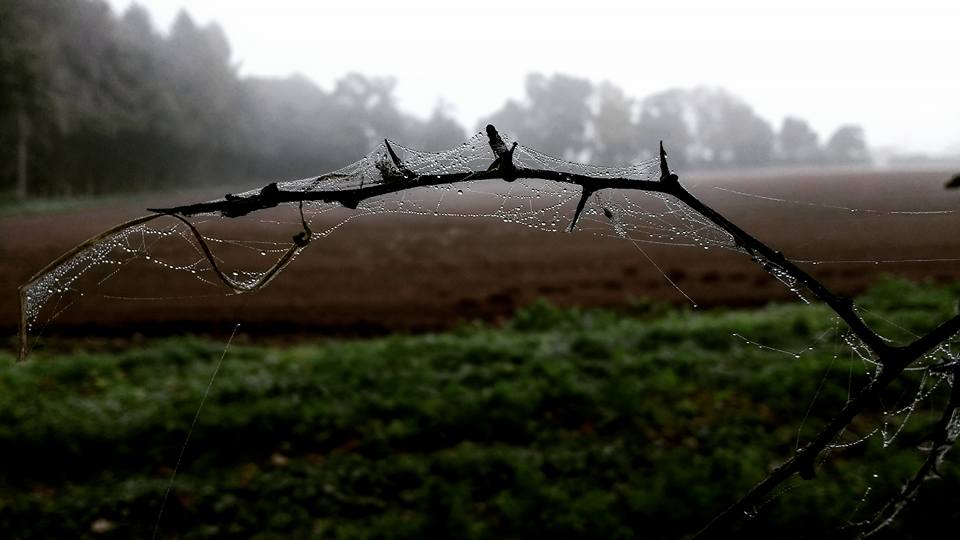
Once again, the who and why is a mystery, and perhaps that is how it should remain. Whether activity continues beyond the season of the witch or not, for me, Leomansley Woods will always remain a magical place.leomansley-cobweb

amelia-bluebellssun.jpg