A Cock & Bull Story


Somehow I’d not spotted these cockerels on Tamworth St before! The cockerels (or chickens as I originally thought they were!) reminded me of some carved cow heads that BrownhillsBob spotted on an old Lichfield butchers shop a few months previous (the old Savers shop) and posted on his great #365daysofbiking blog .

The keystone says that the building was built in 1865.  16 years later the 1881 census for Tamworth St shows the following household:

Name  Relation Marital Status Gender Age Birthplace Occupation Disability

 Henry WELCH Head M Male 54 Rugeley, Stafford, England Poulterer  

 Elizabeth WELCH Wife M Female 56 Harefield, Middlesex, England    

 Louisa WELCH Dau U Female 25 Lichfield School Mistress  

 Arthur WELCH Son U Male 20 Lichfield Poulterers Assistant  

 Alice Mary WELCH Dau U Female 19 Lichfield Dressmaker  

 Elizabeth WELCH Dau U Female 17 Lichfield Pupil Teacher  

 Mary Ann WELCH Dau U Female 15 Lichfield Pupil Teacher  

A poultry dealer on Tamworth St! I think there’s a good chance Mr Henry Welch and his family may have been the occupants of this building? By the way, the rear of the building is also interesting as there is a cart entrance.

Roger Jones (@ziksby on Twitter) very kindly did a bit of investigating on the great historical directories website but could only find general butchers on Tamworth St. However, Henry Welch does turn up as a ‘grocer & poulterer’ in an 1870 directory on Market St, Lichfield. So, it seems at some point between then and 1881 he moved the business to Tamworth St. Did he add the cockerels at this time?

By coincidence, earlier that day I had a look at the mosaic on the landing at Lichfield Library.

Information alongside says:

“This mosaic was rescued by the Lichfield Civic Society in 1985 from the stallriser of 13 Tamworth St. It was restored by Adam Cecconi of Cecconi & Son, Small Heath Birmingham with monies granted by the Swinfen Broun Charitable Trust and is on loan to the college.”

I also found a couple of old adverts for butchers on Tamworth St in a January 1891 edition of the Lichfield Mercury.

HP Craddock Family Butcher, Tamworth St, Lichfield
Fresh Meat daily. Pickled tongue always on hand.

Quantrills Est. 1872
2 Tamworth St, Lichfield
Pork pie & sausage establishment. A great display of hams, porkpies & sausages which surpass any in the city for quality & cheapness. Pure leaf lard, pickled pork etc.
All orders promptly attended to.

Richard Bratby (@RichardBratby) also got in touch via twitter to say that he had seen a photograph of Quantrills and it was on the corner of Bakers Lane, but demolished when the Three Spires shopping centre was built. Richard also said that the photograph is in Heritage Centre collection, so I’ll have to pay them a visit.

I think it would be really interesting to see if any of the other shopfronts & buildings in Lichfield City centre still have clues to the trades that were carried on in them (I think I already found an old branch of Burtons!). If anyone does find any, please get in touch.


Sir Gilbert Scott and Lichfield

Following on from yesterday’s google doodle of the Midland Grand Hotel at St Pancras, to to commemorate the 200th birthday of Sir George Gilbert Scott, I had a quick look at Scott’s connections to Lichfield.

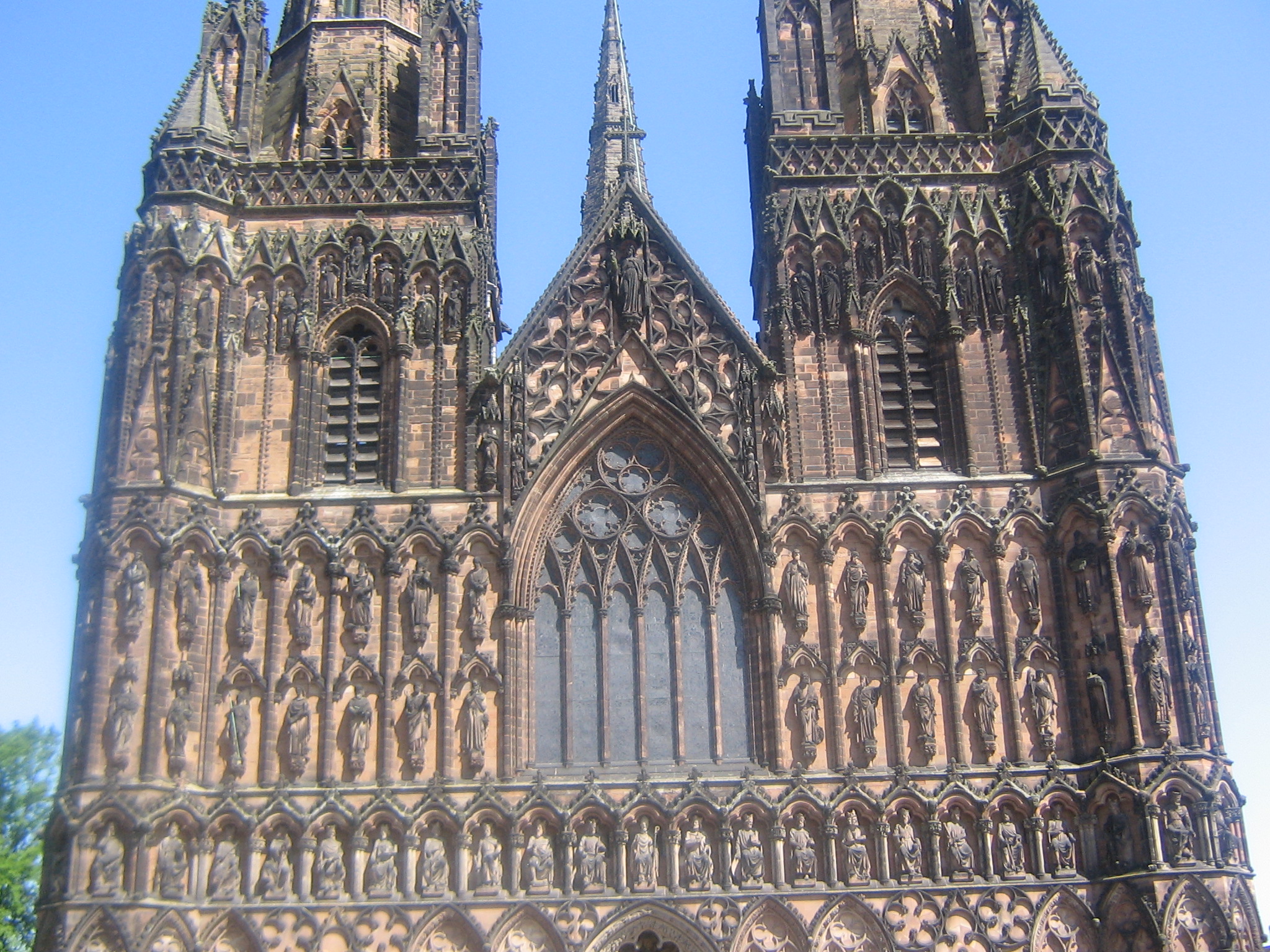
Scott was the Lichfield cathedral architect from 1855 to 1878, first restoring the interior of the Cathedral and then working on the exterior, including the West Front which had been vandalised during the civil war and covered in roman cement in  an earlier restoration.You can read more about the restoration at the Lichfield Cathedral website

It seems Lichfield Cathedral isn’t the only city building that Sir Gilbert Scott was involved with.  In the early days of his career he had formed a partnership with his former assistant William Bonython Moffatt. The Scott & Moffat practice made workhouses their speciality. Apparently, they would monitor the newspapers for adverts by Poor Law Unions looking for architects to build their new workhouses. Scott & Moffat answered an advert placed by the Lichfield Workhouse Board of Guardians, looking for  “Plans and Specifications for a Workhouse to hold two hundred Paupers, in accordance with Mr Kempthorne’s Model.”  Scott & Moffat were eventually selected after much deliberation by the workhouse guardians and work began on the tudor style building on 24th May 1838 and it was officially opened on 8th May 1840. Their work can still be seen at the old St Michael’s hospital on Trent Valley Rd.

Scott and Moffat parted company in 1845, after designing around 40 workhouses together. Scott’s wife Caroline Oldrid was said to have put an end to the partnership, as she believed that Moffat had become unreliable. In 1860, Moffat was was imprisoned as a debtor. After their partnership ended, Scott carried on with his two sons as his assistants. His younger son, John Oldrid Scott took over his father’s practice in 1878 and was the architect overseeing the restoration of the cathedral spire in my previous post! I was reading his notes and letters to the Dean and Chapter just a few days ago (his handwriting is terrible!). Scott’s eldest son George died at the age of 58, strangely enough at the Midland Grand Hotel at St Pancras Station.

Scott was knighted in 1872 but faced some critiscism during his career.  William Morris and others founded the Society for the Protection of Ancient Buildings in 1877, in response to what they felt was the unsympathetic restoration of medieval buildings by Victorian Architects, Scott amongst them. Apparently on Scott’s death, Morris described him as ‘the happily dead dog’.

The Midland Hotel was threatened with demolition in the 1960s, but The Victorian Society campaigned and the hotel became grade I listed.  The hotel was reopened earlier this year as the St. Pancras Renaissance Hotel. 

You can see a list of the buildings Scott worked on here.  I’m pleased to see that they’ve included a picture of Lichfield Cathedral!

Sources
www.scottisharchitects.org.uk

www.workhouses.org.uk

Cathedral City by Howard Clayton

This Won’t Hurt – A History of the Hospitals of Lichfield by Mary Hutchinson, Ingrid Croot and Anna Sadowski

www.guardian.co.uk Article ‘Sir George Gilbert Scott, the unsung hero of British architecture’

The Cathedral Spire – A Hatchett Job!

A couple of weeks ago, I was contacted by Vickie Sutton. Vickie is from a family with some amazing connections to Lichfield. She believes it’s vital that the wonderful memories and stories that have been passed down to her are recorded, and shared with other people, so that they don’t get lost and forgotten.

A caricature of Henry Hatchett by one of his colleagues. (1)

One of the first stories Vickie shared with me is about her great grandfather Henry Hatchett. Henry began working for Bridgemans of Lichfield in the 1890s. Employed as a as a labourer, he mastered the arts of casting, cleaning stone and marble.  Henry was periodically sent to Edinburgh to maintain the Last Supper sculpture (based on the painting by Da Vinci) in St Cuthbert’s Church, and as a result, his colleagues gave him the nickname ‘MacHatchett’! (1)Vickie knew that Henry had been involved in restoring the central spire at Lichfield Cathedral and together, we set out to discover the full story…..


 Lichfield is of course famous for having three spires but it seems that the central spire has had all sorts of problems! It was destroyed in 1646 during the civil war and was restored in 1666. Between 1788 and 1795 it was restored again with further work being carried out in 1892/3.

In 1949 there was trouble with the spire again. The Dean reported that in high wind, the ball and cross were moving. An architect, Mr George Pace, was consulted and gave a verdict that came as a shock to the Dean. Due to corrosion of the iron anchors and cramps, and weathering of the mortar, the spire was in such bad condition that the last 11 feet could be shook by hand. It would need to be repaired immediately. Mr Pace later described how in his view, a delay in the work could have resulted in the spire crashing through the cathedral roof. More than 20ft of the spire had to be pulled down and rebuilt. The Dean was unwilling to finance the work with a bank loan believing that it would have been ‘lazy, and stupid, and unsound finance’ and turned instead to the public, launching the ‘Lichfield Spire Repair Fund’. As Christmas 1949 drew near, the Dean urged people donate suggesting it would be a ‘glorious Christmas present’ for the Cathedral. Eventually, the cost of the work amounted to more than £9,000 and the amount was raised by people, not just from Lichfield but from all over the country.(2)

Twenty-two stone courses were removed from the spire to Bridgeman’s premises on Quonians Lane, where they were either replaced or redressed.

A new cross was designed by the architect George Pace, and incorporated the Jerusalem motif, found on the Cathedral Arms. The ball (2 foot in diameter) was taken down and was found to contain several rolls of parchment and a ½ oz of twist (tobacco) and the remains of half a pint of beer! One of the parchments told how the ball and cross had been taken down for repair and re-gilded on 12th September 1893 and was signed by the Rt Rev The Honourable Augustus Legge. The second parchment had a list of those holding civic office at the time and also the signatures of the men engaged in the work. It was on this list that the name Henry Hatchett, labourer appeared. (3)

The scrolls from 1893 were placed in the archives and replaced with a new scroll inscribed with the names of those holding civic office in 1949/50 and once again, the names of those carrying out the work. The ball was re-gilded with two layers of the finest double English gold leaf. This was carried out in situ by Mr George Kingsland from Birmingham. On 19th June 1950, a celebratory meal was held in the Swan Hotel by the Dean & Chapter, to which everyone involved in the work on the spire was invited. Vickie’s family remember there being some sort of grand unveiling of the new cross and ball, but I haven’t been able to locate any details regarding this yet. (4)

I love this story as it shows that even the most well-known of our buildings can still have secrets! I wonder if the addition of the beer and tobacco was an authorised one? Also, does anyone know where the old parchements are stored?

I really want to thank Vickie for sharing this. We are working on some more of her brilliant family stories at the moment, but in the meantime check out this link and enjoy some of the views from that troublesome central spire.

Sources

1 & 4 The Annals of a Century: Bridgemans of Lichfield 1878 – 1978 by O Keyte

2 & 3Lichfield Mercury Archives accessed at Lichfield Record Office