Know Your Boundaries

I’d wondered about this curious sandstone block, embedded in one of the gate posts of the Garden of Remembrance on Bird St, but it wasn’t until I read a newspaper article on the unveiling and dedication of the war memorial that I learnt that it is apparently an ‘ancient’ boundary stone. The article in the Lichfield Mercury, dated October 22nd 1920, describes how a high wall running along Bird St was demolished and replaced by the stone balustrade that now runs along the edge of the garden. Prior to its demolition, the boundary stone was originally incorporated into this wall, but whether that was its original location, or was an earlier effort to preserve the stone, I don’t yet know. It seems to be marked and I’m wondering whether this is deliberate or not (or if I’m imagining it!). Also, just how ancient is ancient?
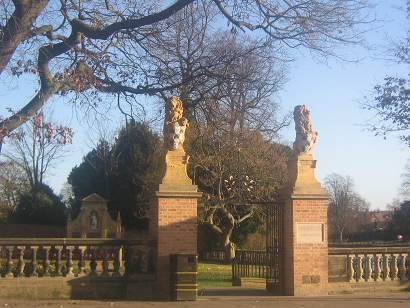
Boundary stone embedded in lower part of right gate pier of Lichfield’s Garden of Remembrance
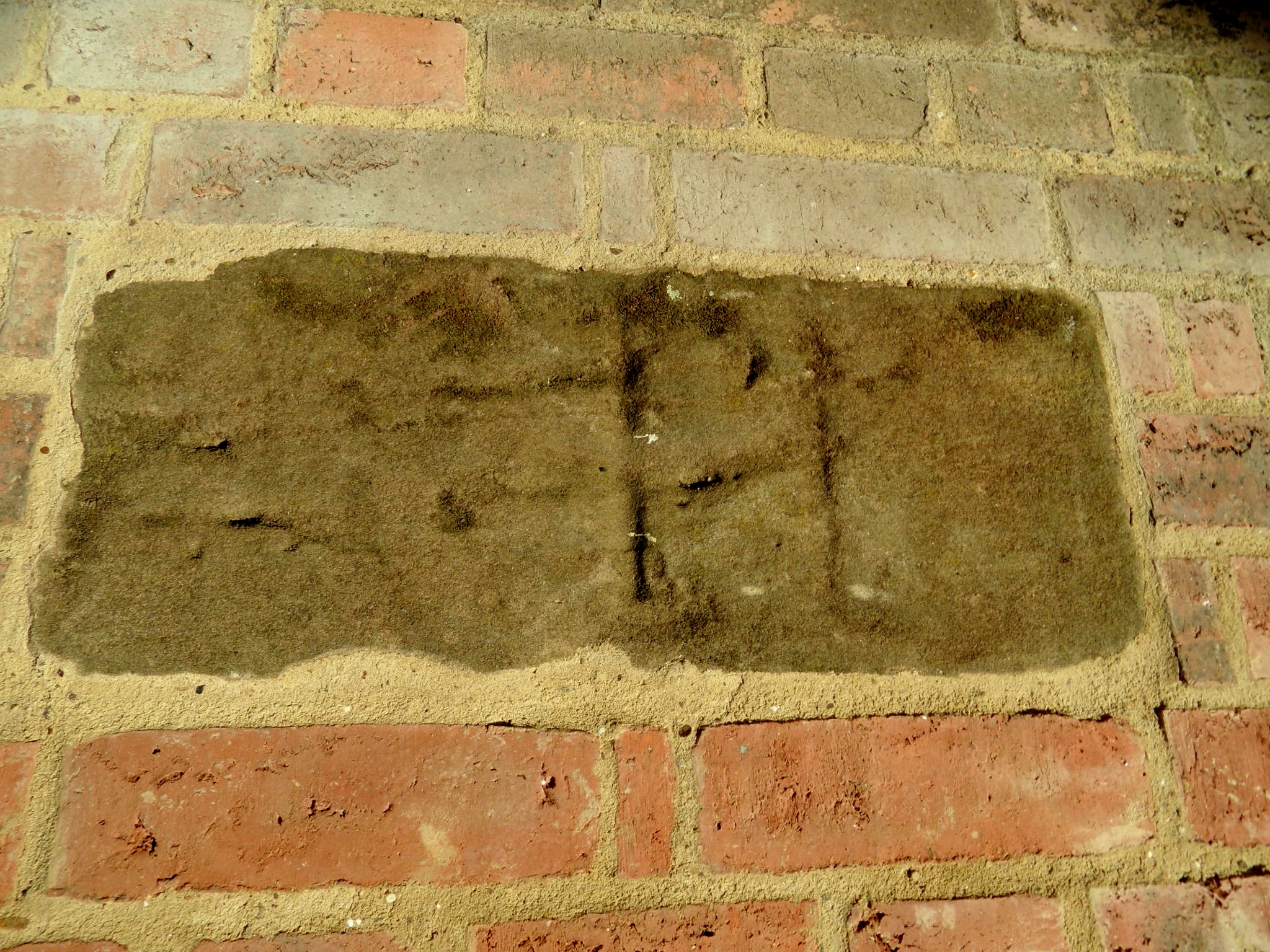
Close up of the ‘ancient’ boundary stone

A newspaper report from May 1936 describes how the Cathedral Choristers observed the tradition of ‘Beating the Bounds’ each Ascension Day. Accompanied by members of the clergy, the boys would start opposite St Mary’s Vicarage and stop off at places were there was, or had been, a well – ‘midway between the pool and Gaia Lane’, the Bishop’s kitchen garden, the Dean’s kitchen garden, Milley’s Hospital, the boundary stone on the Minster Pool Bridge and the Verger’s house in the corner of the Close before finally gathering at the old pump to the North West of the Cathedral, to which water from the Conduit Heads up near Maple Hayes once flowed along a lead pipe. The boys would carry elm boughs, and at each of the stop off points there was a reading from the scriptures and a verse of a hymn was sung. In 1936, the elm boughs were brought inside the Cathedral and laid on the font. An account from 1910 describes how choristers would collect boughs from the Dimbles and then return to the Close where they would decorate the houses before commencing their perambulation. I understand that these days Ascension Day is marked by the choristers singing from the roof. It’s interesting that elm boughs used to play a part in the custom; it makes me think of old traditions related to the Lichfield Bower which takes place in the same month.

‘Beating the bounds’ apparently dates back to a time before maps and was a way of ensuring that the knowledge of where the boundaries of an area, or a parish, lay was passed on. The tradition in The Close seems to have been centred around wells and water, but in other places boundaries were also marked by other natural features.  A Gospel Tree is marked on OS maps of Gentleshaw up until the 1930s and Gospel Oak is a common place name, found all over the country.

On the subject of maps, there’s a great version of John Snape’s 1781 map on BrownhillsBob’s Brownhills Blog here. I think that the boundary of the Close, similar to that described above, is shown clearly on this map in the form of a dotted line running around the Close.

There’s a lot more to be said on boundaries and their markers, including the exciting possibility (for me at least!) that if this one is still here, there just might be others preserved somewhere in or around the city. In fact, we may even have located a couple, purpose as yet unknown.

Edit: Just had one thought myself actually! In many places it seems boundary stones and trees were actually hit with sticks (as can be seen here in Oxford) or physically marked in some other way, as people passed by them on their perambulation. Is it possible the marks on our boundary stone are evidence of it being ‘beaten’ over the centuries?


Fire and Water

This battered wooden case, once used by the Lichfield Aerated Water Co, was recently rescued from a garden bonfire in the village of Selston, Nottinghamshire by Michael Leivers.

The crate must date from the early 1930s as the Lichfield Aerated Water Co was set up in 1931, as a subsidary of Samuel Allsopp & Sons Brewery which had taken over the Lichfield Brewery and its 182 public houses in 1930, before merging with Burton neighbours Ind Coope Ltd in 1934 to become Ind Coope and Allsopp Ltd. (1) On 1st December 1935, the Aerated Water Co was taken over by Burrows and Sturgess, a Derby firm who also produced SPA Grape Fruit, SPA Ginger Ale and SPA Iron Brew alongside soda and tonic water. Burrows and Sturgess moved the business from the old Lichfield Brewery on St John Street to a new factory based at the former maltings on the Birmingham Rd, but kept on the existing manager, a Mr Bourne(2). As part of the take over deal, Burrows and Sturgess were able to supply their products to a large number of premises owned by the newly formed Ind Coope and Allsopp Ltd.

The Derby Telegraph Bygones page features the memories of several people who once worked for Burrows and Sturgess, including a Mr Tipper who was a driver’s mate in the 1950s. Mr Tipper recalls driving to the Lichfield Depot in an AEC Mammoth Major which they would load up with metal, two dozen bottle crates, stacked six high and six wide. At the depot, these would be unloaded and replaced with the empties which were then taken back to Derby to be refilled. There’s a photo here on the Staffordshire Past Track website showing a steam wagon making deliveries for Henson’s Aerated Waters in the 1920s in Burton-on-Trent – would Michael’s wooden crate and its contents have been transported in a similar way?

Thanks so much to Michael for sending me the photo. It’s a great reminder of a long disappeared part of Lichfield’s industrial past and I’m so glad it has been saved from being reduced to a pile of ashes and given a new lease of life as a coffee table. I wonder what other uses it may have had during its eighty or so years? Michael thinks it was being disposed of as part of a house clearance. It’s a bit sad that some people don’t look a bit deeper to see the value in things like this. There’s a lot to be said for ordinary, everyday objects.   Of course, it would be great to hear from anyone who knows more about the short-lived Lichfield Aerated Water Co, or its successor Burrows and Sturgess.

Notes

(1) The VCH has it as a subsidary of Ind Coope and Allsopp, but as this merger between the two didn’t happen until 1935, The Lichfield Aerated Water co would, at least initially, have been a subsidary of Allsopp only. I think.

(2) Does this mean the fomer maltings originally belonging to the City Brewery, but most recently Wolverhampton & Dudley breweries and now being converted into residential accomodation?

Sources:

The Brewing Industry: A Guide to Historical Records edited by Lesley Richmond, Alison Turton

Lichfield: Economic history’, A History of the County of Stafford: Volume 14: Lichfield(1990), pp. 109-131

http://www.midlandspubs.co.uk

Holy Stones

Although St Peter’s Church at Elford was largely rebuilt in the nineteenth century, it is famous for its medieval monuments.  The most well known is the ‘Stanley Boy’, said to depict young John Stanley, last of the male line, holding a tennis ball in his left hand, and pointing to the place where it fatally hit him with his right. On face value, it’s a great story, but the fact that it has been cast into doubt by some makes it even more interesting in my opinion. Nikolaus Pevsner and an article called ‘The so-called Stanley boy monument at Elford’ by Sophie Oosterwijk for the Church Monument Society date the monument as thirteenth century whereas, according to the story, John Stanley died in around 1460. It has been suggested that at some point the effigy may have been modified to add weight to the local legend. It’s a nice reminder that when it comes to history, you can’t even trust what’s carved into stone. There’s a drawing of the effigy from the eighteenth century here on Staffordshire Past Track.

Unfortunately, on my recent visit, I didn’t manage to see the Stanley Boy (or whoever it may be!) close up. The wooden gates separating the Stanley Chapel from the rest of the church seemed to be locked and I didn’t try to hard to open them.  A lady doing her stint on the flower rota had told me that the church had suffered from a recent lead theft and I didn’t want to add to its troubles by breaking anything. Anyway, there were plenty of consolations including the beautiful Minton tiles, stained glass and another curious monument outside.

Just one of the lead pipes stolen for scrap metal, leaving the church vulnerable to water damage.

I’ve walked around my fair share of churchyards and although I’ve seen plenty of worn and weathered stones,  I can’t remember having ever seen a hole in one like this before and would be grateful for any explanations (or failing that, guesses!) for what’s happened here.

Guardian Angel

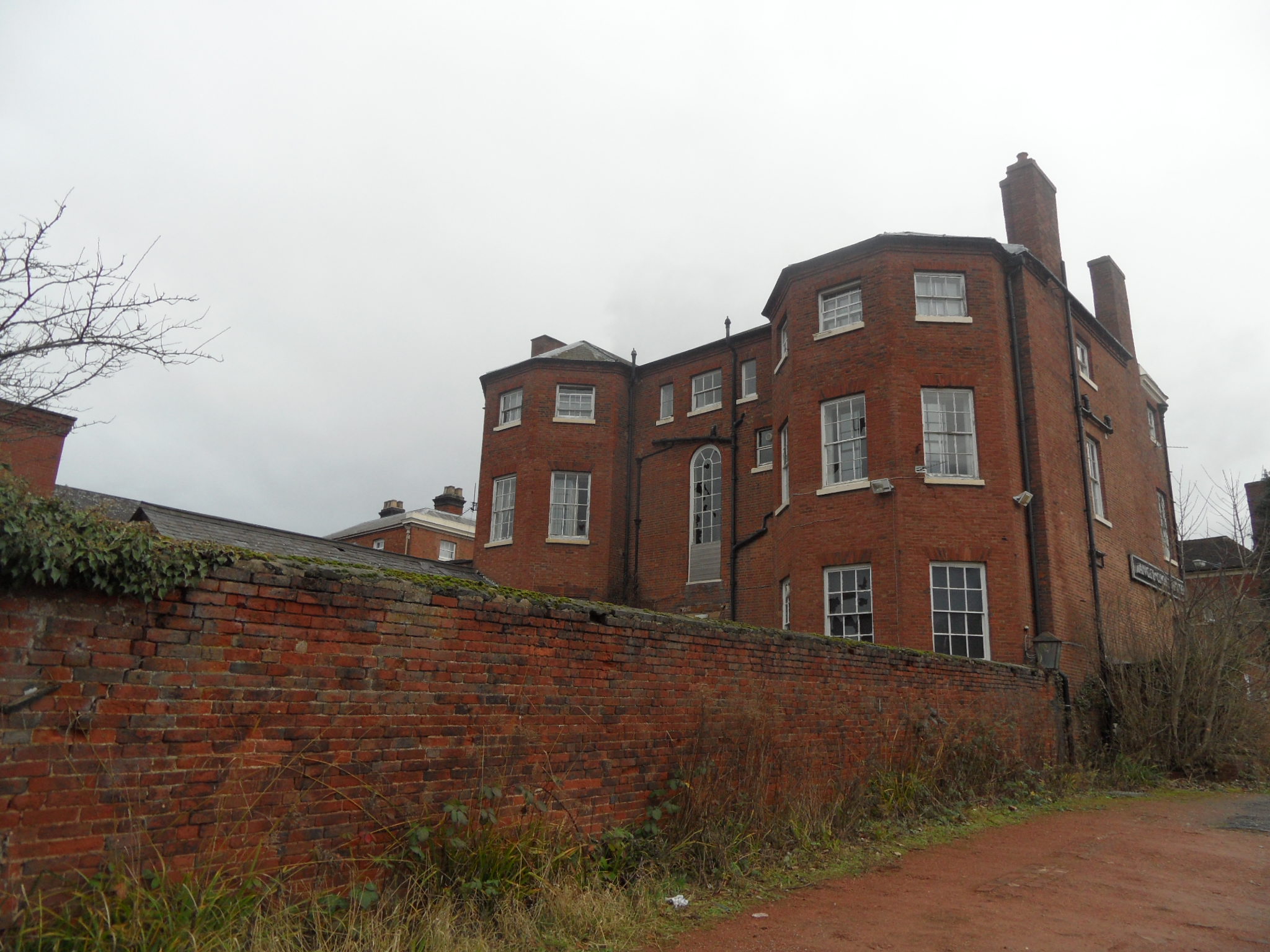
The whispers on the (Beacon) street were true. A new planning application is in the offing to convert the former Angel Croft Hotel into apartments.

The eighteenth century Angel Croft has been one of the most discussed buildings in Lichfield in recent times. Since 2008 it has been empty and vulnerable and its annual appearance on the English Heritage At Risk register has given people real concern about what its future might hold.

As it stands at present, the Angel Croft is at risk from further vandalism and, worse still, arson, which can prove devastating to so many heritage buildings.  My view is ‘use it or lose it’. Sometimes, in order to survive, buildings must adapt and play many roles over the course of their lives. In fact, the Angel Croft was a residential property until its conversion to a hotel in the 1930s. If something positive doesn’t happen soon then there is a possibility that we may lose it altogether and be left with nothing more than a vacant building plot.  I hope that this proposal, which will secure the future of the building and its features, will be supported and that the Angel Croft will not be put at further risk by short sightedness and nostalgia about an unsustainable past.

You can see the documents supporting the planning application here (the planning, design and access statement) and here (the heritage statement), which I’m grateful to the Beacon Street Area Residents Association for forwarding to me.

N.B For anyone interested in the history of this building, the Heritage Statement contains historical information about the Angel Croft, including descriptions, old plans, maps and photographs.


Albert and Percy

Ron Myatt of the Great Wyrley Local History Society has been back in touch with the names of the other two members of the Staffordshire Yeomanry pictured here with a young Frank Halfpenny at some time during the First World War.

Frank Halfpenny, later Sheriff and Mayor of Lichfield (left), Albert Handley (centre) and Percy Johnson (right)

In the centre of the photograph is Albert Handley, and Ron has very kindly passed on to me the following information given to him by Albert’s son.

Albert Handley was born in Bridgtown in 1893. He was the second son of Jairus and Elizabeth Handley (formerly from Willenhall) and brother of Charles, Ellen, Ethel and Maud.  The family moved to moved to Landywood (part of Great Wyrley) and Jairus Handley worked in several pits. Albert was educated at Great Wyrley Council School and left aged 14. Afterwards he went to the Evening Institute where he learnt mathematical skills and secretarial techniques. Albert worked in brickyard in Bridgtown before taking a clerical post with Siemens Electrical, Stafford. Although Albert was employed in a ‘reserved occupation’, in 1915 he managed to enlist in the Staffordshire Yeomanry, where he served until 1919.

After mustering at Burton on Trent, the 3rd / 1st Staffs Yeomanry were affiliated to the 12th Reserve Cavalry Regiment at Aldershot where Albert learned to ride horses and was promoted to NCO rank. In 1916, they served in Egypt, Palestine and Syria. During his service, Albert contracted a near-fatal dose of malaria.

Back home, Albert met Winifred Sambrook ,an infant school teacher, and they were married in 1924. Between 1919 and 1949, he was employed as a clerk at a large mine but also took on additional roles including church officer, society steward and Trustee of Wyrley Wesley Methodist Church. Albert also helped to set-up the fund for first Doctor’s Practice, was the founding Treasurer of the Wyrley Branch of the Nursing Association, and set-up a branch of the Ideal Benefit Society collecting subs and making pay-outs.

In 1937, Albert was appointed clerk of the Parish Council which brought with it a large range of duties including opening libraries, supervising burials, responsibility for recreation grounds and tennis courts as well as administrative tasks. In 1949, he became a Magistrate for Cannock and Penkridge Bench in 1939, eventually being elected chair.

During the Second World War, Albert was a founding member of Civil Defence Corps in 1939, who were responsible for recruiting wardens, issuing gas masks, organising training and dealing with the arrival and billeting of evacuees from Margate. In 1949, Albert became a local Government Officer in the Rating Department of Cannock RDC. Albert died in 1975.

The third man in the photo is Percy Johnson, who Ron believes was Lichfield farmer. However, we know nothing more about Percy, and would be grateful to hear from anyone who is able to help.  I’d also be interested to know the story behind this photograph. Why were Frank, Albert and Percy photographed together, and when was the photograph taken?

If you do have any further information on any of the above, please send me an email or leave a comment below, or alternatively you can leave a message for Ron on the Great Wyrley Local History Society guestbook here.