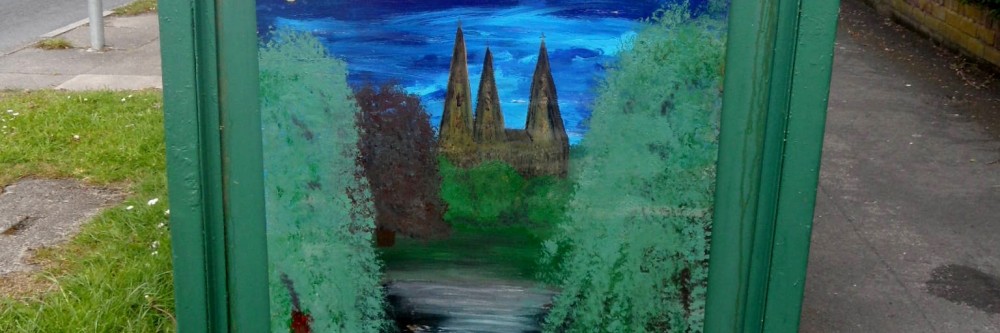
I know the Winter Solstice has passed and the nights are drawing out but I’m still, ok always, in the mood for a dark tale. Here’s a short, but definitely not sweet story about Doctor Darwin and the Dissection of the Deserter.
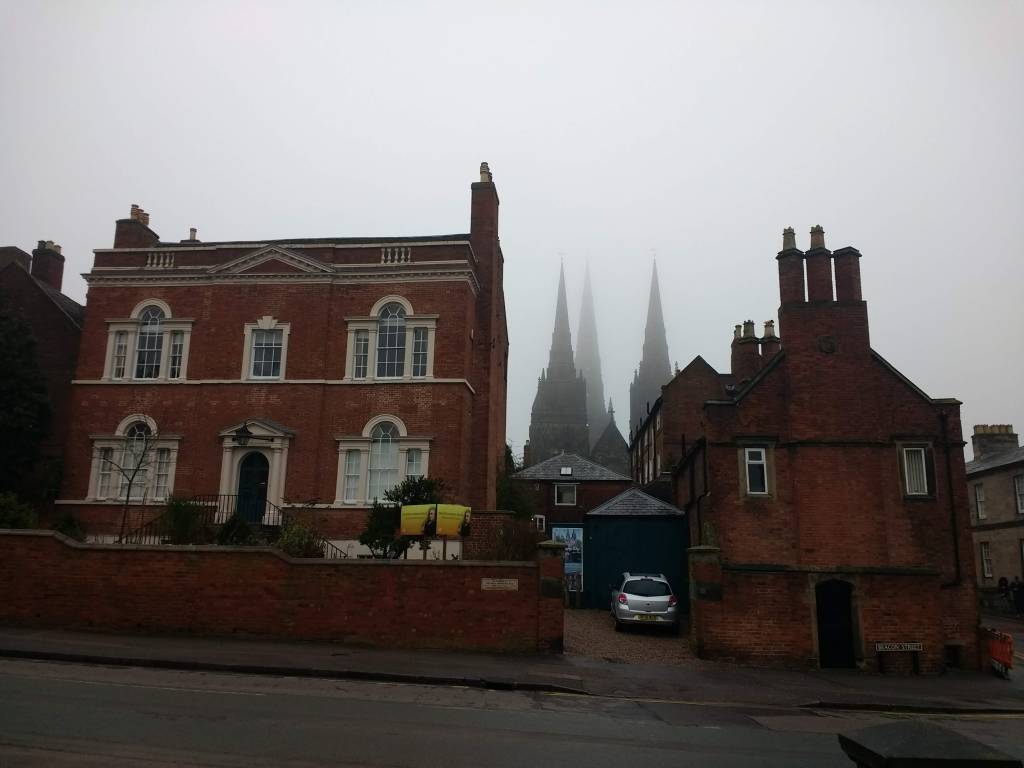
On 23rd October 1762, a notice appeared in Aris’s Birmingham Gazette advertising that,
The Body of the Malefactor, who is order’d to be executed at Lichfield on Monday the 25th Instant will be afterwards convey’d to the House Of Dr DARWIN, who will begin a COURSE of ANATOMICAL LECTURES at Four o’Clock on Tuesday evening, and continue them every Day as long as the Body can be preserved; and shall be glad to be favour’d with the Company of any who profess Medicine or Surgery, or whom the Love of Science may induce.
This public announcement has been discussed in many accounts of Darwin’s life but, as far as I can see, none of them ever named the Malefactor in question. His identity was easy enough to deduce as there is an article in the same newspaper a month prior describing how, Thomas Williams, a Soldier in the King’s Regiment of Volunteers quartered at Lichfield, who ‘had deserted from thence was seized in that City by two men belonging to the Regiment but he ran into the Fields and the Men pursuing him, he turned and stabbed the Foremost one, William Sly, with a Knife so that he died soon after. He then made off but has since been taken and committed to Lichfield Gaol’. The Coroner’s Inquest brought in a verdict of Wilful Murder.
Public hangings were few and far between in Lichfield but drew a bigger crowd than a new batch of Prime arriving at Aldi when they did take place. In the twenty three years Darwin lived in the city, Thomas Williams was the only murder to be hanged at Gallows Wharf. This suggests to me that this course of anatomical lectures may have been a one-off, unless Darwin had a supply of criminal corpses from elsewhere? Somewhere like Birmingham, for example? Disclaimer: as a Brummie I am allowed to get away with saying this. Actually, there was only ever one public execution in the second city, and it’s an intriguing tale indeed. One for another time though.
In December 1978, the Derby Daily Telegraph reported how the ‘Lichfield Quarter Sessions Order Book, 1727 – 58’, had recently been acquired from a sale at Christie’s by the Lichfield Record Office. It was the earliest volume in a series covering the period up until 1923, the rest of which were already held in the archives. It’s likely that it too had once been part of the collection but seems to have somehow strayed into private hands at some point. Criminal eh?
Amongst the many misdemeanors reported amidst its pages is the case of Henry Murral, who was hanged at Lichfield on 12th May 1738 for murdering Edward Cheney with a pitchfork. Just under ten years later, on 9th April 1747, William Hiccock, a soldier belonging to the Regiment of Old Buffs met the same fate for the murder of Mr Pealing, a Labourer from Lichfield.
Although there are examples of murderers being buried beneath the gallows they’d hanged from, I suspect that the bodies of Murral and Hiccock now lie in St Michael’s churchyard as their crimes were committed prior to the Murder Act of 1751, which stipulated that, ‘in no case whatsoever shall the body of any murderer be suffered to be buried’ and should instead by publicly dissected or hanged in chains, their burial in consecrated ground would still have been permissible. In addition, parish registers from the 16th century record the burials of a number of criminals taking place here. Amongst them is an entry for February 17th October 1592, when William Key of Bliffield and Nicholas Hatherton of Lichfield, two prisoners, ‘condemnd according to the laws of the land and executed here at this Cittie were both buryed in one grave’. What they were condemnd for is not recorded. We also of course know that the men executed for forgery in the early 19th century were interred here. I am curious as to what happened to the body of Thomas Williams once it was past the point of preservation. Does he rest in pieces at St Michaels?
Clearly, Doctor Darwin obtained his offender officially. However, there were of course those who did not. There was supposedly an infamous body snatcher called Bannister who lived in the Lichfield area in the first part of the nineteenth century. In July 1851, a group of men were drinking brandy and water at The Angel Inn including fishmonger Abraham Phillips, Henry Cato, landlord of the nearby Three Crowns, a draper’s assistant called Thomas Smith and Mr Orgill, the landlord of the Angel. It was an ill-tempered affair with insults and accusations flying about. At one point, Cato turned to Phillips and told him he’d never had much opinion of him since he’d been in partnership with old Bannister before asking him how many years it had been since his cart broke down from the weight of carrying the dead body of a solicitor named Robinson out of Ridware churchyard. Another man, Mr Emery joined in to say he thought it a bit fishy to suggest Phillip’s cart ever had the body in it, as Phillips had weighed twenty-two stone. Cato, however was adamant. “I can swear it and will prove it”, he declared although given that he ended up in court paying a farthing to Phillips for slander it seems he probably didn’t.
Can we prove it though? Was there any truth to this bodysnatching banter and is there hard evidence to suggest that bodies were taken from graveyards in the Lichfield area? Time to do some more digging…
Update:
In January 1829, two men stood before a judge and jury at the Lichfield quarter sessions accused of body snatching. The previous month, witnesses had seen them carrying a hamper from St Michael’s churchyard to the Swan Inn.
When John Coxon, church warden at St Michael’s and John Charles, a police officer, arrived at The Swan they opened the hamper and found it contained the body of a man who had been interred the previous Tuesday. The hamper was addressed to a man called Johnson of Tooley Street, Southwark, London, the men intending for their corporeal cargo to be delivered to him via coach.
Two pairs of muddy trousers were found at one of the men’s lodgings opposite the churchyard on Greenhill, where evidence of three more disturbed graves was discovered. Two had been broken open but the bodies left behind as their advanced state of decomposition meant they were not fit subjects for surgical operations. There were also rumours in the city that a child body had been stolen from St Chad’s the week before.
William Simpson and James King were both sentenced to 9 months in prison. Whether Mr Johnson of London was punished for his part in these ghastly goings on I do not know. It seems unlikely as he covered his tracks well. The address in Southwark appears to have been an old inn known as the Kings Head, where no doubt anonymous collection would have been arranged for a small fee, no questions asked.
Sources:
Aris’s Birmingham Gazette 27th September 1762
http://www.capitalpunishmentuk.org/lichfield.html
Rev Thomas Harwood (1806), The History and Antiquities of the Church and City of Lichfield
Wolverhampton Chronicle and Staffordshire Advertiser 19th March 1851
Staffordshire Advertiser 15th March 1851
Birmingham Journal 29th November 1828
 Lichfield Lore