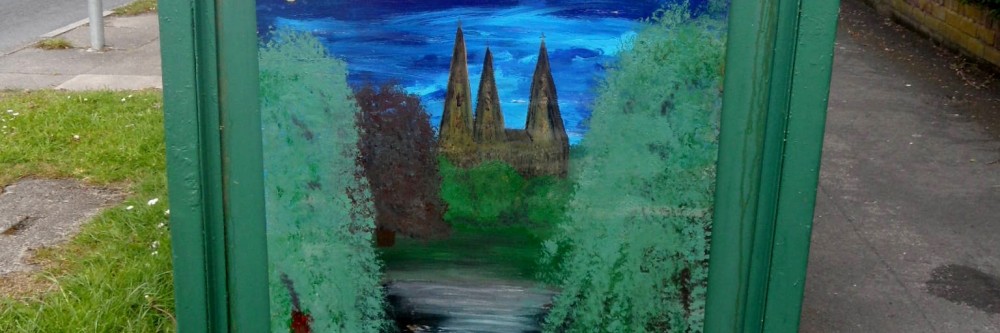
At the turn of the century, the infamous Montague Summers attended Lichfield Theological College. He went on to publish the first English translation of the 15th century witch-hunting manual, the Malleus Maleficarum (“The Hammer of Witches”) along with books on vampires and werewolves. There was a rumour that he had actually seen the devil (we can only assume this was not in Lichfield) and when asked if Old Nick had a goat’s head, horns and a forked tail, he supposedly replied, ‘No tail, my dear’. On his gravestone is the epitaph ‘Tell me strange things’. Ok then Monty, you’re on…
I know I can hardly claim to be compiling a Halloween special given that I am always writing about weird things, but I am hoping to share a small selection of strange things from Staffordshire in the run up to Goth Christmas. And where better to begin our journey across the veil here than here in the bloody city of Lichfield?

In the 1960s, a group of students from Lichfield Theological College found themselves experiencing a Nightmare on Bird Street when staying in Langton House. The Georgian property was named after a 14th century Bishop of Lichfield, but it was the 20th century Bishop of Stafford who performed a service of exorcism there in August 1964 in an attempt to silence the disembodied screams which had been heard inside the hostel since the trainee vicars had taken up residence two years prior.
The Lichfield Mercury reported that in a bid to bring peace to the premises, the Bishop had gathered the residents of the house and performed a service lasting half an hour, in which the Lords Prayer, and others, were said with holy water sprinkled over every room, door and window. From that day on, the only screams to be heard at Langton House have come from outside the building as the younglings make their way home after a night out in ye olde city. Prior to it being purchased by the Theological College, Langton House had been the home of Colonel Boscawen Savage, founder of the Staffordshire Regiment Museum, until his tragic death on 11th June 1958. The house was sold in November 1972 after the closure of the college and has been used as offices ever since.
The Theological College itself occupied the site of the ‘New College’ in The Close, which confusingly was actually very old having been built in the early 13th century. It was originally the residence of the chantry priests of the cathedral but in the 17th century it was divided into private residences. In Lomax’s history of Lichfield, he writes, “The houses in the adjoining court, called the New College, were given by Bishop Burghilll for the residence of the chantry Priests who officiated in the cathedral, previous to which they appear to have formed part of a regular religious foundation. Many human bones have been dug up and about 1728, the skeleton of a female which was placed upright in a stone wall…upon the skull was a silver bodkin, round which the hair had been twisted, and on recently removing other old foundations adjoining, one was found in a similar position, amongst numbers of bones scattered in all directions’.
Only the Theological College’s Victorian chapel, now known as College Hall, remains today although archaeological digs on the site in 1976/77 revealed the medieval vaults of its predecessor survive below ground. Other finds included pottery and tools dating back to Neolithic times, as well as evidence for a timber framed building on the banks of Minster Pool in the 13th century which the HER suggests may have been the college’s lavatorium. The discovery of three Christian burials dating to the late Saxon period suggest to me that the majority of the bones unearthed in the 17th century may also have been the remains of those who worshipped at the wooden church housing the remains of Saint Chad, before the Norman invasion brought with it a new cathedral of stone.
However, despite my own digging, I have as yet been unable to come up with a satisfactory explanation for how or why the remains of two women came to be bricked-up in a medieval wall . A strange thing indeed…
Sources
Miller, D (2014), Witches and Witchcraft
The Archaeological Journal, Vol 2
Lichfield Mercury Friday 5th August 1977
 Lichfield Lore
Very interesting.
LikeLike