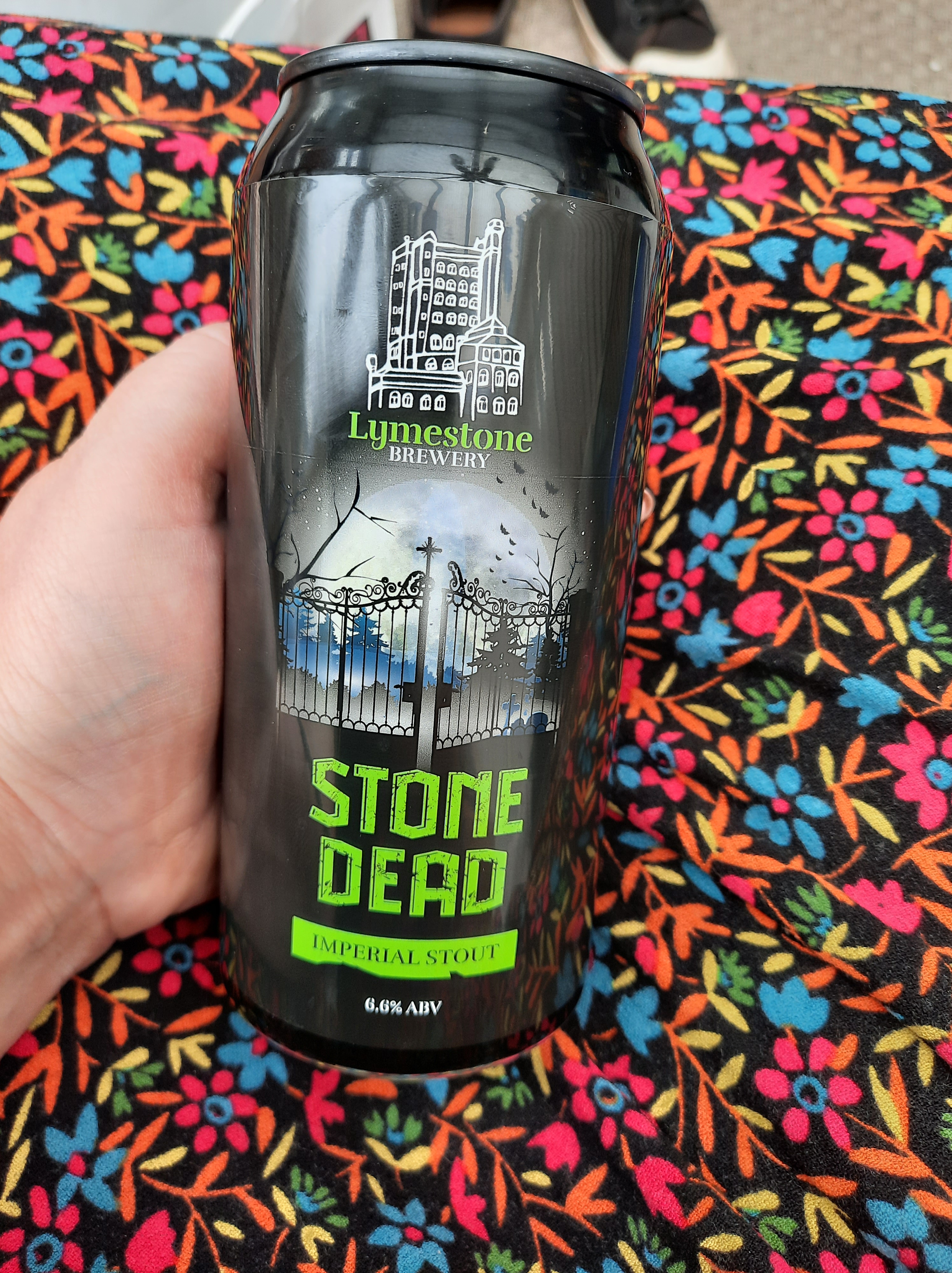
I think this is the first time I’ve written a blog post whilst drinking a beer of the same name. We’ll know how successful this is as writing technique by the final paragraph. Anyway, now my Mum and Dad no longer live in Stone, it’s the church and brewery that are my two favourite things about the place.
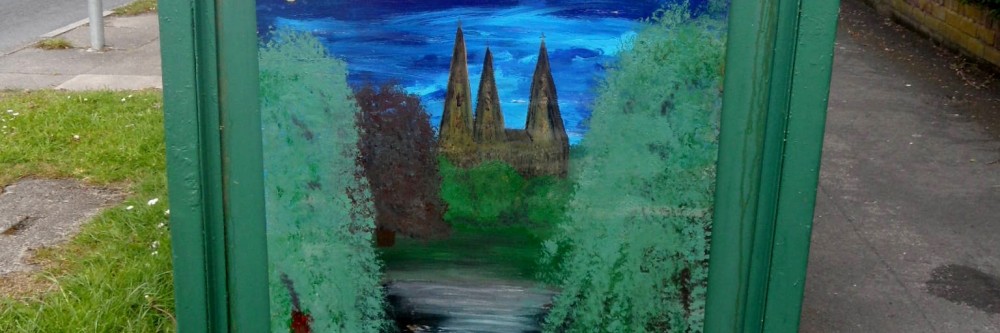
St Michael and St Wulfad’s church was rebuilt in 1758 on the site of a twelfth century priory church which had pretty much collapsed into a pile of stones after the funeral of Elizabeth Unitt, bringing it full circle as legend has it that the church here started out as a pile of stones. The story of Queen Ermenilda erecting cairns over the bodies of her sons, slain by their pagan father Wulfhere after they rebelled Saxon style and converted to Christianity, also gave the town its name. A church was later built over the graves, replaced in 1135AD by the aforementioned Augustinian Priory.

The church registers reveal that the arch and pillars fell on at 12.45am on 31st December 1749, leaving the steeple unsafe. It was removed and the bells taken into storage, except for one which was hung in a tree, causing a ‘witty’ traveller to comment, ‘Poor Stone, paltry people; Got a church without a steeple; The further I travel the more wonders I see; There’s a church with no steeple, it’s a bell in a tree!’.
The new church wasn’t rebuilt on the exact footprint of the former building and I’ve always felt a bit sorry for this couple, left outside to the mercy of the Staffordshire elements after having previously been safely ensconced in the chancel of the medieval church. Interestingly, the dad of the weather-worn William Compton, who lies here with his wife Jane Aston, was the person who purchased the priory at the Reformation. Prior to this there had been a petition sent to the Lord Protector complaining that a William Compton, ‘hath lately attempted to pluck down the said church and hath uncovered a large part thereof and conveyed away the lead for his own purposes’. I can’t help but feel that his stone-cold son and his wife are now paying for the price for his father’s greed. Vengeance is mine, and all that.

Elsewhere in the churchyard is the Jervis family mausoleum. When Ludovic Kennedy arrived here as part of his research into Admiral John Jervis aka Earl St Vincent, he was disappointed to discover that he was unable to gain access. The church has a press clipping of Ludo stood at the door, not quite an angry person in a local newspaper but certainly a disappointed one. It was nothing personal. No-one had entered the vault since the internment of Mary Ann Jervis, by then known as Lady Forster, took place in March 1893 and the locks had rusted and jammed. It wasn’t until several years later that a brave soul volunteered to climb in through the small round window at the back and opened the door from the inside. In the Staffordshire Advertiser’s report into the funeral of Lady Forster it describes how the, ‘the interior of the mausoleum was adorned with white blossoms upon a dark background of evergreens’. The person who climbed through the window reported that these floral tributes were still in place but crumbled to dust as the fresh air entered the vault for the first time in decades.

Unlike Ludo, my good friend Jacky and I have been able to access the mausoleum. Twice. Also unlike Ludo, I had no particular interest in this famous son of Stone who ran away to sea from the family home at Meaford Hall and went on to be a key figure in the British navy. I just happened to be standing there when someone said, ‘Does anyone want to look inside the mausoleum?’. Twice. I think I’m right in saying that Kennedy’s research into Jervis was for his 1975 book ‘Nelson and his Captains‘, but I confess that naval history is not really something which floats my boat.
I am much more drawn to the local legends surrounding the mausoleum and its macabre contents. Hence why my blog is called ‘Lichfield Lore’ and not ‘Lichfield Naval History’. There are rumours that one of the servants from Meaford Hall was buried beneath the threshold of the vault, possibly to continue to serve the Jervises in the afterlife or perhaps to help guard the treasure said to have been stashed in one of the coffins inside. I was hoping that this mythical hoard of riches may have included the silver-gilt coronet presented to Mary Anne Jervis by the Iron Duke in 1838. Wellington’s nickname for her was the ‘Syren’, which is rather fitting for a beautiful young woman from a famous sea-faring family who he had a deep friendship with. However, in 2018 it turned up at Sotheby’s, albeit mysteriously caked in dirt.

Mary Ann Jervis. My, my.
Despite the rumours surrounding them, Wellington turned out not to be Mary Anne’s Waterloo and she instead married David Ochterlony Dyce Sombre, MP for Sudbury between July 1841 and April 1842, when he was removed for bribery. A short tenure indeed, but still longer than any Chancellor of the Exchequer has lasted in 2022. To say the marriage was troubled is an understatement and it ended with Dyce Sombre accusing Mary Anne of infidelity with several men, her own father included, before being certified insane and, showing he could escape if he wanted to, fleeing to France. He spent the rest of his life trying to prove his sanity and reclaim the fortune that his estranged wife had taken control of, before returning to Britain and dying of a septic foot in 1851. The whereabouts of his body is unknown but I think we can safely say it is not inside the Jervis Family Mausoleum. His lost fortune however…
Sources:
Uttoxeter Newsletter 4th October 1991
 Lichfield Lore
I lived at Meaford Hall Nurseries in the late 1960’s having moved from Lichfield, and became very interested in its history and the Jervis family. I was very fortunate to visit the inside of the mausoleum which was a long term wish.
An excellent article
LikeLiked by 1 person
Thanks Penny. Imagine that was a lovely place to live!
LikeLike